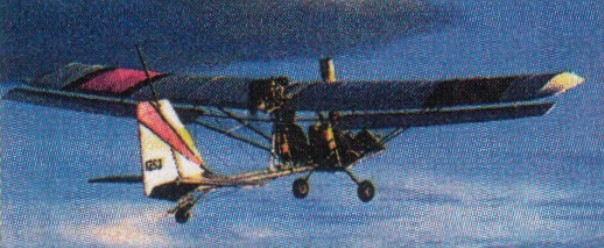
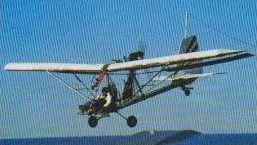
The main product from the LiteFlite stable is the Dragonfly. The Dragonfly is a three axis ultra light aircraft which takes off in a reasonably small area and lands in a reasonably small area. It has dual seating and dual controls.
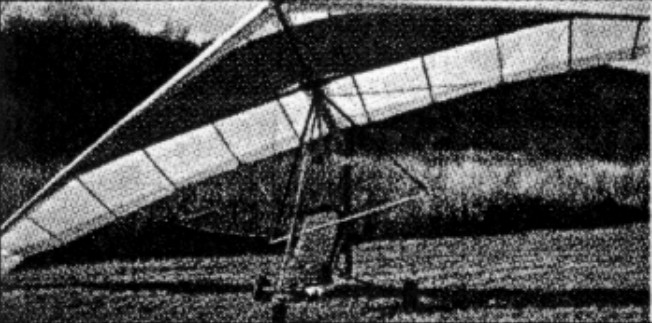
Due to the slow flying speed, the Dragonfly is a favoured hang gliding towing aircraft and has been sold to 12 different countries. The Dragonfly provides a low cost form of aviation which can be flown almost anywhere and is really easy to learn.
The Dragonfly has been in production since 1990 and during this period, in excess of 100 aircraft have been manufactured.
The Dragonfly is constructed from 6061 grade aluminium tubing, is structurally supported by stainless steel wire and has fabric covered wings. It is powered by either a two stroke or four stroke engine. It has a range of options available depending upon your requirements and financial constraints.
Engine: Rotax 582, 65 hp Overall Length: 5.974 m / 19 ft 6 in Maximum Height: 2.316 m / 7 ft 6 in Wing Span: 10.363 m / 34 ft Wing Area: 15.8 sq.m / 170 sq.ft MTOW: 385 kg Gross Weight: 800 lb Empty Weight: 150 kg / 330 lb Fuel cap: 6 USG / 20 lt VNE: 57 knots / 100 kph VC at 5200rpm: 40 knots / 60 kph Stall: 14-17 kt Normal Landing Approach Speed: 26 kt ROC: 1400 fpm /16 m/s Take-off dist: 50 ft Take-Off Distance (To 50ft): 195 feet Landing dist: 100 ft Landing Distance (From 50ft): 363 feet Range: 100 sm Fuel consumption: 16 lt/hr Service ceiling: 16,000 ft Seats: 2 Kit price (1998): US$15,700 Landing gear: tail wheel
The Moy Aerial Steamer was an experimental 15-foot span tandem-wing monoplane, powered by a 3 hp steam engine driving two, 6-foot diameter pusher- propelling paddle wheels. Built by Englishman Thomas Moy, the unmanned flying machine was tested in the Spring of 1875, tethered to a pole, running on a circular track, at the gardens of the Hotel DeLuxe in south London. Spuriously reported to have left the ground and “flown” at a height of six inches, the Aerial Steamer may sometimes be claimed to be the first unmanned airplane to fly from level ground.
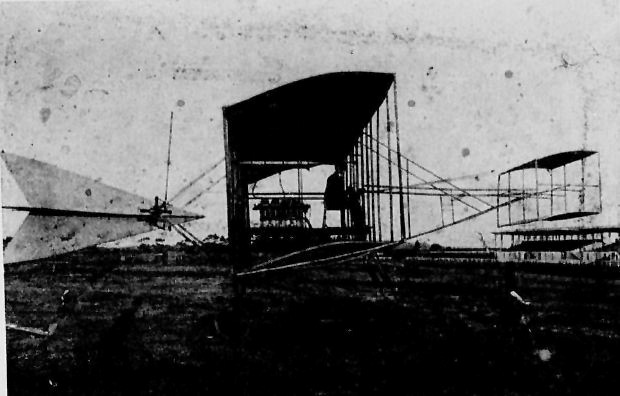
In October of 1910 at the Boufarik Racecourse, Algeria, Leon Mouraret flew his biplane for a distance of 200 meters on his first attempt. On his second attempted at flight the aircraft crashed and was damaged. Boufarik’s flying machine was distinguished by its unusual arrowhead-like tail and by the very high setting of the pilot and frame above the ground. The biplane was powered by a French 60 hp Mutel engine. Mouraret’s biplane was called a “Hydro-aeroplane” and could be fitted with two long floats.
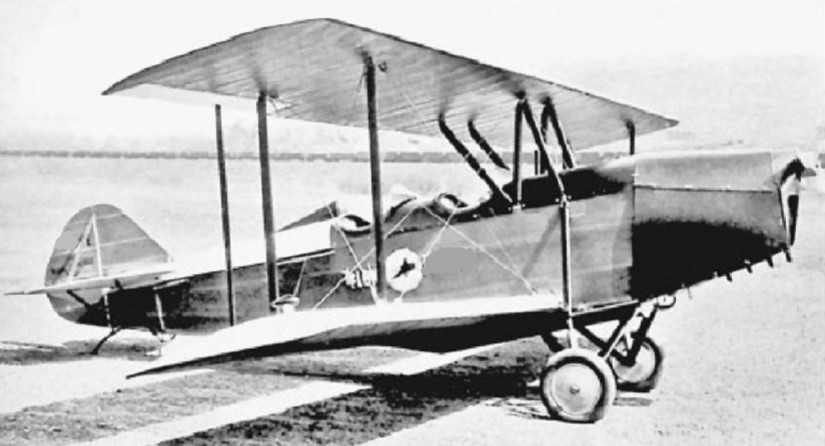
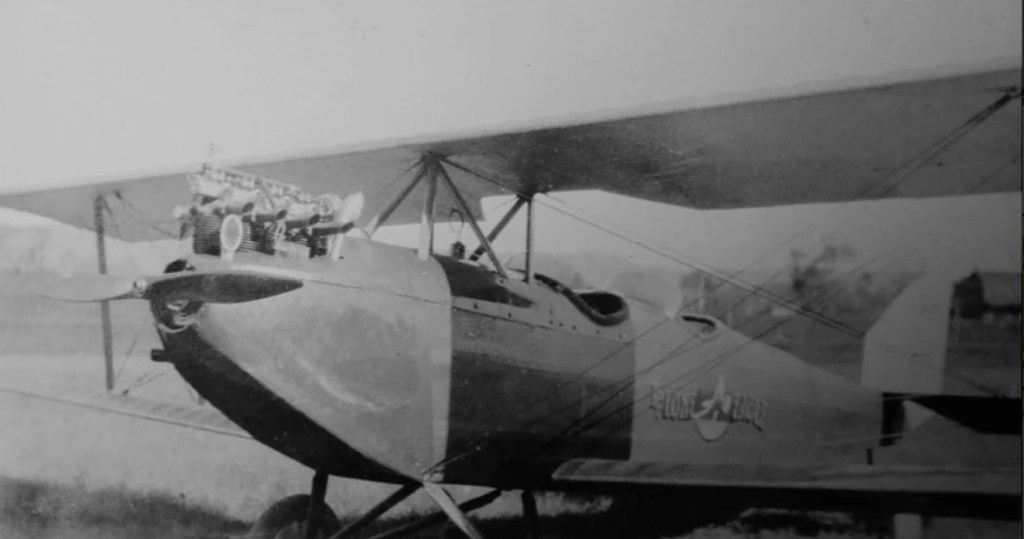
Part of Lindbergh’s 1927 visit to Moundsville included inspecting the Moundsville Airplaine Corporation’s first product– a single-seat bi-plane christened by Jimmy Doolittle as The Lone Eagle, in honor of Charles Lindbergh. Despite Lindbergh’s endorsement, there were not many “Lone Eagles” produced, and the factory went out of business in 1929.
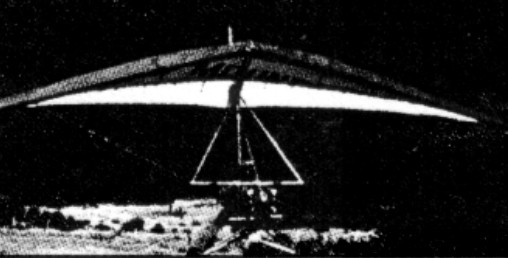
The Teratorn was a single seat single engined high wing monoplane with hybrid control. Wing has unswept leading and trailing edges, and constant chord; cruciform tail. Pitch control by weightshift; yaw control by fully flying rudder; roll control by one third span spollerons; control inputs through weight shift for pitch/yaw/roll. Wing braced from above by kingpost and cables, from below by cables; wing profile; 33% double surface. Undercarriage has three wheels in tail dragger formation; suspension on tailwheel and bungee suspension on main wheels. No ground steering. No brakes. Aluminium tube framework, without pod. Engine mounted above wing driving pusher propeller. Leading edges stiffened with Mylar.
The Teratorn which we are concerned with is itself a venerable design, having appeared at the birth of microlight aviation around the same time as the first powered version of the famous Quicksilver, with which it has a certain similarity. The Teratorn was powered, up till 1982, by the single cylinder Yamaha KT100S giving 15 hp through a reduction drive of 5/1, with initially the option and later the standard replacement by a twin cylinder Rotax of 28 hp with a 2.5/1 reduction drive.
On an original note, the company chose black anodising for the tubes on this hybrid control machine and the wires too were covered in black vinyl. The Teratorn is delivered as a kit requiring 20 to 25 h assembly according to the maker, and costs $3895 with the Rotax motor in 1983. Options include an instrument panel, skis, Kevlar floats and the choice of the Yamaha KT100S, which drops the price by $400. The machine is trailer transportable or on a roof rack and folds to around 16 x 5 x 1 ft (4.9 x 1.5 x 0.3 m). A kit allowing the Teratorn to be converted to the Teratorn TA with three axis control is also available.
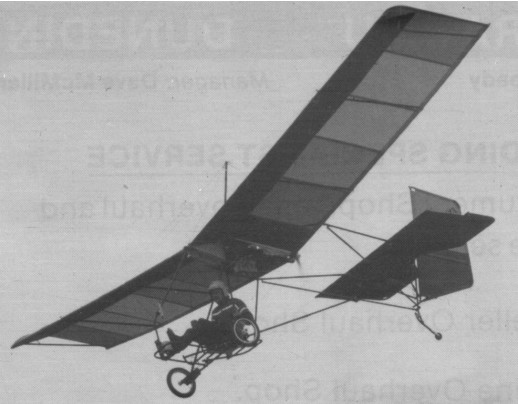
The Teratorn TA was a single seat single engined high wing mono¬plane with conventional three axis control. Wing has unswept leading and trailing edges, and constant chord; cruciform tall. Pitch control by elevator on tail; yaw control by fully flying rudder; roll control by one third span spoilerons; control inputs through stick for pitch/roll and pedals for yaw. Wing braced from above by kingpost and cables, from below by cables; wing profile; 33% double surface. Undercarriage has three wheels in tail dragger formation; steel spring suspension on tailwheel and bungee suspension on main wheels. No ground steering. No brakes. Aluminium tube framework, without pod. Engine mounted below wing driving pusher propeller.
This is the three axis version of the hybrid control Teratorn. The TA appeared in 1982 with the Yamaha KT100S 15 hp engine, though today that has become just an option, the machine being fitted in standard form with the Rotax 300 of 28 hp or the Rotax 377 with 34 hp. Rigging time for the earlier model is 25 min, while this model requires 25 min to rig with two people. The Teratorn TA is sold so that it requires only 20h to complete, according to the maker, and for a price of $4295 with Rotax 300 or $4595 with Rotax 377. The options include the Yamaha engine for a reduction of $300, floats of Kevlar, skis and instrument panel. Production was phased out in favour of the more advanced Tierra.
Teratorn Engine: Rotax 300, 28hp at 6200rpm Propeller diameter and pitch 60 x 24 inch, 1.52 x 0.61 m Reduction ratio 2.5/1 Power per unit area 0.18 hp/sq.ft, 1.9 hp/sq.m Fuel capacity 3.3 US gal, 2.8 Imp gal, 12.5 litre Length overall 18.0 ft, 5.49 m Height overall 9.0 ft, 2.74m Wing span 32.0ft, 9.75m Constant chord 5.0 ft, 1.52 m Sweepback 0 deg Total wing area 160 sq.ft, 14.9 sq.m Wing aspect ratio 6.4/1 Tailwheel diameter overall 3 inch, 7 cm Main wheels diameter overall 16 inch, 41 cm Empty weight 212 lb, 96 kg Max take off weight 474 lb, 215kg Payload 262 lb, 119kg Max wing loading 2.96 lb/sq.ft, 14.4 kg/sq.m Max power loading 16.9 lb/hp, 7.7kg/hp Load factors; +3.0, 3.0 ultimate Max level speed 50 mph, 80 kph Never exceed speed 55 mph, 88 kph Economic cruising speed 35 mph, 56 kph Stalling speed 15 mph, 24 kph Max climb rate at sea level 600 ft/min, 3.1 m/s Min sink rate 250 ft/min at 25 mph, 1.3 m/s at 40 kph Best glide ratio with power off 8/1 at 25 mph, 40 kph Take off distance 50 ft, 15 m Landing distance 75 ft, 23 m Service ceiling 10,000 ft, 3050 m Range at average cruising speed 70 mile, 113 km
Teratorn TA Engine: Rotax 300, 28 hp at 6200 rpm Propeller diameter and pitch 60×24 inch, 1.52×0.61m Reduction ratio 2.5/1 Power per unit area 0.18hp/sq.ft, 1.9 hp/sq.m Fuel capacity 3.3 US gal, 2.8 Imp gal, 12.5 litre Length overall 18.0 ft, 5.49 m Height overall 9.0ft, 2.74m Wing span 32.0ft, 9.75m Constant chord 5.0 ft, 1.52 m Sweepback 0 deg Total wing area 160 sq.ft, 14.9 sq.m Wing aspect ratio 6.4/1 Tailwheel diameter overall 3 inch, 7 cm Main wheels diameter overall 16 inch, 41 cm Empty weight 227 lb, 103kg Max take-off weight 489 lb, 222kg Payload 262 lb, 119 kg Max wing loading 3.06 lb/sq.ft, 14.9kg/sq.m Max power loading 17.5 lb/hp, 7.9 kg/hp Load factors; +4.0, 3.0 ultimate Max level speed 50 mph, 80 kph Never exceed speed 55 mph, 88 kph Max cruising speed 45 mph, 72 kph Economic cruising speed 35 mph, 56 kph Stalling speed 17 mph, 27 kph Max climb rate at sea level 600 ft/min, 3.1 m/s Min sink rate 270 ft/min at 28 mph, 45 m/s at 45 kph Best glide ratio with power off 8/1 at 28mph, 45kph Take off distance 50ft, 15m Landing distance 75ft, 23m Service ceiling 10,000ft, 3050 m Range at average cruising speed 70 mile, 113km
Engine: Rotax 377, 34 hp at 6400 rpm Propeller diameter and pitch 60×36 inch, 1.52×0.91m Toothed belt reduction, ratio 2.6/1 Max static thrust 240 lb, 109kg Power per unit area 0.21hp/sq.ft, 2.3 hp/sq.m Fuel capacity 4.4 US gal, 3.7 Imp gal, 16.7 litre Length overall 18.0 ft, 5.49 m Height overall 9.0ft, 2.74m Wing span 32.0ft, 9.75m Constant chord 5.0 ft, 1.52 m Sweepback 0 deg Total wing area 160 sq.ft, 14.9 sq.m Wing aspect ratio 6.4/1 Tailwheel diameter overall 3 inch, 7 cm Main wheels diameter overall 16 inch, 41 cm Empty weight 237 lb, 108kg Max take-off weight 499 lb, 226kg Payload 262 lb, 119 kg Max wing loading 3.12 lb/sq.ft, 15.2kg/sq.m Max power loading 14.7 lb/hp, 6.6 kg/hp Load factors; +4.0, 3.0 ultimate Max level speed 55 mph, 88 kph Never exceed speed 63 mph, 101 kph Stalling speed 23 mph, 37 kph Max climb rate at sea level 900 ft/min, 4.6 m/s
Designed by Bud Snyder, the Buzzard Light Plane, or MG-1, of 1930 was a two-place, open, high-wing monoplane. Essentially a motorized glider with a pylon-mounted parasol wing and a pusher motor. It was fabric covered except for a dural-covered plywood fuselage bottom.
Purchased by Curtiss-Wright and is assumed to be the basis for, or at least a major influence on, the 1931 Curtiss-Wright CW-1 Junior.
The design was revived in 1983 as the kit-form, Zenoah-powered Ritz Standard A by Gerry Ritz, Wartrace TN.