Around 1910, retired Japanese Navy engineer Sanji Narahara, who had studied munitions at the Imperial University, built an airframe for himself and on May 5, 1911, made a successful flight with a French-made engine installed.
Engines – Power
Narahara No. 3 biplane
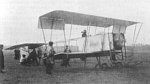
The 1911 Narahara No. 3 biplane was designed by Sanji Narahara and built by Tokyo Airplane Mfg. in Japan.
Narahara No.2 biplane
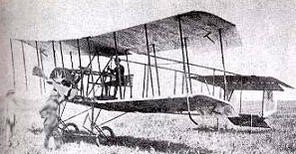
Second biplane designed and built by Sanji Narahara, dating from early 1911. Of twin-boom, open construction and powered by a 50 hp Gnôme rotary, this Japanese machine actually flew as there is at least one photograph showing it in-flight.
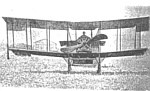
Span: upper 32’10” lower 30’10”
Length: 32’10”
Weight: 1213 lb gross
Napier Sabre
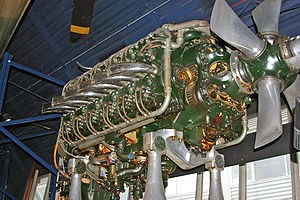
The Napier Sabre was a British H-24-cylinder, liquid-cooled, sleeve valve, piston aero engine, designed by Major Frank Halford and built by D. Napier & Son during World War II. The engine evolved to develop from 2,200 hp (1,600 kW) in its earlier versions to 3,500 hp (2,600 kW) in late-model prototypes.
Prior to the Sabre, Napier had been working on large aero engines for some time. Their Lion, had been a very successful engine between the World Wars and in modified form had powered several of the Supermarine Schneider Trophy competitors in 1923 and 1927, as well as several land speed record cars. By the late 1920s, the Lion was no longer competitive and work started on replacements.
Napier followed the Lion with two new H-block designs: the H-16 (Rapier) and the H-24 (Dagger). The H-block has a compact layout, consisting of two horizontally opposed engines, lying one atop or beside another. Since the cylinders are opposed, the motion in one is balanced by the motion on the opposing side, leading to no first order vibration or second order vibration. In these new designs, Napier chose air cooling but in service, the rear cylinders proved to be impossible to cool properly, which made the engines unreliable.
In 1927, Harry Ricardo published a study on the concept of the sleeve valve engine. In it, he wrote that traditional poppet valve engines would be unlikely to produce much more than 1,500 hp (1,100 kW), a figure that many companies were eyeing for next generation engines. To pass this limit, the sleeve valve would have to be used, to increase volumetric efficiency, as well as to decrease the engine’s sensitivity to detonation, which was prevalent with the poor quality fuels in use at the time. Halford had worked for Ricardo 1919-1922 at their London office and Halford’s 1923 office was in Ladbroke Grove, North Kensington, only a few miles from Ricardo, while Halford’s 1929 office was even closer (700 yards), and while in 1927 Ricardo started work with Bristol Engines on a line of sleeve-valve designs, Halford started work with Napier, using the Dagger as the basis. The layout of the H-block, with its inherent balance and the Sabre’s relatively short stroke, allowed it to run at a higher rate of rotation, to deliver more power from a smaller displacement, provided that good volumetric efficiency could be maintained (with better breathing), which sleeve valves could do.
The Napier company decided first to develop a large 24 cylinder liquid–cooled engine, capable of producing at least 2,000 hp (1,491 kW) in late 1935. Although the company continued with the opposed H layout of the Dagger, this new design positioned the cylinder blocks horizontally and it was to use sleeve valves. All of the accessories were grouped conveniently above and below the cylinder blocks, rather than being at the front and rear of the engine, as in most contemporary designs.
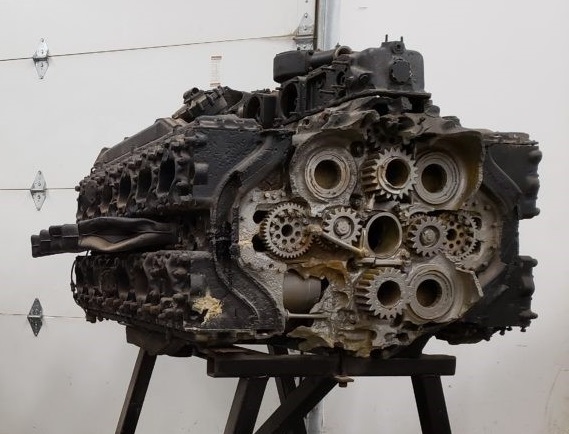
The Air Ministry supported the Sabre programme with a development order in 1937 for two reasons: to provide an alternative engine if the Rolls-Royce Vulture and the Bristol Centaurus failed as the next generation of high power engines and to keep Napier in the aero-engine industry. The first Sabre engines were ready for testing in January 1938, although they were limited to 1,350 hp (1,000 kW). By March, they were passing tests at 2,050 hp (1,500 kW) and by June 1940, when the Sabre passed the Air Ministry’s 100-hour test, the first production versions were delivering 2,200 hp (1,640 kW) from their 2,238 cubic inch (37 litre) displacements. By the end of the year, they were producing 2,400 hp (1,800 kW). The contemporary 1940 Rolls-Royce Merlin II was generating just over 1,000 hp (750 kW) from a 1,647 cubic inch (27 litre) displacement.
Problems arose as soon as mass production began. Prototype engines had been hand-assembled by Napier craftsmen and it proved to be difficult to adapt it to assembly-line production techniques. The sleeves often failed due to the way they were manufactured from chrome-molybdenum steel, leading to seized cylinders, which caused the loss of the sole prototype Martin-Baker MB 3. The Ministry of Aircraft Production was responsible for the development of the engine and arranged for sleeves to be machined by the Bristol Aeroplane Company from their Taurus engine forgings. These nitrided austenitic steel sleeves were the result of many years of intensive sleeve development, experience that Napier did not have. Air filters had to be fitted when a new sleeve problem appeared in 1944 when aircraft were operating from Normandy soil with its abrasive, gritty dust.
Quality control proved to be inadequate, engines were often delivered with improperly cleaned castings, broken piston rings and machine cuttings left inside the engine. Mechanics were overworked trying to keep the Sabres running and during cold weather they had to run them every two hours during the night so that the engine oil would not congeal and prevent the engine from starting the next day. These problems took too long to remedy and the engine gained a bad reputation. To make matters worse, mechanics and pilots unfamiliar with the different nature of the engine, tended to blame the Sabre for problems that were caused by not following correct procedures. This was exacerbated by the representatives of the competing Rolls-Royce company, which had its own agenda. In 1944, Rolls-Royce produced a similar design prototype called the Eagle.
Napier seemed complacent and tinkered with the design for better performance. In 1942, it started a series of projects to improve its high-altitude performance, with the addition of a three-speed, two-stage supercharger, when the basic engine was still not running reliably. In December 1942, the company was purchased by the English Electric Company, which ended the supercharger project immediately and devoted the whole company to solving the production problems, which was achieved quickly.
By 1944, the Sabre V was delivering 2,400 horsepower (1,800 kW) consistently and the reputation of the engine started to improve. This was the last version to enter service, being used in the Hawker Typhoon and its derivative, the Hawker Tempest. Without the advanced supercharger, the engine’s performance over 20,000 ft (6,100 m) fell off rapidly and pilots flying Sabre-powered aircraft, were generally instructed to enter combat only below this altitude. At low altitude, both planes were formidable. As air superiority over Continental Europe was slowly gained, Typhoons were increasingly used as fighter-bombers, notably by the RAF Second Tactical Air Force. The Tempest became the principal destroyer of the V-1 flying bomb (Fieseler Fi 103), since it was the fastest of all the Allied fighters at low levels. Later, the Tempest destroyed about 20 Messerschmitt Me 262 jet aircraft.
Development continued and the later Sabre VII delivered 3,500 hp (2,600 kW) with a new supercharger. The final test engines delivered 5,500 hp (4,100 kW) at 45 lb/in2 boost. By the end of World War II, there were several engines in the same power class. The Pratt & Whitney R-4360 Wasp Major four-row, 28-cylinder radial produced 3,000 hp (2,280 kW) at first and later types produced 3,800 hp (2,834 kW), but these required almost twice the displacement in order to do so, 4,360 cubic inches (71 litres).
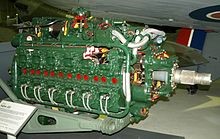
The first operational aircraft to be powered by the Sabre were the Hawker Typhoon and Hawker Tempest; the first aircraft powered by the Sabre was the Napier-Heston Racer, which was designed to capture the world speed record. Other aircraft using the Sabre were early prototype and production variants of the Blackburn Firebrand (in 21 early production aircraft), the Martin-Baker MB 3 prototype and a Hawker Fury prototype (2 built (LA610, VP207), 485 mph). The Napier also flew in Fairey Battle testbed, Folland Fo.108 testbed and Vickers Warwick prototype. The rapid introduction of jet engines after the war led to the quick demise of the Sabre, as there was less need for high power military piston aero engines and because Napier turned its attention to developing turboprop engines.
Variants:
Sabre I (E.107)
(1939) 2,000 horsepower (1,490 kW).
Sabre II
(1940) 2,300 horsepower (1,715 kW). Experimental 0.332:1 propeller reduction gear ratio.
Sabre II (production variant)
2,200 horsepower (1,640 kW). Reduction gear ratio 0.274:1: mainly used in early Hawker Typhoons.
Sabre IIA
2,235 horsepower (1,665 kW). Revised ignition system: maximum boost +9 lbs.
Sabre IIB
2,400 horsepower (1,790 kW). Four choke S.U. carburettor: Mainly used in Hawker Tempest V.
Sabre IIC
2,065 horsepower (1,540 kW). Similar to Mk VII.
Sabre III
2,250 horsepower (1,680 kW). Similar to Mk IIA, tailored for the Blackburn Firebrand: 25 manufactured and installed.
Sabre IV
2,240 horsepower (1,670 kW). As Mk VA with Hobson fuel injection: preliminary flight development engine for Sabre V series. Used in Hawker Tempest I.
Sabre V
2,600 horsepower (1,940 kW). Developed MK II, redesigned supercharger with increased boost, redesigned induction system.
Sabre VA
2,600 horsepower (1,940 kW). Mk V with Hobson-R.A.E fuel injection, single-lever throttle and propeller control: used in Hawker Tempest VI.
Sabre VI
2,310 horsepower (1,720 kW). Mk VA with Rotol cooling fan: used in 2 Hawker Tempest Vs modified to use Napier designed annular radiators; also in experimental Vickers Warwick V.
Sabre VII
3,055 horsepower (2,278 kW). Mk VA strengthened to withstand high powers produced using Water/Methanol injection. Larger supercharger impeller.
Sabre VIII
3,000 horsepower (2,240 kW). Intended for Hawker Fury; tested in the Folland Fo.108.
Sabre E.118
(1941) Three-speed, two-stage supercharger, contra-rotating propeller; test flown in Fo.108.
Sabre E.122
(1946) 3,500 horsepower. Intended for Napier 500mph tailless fighter
Napier Dagger
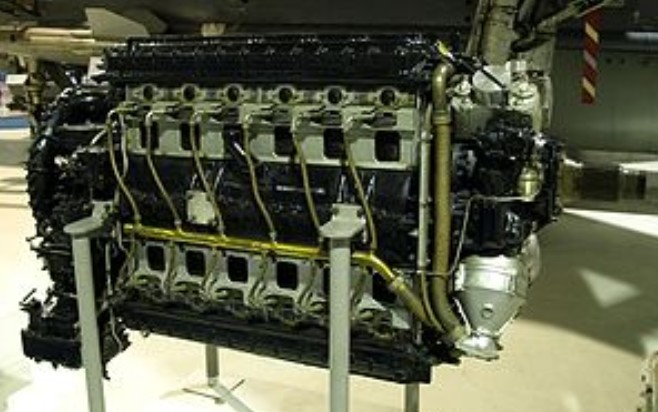
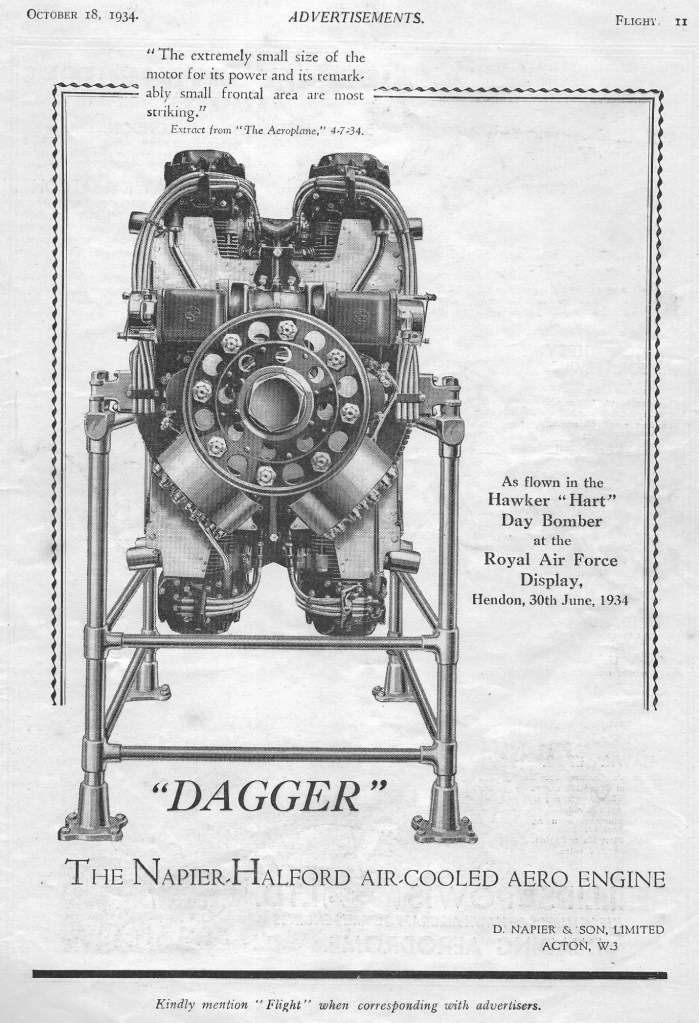
A development of the earlier Napier Rapier, the Napier Dagger was a 24-cylinder H-pattern (or H-Block) air-cooled engine designed by Frank Halford and built by Napier and first run in 1934.
The H-Block has a compact layout, as it essentially consists of two vertically opposed inline engines lying side-by-side and driving side-by-side crankshafts. Since the cylinders are opposed, the motion in one is balanced by the opposite motion in the one on the opposite side, leading to very smooth running.
The Dagger had fast rotation, running at up to 4,000 rpm, but it had conventional poppet valves.
There were problems with cooling, maintenance, manufacturing, and weight, which were not solved during the Dagger’s lifetime and went unresolved well into its successors lifetime, (Napier Sabre). The Dagger powered the Hawker Hector army co-operation aircraft and the Handley Page Hereford (a variant of the Hampden) bomber. The operational usefulness of the Hector was restricted by engine cooling problems, which made it unsuitable for operations in the tropics, and the Hereford was found to be unsuitable for combat because its Dagger VIII engines were noisy and unreliable. The Dagger also found an application in the experimental Martin-Baker MB 2 fighter.
Variants:
Napier-Halford Dagger I
1934 – 650 hp.
Dagger II
1938 – 755 hp
Dagger IIIM
1938 – 725 hp
Dagger VIII
1938 – 955 hp, intermediate altitude supercharger, initially known as E.108
Applications:
Fairey Battle testbed only
Handley Page Hereford
Hawker Hart
Hawker Hector
Martin-Baker MB 2
Specifications:
Napier Dagger III MS
Type: Twenty-four-cylinder supercharged air-cooled H engine
Bore: 3.813 in (96.8 mm)
Stroke: 3.75 in (95.25 mm)
Displacement: 1,027 cu.in (16.8 lt)
Length: 80 in (2,032 mm)
Width: 22.5 in (584 mm)
Height: 45.125 in (1,146 mm)
Dry weight: 1,358 lb (616 kg)
Valvetrain: One inlet and one exhaust valve per cylinder
Supercharger: Single-speed centrifugal type supercharger, 5.04:1 reduction
Fuel system: Napier-Claudel-Hobson carburettor
Fuel type: 87 Octane petrol
Cooling system: Air-cooled
Reduction gear: Spur, 2.69:1
Power output:
725 hp (541 kW) at 3,500 rpm for takeoff
794 hp (592 kW) at 4,000 rpm at 5,000 ft (1,520 m)
Specific power: 0.77 hp/in³ (35.13 kW/l)
Compression ratio: 7.75:1
Specific fuel consumption: 0.43 lb/(hp•h) (261 g/(kW•h))
Oil consumption: 0.18-0.35 oz/(hp•h) (7-13 g/(kW•h))
Power-to-weight ratio: 0.62 hp/lb (1.02 kW/kg)
Napier Cub
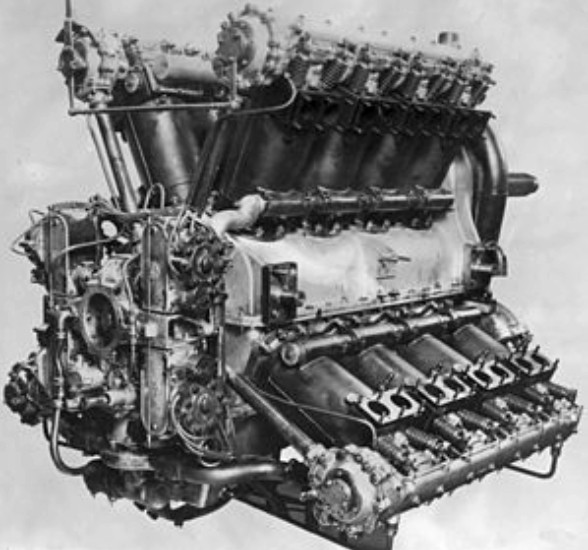
The Napier Cub was a large experimental 1,000 horsepower (750 kW) 16-cylinder ‘X’ pattern liquid-cooled aero engine built by the British engine company Napier & Son. The Cub was the only Napier ‘X’ engine design.
The four banks of four cylinders were arranged in a flattened ‘X’ when viewed from the front. The angle between the upper cylinders was 52.5 degrees, the lower cylinders 127.5 degrees which gave an angle of 90 degrees between the outer cylinder banks. The cylinders consisted of separate individual steel forgings with welded steel water cooling jackets. The carburettor was situated below the propeller reduction gear at the front of the engine and fed the inlet valves through four inlet manifolds. The valve drive gear, magnetos and pumps were fitted to the rear of the crankcase.
First run in 1919 and first flown on 15 December 1922 in an Avro Aldershot biplane bomber aircraft, the only other application was in the Blackburn Cubaroo. Only six engines of this type were ordered and produced.
Specifications:
Type: 16-cylinder liquid-cooled X engine
Bore: 6.25 in (158.75 mm)
Stroke: 7.5 in (190.5 mm)
Displacement: 3,681 cu in (60.32 L)
Dry weight: 2,450 lb (1,111 kg)
Valvetrain: Single overhead camshaft with four poppet valves per cylinder
Fuel system: Updraught carburettor
Fuel type: Petrol
Cooling system: Liquid cooled
Reduction gear: Spur geared, reduction ratio 0.489:1, left hand tractor
Power output: 1,000 hp at 1,800 rpm
Compression ratio: 5.3:1
Power-to-weight ratio: 0.4 hp/lb
Napier Oryx

The Napier Oryx was a British gas-turbine engine designed and built by Napier. The engine was developed by the Aero Gas Turbine Division of Napier in conjunction with Percival. Funding came from the Ministry of Supply.
Its sole application was the unsuccessful Percival P.74. The P.74 was a design for a tipjet-powered helicopter. The jet power to be supplied from engines within the helicopter and piped to the rotor tips.
The output gas temperature from the engines had to be below 400°C for the helicopter’s stainless steel rotor ducts, so a bypass design was used. This also blew “cold” air from the compressor, rather than purely hot turbine exhaust. Rather than using an over-sized compressor with a bypass around the turbine (as commonly used in the turbofan engine), the Oryx used an auxiliary compressor in addition. This was mounted behind the turbine, with its gas flow in the opposite direction to the main engine core. The two air streams were deflected through 90° in a collector chamber, then exited vertically upwards. Gas flow through this collector was arranged so that each stream remained separate, the cold air from the auxiliary compressor passing through a bifurcated duct, so as to wrap around the hotter turbine outlet. By this means, the duct was further protected from the hot exhaust. Separator plates inside each duct split the stream into a number of flows and deflected each one separately, thus preserving the flows approximately constant across the whole duct. When the flows finally merged, they were flowing parallel and at approximately the same velocity, thus reducing turbulence and energy loss.
A Corliss non-throttling valve could divert individual engine output to the outside of the aircraft through a butterfly valve (closed in flight), permitting full running with the rotor stationary for starting and ground running. In the P.74 the two Oryx engines fed their outputs to a common duct that took the thrust to the rotor head.
Rotax electric starters were used but alternate methods could have been used.
First run in November 1953, the Oryx and the P.74 tip jet powered helicopter project, were later cancelled.
The Oryx was expected to be used for the planned commercial P.105 development of the P.74. In the P.105 the two engines would have been fitted back to front on either side of the rotor mast, feeding their outputs to the rotor hub. It was anticipated that 900 “gas horsepower” could be produced in its developed form.
Specifications:
Oryx N.Or.1
Type: Single shaft gas generator
Length: 83.5 in (2,121 mm)
Diameter: 19.25 in (489 mm)
Dry weight: 495 lb (225 kg)
Compressor: 12-stage axial flow
Combustors: 5 tubular chambers
Turbine: 2-stage axial flow
Fuel type: Avtur (D.Eng. R.D. 2482) or wide cut gasoline (D.Eng. R.D. 2486)
Oil system: Vane type pressure pump delivering 80 psi (551.58 kPa), Synthetic lubricant to DERD 2487
Maximum power output: Max take-off: 750 hp (559.27 kW) gas horsepower (the power generated by the maximum flow of gas through a turbine of 100% efficiency) at 21,900 rpm
Overall pressure ratio: 6:1
Air consumption: Power unit – 9.9 lb (4.5 kg) / sec, Auxiliary compressor – 5.1 lb (2.3 kg) / sec
Turbine inlet temperature: 752 °F (400 °C)
Specific fuel consumption: Max continuous: 0.735 lb/ghp/hr (0.443 kg/gkW/hour)
Power-to-weight ratio: 1.56 hp/lb (2.565 kW/kg)
Max continuous Power: 610 hp (454.88 kW) gas horsepower at 21,000 rpm
Max take-off Spec Fuel Consumption: 0.68 lb/ghp/hr (0.41 kg/gkW/hour)
Napier Scorpion / Napier NScD.1 Double Scorpion

The Napier Scorpion was a British liquid-fuelled rocket aircraft booster engine developed and manufactured by Napier. It used hydrogen peroxide / kerosene propellant.
The first Scorpion NSc.1 was successfully flight-tested in a Canberra.
From 1956 the Double Scorpion NScD.1 was fitted experimentally to two Canberra light bombers, to improve high altitude performance. A world altitude record of 70,300 feet (21,427 m) was set by Canberra WK163 on 28 August 1957.
This was on the eve of cancellation of manned aircraft programmes by the 1957 Defence White Paper.
The Scorpion project was cancelled in February 1959, at a reported total cost of £1.25 million.
Specifications:
Scorpion
Propellant: hydrogen peroxide / kerosene
Thrust: 4,000 lbf (17.8 kN)
Double Scorpion
Propellant: hydrogen peroxide / kerosene
Chamber: two
Thrust: 8,000 lbf (35.6 kN)
Length: 856mm (33.7in)
Diameter: 584mm (23in)
Dry weight: 98kg (216lb)
Triple Scorpion
Propellant: hydrogen peroxide / kerosene
Chamber: three, independently fired
Thrust: 12,000 lbf (53.4 kN)
Napier Javelin
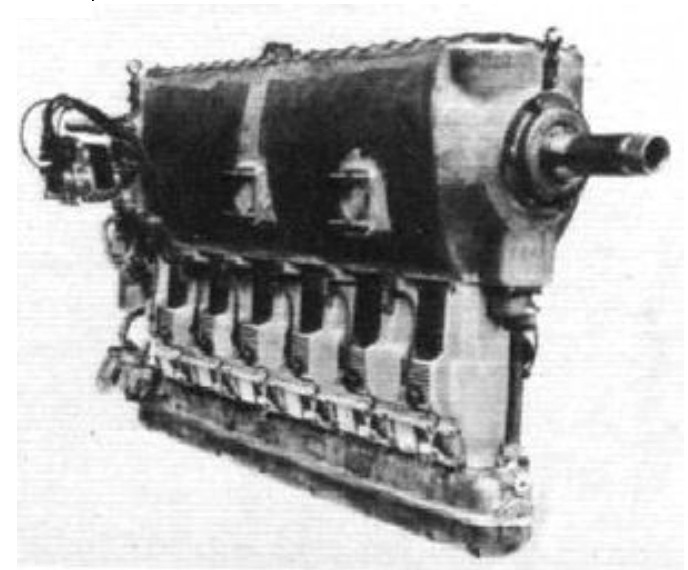
The Napier Javelin was a British six-cylinder air-cooled aero engine designed by Frank Halford and built by Napier & Son. The six cylinders were arranged inverted and inline. Unlike the similar, the poppet valves operated by a single gear driven overhead camshaft.
First run in 1932 and flown in March 1934 in the prototype of the Percival Mew Gull racing aircraft, the engine was also used in the Spartan Arrow biplane and the Percival Gull.
Variants:
Javelin I
Initial version producing 150 hp.
Javelin III
A longer stroke and increased capacity version of 160 hp.
Javelin IIIA
A Mark III with a starter motor, generator and other improvements for the Martin Baker MB.1.
Applications:
Martin-Baker M.B.1
Percival Gull Four Mk.IIA
Percival Mew Gull Mk.I
Spartan Arrow
Specifications:
Javelin I
Type: 6-cylinder inverted inline air-cooled engine.
Bore: 4.5 in (114.3 mm)
Stroke: 5.25 in (133.35 mm)
Displacement: 501 cu in (8.21 lt)
Length: 58.5 in (1486 mm)
Width: 26 in (660.4 mm)
Height: 31.5 in (800 mm)
Dry weight: 410 lb (186 kg)
Valvetrain: Overhead cam poppet-valves
Fuel system: Twin updraught carburettors
Fuel type: Petrol
Cooling system: Air-cooled
Reduction gear: Direct drive, left hand tractor
Power output: 150 hp (112 kW) at 2,000 rpm
Compression ratio: 5.3:1
Napier Gazelle
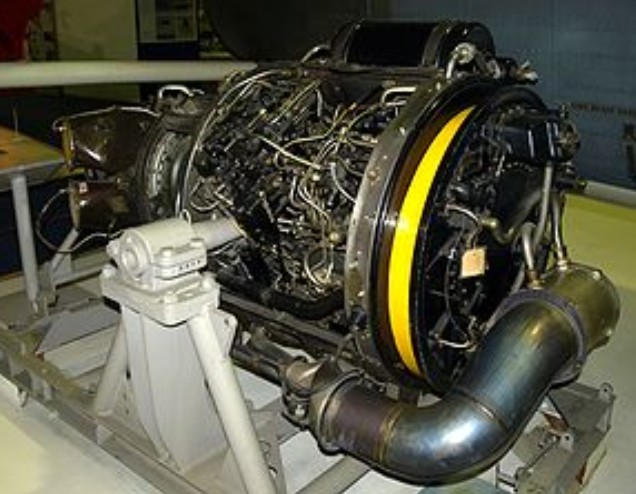
The Napier Gazelle was a turboshaft aero engine manufactured by Napier Aero Engines in the mid-1950s. First run in December 1955, production ceased when the Napier company was taken over by Rolls-Royce in 1962.
Variants:
NGa.1
NGa.2
NGa.2(R)
NGa.2 series 2
NGa.13(R)
NGa.13 series 2
Mk.101
Mk.161
Mk.162 (NGa.13 series 2)
Mk.165
Gazelle 501
Gazelle 503
Gazelle 512
Gazelle 514
Gazelle E.219
Applications:
Westland Wessex HAS 1 and HAS 3
Bristol Belvedere
Specifications:
Gazelle 501 / Mk.101 / NGa.2(R)
Type: Turboshaft
Length: 70 in (1,778 mm)
Diameter: 33.5 in (851 mm)
Dry weight: 830 lb (376.5 kg)
Compressor: 11-stage axial flow
Combustors: 6 flame tubes
Turbine: 2-stage gas generator power turbine + 1-stage free power turbine
Fuel type: Aviation kerosene, (DERD 2482 / 2485 / 2486 / 2488 / 2494)
Oil system: Pressure spray / splash with gear pump and dry sump, oil grade DERD.2487
Maximum power output: 1,650 hp (1,230.4 kW) + 260 lbf (1.16 kN) thrust at 3,000 output shaft rpm, maximum rating for 2.5 minutes
Overall pressure ratio: 6.25:1
Specific fuel consumption: 0.688 lb/hp-hr (0.4185 kg/kW-hr)
Power-to-weight ratio: 1.458 hp/lb (2.397 kW/kg)

