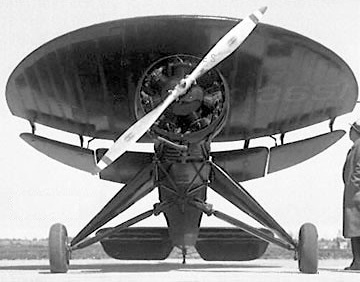
Nemeth Umbrellaplane / Roundwing

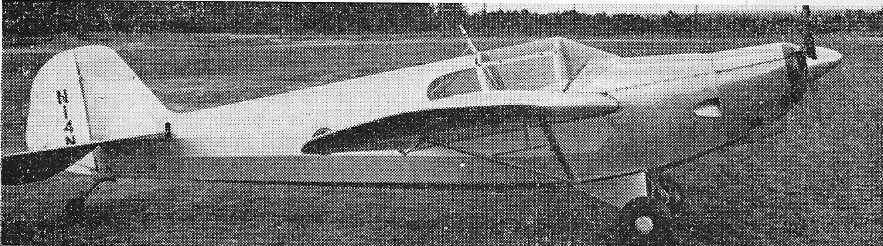
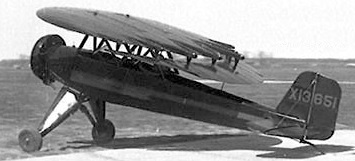
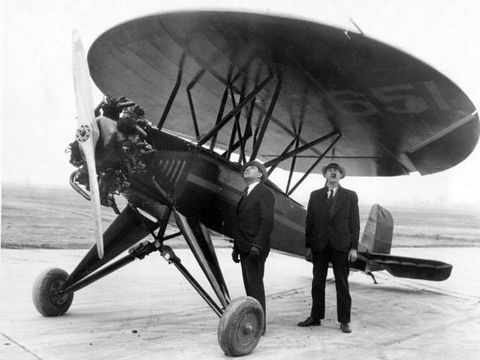
Initial experiments by Nemeth with rotating wingforms go back to 1929. In 1934 Nemeth designed, and students at Miami University (OH) built the Umbrellaplane / Roundwing.

A two place monoplane featuring a circular wing on a lengthened Alliance Argo fuselage for STOL performance, to test circular wing configuration.

The sole example, NX13651, was powered by a 90hp Lambert, later repowered with a 120hp Warner Scarab, and later reworked as a divided wing. Name has been seen spelled Nuneth.

Wingspan: 16’0″
Length: 20’0″
Max speed: 120 mph
Cruise speed: 95-100 mph
Stall: 20-25 mph
Seats: 2

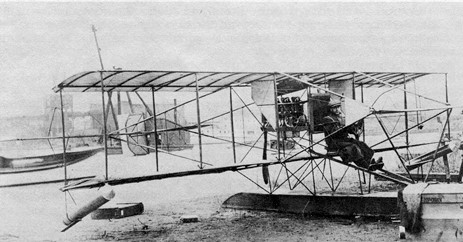
Nelson No. 4 float biplane

The Nels Nelson No. 4 was built in the winter of 1911-12 as a Kirkham engined landplane and fitted with the float in the summer of 1912 – first flight as a floatplane in August. It was flown in both forms but later in 1912 Nelson made further changes and converted it to a permanent wheeled configuration. It was in this form that it was sold to Prof. Charles Swartz, Mgr. of the Aeroplane Exhibition Co. Humboldt, Tenn., who promptly wrecked it.

Nelson Biplane

Nels J. Nelson, a 22-year-old Swedish immigrant working as an automobile mechanic in his shop on Elm Street in New Britain, began building and flying his own aircraft. On May 1, 1911, young Nelson made his first flight from the new field in Plainville, now known as Robertson Airport and the oldest in Connecticut.

That summer he flew some 40 miles to the ball field that also served as an airfield in Saybrook. Located at the end of Dudley and Coulter Streets, the area remained open fields until housing was built there in the 1940s. After arriving, he tested his biplane but it did not rise more than a few feet from the ground.

That evening a crowd of about 2,000 people gathered to see his flying machine and to watch the Saybrook and Deep River baseball game. When the time came, he took his machine to one end of the field, got good speed on the ground and, it was reported, “glided upward like a bird.”

He skillfully circled around while ascending to the magnificent height of two or three hundred feet. While circling, the engine’s radiator cap flew back and broke the wooden propeller. With the loss of thrust the aircraft came down rapidly and struck a fence as it landed. He was in the air for about five minutes.

Nelson continued to fly and build airplanes but, unable to get government contracts, ultimately lost out to other manufacturers. He died at his home in Yonkers, New York, in 1964.
Nelson H-44 / H-49

The H-44 was designed by Ted Nelson in the period following the Second World War and a specially designed motor glider was created by Hawley Bowlus to utilize the engine, the Bowlus/Nelson Dragonfly.

The Nelson H-44 is a single ignition, four-cylinder, horizontally opposed, direct drive, two-stroke aircraft engine. The engine was not certified. Under the CAR 5 regulations then in place in the USA for gliders, a certified auxiliary power glider could be flown with a non-certified engine and propeller. The engine is instead described on the Dragonfly type certificate.
The four-cylinder engine runs on a 12:1 mixture of 80 octane gasoline and SAE 30 oil. It is equipped with a single Carter WA1 carburetor and a recoil starter.

Employed in the Dragonfly the H-44 proved underpowered, which lead to the design of the H-49 version. The engine family was not a success and few were produced.

Variants:
H-44
Original design with a 2.25 in (57 mm) bore and 2.75 in (70 mm) stroke, producing 25 hp (19 kW) at 3900 rpm.

H-49
Upgraded design with E-225 cylinders giving a 2.375 in (60 mm) bore and 2.75 in (70 mm) stroke, producing 28 hp (21 kW) at 4000 rpm.

Applications:
Bowlus/Nelson Dragonfly

Specifications:
H-44
Type: Four-cylinder, two-stroke, single-ignition aircraft engine
Bore: 2.25 in (57 mm)
Stroke: 2.75 in (70 mm)
Displacement: 44 cubic inches
Dry weight: 40 lb (18 kg)
Designer: Ted Nelson
Fuel system: Carter WA1 carburetor
Fuel type: 80 octane gasoline
Oil system: premixed oil in fuel, SAE 30 oil mixed at 12:1 fuel to oil
Cooling system: air