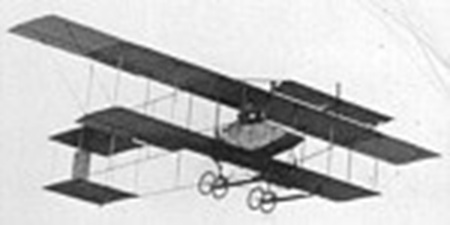
The 1911 Zodiac No. 3 pusher biplane was designed and built by Societe Zodiac in France.
The 1911 Zodiac No. 3 pusher biplane was designed and built by Societe Zodiac in France.
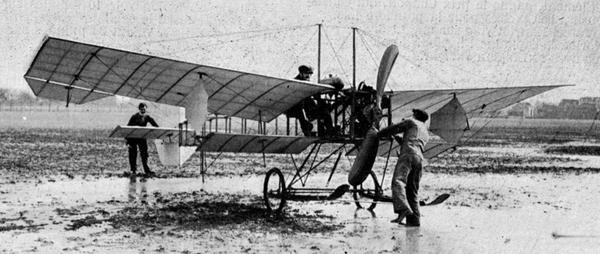
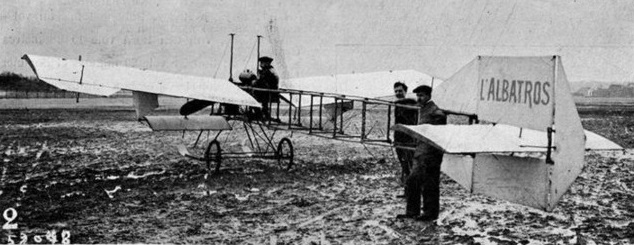
Zodiac monoplane No.2, known as L’Albatros was ordered by the Prince de Nissole and built in 1910 in France.

The third and final configuration of the non-rigid French military airship first flown on December 6, 1911 named in honour of pioneer aviator Capitaine Ferdinand Ferber. Of 76 meters length and of 12.4 meters maximum diameter, the 6000 m³ Zodiac X, here shown in its hangar at Epinal, had a maximum speed of 60 km/h powered by two Dansette-Gillet engines of 100 hp, each driving two propellers. Perhaps the most successful French airship of 1912-13, “Capitaine Ferber” was dismantled in 1914 prior to the outbreak of WWI.
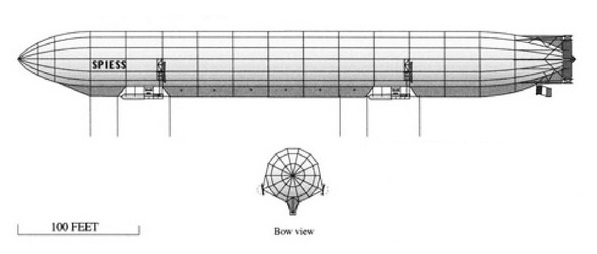
The French military authorities were able to examine the German ZIV and accumulated data was passed to the Zodiac company where the information was utilised by them in the Spiess wooden-framed rigid they were then building.
The Spiess-Zodiac No.XIII was already far advanced in its construction at this time but was now modified, to an extant, in light of the new information. It was lengthened for instance. Being of wooden construction it could have benefited little from the technological windfall obtained from the aluminium-framed ZIV.
The Spiess dirigible was completed within six months, flying in late 1913 and immediately entering army service.
Engines: 2 x Chenu AE 6, 210 hp
Capacity: 580,000 cu.ft / 16450 cu.m
Length: 460 ft / 140.0 m
Width: 44 ft 6 in / 13.5 m
Height: 61 ft 6 in
Gross lift: 16.9 tons
Useful lift: 1.2 tons
Max speed: 42 mph / 38 kt / 70 km/h
Range at cruise: 975 miles
Ceiling: 4000 ft
Crew: 8
Airship, France, 1915
Length : 303.478 ft / 92.5 m
Width of hull : 55.118 ft / 16.8 m
Contained volume : 501544 cu.ft / 14200 cu.m
Max. speed : 37 kts / 69 km/h
Engine : 2 x Zodiac , 217 hp
A two-seat biplane of 1912.

The Zodiac IX was purchased in France in 1910 by Russia and renamed “Kite”. It was sent to the Far East but not used.

Engine: 1 x 59 hp
Volume: 2,140 cu.m
Length: 47 m
Diameter: 9 m
Max.speed: 47 km/h
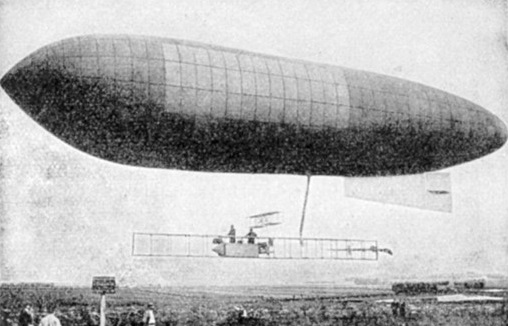
The 1910-built non-rigid Zodiac VIII was purchased in France in 1910 by Russia and renamed Tchajka / Seagull. It was used for training.
Engine: 1 x 59 hp
Length: 47 m
Width: 9 m
Envelope volume: 2140 cu.m
Max speed: 47 kph
The Zoche aero-diesels are a trio of German prototype Diesel radial aero-engines intended for light aircraft. The Zoche ZO range comprises three radial engines, namely: the ZO 01A, a “cross-4”; the ZO 02A, a twin-row “cross-8”; and the ZO 03A, a V-twin. Power outputs are 150 hp (112 kW), 300 hp (224 kW) and 70 hp (52 kW) (respectively).
The founder of the project is Michael Zoche, who claimed that the ZO engines will have the following advantages: they will be lightweight, compact and perfectly smooth; low fuel consumption; high power-to-weight ratio; the lubrication system will allow aerobatics; diesel fuel injection, so no carburetor icing; direct driven generator, so no drive-belts; good reliability through a low part count and absence of poppet valves; pneumatic starting obviates both electric starter motor and heavy starter battery; complete absence of rubber hoses; cheaper parts through modularity; reduced fire risk compared to avgas; good power output, even at altitudes up to 9,000 feet (3,000 m). The engines will also have the “classic” appearance that is suitable for some aircraft types.
The AOPA website explains the “cross-4” ZO 01A as follows: “The radial design was chosen for its ability to be effectively aircooled and 100% balanced at all rpm with a simple counterweight system. All four connecting rods are attached to a single crankshaft throw. This prevents any crankshaft twisting, which is hard to balance out in opposed-configuration engines. Zoche engines use a pneumatic starting system that does away with the need for a heavy-duty starter and battery system”.
Zoche ZO engines are modular and are all direct-drive, air-cooled, radial two-stroke Diesels with up to four cylinders per row. They feature two-stage charging (turbocharger and supercharger), direct fuel-injection and intercooling. Propeller rotation is clockwise (viewed from the cockpit). Engine weights (below) include: starter-generator, hydraulic propeller-governor, turbocharger and supercharger, and oil- and fuel-filters. Engine mountings are attached to the cylinder heads. Engines are to be certified to JAR-E and FAR 33, and a TBO of 2,000 hours is anticipated.
A Zoche engine has run effectively in wind tunnel tests, but Zoche seem barely any closer to production than they were a decade earlier. The Zoche engine gestation period has lasted some 20 years; and whether or when production may start is unknown.
The Lambert Mission 212, a kit-build 4-seat aircraft from Belgium that was nearing completion of pre-production testing, was initially designed around the Zoche ZO1A motor; but, with the non-appearance of the Zoche, Lambert have been obliged to select other engines, the DeltaHawk® DH200A4 (or DH180A4), or the XP-360 engine.
Variants:
ZO 01A
Single-row cross-4, 2,660 cc (162 cu in), (max) 150 hp (112 kW) @ 2500 rpm, 84 kg (185 lb)), fuel consumption 21 litres/h @ 75% power.
ZO 02A
Double-row cross-8, 5,330 cc (325 cu in), (max) 300 hp (224 kW) @ 2500 rpm, 123 kg (271 lb)), fuel consumption 42 litres/h @ 75% power.
ZO 03A
V-twin, 1,330 cc (81 cu in), (max) 70 hp (52 kW) @ 2500 rpm, 55 kg (121 lb)), fuel consumption 10 litres/h @ 75% power.
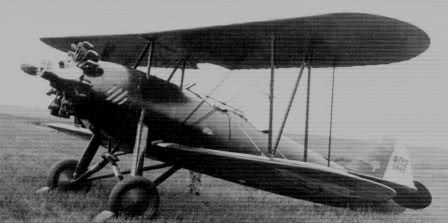
In 1933, the command of the Yugoslav Royal Air Force (YRAF) decided to replace outdated planes with modern school aircraft, for transitional training from basic training to combat.
The designers, R. Fizir and D. Stankov, opted for a biplane concept, although the YRAF preferred a low wing (due to the development of modern combat aircraft). The Zmaj Factory designed a prototype Fizir FP-1, in 1993, but it did not satisfy all the requirements set by the YRAF. As a result, Rudolf Fizir and Dusan Stankov, made adjustments to the Fizir FP-1 and so the plane became the Fizir FP-2. In the end, the concept accepted.
A prototype Fizir FP-2 (Fizir Prelazni) with a Gnome-Rhone K-7 engine of 308 kW power was completed and test flown at the end of 1933. More test flights followed, and by 1934 the plane showed good results.
The Zmaj modified the FP-2 during 1934 using a Walter Pollux 2 engine of 235 kW power, but the results were not satisfactory.
Engine: 1 × Gnome-Rhone K7, 313 kW (420 hp)
Propeller: 2-blade
Wingspan: 10.80 m (35 ft 5 in)
Wing area: 28.80 sq.m (310.0 sq ft)
Length: 7.90 m (25 ft 11 in)
Height: 2.90 m (9 ft 6 in)
Empty weight: 740 kg (1,631 lb)
Gross weight: 1,450 kg (3,197 lb)
Maximum speed: 200 km/h (120 mph; 110 kn) 238 km/h at sea level
Range: 580 km (360 mi; 313 nmi)
Service ceiling: 6,800 m (22,310 ft)
Crew: 2
 All Aero