Air Charter Bristol F.2b Tourer

Three Bristol Tourer replicas were built in Australia. A static display replica was built over 18 months during 1980-1981 as a project by the Civil Aviation Historical Society (WA Division) by Ansett WA carpenter Frank Matthews, under supervision of Ansett engineer Billy Tilly, with help of Frank Colquhoun, a former West Australian Airways mechanic/engineer. It was built for display at the Ansett terminal at Perth Airport (now Terminal 3) and was unveiled in the terminal on 5 December 1981, painted to represet G-AUDK. The Ansett terminal was expanded in the mid-1980s, so in 1986 this replica was donated to the RAAF Association Aviation Heritage Museum at Bull Creek, WA, where it is displayed with part of the fuselage and wing unskinned to reveal the structure.

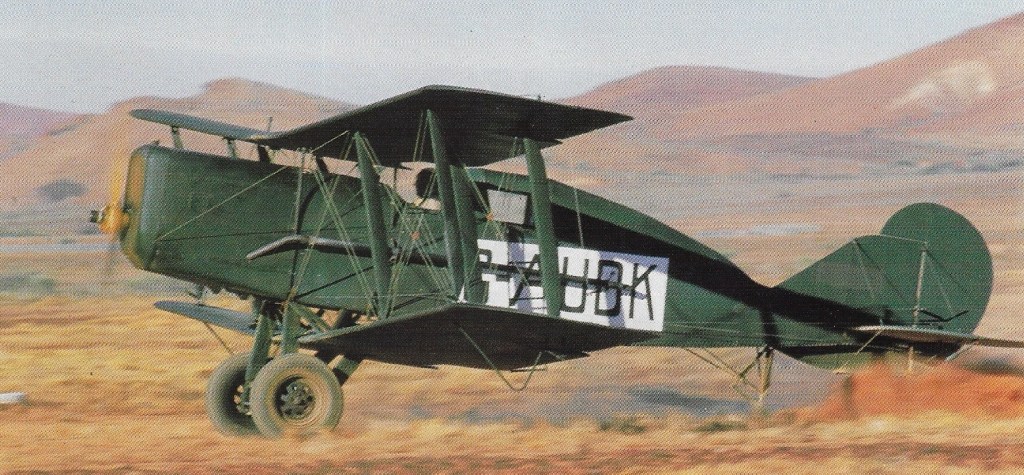
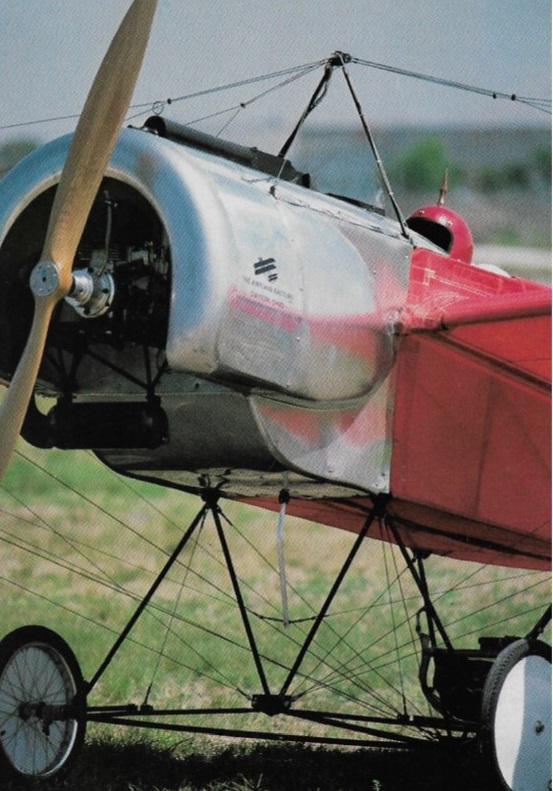
In 1984-1985 an Australian company called A Thousand Skies Ltd had two airworthy Bristol Tourer replicas built in Brisbane, QLD by Air Charter Pty Ltd for a television mini-series “A Thousand Skies”, a story on the life of Sir Charles Kingsford Smith. They were registered as Air Charter Bristol F.2b Tourers, VH-UDC (c/n QA-32-1, painted as G-AUDK) and VH-UDR (c/n QA-32-2, painted as G-AUDJ). These aircraft were powered by 172 kw (230 hp) Continental IO-520 six-cylinder engines, the fuselages being of steel tube construction and the wings of wood, with fabric covering overall. These aircraft were later seen at a number of aviation events but suffered their share of problems.

On 1 June 1992 VH-UDC (painted as G-AUDK) was on a 70-year commemorative flight by owner/pilot Barry Hempel when it suffered engine trouble and was damaged in a forced landing on North West Coastal Highway, 100 km (62 miles) north of Geraldton, WA. The aircraft was restored by Mid West Aero Club and the Shire of Greenough donated it to the Western Australian Museum at Geraldton, where it is now displayed suspended from the ceiling. This is a fitting location, given that the first scheduled air service in Australia by Bristol Tourers of West Australian Airways began at Geraldton Airport on 5 December 1921.
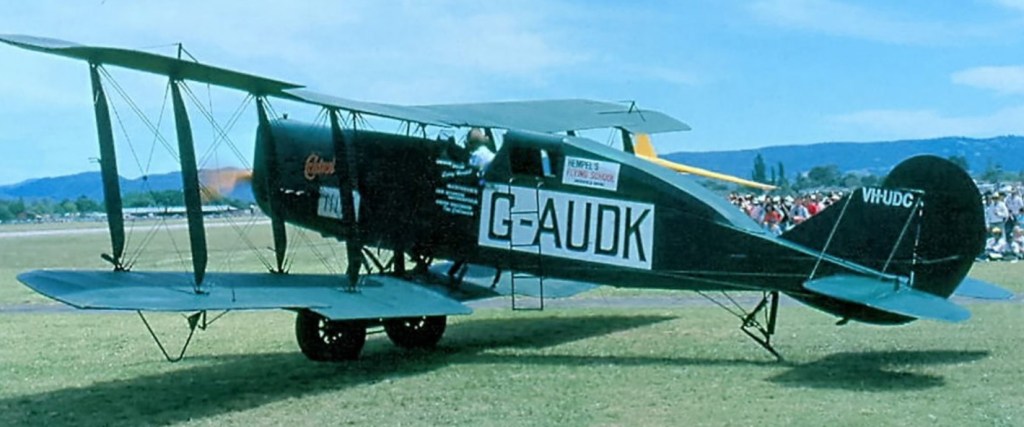
Bristol Tourer replica VH-UDC / G-AUDK at Richmond, VIC in 1988

The second aircraft VH-UDR (painted as G-AUDJ) was registered in March 1985 and was withdrawn from service in March 1986. It was converted to a Bristol Fighter F.2b configuration, painted in military markings to represent C-4623, and was placed on display at the Army Aviation Museum at Oakey, QLD.

UFO 19

Flying Hangar Door

The 1983 “Flying Hangar Door” was home-designed and home-made by a very quiet and talented NASA engineer from Dryden Flight Research Center and weighed as much as a Vespa moped. The all-wing airframe was made of corrugated paper and the wheels were from child’s bicycles (plastic rims). It was powered by a lawnmower engine.

Despite its seemingly bulky shape, the “Flying Hangar Door” was an “excellent flyer”. It is possible that the aircraft never received a proper designation or even a registration.

UFO 22

Aya-7 – unknown manufacturer

Built in Russia, the Aya-7 is a single-seat, high wing monoplane. 30 hp pusher engine. Tricycle landing gear. Length 12’, wing span 17’, wing area 63.6 sq/ft. Empty weight 173 lbs and gross weight 360 lbs. Top speed 69 mph and stall speed 44 mph. Rate of climb 600 fpm. Wing and tail made from wood and fabric. Tail is metal.

UFO 23

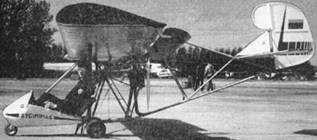
Atgimimas – unknown manufacturer

The Lithuania Atgimimas single-seat, high wing monoplane. 22hp pusher engine. Tricycle landing gear. Length 16.6’, wing span 27’, wing area 116.6 sq/ft. Empty weight 215 lbs and gross weight of 415 lbs. Top speed 72 mph and stall speed 28 mph. Fuselage is tubing while wing is wood and composite. Tail is tubing and fabric.

UFO 24

Antoshka – unknown manufacturer

The Russian Antoshka single-seat biplane. 40 hp pusher engine. Tricycle landing gear. Length 16.2’, wing span 31.2’, wing area 111 sq/ft. Empty weight 297 lbs. Gross weight 475 lbs. Top speed 62 mph, stall speed 37 mph. Wing is metal and fabric with tubing and fabric tail. Fuselage metal.

Fichtel & Sachs KM 48

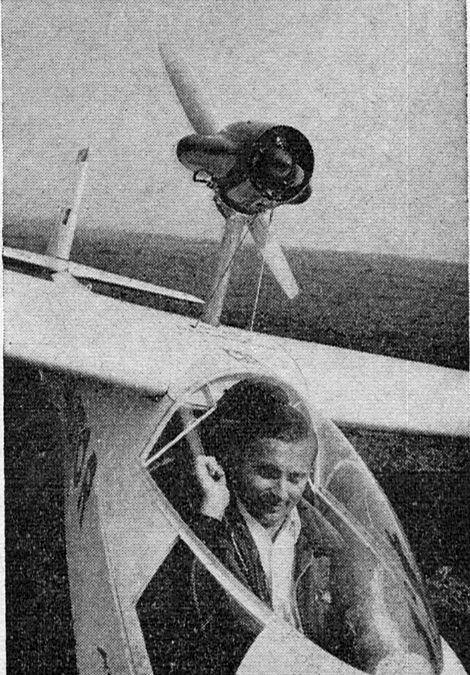
Circa 1967 Fichtel & Sachs AG developed the Wankel KM 48 into an auxiliary power unit for sailplanes.
The 10 bhp engine uses normal grade petrol with 2% by volume of added lubricating oil.

The first installation was in a Ka8 single seat sailplane. The Wankel KMA8 is mounted on a single upward projecting tube above the aircraft C of G. A 31.5in diameter Hoffman pusher propellor is mounted directly on to the output shaft. Engine cooling and appearance are enhanced by a polyester resin glassfibre cowling. The engine, cowling and 1.1 Imp.Gal of fuel weight 38.6 lb.

The test programme showed at a steady 5000 rpm and a forward speed of 40.5 mph, the Ka8 was climbed at up to 140 fpm at around 6500 ft. Maximum level speed was 59 mph.

Fichtel & Sachs believe that 800-1000 between overhauls could be expected.

Displacement: 160 cc
Output: 10 bhp at 5,000 rpm
Engine weight: 18.74 lb

Shenyang FC-31 Gyrfalcon / J-35

Shenyang FC-31

The Shenyang FC-31 Gyrfalcon (also referred to as the J-35 in its naval variant) represents China’s second stealth fighter program and its first carrier-capable fifth-generation aircraft.

The FC-31 features a conventional twin-engine layout with canted vertical stabilisers similar to the F-22.
The aircraft incorporates internal weapons bays to preserve stealth characteristics and uses advanced composite materials to reduce weight and radar signature.

Powered by Russian-designed RD-93 derivatives (the Chinese WS-13 engines), production variants are expected to receive the more powerful WS-19 engines currently under development. These will enable the FC-31 to reach speeds of Mach 1.8 (2,205 km/h) and achieve supercruise capability.

With an estimated unit cost of $70 million, the FC-31/J-35 represents China’s strategic push to modernise its naval air arm. Initial operational capability on China’s newest carriers is expected by 2026, potentially altering the balance of power in the Western Pacific.

Cirrus Vision Jet

Cirrus first began development of the Vision Jet in the early 2000s. The Cirrus founders, the Klapmeier brothers, started the program in their offsite Duluth, Minnesota, facility. It was officially revealed to the public in June 2006 at the Cirrus Owners and Pilots Association meeting.

The first prototype of the Cirrus Vision Jet conducted its maiden flight in July 2008. However, Cirrus ran into difficulties financing the continued testing and development program of the light business jet, especially in 2009 during the height of the Great Recession.

However, after the slow development process in the early 2010s, a new Cirrus investor provided enough financing to complete the development of the aircraft. It was officially certified by the Federal Aviation Administration (FAA) in October 2016. Deliveries of the aircraft began later that same year.

The Vision Jet is a low-wing-configured aircraft with retractable tricycle landing gear. The aircraft’s airframe is also made entirely out of composite materials. It utilizes a single turbofan engine that rests on the top of the fuselage near the rear of the aircraft. Because of the unique engine configuration, the aircraft utilizes a V-tail.

The small cabin can fit up to seven total occupants in three rows. However, the third row is small and typically can only accommodate two adults or three children. Passengers enter the cabin through a clamshell door on the left-hand side of the fuselage.

Additionally, the Vision Jet is powered by the Garmin G3000 avionics suite, including the Garmin Emergency Autoland System. The Vision Jet also features the Cirrus Airframe Parachute System (CAPS).

Vision Jet
Engine: 1 x Williams FJ33 turbofan, 1,850 lb thrust
Wingspan: 38 feet 9 inches
Length: 30 feet 11 inches
Height: 10 feet 11 inches
Gross weight: 6,000 lb
Maximum speed: 311 knots (358 mph)
Range: 600 nm (690 miles)
Service ceiling: 31,000 feet