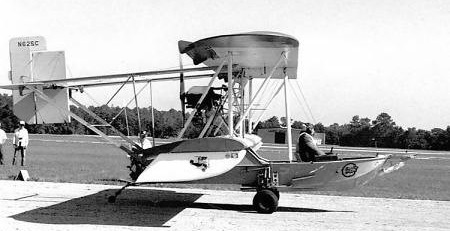
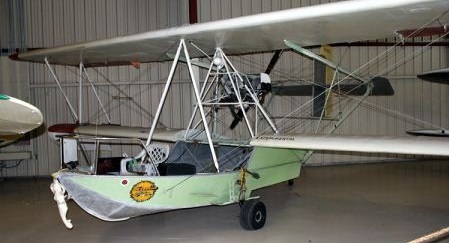
The Sunshine Clipper was a small two-seat amphibious homebuilt aircraft designed and constructed by Henry C. Palmer of St. Petersburg, Florida, USA. The aircraft uses a 14 ft (4.27 m) Orlando Clipper aluminum boat of 1948 vintage as basis for the fuselage, which was then combined with the wings of a Piper J-3 Cub, and parts and components of Piper J-3 Cub, PA-22 Tri-Pacer and PA-25 Pawnee aircraft.
The aircraft (N62SC c/n 1) first flew in November 1987, powered by a 65 hp Continental A65 engine. The aircraft remained a one-of-a-kind design and was registered to the SUN ‘n FUN Aviation Foundation on August 21, 1999 and is on display at the Florida Air Museum.
Engine: Continental A65, 65 hp Span: 33 ft 0 in (7.20 m) Weight empty: 1,100 lb (360 kg) Loaded weight: 1,500 lb (572 kg) Max speed: 65 mph (145 kmh) Cruise speed: 55 mph (120 kmh) Climb: 100 ft (1,000 m)/min
The second Palmer trike, the Skyhook (FAA registered N4411) in spite of its early date of origin, had most of the attributes of a modern ultralight trike, except it used a single cylinder snowmobile engine, as the two-stroke twin cylinders were not available yet. It was powered by a 17 hp (13 kW) at 5000 rpm single cylinder JLO L297 two stroke engine, driving a composite propeller designed and built by Palmer himself and driven by a 2.1/1 reduction gearbox. The engine had electric start and the craft had fiberglass composite spring landing gear.
The airframe consisted of bolted 6061-T6 aluminum tube, with 6061 T-6 extruded angle. The craft took off, flew, and landed at about 30 mph (48 km/h). Palmer’s trikes were not developed further and remained in obscurity. Palmer moved on to design a successful line of personal hovercraft.
In March 1967 Palmer built and flew the first true weight-shift powered ultralight trike aircraft: the Paraplane (FAA Registered N7144) and it was controlled by a single vertical control bar. The Paraplane used two West Bend-Chrysler 820 engines (8 hp at 6000 rpm, reduced to 4700 rpm for about 6.5 hp (4.8 kW) each, for a total of 13 hp). Each engine had a direct drive to a 27in diameter two-blade propeller made of polyester & fiberglass. On March 24, 1967 Palmer registered the trike at the American FAA as the Palmer Parawing D-6, serial 1A, N7144; No restrictions were noted.
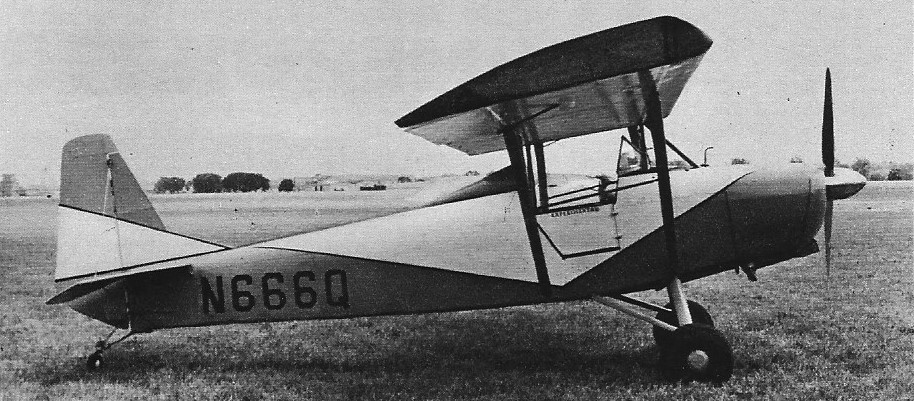
An executive pilot for Eastman Kodak’s Gulfstream, Joseph Palermo built his single-seat P-10 registered N666Q from plans published in Mechanics Illustrated magazine, but changed the tail configuration and skinned the steel tube fuselage with .025 magnesium alloy. The $600 craft took six years to build.
The wing has fabric covered wood structure and is fitted with Palermo’s own designed tips.
Engine: Continental A-65-A8, 65 hp Wingspan: 26 ft / 7.92 m Empty weight: 540 lb / 245 kg MAUW: 740 lb / 335.7 kg Cruise: 87 mph / 140 kph Landing speed: 35 mph / 56 kph ROC: 900 fpm / 4.57 m/sec Range: 270 mi / 435 km
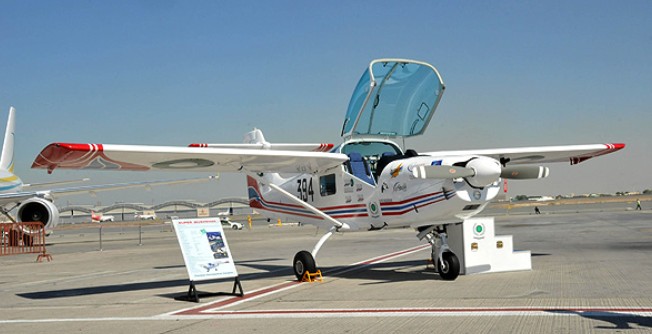
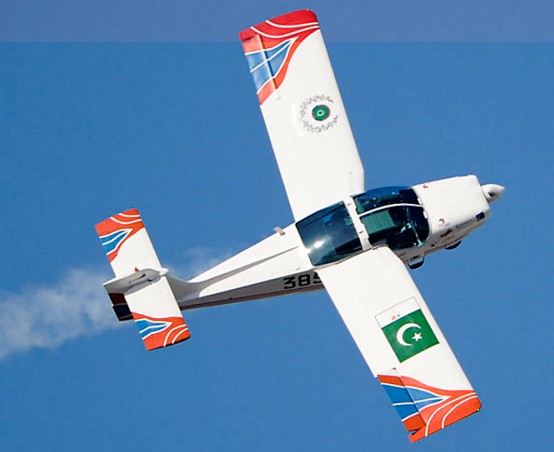
The MFI-395 Super Mushshak is a military trainer / light attack aircraft designed and manufactured by the Pakistan Aeronautical Complex (PAC) for the Pakistan Air Force (PAF) and the Royal Saudi Air Force (RSAF).
The development of the MFI-395 started in 1995. The aircraft was built by upgrading the MFI-17 with an advanced 260hp engine, electrical instruments, dual flight control systems and a Bendix RSA fuel injection system. PAC rolled out the improved version, the MFI-395 Super Mushshak aircraft in 1995.
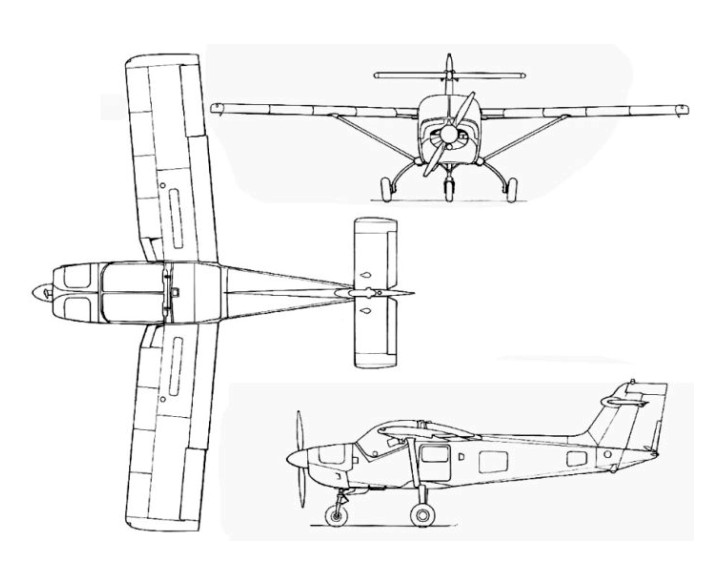
The MFI-395 features a high wing monoplane design. It boasts two integral fuel tanks which carry 47 gallons of fuel. The large baggage compartment located aft of the cockpit can be easily accessed through a door on the rear side of the fuselage.
The Super Mushshak is equipped with a blind screen, which allows the aircraft to carry out instrument flying missions.
The spacious glass cockpit of the MFI-395 accommodates two flight crew members, a student pilot and a flight instructor. It is integrated with two ejection seats adjacent to each other, with an option for third seat at the rear side. It is enclosed by an oval shaped glass canopy which opens upwards to meliorate the visibility.
The cockpit is equipped with two multifunctional displays to exhibit data related to navigation, flight instrumentation, fuel and the engine. It is also equipped with an Enviro R-134 air conditioning system to sustain constant temperature.
The avionics suite incorporated in the MFI-395 includes instrument flight rules (IFR) capable electronic flight instrumentation system (EFIS), a global positioning system, instrument landing system, voice over recorder, UHF radio, automatic direction finder, distance measuring equipment and information friend or foe transponder.
The MFI-395 is fitted with six hardpoints under the wing pylons. The inner two stressed hardpoints can carry up to 150kg each. The remaining four carry rockets, gunpods and Bofor Bantam anti-tank missiles.
The MFI-395 was designed to provide primary flight training to the pilots of the PAF Academy situated at Risalpur. It was designed to suit both military and civilian missions. The aircraft’s design is compliant with the US FAR 23 certification standards in aerobatics and utility classes.
The tricycle type undercarriage allows the aircraft to operate from unprepared airstrips and rough airfields.
The maiden flight of the Super Mushshak took place in August 1996. The production aircraft was rolled out in November 2000. It entered service in May 2001 and was certified by the Pakistan Civil Aviation Authority in 2002.
It was displayed at the Dubai Air Show held in November 2011.
Approximately 300 MFI-395s were operational at the academies of the Pakistan Armed Forces.
Customer orders for the MFI-395 included: PAF (50), RSAF (20) and Royal Air Force of Oman (five). The PAF received its first Super Mushshak in May 2001. Deliveries to the Royal Air Force of Oman were concluded in 2004.
Pakistan signed an agreement with Iraq for the supply of trainer aircraft to Iraqi Air Force, in what is billed as “major milestone” in the export of aviation products from the country.
The contract of sales of Super Mushshak Aircraft to Iraq was signed by General Anwer Hamad Ameen Ahmed, Commander Iraqi Air Force and Air Marshal Sohail Gul Khan, Chairman of the Pakistan Aeronautical Complex (PAC) Kamra.
In total two agreements were signed including the one for sale of the trainer aircraft. According to the first agreement Pakistan Air Force will provide Training, to Iraq Air Defence Force personnel, in all sphere of Modern Air Force concept pertaining to different field special Air Defence, and Air Crew.
The Super Sport was a single-seat homebuilt sport biplane attributed to Ivan Painter of Hollister, California, USA. The engine was reported as a 150 hp Lycoming O-320 series and year of manufacture as 1966. The sole example built was deregistered on August 10, 2012.
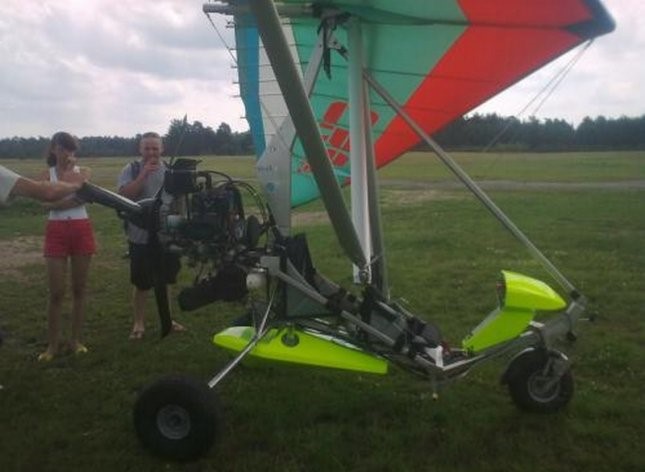
The Pagotto Brako is an Italian ultralight trike, designed by Enio Pagotto and produced by Carpenterie Pagotto of Pianzano.
The aircraft was designed to comply with the Fédération Aéronautique Internationale microlight category, including the category’s maximum gross weight of 450 kg (992 lb). The aircraft has a maximum gross weight of 450 kg (992 lb). It features a cable-braced hang glider-style high wing, weight-shift controls, a two-seats-in-tandem open cockpit without a cockpit fairing, tricycle landing gear with wheel pants and a single engine in pusher configuration.
The aircraft is made from welded stainless steel tubing, with its single or double surface wing covered in Dacron sailcloth. The Brako is factory supplied only with Grif wings. With the Trainer wing it has a wingspan of 10.35 m (34.0 ft). The wing is supported by a single tube-type kingpost and uses an “A” frame weight-shift control bar. The powerplant is a twin-cylinder, air-cooled, two-stroke, dual-ignition 50 hp (37 kW) Rotax 503 engine, with a reconditioned four-cylinder, air- and liquid-cooled, four-stroke, dual-ignition 80 hp (60 kW) Rotax 912UL engine optional.
With the Rotax 503 engine and Grif Trainer wing the aircraft has an empty weight of 158 kg (348 lb) and a gross weight of 450 kg (992 lb), giving a useful load of 292 kg (644 lb). With full fuel of 42 litres (9.2 imp gal; 11 US gal) the payload is 261 kg (575 lb).
A number of different wings can be fitted to the basic carriage, including the beginner Grif Trainer, intermediate Grif Spyder and the higher performance Grif Corsair with wing areas of 12.8 sq.m (138 sq ft) and 13.7 sq.m (147 sq ft).
The aircraft was in production in 2013 and was supplied as a complete ready-to-fly-aircraft.
Brako / Grif Trainer wing Engine: 1 × Rotax 503, 37 kW (50 hp) Propeller: three-bladed composite Wingspan: 10.35 m (33 ft 11 in) Wing area: 16.0 m2 (172 sq ft) Empty weight: 158 kg (348 lb) Gross weight: 450 kg (992 lb) Fuel capacity: 42 litres (9.2 imp gal; 11 US gal) Maximum speed: 100 km/h (62 mph, 54 kn) Cruise speed: 75 km/h (47 mph, 40 kn) Stall speed: 45 km/h (28 mph, 24 kn) Rate of climb: 2.8 m/s (550 ft/min) Wing loading: 28.1 kg/m2 (5.8 lb/sq ft) Crew: one Capacity: one passenger