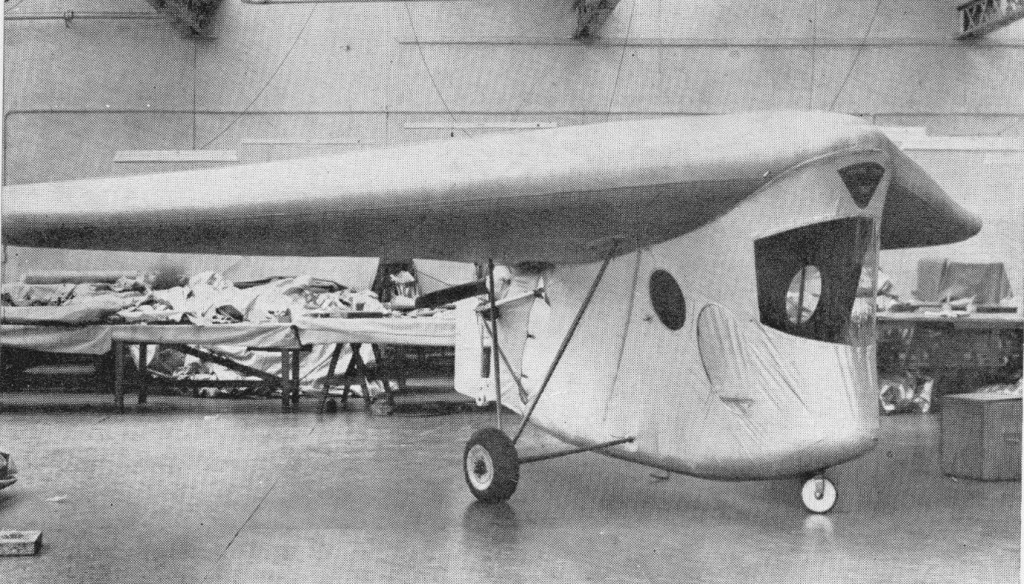
Designed and built by D. Perkins and A. Lock in 1958, the New Horizon was a tail-less, parasol wing monoplane, with a pusher propellor and tricycle undercarriage. It featured an inflatable wing.
Man-powered, it was unsuccessful in flight trials inside the Cardington airship hanger.
Development of the inflatable wing concept did lead to the ‘Reluctant Phoenix’.
After gaining experience with his ‘New Horizon’, D. Perkins went on to design a tail-less delta inflatable man powered aircraft which he called ‘Reluctant Phoenix’.
It first flew inside the Cardington balloon hanger on 18 July 1966 and went on to make 97 similar flights, all of which were only in ground effect.
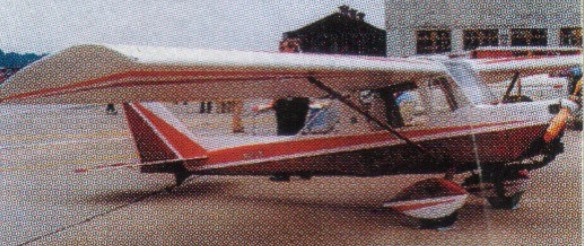
The Perkins Inflatable was built and flown in Britain pre-1960. The entire airframe, apart from the engine and undercarriage, was deflate able and could be packed into a 14 inch diameter bundle, 4 ft 3 in long.
VT 113 Empty weight: 18.5 kg Engine: Vittorazi, 15 hp at 9300 rpm Reduction: 1:3.1 Prop diameter: 113 cm Fuel capacity: 7.5 lt Price (1998): 5 500 000 L
VT 113 E Empty weight: 13 kg Engine: Vittorazi, 15 hp at 9300 rpm Reduction: 1:3.1 Prop diameter: 113 cm Fuel capacity: 7.5 lt Price (1998): 6 300 000 L
VT 125 E Empty weight: 20 kg Engine: Vittorazi, 15 hp at 9300 rpm Reduction: 1:3.5 Prop diameter: 125 cm Fuel capacity: 7.5 lt Price (1998): 5 600 000 L
VT 115 Empty weight: 17 kg Engine: Monocil 80, 10 hp at 9300 rpm Reduction: yes Prop diameter: 113 cm Fuel capacity: 7 lt
VT 125 Empty weight: 17 kg Engine: Monocil 80, 10 hp at 9300 rpm Reduction: yes Prop diameter: 125 cm Fuel capacity: 7 lt
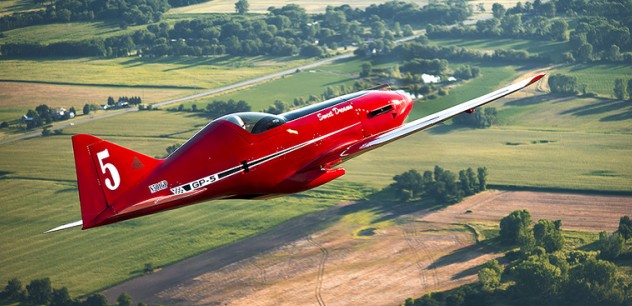
On 12 April 2014 Lee Behel set out from Mojave Airport to break two records, the 3,000m climb and the 3k speed run. Flying his V-8 powered George Pereira designed GP-5, he managed to reach 3,000 meters (or 9,842 feet), in exactly two minutes along with achieving a top speed of 372mph on a flat 3k run to take the records.
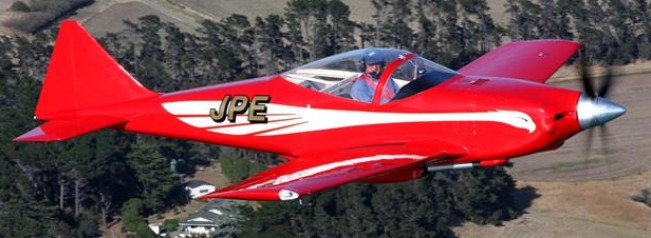
A high performance, low wing, side-by-side two-seater, of all wood construction. The GP4 is the latest in a series of four aircraft designed by George Pereira.
The GP-4 prototype was finished in April, 1984. Extensive flight tests were completed in time to compete for awards at the 1984 EAA Convention in Oshkosh, Wisconsin. That year at Oshkosh, the GP-4 won both the Grand Champion Custom Built and the Outstanding New Design awards. It is a high performance cross-country type aircraft designed to extract the most speed from the power available. Airfoil selection and drag reduction were primary considerations. The construction is of wood with foam and fiberglass utilized in the cowling and fairing areas. Design strength at full gross is 8G’s positive and 6G’s negative obtained by using a massive, one-piece main spar. The GP-4 aircraft has a manual landing gear retracting system but there is a separate set of plans for a hydraulic landing gear.
Osprey Aircraft also marketed as plans and kits is the Osprey GP-4.
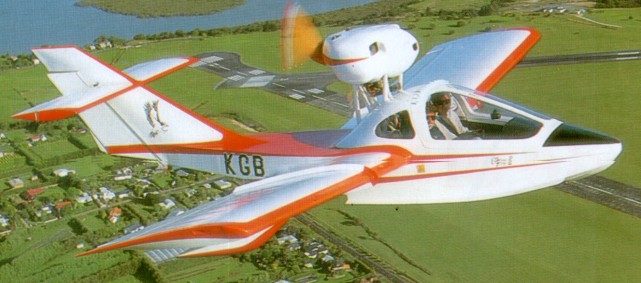
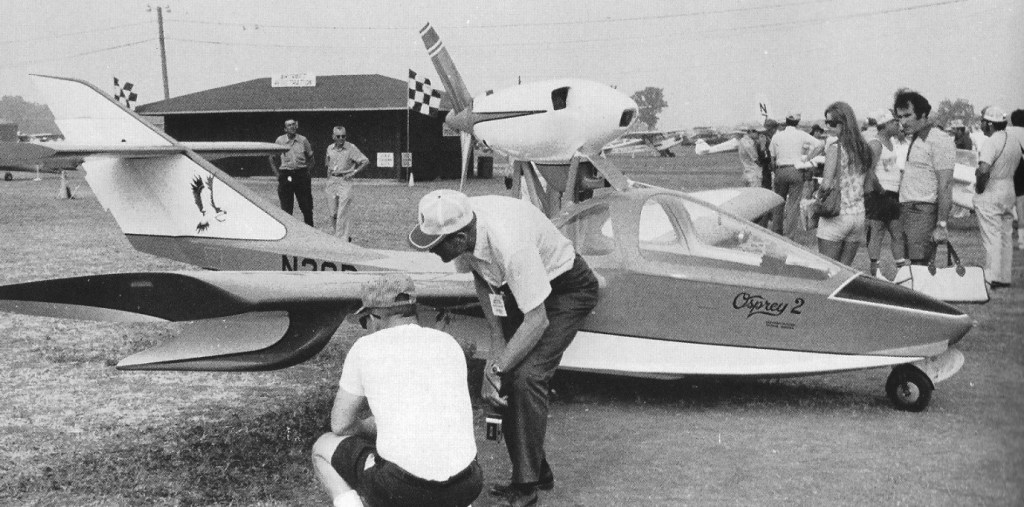
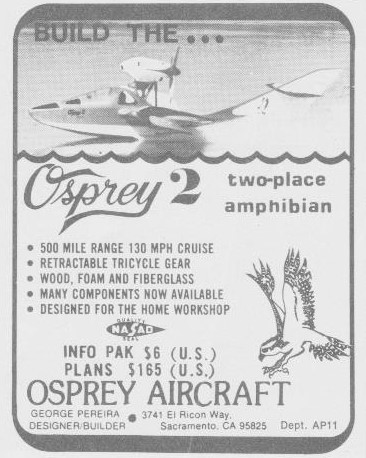
Design and construction of the two place Osprey 2 amphibian began early in 1972 following development of a military version, the U.S. Navy X-28A Air Skimmer, for civil police use in Southeast Asia. The designer, George Pereira, evolved a unique construction technique for the single-place Osprey I by coating the underside of the all-wood fuselage structure with polyurethane foam, later sculptured to the desired shape and covered with several protective layers of fiberglass bonded with resin. The result is a light, strong structure able to resist the shock of hard water landings.
The pusher engine is a Lycoming O-320 flat-four of 160 hp mounted on a pedestal so the prop wash blows directly over the cruciform tail surfaces. Wings are of all-wood construction with a single box spar, while the landing gear for use on land is of the retractable tricycle type. The wings just outboard of the main gear are removable for towing and home storage.
The Osprey 2 was designed to be built, in its entirety, in a workshop with no molds required, and first flew in 1973.
Detailed construction plans are available. They consist of 46 sheets, drawn with amateur builder in mind, plus step-by-step, photo illustrated, construction manual. Price 1982: $3,690 (Excludes engine, propeller, Instruments and paint). Units delivered to June 1981: 500.