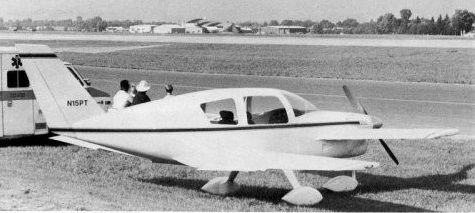
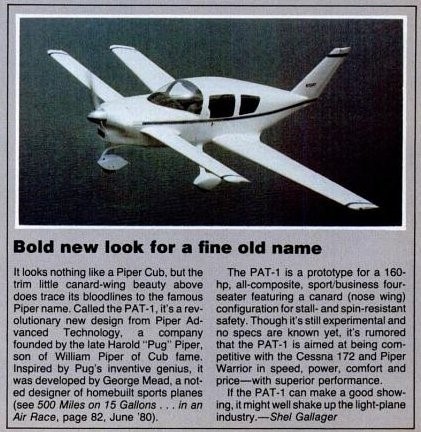
Designed by George Mead, the 1981 Piper Advanced Technology Inc PAT-1 Pugmobile was a four-place cabin, canard monoplane. Powered by a 160hp Lycoming O-320, the prototype, N15PT, had an approach speed of 75 mph.
The prototype crashed on 19 Nowember 1981 killing designer Mead and two passengers.
November 20, 1981 An experimental, single-engine airplane, designed for enhanced safety, crashed yesterday during a demonstration flight over the Chesapeake Bay, killing the aircraft’s designer and two employees of the National Aeronautics and Space Administration’s Langley Research Center. The propeller-driven, four-seater plane, outfitted with an unusual wing near its nose, plunged into the bay shortly before 11:25 a.m. near Gwynn Island, below the mouth of the Rappahannock River about 30 miles north of Hampton, Va. A NASA spokesman said the cause of the crash was not known. Among those killed was George Mead, an aeronautical engineer in his early 30s who designed the novel general aviation craft for Piper Advanced Technology Inc., a Kansas company established last year to build, test and market the plane. The firm, based in Wichita, was started by a son of the founder of the well-known Piper Aircraft Corp. but has no corporate relationship to the older enterprise, a company official said. The others who died in the crash were identified as Wendell Kelley, 41, of Newport News, Va., a NASA research pilot, and Paul F. Coy, 23, of Hampton, Va., a NASA engineer. The two men were aboard to “see how the plane handled,” Langley spokesman Maurice Parker said. A spokesman for the National Transportation Safety Board, which is expected to start investigating the crash today, said initial reports indicated the plane may have broken up in flight. Dennis Harms, one of the craft’s builders, said in a telephone interview from Wichita that the plane destroyed yesterday was the only existing prototype, designated PAT-1. The company has not yet decided whether to rebuild the aircraft, estimated to cost $75,000 to $100,000, and resume testing, he said. The small wing near the plane’s nose, known as a canard, was designed as a safety feature, Harms said. It was intended to prevent stall spin, an often fatal aviation phenomenon that may occur when a plane climbs too steeply, loses its upward lifting force and pitches back, spinning. There was no indication of stall spin in yesterday’s accident. Harms said the 160 horsepower plane — previously flown, chiefly by Mead, for 70 to 80 hours — was also designed for higher speeds than normally achieved by light planes without loss of fuel efficiency or cabin space. Its cruising speed, he said, was 165 miles an hour. NASA researchers were primarily interested in the aircraft’s canard feature, a subject of study for possible use in passenger and military planes, officials said. NASA spokesman Parker said the plane took off from Langley at 10:40 a.m. yesterday on its second day of demonstration flights for officials of the aeronautics agency. No distress call was received from the craft, whose crash was reported to a county sheriff in eastern Virginia. The Coast Guard recovered the three bodies and towed the plane ashore in two pieces, he said.
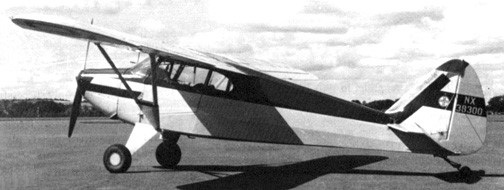
The 1941 four-place Piper P-4, powered by a 120hp Lycoming O-290 engine, was converted from P-1 NX38300. It would have gone into production in 1942 if the war had not interfered.
Built in 1938, the P-3 “Rosewing Cub”was a Cub Coupe with experimental William Rose wing with slats, slotted ailerons, flaps; also known as J-4RX [NX22941].
In 1941 the Piper P-2 NX33281 two-place cabin, high wing monoplane was built. Powered by a 60hp Franklin 4AC-171, later 75hp Continental, it had a cowled engine and one-piece hinged door. It was planned to replace the J-3 in production but the war intervened.
In 1941 the Piper P-1 NX38300 four-place cabin, high wing monoplane was built. Originally known as the 1937 Applegate Amphibian, which used wings and other components of the Cub. Powered by a 130hp Franklin 6AC engine, the wing design appeared in PA-16.
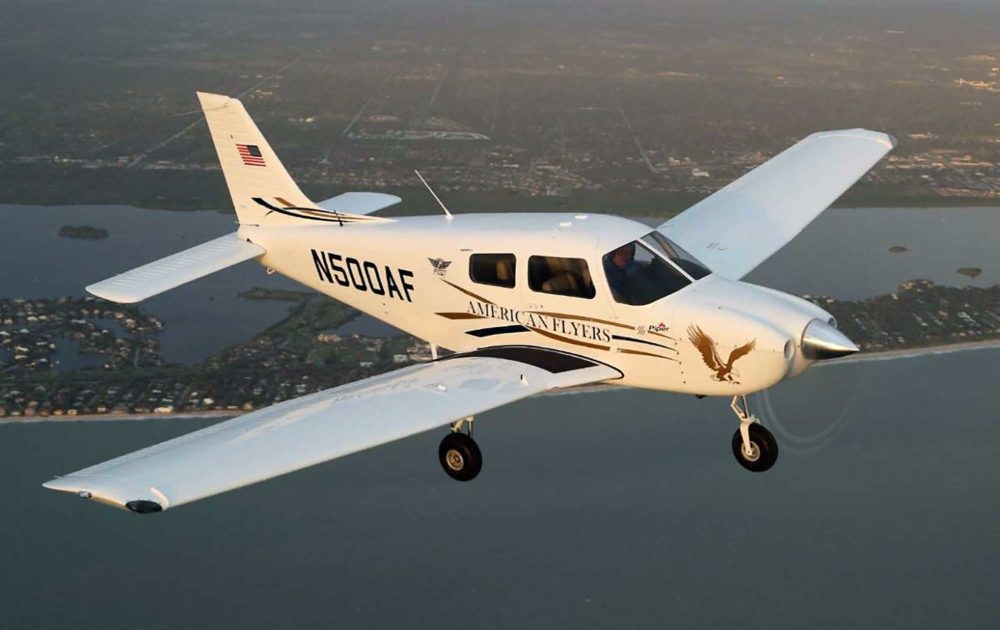
Immediately following certification in 2020, Piper began deliveries to its launch customer, American Flyers, who were to be taking delivery of eight Pilot 100i aircraft by the end of December 2020.
The new Piper Pilot 100i rounds off Piper’s five aircraft portfolio of training aircraft: Pilot 100i, Archer TX, Archer DX (diesel), Arrow (retractable), and twin-engine Seminole. The Piper 100i is priced under $300,000 and IFR equipped with digital autopilot.
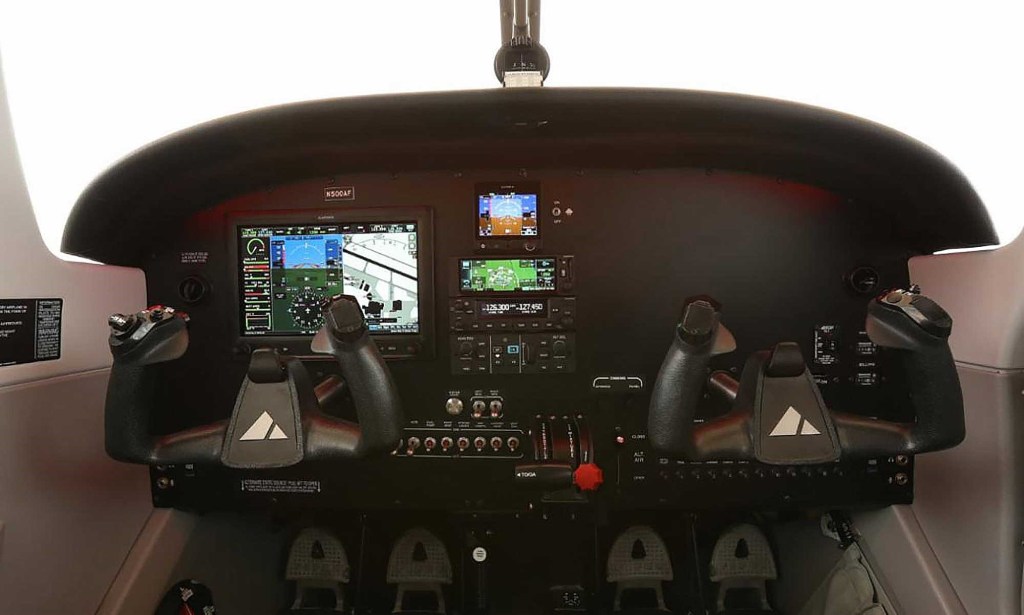
Panel of the Piper Pilot 100i with Garmin G3X Touch primary flight display.
The Piper Pilot 100i G3X avionics suite is a glass platform that allows for toggling between round dial and tape displays in a touchscreen format. This outperformed the G1000 suite on many levels.
The Piper PT-1 was a 1940s American two-seat primary training monoplane designed and built by Piper for Army or Navy primary flight training. A low-wing tandem two-seat monoplane, the PT-1 was the first Piper aircraft to have a low-wing. It had a fabric covering over an all-metal fuselage frame and wooden spar wings and tail unit. The PT-1 had a retractable tailwheel landing gear and was powered by a 130 hp (97 kW) Franklin 6AC-2980D engine.
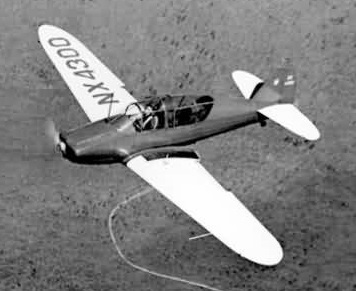
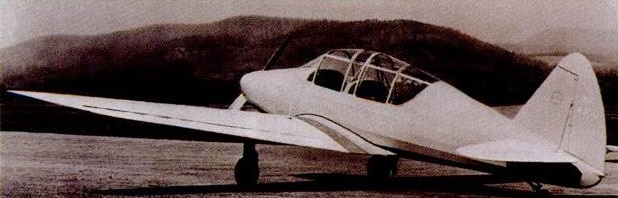
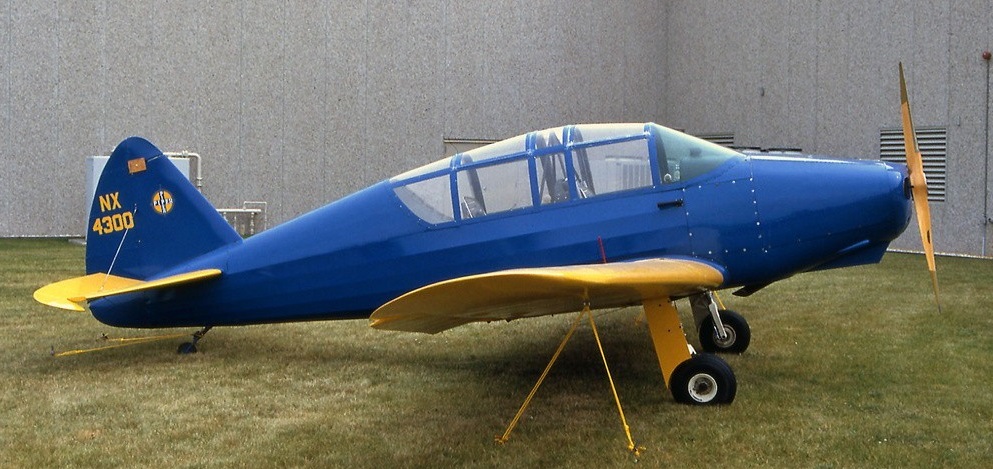
Designed by David Long, the prototype NX4300 first flew in 1942, no further aircraft were built. A four-seat development was designed as the Piper PWA-6 / PA-6 which did not go into production either.
Engine: 1 × Franklin 6AC-298, 130 hp (97 kW) Propeller: 2-bladed fixed pitch wooden airscrew Wingspan: 35 ft 2 in (10.72 m) Length: 22 ft 8 in (6.9 m) Height: 6 ft 6 in (1.98 m) Empty weight: 1,325 lb (601 kg) Gross weight: 2,000 lb (907 kg) Maximum speed: 150 mph (240 km/h, 130 kn) plus Cruise speed: 135 mph (217 km/h, 117 kn) plus Landing speed: less than 50 mph (43 kn; 80 km/h) Range: 700 mi (1,100 km, 610 nmi) Service ceiling: 12,400 ft (3,800 m) Rate of climb: 750 ft/min (3.8 m/s) to 1,000 ft/min (300 m/min) Crew: 2
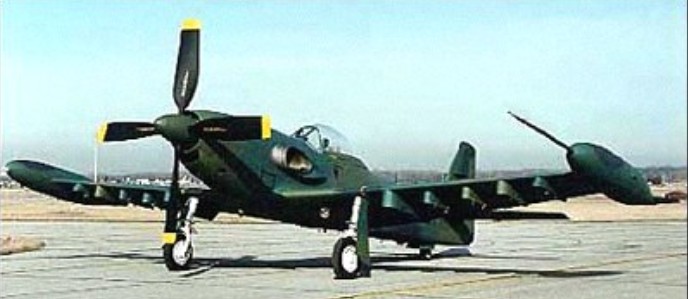
Piper Aircraft has received a USAF contract, expected to total about $12 million, to design, develop and test two new prototypes of the Enforcer as a lightweight close support air¬craft. The Enforcer, powered by a 2,445 ehp Lycoming T55 L 9 turboprop, was developed in 1971 as part of the activities of Cavalier Aircraft Corporation, which had produced a batch of updated North American F 51 Mustangs for export and evolved the Turbo Mustang III with a Dart engine. Piper acquired rights in the Enforcer in 1970 after Cavalier had developed the prototype, and for another 8 years Piper lobbied Congress to force the USAF to officially re-evaluate the Enforcer.
The two new prototypes were conversions of existing F 51 airframes, and modified by Piper at its Lakeland, Florida, plant. As well as the T55 installation, they feature wing tip tanks to increase total fuel capacity to 424 US gal (1605 1t), six wing strong points to carry two podded General Electric GAU 8 30 mm four-¬barrel cannon, 2.75 in (7 cm) unguided rockets or bombs, and aerodynamic improvements that include changes in the aileron control system and a 19 in (48 cm) extension of the rear fuselage, with enlarged tailplane and elevators. With a gross weight of 14,000 lb (6 350 kg), the Enforcer was expected to have a max speed of 350 kts (648 km/h). The USAF five month evaluation is expected to be conducted in the late summer of 1983 and completed by February 1984, embracing 98 flights.
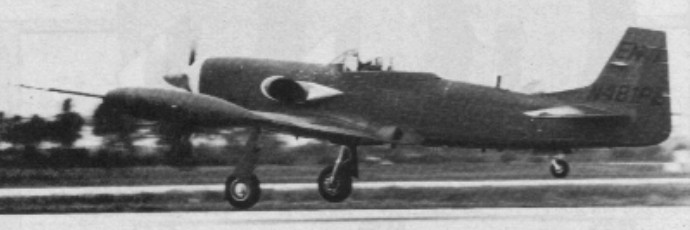
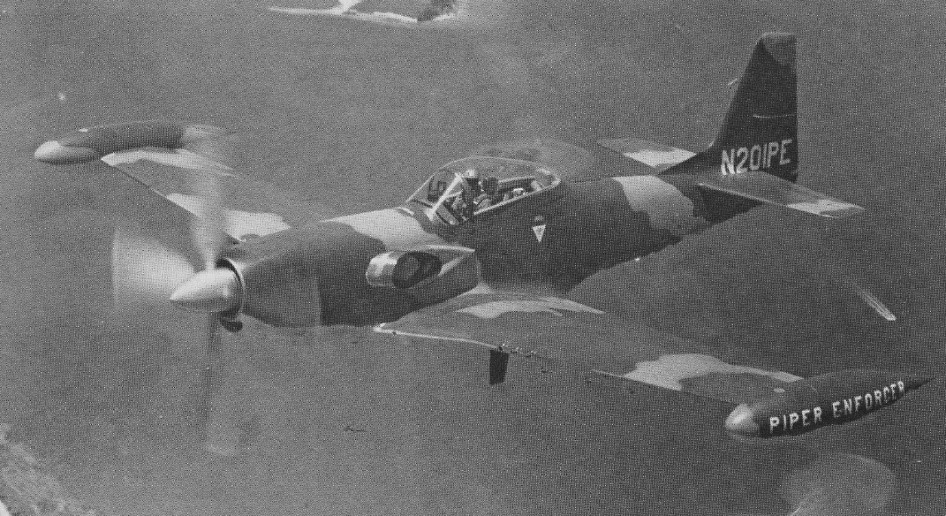
In 1971 Piper built two Enforcers by heavily modifying two existing P-51 Mustang aircraft and fitting them with Lycoming T55-L9A turboprop engines (along with numerous other significant modifications). One airframe was single seat (called the PE-1 and FAA registered N201PE) and the other was a dual-control aircraft (called the PE-2, registered N202PE). Prior to the PAVE COIN evaluation, N202PE was lost in a crash off the Florida Coast.
The Piper PA 48 Enforcer flew for the first time on April 9 1971 from the company’s Lakeland, Florida, facility. The Enforcer that flew is powered by a 2,445 shp Avco Lycoming T55 L 9 turboprop, turning a Skyraider propeller cut down by Piper from 14 feet to 11 feet, 6 inches in diameter. The fuselage has been stretched by 19 inches between the cockpit and fin; the fin area has been increased by nine percent, mostly in chord but slightly in height; the rudder is now equipped with a yaw stability augmentation system; and the tailplane/elevator area has been enlarged by 36 percent. Tip tanks provide 1,900 pounds of fuel capacity, in addition to some wing bending relief and end plate effect.
To ease stick loads at high speed and low level, the Enforcer’s ailerons are equipped with a boost system from a Lockheed T 33. The landing gear embodies Grumman G 1 wheels, T 39 Sabreliner brakes and Mustang type tires, and the tailwheel retracts. With six underwing pylons, the Enforcer’s main armament will be a pair of pod mounted 30mm General Electric four barrel rotary cannons capable of firing at a rate of 2,400 rounds per minute (40 rounds per second). Other weaponry could include miniguns, rockets and cluster bombs.
On the Enforcer’s first flight, the entire mission was flown in the takeoff and landing configuration to examine its stability, controllability and handling. Tests on the second flight included gear retraction, a climb to 20,000 feet and acceleration to 300 knots.
Eventually in the 1979 defense bill $11.9 million was allocated for Piper to build two new prototypes and for the USAF to perform another flight evaluation. Since the Enforcer was never in the Air Force inventory, it was not given an official military designation and did not receive an Air Force serial number. Instead, it carries the Piper designation PA-48 and Federal Aviation Administration (FAA) registration numbers N481PE and N482PE.
By the time the PA-48s were completed, they shared less than ten percent of their structure with the P-51. The two PA-48s were tested during 1983 and 1984 at Eglin AFB, Florida, and Edwards AFB, California. As in the PAVE COIN tests of 1971, the PA-48s were found to perform well in their intended role, but the USAF again decided not to purchase any.
Of the prototype aircraft produced, three of the four still exist. The original PE-1 is disassembled and in storage. One of the PA-48s, N482PE, awaits restoration at Edwards Air Force Base. N481PE has been fully restored and resides in the ‘Prototype Hangar’ at the National Museum of the United States Air Force at Wright-Patterson Air Force Base near Dayton, Ohio.
Engine: 1 x Lycoming T55-L-9 turboprop, 1831kW Max take-off weight: 6350 kg / 13999 lb Wingspan: 12.60 m / 41 ft 4 in Length: 10.40 m / 34 ft 1 in Height: 4.00 m / 13 ft 1 in Wing area: 37.9 sq.m / 407.95 sq ft Max. speed: 650 km/h / 404 mph Ceiling: 11465 m / 37600 ft Range: 1480 km / 920 miles
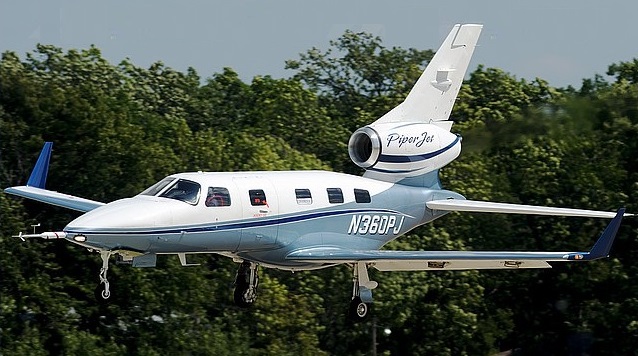
Piper Aircraft announced single-engined VLJ the PiperJet in October 2006, as a competitor to the twin-engined Eclipse 500 and Cessna Citation Mustang very light jets. The aircraft’s fuselage was the same cross section as the propeller-driven Piper PA-46 series, with a four-foot increase in length. It was to be capable of carrying up to 7 passengers and cruise at 360 knots (666.7 km/h), at a maximum altitude of 35,000 feet (10,668.0 m). Maximum range was expected to be 1,300 nautical miles (2,407.6 km), with a full-fuel payload of 800 pounds. Piper selected Williams International to supply its FJ44-3AP turbofan engine for the PiperJet.
Due to the engine being mounted above the center of gravity, power was highly stabilizing (addition of power would push the nose down), which could have been disconcerting to pilots. Initially, Piper designers incorporated an automatic pitch trim system to coordinate horizontal stabilizer angle of incidence with power setting. This system was later replaced by a vectored thrust nozzle, developed by Williams International, which resulted in reduced weight and simplified manufacturing processes.
A design feature of the aircraft was the use of a straight duct air intake design for the vertical stabilizer (tail) mounted engine, rather than an s-duct arrangement.
The prototype first flew on 30 July 2008.
A selling price of US$2.199 million in 2006 dollars was initially set and as of February 19, 2007, Piper announced that it had received 180 pre-orders. An entry-into-service date of early 2010 was initially anticipated, later changed to 2011-12. In October 2009 the company indicated that it had delayed the delivery of the first customer aircraft to mid-2013 and had informed depositors.
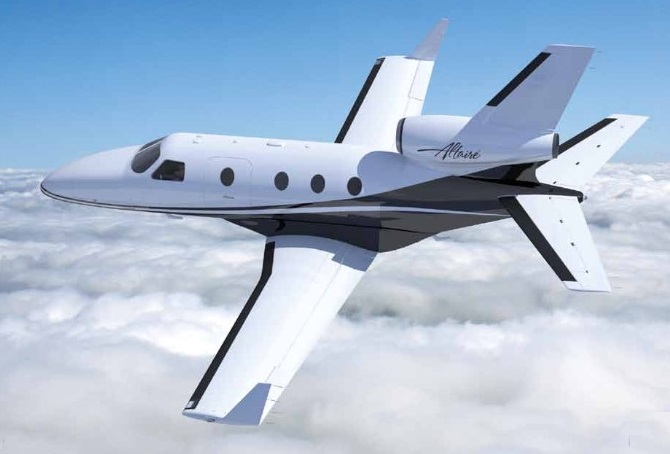
The PiperJet did not enter production and in October 2010 Piper announced it would instead develop an aircraft with a larger circular-section fuselage known as the Piper PiperJet Altaire. The 160 customers who had placed orders for the PiperJet retained their delivery positions with the new aircraft and at the same $2.2 million price.
Based on the PA-47 PiperJet prototype, the Altaire featured a slightly larger fuselage with a rounded cross-section, and included a conventional control yoke for flight control, as opposed to the original PiperJet’s side-stick controller. Piper had been tooling up its facilities in Vero Beach, Florida (USA) to build four Altaire prototypes to be used for FAA (safety & performance) certification of the aircraft through 2013. First delivery of aircraft to customers was scheduled for 2014. The first flight was expected in 2012.
The fuselage of the original Piperjet was designed using the Piper Meridian single-engine turboprop as a template. The new owners of Piper, Imprimis, found fault with this design prompting a revision without direct reference to the Meridian. According to Piper CEO Geoffrey Berger, “We wanted to give our jet customers an even roomier light jet that incorporates a scalable design, paving the way for a future family of competitive business jets,”. The new fuselage design provided an additional 4 inches of headroom and nine more inches of elbow room and does away with a hump in the cabin floor that accommodated the wing spar in the old design.
PiperJet Altaire
The Altaire had been designed for single-pilot operation allowing one passenger to occupy the co-pilot’s seat. Combined with 4 passenger seats in the cabin behind the flight deck, the jet would typically have seated 5 passengers. The cabin would have been specially configured to add an additional seat such that a total of 6 passengers can be accommodated in addition to the pilot. There was 20 cubic feet (570 L) of baggage space behind the passenger seats and another 20 cu ft (570 L). of heated but unpressurized space in the nose of the aircraft. The Altaire would have been powered by the Williams International FJ44-3AP. This model of engine employs a “passive vectored thrust” design that helps compensate for nose-down pitch of the aircraft when power is increased as a result of mounting the engine relatively high up in the tail. Piper estimated that this engine would get the Altaire up to a 35,000 feet (11,000 m) maximum cruise altitude and a 320 knot cruise speed. Maximum cruise speed was projected to be 360 knots. The aircraft was expected to have a 1,200-to-1,300-nautical-mile (2,200 to 2,400 km) non-stop range.
The aircraft was expected to retail for around US$2.6 million, ‘standard’ equipped. Piper estimates variable operating cost at about US$730 per hour. This compares with about US$870 for the comparable model Cessna Mustang.
On 17 October 2011 the company announced that the PiperJet Altaire program was “under review”. Piper’s new interim CEO, appointed that same day, Simon Caldecott said, “This is being undertaken to ensure the company is properly aligning business goals and light-jet market forecasts with investment strategies and economic forecasts.” The next day, on 18 October 2011, AVweb editor-in-chief Russ Niles called for the project to be ended, calling it “unrealistic” to pursue the design in the face of Federal Aviation Administration opposition to certifying a single engined jet to 35,000 ft (10,668 m) and the lack of economic reasoning as the aircraft would cost the same as most twin-engined jets. Niles called on Piper saying, “the sooner it ends its “review” of the project and puts a bullet in it the better.”
On 24 October 2011, despite the Altaire’s development being “on schedule and on budget”, the program was indefinitely suspended by Piper due to economic issues, with the company laying off a number of workers who had been assigned to the project. It was stated the company would entertain offers for the PiperJet/Altaire project.
In 2012, the prototype was located at the Florida Air Museum.
original PA-47 PiperJet Powerplant: 1 × Williams FJ44-3AP turbofan, 2,820 lbf (12.5 kN) thrust Hot Section Inspection: 2,000 hours TBO: 4,000 hours Length: 35 ft 8 in (10.87 m) Wingspan: 44 ft 3 in (13.49 m) Height: 15 ft 8 in (4.78 m) Full fuel payload: intended to be 800 lbs (363 kg) +/-5% Usable Fuel: 457 USgal (1,730 liters) Cruise speed: 360 kn (414 mph; 667 km/h) (intended maximum cruise speed +5% -2.5%) Range: 1,300 nmi (1,496 mi; 2,408 km) (intended maximum range +/-5%) Service ceiling: 35,000 ft (11,000 m) Maximum Cabin Height: 55.0 in (1.4 m) Cabin Length: 17.8 ft (5.4 m) Cabin Width: 55.0 in (1.4 m) Main Entry Door Width: 36.0 in (0.9 m) Total Pressurized Cabin Volume: 260 cu ft (7.3 cu m) Nose Baggage Compartment (unpressurized): 20 cu ft (0.57 cu m) / 200 lbs (90.9 kg) Maximum Cabin Differential: 7.6 psid Crew: 2 Capacity: 6-7 passengers