The 1913 Bleriot XLIV Artillaire monoplane was a canard pusher designed and built by Louis Bleriot in France.
The 1913 Bleriot XLIV Artillaire monoplane was a canard pusher designed and built by Louis Bleriot in France.
The 1913 Bleriot XLIII tandem armored monoplane was a canard pusher designed and built by Louis Bleriot in France.
Span: 33’2″
Length: 19’9″
Weight: 1378 lb gross,
Speed: 75 mph
The 1913 Bleriot XLII was a canard pusher designed and built by Louis Bleriot in France.
Span: 29’2″
Length: 24′

Launched in 2014, the TBM 900 brought 26 refinements aimed at improving both speed and efficiency. According to Daher, key enhancements included a redesigned engine cowling, a new five-blade composite propeller, and aerodynamic tweaks to the fuselage and winglets. These changes resulted in reduced drag and improved climb rates, allowing the TBM 900 to outperform its predecessor while consuming less fuel.
There were also subtle exterior changes introduced to reduce drag. These included a re-contoured tail cone and engine nacelle, and the addition of inner main landing gear doors. Additionally, cabin improvements made the aircraft quieter and more comfortable.

There are five versions of the TBM 900 series aircraft.
Introduced in 2017, the TBM 910 was designed to build upon the aerodynamic and structural improvements of the TBM 900 while focusing primarily on avionics advancements. The TBM 910 featured the Garmin G1000 NXi avionics suite, offering faster processing speeds, improved resolution, and enhanced connectivity options.

The aircraft’s performance remained largely similar to the TBM 900, but the new avionics provided pilots with a more intuitive and user-friendly experience. Features include improved touchscreen controls, ADS-B capabilities, and enhanced synthetic vision.

Introduced in 2019, the TBM 940 introduced an automatic throttle system, which helped pilots manage power settings more efficiently. This variant also featured autoland technology, as well as automatic deicing.
Additional refinements included improved cabin comforts, upgraded climate control, and enhanced noise reduction.
Introduced in 2022, the TBM 960 featured a digital e-throttle and Pratt & Whitney PT6E-66XT engine. The TBM 960 also includes an autoland system.

Additionally, this variant boasts a dual-channel full authority digital engine control (FADEC) feature – Daher calls this EPECS, which stands for Engine and Propeller Electronic Control System. The TBM 960 is the first aircraft in the TBM line to feature this. The TMB 960 also has an MTOW that is 221 lb (100 kg) greater, totaling 7,615 lb (3,454 kg).
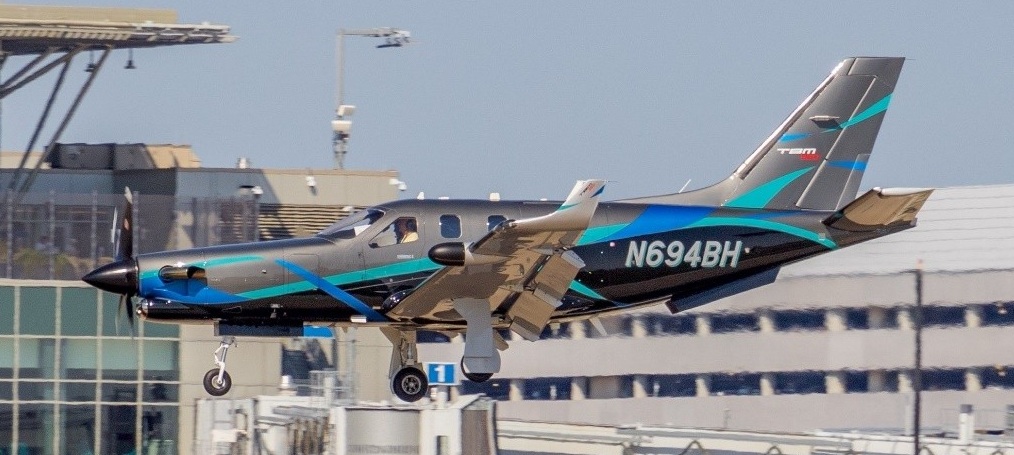
The TBM 960 replaced the 940, and was sold alongside the baseline TBM 910 model.
1,155 TBM series aircraft have been produced, as of July 2023. From its inception with the TBM 700 to the TBM 960.
TBM 900
Engine: Pratt & Whitney Canada PT6A-66D
Maximum cruise speed: 330 knots (380 mph, 611 km/h)
Range: 1,730 nautical miles (1,991 mi, 3,204 km)
Maximum takeoff weight (MTOW): 7,394 lbs (3,354 kg)
Service ceiling: 31,000 ft (9,449 m)
Fuel capacity: 292 US gal (1,105 L)
Seating capacity: 6
TBM 910
Engine: Pratt & Whitney Canada PT6A-66D
Maximum cruise speed: 330 knots (380 mph, 611 km/h)
Range: 1,730 nautical miles (1,991 mi, 3,204 km)
Maximum takeoff weight (MTOW): 7,430 lbs (3,370 kg)
Service ceiling: 31,000 ft (9,449 m)
Fuel capacity: 292 US gal (1,105 L)
Seating capacity: 6
TBM 940
Engine: Pratt & Whitney Canada PT6A-66D
Maximum cruise speed: 330 knots (380 mph, 611 km/h)
Range: 1,730 nautical miles (1,991 mi, 3,204 km)
Maximum takeoff weight (MTOW): 7,430 lbs (3,370 kg)
Service ceiling: 31,000 ft (9,449 m)
Fuel capacity: 292 US gal (1,105 L)
Seating capacity: 6
TBM 960
Engine: Pratt & Whitney Canada PT6E-66XT
Maximum cruise speed: 330 knots (380 mph, 611 km/h)
Range: 1,730 nautical miles (1,991 mi, 3,204 km)
Maximum takeoff weight (MTOW): 7,615 lbs (3,454 kg)
Service ceiling: 31,000 ft (9,449 m)
Fuel capacity: 292 US gal (1,105 L)
Seating capacity: 6
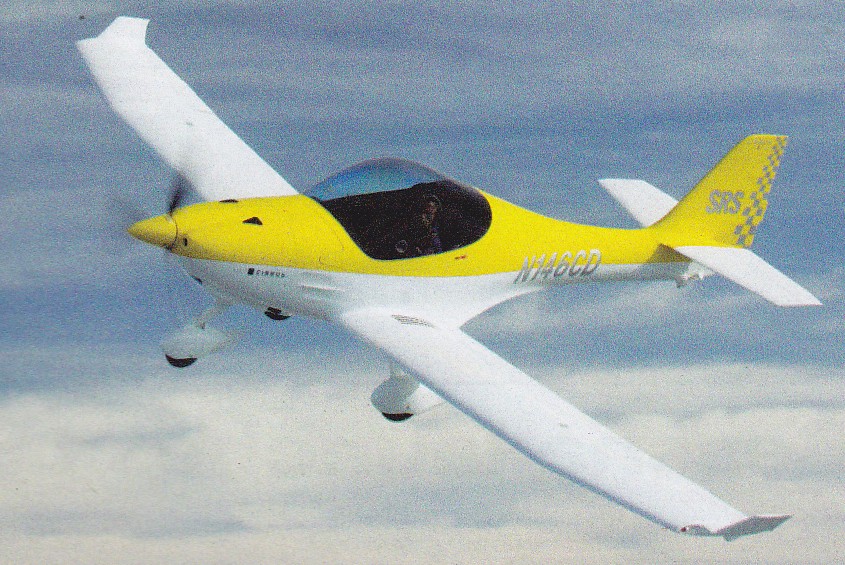
The Cirrus SRS (SR Sport) is the German B&F Fk 14 Polaris all-composites two-seat ultralight modified for US LSA regulations. First flowing in 1999, it was selected by Cirrus after a four-year evaluation of various designs. Powered by a 100 hp / 75 kW Rotax 912S, Cirrus will have to slow the aircraft down to meet the LSA’s 120 kt / 222 kph maximum cruise speed rules.
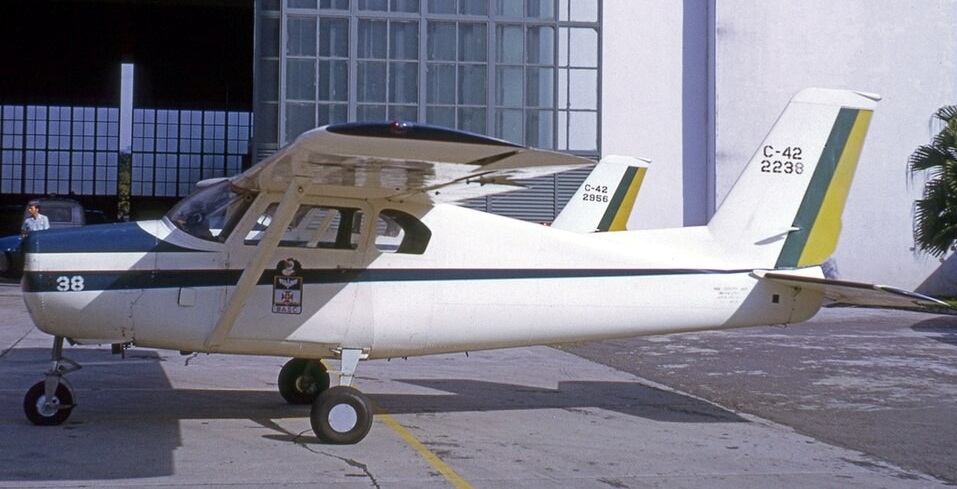
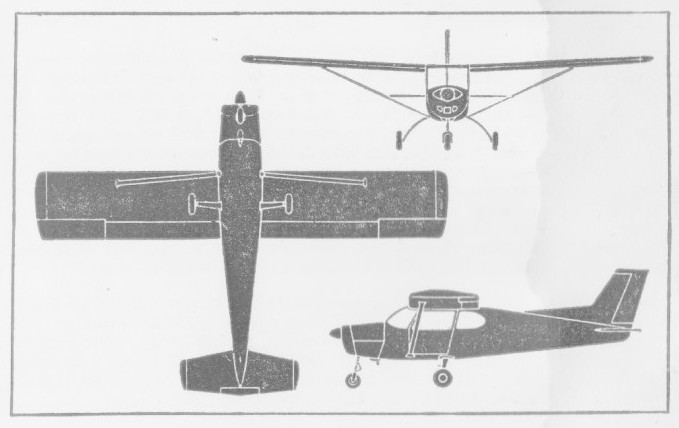
Neiva Regente is a Brazilian propeller-driven four-seat light utility aircraft manufactured by Indústria Aeronáutica Neiva.
The design was started in 1959 for a four-seat cabin monoplane aircraft with a high wing and fixed undercarriage. The prototype, designated the Neiva Regente 360C, was first flown on 7 September 1961 with a 145 hp (108 kW) Continental O-300 piston engine, and received its certificate of airworthiness on 19 November 1963.
The type was ordered into production by the Brazilian Air Force with a more powerful 180 hp (134 kW) Lycoming O-360-A1D engine. Eighty aircraft were built originally designated the U-42 (later changed to C-42) for the utility role. Twenty for the Brazilian Army’s Air Observation Squadron. First delivery occurred late in 1963. Neiva developed a three-seat air observation post version for the Air Force, designated the Regente 420L. Its tailcone was lowered in order to improve visibility, and it used a more powerful Continental IO-360D 210 hp engine. The aircraft was first flown in January 1967 as the YL-42. Forty were built for the Brazilian Air Force as the L-42. It had provision to carry light bombs or rockets on underwing hardpoints.
Two commercial versions were to be manufactured by Neiva, one being powered by a 180 hp Lycoming O-360-A1A and the other by a 145 hp Continental O-300-A.
Neiva also developed a four-seat civil version designated the Lanceiro. The prototype (Registered PP-ZAH) first flew in 1970, followed by production aircraft in 1973. The company’s subsequent involvement with Embraer resulted in the Lanceiro’s program termination.
Variants
Regente 360C – utility version (80 built)
U-42 – military designation of the Regente 360C
C-42 – military designation changed from U-42
Regente 420L – air observation post version (40 built)
L-42 – military designation of the Regente 420L. Originally designated L-8 and L-20.
Lanciero – civil version (2 built)
C-42
Powerplant: 1 × Lycoming O-360-A1D air-cooled flat-four engine, 130 kW (180 hp)
Propeller: 2-bladed Hartzell HC-C2YK-1A/A7666 constant-speed propeller
Length: 7.04 m (23 ft 1 in)
Wingspan: 9.13 m (29 ft 11 in)
Height: 2.93 m (9 ft 7 in)
Wing area: 13.45 sq.m (144.8 sq ft)
Aspect ratio: 6:1
Airfoil: NACA 4410
Empty weight: 640 kg (1,411 lb)
Max takeoff weight: 1,040 kg (2,293 lb)
Fuel capacity: 172 L (45 US gal; 38 imp gal)
Maximum speed: 220 km/h (140 mph, 120 kn) at sea level
Cruise speed: 212 km/h (132 mph, 114 kn) (max cruise)
Stall speed: 90 km/h (56 mph, 49 kn) (flaps down)
Range: 928 km (577 mi, 501 nmi) at 1,500 m (4,900 ft) (econ. cruise)
Service ceiling: 3,600 m (11,800 ft)
Rate of climb: 3.5 m/s (690 ft/min)
Takeoff run to 15 m (50 ft): 350 m (1,150 ft)
Landing run from 15 m (50 ft): 460 m (1,510 ft)
Crew: 1
Capacity: 3 passengers
Engine: 145 hp Continental O-300-A
Length: 7.04 m (23 ft 1 in)
Wingspan: 9.13 m (29 ft 11 in)
Height: 2.93 m (9 ft 7 in)
Wing area: 13.45 sq.m (144.8 sq ft)
Empty weight: 1190 lb
Max speed: 152 mph
Cruise 75%: 141 mph at 6560 ft
ROC: 866 fpm
Service ceiling: 15,420 ft
Range: 755 mi
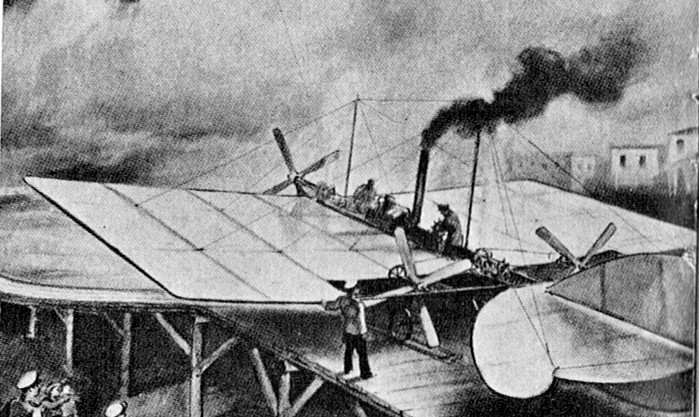
In 1994 A.F. Mozhaiski built a tractor / pusher monoplane near St. Petersburg, Russia.
Powered by an English steam engine and manned by Golubev, it took off down a ski-jump ramp, but could not sustain itself. It was the second machine to leave the ground.
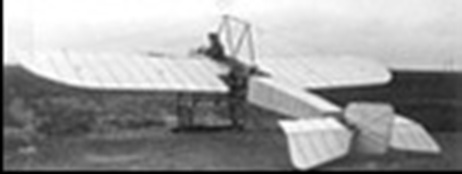
The 1913 Bleriot XLV monoplane was designed and built by Louis Bleriot in France
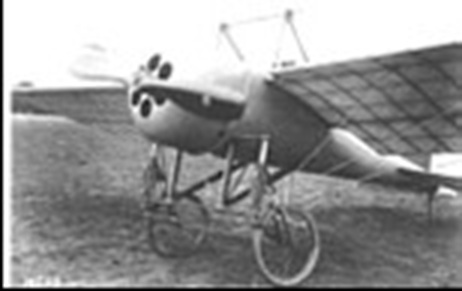
The 1913 Bleriot XXXIX armoured monoplane single seater was designed and built by Louis Bleriot in France.
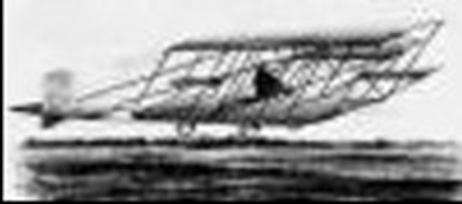
The 1907 Agusta biplane was designed and built by Giovanni Agusta in Italy.
 All Aero