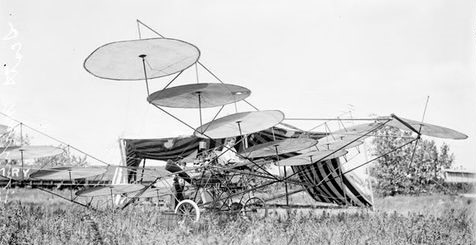
James F Scott’s 1910 smaller craft looked like a helicopter, but wasn’t. It consisted of an open structure bearing two V-frames on which 16 discs were mounted in fore and aft V-frames. The 8′ diameter disks were built of radially ribbed fabric, like umbrellas. There was no drive-shafting or other driving mechanisms for the disks, but a 40hp water-cooled engine drove a pusher propeller. Apparently, the disks were supposed to produce some form of lift. It is not known if the contraption was ever flown.
Construction of the aircraft was started by Ron Scott in the mid 1960s starting with a model rather than a drawing.
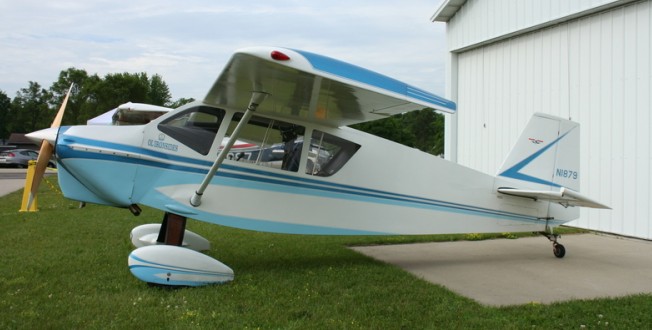
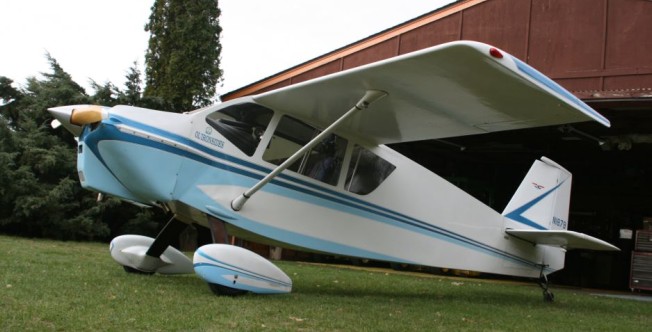
The Scott Ol’ Ironsides is an early homebuilt aircraft using wood construction with stressed fiberglass panel construction. Ol’ Ironsides is a strut-braced high-wing aircraft with conventional landing gear arrangement. The wooden fuselage is made of Sitka Spruce. Fiberglass composite skins were formed in 4 x 8 sheets using two layers of cloth with resin over a waxed Masonite table. The landing gear legs, fuel tank, wink tips, wheel pants, and cowling were also formed out of fibre-glass. Scott integrated elements of the Bowers Fly Baby and Champion J-1 Jupiter construction with the Wittman Tailwind airfoil and general layout into the design. The craft cost US$1530 in 1969.
Ol’ Ironsides first flew on 22 November 1969 with a Continental C-85 engine sourced from a Cessna 140. In 1985 the prototype aircraft was restored and re-engined with a Continental O-200 and Sterba wooden propeller.
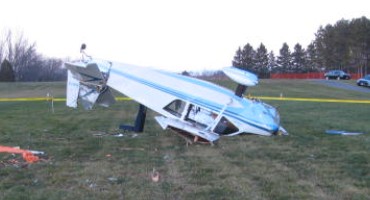
A 79-year-old pilot suffered head injuries after crashing his single-engine airplane at an airstrip in East Troy on Saturday, November 24th 2012. The crash happened just before 3:30 p.m. It occurred on a privately-maintained grass airstrip known as Air Troy Estates. Many residents who reside nearby have planes and hangars adjacent to the runway. The pilot, identified as Ronald Scott, was attempting to land his plane on the runway when he crashed. He had to be removed from the plane — which ended upside down. He was taken to a Waukesha Hospital to be treated for his injuries. Scott was flying an experimental 1969 Scottbuilt (he designed and built this plane) fixed wing XS-1 known as “Old Iron Sides”. The Walworth County Sheriff’s Office and the FAA were coordinating this investigation.
Ol’ Ironsides Construction Number (C/N): 1 Registration Number: N1879 Engine: 1 × Continental C-85, 85 hp (63 kW) Engine: 1 × Continental O-200, 100 hp (75 kW) Wingspan: 19 ft 6 in (5.94 m) Wing area: 79.2 sq ft (7.36 m2) Length: 17 ft (5.2 m) Empty weight: 720 lb (327 kg) Gross weight: 1,125 lb (510 kg) Fuel capacity: 18 USgal Cruise speed: 117 kn; 217 km/h (135 mph) , 145 mph (233 km/h) with O-200 Stall speed: 48 kn; 89 km/h (55 mph) Rate of climb: 1,200 ft/min (6.1 m/s) Seats: 1
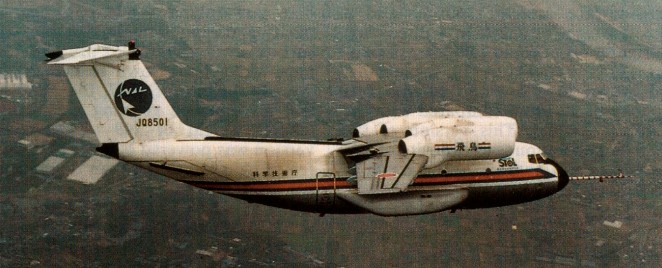
The Asuka, which first flew in October 1985, is a derivative of the Kawasaki C-1 tactical transport. The original P&W JT8D engines have been replaced by four Ishikawajima-Harima Heavy Industries FJR710/600S high bypass ratio turbofans.
The engines are mounted above and ahead of the wing leading edges. The exhaust airflow is directed across the wing extrados and attaches to the trailing edge flaps in whathas been termed “Upper Surface Blowing”. The resulting depression caused by the Coanda effect produces the desired lift force.
The STOL conversion takeoff run to 15m on the first flight was 509m, including a 394m ground run. Takeoff speed was 72 kts. The landing run from 15 m was 439 m, including 320 m on the ground.
STA claims the plane is only experimental and that there are no immediate development prospects.
Der Fledermaus is a one-of-a-kind homebuilt designed and built by E. Alvin Schubert with specific parameters: ease of entry good visibility stability in flight, economy of building and operation, single-place only able to use a VW engine. He picked up a used 25-hp VW in 1960 and rebuilt it to deliver 36-hp with 88-mm cylinders and heads. All goals were achieved. Built circa 1975, it was registered N7873.
Gross weight 745 lbs Empty weight 441 lb Fuel capacity 7 Usgal Wingspan 21 ft Length 16 ft Engine 25-hp VW uprated to 36 hp with 88mm cylinders Vmax 120 mph Cruise speed 90 mph IAS Climb rate 600-800 fpm Ceiling 10,000 ft Takeoff run 600 ft Landing roll 800 ft
Single seat single engined high wing mono¬plane with conventional three axis control. Wing has unswept leading and trailing edges, and constant chord; cruciform tail. Pitch control by elevator on tail; yaw control by fully flying rudder; roll control by ailerons; control inputs through stick for pitch/roll and pedals for yaw. Wing braced from above by kingpost and cables, from below by cables; wing profile double surface. Undercarriage has three wheels in tricycle formation with tailskid; suspension on all wheels. Push right go left nosewheel steering connected to yaw control. Brakes on main wheels. Aluminium¬-tube/steel tube framework, without pod. En¬gine mounted below wing driving pusher propeller.
Publicly shown for the first time at Aero 83 exhibition at Friedrichshafen, the Air Swing first flew in April 1983. Two prototypes were built, powered by a Lloyd 22 hp engine.
The Air Swing uses a double triangular frame whose front tube is extended above the wing where it is supported with a second strut, the two acting as a kingpost and forming an inverse V above the wing. The aircraft has an additional peculiarity in that it uses the large diameter boom which carries the empennage as the axis of rotation for its three bladed propeller.
Engine: Lloyd LS400, 22 hp at 5500 rpm Propeller diameter 50 inch, 1.28 m Toothed belt reduction, ratio 2.0/1 Max static thrust 177 lb, 80kg Power per unit area 0.17hp/sq.ft, 1.8 hp/sq.m Length overall 18.0 ft, 5.50 m Height overall 7.2ft, 2.20m Wing span 33.5ft, 10.20m Constant chord 3.9 ft, 1.20 m Sweepback 0 deg Tailplane span 9.0ft, 2.75 m Total wing area 132 sq.ft, 12.2 sq.m Wing aspect ratio 8.5/1 Wheel track 5.2 ft, 1.60 m Fuel capacity 5.3 US gal, 4.4 Imp gal, 20.0 litre Empty weight 221 lb, 100 kg Max take off weight 508 lb, 230kg Payload 287 lb, 130kg Max wing loading 3.85 lb/sq.ft, 18.8 kg/sq.m Max power loading 23.1 lb/hp, 10.5kg/hp Load factors; +6.0, 3.0 ultimate Never exceed speed 71mph, 115kph Economic cruising speed 50mph, 80kph Stalling speed 29mph, 47 kph Max climb rate at sea level 240 ft/min, 1.2 m/s
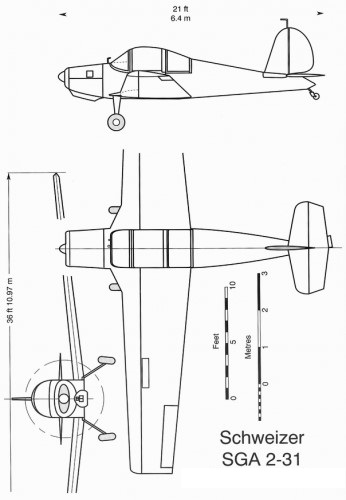
Schweizer developed a line of gliders starting in World War II. The 2-31 was not intended to be a motor glider, but rather a light aircraft utilizing some glider and sailplane technologies, common parts with other Schweizer designs and an affordable price as a result of using smaller powerplants.
A two-seat version of the 1-30, the Schweizer SA 2-31 first flew in July 1960 but not put into production due to competition in the light aircraft market. No further motorgliders were built by the company until 1982.
Schweizer SA 2-31 Wingspan: 36 ft (11 m) Length: 21 ft (6.4 m) Crew: one Capacity: one passenger
In the mid-1990s the Coast Guard decided that the RG-8 aircraft would be more useful if their capabilities were improved to include night operations by the addition of more mission sensor equipment. Discussions with Schweizer Aircraft resulted in a plan to upgrade two RG-8As and build one new aircraft to provide a total of three.
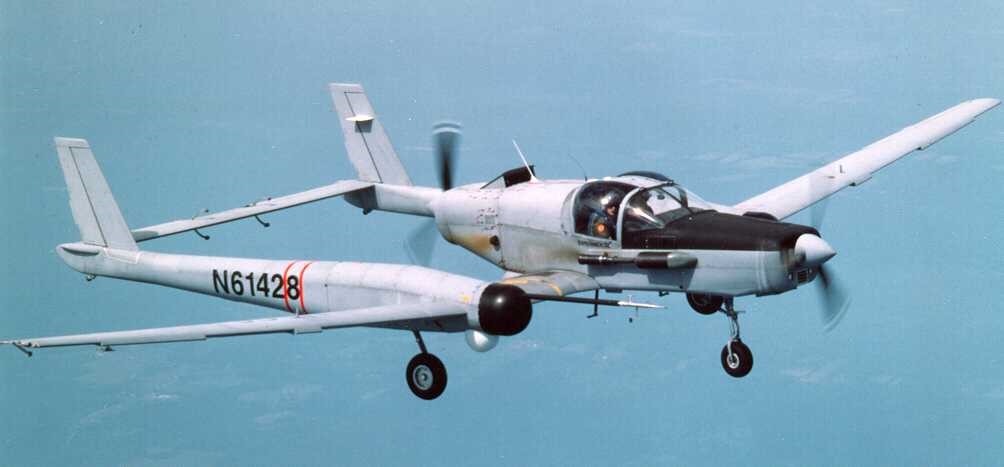
The RU-38 was intended to fulfill both the low altitude, quiet, over water/hostile terrain reconnaissance role and also the high altitude standoff surveillance role. Based on the Schweizer SGM 2-37 motor glider, a total of five RU-38s were produced between 1995 and 2005.
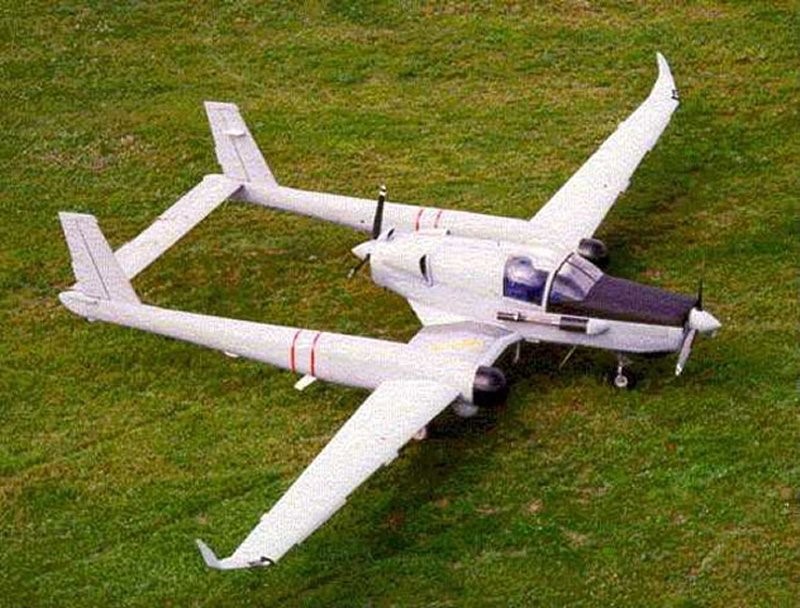
In converting to the new RU-38A configuration, the conventional RG-8A airframe was greatly modified by: Removing the single 235 hp (175 kW) Lycoming O-540-B powerplant Installing two Teledyne Continental Motors GIO-550A engines with a 3:2 gear reduction to 2267 operating rpm. The engines are mounted one in the nose and the other in the rear of the fuselage. Enlarging the crew compartment Improving the engine mufflers Increasing the wingspan from 56.5 ft (17.22m) to 84.13 ft (25.65 m) Changing the single tail fin to a twin-boom configuration with two fins Greatly enlarged sensor bays Improved noise signature reduction Tricycle landing gear replacing the conventional landing gear
The resulting aircraft bears little resemblance to the original TG-8. Installation of the twin-boom pods permits the carriage of more sensors. The left-hand pod houses an AN/APN-215(V) color multi-function X-band sea search radar with mapping capabilities. The right-hand pod houses the AN/AAQ-15 forward looking infrared (FLIR) and Low-Light TV enhanced vision systems.
Schweizer RU-38A
For navigation the RU-38A originally carried both OMEGA and GPS receivers, although the Omega has since been removed with that system’s withdrawal from service in 1997. The aircraft also has HF, VHF and UHF radios for voice and encrypted voice communications, plus direction finding. The crew may also use night vision goggles.
The aircraft has no flaps and instead retains the top and bottom surface divebrakes of its sailplane ancestors.
The RU-38A is designed to transit to its operational area with both engines operating. Once in the surveillance area the rear engine would normally be shut down and the aircraft operated in “quiet surveillance mode”. The second engine would be available for use in an emergency and for return to base at faster speed.
The first Coast Guard RG-8A was returned to Schweizer for conversion to RU-38A status on 24 January 1994. The initial plan called for the conversion of two RG-8As and then fabrication of one new RU-38A.
The first flight of the converted aircraft took place on 31 May 1995. The second USCG RG-8A aircraft that was earmarked for RU-38A upgrade crashed near Puerto Rico in 1996. As a result, the program was reduced to provide only two RU-38As to the USCG. The loss of the RG-8A delayed the program for many months and it was not completed until May 1997.
The first RU-38 was tested by the Air Force 445th Flight Test Squadron at Edwards AFB on behalf of the Coast Guard, starting in July 1998. The airplane flew some 100 test flights during the four-month program.
By September 1999 the two converted RU-38As had been delivered to the Coast Guard in Miami, Florida for operational employment. The RU-38As were flown in drug interdiction missions over the Gulf of Mexico and the Caribbean Sea, but they were reportedly grounded during 2000, due to problems with the aircraft meeting mission requirements or serviceability.
The company further improved the aircraft by replacing the two piston engines with two Rolls Royce Allison 250-B17F turboprop engines which allowed raising the gross weight to 7200 lbs (3265 kg). The new aircraft carries the military designation of RU-38B.
The RU-38B has 140 cubic feet (4.0 cu m) of payload space with a payload weight of 800 lbs (363 kg) available. The payload bays all have large access doors and are located both in the tailbooms and also behind the pilot and co-pilot seats in the fuselage. The latter space can also accommodate a third crew member, if required. Using pallet-mounted sensor packages the aircraft can be quickly changed from one mission to another.
The RU-38B is able to achieve quiet operation while loitering by using a propeller speed as low as 1000 rpm. This is possible because the sailplane-derived wing is efficient and flight at low airspeed can be sustained with low power. Exhaust from the front engine is routed overwing, reducing the noise footprint.
Two RU-38Bs were delivered to the US Department of Justice, one in 2004 and one in 2005.
The aircraft remains in production by Sikorsky Aircraft after acquiring Schweizer and was still being actively marketed by Schweizer in 2011. Neither the RU-38A or B was certified by the Federal Aviation Administration. Instead all aircraft operate as experimental aircraft in the Research and Development category.
RU-38 is the US military designation for the aircraft, indicating Utility, Reconnaissance. The Schweizer company model number is Schweizer SA 2-38A Condor and, in its three-seat configuration, Schweizer SA 3-38A Condor
RU-38A Maximum take-off weight: 5300 lb (2404 kg) Number built: 2
RU-38B Engines: 2 × Rolls Royce Allison 250-B17F Props: Constant Speed, Full Feather Wingspan: 84.13 ft (25.64 m) Wing area: 334.2 ft2 (31.05 m2) Airfoil: Wortmann Fx 61-163 Length: 35.1 ft (10.7 m) Empty weight: 4265 lb (1934 kg) Useful load: 2935 lb (1331 kg) Loaded weight: 7200 lb (3265 kg) Max. takeoff weight: 7200 lb (3265 kg) Maximum speed: 168 knots (312 km/h) Cruise speed: 83 knots (mission speed) (155 km/h) Stall speed: 62 knots with divebrakes closed (116 km/h) Never exceed speed: 168 knots (312 km/h) Service ceiling: 30,000 ft (9144 m) Wing loading: 21.5 lb/ft2 (105.1 kg/m2) Crew: two in side-by-side or three, with two pilots side-by-side and one sensor operator in the rear Number built: 3
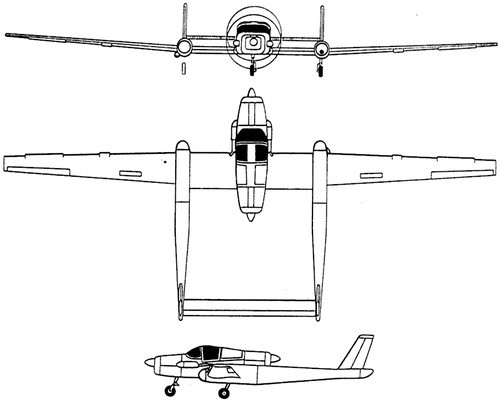
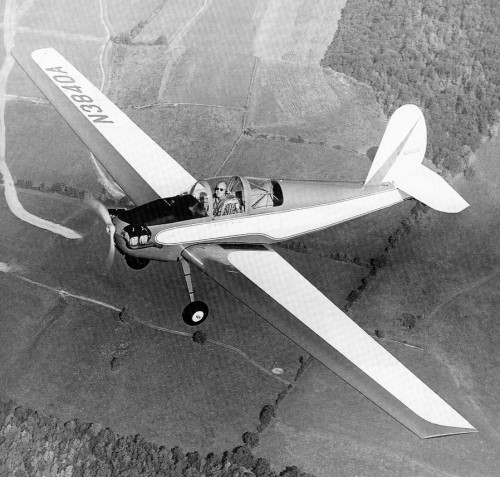
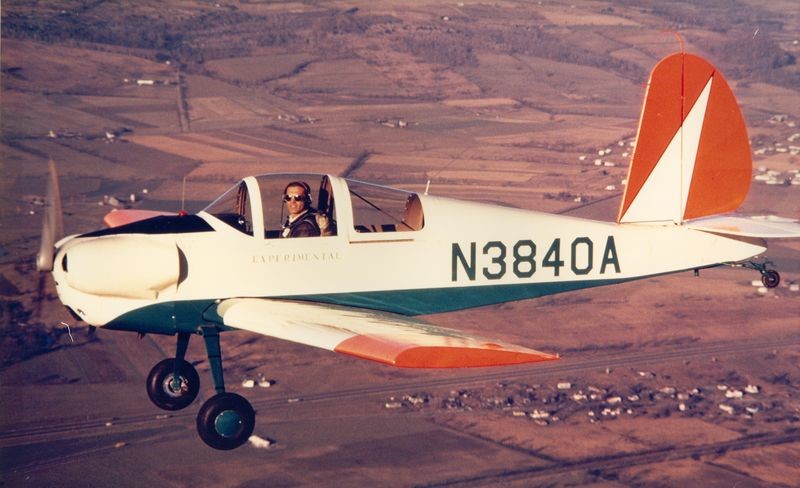
The Schweizer SA 1-30 was the first entry by Schweizer in the powered aircraft market. The 1-30 was not intended to be a motor glider, but rather a light aircraft utilizing some glider and sailplane technologies, common parts with other Schweizer designs and an affordable price as a result of using smaller powerplants. Removable wings, and the ability to be transported by trailer were also criteria for keeping airport-based hangar costs down.
The 1-30 shares the same wings and tail surfaces as the 1-26 glider. The fuselage is of aluminum construction with a welded steel tube tail structure. The wings are removable using the same design as the 1-26. The engine uses a cowling with exposed cylinders like a J-3 Cub for simplicity and cooling efficiency. Wing mounted spoilers were retained from the 1-26, allowing steep low-speed descents at about a 5:1 glide ratio. Three sets of wings were tested including a set (the third) from the model 2-31. An early configuration with the full length SGS 1-26B wings, fuselage and tails, cub cowl and Cessna 170 landing gear legs.
Construction of the prototype was started in April 1958 and first flew in July. The aircraft was tested as a glider aero-towing aircraft using a Schweizer SGU 2-22C. The single-place 1-30 was not intended to go into production, the two-place 2-31 was envisioned as the production model, but was also not produced beyond a single prototype.
The SA 1-30 was modified with a 4 ft (122 cm) shorter wing by simply clipping the length of the wing and aileron at the tips and a fully cowled more powerful engine, re-designated SAU 1-30.
The aircraft was painted twice; once a light tan & red with the second being the tan, green and “day-glow” orange.
Schweizer SA 1-30 Engine: 1 × Continental A65, 65 hp (48 kW) Wingspan: 40 ft (12 m) Wing area: 160 sq ft (15 sq,m) Aspect ratio: 10 Length: 20 ft 3 in (6.17 m) Empty weight: 700 lb (318 kg) Gross weight: 1,100 lb (499 kg) Maximum speed: 96 kn (110 mph, 180 km/h) Cruise speed: 87 kn (100 mph, 160 km/h) Stall speed: 33 kn (38 mph, 61 km/h) Rate of climb: 1,000 ft/min (5.1 m/s) Capacity: 1
The X-26A was an Schweizer SGS 2-32 sailplane that was used by the Navy to expose novice pilots to the phenomenon of yaw/roll coupling. Conventional jet trainers reacted much too quickly and dangerously for effective instruction – an aircraft that had unusually slow roll rates and excellent recovery characteristics was needed instead. Four of the gliders were originally delivered, but accidents soon claimed three of them. In each case the aircraft was replaced with a new one, and the training program continued, making the X-26 the longest-lived X-vehicle.
The Lockheed X-26B was created in response to a requirement for a stealth-type observation aircraft in Vietnam. Two of the Navy X-26A aircraft were temporarily modified with small engines and slow-speed propellers, and were eventually equipped with a variety of intelligence-gathering sensors. Testing in Vietnam was evidently successful as 14 further aircraft were acquired under various designations, including 11 Lockheed YO-3As.
The original X-26As were demodified and returned to the Navy after the construction of the YO-3As. One X-26B and a YO-3A are preserved in the Army Aviation Museum at Fort Rucker, Alabama.
The Schweizer turbine 330 is powered by an Allison 225 C10A engine. The new 350 shp Allison engine has been derated to 200 shp in the 330, which the company claims will provide a full 200 shp under standard day conditions up to 18,000 feet or to 16,000 feet on a 95oF day.
The piston powered 300 and the turbine powered 330 have virtually identical dynamic components main and tail rotor blades, transmissions and drive shafts with the exception of the powerplants.
In training configuration the 330 features three abreast seating, with the middle seat raised and slightly aft to give the instructor an overview. Another variant, for the civil utility market, has four seats in two by two configuration.
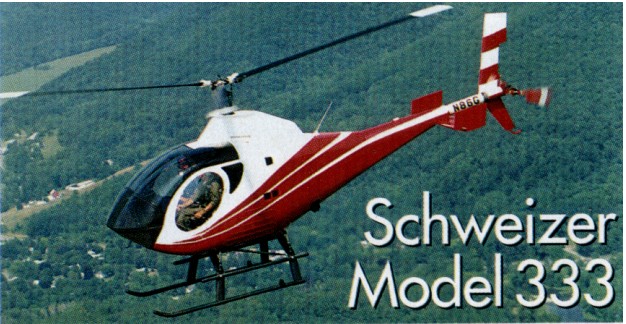
In September 2000 Schweizer Aircraft received type certification for the 333. This upgraded version of the 330SP features a new rotor system composed of cambered airfoil blades combined with an increase in maximum and continuous takeoff power. This gives 290 lbs more useful load and a cruise 20 kts higher than the 330SP. The 330SP may be upgraded to the 333.
Schweizer 330 Sky Knight Engine: Allison 250-C10A, 148 shp Length: 30.84 ft / 9.4 m Height: 8.53 ft / 2.6 m Rotor diameter: 26.903 ft / 8.2 m Max take off weight: 2050.7 lb / 930.0 kg Weight empty: 1049.6 lb / 476.0 kg Max. speed: 100 kt / 185 km/h Cruising speed: 91 kt / 169 km/h Initial climb rate: 1574.8 ft/min / 8.0 m/s Service ceiling: 20997 ft / 6400 m Range: 241 nm / 446 km Fuel capacity: 60 gal / 227 lt Crew: 1 Payload: 2-3 pax
330 / TH-330 Engine: 1 x Allison 250-C20W Instant pwr: 175 kW Rotor dia: 8.17 m / 27’6″ MTOW: 1000 kg Useful load: 475 kg Max speed: 230 mph Max cruise: 108 kts Max range: 495 km Ceiling: 11,200′ HIGE: 13,900 ft HOGE: 11,200 ft Crew: 1 Pax: 3 Seats: 3-4