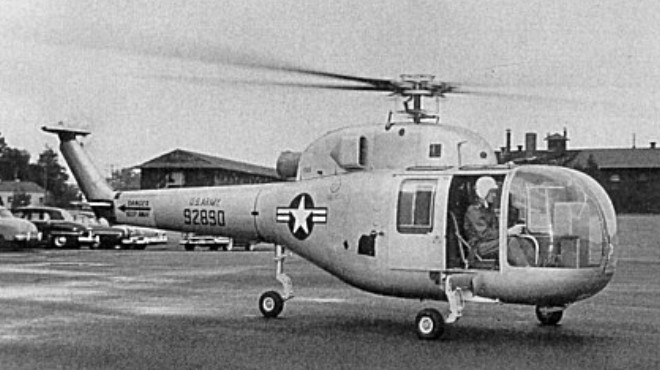
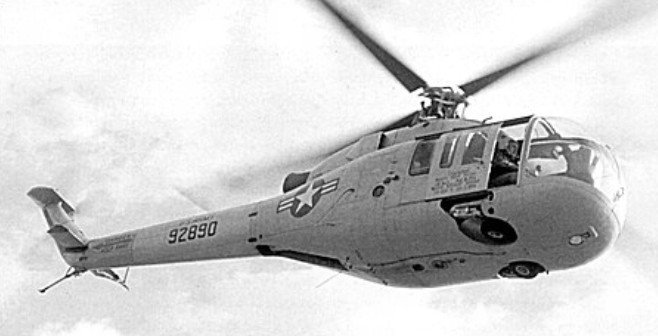
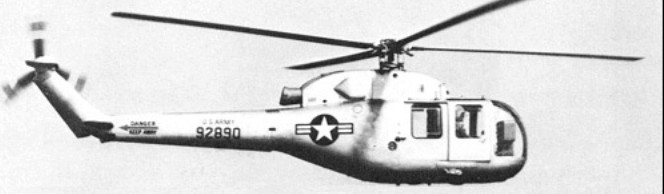
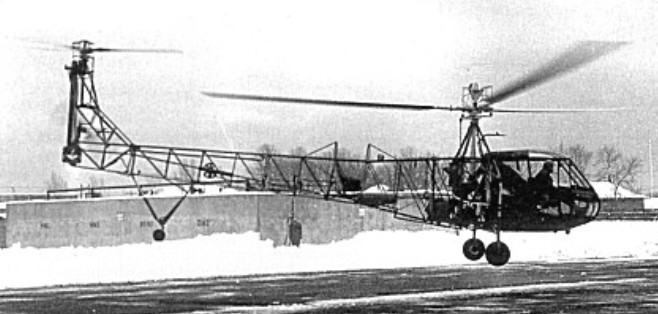
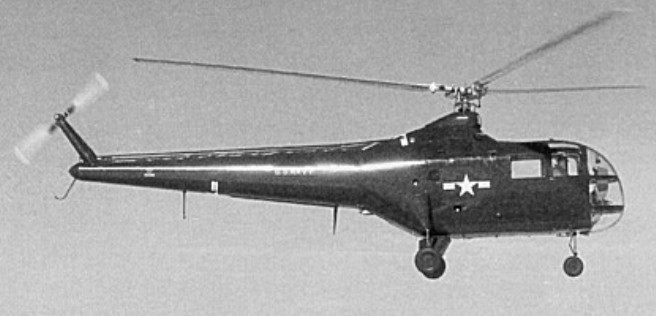
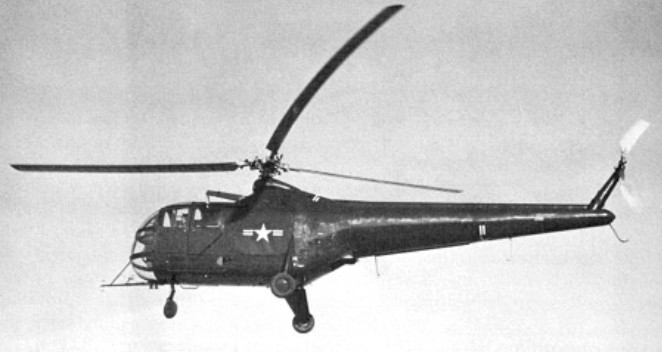
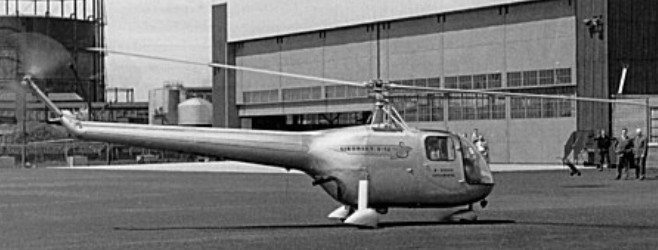
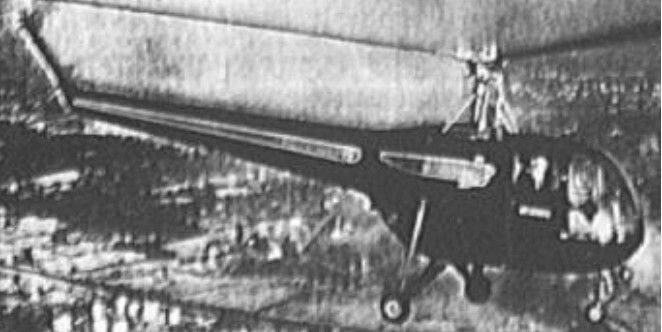
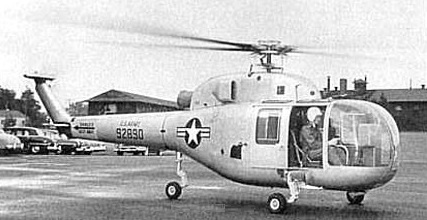
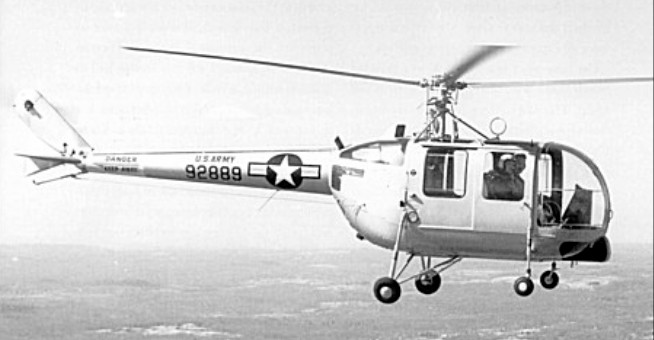
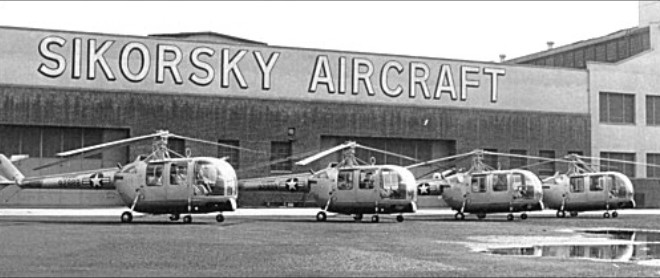
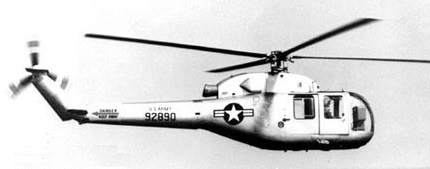
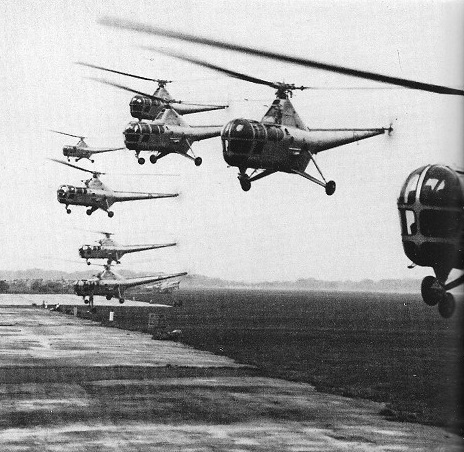
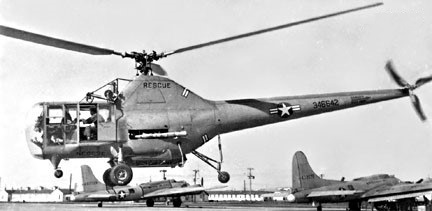
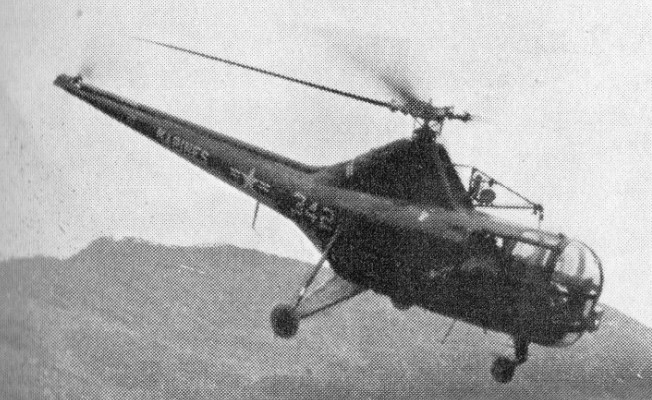
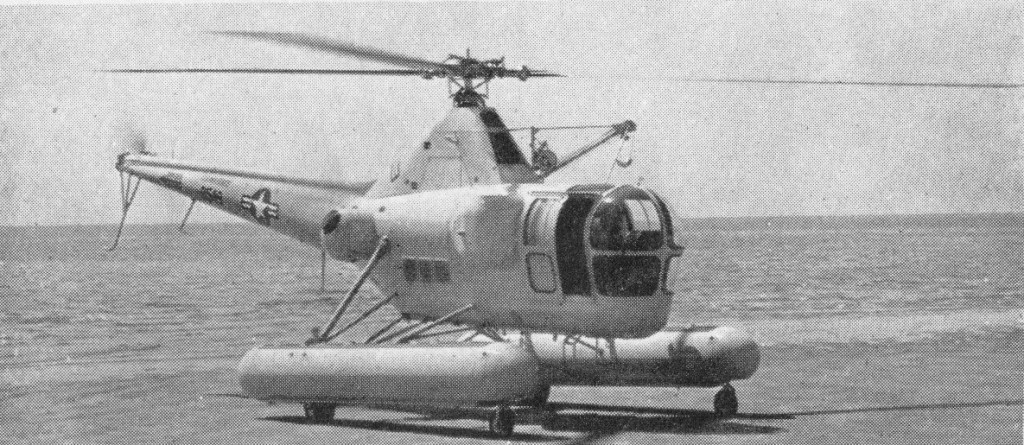
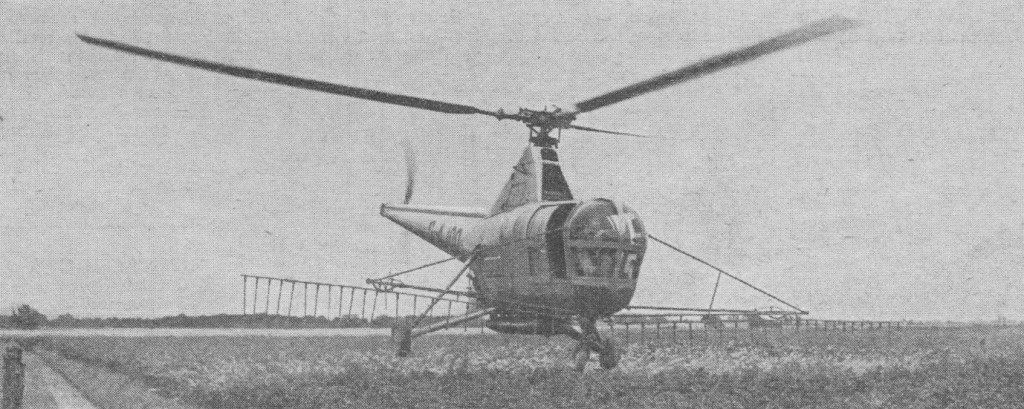
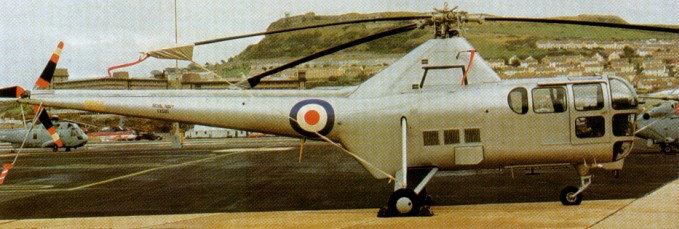
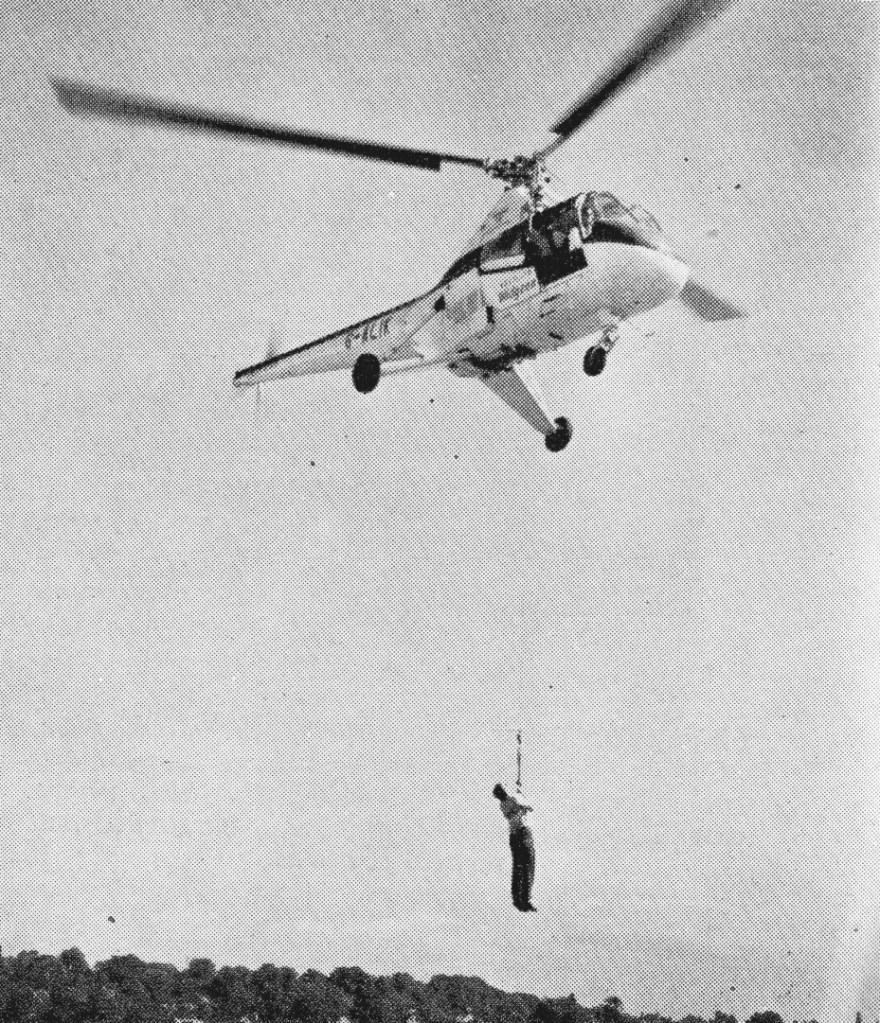
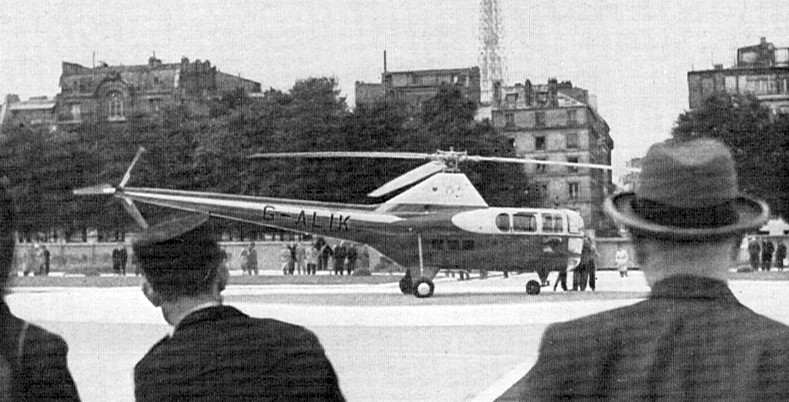
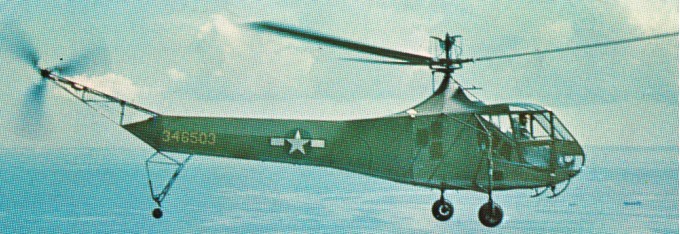
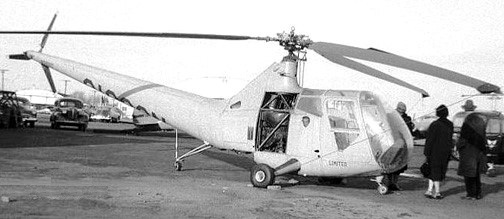
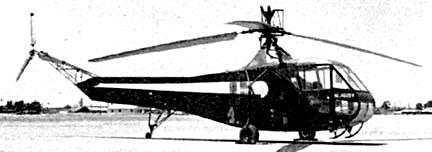
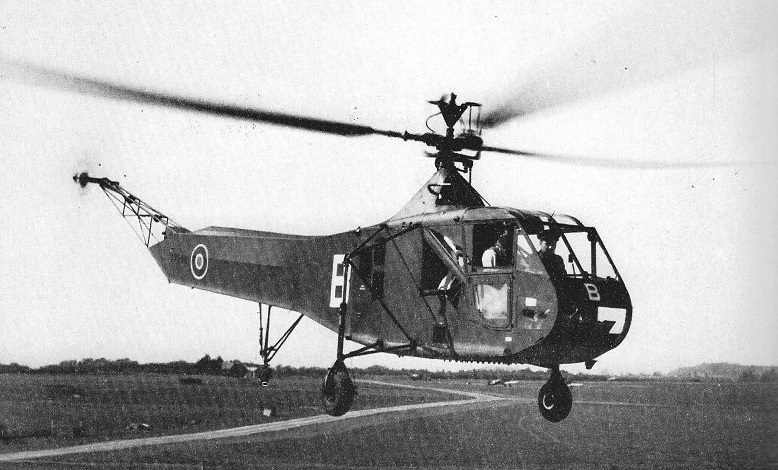
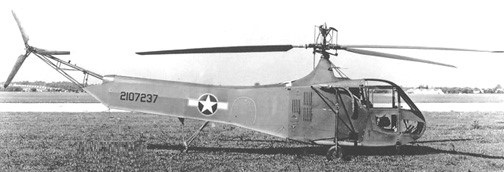
In late 1953 the Army awarded Sikorsky a contract for the experimental conversion of two existing H-18 helicopters from piston to turbine power. The two aircraft selected for conversion were 49-2890 and -2891, the third and fourth H-18s built, with the former to be used for flight testing and the latter for static engineering evaluation. Sikorsky allotted the two craft the company designation S-59, and began the conversion work in early 1954.
On Jul 24, 1953 the S-52T (YH-18B) turbine powered version of the S-52 was first flown. It used a French Turbomeca Artouste I engine. A developed version designated YH-18B and powered by a T51-T-3 (Artouste) turbine is now re-designated XH-39.
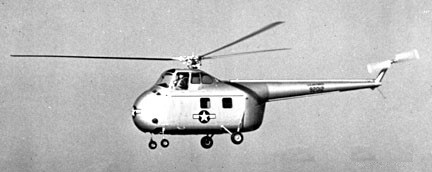
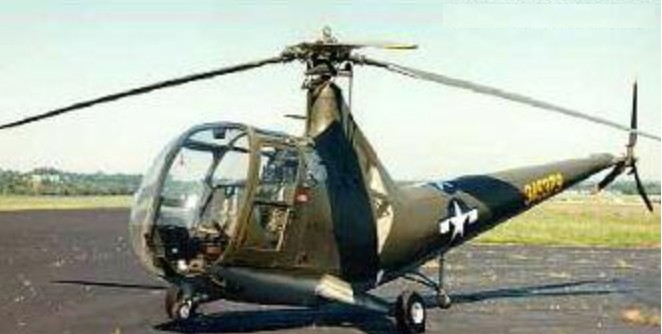
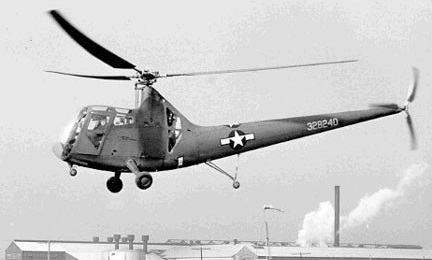
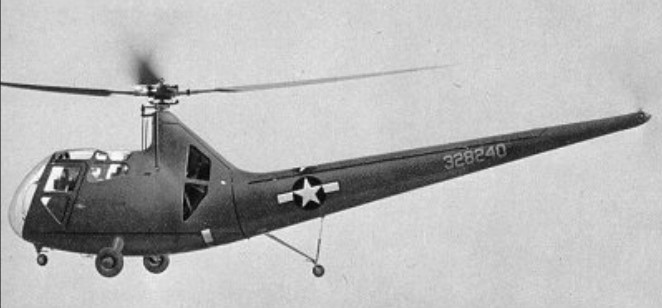
Sikorsky H-39 49-2890
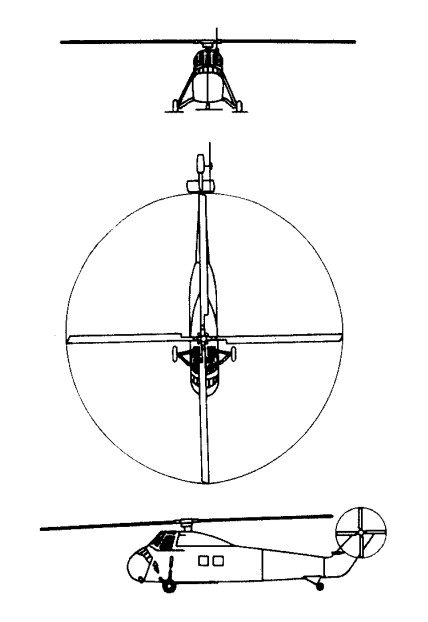
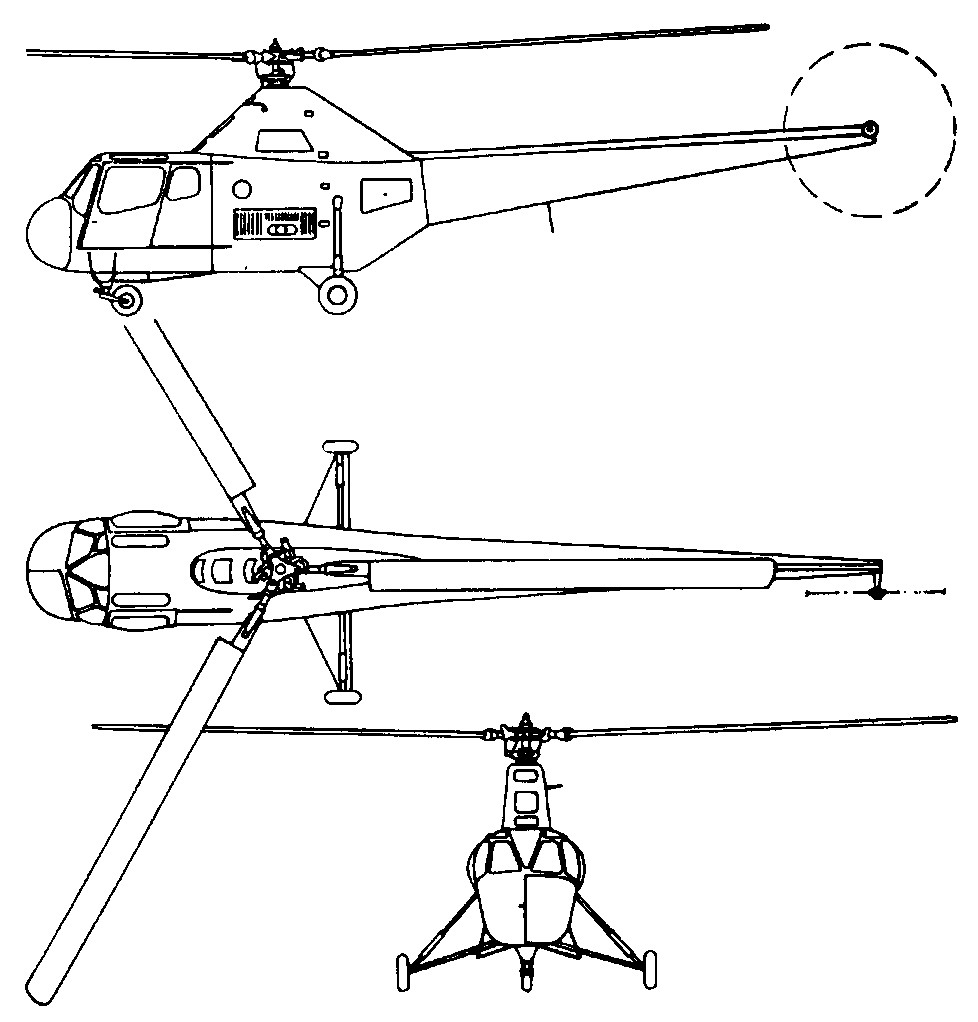
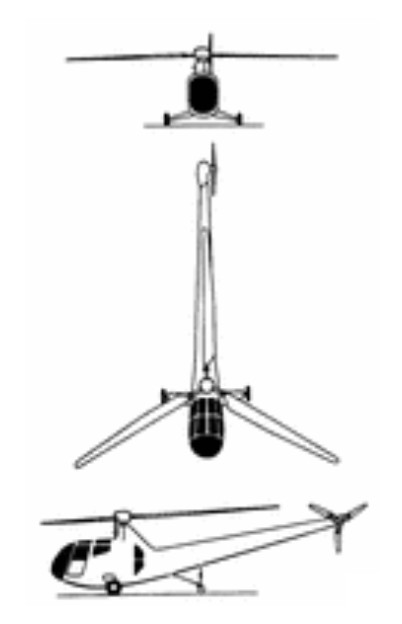
The H-39 retained the H-18’s basic pod-and-boom layout, but differed from the earlier machine in several ways. The H-39 was powered by a single 400shp XT51-T-3 Artouste II turbine engine, which drove a new, fully-articulated, four-bladed main rotor. Other changes included a modified tail rotor, strengthening of the fuselage, incorporation of retractable wheeled landing gear, and the addition of updated electronics.
The Model XH-39 (S-59), using a 400shp Continental XT51 turbine, was rejected by the US Army, despite its speed and the advantage of retractable landing gear, as being old-fashioned in design and unsuitable for further development. Instead, the Army chose the Bell XH-40 with a Lycoming XT53 turbine.
The H-39 was the Army’s first turbine-powered helicopter, and was for a time the world’s fastest rotorcraft.
On 29 August 1954 Army Warrant Officer Billy Wester flew a world speed record of 156 m.p.h / 251km/h over 3km was set up by Sikorsky XH-39.
On 17 October 1954 Army Warrant Officer Billy Wester flew a world height record of 24,500 ft / 7474m was set up by Sikorsky XH-39.
Sikorsky S-59 Engine: 1 x Continental/Turbomeca Artouste XT51-T-3 turboshaft, 300kW / 400 hp Rotors: 4-blade main 3-blade tail Main rotor diameter: 10.0m / 35 ft Fuselage length: 11.95m / 30 ft 3 in Height: 2.99m Max take-off weight: 1226kg / 3,560 lb Empty weight: 749kg Max speed: 176km/h / 156 mph Ceiling: 24,500 ft Hovering ceiling, IGE: 2804m Service ceiling: 4724m Range: 670km Typical range: 253 miles at 138 mph Seats: Pilot and 3 passengers, 800 lb. cargo or 2 stretchers and attendant.
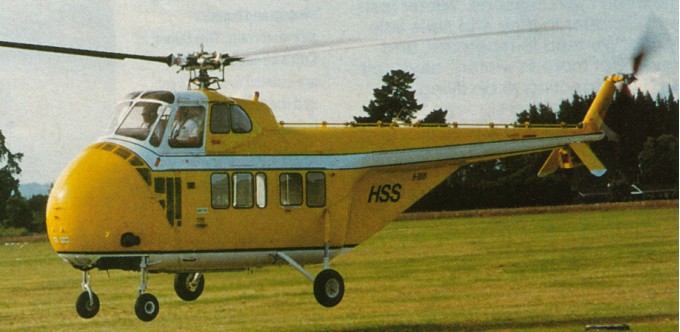
Designed to overcome the range and offensive payload deficiencies of the anti-submarine HO4S version of the S-55 / H-19, the Sikorsky S-58 was developed to a US Navy order for a prototype XHSS-1 placed on 30 June 1952. The nose engine position was retained for the 1525hp / 1137kW Wright R-1820 engine, but a completely new semi-monocoque fuselage, larger-diameter four-bladed main and four-bladed tail rotors, and transmission system were introduced, together with main rotor and rear fuselage folding to facilitate shipboard stowage. The tail rotor has servo control and both main and tail rotors have brakes. Fuel capacity is from 750 litres to 1,164 litres depending on model.
With a completely redesigned, downward-sloping tail section, the S-58 also differed from the S-55 in having a three-point, tail-wheel landing gear. Air-oil shock-absorber struts. Mainwheels have rotating struts to reduce drag and weight and toe-operated brakes. Tailwheel is fully castoring and self-centring, with an anti-swivelling lock. Mainwheel tyres 11.00 x 12. Tailwheel tyre 6.00 x 6. Toe-operated mainwheel brakes. Track 3.66m. Wheelbase 8.75m.
Pilot’s compartment above main cabin seats two side by side with dual controls. Cabin normally seats 12 passengers. Up to eight stretchers can be carried. Sliding windows of pilot’s compartment removable in an emergency. Cabin and cockpit air conditioned and soundproofed.
Designated XHSS-1, it flew for the first time on 8 March 1954.
Designated XHSS-1, it flew for the first time on 8 March 1954. Three were built, 134668 to 134670, later redesignated as YHSS-1. They were again redesignated, as YSH-34G, in 1962.
After evaluation of the XHSS-1 an initial ten were ordered. The first production HSS-1 flew on 20 September 1954, and the type became operational in August 1955. A total of 215 were built: 137849 to 137858, 138460 to 138493, 139017 to 139029, 140121 to 140139, 141571 to 141602, 143864 to 143960, and 145660 to 145669, of which six were transferred to the USAF and in turn to Brazil (60-5424 to 5429) and six to the USCG as HUS-1G (1332 to 1336, and 1343). All redesignated as SH-34G in 1962.
Now designated SH-34G, it has the name Seabat and carries either dunking sonar search equipment or weapons for attacking submarines.
The 1957 HSS-1F was HSS-1 converted with two General Electric YT58-GE engines. Girst flown on 30 January 1957 and redesignated as SH-34H in 1962.
Later Seabats includes the ‘winterised’ LH-34D (formerly HSS-1L). These models in U.S. Navy service were replacement by the SH-3 Sea King and many were converted to utility transports with UH prefixes. Subsequent production orders totalled 427 (53-4475 to 4554, 54-882 to 937, -2860 to 2914, -2995 to 3050, 55-5241 to 5261, 56-4284 to 4342, 57-1684 to 1770, and 58-1721) included 21 transfers from the USN. Redesignated as CH-34A in 1962. In addition to redesignated ships, 21 H-34As were rebuilt as CH-34C.
One JH-34A was built; 53-4475.
The HSS-1N (SH-34J) was developed for night operations, equipped with Doppler for navigation, automatic stabilisation and automatic hover coupler. A single prototype YHSS-1N 143957 was built, redesignated as YSH-34J in 1962.
Production HSS-1N possibly totalled 167 including 145670 to 145712, 147631/147635, 147984/148032, 148934/148963, 149082 to 149087, 149131 to 149133, 149840 to 149842, 150730 to 150732, 150808 to 150819, and 150821 to 150822, of which 11 were procured as SH-34J (150733 to 150807) might also have been built and the total may or may not include exports to Chile, Germany, Italy, and the Netherlands, as well as some transferred to USAF as HH-34J.
A single HSS-1F (SH-34H) flown on 30 January 1957, was powered by two General Electric T58 turboshafts. In 1960 five HSS-1Z (VH-34D) helicopters joined the Executive Flight Detachment for Presidential and VIP transport duties. Seabats stripped of ASW equipment for utility duties were designated UH-34G and UH-34J.
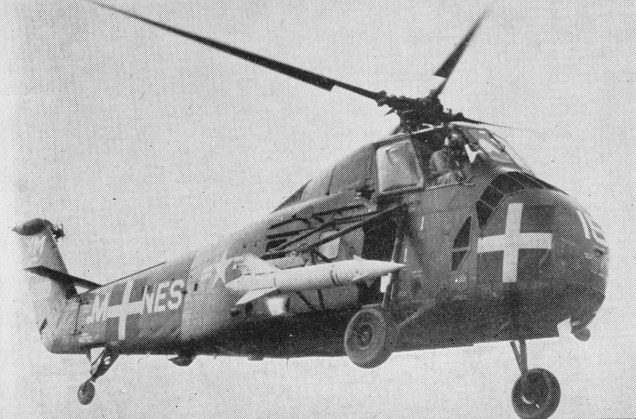
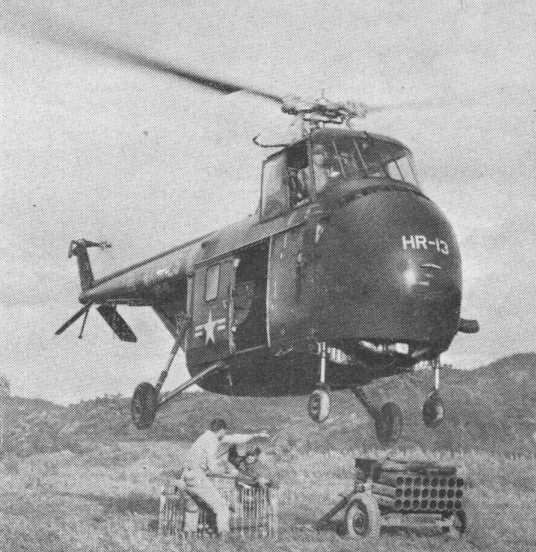
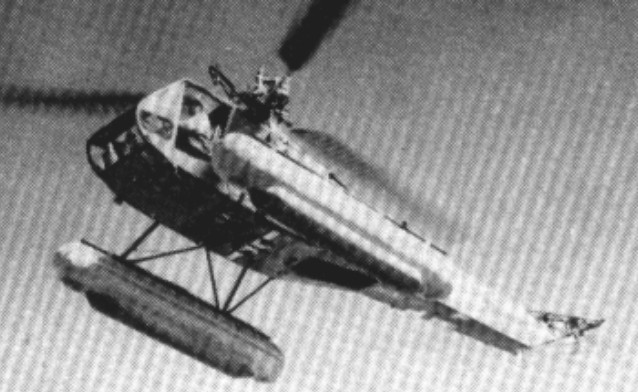
In 1959 a US Marine Corps HUS-1 served as a launching platform for the Martin Bullpup air-to-surface missile during a series of tactical assault trials at Chesapeake Bay.
The Bullpup was claimed to be the largest radio-controlled missile ever fired from a helicopter.
A troop transport variant was simultaneously acquired by the Marine Corps as the HUS Seahorse. One example of this type was loaned to the Army for service test and evaluation. The Army had placed preliminary orders for production H-34A troop transport variants of the Navy XHSS-1 in April 1953 and the performance of the borrowed Marine Seahorse, essentially identical to the H-34 version, confirmed the Army’s belief that the type would be a vast improvement over the H-19s then in service.
H-34B were 1960 H-34A conversion, redesignated as CH-34B in 1962.
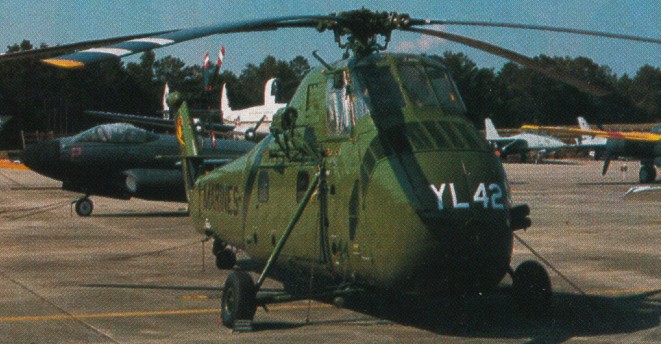
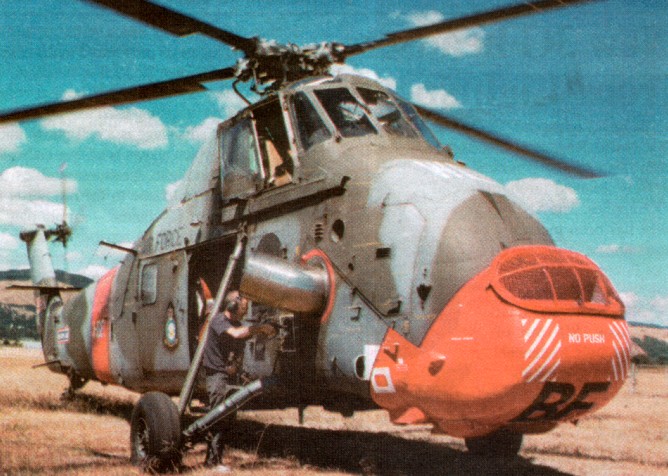
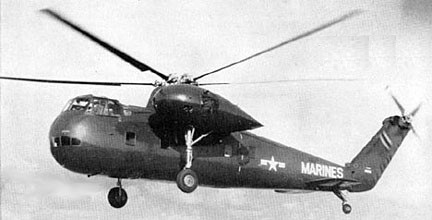
The US Marine Corps ordered the HUS-1 Seahorse (UH-34D) version on 15 October 1954; able to carry 12 Marines or a 1350kg load, this variant entered service in February 1957. The Marines received 570 of the S-58 in the utility version (HUS-1 / UH-34D and -1A, 143961 to 143983, 144630 to 144654, 145713 to 145812, 147147 to 147201, 148053 to 148122, 148753 to 148822, 149318 to 149402, 150195 to 150264, 150552 to 150580, 150691, and 150717 to /150729) and have used the type since 1957 primarily for utility transport and for recovery duties connected with the U.S. satellite programme. The 12-passenger UH-34D and UH-34E (formerly HUS-1 and HUS-1A / UH-34E) are basically alike, the latter being an amphibious version (eight built, 144655 to 144662 and 32 converted from HUS-1) with pontoons for landing on water. Inflatable flotation gear identified the US Marines’ HUS-1A and the US Coast Guard’s HUS-1G (Redesignated as HH-34F in 1962). Four HUS-1L (LH-34D) helicopters were modified for operation in the Arctic. Production continued as redesignated UH-34D after 18 September 1962.
The six 1958 HUS-1G were converted HSS-1 for the USCG. The six, 1332 to 1336, and 1343, were redesignated as HH-34F in 1962.
Four HUS-1, including 144658, 145719, and 150220, were modified for Antarctic duty. They were redesignated as LH-34D in 1962.
Eight HUS-1, 147161, 147179, 147191, 147201, 148803, 148804, 148805 and 150691, were converted as HUS-1Z Presidential aircraft. They were redesignated as VH-34D in 1962.
A total of 603 S-58s were delivered to the US Marines.
The US Army ordered several hundred H-34A, H-34B and H-34C Choctaw helicopters powered by 1063kW R-1820-84 engines and each carrying 16 troops or eight stretchers in the medevac role.
The Army accepted the first of 437 new-construction H-34As in April 1955, the first unit being equipped in September 1955. An additional twenty-one HUS-1 aircraft transferred from the Marine Corps during Fiscal Year 1955 were also designated H-34A (though at least five further USMC Seahorses operated by the Army between 1955 and 1957 retained their original Navy Bureau numbers).
In 1956 an early production example flown by Army Captains Claude E. Hargett and Ellis Hill set new world helicopter speed records on courses of 100 km (141.9mph), 500 km (136mph) and 1000km (132.6mph).
The H-34A was also the first helicopter judged safe enough for routine use by the U.S. President, and in 1957 the Army organized an Executive Flight Detachment equipped with specially modified Choctaws. These aircraft were fitted with extensive soundproofing, plush VIP interiors, and upgraded communications equipment, and were designated VH-34A.
The US Army H-34A, H-34B and H-34C Choctaw helicopters were powered by 1063kW R-1820-84 engines and each carrying 16 troops or eight stretchers in the medevac role. US Army CH-34s maintained a constant patrol along the border of West Germany with Czechoslovakia and East Germany. Army S-58’s have the name Choctaw, the CH-34A and CH-34C differing only in the equipment carried.
The H-34C, with SAR modifications, included 56-4305, -4331, -4333, 57-1692, -1698, -1709, and others. They were redesignated as CH-34C in 1962 along with 21 rebuilt and re-serialed H-34As (63-13190 to 13210.
In 1960 Sikorsky began modifying Army H-34As (and Air Force H-34As and -Bs) to -C model standard through the addition of automatic flight stabilization systems and other detail changes including relocation of Battery, Invertors, and Aux Hyd Reservoir. By January 1962 the Army had 190 H-34Cs and 179 H-34As in its inventory; under the Tri-Service designation system introduced later that year the aircraft were redesignated as, respectively, CH-34C and CH-34B. Several -C model aircraft were subsequently modified to VH-34C standard for VIP transport duties. The VH-34D is a VIP transport.
In 1964 U.S. Marines flying the HUS-1 version of the S-58 saved 1,500 Vietnamese villagers from floodwaters. The aircraft also was used to recover the space capsule of Alan B. Shepard, Jr., America’s first astronaut in space.
HSS-1
Twenty-three UH-34D went to USAF for export to friendly nations (63-8248/8259, -13006/13014, and -13139/13140) and 44 to USN (152686, 153116/153133, 153556/153558, 153695/153704, 154045, 154889/154902, and 156592/156598), of which 10 went to USAFR as HH-34D with new s/ns (60-6913, -6923, 61-4488/4491, -4529, 63-7972/7974).
The CH-34 did not see extensive Army service in Vietnam. The Army’s 1962 decision to deploy the Vertol CH-21 Shawnee to Southeast Asia instead of the faster and more capable Choctaw was based on two considerations. First, in accordance with then-current Army doctrine regarding the area-standardization of aircraft types, the CH-21 was already widely deployed in the Pacific area and the continental United States, whereas all but about thirty of the Army’s CH-34s were based in western Europe. US Army CH-34s maintained a constant patrol along the border of West Germany with Czechoslovakia and East Germany. It was therefore logical and logistically preferable that the CH-21, which was considered acceptable if somewhat past its prime, should be chosen for deployment to Southeast Asia. The Army’s second reason for sending the Shawnee rather than the Choctaw was a somewhat negative opinion of the Choctaw’s combat survivability, a belief based on French experience in North Africa. French forces had used both the CH-21 and the CH-34 in Algeria, the former flown by the Army and Air Force and the latter by the Navy, and official evaluations had indicated that the Shawnee was more likely to survive multiple hits by ground fire than was the CH-34. The French belief that the location and ‘fragile’ construction of the Choctaw’s fuel tanks made the craft extremely vulnerable to ground fire seemed to validate the U.S. Army’s decision to deploy the Shawnee to Vietnam pending the introduction into widespread service of the UH-1 Iroquois. The approximately twenty Army H-34s that did eventually reach Vietnam proved no more vulnerable than any other aircraft in the theatre, however, and ably carried out missions ranging from combat assault to aeromedical evacuation and general cargo transport. Most of these twenty aircraft were turned over to the South Vietnamese during the course of the war, though a few were ultimately reclaimed by the Army prior to the final collapse of the Saigon Government.
One SH-34G was exported to Germany; 152188.
SH-34J production in 1962 was for the USN (151729 to 151731, 152380 to 152381, and 153617 to 153622) of which several transferred to the USAF as HH-34J.
The CH-34 Choctaw remained in frontline Army service well into the late 1960s, and was standard equipment in many Army Reserve and National Guard aviation units for considerably longer. The last Choctaw was not officially retired until the early 1970s, by which time the type’s duties had been divided between the UH-1H Iroquois and the CH-47 Chinook.
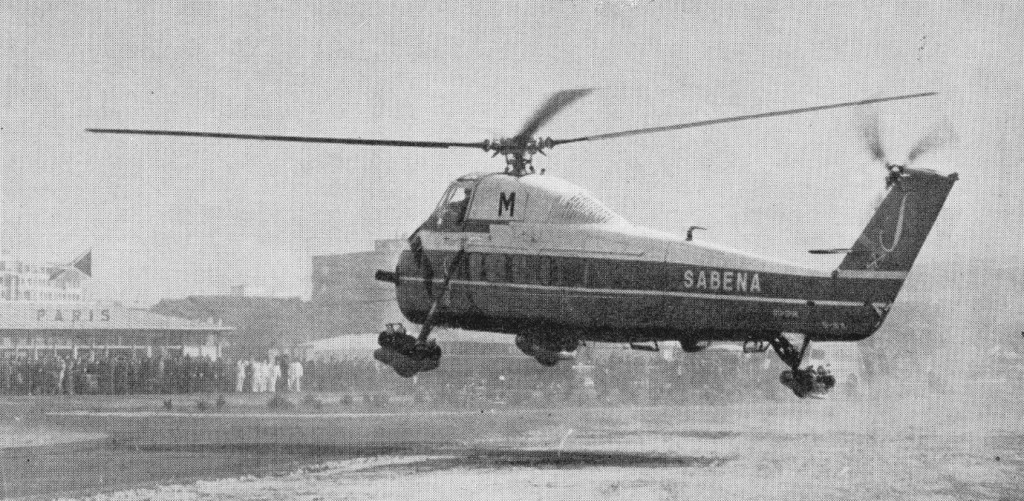
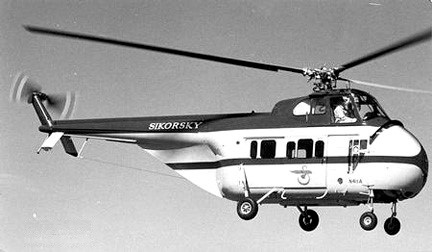
The commercial S-58B and S-58D are passenger/cargo transport helicopters comparable with their military counterparts. The 12-seat airline version, certificated by the FAA in August 1956, was built for Chicago Helicopter Airways (eight), New York Airways (three) and Sabena (eight). First commercial deliveries of S-58C were made in 1956-57.
Substantial numbers of military S-58 variants have been exported, and in mid-1967 were serving with the Federal German Army (one hundred and forty-four); the navies of Argentina (five), Brazil (five), France (twenty-six), Germany, Indonesia, Italy (eighteen), Japan (fourteen) and the Netherlands (twelve); and the air forces of Belgium (nine), Cambodia (three), Canada (four), France (one hundred and ten), Germany, Israel (twelve), Thailand (twenty) and South Vietnam (sixty). Those in French and Belgian service were manufactured in France by Sud-Aviation.
Up to 1970 2,261 total all S-58s were built and production of the S-58 ended in December 1965 after 1766 had been built by Sikorsky, but started again to fulfil additional U.S. orders and one from the Italian Navy for six SH-34J’s.
In January 1970, Sikorsky announced the design of kits for the conversion to turbine power by the installation of the Pratt & Whitney PT6 Twin-Pac. First flight of the S-58T took place 19 August 1970 and in April 1971 Sikorsky received FAA approval for the S-58T PT6A Twin Pac-powered turbine conversion for H-34 airframes. One hundred and forty-six conversions, or conversion kits, were produced until, in 1981, the rights were sold to California Helicopter International. Since then customers for the California Helicopter (Sikorsky) S-58T included New York Airways, the Indonesian and South Korean air forces (now retired) and the government and air force of Thailand. The S-58T is also in service in Argentina with the Presidential Aircraft Squadron. Small numbers were built of S-58B and S-58D civil passenger and cargo transport helicopters, a 12-seat airline version being operated by Chicago Helicopter Airways, New York Airways and SABENA.
When he checked in for a Sabena S-58 flight, Igor Sikorsky was asked if his name was spelt like the helicopter’s.
When production was terminated in January 1970, Sikorsky had manufactured a total 1,820 S-58s of all versions.
The S-58T is a turbine conversion of the normally piston engined military H 34, or civilian S¬58, with the Curtiss Wright R 1820 piston radial engine removed from the nose and replaced by a pair of turbines fastened to a common drive transmission as the PT6T Twin Pac.
The PT6T Twin Pac unit fitted to the S-58T is basically two PT6 turboshaft engines mounted side-by-side and driving into a combining gearbox. Of the total 1800 shp available, only 1505 shp can be absorbed by the transmission during take-off and for continuous operations this is limited to 1254 shp. Should one engine fail, sensors automatically increase the good engine’s output up to the maximum 900 shp. Fuel is carried in 12 under-floor cells.
The useful load rose about 200 pounds on the Standard S 58T, it actually went down by some 80 pounds on the Mark II version, which has airline seating and windows. This increased power from 1,525 hp to 1,875 shp. Since the basic rotor blade system has been retained, there would also seem to be a speed handicap there that no amount of extra power could overcome.
By 1975 more than a hundred S 58Ts had been delivered or are under contract, more than half of them in the form of retrofit kits.
S-58T
The S-58T was first flown on 26 August 1970 with P&WC PT6T-3 twinpack turboshaft engine. Kits were built by Sikorsky but 160 conversions were carried out by California Helicopter International.
S-58T
Offering a 5,000 pound sling load, the Sikorsky S 58T has a 110 knots normal cruise, a 10¬knot edge on both the 212 and the 205A. Furthermore, while all three aircraft can hoist a 5,000 pound sling load, the 58T can do it at higher altitudes. The S 58T manages a gross lift at 6,500 feet.
When properly equipped, it’s IFR for two. Outsized wheel hubcaps house automatically inflatable bubbles for inadvertent oceanic dunking. With an engine out, though, the aircraft can hold onto a service ceiling of 4,300 feet.
While it turns out that the 430 pound weight saving gained by substituting the twin turbines for the old recip engine was pretty well swallowed by updating modifications, there was no loss of range with the same 283 gallons of fuel. Though the new turbines consume an extra 22 gph in cruise, the higher 110 knot cruise (versus 85 knots for the pis¬ton model) yields almost exactly the same 243 nm range at sea level.
Furthermore, the hovering altitude in ground effect on a warm day (ISA + 20) went way up from 2,600 feet in the piston model to 7,700 feet in the S 58T.
Whereas the “old” rotor blade system the 58T is saddled with might have seemed a handicap, the engineers at Sikorsky finessed their way around that by smoothing out the vibration levels, and that, in turn, permitted the boost in cruise speed, rather than the addition of brute power.
Instead of adopting the “Nodamatic” vibration damping technique used by Bell, where the cabin is “suspended” at harmonic vibration points, Sikorsky used something called a Bifilar vibration absorber. This consists of weights fastened to the main rotor hub between the rotor blades more specifically, “pendular dynamic masses.” The 120 pound installation not only provides a five to one reduction in vibration levels, according to Sikorsky engineers, but it greatly reduces tail stresses, mechanical failures and overall maintenance.
In addition to the California Helicopters version, Orlando Helicopters also offers S-58 conversions. An S-58 Heli-Camper, similar in fit to the OHA-S-55 Heli-Camper is available, powered by a Wright Cyclone R-1820-84 engine. A further Orlando S-58T conversion is the Orlando Airliner, an 18-seat all-passenger version with nine additional tinted windows fitted on each side of the cabin. By 1997 nearly 30 conversions have been completed.
Total of 166 also produced under licence by Sud-Aviation in France. Sud-Aviation were completing two modified examples of the Sikorsky S-58, each of which was fitted with a 1900shp Turbomeca Bi-Bastan shaft turbine engine, and the first of these machines flew on 5 October 1962. The S-58 development was not pursued.
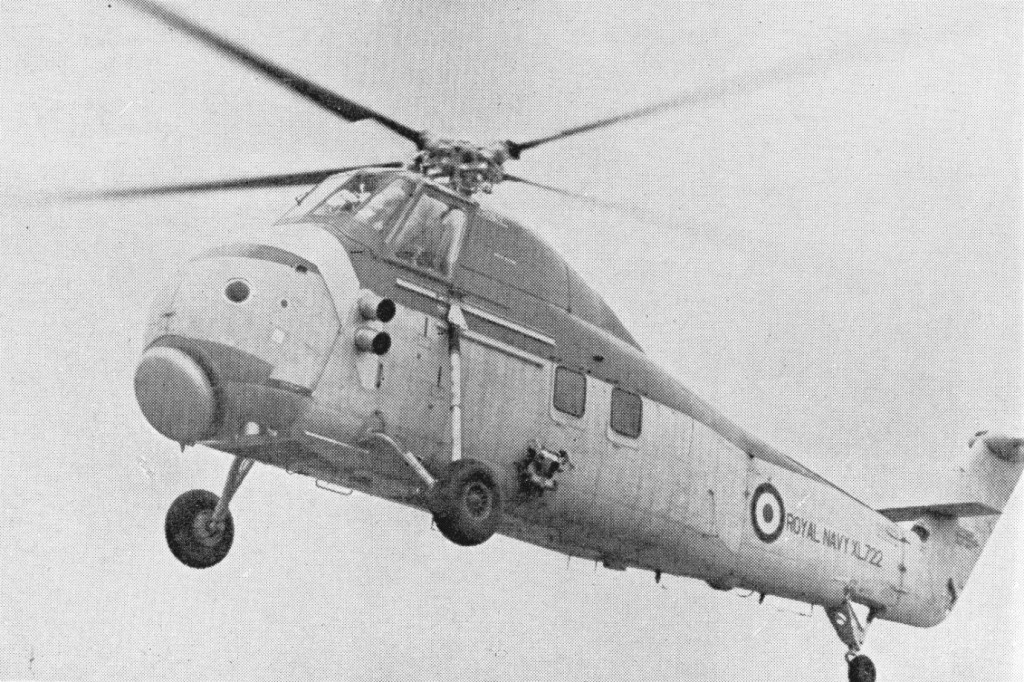
After acquiring a licence in 1956 to manufacture the Sikorsky S-58 helicopter, Westland imported one of these aircraft in HSS-1 configuration. Given the British serial number XL722, this aircraft was test-flown for a time with its original 1525hp Wright R-1820-84 engine before being modified to accept a 1100shp Napier Gazelle NGa.11 gas turbine.
Napier Gazelle powered Wessex first flight 17 May 1957 at Yeovil
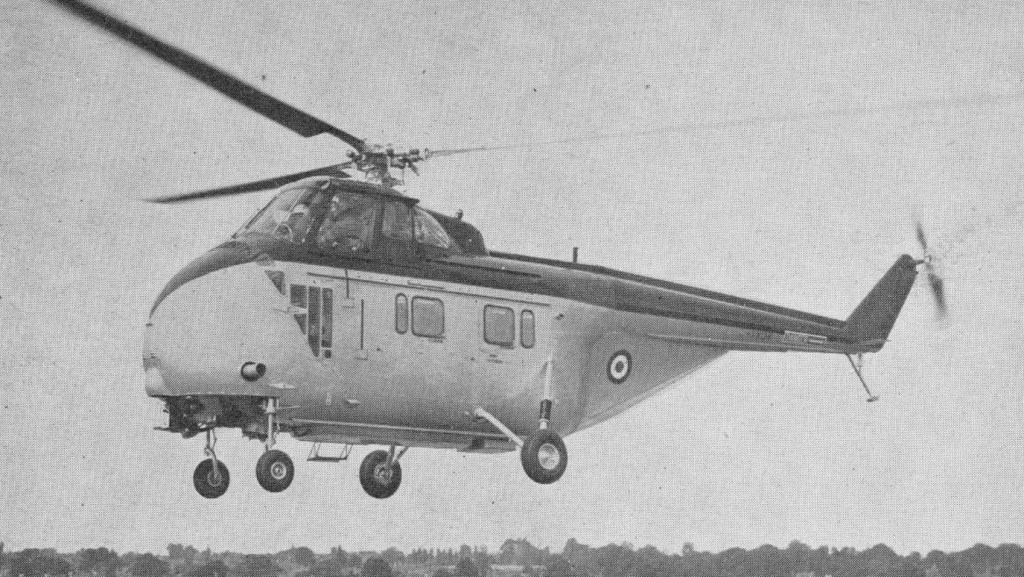
In its new form it was flown for the first time on 17 May 1957, and was later joined by two pre-production Wessex HAS Mk.1’s for Naval trials; the first of these flew on 20 June 1958.
Wessex features – Main and tail rotor each have four blades. Blades attached to hub by taper bolts. Main rotor blades fold manually. Rotor brake fitted. Shaft drive to main rotor through double epicyclic gear. Shaft drive to tail rotor through intermediate and tail gearboxes. Tail end folds to port and forward for stowage. Tail rotor carried at tip of vertical stabilising fin. Small horizontal stabiliser inset in leading-edge of fin.
All blades of light-alloy extruded spar and light-alloy bonded trailing-edge structure. The fuselage is a light-alloy semi-monocoque structure, with steel tube support structure for main rotor gearbox.
Landing gear is a non-retractable tailwheel type. All three units fitted with Westland oleo-pneumatic shock-absorber. Dunlop wheels, tyres and hydraulic disc brakes. Tubeless treaded mainwheel tyres, size 6.00 x 11. Tailwheel tyre size 6.00 x 6.
Compressor bleed air for heating. Ambient air circulation by fan. High-pressure hydraulic system for powered flying controls and 272kg capacity hoist. 24V DC electrical system, with two 6kW generators.
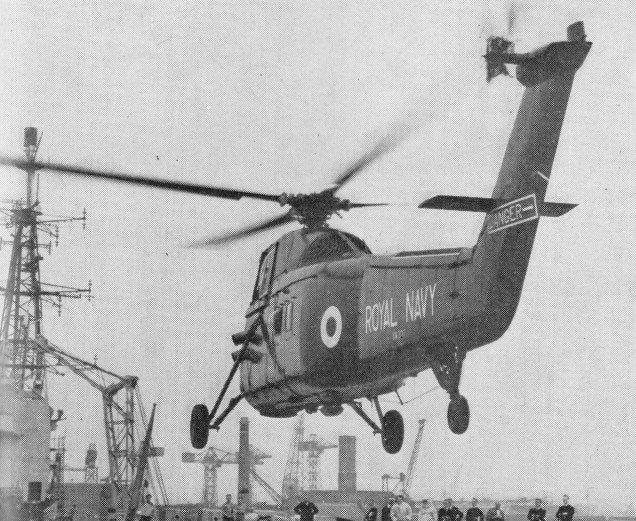
The HAS Mk.1, powered by a Napier Gazelle of 1,450shp (1081kW), went into production in 1959 for the Royal Navy as a submarine search and strike helicopter equipped with dipping Asdic and provision for one or two homing torpedoes. Powered by a 1450shp Gazelle Mk.161 engine, it began service trials with No.700H Flight in April 1960 and has since been delivered to Nos. 706, 737, 771, 815, 819 and 848 Squadrons. The first of these to commission, in July 1961, was No.815; the Wessexes of No.848 Squadron were for commando assault duties aboard H.M.S. Albion, having the ASW gear removed to make room for 16 troops or 8 stretchers and a medical attendant in the main cabin. Alternatively, a slung load of 1814kg can be suspended from an under-fuselage hook.
The original version was the Wessex HAS.Mk1, powered by a Napier Gazelle of 1,450shp (1081kW). The HAS.1 was undergoing service trials with No.700H Sqn during 1960, during which it first landed on an aircraft carrier.
The HAS.1 was supplanted by the Wessex HAS.Mk3 version popularly called the Camel because of its humpbacked search radar above the rear fuselage.
The most extraordinary feature of the Wessex HAS.3 is the stack of avionics and anti-submarine gear that the Royal Navy has fitted it with; the latter consisting of radar and sonar equipment linked together by a small computer to give a “total picture”. All this is operated by a third crewman seated at the rear of the aircraft, in an area which looks like a second cockpit. The sophisticated radar is used for navigation as well as sub hunting.
In August 1964 it was announced that the Iraqi Air Force was acquiring 12 Wessex HC.2. The cost was to be $8m including spares. The Gahanaian air force ordered two Wessex Mk.53.
Much more important numerically is the Wessex HU.Mk 5 version, the Royal Marine Commando assault ver¬sion. These twin engine machines once numbered almost 100. The Navy’s HU Mk.5, for which two orders were placed, entered service in summer 1964 as a commando-carrier assault transport.
In the early 1960s the RAF required a powerful general-purpose helicopter capable of troop-carrying, air ambulance and ground attack roles.
Following the first flight of the true prototype (XR588, this being preceeded by one of the Royal Navy pre-production variants which was later partly converted to an HC.2 version) on 5 October 1962, seventy-one examples of the Wessex HC.2 variant were delivered to the RAF, which first entered RAF service with No.18 Squadron, based at RAF Odiham, Hampshire, in January 1964, replacing the Whirlwind and Belvedere types. The HC Mk.2 was built as a transport helicopter for up to 16 troops, with redesigned gearbox and strengthened airframe.
And doors on each side of flight deck and on starboard side of cabin. Two flexible fuel tanks under cabin floor, total capacity 1,409 litres. Provision for carrying two 500 litre auxiliary tanks in cabin for ferry purposes. Refuelling point in starboard side of fuselage. Oil capacity 9 litres per engine, 19 litres in main gearbox.
Towards the end of 1959 two Whirlwinds joined the Queen’s Flight, designated HCC Mk.8, they had Alvis Leonides Major engines and special interiors.
HCC Mk.8
Westland Wessex HC Mk.2
In 1968 Westland Helicopters received an order for two Wessex aircraft to equip The Queen’s Flight. These were designated HCC4. The aircraft were built to HC2 standard but with the main cabin having a VIP interior finish, furnishings and sound proofing plus an external folding step below the cabin door. Additional Decca navigation equipment was installed on the flight deck. The first flight took place on 17 March 1969. The first official flight was on 1 July 1969 in support of the Investiture of the Prince of Wales at Caernarfon Castle, Wales. The helicopters in their distinctive red/dark blue paint scheme operated for many years from RAF Benson. From 31 March 1995 they moved to RAF Northolt and became part of No.32 (The Royal) Squadron. The Wessex HCC4 was retired in 1998 and No.32 (The Royal) Squadron gave up the task of providing helicopters for the Royal Family.
A commercial version was known as the Srs.60.
The RAAF ordered 27 Westland Wessex Mk31B carrier-borne anti-submarine/search & rescue helicopter from Westland Aircraft Ltd in July 1961. The first was delivered on 1 Nov 1962 and the last on 4 Nov 1963. The HAS Mk.31’s are similar to the HAS Mk.1 apart from their 1540shp Gazelle Mk.162 engines. Australia’s navy anti-submarine duties started in August 1962.
Westland built 356 Wessex in all (including those for the civil market): the HAS Mk.1 version for the Royal Navy; the HC Mk.2 tactical transport version for the RAF; the HAS Mk.3 antisubmarine version with 1550shp Gazelle NGa.18 turbine; the HU. Mk.5 for various roles on the Navy’s commando carriers; the HAS Mk.31 for the Royal Australian Navy; the Wessex Mk.52 for the Iraqui Navy (12); the Wessex Mk.53 for Ghana (3); the Wessex Mk.54 for Borneo and the Wessex Mk.60 commercial version. Seven Wessex Mk.60’s have been built for Bristow Helicopters Ltd. These are 10-passenger commercial equivalents of the Mk.2 and operate in support of the oil and gas drilling rigs in the North Sea.
CH-34A/H-34A Choctaw: Transport and general purpose helicopter for US Army.
CH-34C (formerly H-34C) Choctaw: Similar to CH-34A, but with airborne search equipment.
LH-34D (HSS-1L): Winterised version of Navy Seabat.
SH-34G (HSS-1) Seabat: Anti-submarine version ordered by US Navy 30 June 1952; accepted for service in February 1954.
SH-34J (HSS-1N) Seabat: Improved version of SH-34G.
UH-34D (HUS-1) Seahorse: Utility version for Marines; ordered 15 October 1954 and accepted for service January 1957.
UH-34E (HUS-1A) Seahorse: Version with pontoons for emergency operation from water.
VH-34D (HUS-1Z): VIP transport version of Seahorse.
S-58B: Commercial passenger/freighter version.
S-58C: Commercial passenger-carrying version with two doors on starboard side of cabin.
S-58D: Commercial passenger/freighter version.
S-58T: Turbine conversion with Pratt & Whitney PT6 Twin-Pac, comprising two PT6 engines and combining gearbox; improved performance includes greater speed and lifting power, and better hot-and-high operation.
Westland Wessex HAS. Mk 1 Initial production version, developed for the Royal Navy, with one 1,450shp Napier Gazelle 161 turboshaft engine. Re-engined with a 1,100shp Gazelle NGa.11, flew for the first time 17 May 1957.
Westland Wessex HC. Mk 2 High-performance development of the Mk 1 with two coupled 1,350shp Bristol Siddeley Gnome Mk 110/111 turboshaft engines. Power limitation of 1,550shp at rotor head. Prototype converted from Wessex 1, flew for the first time 18 January 1962, and the first production model (XR588) 5 October 1962.
Westland Wessex Mk 3 Similar to Mk 1, but with 1,850shp Gazelle NGa.18 165 turboshaft engine.
Westland Wessex HCC. Mk 4 Queen’s Royal Flight helicopter.
Westland Wessex HC. Mk 5: SAR helicopter of the Royal Air Force based in Cyprus.
Westland Wessex HU. Mk 5 Similar to Mk 2, for Commando assault duties from carriers of the Royal Navy. Design work began in April 1962 and construction of the prototype was started in May 1962. In service with A&EE (1) and 84 Squadron Akrotiri Cyprus (5).
Westland Wessex HAS. Mk 31 Generally similar to Mk 1, but with a 1,540shp Gazelle Mk 162 engine. Ordered for the Royal Australian Navy for anti-submarine duties from HMAS Melbourne.
Westland Wessex Mk 52 Similar to Mk 2, for Iraqi Air Force.
Westland Wessex Mk 53 Similar to Mk 2, for Ghana Air Force.
Westland Wessex Mk 60 Civil version in service with Uruguayan Navy.
Specifications:
Sikorsky S-58 / H-34 Choctaw Engine: 1 x Wright R-1820, 1137kW / 1504 hp Main rotor diameter: 56 ft / 17.1m Length: 17.3m Height: 4.9m Max take-off weight: 6350kg Empty weight: 3754kg Max speed: 178 km/h / 150 kt Cruising speed: 158km/h Rate of climb: 5.6m/s Service ceiling: 2900m Range: 450km Crew: 2 Passengers: 12-18
CH-34A/H-34A Choctaw Transport and general purpose helicopter for US Army. Engine: 1,525 hp Wright R 1820 84B/D piston. Rotors: 4-blade main; 4-blade tail. Operating speed: 40 – 128 knots Mainwheel tyres 11.00 x 12 Tailwheel tyre 6.00 x 6 Wheel track 3.66m Wheelbase 8.75m Cabin length: 13 ft Seats: 20
CH-34C / H-34C Choctaw Similar to CH-34A Operating speed: 40 – 128 knots Mainwheel tyres 11.00 x 12 Tailwheel tyre 6.00 x 6 Wheel track 3.66m Wheelbase 8.75m Cabin length: 13 ft
LH-34D / HSS-1L Winterised version of Navy Seabat. Engine: 1,425 hp Wright R-1820 Mainwheel tyres 11.00 x 12 Tailwheel tyre 6.00 x 6 Wheel track 3.66m Wheelbase 8.75m Cabin length: 13 ft
SH-34G / HSS-1 Seabat Anti-submarine version ordered by US Navy 30 June 1952; accepted for service in February 1954. Engine: 1,425 hp Wright R-1820 Mainwheel tyres 11.00 x 12 Tailwheel tyre 6.00 x 6 Wheel track 3.66m Wheelbase 8.75m Cabin length: 13 ft
HSS-1F / SH-34H Engines: two General Electric YT58-GE Length: 47’3″
SH-34J / HSS-1N Seabat Improved version of SH-34G. Engine: 1,425 hp Wright R-1820 Mainwheel tyres 11.00 x 12 Tailwheel tyre 6.00 x 6 Wheel track 3.66m Wheelbase 8.75m Cabin length: 13 ft
UH-34D / HUS-1 Seahorse Utility version for Marines; ordered 15 October 1954 and accepted for service January 1957. Engine: Wright R-1820-84 Main rotor: 56’0″ Length: 46’8″ Max speed: 123 mph Mainwheel tyres 11.00 x 12 Tailwheel tyre 6.00 x 6 Wheel track 3.66m Wheelbase 8.75m Cabin length: 13 ft
UH-34E / HUS-1A Seahorse Version with pontoons for emergency operation from water. Cabin length: 13 ft
VH-34D / HUS-1Z VIP transport version of Seahorse. Mainwheel tyres 11.00 x 12 Tailwheel tyre 6.00 x 6 Wheel track 3.66m Wheelbase 8.75m Cabin length: 13 ft
S-58B Engine: 1525hp Wright R-1820-84 Useful load: 5150 lb Max speed: 130 mph Cruise: 101 mph Range: 247 mi Ceiling: 9,500 ft
S-58C Commercial passenger-carrying version with two doors on starboard side of cabin. Engine: 1 x Wright R-1820-84, 1137kW Main rotor diameter: 17.1m Length: 17.3m Height: 4.9m Max take-off weight: 6350kg Empty weight: 3754kg Max speed: 198km/h Cruising speed: 158km/h Rate of climb: 5.6m/s Service ceiling: 2900m Range: 450km Crew: 2 Passengers: 12-18
S-58D Commercial passenger/freighter version.
S-58T Turbine conversion with Pratt & Whitney PT6 Twin-Pac. Engine: P&W PT6T-3 coupled turboshaft, 1525 shp Length: 50 ft 11 in Width: 5 ft 8 in Height: 15 ft 11 in Rotor dia: 56 ft MTOW: 13,000 lb Useful load: 5600 lb Slung cap: 5000 lb Fuel cap (useable): 286 USG Endurance: 2 hr 40 min Max cruise: 110 kt Max speed: 124 kt Fuel consp (cruise): 106 USG/hr Range (cruise speed, 20 min res): 260 nm HIGE: 8950 ft SE ceiling; 2100 ft Crew: 2 Pax cap: 17
S 58T Mark II Engine: UACL PT6T-6, 1,875 shp Main rotor dia: 56 ft Length: 50 ft. 11 in Height: 15 ft. 11 in Disc loading: 5.28 lb/sq.ft Seats: 10 16 Empty weight: 8,354 lb Useful load: 4,446 lb Payload with full fuel: 1,924 lb MTOW: 13,000 lb Power loading: 8.54 lb/hp Fuel capacity (standard): 283 USG/1,910 lb Fuel capacity (optional): 433 USG/2,923 lb ROC: 1,275 fpm Service ceiling: 12,000 ft Single engine service ceiling: 4,200 ft Vne @ 2,000 ft: 124 kt Normal cruise @ 2,000 ft: 110 kt Range @ normal cruise (45 min res. std tanks): 200 nm Endurance @ max cruise (no res, std tanks): 2.6 hr Range max fuel/ cruise: 401 nm/ 3.2 hr Range max fuel / range: 346 nm/ 3.2 hr ROC: 1260 fpm Max sling load: 5000 lb Hovering ceiling in ground effect: 10,400 ft Hovering ceiling out of ground effect: 6,500 ft
Westland Wessex Licence-produced UK version.
Westland Wessex HAS.I Engine: 1 x Napier Gazelle Mk.161, 1450 shp Main rotor diameter: 56 ft Length: 49 ft 11 in Height: 15 ft 10 in Main rotor disc area: 2460 sq.ft Empty weight: 7600 lb MTOW: 12,600 lb Fuel capacity: 266 gal Aux fuel capacity: 200 gal Max speed: 132 mph at SL Cruise sped: 115 mph Sevice ceiling: 14,200 ft Max range w/aux fuel: 600 mi
Westland Wessex HC Mk.2 Engine: 2 x Bristol Siddeley Gnome Mk.110 or Mk.111 turboshaft, 1007kW / 1350 shp total Type 10 coupling gearbox Rotor head rating: 1,550shp Main rotor diameter: 17.07m Length rotors turning: 20.04m Height: 4.93m Max take-off weight: 6123kg Empty weight: 3767kg Max speed: 212km/h Range with max fuel: 769km Crew: 1 -3 Capacity: 16 seats
Westland Wessex HC Mk.5 Engines: One Bristol Siddeley Gnome Mk 112 and one Gnome Mk 113 Type 11 coupling gearbox Main rotor diameter: 17.07m Length rotors turning: 20.04m Height: 4.93m Crew: 1 -3 Capacity: 16 seats / 1814 kg
Westland Wessex HU.Mk 6 Engine: one Rolls Royce Coupled Gnome twin turboshaft with two pow¬er sections each rated at 1,350 shp (1007 kW), combined output limit 1,550 shp (1156 kW). Main rotor diameter 17.07 m (56 ft 0 in) Length overall 20.03 m (65 ft 9 in) Height 4.93 m (16 ft 2 in) Main rotor disc area 228.81 sq.m (2,463.0 sq ft). Empty weight 3927kg (8,6571b) Maximum take off weight 6120 kg (13,500 lb) Maximum speed 214km/h (133mph) Cruising speed 195 km/h (121 mph) Range 769 km (478 miles) Armament: role kit can include two 7.62 mm (0.3 in) GPMGs firing ahead, one or two 20 mm cannon, two or four AS. 11 wire guided missiles, or rocket pods.
Westland Wessex Mk.31B Engine: 1 x 1,575 shp Napier Gazelle 161 free turbine Rotor diameter: 56 ft Length 65 ft 10.5 in Folded length: 38 ft 6 in Height: 14 ft 10 in Empty weight: 8,000 lb Loaded weight: 13,500 Initial Rate of Climb: 1,540 ft/min Ceiling: 14,100 ft Speed: 108 knots Range: 262 nautical miles Bomb load: 2 x torpedoes (external) Crew: 4
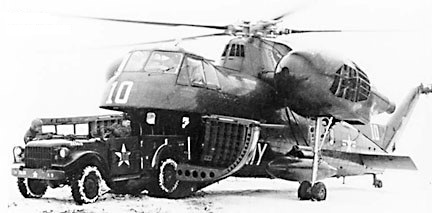
Sikorsky originally developed the Model S-56 twin-engined heavy lift helicopter in response to a 1950 Marine Corps requirement for an assault transport able to carry twenty-three fully equipped troops.
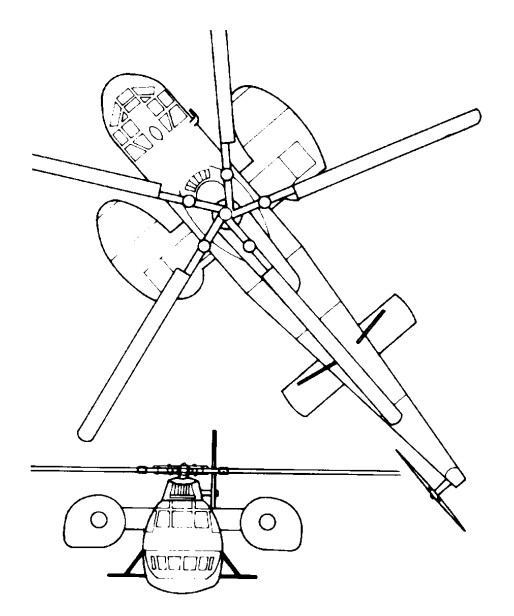
A twin-engine solution was chosen, and to save cabin space, it was decided to house the two 1417kW Pratt & Whitney R-2800-50 Double Wasp engines (1566kW R-280054s on late production aircraft) radial engines in outboard nacelles, from which two drive shafts linked up directly with the reduction gear assembly which drove the big five-blade metal rotor. The S-56 was Sikorsky’s first twin-engined helicopter, although the traditional single main rotor layout was retained, this being a 5-blade unit designed to be able to sustain the aircraft in flight with one blade shot away. The 53.80 cu.m cargo bay had a hoist capable of lifting a one tonne load andclamshell nose-opening doors. The main landing gear wheels retracted, but the tailwheel was fixed. The H-37’s tailboom sloped downward toward the tailwheel and ended in a sharply upswept vertical tail unit carrying a four-bladed anti-torque rotor.
In May 1951 the Navy ordered four XHR2S-1 prototypes (133732 to 133735) for USMC evaluation, and the first of these made its maiden flight on 18 December 1953.
Sikorsky XHR2S-1 Prototype
Fifty-five production HR2S-1 (138418 to 138424, 140314 to 140325, 141603 to 141617, and 145855 to 145875) were built, redesignated as CH-37C in 1962.
In 1954 the Army borrowed one of these preproduction machines, designated it the YH-37, and subjected it to operational and maintenance evaluations before returning it to the Marines. On the basis of the large helicopter’s excellent showing during the Army evaluation, Sikorsky was in late 1954 awarded a contract for nine production H-37A Mojaves. The first of these reached Fort Rucker during the summer of 1956, at about the same time the HR2S-1 naval variant was entering regular Marine squadron service, deliveries to Marine Corps Squadron HMX-1 starting in July 1956. The Army subsequently placed orders for a further 85 H-37As, and all ninety-four aircraft were delivered by June of 1960. US Army H-37A Mojave helicopters went into service, initially with 4th Medium Helicopter Transportation Company, in February 1958.
Sikorsky CH-37A
The ninety-four first production, 54-993 to 1001, 55-610 to 650, 57-1642 to 1661, and 58-983 to 1006, were redesignated as CH-37A in 1962.
For several years the S-56 was the western world’s largest and fastest military helicopter, and held two height-with-payload records from 1956-59. 1959 saw the first overseas H-37 deployment, by the Army to Germany.
Production of the S-56 ended in May 1960, but Sikorsky were engaged until the end of 1962 in converting all but four of the H-37A’s to H-37B (later CH-37B) standard. Improvements in this version included the installation of Lear auto-stabilisation equipment, crash-resistant fuel cells and modified nose doors, and the ability to load and unload while the helicopter was hovering. The Navy and Marine S-56’s became CH-37C’s under the 1962 designation system. Some later production S-56’s had 2100hp R-2800-54 engines.
Two of the 60 HR2S-1’s (141646 and 141647) ordered by the Marine Corps were converted into radar patrol craft (military designation HR2S-1W), with a bulbous dielectric radome and AN/APS-20E search radar under the nose and additional crew members for radar picket duties. Records indicate that the Army also evaluated one of the Navy’s two radar-equipped HR2S-1W airborne early warning (AEW) aircraft. This machine (BuNo 141646) retained the AEW variant’s large chin-mounted radome and AN/APS-20E search radar, and was operated in Army markings and two-tone ‘Arctic’ paint scheme.
Sikorsky HR2S-1W
In June 1963 four CH-37Bs were temporarily deployed to Vietnam to assist in the recovery of downed U.S. aircraft. By the following December the Mojaves had recovered an estimated $7.5 million worth of equipment, most of which was sling-lifted out of enemy-dominated areas virtually inaccessible by any other means. That the CH-37 did not see more extensive service in Vietnam is primarily the result of its replacement in the Army inventory by the turbine-powered Sikorsky CH-54 Tarhe, a machine that weighed slightly less than the CH-37 but which could carry nearly four times as many troops or five times as much cargo.
The last CH-37 was withdrawn from Army service in the late 1960s.
The S-56’s rotor and transmission systems were utilised in the development of the abortive Westland Westminster and Sikorsky’s own S-60 and S-64 crane helicopters, but hopes of selling the S-56 on the commercial market were not realised, due mainly to the high operating costs of a piston-engined machine of this size, and a proposal to fit Lycoming T55 gas turbines was not adopted.
A standard S-56 was ordered by Okanagan Helicopters Ltd. of Canada, for delivery in 1956-57.
In all, 150 S-56s were built; a prototype, 55 for the USMC and 94 for the Army.
Engines: Two P&W R-2800-C5 Double Wasp, 2100 hp Rotor diameter: 21.95 m / 90 ft Length: 19.76 m Height: 6.71 m Weight: Empty: 9386 kg Max weight: 15000 kg Speed: Max: 209 km/h Range: Max 233 km Service Ceiling: 2652 m
Engines: 2x 1,900 h.p. Pratt & Whitney R-2800-50 Rotors: 5-blade Main; 4-blade tail. Rotor diameter: 90 ft. Weight: 28,500 lb. Max. speed: over 150 m.p.h. Range: 200 miles at 120 m.p.h. Seats: 2 crew and 26 passengers.
HR2S-1W Engine: 2 x Pratt & WHitney R-2800-50, 1415kW Main rotor diameter: 21.95m Fuselage length: 20.27m Height: 6.71m Max take-off weight: 14060kg Max speed: 196km/h Service ceiling: 2438m Range: 354km
On 1 May 1949, Sikorsky’s technical department was tasked to create a new helicopter in seven months, which would be capable of carrying ten passengers in addition to a crew of two.
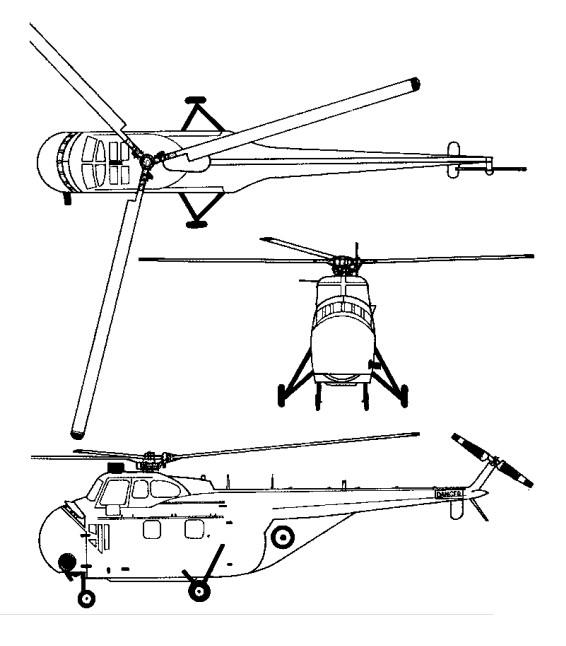
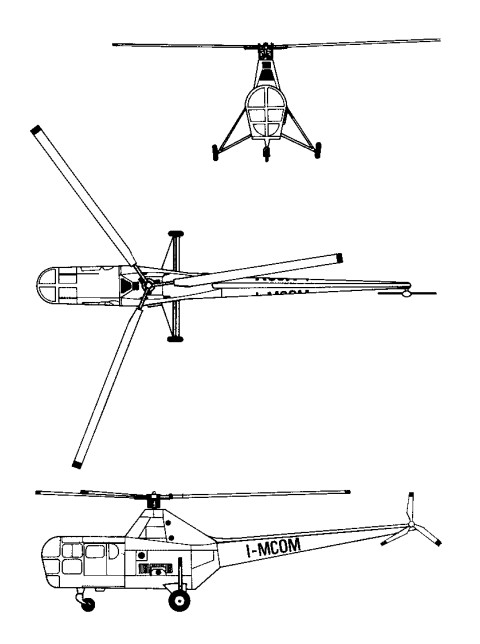
The H-19 was of all-metal pod-and-boom construction, had quadricycle wheeled landing gear, and carried its single piston engine in its nose. The engine was linked to the gear drive of the three-bladed main rotor by a long extension shaft, and was easily accessible via two large clamshell doors. The arrangement of powerplant and drivetrain allowed the placement of a large and unobstructed box-like passenger/cargo cabin directly below the main rotor blades, thus ensuring that loads of varying sizes and composition would not adversely affect the craft’s centre of gravity. The H-19’s two-man cockpit was placed above and slightly forward of the passenger/cargo cabin, with the seats placed one either size of the drive shaft, and offered excellent visibility to the front and sides. The craft’s high-set tailboom carried a vertical tailplane and a two-bladed anti-torque rotor, and was faired into the rear of the fuselage by a triangular fin.
Special attention was paid to the maintenance. The main parts were easily dismantled in an average of 12-15 hours and were all designed for ease of access (the engine, for example, could be changed in two hours, even without special equipment, and daily inspections took a maximum of 15-20 minutes). The S-55 had a monocoque metal fuselage with aluminum and magnesium light alloy bulkheads and skin. Except for the chrome-molybdenum steel-tube rotor pylon, structure is of aluminium and magnesium semi-monocoque construction. The three-blade main rotor had long-life metal blades (they demonstrated a life of over 20000 hours in lab tests). The main rotors are nitrogen filled with a hub mounted integral meter. The fuel was contained in two crash resistant tanks situated beneath the cabin in the lower part of the fuselage and had a total capacity of 700 liters. Each leg of the quadricycle undercarriage had its own shock absorber for maximum stability during take-off and landing and manoeuvres on the ground. Wheel track 3.35m. Floats could also be fitted to the legs for emergency landings on water, or the undercarriage could be replaced by permanent metal amphibious landing gear or permanently inflated rubber bag flotation gear. For use with the normal wheels, ‘doughnut’ pontoons were available which are stowed deflated on each wheel axle and can be inflated in under 5 seconds, when needed for landing on water.
The pilot’s compartment above main cabin seats two side by side with dual controls. Cabin located below main lifting rotor may seat from 7 (commercial) to 10 (military) passengers, the 10 passengers being seated three against front and rear walls and two on each side, all facing inwards. Up to six stretchers may be carried, which can be loaded by optional hydraulic power-operated hoist while aircraft is hovering. Pilot’s compartment may be entered from the outside or from the cabin so that co-pilot may act as attendant.
Engines were one Pratt & Whitney R-1340 S3H2 Wasp radial air-cooled engine rated at 410kW at 1,525m and with 447kW available for take-off at 915m, or one Wright R-1300-3 radial air-cooled engine rated at 522kW at 2,222m and with 596kW available for take-off at 1,675m. Engine on angular mounting in nose of fuselage with sloping shaft drive to rotor gear box below head. With the R-1300 engine, a hydromechanical clutch with free wheel system is used in the drive to the main transmission, and the drive-shaft from the free wheel unit to the main transmission has flexible rubber couplings on each end. Large clamshell doors in nose of fuselage allow complete accessibility to engine from ground level. Internal fuel capacity 700 litres.
In 1948 Sikorsky received a contract for five Sikorsky S-55 utility helicopters for US Air Force evaluation under the designation YH-19 (49-2012 to 49-2016). The first of these flew on 10 November 1949 and was characterized by a blunt-ended fuselage, which lacked the broad, triangular fillet connecting the fuselage to the tail boom which distinguished all the later series aircraft. Another characteristic of the YH-19 was the horizontal stabilizer applied to the starboard side of the tail, which was replaced in the production aircraft by two anhedral tail surfaces. These was powered by a 550hp Wright R-1340-S1H2.
Sikorsky YH-19 49-2012
In 1951 the US Air Force purchased fifty-five H-19A production machines (51-3846/3895, -17662/17666), fitted with 447kW / 550hp Pratt & Whitney R-1340-57 engine as the prototypes. Some were converted to Air-Sea Rescue SH-19A and HH-19A after 1962.
Near the end of 1951 the Air Force accepted the first of an eventual 270 more powerful and slightly modified H-19B aircraft (51-3896/3968, 52-7479/7600, -10991/10994, 53-4404/4464, -4878/4885, 56-6673/6674), and at the same time loaned a single H-19A to the Army for operational evaluation in the utility transport and aeromedical evacuation roles.
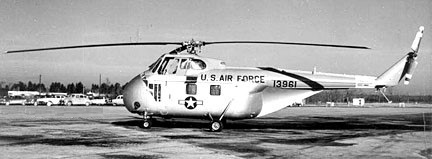
Sikorsky H-19B 51-3961
The H-19B had a 522kW / 700hp Wright R-1340-3 engine and a larger diameter main rotor. The total included the SH-19B version for use as a transport aircraft. Many were converted to Air-Sea Rescue SH-19B and HH-19B with rescue hoists after 1962. Redesignated as UH-19B in 1962.
In the fall of 1951 the Army ordered the first batch of an eventual seventy-two H-19C aircraft (serials 51-14242 through -14313). The Army’s H-19C was essentially identical to the Air Force H-19A and, like that aircraft, was powered by a 600hp R-1340-57 engine and had two small fins fitted to the lower rear of the tailboom in an inverted ‘V’.
They were subsequently nicknamed “Chickasaw” and redesignated UH-19C in 1962. Both variants remained in Army service well into the mid-1960s.
In late 1952 orders were placed for the first of some 336 examples of the more capable H-19D variant (52-7601/7625, 54-1408/1437, 55-3176, -3183/3228, -4937/4944, -4462/4504, -5235/5240, 56-1519/1568, -4246/4283, 57-1616/1641, -2553/2558, -5926/5982), sixty-one of which were transferred to friendly nations under various military assistance programmes.
The H-19D was the Army’s version of the Air Force -B model and shared that aircraft’s more powerful 700hp engine, downward-sloping tailboom, repositioned horizontal tail fins, and smaller-diameter tail rotor. Redesignated UH-19D in 1962.
July 1952 saw the world’s first transatlantic helicopter crossing when two USAF H-19s traveled from the USA to Wiesbaden (Germany) with stops in Labrador, Greenland, Iceland, Scotland, and the Netherlands on their way. Total flight time was about 52 hours, but because of stops the trip took 21 days.
Versions of the S-55 were also acquired by the US Navy, which signed its first contract on 28 April 1950. Between August 1950 and January 1958, the US Navy received 119 helicopters, including ten HO4S-1 (125506 to 125515, equivalent to the H-19A) and 61 HO4S-2, redesignated as UH-19F in 1962 (based on the H-19B, 30 of these were built as HO4S-3G for the US Coast Guard (1252 to 1258, 1281, 1298 to 1310, and 1323 to 1331, redesignated as HH-19G in 1962).
Sikorsky HO4S-3G 1300
Seventy-nine HO4S-3 were built for the USN (133739 to 133753, 133777 to 133779, 138494 to 138529, and 138577 to 138601) and two US Army H-19B transfers (150193 to 150194).
The Marines troop and assault transport versions were designated HRS-1 and HRS-2 (99 built), similar to the HO4S-1, 151 of which were delivered from April 1952. Eighty-four HRS-3 helicopters with Wright R-1300-3 engines were also built.
The aircraft assigned to the SAR divisions of the MATS and US Army Aviation arrived in Korea in January 1953 with the 6th Transportation Company, whereas the Marines were able to test their HRS-1s for rapid assault operations which anticipated full-scale landing operations. MATS Air Rescue versions were designated SH-19B and became HH-19B.
Powered by a Pratt and Whitney engine of 600 h.p. or a Wright engine of 800 h.p., the H-19 has a “brochure” capacity of eight troops, six litters, or a maximum of 1,500 lb of cargo, which can be carried over a distance of some 100 miles at a conservative gross weight of 6,835 lb. The maximum useful load is 3,033 lb, which gives a range of 400 miles, or 1,000 miles with extra tankage. The normal cruising speed is 80 to 86 m.p.h., with a fuel consumption of 31 Imp. gal/hr.
In actual service, the H-19 could be relied upon to bring a mean of two tons into the front line for each hour that the aircraft was at work. Of the 20 aircraft assigned to a company, 12 (or 57 per cent) were normally available at any time.
During operational missions, the average daily flight time was four hours per aircraft, a quarter-hour more than in the service of New York Airways, who operated civil S-55s.
The employment of cargo helicopters in Korea was not, of course, limited to the U.S. Army; the Air Force and, in particular, the Marine Corps, have had such aircraft in that theatre for over two years. An especially notable operation was carried out by Army and Marine Corps’ helicopters flying side-by-side, in which over 6,000 neutral Indian troops were “trucked” from a carrier in Inchon harbour to the Parimunjoin area. The H-19s were limited to 1,000 lb per lift.
The helicopter requires approximately three hours of maintenance after one day’s work. Refuelling time is approximately five minutes.
The 1953 HRS was a USN transport helicopter version of the S-55. First production was sixty as HRS-1; 127783 to 127842. Minor equipment changes were in the HRS-2. 101 were built (129017 to 129049, and 130138 to 130205), of which several were converted to HRS-3 standards. They were redesignated as CH-19E in 1962.
The HRS-3 were powered by a Wright R-1300-2 engine. Twenty-seven were upgraded HRS-2, four were transferred from the USAF, and 103 production were built (130206 to 130264, 137836 to 137845, 140958 to 140961, 141029, 141230, 142430 to 142436, 144244 to 144258, 144268 to 144270, 144666 to 144668, 146298 to 146302, and 146439), of which sixteen went to Spain. They were redesignated as CH-19E in 1962.
The HRS-4 was a planned version for Wright R-1820 engines, none was built.
HRS-3
The 1,000th Sikorsky-built helicopter of the basic S-55 type was delivered to the US Marine Corps in mid-1956. The H-19 Chickasaw holds the distinction of being the Army’s first true transport helicopter and, as such, played an important role in the initial formulation of Army doctrine regarding air mobility and the battlefield employment of troop-carrying helicopters. The Chickasaw made its combat debut during the last stages of the Korean War, and went on to serve in Southeast Asia during the first years of the Vietnam War.
Various techniques and roles were first tested with the S-55 in Korea which were later to form the basis of new military doctrine, such as landing operations behind enemy lines, troop support, recovery of damaged vehicles and their capacity for counterattack and engagement. Another primary task of the helicopter was casualty evacuation or the rescuing of pilots who had come down behind the enemy lines. In the ambulance role, the S-55 could carry up to six stretchers, five of which could be hoisted on board using a mechanical winch fixed outside the cabin. The spacious cabin was designed to accommodate various seating arrangements or freight; it could take up to ten men or a load of approximately 1300kg.
Sikorsky S-55
The S-55 received American civil type approval on 25 March 1952 and the model with the Pratt & Whitney R-1340 engines became the S-55A, while the version with the Wright engine was designated S-55B.
On commercial versions with the R-1300 engine, the tailcone has been sloped down approximately 3.5 degrees to increase clearance of the main rotor in a rough landing.
The first S-55 in commercial use in the world went into service in British Columbia to build the Alcan project in Kitimat, where the building of power lines by helicopter was another first. In 1952, the helicopter became the first rotary wing craft to be used for commercial links in Europe; it was then flown by the Belgian airline Sabena between the chief towns in Belgium and Lille, Rotterdam, Bonn and Cologne, starting on 1 September.
Sabena S-55
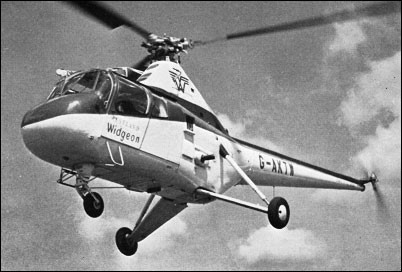
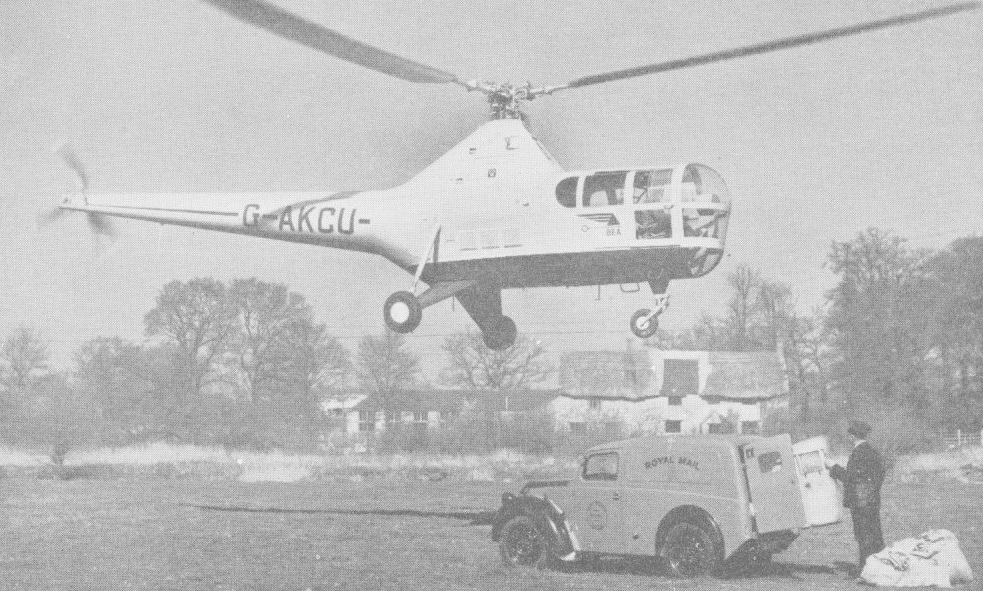
For a time BEA ran regular services with two Sikorsky S-55 between London Airport at Hounslow, Middlesex, and Waterloo in the centre of the city.
BEA S-55
The Whirlwinds were equipped with exterior emergency floatation gear.
UH-19
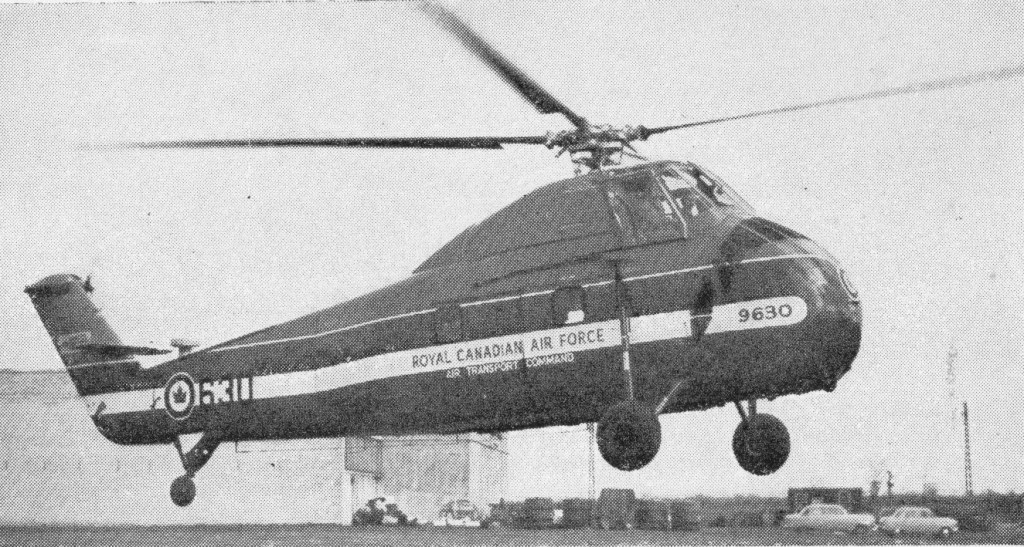
The RCAF included six H-34 transports for service with No.108 Comunication flight in duties connected with construction of the Mid-Canada radar line on the 55th parallel.
RCAF No.108 Comunication flight H-34
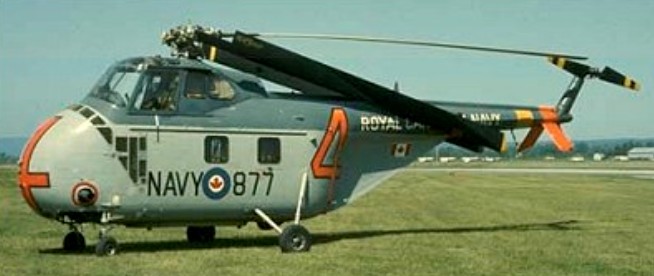
Sikorsky manufactured a total of 1,281 S-55’s in ten years of continuous production commencing in 1949 and another 547 were built under license by Mitsubishi, Sud Aviation, and Westland. It was used by many military services including the RCAF (as the UH-19 and by the RCN (as the HO4S-3) on ‘plane guard’ duties with aircraft carriers.
Licence-production was undertaken by SNCA du Sud Est in France as the Sud-Est Elephant Joyeuse, in Japan by Mitsubishi, and by Westland in the UK, the latter developing versions with the Alvis Leonides Major piston engine and with the Bristol Siddeley Gnome turboshaft under the family name Whirlwind. 2.HIBM in Turkey assembled the H-19 Chickasaw under licence from Sikorsky during 1958.
When Westland began producing the S-55, it specified that the American engine would be used until a more suitable British powerplant was available. To meet this requirement, Alvis developed a double radial called the Leonides Major, which delivered 882hp derated to 750hp. The re-engined Whirlwind flew in 1955. It was followed in 1956 by the Mk.7 version intended to replace the old Fairey Gannet antisubmarine aircraft.
The Series 1 and 2, powered respectively by a Pratt & Whitney R-1340 or Wright R-1300 engine or the 755hp Alvis Leonides Major 755. Installation of Wright R-1300 engines produced the Whirlwind Mk 3 in 1953, followed by the Mk 4 with new P&W R-1340 engines for use in the tropics; then Alvis Leonides Major engine.
The RAF also ordered this helicopter for transport and rescue missions: the Whirlwind HAR Mk.2 (the same as the naval version except for some differences in equipment) joined the Transport and Coastal Command Units from 1955. With Wright R.1300 engines, the Whirlwind Mk.3 went into production for the Royal Navy in 1953 and operated for many years from both ship and shore bases. The subsequent RAF HAR Mk.4 version was modified for use in the tropics and fitted with a new variant of the Pratt & Whitney R-1340. It was used in Malaysia.
WS.55 Whirlwind HAR.3
The turbine-powered S-55 made its first flight as the Whirlwind Series 3 in February 1959, powered by a General Electric T58 and introduced a new nose profile which offered better visibility. At the end of the year a Series 3 flew with a 1050shp Bristol Siddeley Gnorne free-turbine – the licence-built version of the T58. The new turboshaft engine was lighter and more powerful than the piston engine it superseded and offered improved performance and reliability.
The Royal Navy ordered a substantial number for anti-submarine duties under the designation Westland Whirlwind HAS.7. Deliveries began in May 1957.
Westland HAS.7
A total of sixty-eight new air-sea rescue HAR10 and transport HC10s were manufactured by Westland and a number of Whirlwind HAR2 and HAR4 piston-engined helicopters were subsequently re-engined.
Like the S-55, the Series 3 has a single door on the left side. The pilot and co-pilot sit above and behind the engine which places their cabin directly under the centreline of the main rotor. The rotor is hydraulically operated for both cyclic and collective pitch controls. Forward vision for landing was not ideal in earlier versions of the Whirlwind since the engine housing was in the nose. The turbine version was better since, though the nose was longer, it was at a more raked angle. Unlike the US turbine-powered S-55, the Whirlwind Series 3 has its engine exhaust on the left side almost immediately above the forward wheel, which can make cargo loading slightly hazardous if the engine is running or the exhaust hot. The turbine engine can be retrofitted to Series 1 and 2 machines.
Whirlwing HR.5
The first RAF unit to employ the HAR10 was No.225 Squadron, Transport Command, which became operational with the aircraft on 4 November 1961.
Used by the RAF in Europe, the Mediterranean and the Far East, the last squadron to be equipped with the aircraft Cyprus based No.84 Squadron converted to the Westland Wessex in March 1982.
Westland built a total of 364 S-55s under licence between 1953 and 1966, including 68 WS-55 civil aircraft. Most turbine-powered WS-55 Series 3s were converted from piston-engined Series 1s and 2s.
In 1964 Orlando Helicopter Airways Inc, of Sanford, Florida, was founded by Fred P. Clark to support, and in some cases, re-start production of Sikorsky helicopters no longer built by the parent company. In addition to a huge spares resource, Orlando Helicopters now holds the FAA type certificates for all H-19 and S-55 models. Several versions of the S-55 have since been developed by the firm. These include the OHA-S-55 Hen-Camper, a fully fitted out VIP version seating four passengers. New equipment includes a shower, wash-basin and toilet, air conditioning, carpeting and sound-proofing. An optional hydraulic winch, cargo sling or exterior spot-light can also be fitted. The Heli-Camper is powered by an overhauled and reconditioned 596kW Wright-Cyclone R-1300-3D engine.
The OHA-S-55 Nite-Writer is an unprecedented aerial advertising helicopter fitted with a 12.2m x 2.4m array of computer-controlled lights which can display messages and graphics, visible over a distance of 3.2km. More in demand is the OHA-S-55 Bearcat, for which Orlando has developed a quick-change hopper and spray system for crop and fertiliser spraying or seed spreading. Certified in 1991, the Bearcat is powered by a Pratt & Whitney R-1340 engine, which can run on automotive fuel, is fitted with a ‘quiet’ exhaust, and sold for US$300,000.
In October 1985 the company signed an agreement with China’s Guangzhou Machinery Tool Company to licence-build OHA-S-55 Bearcats. Under a 20-year joint venture Guangzhou Orlando Helicopters would first assemble American-built parts before progressing to manufacturing entire units. For carrying heavy external loads, such as logging or construction work, Orlando has developed the OHA-S-55 Heavy Lift which can deal with underslung weights of up to 1361kg. The company has also moved into a unique military market through modifying its S-55s for the US Army Missile Command. As QS-55 Aggressors they have been extensively modified to resemble Mil Mi-24 ‘Hind-E’s as flying targets. The Aggressors can be flown by a pilot or as drones (with dummy pilots in their cockpits) and have a new five-bladed main rotor, extensively redesigned nose, stub wings, and chaff and flare dispensers. A second, more aggressive military version is the armed OHA-AT 55 Defender, design of which began in 1990. Re-engined with a Garrett TPE331-3 turboshaft or a Wright R-1330-3 radial, the Defender also features a stub wing with pylons capable of carrying up to 500kg of weapons, and a five-bladed rotor. Capable of carrying up to 10 fully-equipped troops, the Defender can also be fitted out to accommodate six stretchers and two attendants.
In January 1971 Aviation Specialties Inc received certification for a turbine-powered conversion of Sikorsky S-55 helicopter powered with 1 x 840 hp AirResearch TSE-331, designated S-55-T. Aviation Specialties became Helitec Corporation in 1976.
Whisper Jet Inc produced a modified version of the S-55. The S-55QT is powered by a 650 shp Garrett Air Research TSE331-1OUA-511SW and fitted with a 5 blade main rotor head. Flown by a single pilot, the S-55QT can carry 9 passengers.
S-55C Engine: Pratt & Whitney R-1340 S3H2 Wasp radial, 447kW / 550 hp
YH-19 Engine: Pratt & Whitney R-1340 S3H2 Wasp radial, 447kW / 550 hp
H-19A Engine: Pratt & Whitney R-1340 S3H2 Wasp radial, 447kW / 550 hp AUW 3,263kg Crew: 2 Payload: 10 troops or six stretchers Internal fuel capacity: 700 lt
H-19A Engine: Pratt & Whitney R-1340-57, 600 hp Rotors: 3-blade main; 2-blade tail Rotor diameter: 49 ft. Fuselage length: 41 ft 8.5 in Loaded weight: 6,835 lb Max speed: 105 mph Ceiling: 12,900 ft Typical range: 440 miles at 90 mph Seats: 2 crew+13-10 passengers
H-19A / SH-19A Engine: Pratt & Whitney R-1340-57, 600 hp Rotors: 3-blade main; 2-blade tail Rotor diameter: 53′ 3″ Fuselage length: 41 ft 8.5 in Loaded weight: 6,835 lb Max speed: 115 mph Cruise: 90 mph Ceiling: 12,900 ft Typical range: 440 miles at 90 mph Seats: 2 crew+13-10 passengersInternal fuel capacity: 700 lt
H-19B / SH-19B / UH-19B 1951 Engine: Wright R-1300-3 Cyclone radial, 596kW / 700 hp Rotor diameter 16.16m / 53’0″ Length: 12.88 m / 42’3″ Height: 4.06 m Disc Area: 204.95 sq.m Empty weight: 2381 kg MAUW: 3583 Useful load: 2650 lb Top Speed: 180 km/h / 112 mph Cruise Speed: 146 km/h / 91 mph Range: 579 km / 360 mi Crew: 2 Payload: 10 troops or six stretchers. Internal fuel capacity: 700 lt
H-19C / UH-19C Engine: Pratt & Whitney R-1340 S3H2 Wasp radial, 447kW / 550 hp Maximum speed: 112 mph (180 km/h) Empty weight: 5,250 lb (2381 kg) Maximum weight: 7,900 lb (3583 kg) Rotor diameter: 53 ft (16.2 m) Fuselage length: 42 ft 3 in (12.9 m) Overall height: 14 ft 8 in (4.5 m) Crew: 2 Payload: 10 troops or six stretchers Internal fuel capacity: 700 lt
H-19C / UH-19C 1952 Engine: 600hp R-1340-57 Useful load: 2705 lb Max speed: 101 mpg Cruise: 85 mph Range: 450 mi Ceiling: 10,500 ft
H-19D / UH-19D 1952 Engine: Wright R-1300-3 Cyclone radial, 596kW / 700 hp Rotor diameter: 53 ft (16.2 m) Fuselage length: 42 ft 3 in (12.9 m) Overall height: 14 ft 8 in (4.5 m) Empty weight: 5,250 lb (2381 kg) Maximum weight: 7,900 lb (3583 kg) Useful load: 2650 lb Maximum speed: 112 mph (180 km/h) Cruise: 91 mph Range: 385 mi Ceiling: 12,500′ Crew: 2 Payload: 10 troops or six stretchers Internal fuel capacity: 700 lt
HH 19 Chickasaw Engine: Wright R-1300-3 Cyclone radial, 596kW / 700 hp Length: 42.257 ft / 12.88 m Rotor diameter: 52.986 ft / 16.15 m Max take off weight: 7900.5 lb / 3583.0 kg Weight empty: 5261.1 lb / 2386.0 kg Max. speed: 97 kts / 180 km/h Cruising speed: 79 kts / 146 km/h Range: 313 nm / 580 km Crew: 2 Payload: 10 Pax
HO4-1 U.S. Navy anti-submarine Engine: Wright R-1820, 1,025 hp
HO4-2 U.S. Navy anti-submarine Engine: Wright R-1820, 1,025 hp
HO4S Engine: P&W R-1340-57 Main rotor: 53’3″ Length: 42’1″ Max speed: 115 mph
Westland WS-55 Whirlwind HAS.7 Engine: 1 x Alvis Leonides Major Mk.155, 750 hp Rotor diameter: 53 ft Main rotor disc area: 2206 sq.ft Main rotor: 3 blade Fuselage length: 41 ft 8.5 in Height: 13 ft 3 in Empty weight: 5580 lb MAUW: 7800 lb Fuel capacity: 170 gal Max speed: 109 mph at SL Cruise speed: 86 mph Service ceiling: 13,800 ft Range: 400 mi Tail rotor: 2 blade
Westland WS-55 Whirlwind HAR.9 Rotor diameter 58 ft Fuselage length 41 ft 8.5 in Mauw 7500 lb Cruise speed 90 mph
Westland Whirlwind H.A.R. Mk. 21
Westland Whirlwind H.A.S. Mk. 22 Engine: Wright R-1820, 1,025 hp
Orlando Helicopter Airways OHA-S-55 Heavy Lift Slung load: 1361kg
Orlando Helicopter Airways QS-55 Aggressors Flying target Main rotor: five-blade
Orlando Helicopter Airways OHA-AT 55 Defender Engine: Garrett TPE331-3 turboshaft or Wright R-1330-3 radial Main rotor: five-blade Warload: 500kg Passangers: 10 fully-equipped troops or six stretchers and two attendants.
Aviation Specialties S-55-T Engine: 1 x 840 hp AirResearch TSE-331
Helitec Corporation S-55-T 1971 Engine: 1 x 840 hp AirResearch TSE-331-3U-303
S-55-GW Engine: 700hp Wright R-1300
Whisper Jet Inc S-55QT Engine: 650 shp Garrett Air Research TSE331-1OUA-511SW Main rotor: 5 blade Gross wt: 7700 lb Service ceiling: 14,100ft Max range: 365 miles Max cruise: 98mph Capacity: 9 passenger
After losing to Piasecki’s tandem-rotor configuration, Sikorsky bought back an R-4B from the US Air Force and modified it to the ‘sesqui-tandem’ configuration once tested on the VS-300, with an observer’s seat added aft of the main rotor. The resulting S-54 was first flown on 20 December 1948 and logged 4 hours 25 minutes flying time before being abandoned in early 1949.
Sikorsky considered that at cruising speed the tail rotor did not absorb any more power than that lost owing to rotor interference with twin rotors.
The Sikorsky S-53 was a development of the S-51 series and was designed specifically for utility, observation, and rescue duties aboard aircraft carriers, battleships, and cruisers.
The S-53 featured a fuselage and rotor system very similar to that of the S-51, but with some modifications: the tail rotor was raised above head-height for safety, the landing gear was strengthened for operations from a pitching deck, and the three-bladed main rotor was fitted with a folding mechanism. Amphibious landing gear was optional. A trapdoor in the cabin floor permitted the installation of a camera or a hoist for the transfer of bulky cargo by means of a sling.
The prototype, Bu. 30368, first flew on 22 September 1947.
Two prototypes of this three- to five-place aircraft were procured in 1948 by the U.S. Navy as the XHJS-1 (30368 and 30370), but no production contract resulted.
Additional attempts to market the S-53 were unsuccessful, and the model was developed no further.
XHJS-1 Engine: one 525hp Continental R-975-34 Rotor diameter: 49’0″ Max speed: 110 mph Seats: 3-4
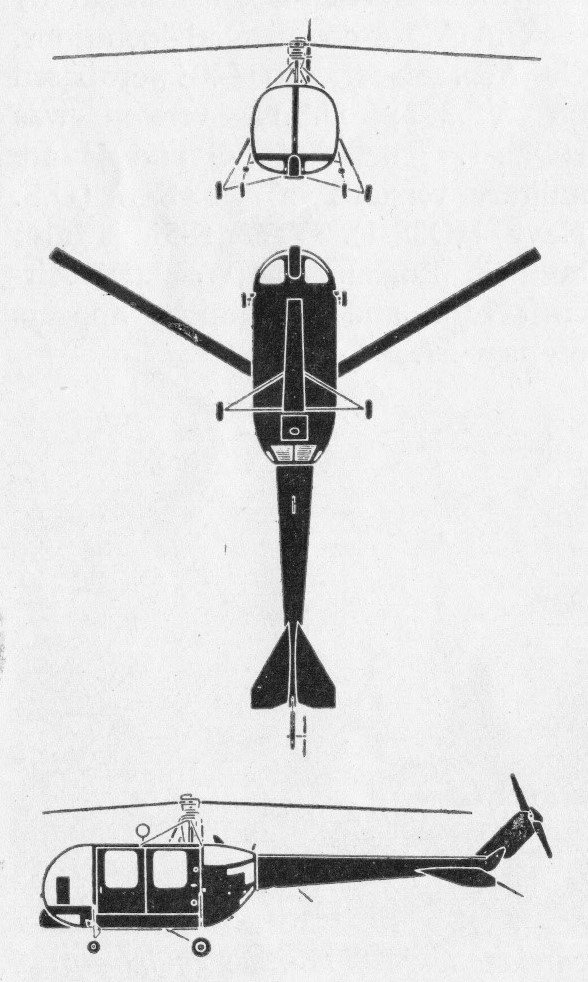
Design work on the Sikorsky Model S-52 began in late 1945, and the craft made its first flight in the summer of the following year. The first American helicopter to be equipped with all-metal main and anti-torque rotor blades, the S-52 had a semi-monocoque, pod-and-boom type fuselage, a single 175hp Franklin engine, quadricycle wheeled landing gear, and a fully-enclosed cabin that could seat up to three people. The machine’s performance was impressive by the standards of the day. The commercial S-52 set three international speed and altitude records in 1948. These 1948 records were 208.57km/h over a 3-kilometer course, 197.55km/h over a 100-kilometer course, and 6468 metres absolute height.
A two-seat helicopter, featuring all-metal rotor blades. The two-seat S-52 (YH-18 Serial number 49-2888) first flew on Feb 12, 1947, powered by a 133kW Franklin engine.
Shortly after gaining the speed record, the little two-seater demonstrated its manoeuvrability, during the course of a routine test flight, by performing a series of successive “loops,” gaining height slightly after each in the approved manner. The pilot was Harry Thompson of Sikorsky’s flight-test department, and the date was May 9th, 1949. Later he repeated the performance – carrying Ralph Alex, then project engineer, as passenger.
The S-52’s performance was a factor in the Army’s 1949 decision to purchase four examples of the slightly modified Model S-52-2 for service test and evaluation. It is the H-18 that holds the distinction of being the first Sikorsky helicopter to be procured for service evaluation by the Army Ground Forces, as distinct from the USAAF.
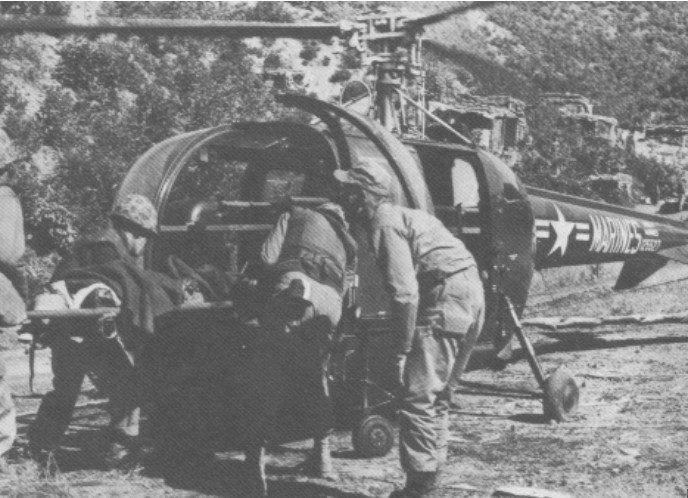
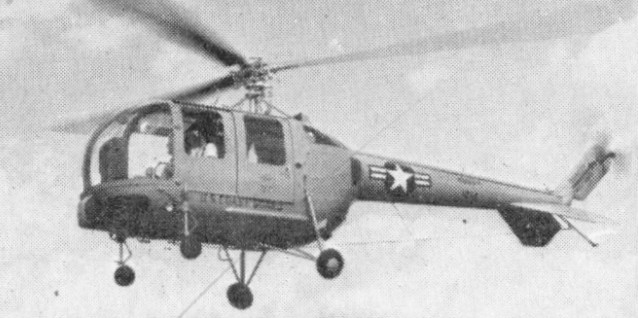
The Army’s four YH-18As (serials 49-2888 through -2891) were essentially similar to the standard commercial S-52, differing primarily in their ability to carry a fourth passenger. Extensive testing showed the YH-18A to be quite capable in the light utility and observation roles, but the Army ultimately decided not to procure the type in quantity. Two were converted as XH-39/-39A test-beds.
Sikorsky H-18 Turbine version 49-2890
The S-52-2, a three/four-seater with a 183kW Franklin O-425-1 engine which was ordered by the US Marine Corps as a replacement for the HO3S. Deliveries of the HO5S-1 began in March 1952, and eight served also with the US Coast Guard as the HO5S-1G (1244 to 1251).
The use of a high-speed rotor allows a wide range of permissible rotor revolutions in flight, which is of particular advantage in the autorotative-landing case. Where an engine-off landing with zero forward speed is desired, it is possible, by using the kinetic energy stored in the rotor, to hover the machine momentarily in the flare-out before touching down. The touch-down itself is perfectly steady with the quadricycle landing gear.
The rotor blades were originally incorporated on the S-52-1 and the main spar is an alloy extrusion which is itself the leading edge of the blade. The trailing edge is made up in sections, each of which is attached to the spar individually. Thus the sections towards the blade tip are relieved of carrying the centrifugal load exerted on the inner sections, resulting in greater overall strength. The blades are fully interchangeable and their uniformity is a considerable contribution to the smoothness of the machine in flight.
S-52-2
The enlarged version, designated S-52-2, was granted its C.A.A. certification in the early part of 1951. A few civil machines were built, but the main production up to the present has been for the U.S. Navy; the type has been designated HO5S-1. Seventy-nine HO5S-1 went to the USN; 125516 to 125527, 126696 to 126705, 128601 to 128620, and 130101 to 130137. The machine is officially classified as a “three-place” helicopter but a fourth occupant can be carried on shorter flights. The large fuel-tankage capacity allows for 227 litres.
With a pilot and three passengers aboard sufficient fuel can be carried for a flight of approximately one-and-a-half hours – or a distance of between 193 kilometres and 225 kilometres at the cruising speed of 153km/h. With only three occupants the fuel tank may be filled, giving an endurance of 3.5 hours and a range, with fuel reserves, of 530 kilometers. This “built-in alternative” increases the machine’s versatility and has been proved to be of much practical value in the field. For delivery flights, auxiliary fuel tanks may be fitted to provide for a maximum distance of 1287 kilometres with pilot only aboard.
In its role as a rescue helicopter the S-52-2 normally carries two stretcher cases alongside the pilot. The canopy opens forward, in a manner reminiscent of the Bristol Freighter, to allow ease of loading and unloading.
Improvements in stability have been effected by the addition of large ventral stabilizing fins to the tail boom. These fins are fixed surfaces, as they have recently been so made on the American S-55. In earlier versions of the S-55 the fins were adjustable by the pilot to provide fore-and-aft trimming in flight, but this is no longer necessary. Additional vertical fin area has also been provided by an extended fairing on the tail-boom elbow to compensate for the increased keel surface forward of the rotor pylon with the longer nose.
The U.S. Navy purchased 89 S-52-3s as the HO5S-1 for general utility duties, all of which were delivered by 1953.
Sikorsky H-18 Turbine version 49-2890
One aircraft was later converted into the sole H-39 turbine-powered research helicopter and the S-52-2 eventually served the Navy, Marine Corps and Coast Guard as the HO5S.
In all its flight history, the S 52 3 only had one AD (Airworthiness Directive) released, relating to re torqueing of the flywheel bolts on the Franklin engine.
On Jul 24, 1953 the S-52T (YH-18B) turbine powered version of the S-52 was first flown. It used a french Turbomeca Artouste I engine. A developed version designated YH-18B and powered by a T51-T-3 (Artoustc) turbine is now re-designated XH-39, and has set up an international helicopter speed record of 156 mph.
Sikorsky YH-1S Engine: 245 h.p. Franklin Rotor dia: 33 ft Weight: 2,400 lb Max Speed: 110 mph
HO5S Engine: Franklin O-425-1 Main rotor: 33’0″ Length: 28’4″ Max speed: 100 mph Seats: 4
HO5S-1G Engine: 1 x Franklin O-425-1, 183kW Main rotor diameter: 10.06m Fuselage length: 8.79m Height: 2.64m Max take-off weight: 1218kg Empty weight: 744kg Max speed: 177km/h Cruising speed: 148km/h Service ceiling: 4815m Range: 576km Crew + passengers: 1+3
S-52-2 Engine: Franklin 6V6-245-BI6F, 245 hp Rotor diameter: 33 ft Rotors: 3-blade main; 2-blade tail Fuselage length: 27 ft 5 in Loaded weight: 2,700 lb Max speed: 110 mph Ceiling: 22,200 ft Typical range: 415 miles at 95 mph Seats: 3-4
H-18 Engine: Franklin O-425-1, 245hp Rotor diameter: 33’0″ Length: 28’10” Useful load: 1050 lb Max speed: 100 mph Cruise speed: 92 mph Range: 358 mi Ceiling: 15,800′. Seats: 4
The development of the XR-5 officially began when the British Air Commission placed an order for two “large” (compared to the diminutive XR-4) prototype Vought-Sikorsky helicopters on April 29, 1942. At this time, German U-boat wolfpacks remained a considerable threat to the lifeline of trans-Atlantic convoys that sustained Great Britain. The convoys were particularly vulnerable in mid-Atlantic, beyond the range of shore-based anti-submarine patrol aircraft. There were also very few aircraft carriers available to sail with the convoys and provide air cover. A helicopter that could carry bombs or depth charges and operate from the decks of escort vessels or even merchant ships appeared to offer an ideal solution to the U-boat problem.
The US Army Air Forces caught on to the possibilities of an upgraded XR-4 and quickly submitted a request on May 8, 1942, for an upgraded design, a “workhorse” helicopter with a useful load of over 495 kg (1,100 lb). The request stated, “it is urgently desired to develop a helicopter with greater useful load, endurance, speed, service ceiling, which would have greater utility than the XR-4.” On May 27, the Air Material Command issued Technical Instruction 1124. This order released funds for the construction of four helicopters of the “workhorse” type, designated XR-5. The requirements of the AAF and the British were similar enough that a single design could probably fulfill both needs. Two of the four machines described in TI 1124 were earmarked for Britain to be paid for using Lend-Lease funds.
The XR-5 came about as a direct result of lessons learned from Sikorsky’s development of the R-4. While the R-4, and its developmental cousin, the R-6, saw operational service in World War II, they were underpowered, difficult to fly, and required excessive maintenance, which led to a limited service life. The production R-5s and their civilian counterpart, the S-51, overcame these difficulties and played an important role in establishing the helicopter as an indispensable aircraft for military and civilian operators.
The design process for the XR-5 was already well under way by the time TI 1124 was issued. More than six months earlier, Igor Sikorsky had anticipated a military request for a purpose-built observation helicopter. The Platt-LePage XR-1 had already won the AAF contract for development of an observation helicopter, but Sikorsky knew it would never become a practical service machine. Well ahead of actual events, he launched a program to develop a more practical design called the VS-327 (V for Vought and S for Sikorsky. Vought, like Sikorsky, was one of several companies owned by the holding company United Aircraft). Development began on September 26, 1941, and William E. Hunt was named project manager. When the Technical Instruction for the XR-5 was issued, the VS-327 handily met the requirements.
Work on the design progressed quickly, but when construction began on the first prototype, the pace slowed. As chief designer, Igor Sikorsky had a pivotal role to play but the demands of other projects distracted him. There was also considerable difficulty obtaining certain strategic materials such as aluminum to build the helicopter. The AAF considered helicopters interesting and promising, but gave conventional warplanes a higher priority. Sikorsky had to build certain sections of the helicopter, such as the tailcone and fuselage panels, from non-strategic materials, such as wood. This increased the aircraft’s weight, reduced structural integrity, and delayed the project. Aluminum versions replaced these wooden components when the predicted shortages failed to materialize. The 450hp Pratt & Whitney R-985 Wasp Junior engine chosen for the XR-5 was also a source of trouble. At that time, this power plant was used in Vought’s OS2U Kingfisher naval floatplane. To speed construction, Sikorsky retained the Kingfisher engine mount arrangement in the XR-5 but during ground runs, the helicopter overheated badly. A fan was needed to force more cooling air through the engine compartment, but there was not enough space to install it within the Kingfisher engine mount. Revising the mount and adding the fan further delayed the program.
Sikorsky was aware that the box-top fuselage of the XR-4 obstructed airflow from the main rotor and reduced the rotor’s lifting capacity. He also knew that visibility out of this earlier design could be much improved and these two design goals drove the overall layout of the XR-5. The fuselage was more streamlined and slimmer in profile, and nearly the entire nose of the helicopter was covered in Plexiglas windows. The observer occupied the front seat of this “fishbowl,” while the pilot occupied the seat directly behind him. The XR-4 used a tricycle undercarriage supplemented by a strut and wheel extending attached beneath the rear fuselage to prevent the tail rotor from striking the ground during flight-testing. Sikorsky dispensed with this wheel and strut on the production models.
Each of the three rotor blades resembled the fixed-wing of a conventional airplane. A laminated wooden spar supported wooden ribs and the whole assembly was covered with fabric. These blades were difficult to build, hard to balance, and easily damaged by rain. Sikorsky replaced the wooden spars with steel tubes in production versions of the XR-5 and this resulted in safer, more durable blades. However, he had to retain the fabric covering. It was not yet possible to build a rotor blade skinned with metal that was also flexible enough to flap and flex in flight. The S-51 had a three-blade rotor which had flapping and drag hinges and could be folded to facilitate storage. The early machines had manual control for the rotor pitch, later replaced by hydraulic servo-controls with power from a hydraulic pump driven by the tail transmission shaft.
Company chief test pilot Les Morris carried out the first flight of the XR-5 (s/n 43-28236) on August 18, 1943. Following adjustments to blade tracking and lead-lag dampers, flights soon exceeded 30 minutes. On September 13, the XR-5 lifted a pilot, observer, and eight passengers perched on the landing gear strut fairings, and exceeded the military useful load requirement by 270 kg (600 lb).
Testing progressed well until October 12. With Sikorsky’s nephew, Jimmy Viner, at the controls, the tail rotor failed at an altitude of 23 m (75 ft). Viner crash-landed and neither he, nor his observer were injured, but the aircraft suffered significant damage. Production on the next XR-5 (s/n 43-28237) was quickly stepped up and test flying resumed the last week of November 1943.
AAF leaders authorized series production of the XR-5 on March 24, 1943, to commence whenever the final development phase of the XR-5 was complete. This contract specified a production run of 250 aircraft, 100 of them earmarked for Great Britain. The contract soon increased by 150 helicopters for the AAF, and the Navy ordered 50 more. The development process had continued at a steady but relatively slow pace, as much of Sikorsky’s effort was focused on series production of the R-4 and R-6. These helicopters had met their contract requirements while the XR-5 was still struggling through the test program. Great Britain cancelled two XR-5s on March 25, 1944, because aircraft carriers and long-range patrol aircraft had filled the antisubmarine role originally envisioned for the R-5. The AAF quickly moved to take over this order, as Lt. Col. Frank Gregory, head of the AAF helicopter program, remained enthusiastic about XR-5. He considered it more advanced than any other American helicopter developed up to that time. Flight tests began on the fifth and final XR-5 at the Sikorsky plant in Bridgeport, CT, on January 17, 1944. The AAF accepted this aircraft and transferred it to Wright Field for further development on September 30, 1944.
That this dawn of a new technological era remained perilous for both man and machine is graphically illustrated by the fate of the XR-5s. The third (s/n 43-28238) was destroyed on November 4, 1944. The fabric covering one of the rotor blades tore loose and in the ensuing crash, the helicopter rolled over. The second XR-5 suffered a fatal crash at Gainesville, Florida, on December 2, 1944, when welds in one of the steel collars holding the blades to the rotor mast failed. As a result, a different welding technique was adopted on the assembly line. The first XR-5 suffered an engine failure while flying to a war bond rally in Nebraska. The pilot crash-landed but the airframe was too damaged to repair it was scavenged for spare parts. The AAF continued to test the last XR-5 (s/n 43-47954) until 1946, when the service handed the helicopter over to the National Air Museum (later the Smithsonian National Air and Space Museum).
By March 29, 1945, the AAF declared the XR-5 development program complete and service planners cleared the R-5A for series production. The AAF designated the first 26 aircraft off the line as YR-5A service test aircraft, but these helicopters did not otherwise differ from production R-5As. Two were assigned to the Navy under the designation HO2S-1 (75689 and 75690). In 1946 they were handed over to USCG as HO2S-1G. Trouble returned to the program after the R-5A began flying. Poor aerodynamic analysis by the National Advisory Committee for Aeronautics (NACA) caused Sikorsky to turn out unbalanced rotor blades, and the company was forced to correct the flaw with makeshift repairs that hurt performance of the production aircraft. When World War II ended, the AAF cancelled or reduced a number of aircraft contracts, including the R-5A, and Sikorsky completed 60 YR-5A and R-5A aircraft, of which, only nine were delivered before V-E Day. Ironically, the cancellation allowed the designer to further refine the aircraft, and to develop it for the civil market. This work produced the R-5F and its civilian counterpart, the S-51. In these models, the rear-seat cockpit was converted into seating for three and the observer seat became the pilot’s position.
Of the five XR-5, 43-28236/28239 to -47954, two were fitted with British equipment and redesignated as XR-5A.
Royal Navy Westland-Sikorsky S-51 Dragonfly – 1952
While production of the R-5A was getting under way (34 built, 43-46626 to -46659), five pre-series aircraft, 43-46611 to 46615, were converted into the R-5E, which had dual control. The YH-5E were redesignated as YH-5E in 1948. Twenty-one modified R-5As, 43-46606 and -46640 to -46659, were later given new, 600hp Wasp Junior engines and redesignated R-5D, then H-5D in 1948. The R-5D featured with nose wheel, rescue hoist, and external fuel tank. From the latter, the S-51 was developed, with a slightly enlarged four-seat cabin and a tricycle landing gear. The R-5A were fitted with external litters for SAR duty.
Sikorsky YR-5D 43-46642
Modified from a military design for the civil market (TC H-2), the S-51 was the world’s first commercial helicopter, inaugurated Philadelphia’s Helicopter Air Transport service. With a three-blade main rotor the S-51 first flew on 16 February 1946, and went to the USAF as R-5F, and USN as HO3S-1. Eleven of the 1948 R-5F were built, 47-480 to -490, basically a four-place military S-51 (with nose wheel). Licensed production in Great Britain as Westland-Sikorsky Dragonfly (with 520hp Alvis). The S-51 was a prototype for S-53.
Ninety-two of the 1946 HO3S-1 were built (57995 to 57998, 122508 to 122529, 122709 to 122728, 123118 to 123143, and 124334 to 124353). Nine HO3S-1s were used by the US Coast Guard as HO3S-1Gs (1230 to 1238). HO3S-1s served with distinction in the Korean War with Squadron HU-1. In 1950 Sikorsky built and tested a single XHO3S-3 with a redesigned rotor head and blades.
HO3S-2 was a designation reserved for a USN version of the H-5H but not used.
One HO3S-1 was fitted with a different rotor in 1950 as the XHO3S-3.
Although the AAF accepted R-5A helicopters before the end of World War II, these never reached operational units and service interest in the aircraft appeared to be waning. Sikorsky believed that without military customers, the civilian S-51 held the key to continued growth of the helicopter market and he promoted it vigorously.
On November 29, 1945, an S-51 dramatically rescued two seamen from a foundering barge off the coast at Bridgeport during severe weather. This event renewed military interest and a number of R-5 variants served until after the Korean War. Before the arrival of Bell’s H-13 (Model 47) into the Korean combat zone in 1951, military pilots flying the H-5 (H for helicopter replaced R for rotorcraft) conducted most of the thousands of medical evacuation (medevac) missions flown during that war. The H-5 and the H-13 reduced the fatality rate among wounded soldiers during the Korean War by more than 50 percent, however, the narrow center of gravity range on the H-5 soon made it obsolete compared to newer helicopters. Sikorsky attempted to extend the longevity of this classic design by offering the U. S. Navy a new five-seat version, the XHJS-1, but the helicopter lost out to Piasecki’s tandem-rotor HUP-1.
In 1950 Sikorsky built and tested a single XHO3S-3 with a redesigned rotor head and blades. The R-5B, R-5C and HO3S-2 were planned variants later cancelled.
8ikorsky H-5
Thirty-nine of the 1948 H-5G SAR version with hoist were built: 48-524 to -562.
Sixteen of the 1949 H-5H combination wheel and pontoon gear variant were built: 49-1996 to -2100.
Sikorsky H-5H
As the H-5 disappeared from the U.S. military inventories, Westland Aircraft Limited of England continued to build the aircraft, under license, as the HR.1 Dragonfly. These aircraft served with the Royal Air Force and Royal Navy throughout most of the 1950s. The British built version has a 520 hp Alvis Leonides radial engine installed with the crankshaft vertical, and having all metal rotor blades.
In December 1946 Westland Aircraft of Yeovil purchased a licence to build the S-51 in Britain. When they ceased production in 1953 they had built 139 machines. The Dragonfly, as the British-built machine was known, had a 520hp Alvis Leonides engine, a redesigned cabin for four passengers plus the pilot, and a three-blade rotor.
Basically similar to the US-built aircraft, the type was assembled from British-built components and in all but one variant was powered by the Alvis Leonides engine. The first civil Westland/ Sikorsky WS-51 was flown on 5 October 1948 and on 24 July 1951 the type became the first British-built helicopter to gain a certificate of airworthiness. Before that, in 1950, a version designated Dragonfly HR.Mk 1 equipped the Royal Navy’s first helicopter squadron, No. 705 formed at RNAS Gosport.
Pest Control Westland Sikorsky – 1949
Commercial versions are the Mk. 1A with Alvis Lconides and Mk. 1B with Wasp Junior engine, as in the American model. In the British services the type is known as the Dragonfly: the H.R. Mk. 1 (composite blades) and H.R. Mk. 3 (metal blades) are used by the Royal Navy; similar models in service with the R.A.F. are designated H.C. Mk. 2 and H.C. N1k. 4 respectively.
Westland WS.51 Dragonfly NR.1
Built to a total of 133, the Dragonfly was followed by a developed version, the Westland Widgeon, the prototype of which was a conversion of a Dragonfly to provide five-seat capacity and which benefited from the introduction of the improved rotor of the Sikorsky S-55. It had a four-blade main rotor with a 520hp Leonides 521 engine. The Widgeon original airframe was given a new front fuselage for a pilot and four passengers in a two/three arrangement, and small clamshell nose doors. The first Dragonfly converted to Widgeon standard, first flew on 23 August, 1955, for 30 minutes, at Yeovil, piloted by Roy Dradley.
During 1957, the five seat Widgeon obtained a Type Certificate of Airworthiness.
Westland produced 15 Widgeons and sold them to Ceylon, Jordan, Brazil and the Hong Kong police department. The Widgeon used an S-55 rotorhead which employs an offset flapping-hinge system, thus allowing more latitude in the centre of gravity and the position of cargo or passengers.
Westland sold their UK-built helicopters to Belgium, Ceylon, Egypt, France, Iraq, Italy, Japan, Thailand and Yugoslavia. At least one model was equipped for rescue operations with an external hoist capable of lifting up to 455kg. The bulk of these sales were for military use, but Belgium became a European pioneer in the civil field when Sabena bought three. The S-51 had a three-blade rotor which had flapping and drag hinges and could be folded to facilitate storage. The early machines had manual control for the rotor pitch, later replaced by hydraulic servo-controls with power from a hydraulic pump driven by the tail transmission shaft.
1949 London-Paris service, pilot Alan Bristow landing at Les Invalides
Westland Widgeon
B.E.A. commenced helicopter operations on 21 February 1949 with S-51s. BEA ran a trial helicopter service between Cardiff and Liverpool during 1950-51 and later, a service between Birmingham and London using the Sikorsky S-51.
BEA S-51
Helicopter Air Transport (HAT), based in New Jersey, became one of the first commercial helicopter operators when it took delivery of several S-51s in 1946. The operating cost of these aircraft proved too high for HAT’s primary business, flight training, and the company went bankrupt. A number of airlines and other companies experimented in the late 1940s and early 1950s with the S-51 for passenger, freight, and mail service but again, the costs of operating and maintaining the helicopter were simply too high for any of these enterprises too succeed. The S-51 failed to develop into a commercially viable aircraft but it proved that civilian helicopters could perform useful jobs, and it paved the way for more advanced designs. However, no helicopter airline has survived without massive government subsidies.
The S-51 has the distinction of being the first helicopter in the world to fly a regular service, and it did so in the United Kingdom. It flew in British European Airways’ colours between Liverpool and Cardiff in June 1950.
Dragonfly HR.Mk 1 Initial air/sea rescue (ASR) version for Royal Navy with the Alvis Leonides 50 radial engine
Dragonfly HC.Mk 2 Similar to Dragonfly HR.Mk 1 but equipped as casualty evacuation aircraft for the RAF
Dragonfly HR.Mk 3 Major production ASR version for Royal Navy (58 built); generally as Dragonfly HR.Mk 1 but introduced all-metal rotor
Dragonfly HC.Mk 4 Casualty evacuation version for RAF, similar to Dragonfly HR.Mk 3
Dragonfly HR.Mk 5 Final ASR version for Royal Navy, similar to Dragonfly HR.Mk 3
Westland/Sikorsky Mk 1A Civil version with 388kW Alvis Leonides 521/1 engine; most used as civil transports, but small numbers to Japan for rescue, and to Italian and Thai air forces
Westland/Sikorsky Mk 1B Civil version similar to Mk 1A but with 336kW Pratt & Whitney R-985-B4 Wasp Junior engine
Sikorsky XR-5 / VS-327 Rotor Diameter: 14.6 m (48 ft) Length: 13.71 m (44 ft 11.5 in) Height: 3.9 m (13 ft) Weight empty: 1,656 kg (3,650 lb)
Sikorsky S-51 DragonFly (H-5) Engine: One P&W R-985-AN-5 Wasp Junior, 450 hp / 336kW Rotor diameter: 14.63 m Length rotors turning: 13.70m Fuselage length: 12.45 m Height: 3.96 m Weight: Empty: 1715 kg Max take-off weight: 2263kg Speed: Max: 171 km/h Range: 579 km Service Ceiling: 4389 m Crew: 1 Passengers: 3
H-5 Engine: 450 h.p. Pratt & Whitney R985-5 or -7 Wasp Junior Rotors: 3-blade main; 2-blade tail Rotor dia.: 49 ft Fuselage length: 44 ft 11.5 in Loaded weight: 5,500 lb Max. Speed: 103 mph Ceiling: 13,500 ft Typical range: 260 miles at 85 mph Seats: 4
HO3S-1 Engine: 450 hp P&W R-985-AN-5 Rotor: 49’0″ Length: 41’1″ Max speed: 105 mph
Westland WS.51 Dragonfly HR.5 Engine: 520 hp Alvis Leonides radial Main rotor diameter: 14.99m Cruising speed: 142km/h
Westland WS.51 Dragonfly NR.1 Engine: 520 hp Alvis Leonides radial Main rotor diameter: 14.99m Cruising speed: 142km/h
Westland Widgeon Engine: 520hp Leonides 521 Rotor dia: 49 ft 2 in Length overall: 57 ft 7.5 in Height: 12 ft 11.5 in Empty weight; 4424 lb MTOW: 5900 lb Max payload: 1108 lb Range max payload: 20 nm Max range: 262 nm. Max speed: 83 kt Normal cruise: 70 kt ROC: 970 fpm Service ceiling: 10,500 ft HIGE: 7500 ft Seats: 5
Westland Widgeon 5 Engine; Alvis Leonides Major Empty weight: 5262 lb MAUW: 8000 lb Max speed SL/ 95 kt ROC: 825 fpm Service ceiling: 12,500 ft HIGE: 7,000 ft Range: 300 nm Max range; 1214 nm
Westland Dragonfly Engine: 520 h.p. Alvis Leonides 50 Rotors: 3-blade main; 3-blade tail Rotor diameter: 49 ft Fuselage length: 57 ft 0.1 in Loaded weight: 5,870 lb Max speed: 103 mph Ceiling: 14,200 ft Typical range: 300 miles at 85 mph with full load Seats: 4.
The Sikorsky R-6 was developed parallel with the improved R-5. Ordered in 1943, the Sikorsky VS-316B or XR-6 prototype (43-47955) made its maiden flight on 15 October 1943. It was essentially a refined and developed version of the R-4, and the same rotor and transmission system was used in both types. A 225hp Lycoming O-435-7 engine provided the power, and the fuselage was transformed into a highly streamlined, metal-skinned unit with a one-piece moulded plexiglas cabin for the 2 crew members, and a four-wheel landing gear arrangement
First flown on Oct 15, 1943, Les Morris, was the Chief Test Pilot on the Sikorsky VS-300 starting in March, 1941 (and on the XR-4, XR-5 and XR-6 which followed).
On a March 1944 the XR-6 set new helicopter distance, endurance and altitude records when it made a non-stop flight of 623km from Washington, D.C, to Dayton, Ohio, in 4 hr. 55 min, climbing to 1524m over the Allegheny Mountains en route.
The XR-6 was followed by five 2-seat service test XR-6A’s for the USAAF (43-28240 to 28244) of which three, 46446 to 46448, went to the U.S. Navy (as XHOS-1), built by Sikorsky with 240hp Franklin O-405-9 engines.
Sikorsky XR-6A 43-28240
Twenty-six generally similar pre-production YR-6A’s, 43-45316 to 45341, were built by the Nash-Kelvinator Corporation under license from Sikorsky. Sikorsky Co, heavily involved in F4U production, contracted Kelvinator—then a licensee of Pratt & Whitney building airplane engines—to take over production of the R-6A. Redesignated as YH-6A in 1948. Kelvinator had an available plant in Detroit, and the tooling for the project was moved there. Kelvinator carried out the production of the one hundred and ninety-three R-6A’s (43-45342 to -45534) built from 1945. Thirty-six of these were delivered to the U.S. Navy as the HOS-1, 75589 to 75624 and 75729 to 75730, and formed the equipment of that service’s first helicopter squadron, which commissioned in July 1946. Twenty-seven were later were handed over to the USCG as HOS-1G. Those remaining in service in 1948 were redesignated as H-6A. One hundred and fifty went to the RAF in 1946 as Hoverfly II.
Forty R-6A’s were supplied to Britain under Lend-Lease, these being named Hoverfly II in British service. Fifteen of them were allocated to the Fleet Air Arm for communications and training in 1946; others served with No.657 (AOP) Squadron RAF and the Airborne Forces Experimental Establishment.
Like the R-4, the R-6 could be fitted with pontoons as an alternative to a wheeled landing gear, and was employed on a variety of duties including air/sea rescue, casualty evacuation and observation.
Beginning with the R-6, helicopters flown by the U.S. Coast Guard had Navy designations with the suffix letter G (as HOS-1G) until the 1962 redesignation of U.S. military aircraft.
Its career was, however, a short one: it was frequently beset by engine difficulties, and soon gave way to the more reliable R-5 and its derivatives. A proposed Lycoming-powered R-6B version by Nash-Kelvinator was cancelled.
R-6 Engine: One Lycoming O-405-9, 235 hp/168kW Rotor diameter: 11.58 m Length: 11.60 m Height: 3.4 m Max take-off weight: 1317kg Empty weight: 923kg Cruise Speed: 110 km/h Max speed: 161km/h Range: 565 km Rate of climb: 4.0m/s Service ceiling: 3050m Passengers: 1 Crew: 1
R-6A / H-6A Engine: Lycoming O-435 Main rotor: 38’0″ Length: 38’3″ Max speed: 96 mph
HOS Engine: Franklin O-405-9 Main rotor: 38’0″ Length: 38’3″ Max speed: 105 mph
In 1941, the Vought Sikorsky Division of United Air¬craft was awarded a development contract for an experimental helicopter, designated XR 4. With an uncovered fuselage, it featured the first tail rotor configuration.
Designed by Igor Sikorsky and Michael Gluhareff, the prototype VS-316A first flew on 14 January 1942. The sole prototype (41-18874) was the first helicopter built expressly for military service (USAAF).
Sikorsky XR-4 41-18874
The XR-4 was delivered by air with Sikorsky along as a passenger. During the trip, they hovered low to read highway signs and once asked an astonished motorist for directions to the Army airfield. It arrived at Wright Field, Ohio, on 18 May 1942, having completed, in stages, the 1225km trip from Bridgeport, Connecticut, in 16 hr 10 min flying time.
It became XR-4C in 1943.
Sikorsky VS-316 NX28996
The Sikorsky R-4, or VS-316A, was a definitive development of Igor Sikorsky’s successful pre-war VS-300. Like the VS-300, it had a framework of heavy-gauge steel tube, and all but the extreme rear end of the fuselage was fabric-covered, as were the 10.97m diameter main rotor blades. It retained the single three-¬blade rotor and anti torque rotor of the VS 300, driven through transmission shafts and gearboxes. A completely new feature was the fully-enclosed cabin, with side-by-side seating and dual controls for the 2-man crew.
Sikorsky VS-316A
Les Morris, was the Chief Test Pilot on the Sikorsky VS-300 starting in March, 1941 (and on the XR-4, XR-5 and XR-6 which followed).
An experimental R-4 was fitted with a tilting tail rotor.
Later in 1942 an order was placed for three service test YR-4A’s (42-107234 to 107236) with 180hp R-550-1 engines and main rotors of 11.58m diameter, and similar changes were made to the XR-4 in 1943, after which it was redesignated XR-4C.
These were generally similar to the XR-4 except for an enlarged cabin, and were used inter alia for winterisation and tropical trials in Alaska and Burma. The first helicopter in the history of warfare were used during Operation Thursday, Burma, in 1944. They were Sikorsky R-4Bs. With a range of about 75 miles and cruise of 75 mph, they were used to transport wounded Chindits out of the stronghold.
Other 1943 developments included the first-ever landing by a helicopter on a ship at sea (by Colonel Frank Gregory on 7 May 1943) on the tanker Bunker Hill in Long Island Sound, USA, and the production of twenty-seven pre-series YR-4B’s for further evaluation by the USAAF, the U.S. Navy (three), U.S. Coast Guard (three) and the RAF (seven). The Navy designation was HNS.
RAF R-4 1945
Thirty production machines (YR-4As and YR-4Bs) were ordered in total.
In 1944 the R-4 became the first helicopter in the world to be placed in series production.
Twenty-seven YR-4B were produced, 42-107237/107248, 43-28223/28235, -28247, -47953, of which 3 to USCG and 7 to Great Britain as Hoverfly I. Additionally, 15 were produced for USN as HNS-1. They were fitted with bomb racks for anti-sub duty.
Three YR-4Bs and 22 R-4Bs were transferred from the USAAF as HNS-1 (39033 to 39052, 46445, 46699 to 46700, and 75727 to 75728).
Sikorsky YR-4B 42-107237
One hundred production R-4B’s were built, 43-46500 to 46599, similar to the YR-4B except for a more powerful engine; thirty-five were delivered to the USAAF for observation and liaison duties, and twenty to the U.S. Navy as HNS-1 reconnaissance and air/sea rescue aircraft. Twenty or twenty-two went to USCG as HNS-1 and 45 to RAF. The US Navy established its first helicopter squadron, VX-3, at Floyd Bennett Field NAS.
The YR-4B were redesignated as YH-4B in 1948.
HNS-1
The remaining forty-five were supplied to Great Britain under Lend-Lease, most of them going to the Royal Navy. The R-4B was known in British service as the Hoverfly I. In the RAF the Hoverfly I replaced the Rota (Cierva C.30A) autogiros of No.529 Squadron from August 1944, and some were supplied to the Helicopter Training School at Andover early in 1945. By the end of the year the type had passed out of RAF service, some aircraft being allocated for radar calibration work with the Telecommunications Research Establishment; others undertook snow and flood reporting duties, and one was allocated to the King’s Flight to carry mail and freight. The Joint Experimental Helicopter Unit, established in 1954, was equipped initially with R-4B and R-6A helicopters handed on from the Royal Air Force and Fleet Air Arm.
A U.S. Navy HNS-1 was flown by the Coast Guard, which was given responsibility for Navy helicopter development and operations during World War II. A float-equipped HNS-1 operated the icebreaker Northwind (AG-89) during Rear Admiral Richard E. Byrd’s 1947 expedition to the Antarctic.
USCG Northwind March 1947 Wellington New Zealand – Grumman J2F-6 Duck & Sikorsky HNS-1 BuNo 39043, the first helicopter to fly in New Zealand
It was not long before Sikorsky’s predictions about the lifesaving capabilities of the helicopter came true. U.S. Coast Guard Cdr. Frank Erickson flew the R-4 on the first helicopter mercy mission in January 1944, delivering blood plasma for injured sailors after an explosion occurred aboard a U.S. Navy destroyer outside of New York City’s harbor.
The first helicopter rescue during combat occurred in March 1944. Army Air Corps Lt. Carter Harman flew an R4 in Burma to rescue four men from behind enemy lines.
A Navy-Coast Guard HNS-1 was “stuffed” into a C-54 transport of the Air Transport Command at the Coast Guard air station in Brooklyn, N.Y. The helicopter was flown 1,000 miles on 29 April 1945, to Goose Bay, Labrador. It was then reassembled and rescued 11 Canadian airmen from two separate crashes in rugged territory, carrying them to safety one man per flight.
The first civilian helicopter rescue took place in November 1945, in Long Island Sound near Fairfield, Conn. An Army R-5 flown by Sikorsky pilot Viner rescued two men from an oil barge during a storm. The R-4 did not enjoy a long service career, either in Britain or the United States, being supplanted in the early post-war years by the Sikorsky S-51 and its British-built equivalent, the Westland Dragonfly. Those still in American service were redesignated H-4B in 1948.
By the time production switched to the improved R-5/S-51 series, a total of 130 Sikorsky R-4s had been built.
VS-316A / XR-4 Engine: 165hp Warner R-500-3 Main rotor: 36’0″ Length: 35’5″ Max speed: 102 mph Cruise: 85 mph
XR-4C Engine: 180hp R-550-1
YR-4A Engine: 180hp R-550-1 Main rotor: 38’0″ Length: 35’5″ Max speed: 75 mph
YR-4B / YH-4B 1943 Engine: 180hp R-550-1 Main rotor: 38’0″ Length: 48’2″ Useful load: 515 lb Max speed: 75 mph Range: 130 mi Ceiling: 8,000′
R-4B / H-4B Engine: Warner R.550-3, 180 hp / 134kW Rotor dia: 38 ft (11.58 m) Fuselage length: 10.35 m Length: 48 ft 2 in (14.68 m) Height: 12 ft 5 in (3.78 m) Empty weight: 952kg Max TO wt: 2535 lb (1150 kg) Max level speed: 75 mph (121 kph) Max speed @ 1150 kg: 65 kts Rate of climb: 3.3m/s Seats: 2
HNS Engine 180hp Warner R-550-3 Main rotor: 38’0″ Length: 35’5″ Max speed: 77 mph