Somers-Kendall S.K.1

Funded by Nat Somers and designed by Hugh Kendall the Somers Kendal SK-1 was planned to win a Royal Aero Club prize for the design of a light aircraft, and to race, all with acrobatic abilities.

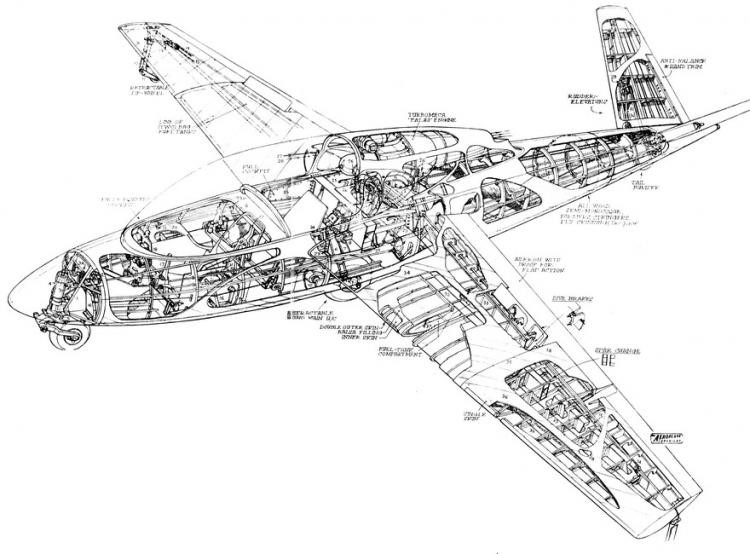
The tandem two-seat SK-1 is made of wood. The wings each hold a structural tank. Both tanks have a total capacity of 227 liters. The leading edge and wing tips are made of synthetic fiber impregnated fiberglass. The laminar wing has an aspect ratio of 8. The flaps extend over the entire span and contribute to the high lift by simultaneously operating down.
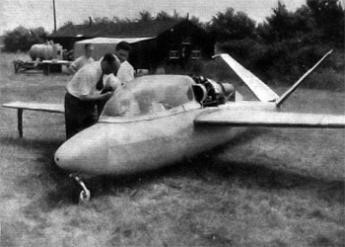
The only metal parts of the aircraft are the engine mounts, the landing gear and butterfly tail. The undercarriage front wheel was a Miles Gemini tail wheel, with a singe main wheel. Side outriggers fully retracted into the wing.

The butterfly tail is full flying and smaller trailing edge flaps act as servo trim tabs.

Built at Woodley, the first flight of the SK-1 was flown by Hugh Woodley Kendall, its designer, on Oct. 8, 1955, registered G-AOBC. It suffered a mid-air turbine failure on 11 July 1957.

The lack of market opportunity (either as aircraft race or as training aircraft for the RAF) terminated the project.

It went to the College of Aeronautics, Cranfield for use as a design example but departed in the mid-1960s.

It was found in 1974 under re-build at a farm near Dunstable.
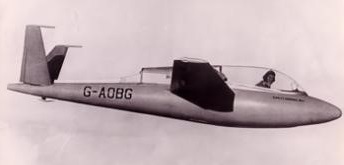
Circa 2010, the Somers-Kendall SK-1 was bought by Peter Bishop of Hamburg, Germany. The body is in good condition and it was transferred to Classic Aero Services in France for restoration.
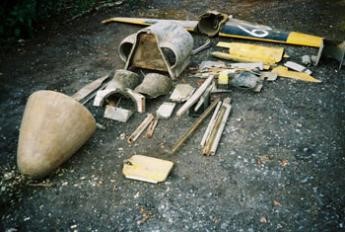
Some other elements exist, but the wings and canopy were missing.

Engine: Turbomeca Palas, 160 Kp
Span 22 ft 9 in / 6.93 m
Wing area: 6.25 m²
Length 20 ft 10 in / 6.35 m
Height: 1.62 m
Fuselage weight: 217 Kg
Engine and accessories weight: 90 Kg
Equipment and oil weight; 35 Kg
Empty weight: 343 Kg
Aerobatic mauw 1300 lb
Fuel capacity: 228 lt
Vne: 645 km / h
Max speed: 332 mph / 535 Km / h (at sea level)
Max cruise: 450 km / h
Initial climb rate: 1850 ft / min
Range: 1160 km at 20,000 ft at 190 kts
Take-off (50 feet, 750 Kg): 685m
Landing dist (50 feet to 650 Kg): 595m
Load factor: + / – 6 g

Soltau Sturmvogel / Schwingenflieger

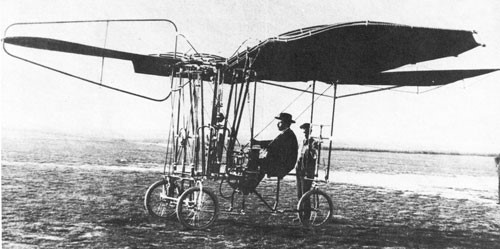
The “Sturmvogel” was an ornithopter designed by Austro-Hungarian engineer Andreas Soltau. It was powered by a carbonic acid engine. It was a relatively large machine, with a span of 11 meters and a wing area of 30 square meters. It had an elevator at the rear, a birdlike construction, and the rudder in front.

The machine was not successful, as the flapping had a too low frequency to lift it off. Tests were made at Linz on 16 August 1909, which were highly published in the contemporary Austro-Hungarian press. After his adventure with the Sturmvogel, Soltau left aeronautics, but he can still be traced in patents dating from the 1920s, one of which features a hot-air engine.

Soloy Pathfinder 21

The first flight of Soloy Corporation’s modified Cessna 208B Cara¬van, Pathfinder 21, was successfully made on 30 April at Olympia, United States. Flying the aircraft was Soloy’s chief test pilot Paul Haggland and on board for the milestone was crew chief Dan Wright and company president Joe Soloy. The Pathfinder 21 is equipped with two Pratt & Whitney Canada PT6D-114A engines powering a single propeller. The arrangement incorporates a Soloy Dual Pac gearbox assembly, which was certified by the FAA on 18 November 1997. The aircraft’s wings, struts and landing gear have been reinforced to enable its gross ramp weight to be increased to 5,675 kgs (12,500 lbs). The aircraft’s fuselage length has also been increased to almost 2 m more than Cessna’s design.

Engines: 2 x Pratt & Whitney Canada PT6D-114A
Max ramp wt: 5,675 kgs (12,500 lbs)

Soloviev D-90A / Aviadvigatel PS-90

PS-90A-76

The Aviadvigatel PS-90 is a Russian high-bypass commercial turbofan rated at 16000 kgf (157 kN, 35,300 lbf) thrust. It powers Russian airliners such as the Ilyushin Il-96 and the Tupolev Tu-204/Tu-214 series and transport aircraft such as the Ilyushin Il-76. It is made by the Russian aircraft engine company Aviadvigatel, which is the successor of the Soviet Soloviev Design Bureau. “PS” are the initials of Pavel Aleksandrovich Soloviev (Russian:Павел Алеќсандрович Соловьёв).

With the advent of new generation of Russian airliners, Aviadvigatel developed the PS-90 to satisfy the demands of economy, performance and exhaust emissions. It represented a huge advance over previous generations of 1960s era Soviet engines. The PS-90 is almost double the efficiency of those engines and is reasonably competitive to the current generation of western engines.

It incorporates many firsts in a Russian engine with advanced technology features such as
High-bypass turbofan design for economy
Integrated exhaust with exhaust mixer for good efficiency
Acoustically treated exhaust duct for low noise
Full-authority digital engine control (FADEC)
Long service life based on on-condition maintenance
Modular design for ease of maintenance
It was first certified in 1992 and has been in service since. Approximately 300 had been built to 2010.

Variants:
There are five variants; the basic PS-90A, the PS-90A-76, the improved PS-90A variants, PS-90A1 and PS-90A2, and the PS-90A-42 turbojet.

PS-90A
The PS-90A engine is the initial variant and is standard equipment for Ilyushin Il-96-400, Tupolev-204-100 and the Tupolev-214. For the first time it allowed Russian airliners to achieve similar performance and economy to their western counterparts. PS-90A is rated nominally at 16000 kgf (157 kN, 35,300 lbf) thrust, 13.3% less than the original Rolls-Royce RB211-535E4 engine (which are also offered on the Tu-204), and the fuel consumption is 8.2% less than it.

PS-90A-76
This variant is a modification of the basic PS-90A engine. It extends the service life of the Il-76 transport airplanes and raises their efficiency by installation of the PS-90A-76 engine instead of the D-30KP. It transformed these airplanes into the quiet, economical and extended range variant, the Ilyushin Il-76MF. It is rated nominally at 14,500 kgf (142 kN, 32,000 lbf) thrust.

PS-90A2
The PS-90A2 is an advanced derivative of the PS-90A,developed in co-operation with Pratt & Whitney. It has a proportion of components from France, Germany, Sweden and the USA. It is lighter than PS-90A and features improved FADEC. These features improve the performance and reduce maintenance costs by 40%.. The PS-90A2 is the first Russian engine to be ETOPS-180 min rated. It was offered in newly built aircraft and is completely interchangeable with the PS-90A.
It has the same thrust rating as the PS-90A, 16000 kgf (157 kN, 35,300 lbf) thrust. It is also capable of 18000 kgf (176 kN, 39,600 lbf) thrust.
Future American involvement in engine development has been put in doubt after attempts to block sale of PS-90A2 engines to a major Iranian customer for the type.

Specifications:
PS-90A1
Type: Twin-spool high bypass turbofan with a single-stage fan
Length: 4,964 mm (195.4 in)
Fan diameter: 1,900 mm (75 in)
Dry weight: 2,950 kg (6,500 lb)
Compressor: 2-stage LP, 13-stage HP
Combustors: Fully annular
Turbine: 2-stage HP, 4-stage LP
Maximum thrust: 17,400 Kgf; 38,400 lbf (171 kN)
Bypass ratio: 4.4
Fuel consumption: 0.595 kg/kgf hour

Soloviev D-20

The Soloviev D-20P was a low-bypass turbofan engine rated at 52.9 kN (11,900 lbf) thrust. It was built by the Soloviev Design Bureau. The engine was used on the Tupolev Tu-124.

Type: Twin-spool turbofan engine
Dry weight: 1,468 kg
Compressor: Three-stage LP, eight-stage HP, axial flow
Combustors: 12-chamber cannular
Turbine: Two-stage LP turbine, single-stage HP turbine
Maximum thrust: 5,400 kg
Overall pressure ratio: 13:1
Bypass ratio: 1:1

Solo 2350

A two-stroke, two-cylinder, in-line air cooled light sport engine.

The Solo 2350 D features a mixture control via two diaphragm carburettors, CDI ignition. A crank-case pressure operated fuel pump and crankshaft mounted propeller. With no engine starter, the Solo 2350 D has Type Certificate LBA 4603.

2350 C

Engine: Solo 2350 D
Without Muffler
Cruise power: 19.6 kW at 5,500 1/min
Max rpm: 6,000 1/min
Recommended rpm: 5,000 1/min
Cylinder head temp: Max. 275°C (measured at spark plug)
Fuel consump. at cruise: Approx 2,24 US gal./hr (8,5 l/h)

Engine: Solo 2350 D
With Muffler
Cruise power:
15.3 kW at 5,500 1/min
Max rpm: 6,500 1/min
Recommended rpm: 5,000 1/min
Cylinder head temp: Max. 275°C (measured at spark plug)
Fuel consump. at cruise: Approx 2,24 US gal./hr (8,5 l/h)

Solid Air Diamant

Diamant Twin Hazard

Also available as a single seater, the two seater seats side-by-side.

Diamant LP

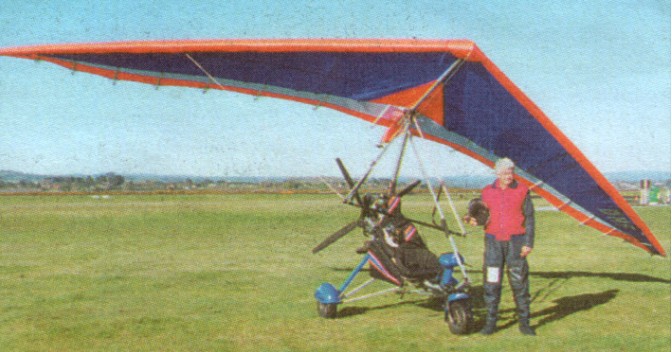
The Solid Air Diamant LP (English: Diamond, Light Performance) is a German ultralight trike, designed and produced by Solid Air UL-Bau Franz of Hundheim, Rheinland-Pfalz. The aircraft was supplied as a complete ready-to-fly-aircraft.

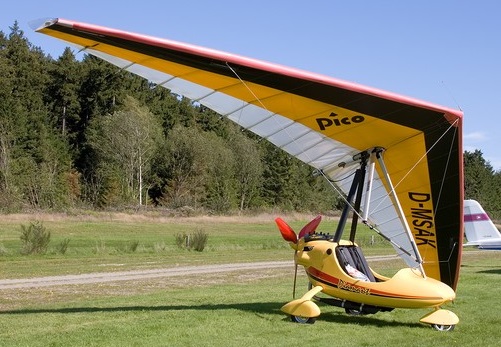
The Solid Air Diamant Twin (English: Diamond) ultralight trike was supplied as a complete ready-to-fly-aircraft.

Diamant Twin

Diamant Twin Hazard
Empty weight: 170 kg
Wing span: 10.50 m
Wing area: 13 sq.m
Fuel capacity: 40-60 lt
Certification: Vz
Engine: Hirth F 30, 60 hp
MAUW: 383 kg
Seats: 2
Max speed: 120 kph
Cruise speed: 110 kph
Minimum speed: 50 kph
Climb rate: 3.5 m/s
Fuel consumption: 8 lt/hr
Price (1998): 41 000 DM