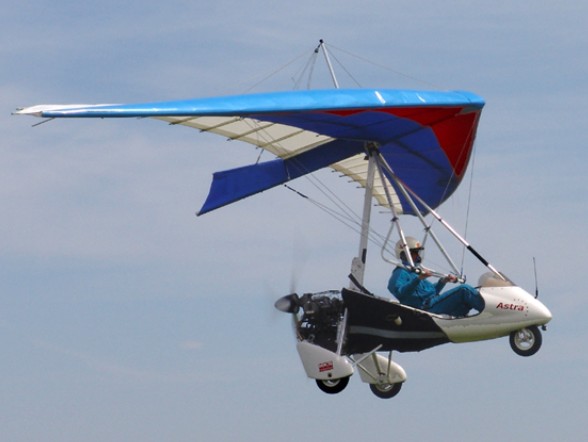
Designed by Allistair Wilson and built in Bloomfield, Indiana, the Astra trike is built to exceed the Light Sport Aircraft standards. The Astra has wide comfortable seating and can be used for serious cross country flying or simply enjoying the scenery.
The Astra Trike is manufactured in the American Mid West and has been developed using British technology. Two engine options were available: the HKS 700E – 60 BHP – 2 cylinder – 4 stroke or the 4 cylinder- 4 stroke – Rotax 912. The Astra Trike has been designed and manufactured to comply with the requirements of BCAR Section S Issue 2, and the American Sportplane aircraft design category.
Many parts for the wing are manufactured by Sport Flight International, including the wing sail, storage bag, wing bag and packing set. Sport Flight International also manufacture the structural wing frame tubes for the Astra Trike. Bill Sherlock test flew the first complete Astra Trike at Shawnee airport, Bloomfield Indiana, on the 26th April 2005.
The Astra Trike is the product of years of research and development, bringing to America a world class trike, capable of effortless cross country flying, with the reliability of a four stroke engine at an affordable 2009 Price.
The Astra 912 is powered by the 80 hp Rotax 912 four cylinder four stroke engine, allowing the trike to cruise at 70 mph, and burn just over 3.0 gallons per hour. Maximum level speed is 80 mph, VNE is 90 mph. Stall speed occurs at 32 mph. Rate of climb 800-1100 feet per minute depending on load and density altitude. Take off run 180 – 250 feet depndent on load and dnsity altitude. Astra 15.6 m double surface wing. Composite front fairing with windshield, Instrument panel, and composite wheel pants.
Dual rear brakes with parking brake, Warp Drive composite 3-blade propeller, Polyurethane shock absorber suspension system, Fabric skirt, 11.5 gallon fuel tank, Rotax mechanical fuel pump system, Cast aluminum spoked wheels, Wide composite seat with folding backrest, Chrome Moly steel maingear, Rear seat nose-wheel steering. Dual stainless steel muffler system, Pod storage bag, 10-row oil cooler, all aluminum radiator.
Standard instrument fit on the Astra 912 are Airspeed Indicator, Sensitive Altimeter, Fuel gauge, Digital engine monitoring which includes dual CHT and quadruple EGT, Hour meter, Flight timer, Voltage, Oil temperature, Oil pressure, Tachometer and In-dash Compass. Available Options include: Ballistic Recovery System Parachute, Vertical Speed Indicator, Fuel computer, Lynx Radio antenna, Dual Strobe system, High intensity headlight, Complete Lynx system including, Helmets, Vizors, Headsets, Intercom (self or aircraft powered), Radio, PTT cable, Windshield extension, Gas lift strut to assist in lifting the wing during set-up and takedown.
The Astra HKS is powered by the 60 hp Japanese HKS twin cylinder four stroke engine. This allows the trike to cruise at 55 – 65 mph, while burning just over 2.2 gallons per hour. Maximum level speed is 75 mph, VNE is 90 mph. Stall speed occurs at 32 mph Rate of Climb is 400 – 800 feet per minute depending on flight loads and density altitude. Astra 15.6 m double surface wing Composite front fairing with windshield and Instrument panel, composite wheel pants.
Dual rear brakes with parking brake, composite 3-blade propeller with reinforced leading edge, Polyurethane shock absorber suspension, Fabric skirt, 11.5 gallon fuel tank, Electric and mechanical fuel pump system, Cast aluminum spoked wheels, Wide composite seat with folding backrest, Chrome Moly steel maingear, Rear seat nose-wheel steering. Standard instrument fit on the Astra HKS are Airspeed Indicator, Sensitive Altimeter, Fuel gauge, Dual CHT, Dual EGT, RPM , Hourmeter, Voltmeter and In Dash Compass. Available Options include: Digital engine monitoring with warning light for out of range engine parameters, Jet Hot coating on the Muffler, Ballistic Recovery System Parachute, Vertical Speed Indicator, Fuel computer, Lynx Radio antenna,Dual Strobe system, headlight, Complete Lynx system including, Helmets, vizor, headsets, intercom (self or aircraft powered), Radio, PTT cable, Windshield extension, Gas lift strut to assist in lifting the wing during set-up and takedown.
The Astra S2 is powered by the 100 hp Rotax 912S four cylinder four stroke engine. A reliable, efficient and powerful engine that allows the trike an effortless cruise anywhere between 55 and 100 mph, and burn just over 3.5 gallons per hour. Maximum level speed is 105 mph, VNE is 115 mph. Stall speed occurs at 38 mph. Rate of climb is normally between 1000 -1300 feet per minute depending on load and density altitude. Take off run is typically 300 – 450 feet again dependent on load and density altitude. Astra S2 10.6 m double surface wing Composite front fairing with extended two piece windshield and Instrument panel, composite Pylon fairing and stabiliser wheel pants. Electric trim, Dual rear brakes with parking brake, composite 3-blade propeller with reinforced leading edge and prop spinner, Polyurethane maingear shock absorber suspension, Fabric skirt, 11.5 gallon fuel tank, Rotax mechanical fuel pump system, Cast aluminum spoked wheels, Wide composite seat with folding backrest, Chrome Moly steel maingear, Rear seat nose-wheel steering. Standard instrument fit on the Astra S2 are Airspeed Indicator, Sensitive Altimeter, Fuel gauge, Digital engine monitoring which includes dual CHT and quadruple EGT, Hour meter, Flight timer, Voltage, Oil temperature, Oil pressure, Tachometer and In-dash Compass. Available Options include: Ballistic Recovery System Parachute, Vertical Speed Indicator, Fuel computer, Lynx Radio antenna, Dual Streamlined Strobe System, High intensity headlight, Complete Lynx system including, Helmets, Vizors, Headsets, Intercom (self or aircraft powered), Radio, PTT cable, Windshield extension, Gas lift strut to assist in lifting the wing during set-up and takedown. Instructor Training Bars.
The Astra 503 is powered by the 54 hp Rotax 503 two cylinder four stroke engine. It powers the trike to a cruise speed between 55 and 65 mph, burning just over 4 gallons per hour. Maximum level speed is 70 mph, VNE is 90 mph. Stall speed occurs at 32 mph. Rate of climb is normally 250 -700 feet per minute depending on load and density altitude. Take off run is typically 200- 400 feet again dependent on load and density altitude. Astra A1 15.6 m double surface wing Composite front fairing with extended two piece windshield and Instrument panel, and wheel pants. Dual rear brakes with parking brake, composite warp drive 3-blade propeller, Polyurethane maingear shock absorber suspension, Fabric skirt, 11.5 gallon fuel tank, Rotax mechanical fuel pump system, Cast aluminum spoked wheels, Wide composite seat with folding backrest, Chrome Moly steel maingear, Rear seat nose-wheel steering. Standard instrument fit on the Astra 503 are Airspeed Indicator, Fuel gauge, Digital Altimeter and VSI, digital engine monitoring which includes dual CHT and dual EGT, Hour meter, Flight timer, Voltage, Tachometer and In-dash Compass. Available Options include: Ballistic Recovery System Parachute, Analogue Altimeter and Vertical Speed Indicator, Lynx Radio antenna, Dual Strobe System, High intensity headlight, Complete Lynx system including, Helmets, Vizors, Headsets, Intercom (self or aircraft powered), Radio, PTT cable, Windshield extension, Gas lift strut to assist in lifting the wing during set-up and takedown. Instructor Training Bars.
The Astra 103 is powered by the Rotax 503 two cylinder two cycle engine. This allows the trike a cruise speed between 55 and 63 mph, and burn just over 4 gallons per hour. Maximum level speed is 63 mph, VNE is 90 mph. Stall speed occurs at 25 mph. Rate of climb is normally between 300 and 500 feet per minute depending on load and density altitude. Take off run is typically 300 – 450 feet, again dependent on load and density altitude. Astra 103 10.6 m double surface wing. Composite front fairing with windshield and Instrument panel, and stabiliser wheel pants., Wooden 2 -blade propeller with protected leading edge, Bungee maingear shock absorber suspension, Fabric skirt, 5 gallon fuel tank, Rotax mechanical fuel pump system, Cast Nylon wheels, Wide fabric seat, Chrome Moly steel maingear. Standard instrument fit on the Astra 103 are Airspeed Indicator, Digital Altimeter and VSI, engine monitoring which includes dual CHT and dual EGT, Hour meter, Flight timer, Voltage, Tachometer. Available Options include: Ballistic Recovery System Parachute, Lynx Radio Antenna, Dual Streamlined Strobe System, High intensity headlight, Complete Lynx system including, Helmet, Vizor, Headset, Radio, PTT cable, Windshield extension, Gas lift strut to assist in lifting the wing during set-up and takedown.