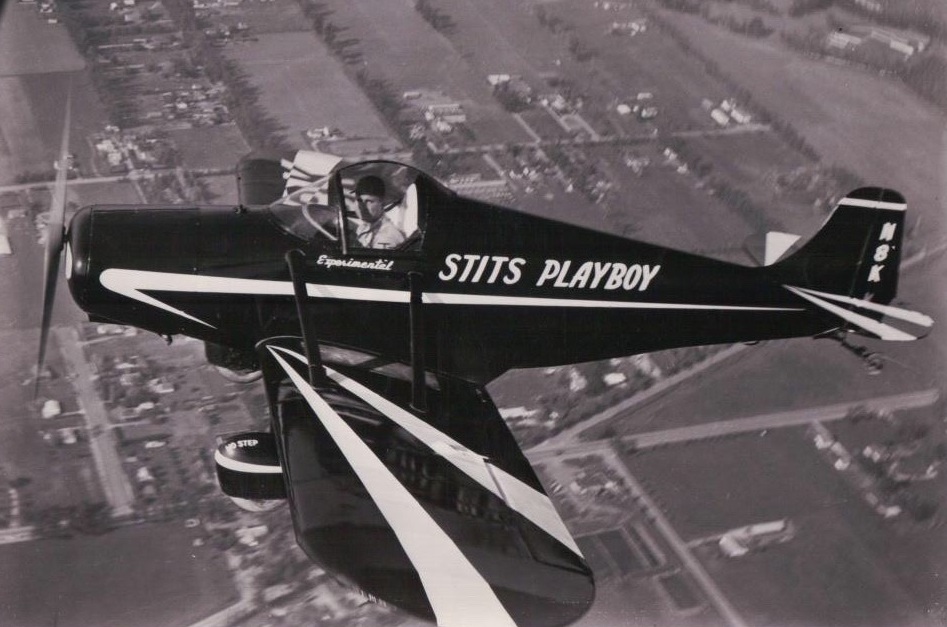
Stits SA-3 Playboy

SA-3A

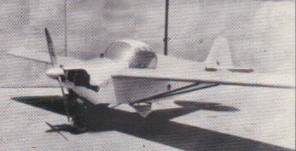
In 1952 Ray Stits designed and built the single-place Stits SA-3A Playboy. It was his third aircraft design. A subsequent variation was the two-place, side-by-side Stits SA-3B Playboy (his fifth design) in 1954.
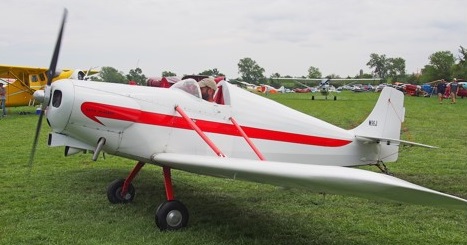
SA-3A

One of the more popular designs by Ray Stits, the Playboy was designed for backyard builders to construct from easy-¬to-follow plans or simple-to-do work kits. The Playboy can handle any one of several four-cyclinder engines in the 85- to 160-hp class. Probably the most common is the 85-hp Con¬tinental. Construction is mixed, with wooden wings and a steel-tube fuselage. All surfaces are fabric covered. The Playboy is easily recognizable because of its sliding canopy and strut-braced low-wing design.
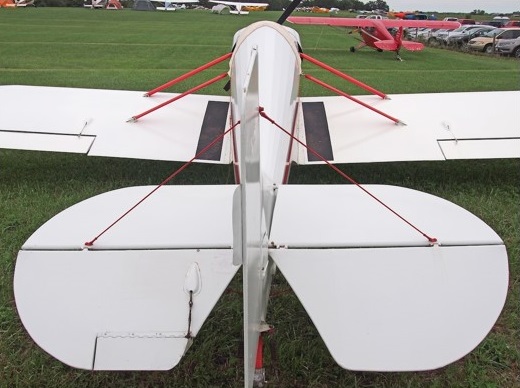
SA-3A

The Playboy is rated for aerobatics, but it doesn’t have inverted fuel or oil, so you’d have to stay with positive Gs, and with 65 horses there are limits to what it can do. It’s responsive, but yet not light on the controls, but the tail is extremely light, so even on run up you have to be careful to hold the tail down, or she’ll want to nose over.
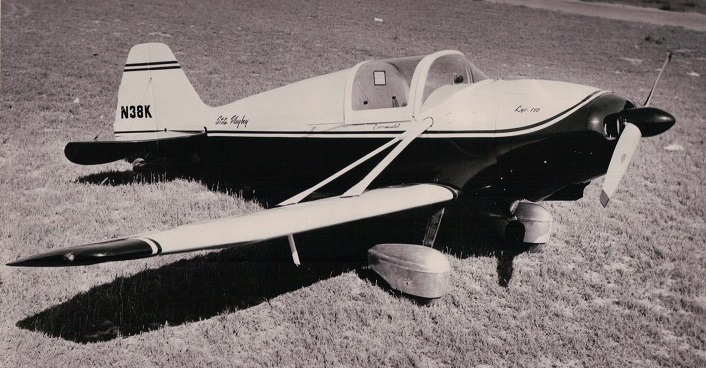
SA3B Two Place Playboy Courtesy Don Stits

The original Playboy N38K has been rebuilt and now resides in the EAA museum.
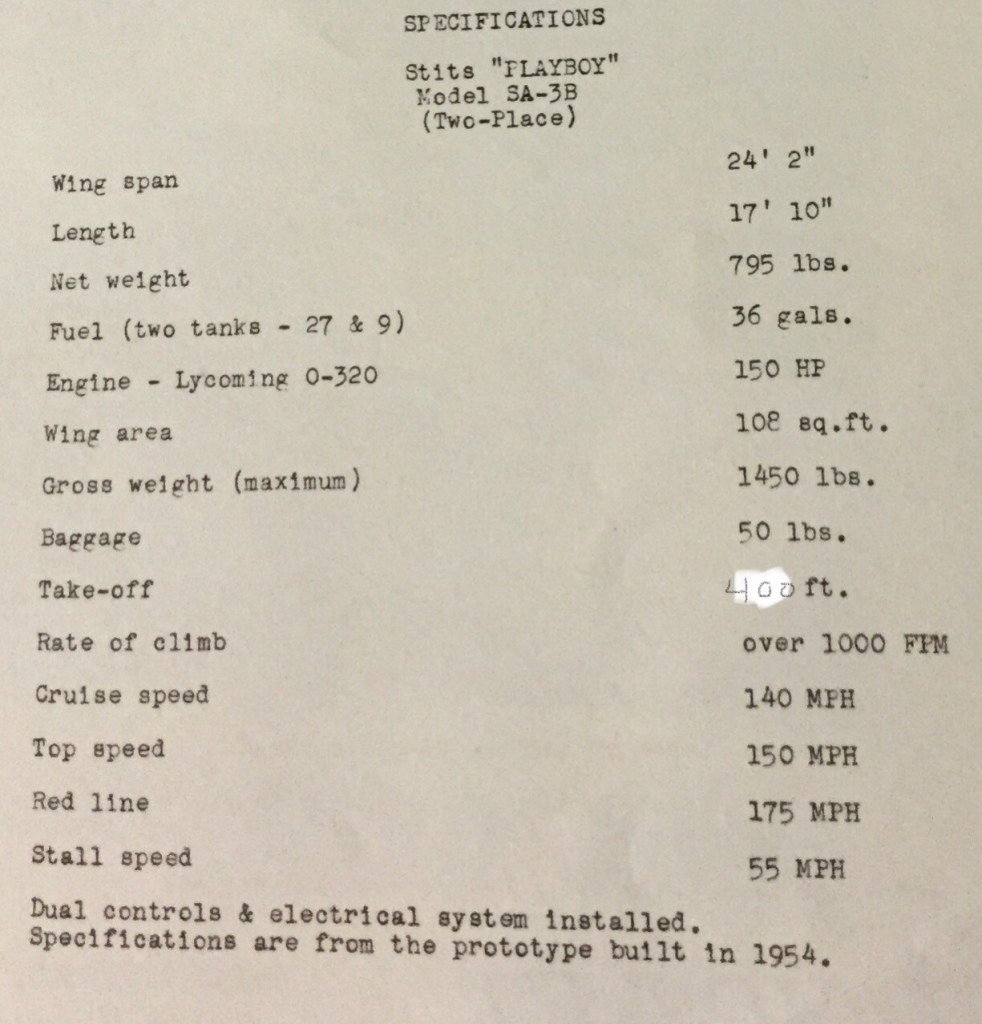
Original SA3B Two Place Playboy Data Sheet

The Stits SA-3A Playboy served as a catalyst for Richard VanGrunsven, who, after modifying and improving the Playboy in 1965 (and calling it an RV-1), was further inspired to build an airplane of his own design — the RV-3.

Gallery

SA-3A
Engines: 65-90hp Continental
Wingspan 22’2”
Length 17’4”
Height: 6 ft 4 in
Gross Wt. 902 lbs
Empty Wt. 600 lbs
Top speed 135 mph
Cruise 125 mph
Stall: 38 mph
Ceiling: 12,000′
Climb rate 1050 fpm
Range 400 sm
Seats: 1

SA-3B Playboy
Engine: 115hp Lycoming, 100-180hp Continental
Wingspan: 24’2″
Length: 17’10”
Useful load: 655 lb
Seats: 2
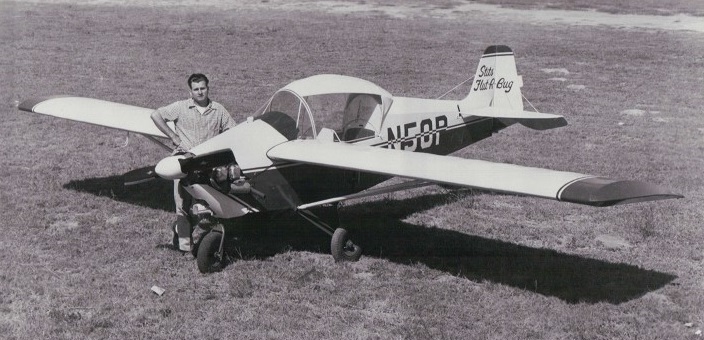
Stits SA-6 Flut-R-Bug

SA6A Flut-R-Bug Courtesy Don Stits

The two-seat Flut-R-Bug was designed in 1955 by Ray Stits for homebuilding projects. The improved SA-6B model was built in considerable numbers including two in Australia where they were to act as prototypes for a local version known as the Hamilton Jackaroo. This never eventuated. The steel-tube fuselage and wooden wings are fabric-covered. Fitted with a tricycle undercarriage and with a 75 hp motor the Flut-R-Bug can cruise at 135 km/h for about 400 km.

SA-6B Flut-R-Bug Courtesy Don Stits

The first Flut-R-Bug was the Model SA-5A, followed by the SA-5B. Stits also designed tandem versions (SA-6A and SA-6B) and then the two-place, side-by-side SA-6C. The Flut-R-Bug was typically powered by either a small Continental or Lycoming engine.

SA-6C Flut-R-Bug Courtesy Don Stits

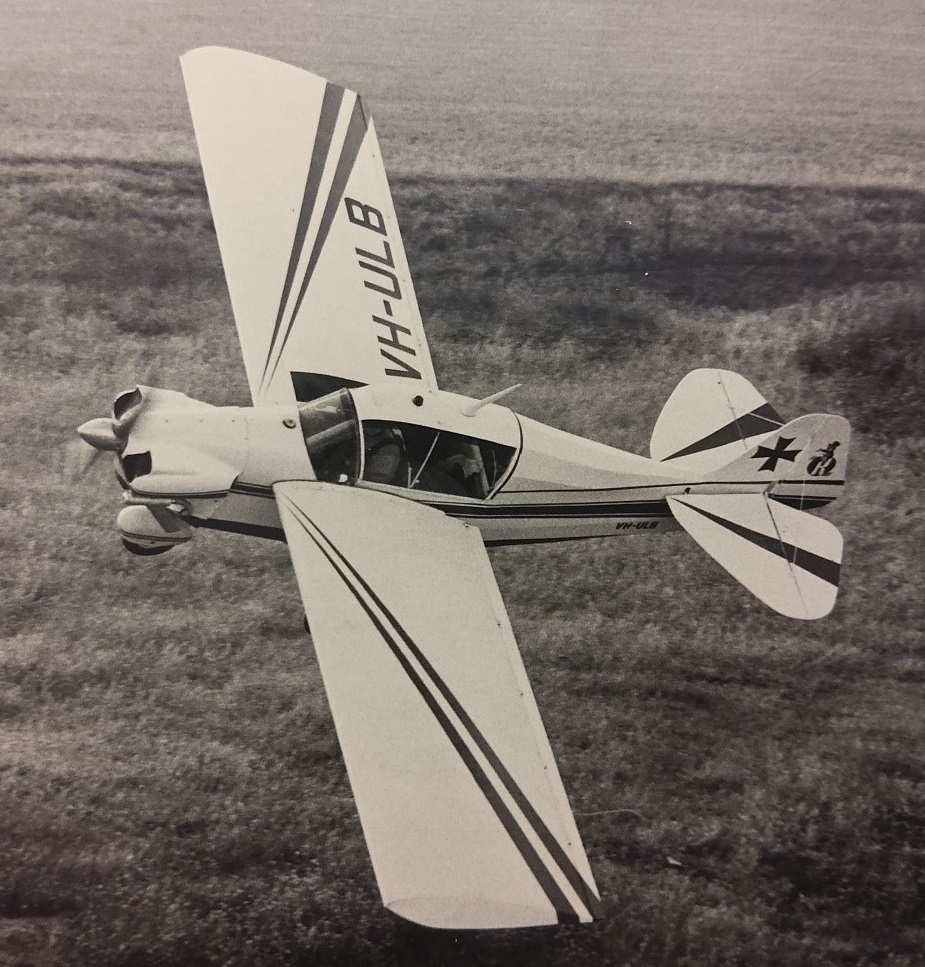
There were possibly two aircraft (VH-ULA & ULB) built in Australia by Norman Hamilton with a view to producing them commercially. Further production did not eventuate. VH-ULB written off in a ground accident in 1984.

VH-ULB – the second Stits manufactured in Australia courtesy David Whitten

Stits SA-2A Sky Baby

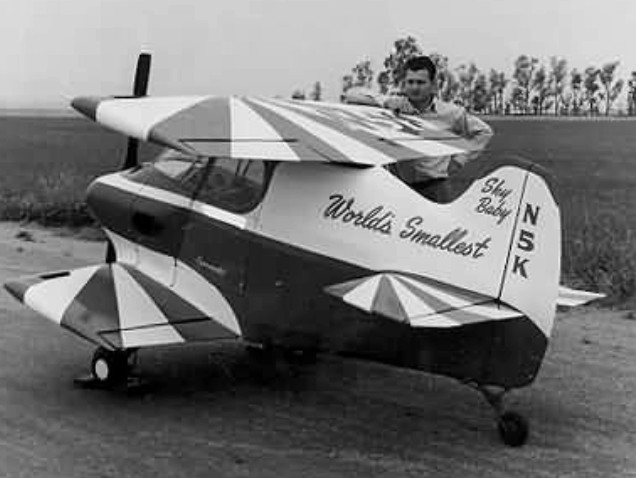
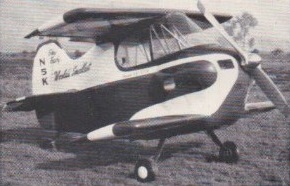
The Sky Baby was designed by Ray Stits, who built his Junior in 1948. No sooner had Stits completed it than word spread that someone was working on a design just a fraction smaller. Not about to be inched out of his record, Stits set to work again and finished the Sky Baby at his Riverside, California workshop in the summer of 1952.

Stits Sky-Baby N5K

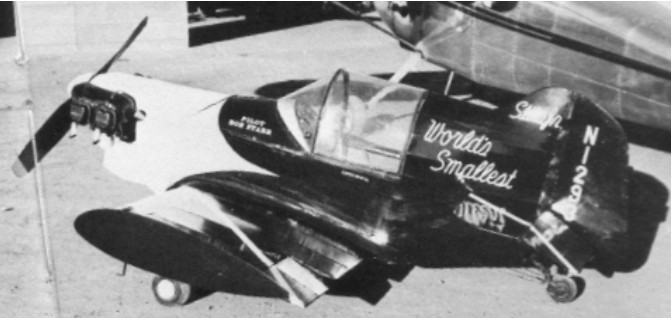
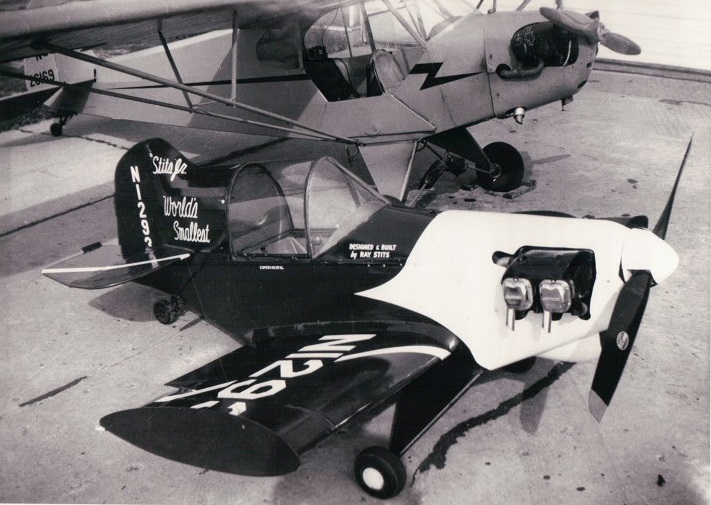
It was incredibly small, with biplane wings 2.18 m (7 ft 2 in) in span. The Sky Baby was powered by a 112 hp Continental engine, race tuned, which gave it a maximum speed close to 322 kph (200 mph).

Bob Starr, Ray Stits’ partner, flew it and had the experience and outstanding piloting qualities which the tricky midget apparently demanded. There was a second pilot, Lester Cole of Cole Bros Airshows.

Courtesy Don Stits

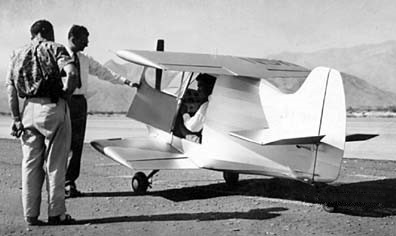
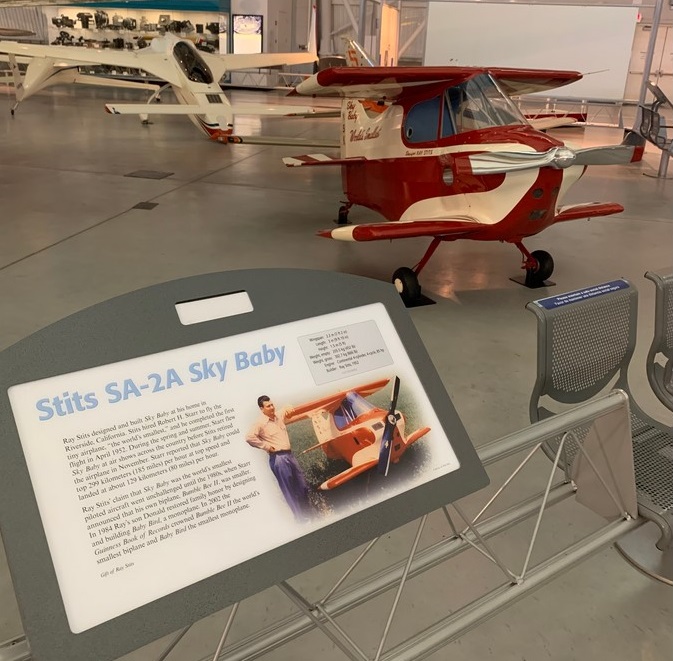
The Sky Baby still holds the title of world’s smallest aircraft in 1980. It was preserved at the Experimental Aircraft Association’s museum in a suburb of Milwaukee, Wisconsin, then on display at Smithsonian Air & Space museum.

Skybaby at Smithsonian 2022 Courtesy Don Stits

SA-2A Sky-Baby
Engine: 65hp Continental C-65
Wingspan: 2.18 m (7 ft 2 in)
Length: 11’4″
Empty weight: 452 lb
Gross wt: 666 lb
Useful load: 214 lb
Maximum speed: 185 mph
Stall: 55 mph
Seats: 1

Stits SA-1 Junior

Ray Stits built his first small plane in 1948, the Junior. The incentive to build “Junior”, the monoplane, came from a discussion about the world’s smallest airplane. Someone mentioned Steve Wittman’s little racer with a 13’ span and Ray Stits queried whether or not he could fly something with a 10’10” wingspan. One of the participants in that conversation said it wouldn’t be possible and that was all it took. Ray started building. He’d actually been thinking about it for a long time and proceeded with a 40hp engine from an Aeronca. That got changed to a 65 hp Continental. The plane was a handful and after the third crash on the fifth test flight, Ray shortened the wings to 8’10” and attached tip gates to generate more lift and better aileron control. He found a new pilot, Bob Starr, a former P-51 pilot. In 1950, Junior was a big hit in airshows. He began thinking about a larger sport plane that would be easy to build and fly, but he got side-tracked with another design: his quest to create the world’s smallest biplane.

SA1A Junior Courtesy Don Stits

Junior wound up on a scrap heap after an off airport landing.

Engine: 65 hp
Wingspan: 8 ft 10 in
Length: 11 ft 4 in
Empty weight: 393 lb

Stinson W

The 1931 Stinson W (ATC 435) was a deluxe version of Junior, priced at $8,995.

Five were built; NC10849, NC12144, NC12146, NC12160, and NC12177.

Engine: P&W Wasp Jr, 300hp
Wingspan: 42’1″
Length: 30’10”
Useful load: 1271 lb
Max speed: 143 mph
Cruise: 122 mph
Stall: 60 mph
Range: 470 mi
Seats: 4

Stinson R / R-1 / R-2 / R-3

Stinson R NC12153

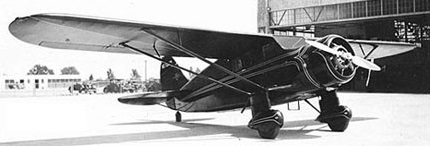
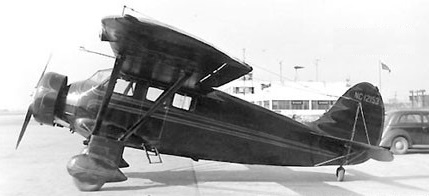
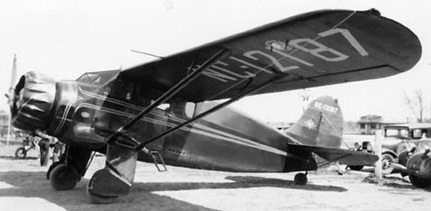
The Stinson R / R-1 (ATC 457) of 1932 was designed by Robert Ayer and C R Irvine as a four-place cabin high wing monoplane. A deluxe Junior, and forerunner of Reliant, powered by a 215hp Lycoming R-680 engine, the R-1 was to have a retractable gear added, but was never built.

Thirty R-1 were sold, priced at $5,595, including NC436M/440M, NC446M/448M, NC479M, NC10861, NC10874, NC10876, NC12134, NC12139, NC12147/12156, prototype NC12178, NC12189, and NC12197.

Stinson R NC12153

Eddie Stinson was fatally injured in a crash landing of the prototype R on 25 January 1932.

The 1932 R-2 (ATC 489), powered with a 240hp Lycoming R-680 engine, was advertised for $6,497 with retractable gear modification, but none was produced as such. Three were built; NS40, NX447M, and NX12178 modified from R, and possibly one other.

Stinson R-3 NC12187

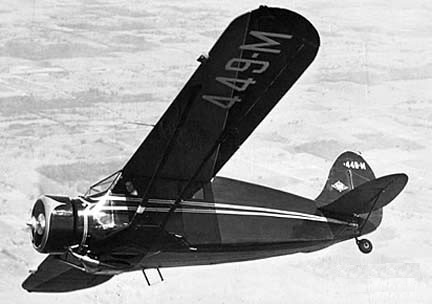
The 1933 R-3 (ATC 493) was the same as the R-2, but with fixed, non-operating prototypical retracting gear. Three were built; NC449M, NC12131, and NC12187, priced at $5,995. Only one was so modified to operating retractable gear as R-3S

The 1934 R-3S (ATC 539) conversion from R-3 NC449M featured a 245hp Lycoming R-680 engine, controllable prop and other improvements.

Stinson R-3S N449M

R / R-1
Engine: 215hp Lycoming R-680
Wingspan: 43’3″
Length: 26’1″
Useful load: 1100 lb
Max speed: 130 mph
Cruise: 110 mph
Stall: 52 mph
Range: 450 mi
Ceiling: 12,500′
Seats: 4

R-2
Engine: 240hp Lycoming R-680
Wingspan: 43’3″
Length: 26’2″
Useful load: 1210 lb
Max speed: 138 mph
Cruise: 118 mph
Stall: 62 mph
Range: 550 mi
Seats: 4

R-3
Engine: 240hp Lycoming R-680
Wingspan: 43’3″
Length: 26’2″
Useful load: 1210 lb
Max speed: 133 mph
Cruise: 112 mph
Stall: 62 mph
Range: 450 mi
Seats: 4

R-3S
Engine: 245hp Lycoming R-680
Wingspan: 43’3″
Length: 26’2″
Useful load: 1010 lb
Max speed: 133 mph
Cruise: 112 mph
Stall: 52 mph
Range: 450 mi
Seats: 4
Specs