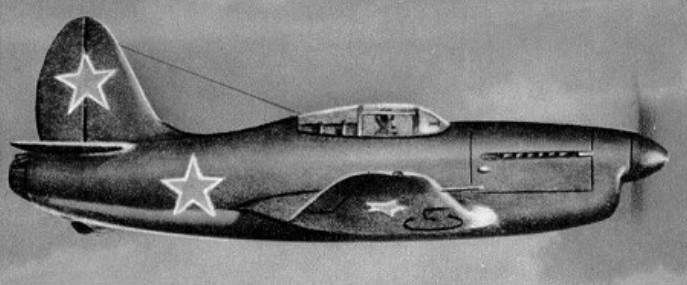
Sukhoi Su-5 / I-107

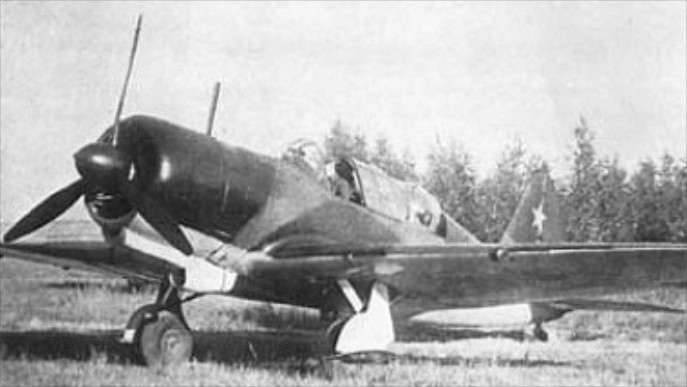
The development at the TsIAM (Central Aero Engine Institute) by K V Kholshchevnikov of the so-called “accelerator”, or VRDK (Vozdushno-reaktivny dvigatyel kompressorny, or Air-reaction engine compressor), prompted the development of mixed-power single-seat fighters as an interim means of meeting the potential threat of German turbojet-powered fighters. Both Mikoyan-Gurevich and Sukhoi bureaux were assigned the task of creating such fighters, the former developing the MiG-13 alias I-250(N) and the latter the Su-5 alias I-107. The VRDK provided 300kg thrust for up to 10 min at high altitude to boost the power available from the Klimov M-107A (VK-107A) 12-cylinder Vee-type liquid-cooled engine which delivered 1,650hp for take-off. An all-metal stressed-skin single-seat monoplane with a monocoque fuselage, the Su-5 had an armament of one 23mm engine-mounted cannon and two 12.7mm machine guns.

First flown in April 1945, the prototype was soon fitted with a new wing of laminar-flow type developed by the TsAGI, and during one subsequent flight test a speed of 793km/h was attained at 4350m, this being 25km/h faster than had been calculated for that altitude. The effect of the VRDK was a gain of 90km/h at low altitude rising to 110km/h at 7800m, at which it was anticipated that maximum speed would be 810km/h. Early in July 1945, before this speed could be attained, the M-107A engine suffered some damage in flight and when it was found to be irreparable, the Su-5 flight test programme was abandoned.

Engine: Klimov M-107A (VK-107A) V-12, 1,650hp & 1 x VRDK Air-reaction engine compressor
Max take-off weight: 3804 kg / 8386 lb
Empty weight: 2954 kg / 6512 lb
Wingspan: 10.56 m / 35 ft 8 in
Length: 8.51 m / 28 ft 11 in
Height: 3.53 m / 12 ft 7 in
Wing area: 17.00 sq.m / 182.99 sq ft
Max. speed: 810 km/h / 503 mph
Range: 600 km / 373 miles
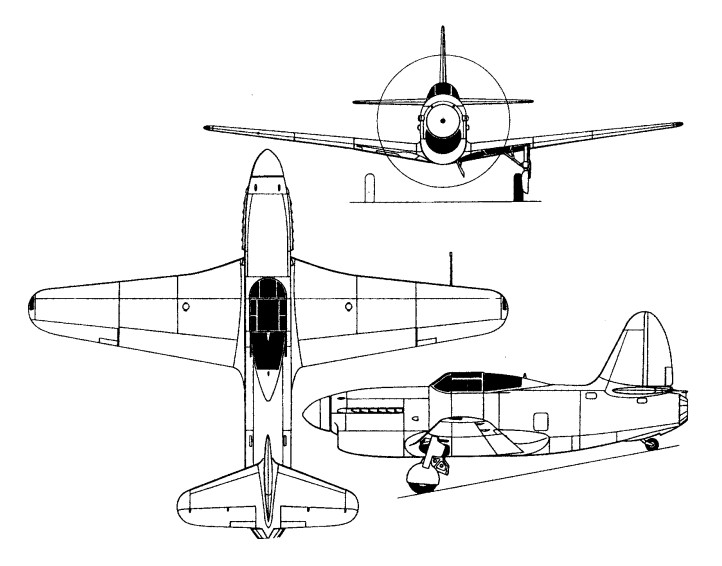
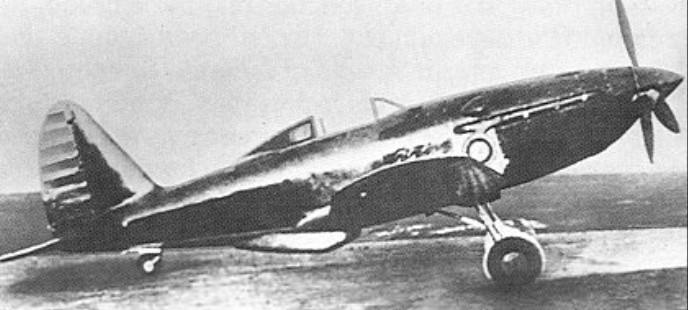
Sukhoi Su-5 (I-107)

Sukhoi Su-3 / I-360

At the time of the evacuation of the Sukhoi OKB to Novosibirsk, the prototype of a developed version of the Su-1, the Su-3, was under construction. Initiated under the designation I-360, the Su-3 mated the Su-1 fuselage and tail surfaces with an entirely new wing of revised profile with shorter-span outer panels resulting in a 2.00sq.m reduction in wing area. The radiator bath was enlarged, but in all other major respects the Su-3 was similar to the Su-1. Retaining the M-105P engine and the same armament, the Su-3 was completed at Novosibirsk and entered flight test in the late summer of 1942. Although the TsIAM had meanwhile undertaken much development work on the TK-2 turbo-supercharger, the principal defects were found to remain, and, as a consequence, development of the Su-3 was discontinued towards the end of 1942.

Engine: Klimov M-105P V-12, 1,100hp
Max take-off weight: 2860 kg / 6305 lb
Empty weight: 2490 kg / 5490 lb
Wingspan: 10.10 m / 33 ft 2 in
Length: 8.42 m / 28 ft 7 in
Height: 2.71 m / 9 ft 11 in
Wing area: 17.00 sq.m / 182.99 sq ft
Max. speed: 638 km/h / 396 mph
Range: 700 km / 435 miles
Armament: one 20mm cannon and two 7.62mm machine guns

Sukhoi BB-1 / Su-2

During 1939, Sukhoi established his own design bureau, and began the redesign of the ANT 51 with an M 88B engine, a low wing and an increased offensive load, this emerging as the BB 1, entering series production in 1940, and being redesignated Su 2 in 1941.

The Sukhoi Su-2 entered service with the V-VS early in 1941 but, as far as is known, was not encountered during the Winter War which ended the previous year. Derived from Sukhoi’s ANT-51 and designated BB-1 during its early trials, the aircraft was fairly efficient by current standards once the M-87 engine had been replaced by the M-88 and then the M-88B.

Despite being further improved by installation of the 746kW M-88B radial, the Su-2 was found to be desperately vulnerable and virtually unable to defend itself with its single small-calibre machine-gun in the unwieldy manually-operated dorsal turret. Estimates suggest that about 100 were in service with the Frontovaya Aviatsya at the time that the German army rolled into the Soviet Union in June 1941, but that dozens were shot down by flak and fighters in the first few disastrous weeks.

The Su 2 was built in fairly substantial numbers, both with the IM 88B engine and with the more powerful M 82. The state of the Soviet aircraft industry in 1941 prevented much being done to remedy the immediate lack of suitable ground support aircraft (until production of the two-seat Il-2m3 could be stepped up) and recourse was made to further attempts to improve the Su-2 by installation of the 1134kW M-82 radial and freguent deletion of the dorsal turret, but with little tactical benefit. Accepting that losses would remain high, the Soviets therefore simply loaded the aircraft with further bombs and rockets on the supposition that the more explosive delivered against the enemy the better the chances of some degree of success. This version, as well as the completely redesigned Su-6, were abandoned in favour of all-out dependence on the Il-2m3. The Su-2 probably did not survive in production beyond mid-1942.

Engine: 1 x M-88B, 735kW
Max take-off weight: 4400 kg / 9700 lb
Empty weight: 3000 kg / 6614 lb
Wingspan: 14.3 m / 47 ft 11 in
Length: 10.3 m / 34 ft 10 in
Wing area: 29.0 sq.m / 312.15 sq ft
Max. speed: 460 km/h / 286 mph
Ceiling: 3800 m / 12450 ft
Range w/max.fuel: 1200 km / 746 miles
Armament: 5 x 7.62mm machine-guns
Bombload: 600kg
Crew: 2

Sukhoi Su-2

Sukhoi Su-1 / I-330

Pavel O Sukhoi established his own OKB, or Experimental Design Bureau, in December 1938, and, early in the following year, was assigned the task of designing an advanced single-seat high-altitude fighter. Initially designated I-330, the fighter was of mixed construction, with a single-spar all-metal wing of comparatively high aspect ratio with flush-riveted light alloy skinning, and a wooden semi-monocoque fuselage with shpon, or bakelite-ply, skinning. Power was provided by a Klimov M-105P 12-cylinder liquid-cooled Vee-type engine rated at 1,100hp for take-off and fitted with a pair of TsIAM-developed TK-2 exhaust-driven turbo-superchargers, the radiator being accommodated in the fuselage aft of the cockpit and exhausting over the rear decking. Armament consisted of one 20mm cannon and two 7.62mm machine guns. Factory testing commenced late 1940, by which time the designation Su-1 had been adopted, State testing being performed in the following summer. The turbo-superchargers proved capricious and the Su-1 was flown on several occasions with the TK-2s removed. Although the fighter met its specified performance with the turbo-superchargers functioning, their failure frequency was unacceptable and the TsIAM had failed to improve reliability by October 1941, when the OKB was evacuated from Moscow to Novosibirsk, the Su-1 being damaged in the process. This prototype was not rebuilt, development continuing with the Su-3.

Engine: Klimov M-105P V-12, 1,100hp
Max take-off weight: 2875 kg / 6338 lb
Empty weight: 2495 kg / 5501 lb
Wingspan: 11.50 m / 38 ft 9 in
Length: 8.42 m / 28 ft 7 in
Height: 2.71 m / 9 ft 11 in
Wing area: 19.00 sq.m / 204.51 sq ft
Max. speed: 641 km/h / 398 mph
Range: 720 km / 447 miles
Armament: one 20mm cannon and two 7.62mm machine guns

Sukhoi Su-1 (I-330)

Sud-Ouest SO.7050 / SO.7055 / SO.7060 Deauville

SO.7060 Deauville

Developed from the SO.7050 and SO.7055 two-seat cabin monoplanes, the SO.7060 Deauville differs primarily in having the 75 hp Mathis 4GO replaced by a 105 hp Walter Minor 4-III.

The first of two Deauville prototypes flew on 22 March 1948. Of all-metal construction, dual controls are provided and a third seat may be fitted aft of the side-by-side front seats.

SO.7050
Engine: 75 hp Mathis 4GO

SO.7055
Engine: 75 hp Mathis 4GO

SO.7060 Deauville
Engine: 105 hp Walter Minor 4-III
Wing span: 34 ft
Wing area: 161.4 sq.ft
Length: 21 ft 10 in
Height: 7 ft 11 in
Empty weight: 1140 lb
Loaded weight: 1760 lb
Max speed: 127 mph
Cruise: 105 mph at 3280 ft
Range: 500 mi

Sud-Ouest Deltaviex

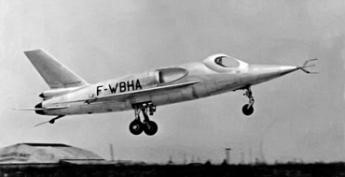
The Deltaviex is an experimental aircraft designed by ONERA for development of supersonic aircraft. designed in 1953 by ONERA, the prototype was built by SNCASO in Courbevoie, under the direction of engineer Aliette.

The aircraft was intended for multiple testing, including a roll stabilization device obtained by the profile of the trailing edge landing flaps. This device was developed lift while providing propulsion. Conventional ailerons were located at the ends of the wings. At 3.40 m they were partly intended to produce a very low inertia and damping in roll. The jet was formed by air bled from the engine in a small proportion (about 2%). The system has a switchable ramp equipped with many output holes. The steering was done with an extremely short period of around five hundredths of a second, producing a flap ange of + / – 2 °. The 70° wing thickness does not exceed 6%. It is adjustable in flight to 1 ° -4 °. The tricycle undercarriage is retractable.

The Deltaviex made its first flight in 1954 with Robert Fouquet at the controls, registered F-WBHA c/n. 001. It was mainly flown by Robert Fouquet, chosen due to his small size, essential in the cramped cockpit of the minuscule aircraft. Its small size allowed testing it in the wind tunnel at Modane (Savoy) at full scale in order to precisely measure its behaviour in various flying situations. The aircraft served for trials with blown ailerons, whereby bleed air from its Marboré II engine was blown over the wing trailing edge, a system later installed for example on the F-104 Starfighter. An innovative directional control system was installed, using pressurised air instead of a rudder and elevator to change direction.

Testing remained secret until November 8, 1956, when the Deltaviex was introduced to the press.

During testing (at Brétigny, Meudon, and Modane), the Deltaviex changed canopy type three times.

The single example of the Deltaviex finished its career at Modane (Savoie). It was recovered in 1984, from a garage owner in the region, by the Association of Ailes Anciennes Toulouse. It is held association at:
Ailes Anciennes Toulouse
Derrière le 5 chemin de Laporte
Saint Martin du Touch
31300 Toulouse

Gallery

Engine: Turbomeca Marbore II turbojet, 400 Kp
Wingspan: 3.40 m
Length: 7.10 m
Height: 2.50 m
Empty weight: 550 kg
Max weight: 920 kg
Wing area: 5 m²
Max speed: 400 km h
Range: 300 km

Sud-Ouest SO 9050 Trident II

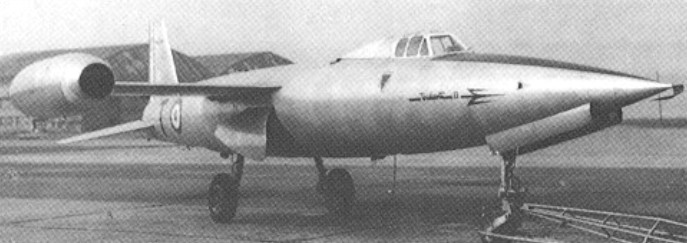
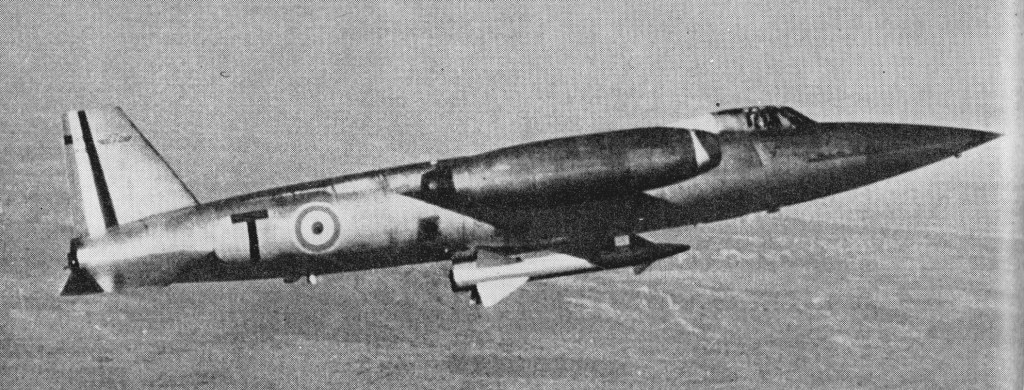
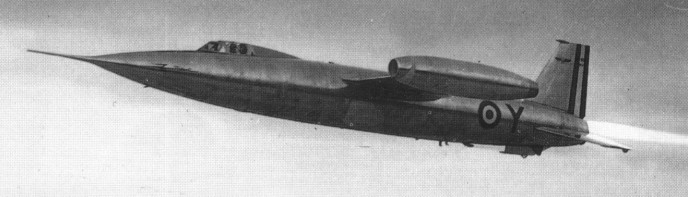
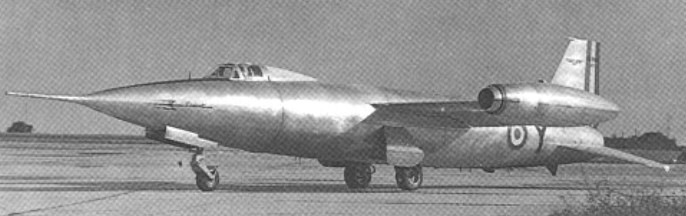
Embodying experience gained with the SO 9000, the SO 9050 – two prototypes of which were ordered in 1954 – embodied considerable redesign, entrusted to Dassault. A smaller wing of reduced thickness/chord ratio was adopted, the cockpit was enlarged, air brakes were transferred from the wing to the rear fuselage, a taller undercarriage was provided and a two-barrel SEPR 631 rocket motor of 3000kg / 6614 lb was adopted, combined with wing-tip 2425 lb st Turbomé Gabizo turbojets. It could carry a 330 lb Matra self-homing missile under the fuselage.

Sud Ouest SO 9050 Trident II Article

The first prototype SO 9050 was flown on 19 July 1955, its first flight on rocket power taking place on the following 21 December, and the second prototype flew on 4 January 1956, but was destroyed during its second flight. A third prototype had meanwhile been ordered, this flying on 30 March 1956, and some 10 weeks later, on 11 June, a contract was placed for six pre-series aircraft, a supplementary contract for a further four following (although the latter was to be cancelled on 24 October 1957 as an economy measure). The pre-series SO 9050 differed from the prototypes primarily in having 1100kg Turbomeca Gabizo turbojets in place of the Vipers at the wingtips and provision for nose-mounted AI radar and a single ventrally-mounted Matra R 511 air-air missile. The first pre-series aircraft was flown on 3 May 1957 and the third on 30 January 1958, but three months later, on 26 April, the programme was cancelled. During tests, Mach=1.9 was achieved at 19500m and an altitude of 26000m exceeded.

Both prototypes were lost in aerial accidents, the second confirming the inherent dangers of a rocket engine with its immensely volatile fuel.

Gallery

SO-9050 Trident II
Engines: 2 x Turbomé Gabizo turbojets, 2425 lb st, 1 x SEPR rocket, 6614 lb thrust.
Loaded weight: 5900 kg / 13007 lb
Empty weight: 2910 kg / 6415 lb
Wingspan: 6.95 m / 23 ft 10 in
Length: 13.26 m / 44 ft 6 in
Height: 3.20 m / 11 ft 6 in
Wing area: 14.50 sq.m / 156.08 sq ft
Max speed: M1.8 (1188 mph)

Sud-Ouest SO 9050 Trident II

Sud-Ouest SO 9000 Trident

SO-9000 Trident I

Stemming from the lightweight fighter philosophy that emerged from the Korean conflict, the SO 9000 Trident single-seat interceptor developed by a team led by Lucien Servanty was of unusual concept in employing turbojets for auxiliary power and a rocket motor for primary thrust. Two prototypes of the Trident were ordered on 8 April 1951, the first of these flying on 2 March 1953 solely on the power of two wingtip-mounted Turbomeca Marbore II turbojets each rated at 400kg, the more powerful Vipers being substituted in 1955. The second prototype was destroyed on its first flight on 1 September 1953, but development continued with the first example, which, on 4 September 1954, flew for the first time with its primary power plant, a triple-barrel SEPR 481 triple-chamber liquid rocket motor providing a total thrust of 4500kg. As the aircraft could not take-off on the power of the Marbores at fully loaded weight, these gave place to Dassault MD 30 (Viper ASV 5) turbojets of 745kg, with which it flew on 17 May 1955. Although conceived as a combat aircraft, the SO 9000 had meanwhile been overtaken by a more advanced development, the SO 9050, and its test programme was terminated on 10 December 1956, the prototype having achieved a speed of Mach=1.63 – the highest speed attained by any piloted aircraft in Europe at that time – and an altitude of 15,000m.

SO 9000 Trident

SO-9000 Trident I
2 x Marboré II turbojets, 800 lb st

SO-9000 Trident I
2 x Armstrong Siddeley Viper 5 turbojet, 1640 lb st, 1 x SEPR 481 rocket, 9920 lb thrust
Wingspan: 26 ft 8.75 in (8.15m)
Length: 45 ft 11.25 in (14m)
Wing area: 99.03 sq.ft (9.2 sq.m)
Max wt: 12,125 lb (5500kg)
Max speed: 1056 mph @ 36,000 ft
Crew: 1

Sud-Ouest SO 8000 Narval

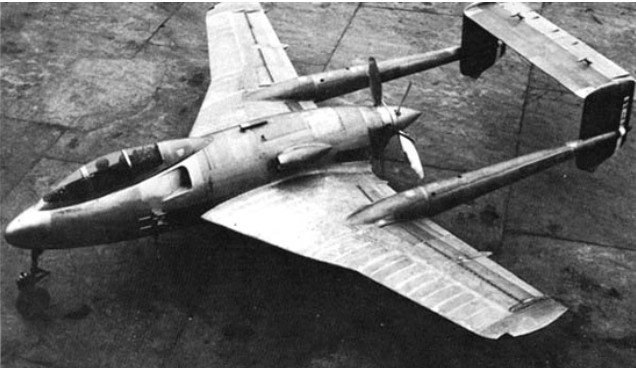
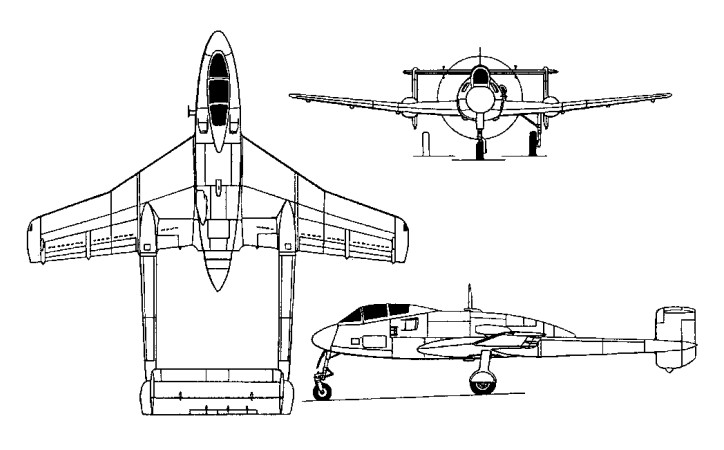
The subject of an order for two prototypes on 31 May 1946, the SO 8000 Narval (Narwhal) was conceived by a team under the leadership of Ing Dupuy at the Societe Nationale de Constructions Aeronautiques de Sud-Ouest (SNCASO) as a shipboard fighter and attack aircraft. Of twin-boom configuration with a sweptback wing – 24 degrees inboard and 13.5 degrees outboard on the leading edge – and a tricycle undercarriage, the Narval was powered by an Arsenal 12 H-02 (Junkers Jumo 213) engine rated at 2,250hp, installed as a pusher and driving contra-rotating propellers. Proposed armament comprised six 20mm cannon with provision for up to 1000kg of external ordnance.

Development was somewhat protracted, and the first flight (by the second prototype) did not take place until 1 April 1949, the second following on 30 December. Numerous problems arose during the test programme, dictating changes in the control surfaces, the air intakes and the propellers (Rotol propellers replacing the original Chauviere units); constant troubles were experienced with the engine, and, following the generally unfavourable results of evaluation at the Centre d’Essais en Vol in January 1950, development of the Narval was discontinued. The second prototype effected its 43rd and last flight on 8 January 1950, and the first prototype flew only once. Proposals to adapt the design for a Rolls-Royce Nene turbojet as the SO 8010 were not pursued. The quoted performance was not, in fact, achieved during flight test.

Loaded weight: 6606 kg / 14564 lb
Empty weight: 4821 kg / 10629 lb
Wingspan: 11.77 m / 39 ft 7 in
Length: 11.83 m / 39 ft 10 in
Height: 3.20 m / 11 ft 6 in
Wing area: 26.30 sq.m / 283.09 sq ft
Max. speed: 730 km/h / 454 mph
Range w/max.fuel: 4500 km / 2796 miles

Sud-Ouest SO 8000 Narval