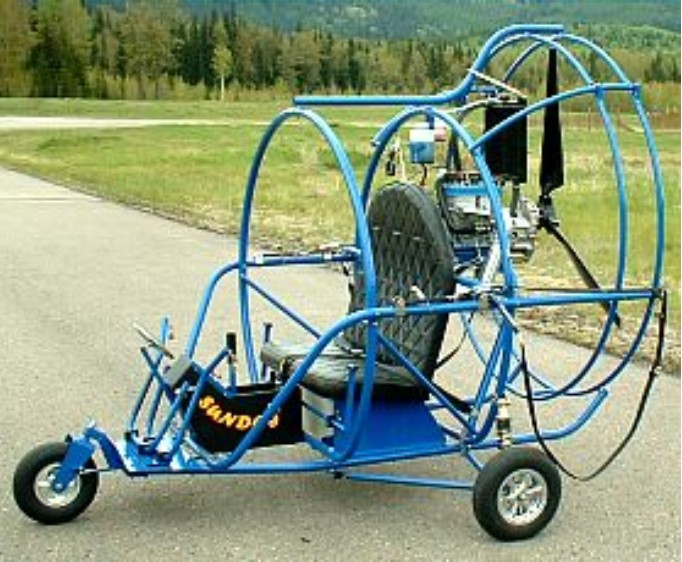
Sundog Powerchutes Two seater

A two-seater powered parachute, constructed with 6061T6 – Tubing + Plate, 304SS – Stainless Steel, and AN bolts. The risers are nylon webbing. The airframe/ cart, seat belts, and upholstery colour range is optional.

Dual Controls: Throttle + Steering

2009 Kit Price: 15,995 US$
2009 Price: $20,750.00 Canadian Dollars, assembled.

Engine: Rotax 582, 65 hp
E box, electric start
Fuel Tank: 10 USG
Parachute: Apco 500
Prop: Powerfin or GSC
Empty weight: 152 kg / 336 lbs.
MTOW Weight: 222 kg / 489 lbs
Length: 101 in
Width: 76 in
Height: 84 in
Air Speed: 28 to 33 mph
Takeoff Distance: 60 – 200 ft
Landing Distance: 30 – 100 ft
Glide Ratio: 4 – 5 to 1
Rate Of Climb: 400 – 800 ft/min.
Sink Rate: 500 – 700 ft/min.

Sundog Powerchutes PPC One seat

A one-seater powered parachute, constructed with 6061T6 – Tubing + Plate, 304SS – Stainless Steel, and AN bolts. The risers are nylon webbing. The airframe/ cart, seat belts, and upholstery colour range is optional.

Single Controls: Throttle + Steering

Price: $17,000.00 Canadian Dollars, assembled, in 2009.

Engine: Rotax 503, 52 hp
B box, recoil start
Prop: Powerfin or GSC
Length: 101 in
Width: 76 in
Height: 84 in
Parachute: Apco 500
Empty weight: 302 lb
Maximum Payload: 377 lbs
Air speed: 28 to 33 mph
Takeoff Distance: 60 – 200 ft
Landing Distance: 30 – 100 ft
Glide Ratio: 4 – 5 to 1
Rate Of Climb: 300 – 800 ft/min.
Sink Rate: 500 – 700 ft/min
Fuel Tank: 5 or 10 UGS

Sunbeam Spartan

Louis Coatalen concentrated on water-cooled engines for the most part, but did design an air-cooled V-12 named Spartan. Little is known of this engine which had a bore of 105 mm (4 in) and stroke of 130 mm (5 in), capacity of 14.03 l (856 cu in) and output of 149 kW (200 hp) driving a propeller through a reduction gearbox. The single overhead camshaft operated two inlet and two exhaust valves per cylinder via rockers and ignition was supplied by two 6-cyl. Magnetos supplying spark to one spark-plug per cylinder.

Produced in 1916/17 as prototypes only, testing was conducted in a Saunders T.1.

Specifications:
Spartan
Type: V-12 air-cooled piston engine
Bore: 105 mm (4 in)
Stroke: 130 mm (5 in)
Displacement: 14.03 l (856 cu in)
Designer: Louis Coatalen
Valvetrain: Single overhead camshaft, two exhaust and two inlet valves per cylinder
Fuel system: gravity fed
Fuel type: Gasoline
Oil system: Dry sump, pressure fed
Cooling system: Air-cooled
Reduction gear: ratio not known
Power output: 149 kW (200 hp)

Sunbeam Sikh / Semi-Sikh

At the end of the First World War there was an expectation that Britain would continue the development of airships to provide air travel throughout the British Empire. To power the expected airships Louis Coatalen designed the large Sikh V-12 engine delivering 800 hp (597 kW) at only 1,400 rpm, from 64.1 litre (3,913 cu.in) displacement in a 60-degree V12 configuration, with six valves per cylinder operated by rockers actuated by overhead camshafts.

First run on 11 May 1919 and passing Air Ministry acceptance tests in time for one to be displayed at the 1919 Paris Aero Salon and the 1920 Olympia Aero Show where it generated much interest, due to its size, but no production orders. Competition to power what little airship production there was came from the Rolls-Royce Condor and the Napier Cub. Development work continued till the engine produced 1,000 hp (746 kW) by 1923.

To power smaller airships or Blimps, Coatalen used one cylinder bank to create the Sikh II aka Semi-Sikh, a straight six-cylinder developing 400 to 425 hp (298 to 317 kW) @ 1,400 rpm. As with the Sikh, the market for airship engines dried up after the war, so no production Sikh II engines were built.

In the late 1920s large airships were in favour again, so Coatalen revised the Sikh and developed the Sunbeam Sikh III for the R100 and R101 airship families. Retaining the bore, stroke and displacement of the earlier engine, detail refinements included five valves per cylinder and enclosed valve-gear. The Sikh III was displayed at the 1929 Olympia Aero Show, generating interest due to its large size, weight and power. After the R101 disaster the large Empire airships were abandoned, and the airship market for Sunbeam engines disappeared for a second time, leaving the Sikh III with no orders.

No Sikh engines of any version were sold.

Variants:
Sikh
The original 800 hp airship engine intended for use by airships to be developed after the war, which were cancelled.

Sikh II
Following his previous practise Coatalen developed a straight six version of the Sikhusing a single bank of cylinders. Also intended for airships to be developed after the war,the Sikh II was cancelled when the airships did not materialise.(32.1L / 1,957 cu.in)

Semi-Sikh
Alternative name for the Sikh II.

Sikh III
In the late 1920s, renewed interest in airships, which spawned the Empire Airship programme, also encouraged development of engines to power the airships with. The Sikh III was one of these; closely following the Sikh in construction, major differences included two inlet valves instead of three and enclosed valve-gear.

Specification:
Sikh III
Type: V-12 60-degree water-cooled piston engine
Bore: 180 mm (7.1in)
Stroke: 210 mm (8.3in)
Displacement: 3,912cu in (64.113l)
Length: 2,185 mm (7ft 2in)
Width: 1,018 mm (3ft 4in)
Height: 1,652 mm (5ft 4.5in)
Dry weight: 1,252 kg (2,760lb) Dry
Valvetrain: overhead camshaft two inlet and three exhaust valves per cylinder
Fuel system: 2x six-cylinder carburettors
Oil system: Dry sump, pressure feed
Cooling system: Water-cooling through radiators
Reduction gear: Spur gear 38:67
2x magneto
Power output: 746 kW (1,000 hp) @ 1,650 rpm
Compression ratio: 5:1

Sunbeam Nubian / 155 hp

In March 1916 Louis Coatalen, the chief designer at Sunbeam, responded to the Admiralty’s request for more powerful engines by designing the 90 degree, V-8 Nubian, also called the Sunbeam 155 hp. The Nubian featured the twin overhead camshafts and four valves of his pre-war engines for Grand Prix and TT racing cars. With a bore of 95 mm (4 in) and stroke of 135 mm (5 in) the Nubian displaced 7.685 l (469 cu in) and was rated at 155 hp (116 kW) with a reduction gear ratio of 0.615:1.

The original engine was built with 60 degree angle between cylinder banks but severe vibration problems forced Coatalen to redesign it with a 90 degree angle, emerging as the Nubian II. Intended to power the Supermarine AD Flying Boat the teething troubles of the Nubian forced Supermarine to use a 150 hp (112 kW) Hispano-Suiza V-8 engine instead.

Deliveries of the Nubian II began in October 1917, by which time the Nubian was overshadowed by the more powerful V-8s from Hispano-Suiza and the 200 hp (149 kW) Sunbeam Arab. The only aircraft known to have been powered by a Nubian was the Saunders T.1, but some of the 36 engines built, of 50 ordered, are believed to have been supplied to the Imperial Russian Air Service.

The Nubian suffered from a poor design decision at first and was overtaken by events which prevented widespread use, but its cousin, the V-12 Sunbeam Afridi and its family members found greater success.

Variants:
Sunbeam Nubian
The initial V-8 engine with 60 degree Vee and rated at 155 hp (116 kW).

Sunbeam Nubian II
Re-designed with 90 degree cylinder angle to alleviate severe vibration problems, the Nubian II was late in delivery and was not widely used.

Applications:
Saunders T.1
Blackburn GP – handed left and right

Specifications:
Nubian II
Type: V-8 90 degree Vee, water-cooled piston engine
Bore: 95 mm (4 in)
Stroke: 135 mm (5 in)
Displacement: 7.685 l (469 cu in)
Length: 1,052 mm (41 in)
Height: 765 mm (30 in)
Dry weight: 310 kg (683 lb)
Designer: Louis Coatalen
Valvetrain: Twin direct overhead camshaft, two exhaust and two inlet valves per cylinder
Fuel system: gravity fed
Fuel type: Gasoline
Oil system: Dry sump, pressure fed
Cooling system: Water-cooled by radiator
Reduction gear: 0.615:1
Power output: 115.6 kW (155 hp)

Sunbeam Amazon

In similar fashion to other engine families designed by Coatalen the Cossack spawned a straight-six derivative in the Amazon, in effect half a Cossack, retaining the 110 x 160mm bore/stroke, overhead camshaft, four poppet valves per cylinder and cast-iron cylinder blocks in groups of three. An output of 160 hp (119 kW) from 9.2 l (561 cu in) for a running weight of 747 lb (339 kg) led to a high power to weight ratio. Despite the high output the Amazon was little used in Britain, with only possible use aboard Coastal airships and some supplied to the Imperial Russian Air Service. Amazon production totalled 77 out of an order for 100, 23 of which were cancelled. A non-aviation use version of the Amazon was produced as the Sunbeam Amazon II, fitted with hand and/or compressed-air starters and single magneto ignition system.

Variants:
Amazon
A straight six version of the Cossack retaining the dual ignition system, bore and stroke and cast-iron blocks in groups of three. Rated at 160 hp (119 kW) at 2,000rpm.

Amazon II
A non-aviation use version of the Amazon with single ignition system. Rated at 160 hp (119 kW) at 2,000 rpm.

Sunbeam Cossack

As the First World War raged through 1914 and 1915, The Admiralty demanded engines with more power for its existing and future aircraft. The problem was exemplified by the Short Type 184 seaplanes of the RNAS, powered by Sunbeam Mohawk engines, which could barely lift the standard air-dropped torpedo with crew reduced to two and minimal fuel. An engine with a base rating of at least 300 hp (224 kW) was demanded by the Admiralty. Responses came from Rolls-Royce with the Rolls-Royce Eagle and Sunbeam with the Sunbeam Cossack.

Louis Coatalen designed the Cossack as a twin overhead camshaft 60° V-12, with four valves per cylinder, bore of 110 mm (4 in) and stroke of 130 mm (5 in). Output from the Cossack was 310 hp (231 kW) @ 2,000rpm, with a running weight of 1,372.5 lb (623 kg), driving a large diameter propeller through a 2:1 reduction gear. First run in 1916, construction of the Cossack was largely of aluminium alloy with cast-iron cylinder blocks and integral heads in groups of three.

Large orders were placed for the Cossack but deliveries were very slow, with only eleven, largely hand-built, engines delivered from March 1916 to September 1916. The end of Sunbeam Gurkha production in October 1916 freed up factory resources to allow up to thirty engines a month to be delivered until Cossack production ended in December 1917 after 350 deliveries.

Development of the basic engine produced the Sunbeam Cossack II with four magnetos, to counter the unreliability of British contemporary magnetos, and a compressed-air or hand driven starter, rated at 320 hp (239 kW).

Late in the First World War Britain’s airship aspirations were boosted by the order for the R36, R37 and R38. All three airships were powered a variety of engines including the Sunbeam Cossack III a derivative of the Cossack with a flywheel, hand or air starter, engine controls and magnetos mounted directly on the engine for access by the engine mechanics. The Cossack 3 was designed with a water-cooled exhaust and speed governor. The overhead camshaft was gear driven from the crankshaft. Only 14 Cossack IIIs were built due to the cancellation of the post-war British airships.

To extract more power from the Cossack lineage Coatalen designed a W-18 version known as the Sunbeam Viking. This engine used Cossack blocks in a W arrangement with 60° between banks having a capacity of 33.6 l (2,050 cu in) giving 450 hp (336 kW) @ a propeller speed of 900rpm. Orders for 50 engines were received, intended to power the large AD Seaplane Type 1000 aircraft, but most of the nine engines produced were fitted to motor boats, the remaining 41 being cancelled.

Variants:
Cossack I
The basic production V-12 engine with cast-iron blocks, 110 mm (4 in) bore and single ignition system fed by two magnetos. Rated at 310 hp (231 kW) at 2,000rpm.

Cossack II
An improved Cossack with dual ignition system and hand / compressed air starter. Rated at 320 hp (239 kW) at 2,000rpm.

Cossack 3
Built for airship use. Produced 350 hp at 2,000 rpm and weighed 1,200 lb (540 kg) dry.

Number built 1916-1920:
UK 350
France 150
US 1+?
Cossack III 14

Applications:
AD Seaplane Type 1000
Short Type 310
Porte Baby FB.2
Felixstowe F.3
Handley Page Type O/400
Tellier Flying boat
HM Airship R36
HM Airship R37 Airship scrapped when 95% complete
HM Airship R38 (R38 class discontinued)

Specifications:
Cossack II
Type: V-12 water-cooled piston engine
Bore: 110 mm (4 in)
Stroke: 160 mm (6 in)
Displacement: 18.246 l (1,113 cu in)
Length: 1,569 mm (62 in)
Width: 960 mm (38 in)
Height: 988 mm (39 in)
Dry weight: 622.5 kg (1,372 lb) Running
Designer: Louis Coatalen
Valvetrain: Twin overhead camshaft, two exhaust and two inlet valves per cylinder
Fuel system: 4 x Claudel-Hobson CS 42 mm (2 in) bore carburettors, gravity fed
Fuel type: Gasoline
Oil system: Dry sump, pressure fed
Cooling system: Water-cooled by radiator
Reduction gear: 2:1
Power output: 238.6 kW (320 hp) @ 2,000rpm
Sunbeam Matabele

The final derivative of the Cossack family was the Sunbeam Matabele, retaining the Aluminium alloy blocks and 122 mm (5 in) bore of the Saracen. The Cossack was a twin overhead camshaft V12, with four valves per cylinder. The Matabele fitted this with two of the blocks from the Saracen, using aluminium instead of the Cossack’s cast iron. The Saracen’s bore was slightly larger at 122 mm (from the Cossack’s 110 mm) and with the same stroke of 160 mm this gave a capacity of 22.4 litres (1,370 cu in). Ignition was by four magnetos (two per bank), with twin sparkplugs. A propeller reduction gear of 1.63:1 was fitted. First run in May 1918, the V-12 Matabele delivered 420 hp (313 kW) at 2,000 rpm.

Developed in two versions, the Sunbeam Matabele I, for aviation use, was fitted with four magnetos, whilst the Sunbeam Matabele II was only fitted with two magnetos supplying a single ignition system for non-aviation use.

Used mainly in Airco DH.4 bombers, the Matabele also found favour as a power-boat and speed-record car engine. No Matabeles were built during the First World War, but prototypes and at least eight production engines were built after the war for various applications.

The Matabele was tested successfully in a DH.4 from May 1918. The only order for the engine, came from France, where the engine was used to power the Nieuport-Delage NiD 30 airliner.

Variants:
Matabele I
The Matabele I was a v-12 engine with similar aluminium alloy blocks to the Saracen, as well as the larger bore of 122 mm (5 in), rated at 160 hp (119 kW) at 2,000 rpm. Intended for general aviation use the Matabele I had a dual ignition system with four magnetos.

Matabele II
For non-aviation use the Matabele II had a single magneto per bank and compressed-air / hand starters. This engine found favour powering motor-boats.

Specifications:
Matabele
Type: 12-cylinder naturally aspirated liquid-cooled “Vee” piston aircraft engine
Bore: 122 mm (4.8 in)
Stroke: 160 mm (6.3 in)
Displacement: 22.4 L (1,367 cu.in)
Dry weight: 1,091 lb (495 kg) wet
Valvetrain: Twin overhead camshaft, twin intake and twin exhaust valve per cylinder
Fuel system: Two Claudel-Hobson HC.7 carburettors
Cooling system: water
Reduction gear: 1.63:1
Power output: 400 hp (300 kW) at 2,000 rpm
Specific power: 13.4 kW/litre

Sunbeam Gurkha

The Gurkha was developed as a replacement for the Mohawk with a bore of 100 mm (3.94in) and the gear ratio was reduced to 1.86:1, giving 240 hp (179 kW) at 2000 rpm. Production ended in October 1916, after 74 units had been supplied to power the Short 184 seaplanes of the Royal Naval Air Service.

The Gurkha engine preserved at the Fleet Air Arm Museum, Yeovilton, Somerset, England, is the only surviving Sunbeam side-valve engine in the world. It is installed in the Short 184, aircraft number 8359, that played a minor role in the Battle of Jutland at the end of May 1916. The pilot on that occasion was Flight Lieutenant Frederick Rutland (who was ever after known as “Rutland of Jutland”),