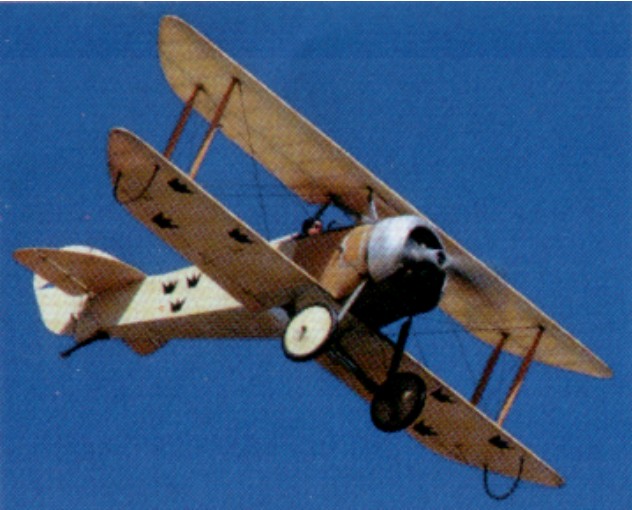
Designed and built by the Swedish Army Aircraft Factory, as a trainer for the Swedish airforce and first flown in June 1919. Only 28 were built before the type was retired in the 1920s.
Engine: Thulin A rotary
Designed and built by the Swedish Army Aircraft Factory, as a trainer for the Swedish airforce and first flown in June 1919. Only 28 were built before the type was retired in the 1920s.
Engine: Thulin A rotary
The Tumansky R-21 was developed at Tushino motor plant (part of OKB-300), headed by Nikolai Georgievich Metskhvarishvili, as a twin-spool axial-flow afterburning turbojet. It was based on the Tumansky R-11 with the goal of increasing thrust and airflow, using a new six-stage compressor with a larger diameter and different rotor blades than its predecessor as well as a new afterburner chamber and variable exhaust nozzle. The increased pressure ratio and turbine inlet temperature required components to be fabricated from advanced alloys.
Several contemporary Soviet aircraft were planned to use the R-21, including the Sukhoi T-58, Sukhoi T-6 and the Mikoyan-Gurevich Ye-8. On September 11, 1962 an R-21, fitted to a Ye-8, exploded in mid-air after compressor failure; test pilot Mosolov survived the ejection at Mach 1.78, but he never fully recovered. Shortly afterward the Ye-8 program was cancelled along with R-21 development in favour of heavier fighter planes such as the Mikoyan-Gurevich MiG-23, which required more powerful engines.
The R-21F-300 was the only version built.
R-21F-300
Type: Afterburning turbojet
Diameter: 987 mm (38.9 in)
Dry weight: 1,250 kg (2,755 lb)
Compressor: Six-stage axial compressor
Maximum thrust:
46.1 kN (10,361 lbf) military power
70.6 kN (15,873 lbf) with afterburner
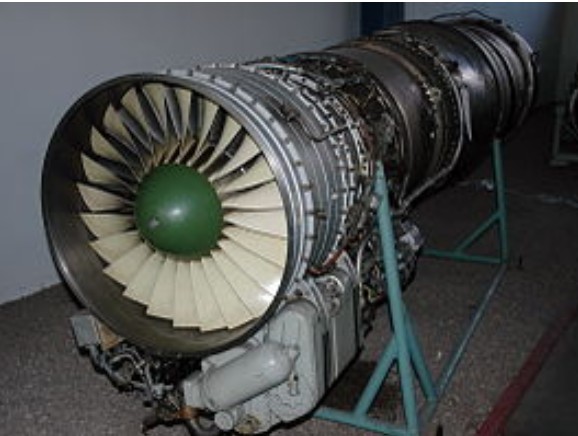
The Tumansky R-11 (initially AM-11) turbojet engine was developed by A.A. Mikulin, S.K. Tumansky, and B.S. Stechkin as a twin-spool axial-flow high-altitude non-afterburning turbojet for Yakovlev Yak-25RV reconnaissance aircraft. This engine was the first Soviet twin-spool turbojet. It was first run in early 1956. The basic design was very successful and it was evolved into Tumansky R-13 and Tumansky R-25. Also experimental Tumansky R-21 was an evolution of R-11. A total of 20,900 R-11 engines were built.
Variants:
R-11V-300 – first production version, high-altitude, non-afterburning
R-11F-300 (R-37F) – afterburning version, entered production in 1956, used on MiG-21F, P and U.
R-11AF-300 – improved version for Yakovlev Yak-28B, L and U.
R-11F2-300 – new compressor, afterburner and nozzle, used on MiG-21P, PF and FL.
R-11AF2-300 – R-11F2-300 adapted for Yakovlev Yak-28I, R and P.
R-11F2S-300 – upgraded version for MiG-21PFM, PFS, S, U and UM, and for Sukhoi Su-15, UT and UM.
Shenyang WP-7, Chinese license built copies of the R-11
Specifications:
R-11F2S-300
Type: Afterburning turbojet
Length: 4,600 mm (181.1 in)
Diameter: 906 mm (35.7 in)
Dry weight: 1,124 kg (2,477 lb)
Compressor: Axial compressor
Maximum thrust:
38.7 kN (8,708 lbf) military power
60.6 kN (13,635 lbf) with afterburner
Overall pressure ratio: 8.9:1
Turbine inlet temperature: 955 °C (1,750 °F)
Specific fuel consumption:
97 kg/(h·kN) (0.95 lb/(h·lbf)) at idle
242 kg/(h·kN) (2.37 lb/(h·lbf)) with afterburner
Thrust-to-weight ratio: 53.9 N/kg (5.5:1)
The R-15-300 axial flow, single shaft turbojet with an afterburner was designed at OKB-300 design bureau led by Sergei Tumansky in the late 1950s. The engine was originally designed to be used in the Tupolev Tu-121 high-altitude high-speed cruise missile. Due to lacking Soviet resources and funding the engine casing was mainly steel, and in areas exposed to high levels of heat, 30 micrometre silver-plated steel. At the time, the USSR did not have the resources to exploit metals such as titanium, or other composite alloys, which could have greatly reduced the engine’s weight. The Tu-121 effort was later canceled, but its basic design was re-used to create the Tupolev Tu-123 reconnaissance drone.
At dry thrust the engine could produce 7,500 kilograms force (73.5 kN, 16,500 lbf); with afterburner the output is 11,200 kilograms force (110 kN, 24,700 lbf). This allowed speeds of up to mach 3.2 in the Mikoyan-Gurevich MiG-25 (which used two engines). However, at speeds above mach 3, the force of the engine sucking fuel through the pumps overwhelmed the pumps’ ability to limit the flow. At this point, the engines effectively became ramjets, as air began to bypass the low pressure compressors, accelerating out of control until the pilot could regain throttle control through using firewalls or compressor stall, or the tanks ran dry. The engine also suffered from huge fuel consumption issues, especially at low altitudes. The engines did give excellent performance at high altitude though, with good fuel consumption and speeds at 80,000 feet (24,000 m), which was considerably better than any Western aircraft at the time (early 1960s). The MiG-25 was able to supercruise. The R-15BD-300 was known for ease of maintenance, performance, and good monitoring systems for both pilots and engineers.
Variants:
R-15-300: Original version. Used in Tupolev Tu-123 Yastreb drone.
R-15-300M:
R-15B-300: Electronic engine controls (the first for the Soviet engine). and modifications to increase life span. Original engine for the MiG-25P, MiG-25R and variants. Life expectancy 150 hours.
R-15BD-300: Improved and more powerful version for MiG-25PD and MiG-25PDS. Life expectancy increased to 1000 hours.
R-15BF2-300: Uprated version. Used in Ye-266M high-performance MiG-25M prototype. MiG-25M aircraft was never put into production
Applications:
The only aircraft that uses the R-15-300 is the MiG-25. These engines made it the fastest (clocked at Mach 3.2) fighter aircraft ever put into production.
Prototypes were also used for Mikoyan-Gurevich Ye-150 family of single-engine interceptor prototypes.
Tupolev Tu-123 drone
Specifications:
R-15B-300
Type: Afterburning turbojet
Length: 6,264 mm (246.6 in)
Diameter: 1,512 mm (59.5 in)
Dry weight: 2,454 kg (5,410 lb)
Compressor: 5-stage axial compressor
Turbine: single-stage turbine
Maximum thrust:
73.5 kN (16,523 lbf) military power
100.1 kN (22,503 lbf) with afterburner
Overall pressure ratio: 4.75:1
Turbine inlet temperature: 942 °C (1,727 °F)
Specific fuel consumption:
127 kg/(h·kN) (1.25 lb/(h·lbf)) at idle
275 kg/(h·kN) (2.70 lb/(h·lbf)) with afterburner
The Tumansky R-13, designed by Sergei Alekseevich Gavrilov, is a development of the successful Tumansky R-11 engine. It is a two-spool axial-flow turbojet featuring a new five-stage high-pressure compressor, new combustion chamber design to facilitate restarting the engine at high altitudes, new afterburner, and greater use of titanium components. It is used by MiG-21M, MF, SM, and SMT, and Sukhoi Su-15M and TM. R-13 is also built in China as LM WP13, and experienced similar fate like Tumansky R-11: originally, both were supposed to be licensed built in China, but due to Sino-Soviet split, all Soviet technical support was withdrawn and China was forced to do the job itself. Under the leadership of the general designer Mr. Jiang Hepu, both R-11 and R-13 were successfully built in China on its own, and were given the designation of WP-7 and WP-13 respectively.
Specifications:
R-13-300
Type: Afterburning turbojet
Length: 4,605 mm (181.3 in)
Diameter: 1,095 mm (43.1 in)
Dry weight: 1,205 kg (2,656 lb)
Compressor: Two-spool axial compressor
Maximum thrust:
39.9 kN (8,970 lbf) military thrust
63.7 kN (14,320 lbf) with afterburner
Overall pressure ratio: 8.9:1
Turbine inlet temperature: 1,005 °C (1,840 °F)
Specific fuel consumption:
95 kg/(h·kN) (0.93 lb/(h·lbf)) at idle
213 kg/(h·kN) (2.09 lb/(h·lbf)) with afterburner
Thrust-to-weight ratio: 52.8 N/kg (5.4:1)
In 1934, USSR licensed the French Gnome-Rhone 14K aircraft engine producing 800 hp (595 kW), which entered production as the M-85 radial. The engine was subsequently modified to M-86 which produced 960 hp (715 kW) at takeoff thanks to increased supercharging and a higher compression ratio. First run in 1938, the M-87 was created to further increase the power output. Cylinders and pistons were revised to increase the compression ratio and the supercharger was redesigned. The resulting engine had better high-altitude performance and entered production in 1938. However, the engine proved unreliable and suffered from failure of gears in the reduction gearbox. Later the M-88 was designed to address the shortcomings of the M-87. At first the M-88 was not a success, but the designers persisted, and the M-88 was made into a reliable and widely produced engine. The M-87 was used in Ilyushin Il-4 and Sukhoi Su-2 bombers, and the Polikarpov I-180 fighter.
Specifications:
M-87
Type: Two-row, 14-cylinder, air-cooled supercharged radial engine
Bore: 146 mm (5.75 in)
Stroke: 165 mm (6.5 in)
Displacement: 38.72 L (2,363 cu.in)
Dry weight: 640 kg (1,140 lb)
Supercharger: Centrifugal type supercharger
Cooling system: air
Power output: 950 hp (710 kW) at 2,250 rpm for takeoff and at 4,500 m (14,765 ft)
Specific power: 18.4 kW/L (0.4 hp/cu.in)
Compression ratio: 6.1:1
Power-to-weight ratio: 1.1 kW/kg (0.8 hp/lb)

Tugan Aircraft Ltd built in 1936 six examples of the Gannet twin-engined, high-wing monoplane for cartographic survey/ambulance duties for the RAAF, designed by Wg Cdr L. J. Wackett. Taken over 1936 by Commonwealth Aircraft Corporation.
The seven-seat utility flew in RAAF colours from November 1935.
After Japan’s entry to the war in December 1941 they were used as air ambulances.
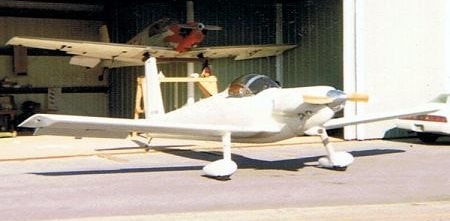
The LGT-2 Pamela was another original homebuilt aircraft designed and constructed by L.G. Tucker of Greeneville, Tennessee, USA.
Development and construction of the LGT-2 single-seat sporting monoplane started in 1972. It was conventional in configuration, constructed of wood and covered with Dacron. Power plant was a 125 hp Avco Lycoming O-290 flat-four engine, driving a Hegy two-blade wooden propeller. It had a 16 gal (60.5 l) fuel tank in fuselage, with a refueling point forward of canopy. Oil capacity was 2 gal (7.5 l).
Its non-retractable tail wheel type landing gear had cantilever spring steel main legs, McCreary 15×5 in (38.1×12.7 cm) main wheel tires (30 lb/sq.in, 2.11 kg/sq.cm), Rosenhan hydraulically actuated drum brakes, and streamline wheel fairings which were removable. A rearward sliding canopy enclosed the cockpit. The electrical system included a 12V battery and DC generator. Avionics comprised a Genave 200 radio and VOR; blind-flying instrumentation was fitted.
Registered N3988 the aircraft made the first flight in May 1981. Only one example was completed and this had a 125 hp Lycoming O-290 engine. The registration was cancelled in 1998.
Engine: 125 hp Lycoming O-290
Propeller diameter: 5 ft 10 in (1.78 m)
Span: 29 ft 0 in (8.08 m)
Wing aspect ratio: 9
Wing chord, at root: 4 ft 0 in (1.22 m)
Wing chord, at tip: 3 ft 0 in (0.91 m)
Length: 20 ft 0 in (6.10 m)
Height: 6 ft 0 in (1.83 m)
Tail plane span: 8 ft 0 in (2.44 m)
Wing area: 87 sq.ft (8.08 sq.m)
Wheel track: 7 ft 0 in (2.13 m)
Empty weight: 935 lb (424 kg)
Loaded weight: 250 lb (113 kg)
Max take off weight: 1,297 lb (588 kg)
Never-exceed speed: 200 mph (322 kmh)
Max level speed: 180 mph (290 kmh) at 2,000 ft (610 m)
Max cruise speed: 170 mph (274 kmh) at 10,000 ft (3,050 m)
Stall speed: 55 mph (89 kmh)
Climb: 1,600 ft (488 m)/min
Take off run: 400 ft (122 m)
Landing run: 1,000 ft (305 m)
Service ceiling: above 15,000 ft (4,570 m)
Range: 300 mls (483 km)

The one-of-a-kind LGT-1 Le Petite Cygne (Little Swan) N1295V was an original design homebuilt of L.G. Tucker of Greeneville, Tennessee, USA, with a mixed steel tube, wood and fabric construction. When first flown in April 1964 the aircraft had a 37 hp Aeronca E113-2 engine and an open cockpit. After a minor accident, the aircraft was rebuilt with a 40 hp Continental A40-4 and also received a cockpit canopy. Its registration was cancelled on June 25, 1983.
Le Petit Cygne
Engine: Aeronca E113-2, 36hp, later 40hp Continental
Wingspan: 28’0″
Empty weight: 505 lb
Max speed: 110 mph
Stall: 40 mph
Seats: 1
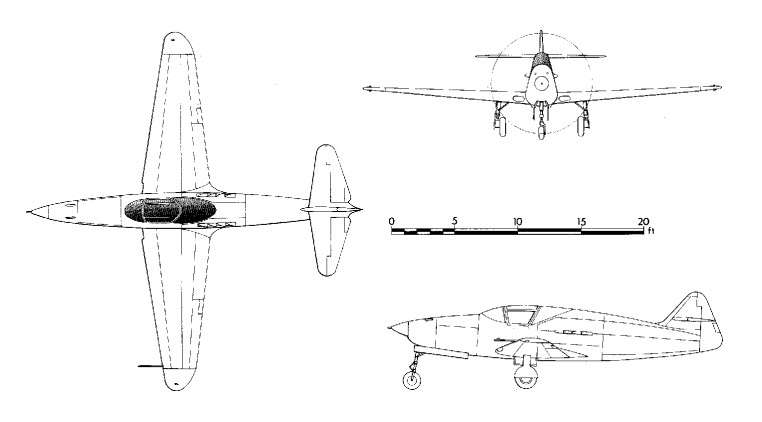
In 1940 the Tucker Aviation Co, of Detroit, proposed a fighter that was conventional, simple, and intended to yield thousands of cheap, easily maintained and tough pursuits in a matter of months. Powered by the 720 hp Miller L 510 V 8, driving a 2-blade propeller via a long shaft, it was to have, a metal skinned steel tube fuselage and wooden wings, with two or three guns in the nose, one firing through the propeller hub. Gross weight was estimated at 3,000 lb and speed 308 m.p.h. The company were unable to fulfil the Army contract.