Nord 3400

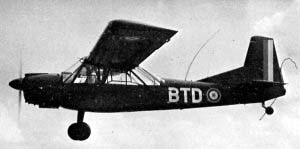
The Nord 3400 Norbarbe was a French two-seat observation and casualty-evacuation aircraft built by Nord Aviation for the French Army Light Aviation.

The Nord 3400 was designed to meet a French Army requirement for a two-seat observation aircraft, with a secondary casualty-evacuation role. The 3400 was a braced high-wing monoplane with a fixed tailwheel landing gear and an enclosed cabin with tandem seating for a pilot and observer. The prototype F-MBTD first flew on 20 January 1958, powered by a 179 kW (240 hp) Potez 4D-30 engine. A second prototype with an increased span and wing area followed, being powered by a 194 kW (260 hp) Potez 4D-34 engine. A production batch of 150 was ordered by the French Army in the same configuration as the second prototype.

The wings may be folded for storage.

The first Nord 340 was accepted by the ALAT on 9 July 1959 and the 150th and last was delivered in March 1961.
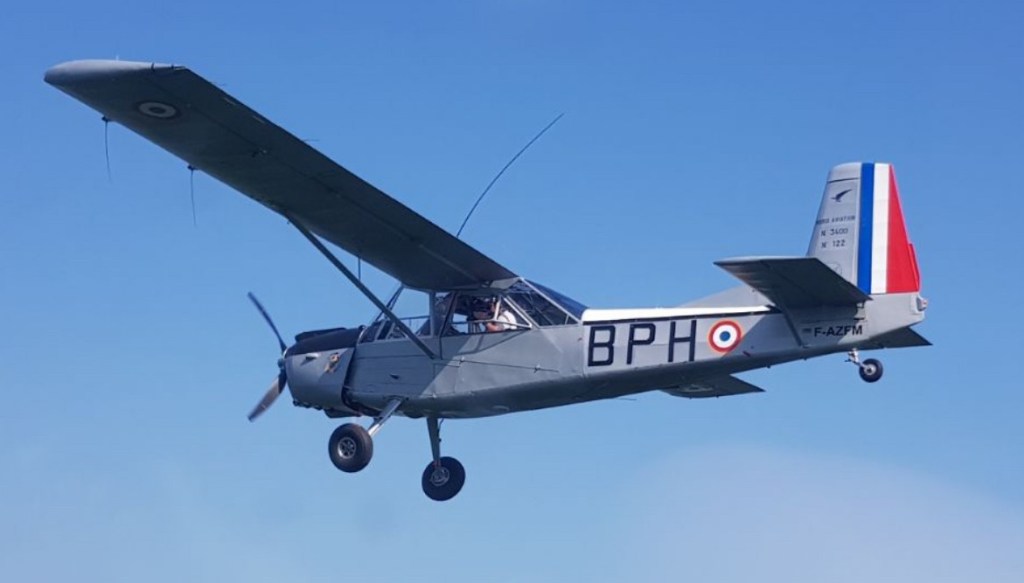
Nord 3400-01
First prototype F-MBTD
Engine: 179 kW (240 hp) Potez 4D-30
Wing span: 12.7 m (42 ft)
Wing area: 19.5 sq.m (210 sq ft)

Second prototype
Engine: 194 kW (260 hp) Potez 4D-34

Nord 3400
Powerplant: 1 × Potez 4D-30, 180 kW (240 hp)
Propeller: 2-bladed Ratier Type 24-56 adjustable-pitch
Propeller diameter: 2.25 m (7 ft 5 in) diameter adjustable-pitch propeller
Wingspan: 13.11 m (43 ft 0 in)
Wing area: 20.82 sq.m (224.1 sq ft)
Aspect ratio: 8.2
Airfoil: NACA 23015[4]
Length: 8.42 m (27 ft 7 in)
Height: 3.1 m (10 ft 2 in)
Empty weight: 920 kg (2,028 lb) equipped
Max take-off weight: 1,350 kg (2,976 lb)
Fuel capacity: 220 L (58.1 US gal; 48.4 imp gal) in two self-sealing rubber tanks (160 kg (353 lb))
Maximum speed: 235 km/h (146 mph, 127 kn)
Cruise speed: 200 km/h (120 mph, 110 kn)
Stall speed: 70 km/h (43 mph, 38 kn) <
Range: 1,000 km (620 mi, 540 nmi)
Rate of climb: 7 m/s (1,400 ft/min)
Wing loading: 65 kg/sq.m (13 lb/sq ft)
Power/mass: 0.192 kW/kg (0.117 hp/lb)
Take-off run: <100 m (328 ft)
Landing run: <100 m (328 ft)
Crew: 2

Scaled Composites 437 Vanguard

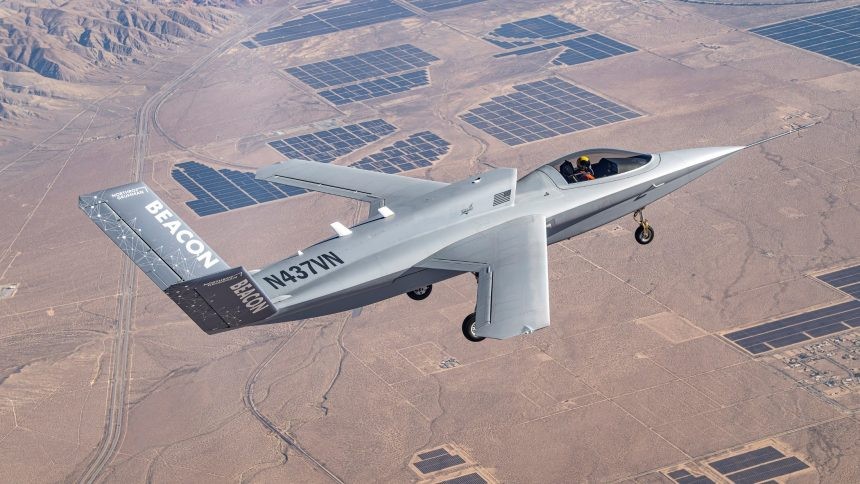
Vanguard during the first flight after the modifications, and its second flight overall.

The Model 437 Vanguard was originally conceived as an unmanned loyal wingman concept in 2021, designed to operate alongside crewed aircraft in attritable roles. Renderings at the time depicted an uncrewed platform with a range of around 3,000 nautical miles, a cruise speed near Mach 0.8, and payload options including AIM-120 AMRAAMs or side-looking radar systems.

Its first flight in August 2024 revealed a cockpit, making the Vanguard an optionally piloted aircraft. As we reported on that occasion, the Vanguard is powered by a single Pratt & Whitney PW535 turbofan engine producing 3,400 pounds of thrust, and features a wingspan of 41 ft (12.5 m), gross takeoff weight of 10,000 lb (4,536 kg), and endurance of six hours.

Northrop Grumman contributed to the program through its Digital Pathfinder initiative, using advanced digital engineering methods to design and build the Model 437’s wings. The process, the company said, reduced rework to less than one percent compared to the 15–20% typical of conventional design programs, drawing directly on lessons from the B-21 Raider stealth bomber program.

The Model 437 Vanguard resumed flight testing at Mojave Air and Space Port, , announced by Scaled Composites on Sep. 20, 2025, comes after extensive modifications to the airframe for its new role since its first flight in August 2024.

The company reported updates to the hydraulic system, cockpit integration of new pilot interfaces, and the incorporation of autonomy subsystems developed by Northrop Grumman for Beacon. These upgrades pave the way for the Model 437 to serve as a versatile airborne platform for experimentation with autonomy and artificial intelligence-driven mission software.

“We had the challenge of taking an airplane that has only flown once and converting it into a versatile autonomous testbed, which demonstrates Scaled’s agility and flexibility in achieving new test objectives,” said project engineer Yuto Shinagawa, highlighting the integration of flight safety protections for autonomous operations. As an example, he mentioned the introduction of protections in the flight control system to assure flight safety when engaging the autonomous system.

As Scaled Composites resumes envelope expansion flights, the focus will be on validating the integration of Beacon’s autonomy ecosystem and ensuring safe transitions between crewed and autonomous modes. The aircraft’s optional manned capability allows safety pilots to supervise tests while gradually handing over control to autonomy software, reducing risks in early phases.

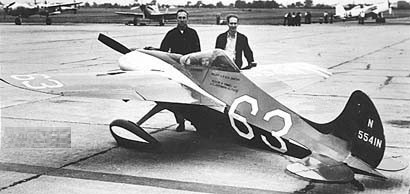
Anderson Special

Anderson Special N5541N

The 1948 Anderson Special was a single-place low wing 85hp Continental C-85 powered midget racer with a diamond-shaped fuselage cross-section. Raced by Bruce Raymond as Ace of Diamonds and Beetle Bomb, registered N5541N, it was modified as mid-wing in 1949.

The Special crashed in racing in 1950 and the wings were salvaged for use on the 1953 Pitt Yellow Jacket.