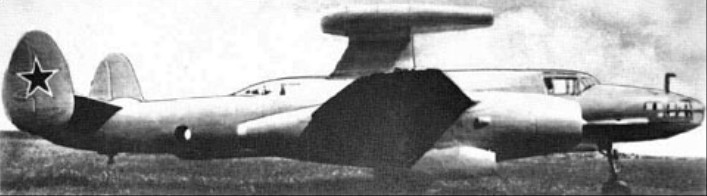
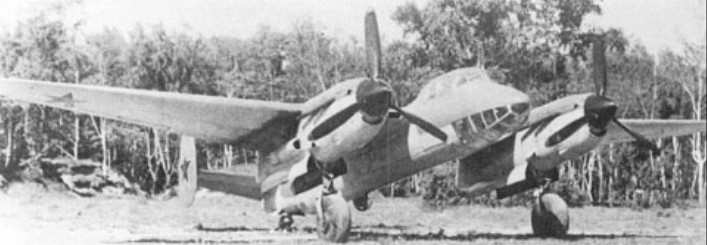
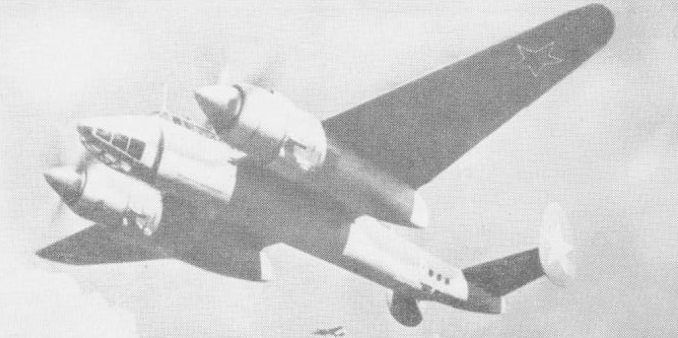
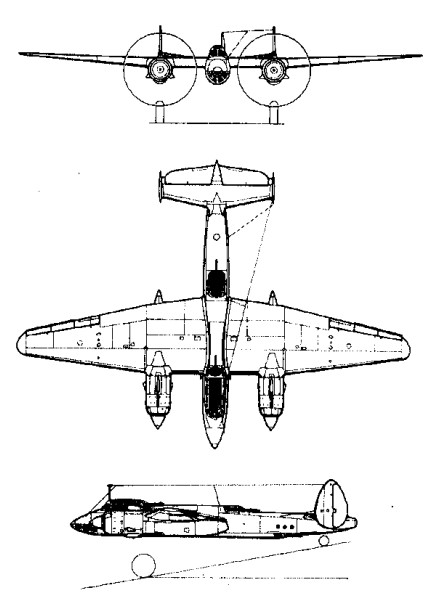
The Tu-78 and Tu-79 were essentially the Tu-73 but with Soviet licence-built 5952-lb (2700-kg) Rolls-Royce engines. The two Nenes were now called the RD-45, and the Derwent, the RD-500. The prototype was built at factory N 156 with Sergei Yeger in charge. It made its first flight on 17 April 1948 and its state tests were completed by December. It was approved for serial production under the VVS designation Tu-20, but this was not actually carried out because of the shortage of production facilities. The Tu-20 designation would be used again later. The Tu-79 was a long-range reconnaissance aircraft originally designated Tu-73R. By then, 1949, Klimov had developed the Nene/RD-45 to produce 2,700kg thrust, and the Tu-79 was to have been fitted with two of these VK-1 engines in place of the lower powered RD-45s. The VVS allocated the designation Tu-22 to planned production. Although this one was never actually built, the Tu-22 designation would also be used later.
Tu-79 Engines: 2 x VK-1 turbojets Max speed: 535 mph (861 km/h) at 16,405 ft (5000 m)
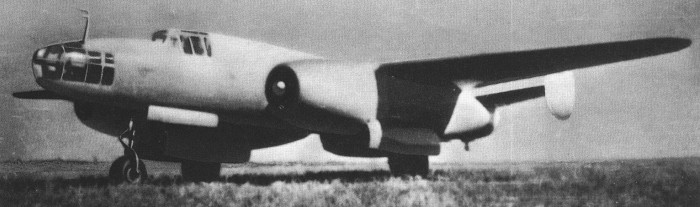
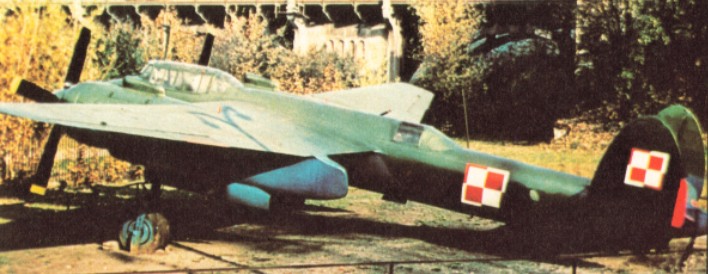
The Tu-12 was the last derivative of the Tu-2, better known as the Tu-77, really as a follow-on of the ANT numbering sequence. The VVS gave it the designation Tu-12. The Tu-12 was the Soviet Union’s first jet bomber. Tupolev intended it as an interim measure to develop later aircraft and to train crews in the handling of larger jet aircraft. Sergei Yeger, working under Tupolev’s supervision, led the programme. He took the basic Tu-2 fuselage, wings and tailplane, and adapted them only for the higher speeds of a jet. It was one of very few jets of the 1940s to feature a twin tail. The undercarriage was changed from a tailwheeler to a tricycle, and under the wings were fitted Rolls-Royce Derwent engines; for several years after the war, the British government allowed engines, and some other aviation components, to be sold to the USSR. Although Soviet designers were hurriedly developing jet engines, by the time of the Tu-12 in 1947 even MiG-15s were using either Rolls-Royce engines or licence-built copies of them. Only Lyulka’s jet engines were of Soviet design and manufacture, and these at that time had hardly half the power of the Nenes fitted on the Tu-12, which gave a static thrust of 2,270kp/5,0041b. The first Tu-12 was built at factory N156, the new title for the former KOSOS TsAGI works attached to the design offices. It was completed in May 1947, and after transfer to Zhukovski and reassembly, Aleksei Pereliot flew it on its first flight on 27 June. There were no major difficulties found in the test programme. For an interim aircraft its performance was reasonable: maximum speed was 783kph/487mph, range was 2,200km/l,367 miles, and its service ceiling was ll,300m/37,075feet. The VVS accepted the prototype Tu-12, and production began at factory N23 in Moscow with an order for five. However, only three were completed. These were completed by 1950, and were used by the Air Force in a training role for a short while. One was used as a flight test aircraft by the LII for experimental work with rocket engines, which were mounted on a pylon above the centre fuselage.
Engine: 2 x Rolls-Royce Nene I turbojets, 5000-lb (2272-kg) Max take-off weight: 15720 kg / 34657 lb Empty weight: 8993 kg / 19826 lb Wingspan: 18.86 m / 62 ft 11 in Length: 15.75 m / 52 ft 8 in Height: 4.19 m / 14 ft 9 in Wing area: 48.8 sq.m / 525.28 sq ft Max. speed: 783 km/h / 487 mph Ceiling: 11360 m / 37250 ft Range: 2200 km / 1367 miles Crew: 4
Next in the extended B-29/Tu-4 family was a military transport, basically a version of the Tu-70. Its design was very similar to its civilian counterpart. Again Dmitri Markov had gone for a low-wing, four-engined transport, with the wings, undercarriage and tailplane virtually identical to those of the B-29/Tu-4; only the wing’s centre section had any major differences in order to fit a low- rather than a mid-wing arrangement. The fuselage was also almost a direct copy of the Tu-70 in length, cockpit and cross-section, but its military purpose resulted in some differences. These included the interior: rather than a luxury passenger cabin, the Tu-75 had a pressurised cargo hold with an underbody loading ramp which swung downwards on hinges to allow ramp access for its planned military cargoes. These could include vehicles such as jeeps or small tracked armoured personnel carriers. General cargo could be loaded or unloaded using a hoist which was mounted in the aircraft beside the loading ramp. Ahead of its time, even aero engines could be carried in the hold. Alternatively, 100 fully equipped paratroops could be carried, and could exit the aircraft while in flight.
Like the Tu-70, powerplants were those of the B-29, but this time Shvetsov’s copy, the ASh-73K, was used, with each engine giving 2,300hp. It was armed with three pairs of machine-guns, one on the upper fuselage, one below and one in the tail.
Work began on the Tu-75 in 1947, and the prototype was built at factory N 156. Its first flight was made on 22 January 1950. Although the aircraft was not put into production, it was another step on the road to the VVS building up its strategic transport and bomber capability.
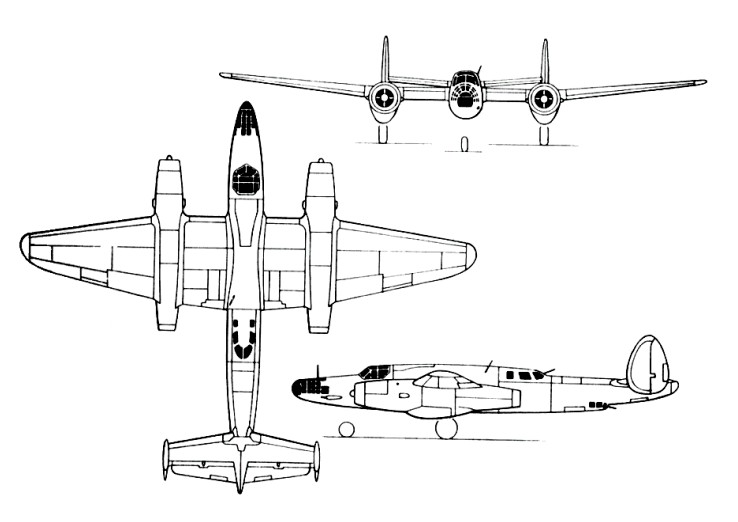
The bureau developed the Tu-72 as a contender for the Soviet air force’s main light bomber requirement, which was ultimately met by the cheaper Il-28. It was to be a mid-winged, twin-engined aircraft without sweep, and the engines were due to be hung under the wings. Rolls-Royce Nenes were the chosen powerplants, but Air Force worries over the adequacy of two engines to power an aircraft of this size and weight led Tupolev to design a similar, but slightly larger aircraft, the Tu-73, with a third engine, this time a 3500-lb / 1600kg Rolls-Royce Derwent, fitted in the tail but with an S-shaped duct air intake noticeable at the front of the fin. While design work of both aircraft continued in parallel, it was the three-engined Tu-73 that was actually built.
Its first flight was made on 29 December 1947. It went well. During state tests, its performance was measured as top speed 870km/h, range 2,800km, and service ceiling 11,500m.
The Tu-74 (or Tu-73R) was a proposed photo-reconnaissance version which was not developed.
The Tu-78 and Tu-79 were essentially the Tu-73 but with Soviet licence-built Rolls-Royce engines.
Tu-73 Engines: 2 x 2270kg Rolls Royce Nene I and 1 x 1589kg Derwent V turbojet Max take-off weight: 24200 kg / 53352 lb Empty weight: 14340 kg / 31614 lb Wingspan: 21.71 m / 71 ft 3 in Length: 20.32 m / 67 ft 8 in Wing area: 67.36 sq.m / 725.06 sq ft Max. speed: 872 km/h / 542 mph Range: 2810 km / 1746 miles Armament: 6 x 23mm cannon Bombload: 3000kg
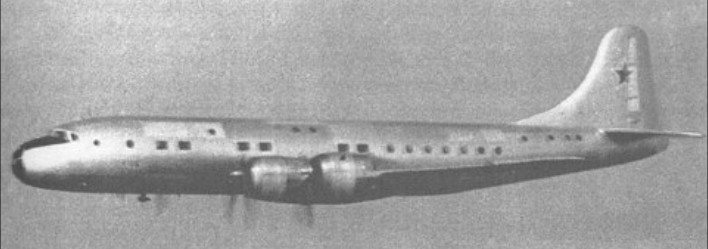
The Tu-70, NATO code name ‘Cart’, was a one-off long range airliner development from the Boeing B-29/Tupolev Tu-4. The prototype, incorporating a B-29 landing gear, tail unit and engines, first flew on 27 November 1946, designed for crew of eight and 48 VIP passengers, but used with crew of six and 72 passengers as staff transport for air force. A new nose with conventional cockpit/flight deck instead of low-drag Superfortress-style nose was built.
Engines: 4 x ASh-73TK, 1770hp Max take-off weight: 51400 kg / 113318 lb Empty weight: 38290 kg / 84415 lb Wingspan: 43.05 m / 141 ft 3 in Length: 35.61 m / 117 ft 10 in Height: 9.75 m / 32 ft 0 in Wing area: 161.7 sq.m / 1740.52 sq ft Max. speed: 560 km/h / 348 mph Range: 4900 km / 3045 miles Crew: 6 Passengers: 48
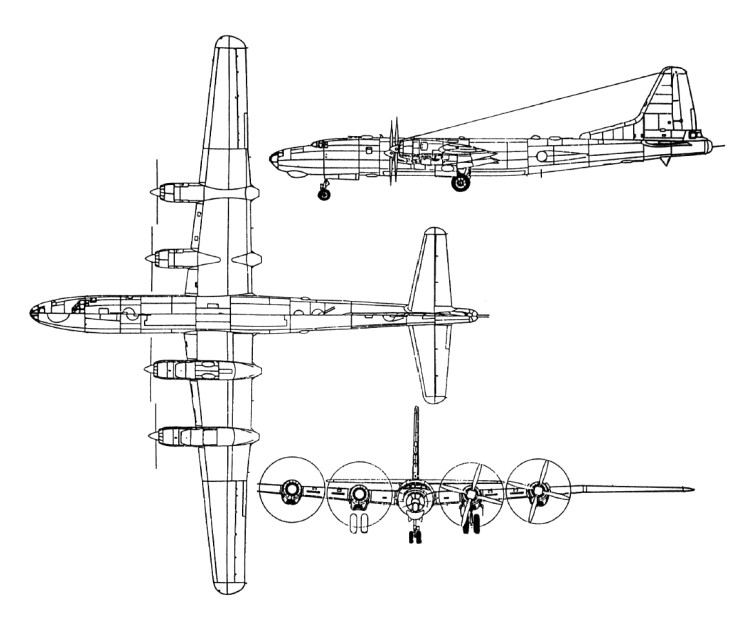
At the end of the 1940s, Vladimir Dobrynin’s engine design bureau had developed a new air-cooled, twenty-four cylinder in-line piston engine, the VD-4K, which offered a 4,300hp supercharged power output. Dmitri Markov set about designing a very long-range strategic bomber with these engines. Starting from the Tu-80 he began by designing a high-aspect wing with increased span – now it was 55.94m compared to the 43.83m of the Tu-75 and Tu-80, and wing area was 273.6sq.m, compared to 162.7sq.m. Wing aspect ratio was 11.4:1.
This allowed the new aircraft to carry forty-four tonnes of fuel which would give it a range of 12,000km. He streamlined the fuselage, and provided accommodation for a second crew which would be needed with the aircraft’s twenty-six hour endurance capability. Normal crew was eight so the Tu-85 carried sixteen in a pressurised cabin. The Tu-85 was fitted with large four-blade propellers, and it was armed with five turrets each fitted with a pair of NR-23 cannons which could be remotely controlled by a gunner, who had a screen to show the arc of fire from each position a development of the B-29/Tu-4 system.
The Tu-85 was constructed at factory N 156 in 1949 and 1950. When completed, it was brought to Zhukovski aerodrome, reassembled and readied for flight. On 9 January 1951, Aleksei Pereliot was in command as it took off for the first time.
In factory and state tests, it gave excellent results. Although its empty weight was 55.4 tonnes and its normal take-off weight seventy-five tonnes, it could take off at 107 tonnes when necessary, allowing it to carry the enormous fuel load needed to achieve its 12,300km range with a five-tonne payload, or to increase its normal five-tonne bomb load to twenty tonnes. Cruising speed for maximum range was established at 450km/h, but maximum speed was much higher. At low level, it was measured at 563km/h, and at a level of 10,000m it reached 665km/h.
By now, turbine engines were establishing themselves and offering higher speeds with lower fuel burns. The Tu-85 was the end of the line for Tupolev’s piston-engined, and also for Soviet aircraft. Limited flight trials were undertaken but further development was later cancelled. Only one Tu-85, the prototype was built. It was the last large Tupolev aircraft without swept wings.
Engines: 4 x VD-4K piston engines, 3160hp Max take-off weight: 107000 kg / 235896 lb Empty weight: 55400 kg / 122137 lb Wingspan: 55.94 m / 184 ft 6 in Length: 39.31 m / 129 ft 12 in Height: 11.36 m / 37 ft 3 in Wing area: 273.6 sq.m / 2945.00 sq ft Max. speed: 665 km/h / 413 mph Cruise speed: 563 km/h / 350 mph Ceiling: 13000 m / 42650 ft Range: 13000 km / 8078 miles Crew: 11-16
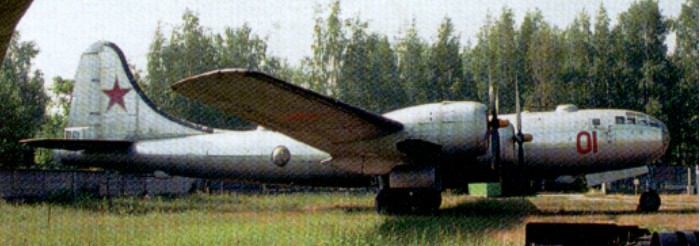
At the end of 1948, just as production Tu-4s were beginning to be delivered to the VVS, Tupolev and Markov began work on a replacement. In a sense, it was an improved B-29 design, with a major programme to trim weight and thus to improve performance.
A new wing with better aerodynamic qualities and with a lighter but stronger spar was developed with integral wing tankage. The fuselage was lightened and the round Tu-4 nose of the same chord as the fuselage was replaced with one in which the cockpit was raised above the nose for improved visibility. A new, more angular tail was also built, with a distinctive dorsal fin. Its engines were four of Shvetsov’s ASh-73TKFNs, a Soviet-built turbocharged version of the original B-29 engines.
All these changes resulted in the Tu-80 being substantially lighter than the Tu-4, and this allowed it to carry more fuel. Its first flight was made on 1 December 1949 from Zhukovski. In state tests, its maximum speed was established as 640km/h. But the Tu-80 was just another step on the way to the Soviet Union achieving a long-range strategic bomber. With the coming of age of turbines, it was not developed beyond its test programme.
Engines: 4 x ASh-73FN, 1770hp Max take-off weight: 67200 kg / 148151 lb Empty weight: 41030 kg / 90456 lb Wingspan: 44.3 m / 145 ft 4 in Length: 36.6 m / 120 ft 1 in Height: 8.91 m / 29 ft 3 in Wing area: 173.1 sq.m / 1863.23 sq ft Max. speed: 650 km/h / 404 mph Ceiling: 11180 m / 36700 ft Range: 7000-8000 km / 4350 – 4971 miles Crew: 11
Another Tu-2 variant was the Tu-10. This was a four-crew aircraft fitted with inline Mikulin AM-39FNVs of 1850hp. Its first flight took place on 19 May 1945, and it proved to have perhaps the best performance of any Tu-2. At 8600m it attained a speed of 641km/h. Ceiling was 10,450m but range fell to 1,740km. A small batch was produced in Omsk between 1945 and 1947.
Three examples of the Boeing B-29 arrived in late 1944 (examples of which had made emergency landings in Russia during 1944 in the course of operations against Japan); one being dissected and analysed, and the other two used as crew trainers and evaluation.
The Soviet Union built the Tu-4 by copying them as a virtual exterior clone of the B-29 but with significant interior modifications. It was a heavier aircraft and did not possess either the pressurised tunnel linking the forward to midships crew locations or the integral fuel tankage of the B-29. The first of a 20-aircraft pre-production batch flew on 3 July 1947.
Placed in service in 1948, series production terminated after over 400 aircraft had been delivered in 1952, by which time the Tu-4 was in large scale service with the Soviet DA (Long-Range Aviation), being accorded the NATO reporting name ‘Bull’. Some were used as wingtip-to-wingtip inflight-refuelling tankers, others as conventional HDU-equipped tankers.
It is reported that about 1200 were built.
The type was exported to China where some were re-engined with Ivchenko AI-20 turboprops and were sporadically used into the 1990s as AEW and drone launching platforms.
Engines: 4 x ASh-90, 1705kW Max take-off weight: 61300 kg / 135144 lb Empty weight: 35000 kg / 77162 lb Wingspan: 43.1 m / 141 ft 5 in Length: 30.2 m / 99 ft 1 in Height: 8.5 m / 28 ft 11 in Wing area: 161.5 sq.m / 1738.37 sq ft Max. speed: 570 km/h / 354 mph Ceiling: 11000 m / 36100 ft Range w/max.payload: 5000 km / 3107 miles Crew: 11 Armament: 5 x 23mm cannons Bombload: 5000kg
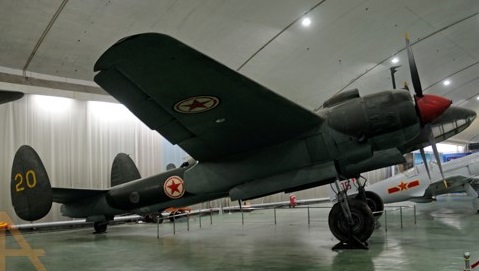
The origin of the Tupolev Tu-2 lay in the ANT-58, ANT-59 and ANT-60 light bomber prototypes that came from the design bureau of Andrei N. Tupolev during 1938-40. Powered by two 1044kW Mikulin AM-37 V-12 engines, the ANT-58 made its first flight on 29 January 1941.
The ANT-60 was re-engined with the big and powerful 1104kW M-82 radials because of the relative unreliability of the AM-37s. The result was the definitive Tu-2 bomber that was to see service with the V-VS during the last year of World War II and well into the 1950s.
Soviet industry was still in a state of upheaval following the years of 1941-2, when the German army struck deep into Belorussia and the Ukraine. The Tu-2 was too complicated an aircraft for the conditions prevailing, and after many months in which the Tu-2 was modified and simplified for the mass production lines, the Tu-2S (Seriinyi, or series) appeared, flying for the first time on 26 August 1943. A small number of Tu-2s had previously been passed to front line regiments in September 1942, where their performance, armament and bombload had received general enthusiasm.
By January 1944 the first production Tu-2 and Tu-2S bombers had been passed to the regiments of the V-VS, but it was not until June of that year that Tu-2s saw action on a large scale. The sector was the Karelian (Finnish) front in the north where the V-VS forces, under the overall command of General A.A. Novikov, numbered 757 aircraft of the 13th VA (Air Army), the V-VS KBF (Red Banner Baltic Fleet) and the 2nd GVIAK (guards fighter corps). Of the 249 Tu-2 and Petlyakov Pe-2 light bombers in the Soviet order of battle, many came under Colonel I.P. Skok’s 334th Bomber Air Division which subsequently received a citation for its work. Reconnaissance work was now being carried out by Tu-2D and Tu-2R aircraft with modified mainplanes, nose glazing, and capacity for vertical and oblique cameras. Wartime production of the Tupolev Tu-2 and its sub-types amounted to 1,111. As a bomber it did not come into its own until the autumn of 1944. However, as German resistance stiffened on nearing the eastern borders of the Reich V-VS bombers, including Tupolev Tu-2s, were called up to attack strongpoints at Kustrin and other fortified ports and cities. September 1945 saw many Tu-2s in action against the Japanese Kwantung Army in Manchuria before the final surrender.
Tu-2
Tupolev was awarded a Stalin Prize for his Tu 2 medium bomber, the only wholly new Soviet wartime aircraft to go into production.
Tu-2S Engines: 2 x ASh-82FNV, 1380kW Max take-off weight: 11360 kg / 25045 lb Empty weight: 7474 kg / 16477 lb Wingspan: 18.86 m / 62 ft 11 in Length: 13.8 m / 45 ft 3 in Height: 4.55 m / 15 ft 11 in Wing area: 48.8 sq.m / 525.28 sq ft Max. speed: 550 km/h / 342 mph Ceiling: 9500 m / 31150 ft Range: 1400 km / 870 miles Crew: 4 Armament: 2 x 20mm cannons, 3 x 12.7mm machine-guns Bombload: 4000kg