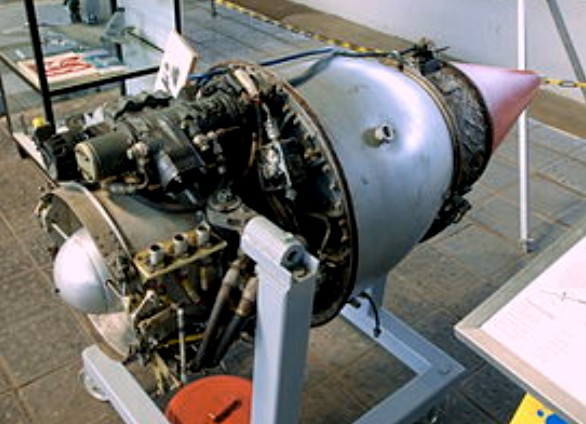
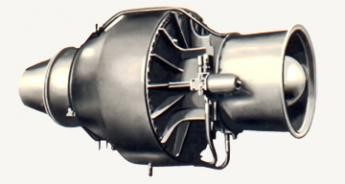
The Turboméca Marboré was a small turbojet engine produced by Turbomeca from the 1950s into the 1970s. First flown on 16 June 1951, the most popular uses of this engine were in the Fouga Magister and the Morane-Saulnier MS-760. It was also licensed for production in the United States as the Teledyne CAE J69.
Marbore I
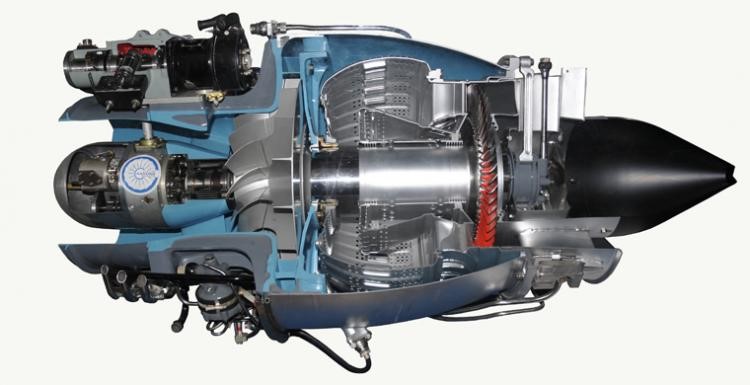
The first major production version was the Marboré II, which had a maximum thrust of 880 lbf (3.9 kN) at 22,500 rpm. In its most basic form, it is a single-spool, centrifugal compressor turbojet. Fuel consumption was rated at 109 gal/h. Variations include military or civilian aircraft, oil tank design, auxiliary equipment, and exhaust pipe configuration. Some variants also included one axial stage compressor for additional performance. The engine dimensions of different variants with different auxiliary components and mounting configurations.
The Marbore II has a single stage centrifugal compressor with with an annular combustion chamber and single stage turbine. Starting is by an electric starter and 2 torch igniters.
Marbore II
Marbore II was fitted on the Nord 2505 (Modified Nord 2503, powered by two 1864-kW (2,500-hp) Pratt & Whitney R-2800-CB17 radial piston engines and two Turbomeca Marboré IIE auxiliary turbojets added).
Turbomeca Marboré IIE
These were eventually replaced by the Marboré VI series which were slightly more powerful at was 1080 lbf (4.8 kN) instead of 880 lbf. Fuel consumption was only slightly higher at 119 gal/h. This was a 23% increase in thrust with slightly more than a 9% increase in fuel consumption. As a result the IV series were used to re-engine many II-series aircraft, and Marboré II engines are still available cheaply as surplus for the experimenter.
Turbomeca Marboré VI
The original Marboré, as well as Marboré III, IV, and V were not produced in significant numbers. A typical weight for this series of engines is 140 kilograms or 310 pounds. Fuel consumption is 190 gallons per hour on the Marbore VI at 15,000 feet, as compared to 138 gallons per hour on Marbore II engines (same altitude). An increase of 27% fuel consumption and a decrease in cruise range capabilities.
Variants:
Marboré I Marboré II Marboré IIC Marboré IIE Marboré III Marboré IV Marboré V Marboré VI Teledyne CAE J69: Licence production and development in the United States.
Applications:
Marboré: Ambrosini Sagittario Bölkow Bo 46 Fouga Magister Fouga Zéphyr Hispano HA-200 Morane-Saulnier MS.755 Fleuret Morane-Saulnier MS.760 Paris Nord Aviation CT20 SNCASO Trident
Specifications:
Marbore I Diameter: 60 cm / 23.4 in Length: 138 cm / 54.2 in Weight: 120 kg / 265 lb
Marbore II Take off thrust: 880 lbs S.F.C: 1,15 lbs/lbs/h Maximum continuous thrust: 705 lbs S.F.C: 1,10 lbs/lbs/h Weight: 322 lbs
Marboré IIC Type: Turbojet Length: 61.7 in (156.7 cm) Diameter: 24.9 in (63.2 cm) Dry weight: 358 lb (162.4 kg) Compressor: Single stage centrifugal Combustors: Single annular combustion chamber Turbine: Single stage Fuel type: Aviation kerosene Air 3405 (JP-1) Maximum thrust: 880 lbf (3.91 kN) at 22,600 rpm Turbine inlet temperature: 650 C Thrust-to-weight ratio: 2.458 lbf/lb (0.024 kN/kg)
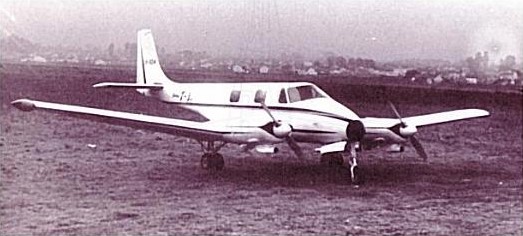
Turbay SA was formed in January 1961 to build the proposed T-3B production version and a lengthened fuselage development, the T-4, but no production was achieved.
In 1957, the Argentine aircraft designer Alfredo Turbay began work on a twin-engined STOL light transport, the Turbay T-3A, with Turbay S.A. formed at Buenos Aires in January 1961 to build the new design. The T-3A was a low-wing cantilever monoplane of all metal construction. It was powered by two 130 kW (180 hp) Lycoming O-360-A1D engines driving two-bladed propellers, and was fitted with a retractable nosewheel undercarriage.
Alfredo Turbay piloted the T-3A on its first flight on 8 December 1964. Production was planned of the T-3B, which was to be fitted with 190–260 kW (250–350 hp) Lycoming or Continental engines, giving improved performance. These plans did not come to fruition, with the prototype T-3B never completed, and no production occurring.
Powerplants: 2 × Lycoming O-360-A1D, 130 kW (180 hp) each Propellers: 2-blade Hartzell HC-92 zk-2b/8447-12A metal Wingspan: 13.52 m (44 ft 4 in) Wing area: 24.08 m2 (259.2 sq ft) Aspect ratio: 7.5:1 Airfoil: NACA 23024 at root, NACA 4412 at tip Length: 9.40 m (30 ft 10 in) Height: 3.60 m (11 ft 10 in) Empty weight: 1,034 kg (2,280 lb) equipped Max. zero-fuel weight: 1,725 kg (3,803 lb) Max takeoff weight: 1,860 kg (4,101 lb) (MTOW and MLW) Fuel capacity: 360 L (95 US gal; 79 imp gal) in four wing tanks, with provision for 2x 80 L (21 US gal; 18 imp gal) external tanks; 24 L (6 US gal; 5 imp gal) oil Wing loading: 77 kg/m2 (16 lb/sq ft) Power/mass: 0.1442 kW/kg (0.0877 hp/lb) Maximum speed: 318 km/h (198 mph, 172 kn) Econ. Cruise: 230 km/h (140 mph, 120 kn) Max cruise: 255 km/h (158 mph; 138 kn) Stall speed: 85.4 km/h (53.1 mph, 46.1 kn) Never exceed speed: 342 km/h (213 mph, 185 kn) Range: 1,380 km (860 mi, 750 nmi) with maximum payload, zero wind Range: 1,840 km (1,143 mi; 994 nmi) with maximum fuel, zero wind Service ceiling: 7,600 m (24,900 ft) SE Service ceiling: 3,500 m (11,483 ft) Rate of climb: 6.6 m/s (1,300 ft/min) Take-off run: 118 m (387 ft) Take-off distance to 15.25 m (50 ft): 225 m (738 ft) Landing run: 100 m (328 ft) Landing distance from 15 m (49 ft): 180 m (591 ft) Crew: 1 Capacity: 6 passengers / 522 kg (1,151 lb) max. payload / tanks for 800 L (211 US gal; 176 imp gal) chemicals
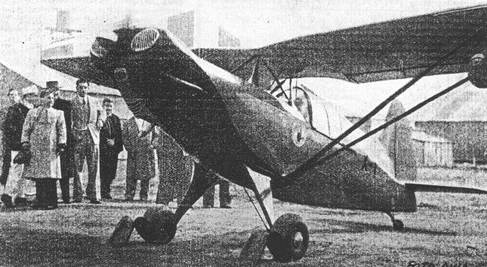
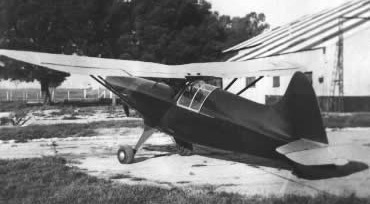
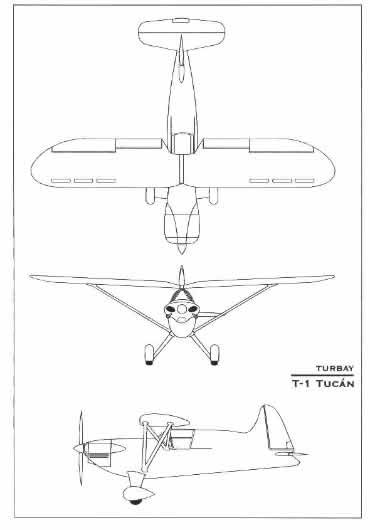
Designed by Alfredo Turbay and built by Sociedad Anonima Sfreddo & Paolini, the Tucán is a parasol-wing braced monoplane with a fixed cantilever type landing gear, tailwheel and powered by a 65 hp (48 kW) Continental A65 air-cooled piston engine. The design of the T-1 toucan started it in 1937, reaching its final form in 1939.
It had an enclosed cockpit just aft of the wing trailing-edge with a sliding canopy.
The first of January 1941 began with the construction of this prototype at the Technical Institute of the National University of Tucuman in the Popular Aviation Center founded by Los Tucanes Turbay himself and his colleagues a couple years earlier.
Construction was finished in April 1943 and between 2 and 5 February was statically tested and approved by the Directorate General of Civil Aviation granting the first experimental enrolment of registration, LV-X1.
The first flight was made on April 5, 1943 with an excellent performance, which made Turbay interested in taking it to Buenos Aires to get potential customers and try to manufacture in series. The plane arrived at Airfield San Fernando in Buenos Aires in May 1943 and on May 16 before national, military and aerospace Argentina and higher authorities. This made the Sfreddo and Paolini SA hire him as technical manager of the company. They planned to sell the aircraft at $10,000 National Currency each, which made it very accessible for the time. Turbay made some tweaks to the model and officially presented to the press and public at the airport on August 22 of that year.
Series production under license by Sfreddo and Paolini for the construction of 6 units were scheduled and minor modifications began with the works. The series aircraft would be equipped with the same engine as the prototype, the Continental A65 65 hp, but the Directorate General of Civil Aviation cancelled its commitment because of World War II for which production was suspended. Sfreddo & Paolini was seized and nationalized by the government.
While there were several attempts to build the plane in series, political and economic problems of the country prevented this. Plans to revive production in 1963 were thwarted. The prototype, once approved, was re-registered LV-NBE on September 13, 1944. On January 23, 1945 Turbay sold the aircraft to Bruno Zantini and to Orlando Harriet on September 25 of that year. On 22 November 1956 the record was transferred to Roberto Velazquez who completely destroyed it in an accident on April 18, 1957 in Bell Ville, province of Cordoba.
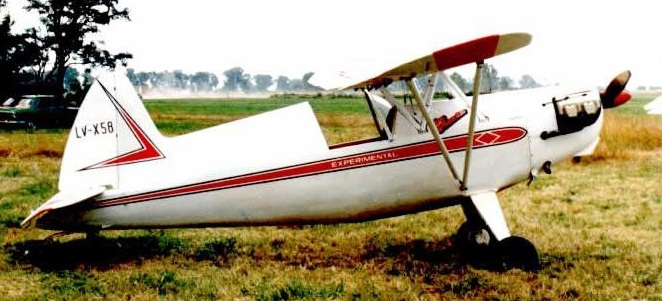
In 1975 Luis Fernandez finished building a second aircraft with planes bought in 1969 at the AVEX institution that Turbay. This aircraft was registered as LV-X58 and first flew on October 9, 1975.
The Tupolev-Myasishchec Type 31 was believed to be an interim bomber design built only in pre-production quantities and used to test the turboprop power plants later employed by the type 40 Bear. The type 31 Barge originally employed diesel engines believed to be 4300 hp M-224, but these were later replaced by four turbines of about 4500 shp, plus 1200 lb residual thrust.
Est. Wingspan: 185 ft Length: 145 ft Height: 38 ft Loaded weight: 210,000 lb Max speed: 380 mph Cruise: 340 mph Max range: 7500 mi
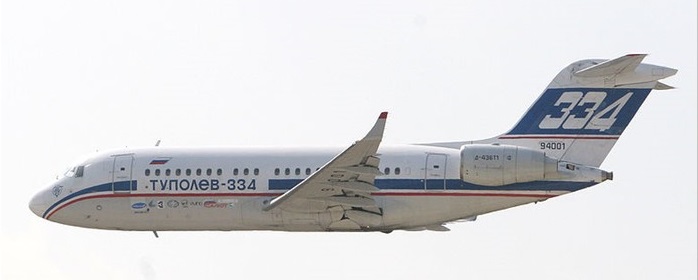
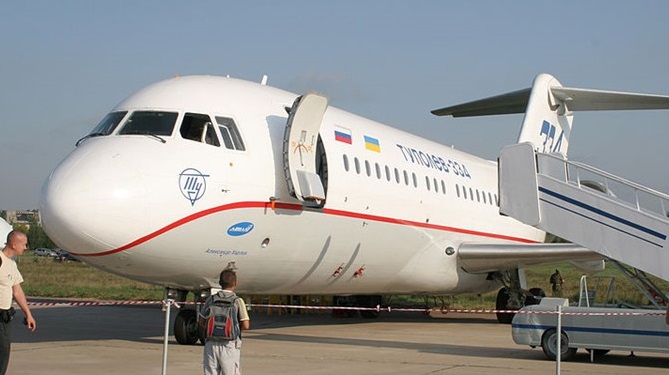
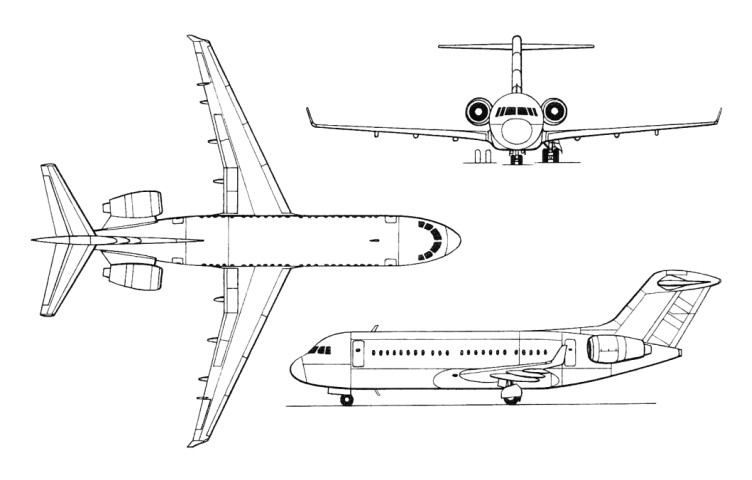
The Tupolev Tu-334 was a Russian short to medium range airliner project that was developed to replace the ageing Tu-134s and Yak-42s in service around the world. The airframe was based on a shortened Tu-204 fuselage and a scaled-down version of that aircraft’s wing. Unlike the Tu-204, however, the Tu-334 has a T-tail and engines mounted on the sides of the rear fuselage instead of under the wings.
Power is from two D-436T-1 turbofan engines with reversers (2×73.6 kN, 2×7500 kgf) produced by Zaporozhie Engine Manufacturing Design Bureau provided . The engine was certified in 2000. Engine is produced in co-operation with “Motor Sich” JSC (Ukrain), “Moscow Engineering Manufacturing Corporation”Salut” JSC (Russia), “Ufa Engine Manufacturing Corporation” JSC (Russia). TU-334 aircraft variants were supposed to be provided with turbofan D-436T-2 engines with thrust of 80.4-83.4 kN (8200 kgf) each.
Work commenced on the Tu-334 in the early 1990s, but proceeded slowly due to funding problems arising from the break-up of the Soviet Union. A prototype was displayed in 1995, but this was little more than a mock-up with few systems installed. A functional aircraft first flew on February 8, 1999, and later that year, agreements were put in place for MiG to undertake part of the production of the airliner. A Russian type certificate was obtained – after some delay – on December 30, 2003.
Since then, development remained slow due to protracted budget problems. In turn, the certification of the aircraft and its planned entry into serial production was delayed multiple times. As of December 2006 there were firm orders for the Tupolev Tu-334 from seven airlines, including Atlant-Soyuz Airlines and there were letters of intent from 24 airlines to obtain another 297 airplanes. Price per unit for the business version is estimated to be around $43–44 million.
Production lines were established for the 102- seat -100 in Aviant’s factory in Kiev, and for the 126-seat -200 in Aviacor’s Samara factory. A second -100 factory was also planned by Tavia at Taganrog. By 1996 series production of the Tu-334 at the Aviant factory in Kiev was 90% ready, but on 05 October 1996 the Russian government decided that Russia’s MIG MAPO was to take over from Kiev the manufacture of the new Tu-334 airliner. MIG MAPO had offered co-operation with Aviant: the Kiev plant would handover production tooling for half the aircraft parts to Moscow, the other half would be manufactured in Kiev and delivered to Moscow. Aviant had no choice since the rights for intellectual property of the aircraft belong to Russia. The assembly shop at the aircraft factory in Lukhovitsy was built especially for its production.
In February 2000 Vladimir Kravchuk, Deputy Director, Tu-334 program said the MiG Aircraft Concern was making production contracts and agreements on Tu-334 program with various aerospace enterprises in Russia and Ukraine. The Company had entered into an agreement with aircraft plants at Taganrog, which were expected to deliver a ready Tu-334 fuselage in March 2000. Ulyanovsk-based aircraft plant was to produce nose parts of Tu-334. These were made identical to nose parts of Tu-204 being mass-produced at Ulyanovsk. Russia’s Government had designated MiG the principle facility for producing Tu-334. The production was to cost 370 mln US dollars. The plan envisages the cost recovery after 7.5 years under production of at least 67 planes.
Serial production of TU-334-100 preparation has started at KAPO n.a.Gorbunov in accordance with Resolution of the Government of the Russian Federation of 15 April, 2005 No.217 “On organization of serial production of TU-334 a/c and its versions at FGUP “KAPO n.a.Gorbunov”. In January 2007 the oil-rich Russian republic of Tatarstan proposed to adopt the twinjet as the vehicle for the upgrade of its Gorbunov Aircraft Manufacturing Association (KAPO) manufacturing plant. The KAPO plant could take over production of dormant twinjet in exchange for $100 million to renovate factory.
In December 2007 it was reported that Iran was ready to make a purchase of up to 130 Tupolev Tu-214 and Tu-334 over ten years. The Iran Aviation Industries Organization (IAIO) was in negotiations to purchase licenses to assemble the aircraft in Iran by 2011 and manufacture them completely by 2015 alongside Tu-214. Nothing concrete became of these negotiations before the cancellation of the Tu-334 programme.
In June 2008 the Russian government bought 6 Tu-334. Four planes were Tu-334-100 with VIP-interiors and two planes were for the Federal Security Service. GTK Rossiya, the Russian government airline that provides flight services to the president and FSO federal security service, selected the Tupolev Tu-334 over Sukhoi’s Superjet 100 and Antonov’s An-148 in a tender for four aircraft, for delivery no later than 2010. Delivery under the state contract was planned as follows: 2010 – one plane, 2011 – two and in 2012 – three. KAPO resumed building Tu 334-100. This is the hull #03 of the experimental batch. While the second aircraft of this batch (#05 built by Aviant Kiev State Aviation Plant) was still flying to extend the certified conditions of operation, this one was likely to become the first Tu-334 sold as a product.
As late as 2008, Tupolev reported that a total of about 100 airlines had expressed an interest in placing orders for Tu-334s.
On 31 July 2008 Sergei Ilyushenkov, managing director of the Tupolev joint-stock company, said commercial production of a new Russian short-haul passenger airliner, the Tu-334, will start within the next six months. The Tu-334, including its business-class version, would be assembled at the KAPO Kazan aircraft plant. The project will be funded by a private investor. He said the Tu-334 business version would cost around $43-44 million, compared with over $60 million for a Bombardier business jet. Ilyushenkov also said the Tu-334’s range could subsequently be increased to 6,400 km by using additional fuel tanks. The aircraft had gone through certification, and can be launched into serial production at a minor expense once there were reliable orders from air carriers.
In 2009, with the project years behind the projected schedule and only two examples built and flying ten years after first flight, the Tu-334 came under review during the rationalisation of the Russian aircraft companies, which led to the formation of United Aircraft Corporation. In mid-2009, the decision was taken to not continue with the Tu-334 programme and instead focus efforts on the Sukhoi Superjet 100 and the Antonov An-148.
TU-334 A state-of-the-art short-haul aircraft designed on the basis of advanced developments in aerodynamics, structure, and avionics ensuring high-level comfort and safety, and high-quality standards traditional for “TUPOLEV” PSC. Various versions, universal layouts and up-to-date avionics allow operators to choose the TU-334 aircraft version that would be ideal for any flight mission.
TU-334-100 A basic version designated to carry 102 passengers in tourist class. The aircraft is powered by D436T1 engines. In 2003 it was certified against AP-25 Russian Airworthiness Rules.
Tu-334-100 Engines: 2 x Progress D-436T1 turbofans, 7500kg Wingspan: 29.77 m / 98 ft 8 in Length: 31.26 m / 103 ft 7 in Height: 9.38 m / 31 ft 9 in Wing area: 83.23 sq.m / 895.88 sq ft Empty weight: 30,050 kg (66,250 lb) Max. takeoff weight: 47,900 kg / 105,380 lb Payload: 11000kg / 24251 lb Maximum speed: 865 km/h (465 kt, 545 mph) Cruise speed: 820 km/h / 510 mph / 440 kt Service ceiling: 11,100 m / 36,400 ft Range: 2380 km / 1479 miles Passengers: 102 Crew: 2
A medium-range passenger aircraft with 214 seats, designed as a replacement for the Tu-154. First flown on 2 January 1989, the Tu-204 was the first Soviet-built airliner with fly-by-wire controls.
The Tu-214 airliner is based on the Tu-204 but features increased take-off weights and longer range. The first flight of the Tu-214 was in March 1996.
Tu-214
Despite its formal designation as a civilian aircraft, the Tu-214 plane has never truly functioned as a commercial airliner. Instead, it has been produced almost exclusively in niche variants, such as the Tu-214R aircraft for reconnaissance, the Tu-214ON unit for observation, and various government “special mission” aircraft.
Tu-214 passenger jet
In 2014 Kazan Aviation Plant fulfilled only 10% of its production quota for the Tu-214 airliners, delivering just two aircraft instead of the planned twenty. The aircraft are even sent abroad, to Belarus, for painting. With a goal of building 70 Tu-214 units by 2030, manufacturing rates make that deadline highly unrealistic.
Tu-204 Engines: 2 x PS-90A turbofans, 157kN Max take-off weight: 93500 kg / 206133 lb Empty weight: 56500 kg / 124562 lb Wingspan: 42.0 m / 138 ft 10 in Length: 46.0 m / 151 ft 11 in Height: 13.9 m / 46 ft 7 in Wing area: 168 sq.m / 1808.34 sq ft Max. speed: 810-850 km/h / 503 – 528 mph Range: 4600 km / 2858 miles Crew: 2-3 Passengers: 214
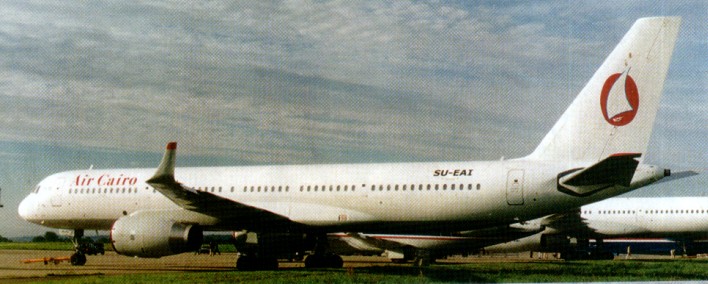
Tu-204-120 Engines: 2 x Rolls-Royce RB211-535E4-B Pax seats: 208
Tu-204C-120 Engines: 2 x Rolls-Royce RB211-535E4-B
Tu-214 Maximum take-off weight: 110.7 tons Commercial payload: 25 tons