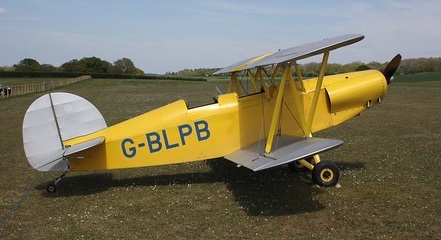
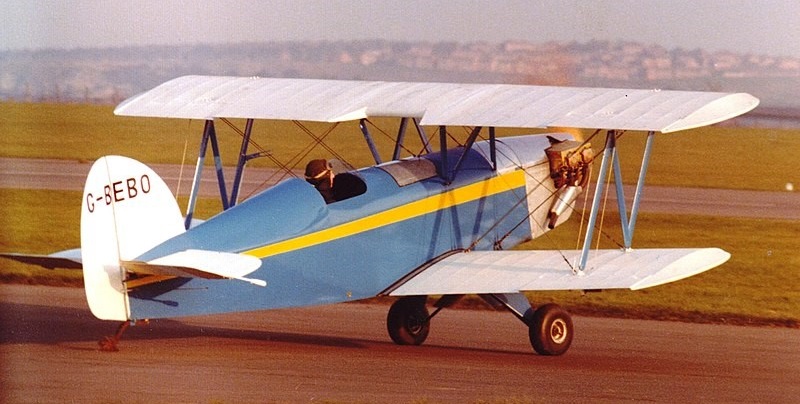
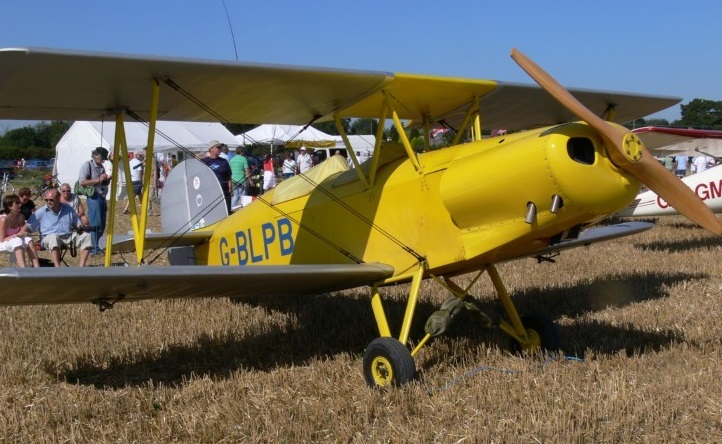
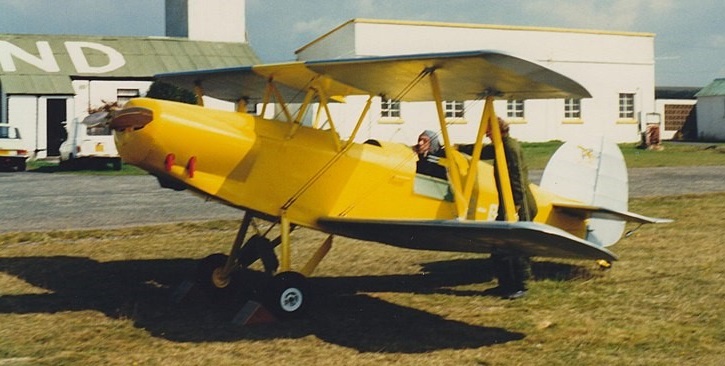
The Turner Two Seat Wot (TSW-2) is a biplane aircraft designed for amateur construction by Chris Turner in 1976. The aircraft was originally conceived as a two-seat version of the Currie Wot, however few component parts of the original Wot were retained by the time the design had been finalised. The Turner TSW-2 has a reduced wingspan, four ailerons and uses a different aerofoil section for the staggered wings. The aileron bellcrank fittings are made to the Currie Wot drawings.
The Turner Two Seat Wot’s structure is primarily of wood with metal interplane struts, cabane struts, undercarriage and engine mount. Two examples were constructed G-BEBO and G-BLPB. The prototype G-BEBO was fitted with a 125 hp (93 kW) Lycoming O-290-3 engine and G-BLPB a 150 hp (112 kW) Lycoming 0-320-A1A engine.
Chris Turner was awarded the Best New Design Award at the 1987 Popular Flying Association Rally at Cranfield, Bedfordshire.
The prototype Turner TSW-2, G-BEBO, was built by its designer Chris Turner. It was registered with the Civil Aviation Authority on 30 June 1976 and first flown from Sunderland Airport in 1978. The aircraft was destroyed in a hangar fire at Hunday Farm and de-registered in January 2003.
This second example, G-BLPB, was built by James Woolford and Kingsley Thomas in Mullion Cornwall between 1980 and 1986. It first flew from Land’s End Airport on 31 August 1986. This aircraft is still airworthy and in 2017 was based on a farm strip in Wiltshire.
The Turner TSW-2 was the subject of a test flight report in Popular Flying by John Harper, who stated that the aircraft was capable of executing the Aerobatics Association’s Beginners Sequence of aerobatic manoeuvrers.
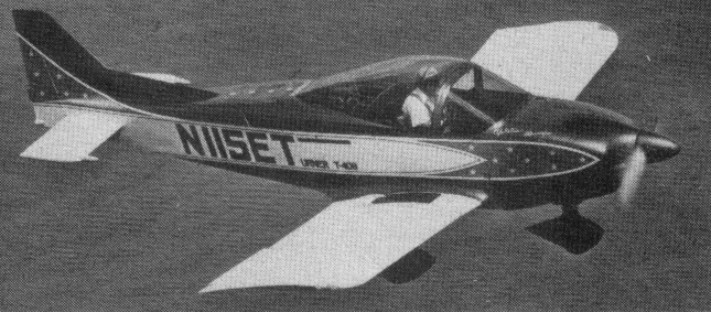
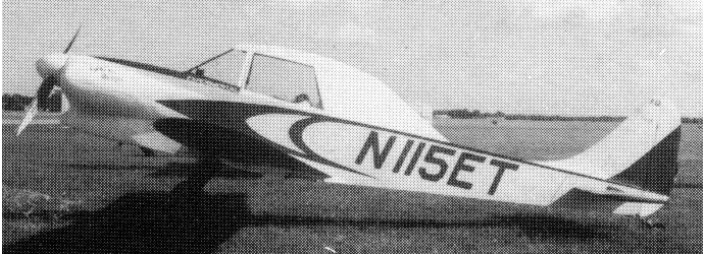
The Turner T-40B is basically the same as the T-40A, but with tricycle landing gear and other improvements. Development of the prototype began in 1966 and the first flight was made in 1969. Originally an 85-hp engine was used, but it was replaced by a 125-hp Lycoming in order to improve high altitude performance. Other refinements on the basic T-40A frame are: a bubble canopy, hydraulically-operated double-slotted flaps, and a fixed leading-edge droop.
Engine: Lycoming, 150 hp HP range: 100-150 Height: 6 ft Length: 20.8 ft Wing span: 29.6 ft Wing area: 106 sq.ft Weight empty: 1050 lbs Gross: 1640 lbs Fuel cap: 30 USG Speed max: 170 mph Cruise: 155 mph Range: 525 sm Stall: 62 mph ROC: 1200 fpm Take-off dist: 1100 ft Landing dist: 900 ft Service ceiling: 14,500 ft Seats: 2 Landing gear: nose or tail wheel
The T-40 was so successful that it collected 18 awards and convinced Turner that the only thing wrong with it was that nobody could ride along to enjoy the reading on the airspeed indicator; thus he created the T-40A. It is a two-place version of its predecessor. Turner simply divided the entire fuselage of the T-40 down the middle and in¬creased the cabin width from 24 to 40 inches. Flight tests showed that the 85-hp engine would still deliver 163 mph top speed with a fuselage nearly twice as wide as before and with considerably more airframe weight. Both Turners feature folding wings.
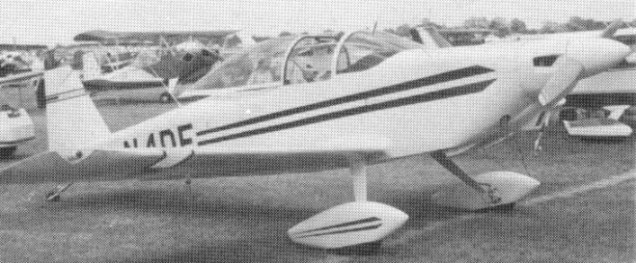
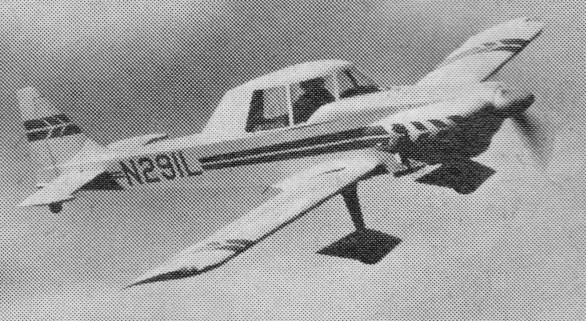
A Super T-40A with a 125hp motor appeared in 1972, and 1981 saw the entry of T-40C, or T-77, with a 150hp Lycoming.
T-40A Engine: Lycoming, 125 hp HP range: 100-125 Height: 6 ft Length: 20 ft Wing span: 25.4 ft Wing area: 96 sq.ft Empty weight: 1050 lb Gross weight: 1600 lb Fuel capacity: 22 USG Top speed: 160 mph Cruise: 147 mph Stall: 56 mph Range: 475 nm Rate of climb: 850 fpm Takeoff dist: 1250 ft Landing dist: 1200 ft Service ceiling: 12,000 ft Seats: 2 Landing gear: nose or tailwheel
“Super” T-40A Engine: Lycoming, 125 hp Height: 6 ft Length: 20 ft Wing span: 27.67 ft Wing area: 96 sq.ft Weight empty: 1050 lbs Gross: 1600 lbs Fuel cap: 22 USG Speed max: 170 mph Cruise: 147 mph Range: 475 sm Stall: 56 mph ROC: 850 fpm Take-off dist: 1250 ft Landing dist: 1200 ft Service ceiling: 12,000 ft Seats: 2 Landing gear: nose or tail wheel
The Turner airplane family got started in 1958. First aircraft in the series was the T-40, a sleek, hot little single-seater which won the 1961 Outstanding Design Trophy at the Experimental Aircraft Association Fly-In. Of all-wood construction and featuring a sliding hood canopy, the T-40 was first powered by a 65-hp engine and did without all the frills associated with an electrical system. First flying on 3 April 1961, in this form it cruised at 128 and blitzed along at 145 with the throttle firewalled. It featured folding wings for storage in a single-car garage. Later, an 85-hp package was added. Both Turners feature folding wings.
Engine: Continental, 85 hp HP range: 60-125 Height: 5.42 ft Length: 19.75 ft Wing span: 22.25 ft Wing area: 78 sq.ft Weight empty: 750 lbs Gross: 1060 lbs Fuel cap: 19 USG Speed max: 170 mph Cruise: 145 mph Range: 525 sm Stall: 55 mph ROC: 1100 fpm Take-off dist: 600 ft Landing dist: 400 ft Service ceiling: 12,500 ft Seats: 1 Landing gear: nose or tail wheel
The origins of aircraft construction in Turkey can be traced back to the first maintenance unit of the Turkish Air Force officially established on 1 June 1911, set up at the airport in Yesilköy / Istanbul. During the First World War maintenance facilities were established in Baghdad, Damascus, Izmir and Konya. They were under the umbrella of the 9th Department of Aviation Affairs (9 Hava Isleri Subesi), which was established on 15 Febuary 1915. The main task of this maintenance facilities was the maintenance of the aircraft of the German Air Force but due to the war situation could not always be guaranteed the supply of spare parts. The technicians at the front often no choice but to produce the items urgently needed themselves. In 1917 the Baghdad facility built a “new airplane”, the Baghdad first, which was built from parts of Albatros C III and from captured aircraft parts “redesigned”.
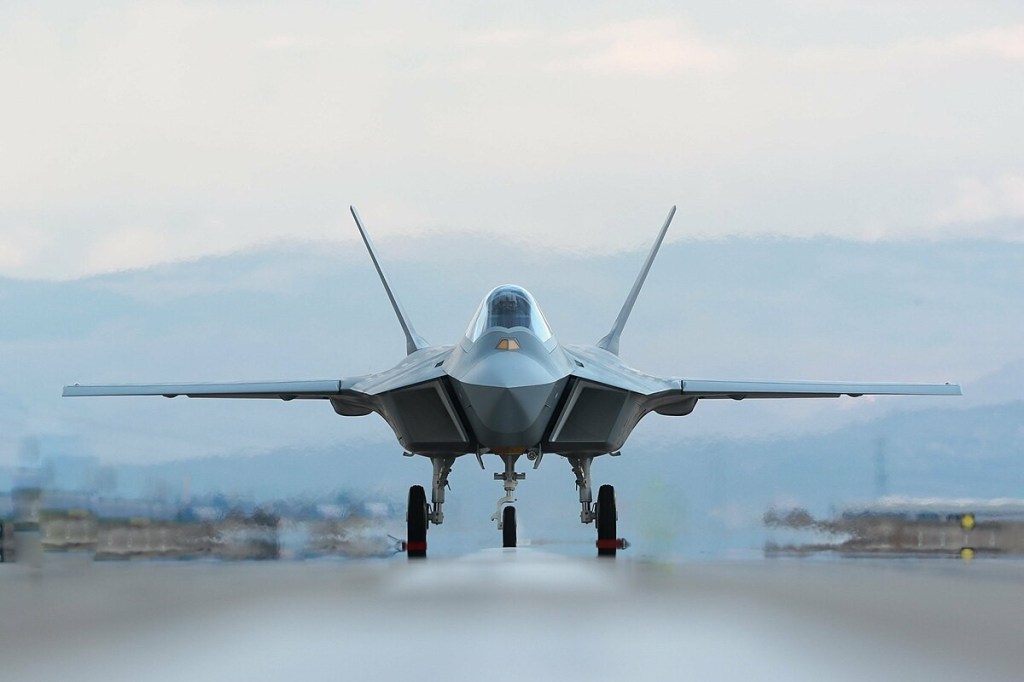
The Kaan program, initiated in 2016 with an investment of $1.18 billion, was designed to replace Türkiye’s aging F-16 fleet. Developed with international collaboration from partners such as BAE Systems and Rolls-Royce, the program prioritizes local production and technology ownership. The aircraft incorporates advanced design features, including supercruise capability and reduced radar cross-section, alongside a suite of indigenous munitions such as the Gökdoğan and Bozdoğan air-to-air missiles. The program emphasizes network-enabled warfare capabilities and interoperability with UAVs and other air force assets.
The Kaan, developed by Turkish Aerospace Industries (TAI), is a fifth-generation twin-engine stealth fighter designed for air superiority and multirole operations. It is equipped with advanced AESA radar capable of detecting targets over 100 kilometers away, internal weapon bays to reduce radar visibility, and a payload capacity of more than 6,000 kilograms. Initial models are powered by General Electric F110 engines, with plans to integrate domestically developed engines in later versions. The Kaan is designed to operate with other platforms in the Turkish Air Force, including the F-35A.
The TAI TF Kaan, a fifth-generation stealth fighter jet, achieved its maiden flight on February 21, 2024, with a second successful flight on May 6, 2024.
Engines: General Electric F110 Wingspan: 14 m Length: 21 m Height: 6 m Speed: Mach 1.8 Operating altitude: 55,000 ft Combat range: of approx 1,100 km
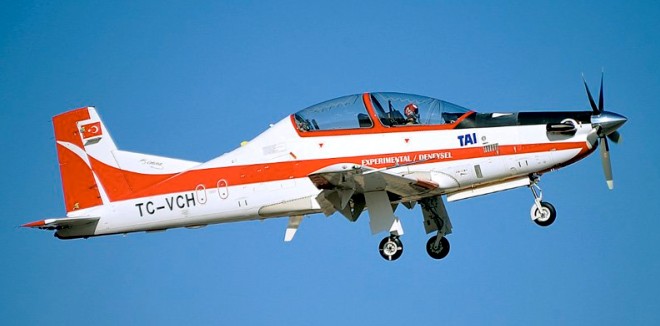
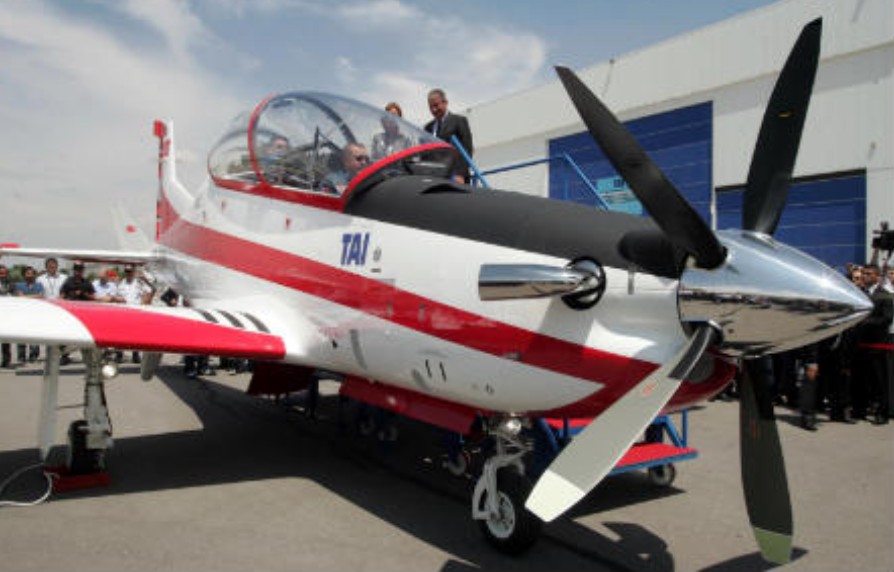
The TAI Hürkuş (Free Bird) is a tandem two-seat, low wing, single engine, turboprop aircraft developed by Turkish Aerospace Industries (TAI) as a new basic trainer and ground attack aircraft for the Turkish Armed Forces.
The aircraft is named after Vecihi Hürkuş, a Turkish aviation pioneer and the first Turkish airplane manufacturer.
The TAI Hürkuş Development Program started with an agreement signed between Turkish Undersecretariat for Defense Industries (Savunma Sanayii Müsteşarlığı (SSM)) and TAI in March 2006. Under the agreement the company was to design, manufacture and complete the civil certification the aircraft to European Aviation Safety Agency CS 23 standards.
HÜRKUŞ Within the framework of the program; two aircraft configurations were to be developed.
HÜRKUŞ-A: Basic version which is to be certified with EASA according to CS-23 requirements. HÜRKUŞ-B: Advanced version with integrated avionics (including HUD, MFDs, and Mission Computer).
By June 2012 the Hürkuş program had consumed one million man-hours with the work of 140 engineers. About a quarter of the Turkish engineers who have worked on Hürkuş are female, as well as two of the three project heads.
The Hürkuş was to be equipped for inverted, day and night flying as well as basic pilot training, instrument flying, navigation training, weapons and formation training. The aircraft has good visibility from both cockpits with a 50 degree down-view angle from the rear cockpit, cabin pressurization (nominal 4.16 psid), Martin-Baker Mk T-16 N 0/0 ejection seats, an on-board oxygen generation system (OBOGS), an Environmental Control System (Vapor Cycle Cooling), an anti-G system, high shock absorbing landing gear for training missions, and Hands On Throttle and Stick (HOTAS). Microtecnica of Turin, Italy was been selected to provide the aircraft’s environmental control system. The Hürkuş has been designed for a 35-year service life with a TAI designed wing airfoil.
The Hürkuş development program has been subject to delays. In 2007 it was forecast that the first prototype would fly in late-2009 with first delivery, upon completion of the certification process, forecast for 2011. On 27 June 2012, the Hürkuş was officially rolled out at a ceremony held at TAI’s Kazan premises. The forecast date for the first flight was then delayed until later in 2012 and actually occurred on 29 August 2013 when the aircraft flew from the Ankara Akıncı Air Base on a 33-minute flight. The first flight was performed with landing gear down and to a height of 9500 ft.
Stability and control checks in different flight configurations have been conducted in the following flight tests. Landing gear up-down tests, cockpit pressurized tests and system functions pre-checks have been performed. The aircraft has reached 12.500 ft height and 158 knots speed currently.
At an SSIK’s meeting, held on Sept. 26, 2013, in order to meet the 15 new-generation trainer aircraft requirement of TurAF, contract negotiations regarding the serial production of HÜRKUŞ was started with TAI. The negotiations regarding HÜRKUŞ-B contract was on the signing.
Two prototypes were built. Entering service in 2015, 15 were built.
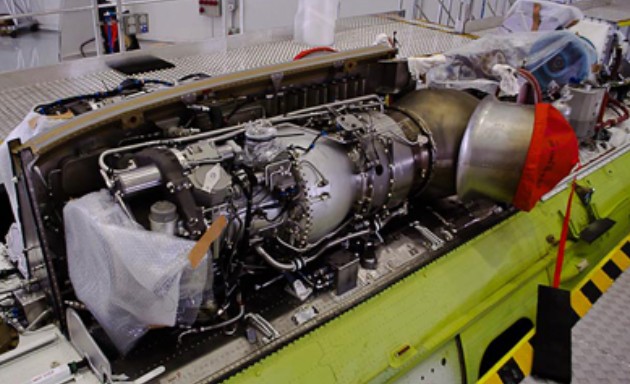
Hürkuş Engine: 1 × Pratt & Whitney Canada PT6A-68T turboprop, 1,200 kW (1,600 shp) Propellers: 5-bladed Hartzell Propeller HC-B5MA-3 Wingspan: 9.96 m (32 ft 8 in) Length: 11.17 m (36 ft 8 in) Height: 3.70 m (12 ft 2 in) Maximum speed: 574 km/h (357 mph; 310 kn) Cruising speed: 463 km/h (288 mph; 250 kn) Stall speed: 143 km/h (89 mph; 77 kn) Range: 1,478 km (918 mi; 798 nmi) at 15000 ft (4572 m) Endurance: 4.25 hours at 15000 ft (4572 m) Service ceiling: 10,577 m (34,701 ft) Rate of climb: 22 m/s (4,300 ft/min) Total Take-Off Distance (@ sea level): 1605 ft (489 m) Total Landing Distance (@ sea level): 1945 ft (593 m) g limits: +7/-3.5 Hardpoints: 4 Seats: 2
The Turbomeca Gabizo was a small turbojet engine produced by Turbomeca and first run in 1954. The components were designed to take the stresses of high-speed fighter aircraft with some variants featuring afterburner.
Applications: Fouga CM.171 Makalu Dassault Étendard II SNCASO Trident
Specifications: Gabizo Type: Turbojet Length: 86 in (218.4 cm) Diameter: 26.5 in (67.3 cm) Dry weight: 560 lb (254.0 kg) Compressor: Single stage axial plus single-stage centrifugal Combustors: Single annular combustion chamber Turbine: Single-stage Maximum thrust: 2,426 lbf (10.78 kN)(maximum thrust) 1,940 lbf (8.62 kN)(maximum continuous thrust) Overall pressure ratio: 5.1:1 Specific fuel consumption: 1.04 Thrust-to-weight ratio: 4.332 lbf/lb (0.042 kN/kg)
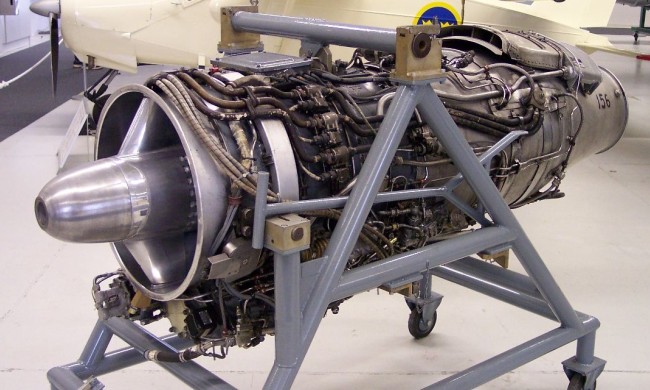
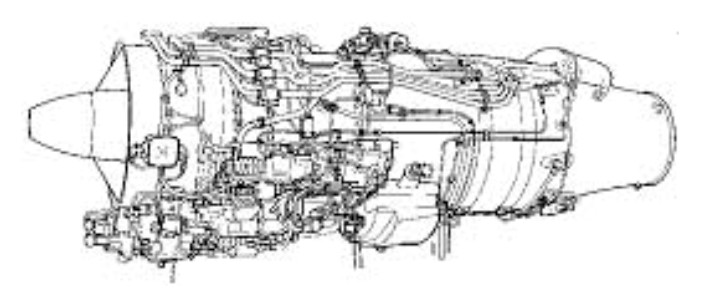
The Turbomeca Aubisque was a small turbofan engine designed and produced by Turbomeca andfirst run in 1961. Its only application was the Saab 105 military trainer aircraft as the RM9.
The engine is named after the Col d’Aubisque in the Pyrenees mountains, in line with company tradition.
The earlier Turbomeca Marboré turbojet was originally intended for the Saab 105, but when Saab needed more thrust than the Marboré produced, Turbomeca offered the Aubisque turbofan. Basically a turbofan version of the Turbomeca Bastan turboprop, the Aubisque went into the production for the Saab 105. About 300 were produced. They were in service for 30 years until replaced in the mid-90’s, by the Williams FJ44 turbofan, for the remaining Swedish Air Force Saab 105s.
Aubisque Type: Low-bypass turbofan Length: 2,067 mm (81.4 in) Diameter: 564 mm (22.2 in) Dry weight: 243 kg (535.7 lb) Compressor: Geared fan stage + single stage axial + single stage centrifugal Combustors: Annular chamber Turbine: Two stage Maximum thrust: 6.9 kN (1,543 lbf) at 32,500 rpm Overall pressure ratio: 6.9:1 Fuel consumption: 420 kg (925.9 lb)/hr Thrust-to-weight ratio: 0.062 kN/kg (2.88 lbf/lb)