A high-speed twin-engined transport developed from earlier Remington-Burnelli Airliner projects
Engines – Power
Unruh-Albright Special III
Marion Unruh began construction in Japan and finished the open cockpit biplane in Austin, Texas, USA, in 1957. The registration was N1473V.
Engine: 125hp Menasco D4-87
Wingspan: (upper) 21’0″ (lower): 19’6″
Length: 17’1″
Useful load: 390 lb
Max speed: 146 ph
Cruise sped: 118-128 mph
Stall: 66 mph
Seats: 2
Unruh-Albright Special II
The Unruh-Albright Special II construction was begun in 1937 by Marion Unruh, but it was not until after he had retired from USAF in 1959 that it was finished, in 1966. Registered N8635E, the open cockpit biplane first flew on 27 June 1966.
Engine: 75hp Continental A-75
Wingspan (upper): 15’0″ (lower): 13’0″
Length: 15’5″
Useful load: 300 lb
Max speed: 150 mph
Cruise speed: 120 mph
Stall: 70 mph
Seats: 1
Unruh-Albright Pretty Prairie Special I
The 1938 Pretty Prairie Special I, designed by Marion Unruh, was based on the Knight Twister. An open cockpit biplane, N25460 was built by George Albright.
Engine: 60hp Rearwin-LeBlond
Wingspan (upper): 24’0″ (lower) 18’0″
Length: 16’0″
Max speed: 100 mph
Cruise speed: 95 mph
Stall: 50 mph
Seats: 2
University of Toronto UTAIS Ornithopter No.1
The UTAIS Ornithopter No.1, which “flew” in 2006 was designed by the University of Toronto. The light No.1 used a small motor to power its flapping wings. Realizing that a motor wasn’t enough to flap it off the ground, the designers also fitted the airplane with a jet engine booster to launch it into the air. The University claimed that most of the thrust was coming from the wings.
When the No.1 did its first test flight, it jumped off the runway for 14 seconds after the jet booster activated, traveled awkwardly for a third of a kilometer, nosed down, and crashed. The University claimed the test was a success.
University of Minnesota T-1 / Akerman T-1
The T-1 was a 1936 tailless experimental student project under the guidance of Prof John D Akerman. A single place, open cockpit, low wing monoplane, it was powered by a 55hp Jacobs engine and registered NX14880.
United States Army Engineering Division FVL-8
biplane fighter designed by Italian Ottorino Pomilio
United Helicopters J-5
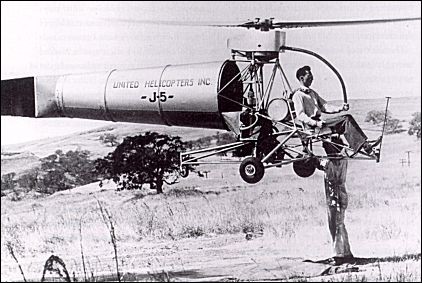
To counteract torque this two-bladed-rotor experimental helicopter used not a conventional tail rotor but a jet thrust system. The latter consisted of a fan blower placed just behind the engine with a ‘stove pipe’ tail forward. Air was thus forced under pressure through the hollow fuselage into a tail orifice where vanes directed the jet thrust laterally.
Main rotor torque was effectively overcome, but this torque compensation system’s power requirements proved markedly excessive at speeds greater than 64km/h. Single-seat experimental helicopter with open frame front mounting pilot and engine and metal cone tail with jet thrust duct. One built.
United Helicopters Flying Frame

United Helicopters C4 Commuter
A two-seat C4 Commuter prototype was flown.

