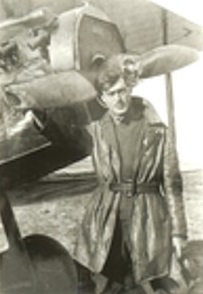
Frank Van Dersarl was born August 13, 1895 in Denver. He flew a Bleriot airplane on August 10, 1911 at Sable Airstrip located in Aurora at the junction of Sable Blvd. and the Union Pacific railroad tracks. It was a favored location for early flyers and auto racers. This aircraft was assembled by Frank and his brothers, John and Jules, using plans purchased in France from Bleriot. They were 10 and 12 years old at the time. He also flew a glider, which was built at the age of 12 from a booklet ordered from a London company. It crashed on its first flight.
Pioneer aviator Harry Combs (1913-2003), with only 30 hours of flying under his belt, at the age of 16, decided to build his own aeroplane. With the help of Frank Van Dersarl they completed the construction of a sport bi-plane called the VAMP Bat in 1929. The VAMP Bat had a short life, after flying to Pueblo, Combs lost control of the aircraft on the runway, there were no brakes and only a tailskid, caught in high winds the aircraft flipped on its back. Combs said ‘I was hanging upside down inches from the ground. It busted up. I should have known that when you don’t have brakes you have to stay on the grass’.
Jules “J.J.” VanDersarl and his younger brother, Frank, lived just outside Denver, Colo.; their mother worked as a housekeeper; and they barely made it through grade school. But both brothers proved to have innate mechanical talents that made them proficient at machining, carpentry and other skills. J.J. experimented with gliders at age 12, and later, a few months after Blériot’s 1909 Channel flight, he and Frank obtained all the publications and photographs they could, they used those references to build their own Blériot XI in 1911…then learned to fly it.
According to Javier Arango, director of The Aeroplane Collection in Paso Robles, Calif., who now owns the VanDersarl Blériot, the brothers “must have had some guidance and lots of information,” because the dimensions of their airplane are close to those of the original. Their homebuilt differs from the standard Blériot XI in three respects, however. First and foremost, instead of the 25-hp Anzani 3-cylinder radial or Gnome rotary engine that normally powered Blériots, the VanDersarls, using their general knowledge and machining skills, adapted a 4-cylinder inline air-cooled automobile engine with a reworked oil system to aerial use. Just what that engine was remains uncertain, though Arango said it was “close in dimensions” to the power plant used in the Metz, a car equipped with a liquid-cooled engine that the company had planned to adapt to aviation but which never quite materialized.
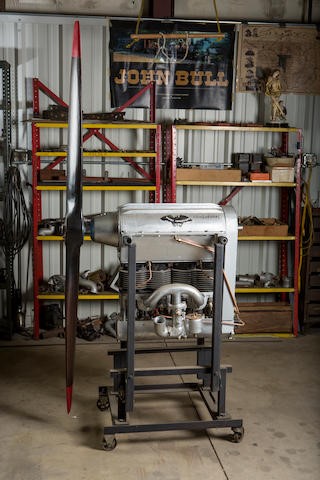
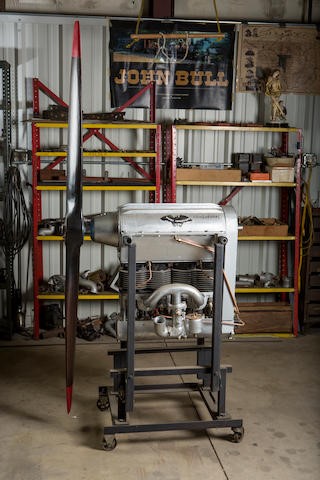
VAMP Bat engine
A second difference, Arango noted, was that “some of the structure around the empennage is placed slightly differently than in most Blériots.” Finally, he said, “The French Blériots were built to a high quality, but our plane was built by teen agers in Colorado who just wanted to go fly—it’s a little rougher than pristine Blériots.” Even so, the handmade airplane worked remarkably well. “There is a photo of the first flight, which ended up in a landing that broke the landing gear,” Arango reported. “But it was repaired and flew again. Both brothers flew it.”
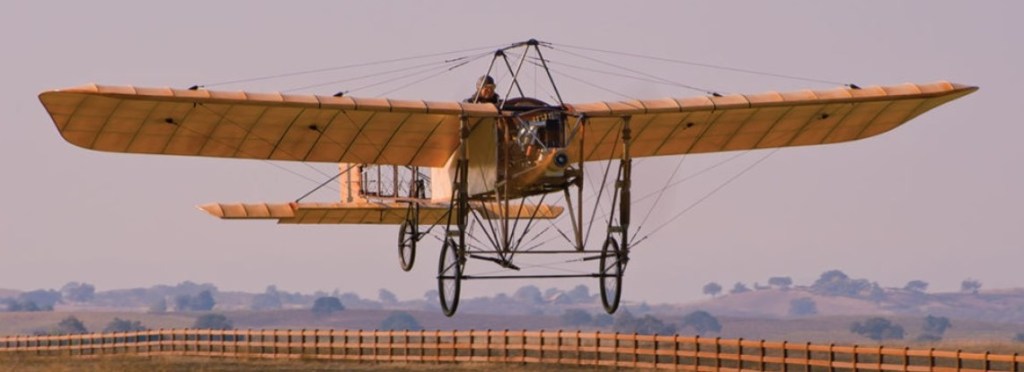
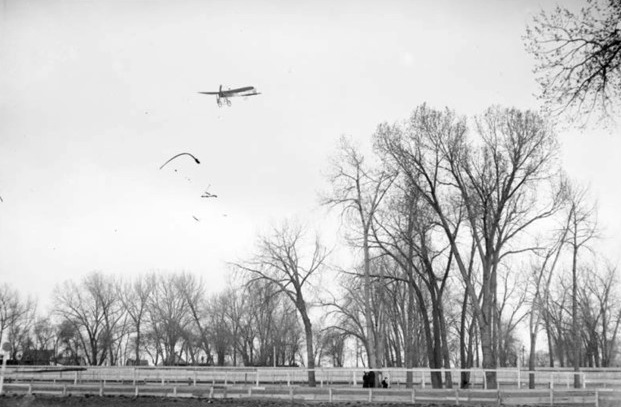
Over a Denver, Colorado field, local photographer Harry M. Rhoades captured what is believed to be the only known picture of the Vandersarl Blériot in flight.
VAMP actually stood for VanDersarl Aeroplane Motor Products in its original iteration (George Thompson).
1913: VAMP (Van Dersarl Motor Products) Aircraft Co, Denver CO. USA
Frank A. Van Dersarl worked for Mountain Flyers where he was General Manager and Chief Pilot, giving aviation demonstrations, entertaining flights and exhibitions. They did stunts, flew with fireworks, did aerial photography and sold rides.
The VanDersarls went on to fly Curtiss JN-4 Jennys and Standards, and in the 1920s, Arango said, “Frank started an airport and barnstorming operation.” The most remarkable thing, though, is that Frank kept the homebuilt in which he and J.J. had first learned how to fly.
He founded Rocky Mountain Airlines in 1921. For seven years he ran the Denver Post airshows, and was the owner of the Vamp Aircraft Company. At one time, Frank and his brothers employed Charles A. Lindbergh in their Denver enterprise.
The VAMP Company, owned by Frank A. Van Dersarl (1895-1983), was based in Denver, and built several types of aircraft, believed 40+ machines in total, powered by their own VAMP engines, including replicas of Bleriot monoplanes and Cessna mid-wings.
Frank owned and ran the first aviation school in Denver in 1930-32 and also was the Chief of the Curtiss-Wright Denver branch. He built the first Mooney airplane. He constructed a total of about 46 airplanes. In later years, he worked on the Boeing B-29 program. Frank also owned and operated the Denver Union Airport, but the depression put an end to this enterprise.
During WWII, he worked at the Denver Opportunity School and trained hundreds of workers and mechanics for the aviation industry. After the war, and until his retirement in 1967, he worked for the Colorado State Highway Department.
All three brothers were present for the awards presentation by the Colorado Hall of Fame, when Frank was the first to be honored.
In the 1960s Frank VanDersarl tried to restore the Blériot, but he died before completing the project. After J.J. VanDersarl died in Raton, N.M., in November 1977, the monoplane was exhibited at the Museum of New Mexico. In 1994 it was bought by Joseph Gertler, who loaned it to Dowling College in Bayport, N.Y. There it was further restored by John Zale, Frankie Mineo, Russ Moore and the Bayport Aerodrome Society. Then in 2009 Arango’s C.C. Air Corporation purchased it and added it to The Aeroplane Collection, with the ultimate goal of making it airworthy for the first time in a century.
“When we got it the plane was minimally restored,” Arango explained. “It was extremely authentic.” That meant it served as a useful reference toward the inevitable replacement of deteriorated material and components. “Chuck Wentworth from Antique Aero, who is really the main character in the restoration project, inspected it and went through everything,” he said. “The entire fuselage was in good shape. There were busted wires and turnbuckles that had to be reproduced and replaced to get it back to original condition. Chuck had to find parts of 1911 vintage to get the correct look, based on plans and photos. For example, they’d stuck a fake control wheel in the cockpit for display. We took all of that out.
“The wings were difficult—they were not the same age as the fuselage. They were probably damaged and were repaired or rebuilt by the VanDersarls. It took a lot of work with the wings to make them airworthy. The cotton covering was difficult to work with, and we even had to find the ‘honey-colored coating’ the VanDersarls described. We used a varnish that was tinted to get the correct honey color.”
Though he considered obtaining an Anzani engine, Arango decided to heed the advice of the National Air and Space Museum and “keep it as it was” by reconstructing the original engine. Fortunately for the restoration team, the VanDersarls “left good data on the cylinders, the copper cooling fins—all the specifications we needed to build the engine from scratch. The engine was put together with help from period publications and photos of the original.” The most difficult part was getting period components, but they managed to obtain a 1905 Bosch magneto, a brass carburetor of 1909 vintage, a tachometer, a magneto switch and a 1910 automobile oil gauge. In 2011 Wentworth unveiled the Blériot at the National Aviation Heritage Invitational in Reno, Nev. There on September 18 it won the event’s top award, the RollsRoyce Aviation Heritage Trophy.
Once the four-year project was completed, Arango and his team went through a systematic process toward getting it approved for flight by the Federal Aviation Administration. This presented some challenges, Arango said, since the Blériot XI predated the Civil Aeronautics Administration, let alone the FAA, and “there is no certificate and no paperwork of the age to make it current.” After the FAA inspected the aircraft, however, it finally registered the VanDersarl Blériot as an experimental airplane on August 16, 2012. This meant it could be flown under certain restrictions, such as not carrying a passenger for hire and with limits on the number of flights and travel radius around the airfield. “That was fine by us,” said Arango, “because we were happy to just fly, more or less in a straight line.”
Even with FAA approval, the VanDersarl Blériot underwent testing, reinspection and taxiing trials before it finally got airborne for the first time in more than a century on November 3, 2012. Since then, Arango keeps its flight itinerary at Paso Robles under tight self-imposed restrictions. “It’s a marginal airplane,” he explained, “with a 50-hp engine and very cambered wings that cause a lot of drag. It’s a good-flying airplane, but I’m not going to risk the airframe. It’s one of a kind, touched twice by its creators, and once by Chuck. I wanted it authentic to its own type.”
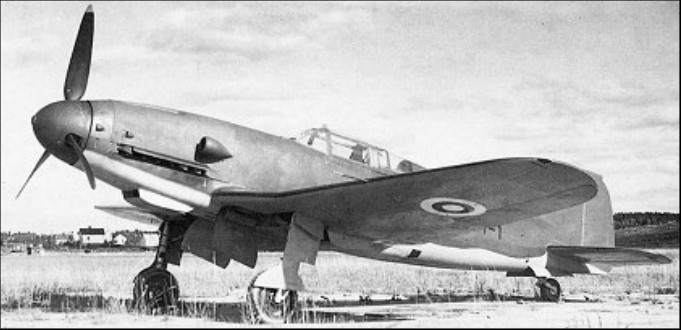
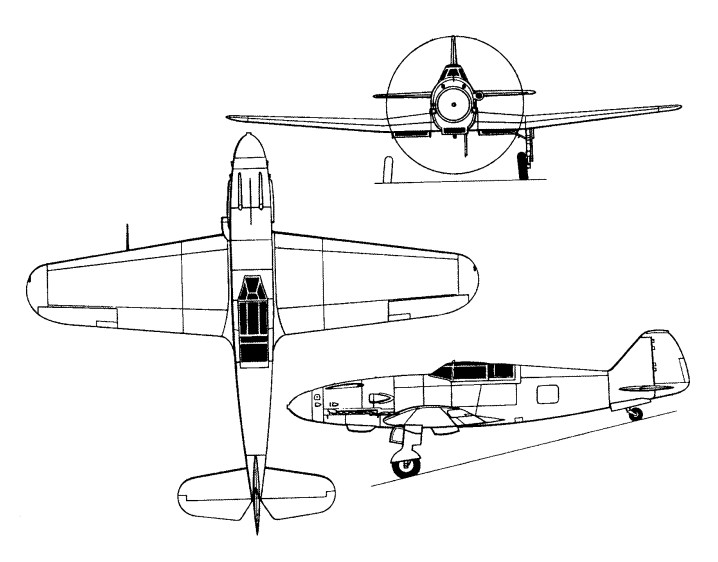
Conceived to make maximum use of indigenous materials with emphasis on suitability for operation from small Finnish front-line airfields under the most severe climatic conditions, the Pybrremyrsky (Whirlwind) was designed by Dipl-Ing Torsti R Verkkola. Powered by a 12-cylinder inverted-Vee Daimler-Benz DB 605AC engine rated at 1475hp, the Pyorremyrsky had a single-spar wooden wing with plywood skinning and a fuselage of steel-tube construction with detachable metal panels forward and a wooden ply-covered mono-coque aft. Armament comprised one engine-mounted 20mm MG 151 cannon and two 12.7mm LKK/42 machine guns, provision being made for two 200kg bombs underwing. Prototype construction was slowed by the preoccupation of the VL with higher priority programmes, and work on the Pyorremyrsky, which had languished for several months, came to a halt with the Finnish-Soviet Armistice of 4 September 1944. Somewhat surprisingly, construction of the fighter was resumed later, in January 1945. A DB 605AC engine was removed from a Bf 109G and installed in the prototype, which flew for the first time on 21 November 1945. The Pyorremyrsky could outclimb the Bf 109G-6 and was more manoeuvrable, but, as no funds were available for the purchase of new aircraft for Ilmavoimat and sufficient Bf 109Gs remained to equip the Ilmavoimien fighter force that was permitted under the Armistice terms, the prototype was grounded after 30 hours flying and the programme terminated.
Max take-off weight: 3310 kg / 7297 lb Empty weight: 2619 kg / 5774 lb Wingspan: 10.38 m / 34 ft 1 in Length: 9.85 m / 32 ft 4 in Height: 3.89 m / 13 ft 9 in Wing area: 19.00 sq.m / 204.51 sq ft Max. speed: 620 km/h / 385 mph
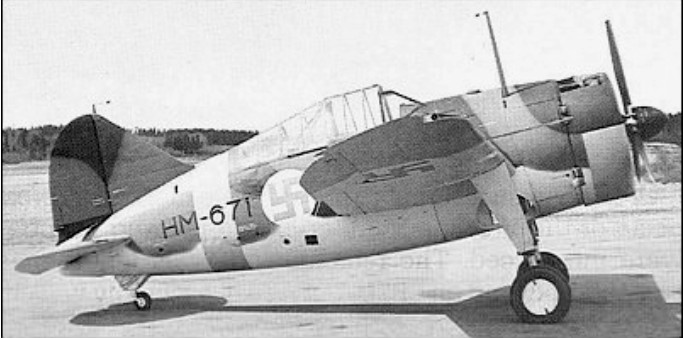
The Humu – literally “Reckless” – was produced by Valtion Lentokonetehdas. It was not that the Humu was unconventional in any respect. It was a copy of a seven-year-old American design adapted to make use of locally-available materials and captured equipment, and built without benefit of licence or assistance from the parent manufacturer. The Finnish air arm, Ilmavoimat, had acquired 43 Brewster B-239 shipboard fighters that had been declared surplus to US Navy requirements. These had proved singularly successful in Ilmavoimien service, and, in 1942, it was proposed that an attempt be made by the VL to remedy a shortfall of fighters of this type by producing a copy. Because of shortages of metal, this was to make as much use as possible of wood and to embody so-called “war booty” instrumentation and power plant – equipment captured from the Soviet forces by the Finns themselves and similar equipment captured by the Wehrmacht and sold to the Finns. The task of designing an entirely new wooden wing was assigned to M T Vainio, who was also responsible for the overall project, and, in October 1942, an order was placed with the VL for four prototypes, the intention at that time being to build a series of 90 aircraft. The chosen engine was the 930hp Shvetsov M-63, which was flown on 5 June 1943 in a B-239. Static testing of the wooden wing was not entirely satisfactory. Nevertheless, in September 1943, orders were confirmed for five prototypes of the Humu and 55 production aircraft. The wooden wing was found to add 250kg to air-frame weight, however, and the transfer of the fuel tanks from the wing to the fuselage shifted the CG aft, adversely affecting manoeuvrability. Initiation of series production was, therefore, delayed pending results of prototype tests, and in the summer of 1944 the programme was terminated as it was concluded that the Humu would have inadequate combat capability by the time it achieved service. Only one prototype Humu was completed, and this, having an armament of three 12.7mm guns and a mix of Finnish and Soviet instrumentation, flew on 8 August 1944. The M-63 engine failed to give its full power during subsequent flight testing, but 19 hrs 50 min were flown before, in 1945, the sole example of this aircraft was placed in storage.
The performance of VL Humu was not measured. The information of maximum speed is based on tests of wooden wing and M-63 motor in Brester 239 (BW-392) October 1942. BW-392 was 350 kg heavier than VL Humu and those days the Finns did not adjust the M-63 correctly due to lack of the instruction manual. The Finns got the instruction manual from Germany in 1943.
The prototype of VL Humu (HM-671) is in The Aviation Museum of Central Finland in Tikkakoski, Finland.
Max take-off weight: 2895 kg / 6382 lb Empty weight: 2050 kg / 4520 lb Length: 8.03 m / 26 ft 4 in Max. speed: 430 km/h / 267 mph
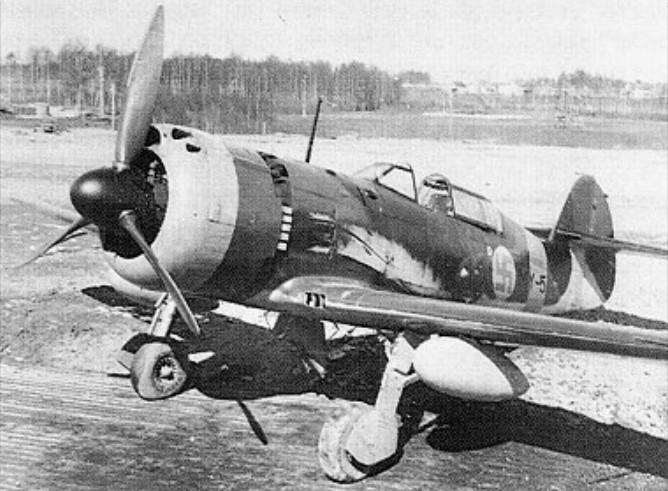
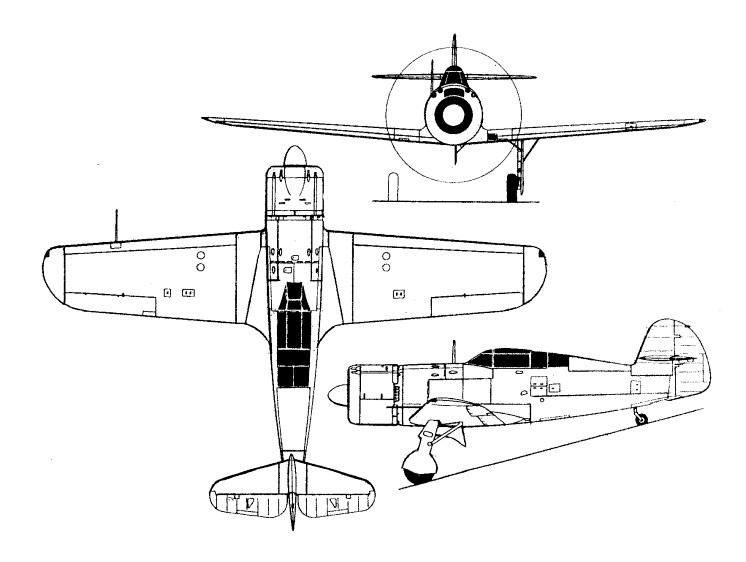
On 8 June 1939, the VL (Valtion Lentokonetehdas) received a contract from the Ministry of Defence to design a new single-seat fighter. Chief designer was Dipl Ing A Ylinen, who was assisted by T Verkkola and M Vainio, and, within nine months of receiving the definitive prototype contract on 20 December 1940, the prototype of the Myrsky (Storm) was in final assembly. A conventional low-wing cantilever monoplane, the Myrsky had a plywood-skinned two-spar wooden wing and a welded steel-tube fuselage covered by dural panels forward and fabric aft. Power was provided by a Pratt & Whitney R-1830-SC3-G Twin Wasp 14-cylinder radial rated at 1115hp for take-off. The prototype was flown on 23 December 1941, but immediately encountered the first of what were to be many teething troubles. On 30 May 1942, the VL received a contract for three development aircraft which were to embody numerous detail structural and other changes, these including an increase in wing area of 1.3sq.m and a change in armament from two 12.7mm and four 7.7mm guns to three (in first and second) or four (in third aircraft) of the larger-calibre weapons. The first of these was completed on 30 April 1943, but crashed a week later, and the second suffered a wheels-up landing three months later, and broke up in the air shortly after resuming flight test. The third was evaluated in service, and, on 17 March 1944, lost both wings in a dive. In the meantime, VL had initiated production of the first series model which was referred to as the Myrsky II Series. All the progressive changes that had been introduced in the pre-series aircraft were incorporated, armament was standardised on four 12.7mm LKK/42 guns, and by the end of July 1944 the VL had completed 14 of the II Series aircraft, a further 16 having been delivered by the truce of 4 September. Production continued after the truce and the last five of the 47 built were delivered straight to the Air Force Depot on 30 December 1944 without flight testing. The Myrsky II series was assigned to a tactical reconnaissance squadron (TLeLv 12) which received its first aircraft on 23 July 1944, 20 being delivered to the squadron before the Armistice, and a second squadron (TLeLv 16) initiating conversion to the Myrsky meanwhile. The Myrsky was flown operationally over Lapland against the Wehrmacht under the terms of the Finnish-Soviet agreement, but Ilmavoimat flew this fighter only to a limited extent, and the service’s doubts as to its durability and sturdiness, despite continuous reinforcement of various components, finally came to a head on 9 May 1947 when a Myrsky broke up in a dive, all aircraft of this type then being grounded.
Max take-off weight: 3213 kg / 7083 lb Empty weight: 2337 kg / 5152 lb Wingspan: 11.00 m / 36 ft 1 in Length: 8.35 m / 27 ft 5 in Height: 3.00 m / 10 ft 10 in Wing area: 18.00 sq.m / 193.75 sq ft Max. speed: 535 km/h / 332 mph Range: 500 km / 311 miles
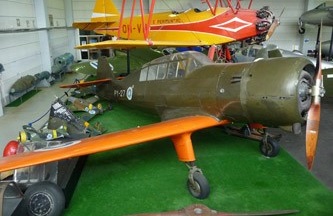
V.L. Pyry II – Registration number: PY-27, Serial number: 26
After VL was reorganized in 1936 and moved to Tampere, it produced Pyry monoplane trainers.
A two-seat advanced trainer designed in Finland. The prototype Pyry I, maiden flight was on 29 march 1939. The Finish Air Force had 40 aircrafts in use in 1941 – 1962.
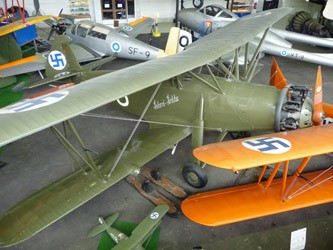
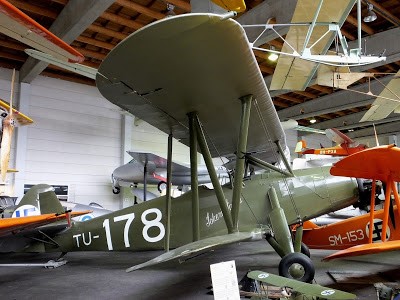
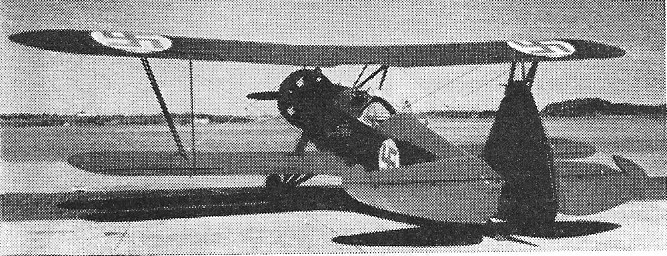
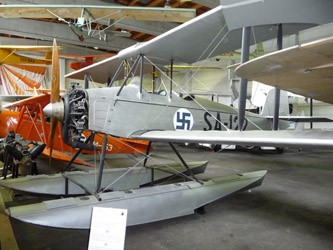
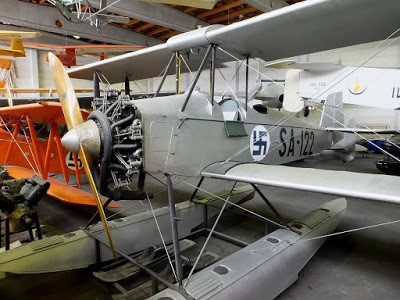
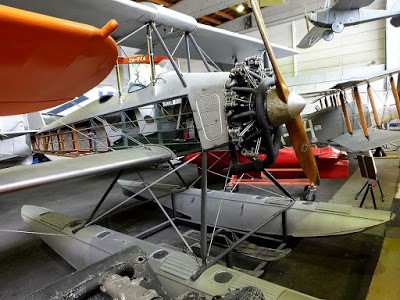
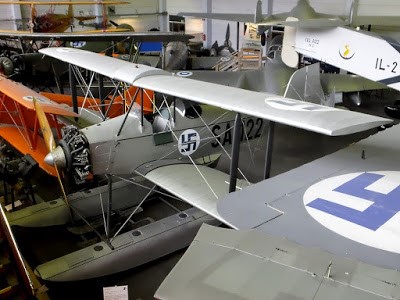
V.L. Sääski II – Registration number: SÄ-122, Serial number: 11
First VL product was the Saa’ski two-seat trainer. A trainer designed by engineer K.W. Berger and A. Nieminen. The first aircraft designed in Finland for mass production. The Finnish Air Force used 34 Sääski aircraft in 1928 – 1941. In addition, 5 aircraft were in civilian and official use.
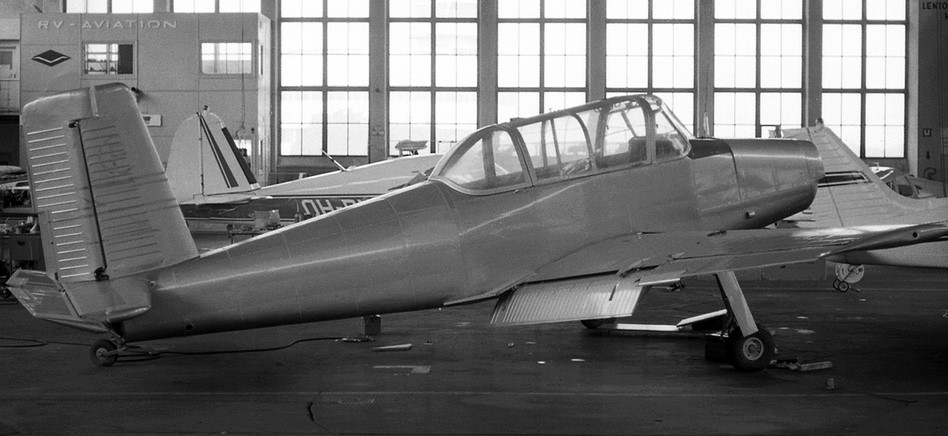
The TL-III Tuuli was a primary trainer for the Finnish Air Force.
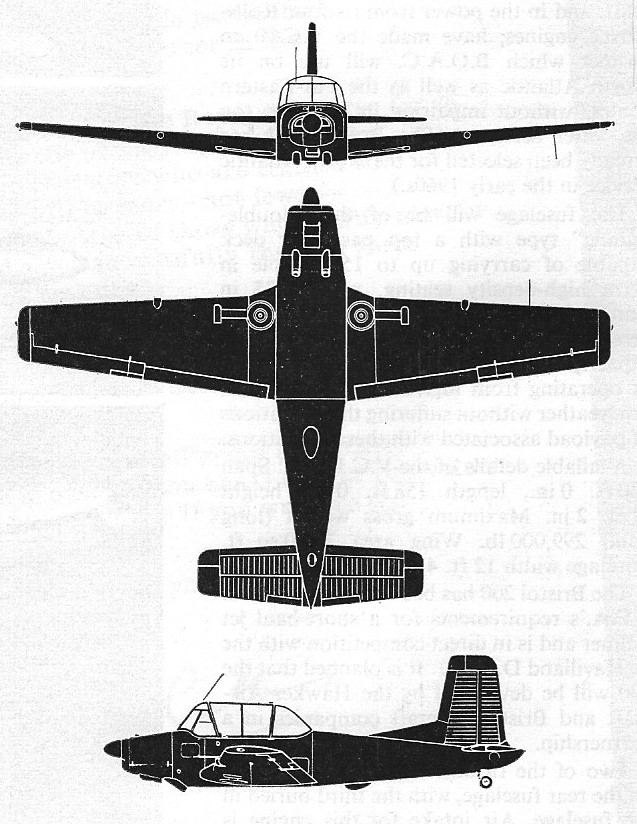
The wing is a light alloy stressed-skin structure. With a main spar at 25% chord. The slotted ailerons are light-alloyed covered. Aerodynamically and mass balanced, and fitted with balance tabs adjustable on ground. The landing flaps open 40 degrees, and the ailerons are coupled to the landing flaps so when the flaps fully open the ailerons are deflected 15 degrees.
The fuselage is a light-metal stressed-skin construction. Two main frames, one at the instrument panel and one behind the cargo compartment, divide the fuselage into three separately manufactured parts, which are riveted together. The extension of the main spar passes under the front seats in the fuselage, to which the fastening points of the main spar of the wings are attached. The fastening point of the auxiliary spar connects with a reinforced fuselage rib. The rudder and the elevators are stressed-skin structures with light-alloy covering.
The fin and stabiliser are attached to the reinforced ribs on the rear fuselage. Landing gear is rtractable mains and fixed tailwheel. The front cockpit has side-by-side pilot seats with full dual controls.
It was available in three versions; an aerobatic two-seater, a three-seat utility aircraft, and a for-seat liaison aircraft. It is capable of fitting a standard size stretcher.
Engine: Continental O-470-A, 225 hp Span: 36 ft 1 in Length: 26 ft 3 in Height: 8 ft 6 in Empty weight: 2350 lb Loaded weight: 3166 lb Max speed SL: 136 mph Cruise: 112 mph