2Si 460 / Cuyuna 460

The 2si 460 is a family of in-line twin-cylinder, two-stroke, single ignition, aircraft engines that were designed for ultralight aircraft.

The basic engine was originally designed and produced by JLO of Germany and was later acquired by the AMW Cuyuna Engine Company of Beaufort, South Carolina and marketed under the Cuyuna brand name. Later the engine was marketed by Cuyuna under the Two Stroke International (2si) brand. Cuyuna no longer markets engines for aircraft use although the 460 is still in production as a diesel/multifuel or gasoline industrial, marine and sport vehicle engine.

The 460 is a conventional twin-cylinder engine that weighs 59 lb (27 kg) in its F35 aircraft version. The engine features single capacitor discharge ignition, piston porting, tuned exhaust system, one or two slide venturi-type carburetors, fuel pump, a cast iron cylinder liner, ball, needle and roller bearings throughout. The aircraft version was offered with cog belt drive or a gearbox reduction system. Starting is electric starter or recoil starter.

Variants

460-F35
Gasoline aircraft engine, single carburetor, 35 hp (26 kW) at 6000 rpm, weight 59 lb (27 kg), out of production.

460-F40
Gasoline aircraft engine, single carburetor, 40 hp (30 kW) at 6500 rpm, weight 70 lb (32 kg), out of production.

460-F45
Gasoline aircraft engine, dual carburetors, 45 hp (34 kW) at 6750 rpm, weight 70 lb (32 kg), out of production.

460 MF
Diesel/multi-fuel engine for marine and industrial applications, 37 hp (28 kW) at 6000 rpm, weight 78.5 lb (36 kg) without gearbox.

460F-35
Gasoline industrial engine and sport vehicle engine for auto racing, kart and All-terrain vehicle applications, single carburetor, 35 hp (26 kW) at 6000 rpm, basic weight 55 lb (25 kg).

460FE-35
Gasoline industrial engine and sport vehicle engine for auto racing, kart and ATV applications with electric start, single carburetor, 35 hp (26 kW) at 6000 rpm, basic weight 55 lb (25 kg).

460L-50
Gasoline marine engine powering a jet pump, 50 hp (37 kW) at 6750 rpm.

Specifications

460-F35 aircraft engine
Type: Twin-cylinder, two-stroke aircraft engine
Valvetrain: piston porting
Fuel type: Minimum 92 octane
Oil system: premixed oil and fuel
Cooling system: fan cooled
Reduction gear: cog belt or optional gearbox
Bore: 69.5 mm (2.74 in)
Stroke: 60.0 mm (2.36 in)
Displacement: 455 cc (27.77 cu in)
Length: 14.5 in (368.30 mm)
Width: 16.0 in (406.40 mm)
Height: 16.0 in (406.40 mm)
Dry weight: 59 lb (27 kg)
Power output: 35 hp (26 kW) at 6000 rpm
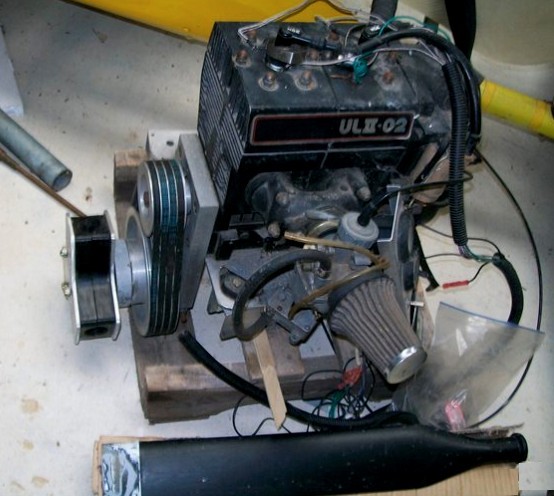
2si Cuyuna 340 / 430 / UL-II

Cuyuna UL11-02

While developing the Pterodactyl Pfledge flying wing ultralight in the late 1970s, designer Jack McCornack experimented with a number of possible engines. Early flights used a German-made Sachs engine, but the high exchange rate and long lead times for this engine convinced him to try other options.

2si Cuyuna 340 / 430 / UL-II Article

McCornack settled on a two-stroke snowmobile engine produced by the Cuyuna Development Company as having the best potential. In 1979 He modified the engine with a crankcase extension, an additional main bearing, lowered the compression ratio using an additional head gasket and substituted a smaller 32 mm (1.26 in) Mikuni carburettor, amongst other modifications. The original snowmobile engine produced 40 hp (30 kW). Lowering the compression ratio not only de-rated the engine, but also made pull-starting easier and allowed it to run on lower-octane regular auto fuel. The resulting engine worked well, was de-rated to produce 30 hp (22 kW) at 5,500 rpm and proved reliable in service.
Citing liability concerns over producing a two-stroke engine for human-carrying aircraft applications, Cuyuna declined to produce the modified engine. Instead, Cuyuna decided that the resulting engine was different enough from the base snowmobile engine that they would supply assembled and test-run shortblocks as parts to McCornack’s company, Pterodactyl Limited, who would then complete the engines and be the manufacturer, allowing Cuyuna to continue producing snowmobile engines.
After two years of poor sales of snowmobiles, due to a dearth of snow and no lawsuits against Pterodactyl Limited regarding the engine, Cuyuna agreed to build the engines themselves.
The 430 was also produced in a reduced 2.362 in (60.0 mm) bore version called the 340. The modification reduced its displacement to 339 cc and output to 25 hp (19 kW) at 5500 rpm. The standard 430 has a bore of 2.658 in (67.5 mm).
Unit cost 1980: US$800

Variants
340D – Direct drive version, 25 hp (19 kW) at 5500 rpm, recoil starter.

340R – Reduction drive version using a belt drive system, 25 hp (19 kW) at 5500 rpm, recoil starter

430D – Direct drive version, 30 hp (22 kW) at 5500 rpm, recoil starter.

430F – Reduction drive version using a 3:1 gearbox system, dual carburetors, producing 45 hp (34 kW).

430R – Reduction drive version using a belt drive system, 30 hp (22 kW) at 5500 rpm, recoil starter

UL II – 35 hp (26 kW) version

Specifications

430D
Type: Direct drive two-stroke piston aircraft engine
Bore: 2.658 in (68 mm)
Stroke: 2.362 in (60 mm)
Displacement: 428 cc (26.11 cubic inches)
Dry weight: 65 lb (29 kg)
Designer: McCornack/Cuyuna
Fuel type: Regular auto fuel
Oil system: 40:1 premixed fuel and oil
Cooling system: fan forced air
Power output: 30 hp (22 kW)
Compression ratio: 12.5:1
Power-to-weight ratio: 0.46 hp/lb (0.76 kW/kg)

2Si 230 / Cuyuna 230

The basic engine was originally designed and produced by JLO of Germany and was later acquired by the AMW Cuyuna Engine Company of Beaufort, South Carolina and marketed under the Cuyuna brand name. Later the engine was marketed by Cuyuna under the Two Stroke International (2si) brand. Cuyuna no longer markets engines for aircraft use although the 230 was still in production as a diesel/multifuel or gasoline industrial and marine engine.
The 230 is a conventional single-cylinder two-stroke engine that weighs only 36 lb (16 kg) in its A20 version. The engine features single capacitor discharge ignition, piston porting, tuned exhaust system, slide venturi-type carburettor, fuel pump, a cast iron cylinder liner, ball, needle and roller bearings throughout. The engine was offered with cog belt drive or a gearbox reduction system. Starting is electric starter or recoil starter.

Variants

230-A20 – Gasoline aircraft engine, 20 hp (15 kW) at 6000 rpm, weight 36 lb (16 kg), out of production.

230-F22 – Gasoline aircraft engine, 22 hp (16 kW) at 6500 rpm, weight 48 lb (22 kg), out of production.

Specifications

230-A20
Type: Single-cylinder, two-stroke aircraft engine
Bore: 69.5 mm (2.74 in)
Stroke: 60.0 mm (2.36 in)
Displacement: 228 cc (13.91 cu in)
Length: 11.7 in (297.18 mm)
Width: 14.6 in (370.84 mm)
Height: 14.0 in (355.60 mm)
Dry weight: 36 lb (16 kg)
Valvetrain: piston porting
Fuel type: Minimum 92 octane
Oil system: premixed oil and fuel
Cooling system: air-cooled
Reduction gear: cog belt or optional gearbox
Power output: 20 hp (15 kW) at 6000 rpm

230F-22
Cycle: 2
No cylinders: 1
Bore: 69.50 mm
Stroke: 60 mm
Displacement: 228 cc
Cooling: Air
Ignition: Coil
Reduction: Poly-V belt
Reduction Ratio: 2.5-1
Weight: 20 kg
Max pwr: 22 hp at 6500 rpm
Price 1998: 14,000 Fttc

230F-20
Cycle: 2
No cylinders: 1
Bore: 69.5 mm
Stroke: 60 mm
Displacement: 228 cc
Cooling: Air
Ignition: Coil
Reduction: Poly-V belt
Reduction Ratio: 2.04-1 to 3.06-1
Weight: 22 kg
Max pwr: 20 hp at 6500 rpm
Price 1998: 15,500 Fttc

2Si 215 / Cuyuna 215R

The 215 is a conventional single-cylinder two-stroke engine that weighs 39 lb (18 kg) in its 215R aircraft version. The engine features single breaker and points ignition, with single capacitor discharge ignition used on the current models. It also incorporates piston porting, tuned exhaust system, single carburettor, fan cooling, fuel pump, a cast iron cylinder liner, ball, needle and roller bearings throughout. The 215R aircraft version was offered with an optional belt reduction system and the modern industrial versions have an optional gearbox with ratios of 2.04, 2.65 and 3.06. Starting is a recoil starter with a custom electric starter available as an option.

The basic engine was originally designed and produced by JLO of Germany and was later acquired by the AMW Cuyuna Engine Company of Beaufort, South Carolina and marketed under the Cuyuna brand name. Later the engine was marketed by Cuyuna under the Two Stroke International (2si) brand. Cuyuna no longer markets engines for aircraft use although the 215 was still in production as an industrial and multi-fuel engine.

Variants
215D – Gasoline aircraft engine with direct drive. Single carburetor, 20 hp (15 kW) at 6000 rpm, weight 42 lb (19 kg).
215R – Gasoline aircraft engine with belt reduction drive. Single carburetor, 20 hp (15 kW) at 6000 rpm, weight 39 lb (18 kg).

Specifications

215D
Type: Single-cylinder, two-stroke aircraft engine
Bore: 2.658 in (67.5 mm)
Stroke: 2.362 in (60.0 mm)
Displacement: 214 cc (13.06 cu in)
Length: 11.75 in (298.5 mm)
Width: 7.0 in (177.8 mm)
Height: 14.0 in (355.6 mm)
Dry weight: 42 lb (19 kg)
Components
Valvetrain: piston porting
Fuel type: Regular auto fuel
Oil system: premixed oil and fuel at 50:1
Cooling system: fan cooled
Reduction gear: optional belt reduction
Performance
Power output: 20 hp (15 kW) at 6000 rpm
Compression ratio: 12.5:1

2si / Two Stroke International        

2si is an American engine manufacturer located in Beaufort, South Carolina, USA. The company is a wholly owned subsidiary of the AMW Cuyuna Engine Company, formerly known as the Cuyuna Development Company.

The company acquired a line of two-stroke engines that were originally designed and produced by JLO of Germany and marketed them under the Cuyuna brand name for snowmobile and later ultralight aircraft use. Later Cuyuna formed a subsidiary Two Stroke International, commonly known as 2si, to produce and market the engine line. Cuyuna no longer sells engines for aircraft use, but instead markets them for industrial, marine, auto racing, kart and all-terrain vehicle applications.

1998:
8 Schein Loop
SC 29902 Beaufort
USA