Vortech Skylark 1

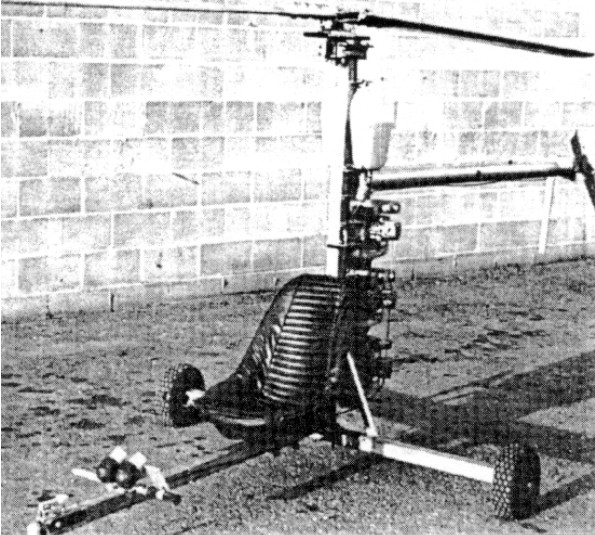
Developed from the G-1 design, pilots have expressed amazement at this craft’s stability and manoeuvrability. The Skylark can be flown in the Experimental Aircraft category. Although this is one of the more affordable homebuilts, the airframe and all of its major components have been designed for quality, dependability and durability.

Full instrumentation Skylark kit minus engine and instruments: $19,995 in 2001.
Skylark construction plans in 2001:
Reduced-size prints (11″ x 17″ format): $75 (add $6 postage U.S. or $16 foreign)
Full size prints (18″ x 24″ format): $175 (add $7 postage U.S. or $22 foreign)

Features of the Skylark:

  • Full helicopter flight: vertical take-offs & landings; forward, backward & sideward flight; hovering.
  • Standard helicopter control system
    -All-aluminum main- & tail-rotor blades
  • Aircraft-grade steel & aluminum airframe & major components, plus all AN hardware
  • Full instrumentation

Engine Rotax 582, 65 hp
Main Rotor Diameter 19 ft
Disk area: 283 sq.ft
Tail Rotor Diameter 3 ft 6 in
Height 7 ft
Length 17 ft 6 in
Empty Weight 350 lbs
Gross Weight 725 lbs
Payload Weight 375 lbs
Fuel cap: 10 USG
Power Loading 10.8 lbs/hp
Disc Loading 2.5 lbs/sq ft
Maximum Speed 95 mph
Cruise Speed 70 mph
Rate Of Climb 1,000 fpm
Maximum Altitude 12,500 ft
Range: 120 sm
Seats: 1

Vortech G-1

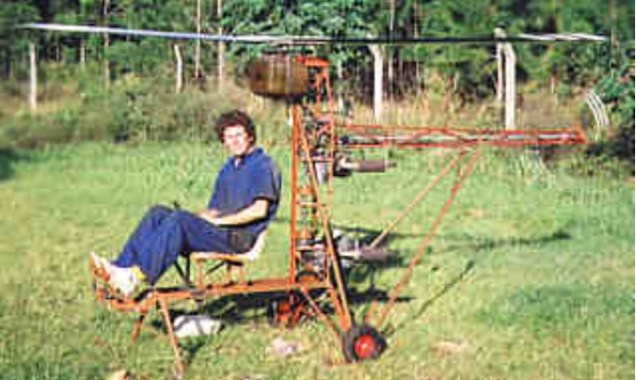
The G-1 Ultrtalight Helicopter, created in the early 1970s by Art Weilage, was tested and sold as low-cost kits by Compcop, Inc. Vortech offers the original construction prints to hobbyists curious about this design, or who want to study the concept as inspiration for a design of their own.

Developed, tested and sold in the 1970’s by Compcop, the G-1 was designed to fill the need for an affordable, easy-to-build ultralight helicopter. The entire helicopter can be built at home with ordinary tools at a low cost. No license is required to fly the G-1 because it is in the license-free “Ultralight Aircraft” category (see FAR Part 103). The construction manual provides all the details needed to build the G-1 with an engine of 40 h.p. or higher. The three McCulloch go-cart engines can be replaced with a single engine such as the Rotax 447. Aluminium construction.

Carries one person. Takes off and lands vertically. Flies forward, backward, sideward, & hovers.

Engines: 3 x McCulloch MC101 42 hp
Empty wt: 150 lb
Max wt: 420 lb
Rotor span: 12ft
Height: 5.5ft
Length: 12ft
Max speed: 80 mph
Cruise: 55 mph
Climb rate: 1,000 fpm
Range: 120 sm
Service ceiling: 10,000 ft
Seats: 1

Engine (typical) Kawasaki or Rotax, 40+ hp
Length 12 ft
Width 5.7 ft
Height 5 ft 6 in
Main rotor diameter 12 ft
Tail rotor diameter 2 ft
Empty weight 150 lbs
Gross weight 420 lbs
Useful payload 270 lbs
Fuel capacity 5 USgals
Fuel consumption 4 USgals/hour
Speed (max.) 80 mph
Altitude (max.) 10,000 ft asl

Engine: 3 x McCulloch, 9.5 hp
Rotor span: 3.66 m
MAUW: 190 kg
Empty weight: 66 kg
Fuel capacity: 19 lt
Max speed: 128 kph
Cruise speed: 80 kph
Fuel consumption: 12 lt/hr
Seats: 1
Plan price (1998): $34.95

von Hagan 1911 Aeroplane

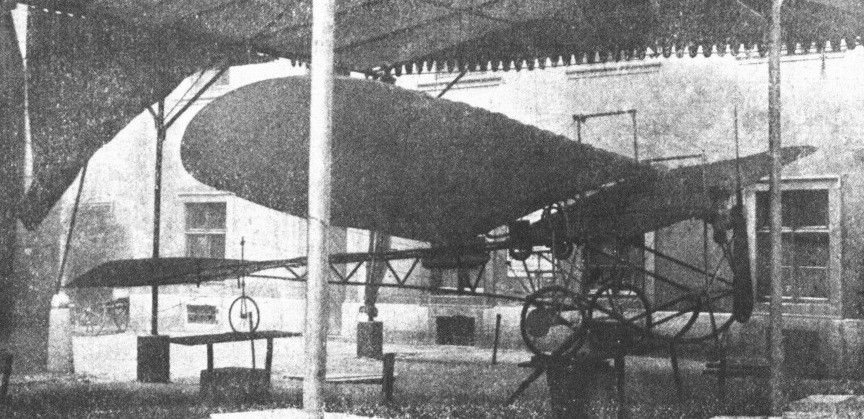
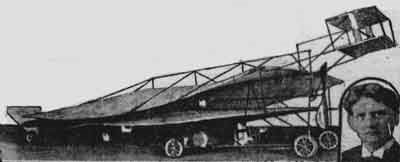
Built by German immigrant Alexander von Hagan in Seattle, Washington, the machine had two sets of silk wings, an aluminium framework, two motors and three propellers. It weighed 600 pounds without the operator. One propeller was in the front, the second three-quarters back, and the third at the rear. One 40 hp motor ran the two front propellers and a smaller one of 35 hp powered the rear. Von Hagan was born in 1859 and served in the German army for 14 years.

von Cosel 1930 monoplane

In 1930 Carl T von Cosel, of Key West FL. Built a two-place cabin, high-wing monoplane amphibian, registered N879Y and powered by a 180hp LeRhône rotary engine.

The wings were never attached, so the plane was never flown. Some reports claimed that von Cosel, an undertaker by trade, kept his dead wife in it for an unstated period of time.

When he left Key West in 1940, he took the plane with him and both disappeared.

Volvo Aero

Volvo Aero
Nohab Flygmotorfabriker AB
Svenska Flygmotor AB

Nohab Flygmotorfabriker AB was founded in Trollhättan, Sweden, in 1930 to produce aircraft engines for the Swedish Board of Aviation. As the name of the company indicates it was a subsidiary to NOHAB. In 1937 it became a part of the newly founded SAAB but already in 1941 Volvo acquired a majority of the stock and the name was changed to Svenska Flygmotor AB (SFA), and later on Volvo Flygmotor.

Since the 1950s the company have been the major engine supplier to the Swedish Air Force. The Volvo Aero Group has 3,600 employees and in 2003 had total sales of 0.9 billion euros. Today Volvo Aero is a partner in more than ten commercial engine programmes. Components from Volvo Aero are installed in more than 90% of all large commercial aircraft engines sold.

On 6 July 2012 Volvo Aero was acquired by the British aerospace manufacturer GKN in a SEK 6.9 billion deal.

Volvo Aero was a supplier of single-engine systems for military aircraft. These have largely been in partnership with other engine manufacturers, such as the RM1 (de Havilland Goblin) for the Saab 21R, RM2 (de Havilland Ghost) for the Saab J29, RM5 and RM6 (Rolls-Royce Avon) for the Saab 32 Lansen, the RM6B for the Saab 35 Draken, and the RM8 (Pratt & Whitney JT8D) for the Saab 37 Viggen. The Saab JAS 39 Gripen’s RM12 engine is a derivative of the General Electric F404.

Svenska Flygmotor also designed the B42, horizontally-opposed four-cylinder engine, intended for the SAAB Safir. However, SAAB decided on using engines from de Havilland and Lycoming for the Safir. In the end the B42 came to power the Infanterikanonvagn 103 assault gun. A follow-up called B44 powered the Pansarbandvagn 301 armoured personnel carrier.

Volvo Aero delivered engine components, mainly complex engine structures like turbine exhaust casings, turbine mid frames, LPT cases, compressor housings, LPT shafts, vanes, and large rotating parts.

Volvo Aero also had a facility in Trollhättan where they did maintenance on aircraft engines and stationary gas turbines. The aircraft engines are Pratt & Whitney Canada PW100 and TFE-731 engines. The Stationary gas turbines is General Electric LM1600 engine, and the DR990, which Volvo bought the OEM responsibility from Dresser Rand.

Volvo Aero manufactured combustion chambers, nozzles and turbines for commercial launch vehicles.

The company have produced the F-series hydraulic motors under the Volvo Flygmotor and VOAC brands.

Volvo Aero subsidiaries were located in the United States and Norway, in addition to Volvo’s home country, Sweden. The Norwegian plant, in Kongsberg, is the former Norsk Jetmotor, itself formerly a part of Kongsberg Våpenfabrikk.