Equipped with removable wings the Comp Air 3 is of composite construction
Seats: 3
Undercarriage: Tricycle or Tailwheel
Equipped with removable wings the Comp Air 3 is of composite construction
Seats: 3
Undercarriage: Tricycle or Tailwheel
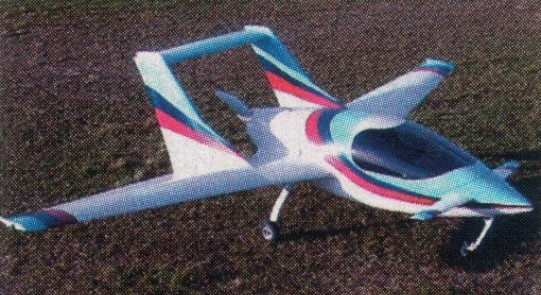
In the 1990’s, West Coast entrepreneur William Shaw and aeronautical engineer and aircraft designer Martin Hollmann, developed the three-wing design called Discovery. The carbon composite construction of the new Discovery is both strong and light, and the interior provides room and comfort for two, plus a baggage compartment. Originally designed as near 200 mph speedster, the Discovery has handling characteristics that will qualify it for the Light Sport Aircraft category (with factory speed reduction modifications).
The Discovery engineering team has used the three wing surface design to develop an airplane that is in both the high end experimental and the new LSA categories. “Three wing surface designs”, offer the best features of both conventional and canard winged airplanes. The high horizontal tail surface of the Discovery has efficient pitch control throughout the flight envelope and particularly at slower speeds. The small canard wing offers trim control and the safety advantage of slow speed stall resistance.
Engine: Lycoming O-360, 180 hp.
Hp range: 115-200.
Range: 810 sm.
Roc: 1500 fpm.
To dist: 800 ft.
Ldg dist: 1200 ft.
Fuel cap: 30 USG.
Empty wt: 860 lbs.
Mtow: 1620 lbs.
Length: 17.9 ft.
Wingspan: 30 ft.
Undercarriage: Nose / fixed.
Wing span: 30 ft.
Wing Cord (root): 4.91 ft.
Wing cord (tip): 3.16 ft.
Seating: 2 place (side by side)
Wing area: 125. sq. ft.
Wing aspect ratio: 7.44
Wing airfoil section: NASA (NLF-0215)
Wing loading (gross wt): 12.18 lb./sq. ft.
Carnard span: 7.9 ft.
Carnard chord (root): 1.33 ft.
Carnard chord (tip):.067 ft.
Carnard area: 7.90 sq. ft.
Carnard airfoil section: NASA (NLF-0215)
Carnard aspect ratio: 8.35
Horizontal tail span: 7.90 ft.
Horizontal tail chord: 2.00 ft.
Horizontal tail aspect ratio: 3.96
Horizontal tail area: 15.80 sq. ft.
Horizontal tail airfoil section: NASA (63218)
Length overall: 17.92 ft.
Fuel capacity: 30 USG
Wheel base: 71 in.
Max speed level flight sea level: 200 mph
Cruise 75% pwr: 170 mph
Stall speed (gross weight): 58 mph
Initial ROC at sea level: 1500 ft/min
Range @ 75% power (no res): 714 miles
Maneuvering speed: 135 mph
Never exceed speed: 240 mph
G-limits at gross weight: +6.4 / -3.2
Cabin width: 43.00 in
Cabin height: 39.00 in.
Baggage area: 24 cubic feet
Controls: Centre stick/dual controls
An 11.5m span, ram-air parachute supporting a trike and powered by a Rotax 503 and a three-blade Ivo prop.
Engine: Rotax 503
Wing span: 11.5 m.
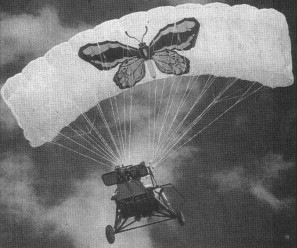
The Aerochute Dual is a two seater powered parachute designed specifically with safety and ease of operation in mind. The parachute is a 15 cell Ram Air canopy. It is 370 sq. ft. and made of a rip-stop nylon. The parachute is designed to be virtually stall or spin resistant. The engine is a Rotax 503 two stroke. It puts out 52hp. and is used with a 3 blade propeller. The fuel capacity is 30L which can give up to two hours flight time.
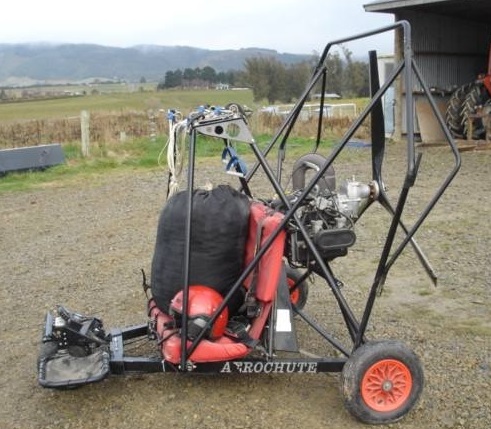
The Aerochute takes off from the ground with the parachute behind you. Once the engine is started the propeller blows the canopy up and the Aerochute takes off within 10 – 15m. Climbing and descending is controlled by using power through a foot throttle. Steering toggles (similar to parachutists) are used to turn left and right. Landing is achieved by backing the power off and flaring the parachute just above the ground.
Optional extras include tachometer 2″ 0-8000 rpm cdi, 2″ round dual cht, foot webbing, flight control sticks, front floor, and floor for sticks rear.
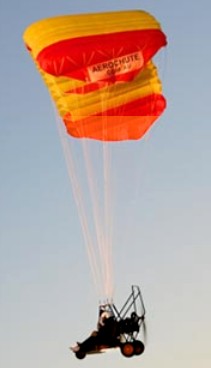
Engine: Rotax 503 Dual Ignition, 52 hp
Propeller: IVO 3 Blade Composite
Empty Weight – airframe: 100 kg
Max Cockpit Wt: 200 kg
Wing Area: 367 sq.ft
Fuel Capacity: 29 lt
Endurance: approx 2 hr
Fabric: Rip Stop Nylon
Glide ratio: 4.5: 1
Sink Rate: 9.8 ft/sec
Wing Span: 35 ft
Wing Chord: 10.5 ft
Wing Load: 1.8lb/sq.ft
Undercarriage: 8″ Rear Wheels
Speed: 60-70 kph
VNE: 45 mph
Max Wind: 15 kts
Rate of Climb: 1000 fpm solo
Max Temperature: 40 C
Takeoff Roll: 10 – 15m
Noise Level: 76 dB
Max. cross wind: 5 knots.
Rigging time: 5-10 minutes
Aerochute Industries Pty Ltd was founded in 1989 by Stephen Conte, who, in conjunction with brother John developed the Aerochute Dual Seater which was specifically designed for customer satisfaction and safety.
The company first introduced the concept of the powered parachute into Australia in early 1989 as a single seat model. Since then development and design changes have led to the Aerochute Dual Seater. The company is engaged in the design, manufacture and construction of the Aerochute which it fabricates from raw materials into the parts needed to manufacture the finished product.
The Aerochute has been approved by the Civil Aviation Safety Authority of Australia. The company is an accredited training organisation for powered parachutes in Australia, and provides backup of spare parts and knowledge of the product.
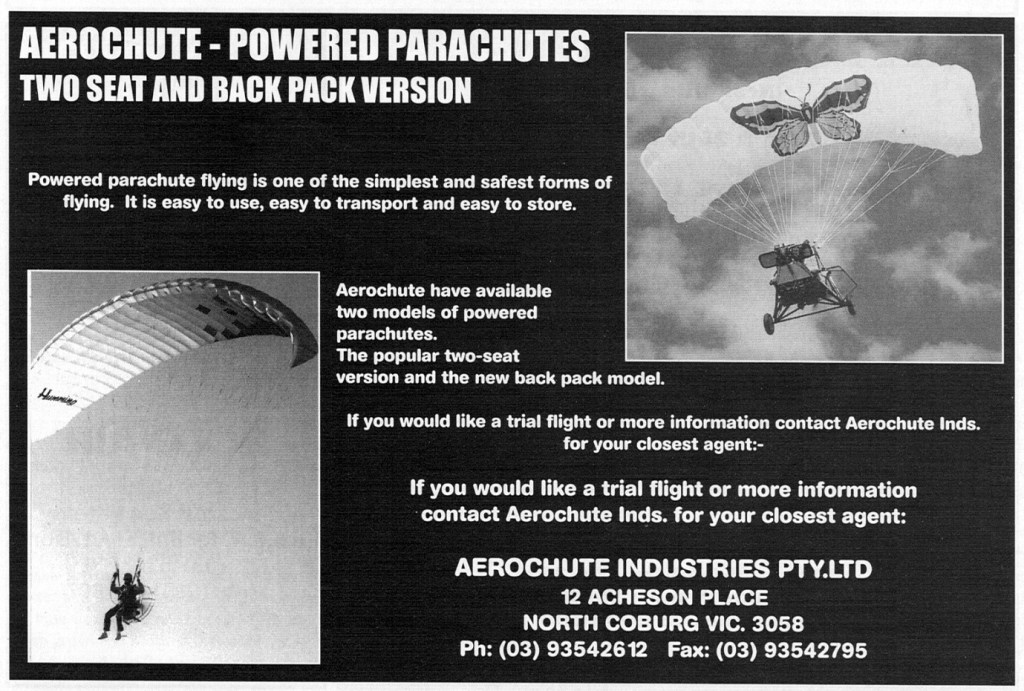
2001: Located in Melbourne, Australia.
2007: 12 Acheson Place, North Coburg, Victoria 3058, Australia
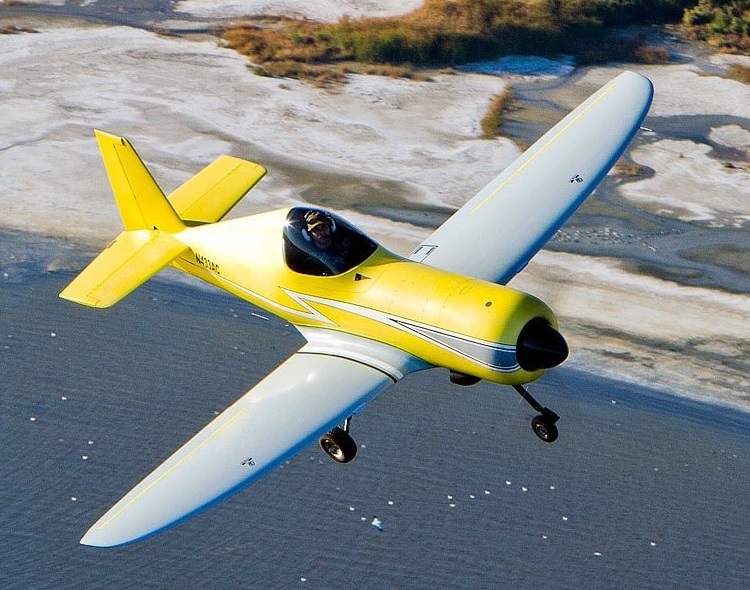
The LT-1 was designed by a surfboard maker who worked with Reno air racing champion Darryl Greenamyer on some of the pilot’s most recent composite airplanes. They expect the plane, which has a 21-foot wingspan, to have a maximum weight of less than 800 pounds and burn just three gallons per hour at cruise speed.
In development a few years, the Aerochia LT-1 carbon-fiber composite fuselage is powered by a two-cylinder, four-stroke HKS engine producing 60 horsepower. Aerochia expects to get speeds as great as 160 mph from the engine.
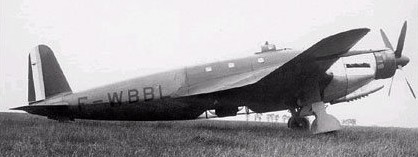
An experimental aircraft intended for high-altitude researches. The engine was a pair of DB605 coupled together to form a DB610 with an output of 2,950 h.p. which drove a single four bladed propeller. The crew of three occupied a pressure cabin with room for two observers.
The only prototype first flew on 6 June 1946. The engine overheated constantly and with money running out this one off only achieved some forty hours flying time before it was grounded and eventually scrapped.
Engine: 1 x 3000hp Daimler-Benz DB-610A piston engine
Take-off weight: 9971 kg / 21982 lb
Empty weight: 7367 kg / 16242 lb
Wingspan: 22.32 m / 73 ft 3 in
Length: 17.09 m / 56 ft 1 in
Height: 6.10 m / 20 ft 0 in
Wing area: 50.0 sq.m / 538.2 sq.ft
Max. Speed: 600 km/h / 373 mph
Ceiling: 13500 m / 44300 ft
Crew: 5
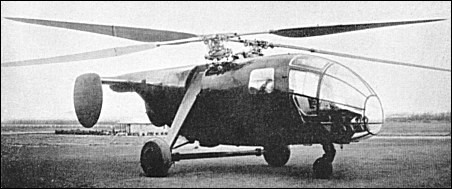
The Helicopter Division of SNCAC was established by Rene Dorand and designed and built three prototypes of the NC.2001 “Abeille” helicopter, the second of which was flown on 28 June 1949, following ground destruction of the first machine. It had twin inter-meshing two-blade rotors, an all-metal fuselage with an extensively glazed nose and accommodation for five people. The undercarriage was a fixed tricycle type and it had a tailplane with twin fins. The NC.2001 was powered by a 450hp Renault 12S00 piston engine. The project was discontinued on the dissolution of SNCAC in 1949 with only one flight having been made.
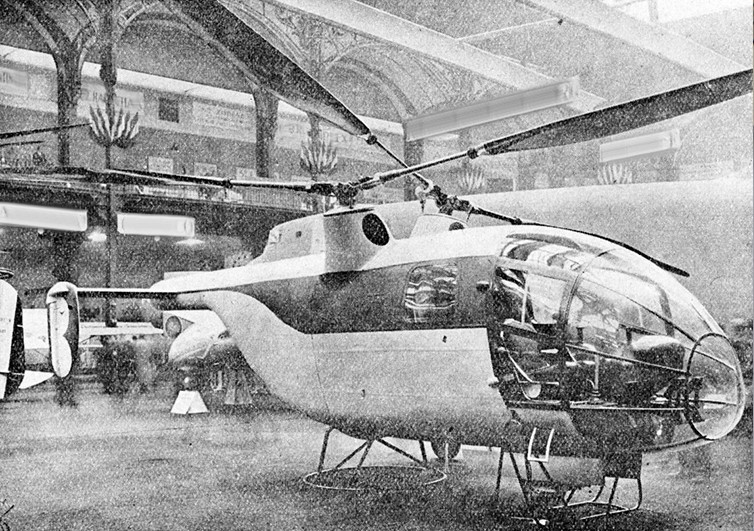
NC.2001
Engine: 1 x Renault, 335kW
Rotor diameter: 15.0m
Length: 9.7m
Max take-off weight: 2550kg
Max speed: 159km/h
Ceiling: 4880m
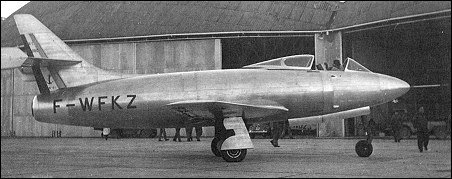
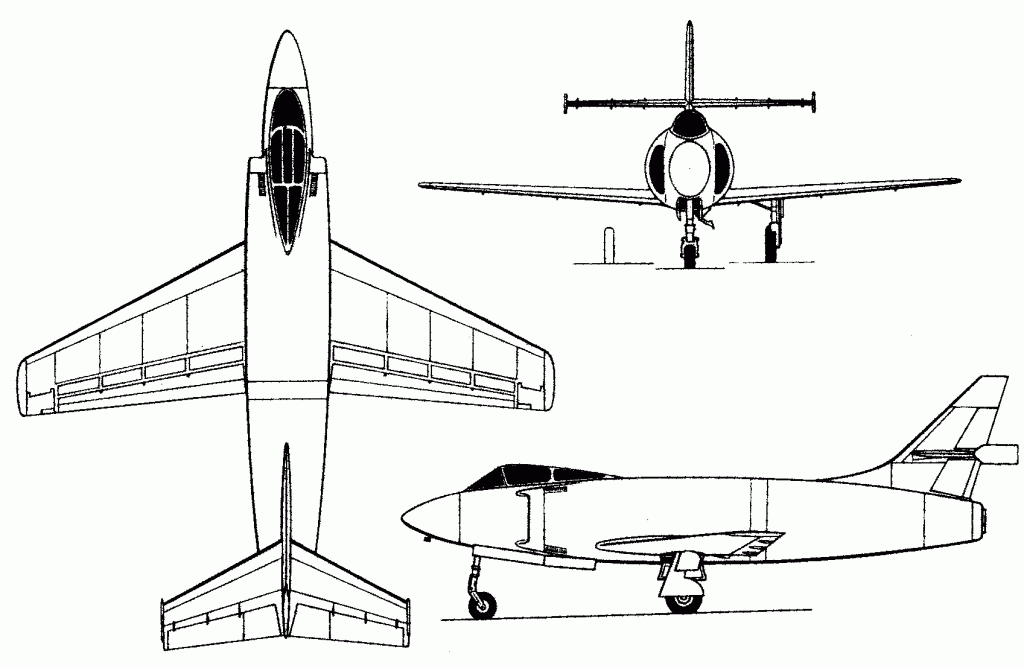
In June 1946, the Service Technique Aeronautique issued a preliminary requirement for a shipboard fighter armed with three 20mm or 30mm cannon and capable of carrying two 500kg bombs or eight 90mm rockets. Responding to this requirement, the SNCA du Nord tendered the Nord 2200, in competition with the Aerocentre NC 1080 and the Arsenal VG 90.
Designed under the direction of Ingenieur Pillon and built by the SNCA du Centre (Aerocentre), the NC 1080 was powered by a 2268kg Rolls-Royce Nene turbojet, featured 22 deg 30 min wing sweepback at quarter-chord and was intended to mount an armament of three 30mm cannon.
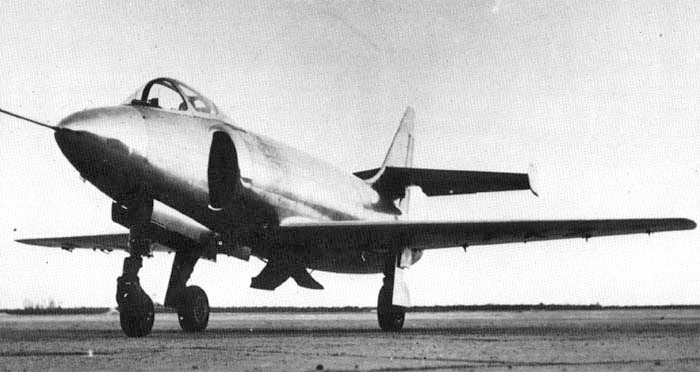
The prototype was flown on 29 July 1949, and modifications were immediately found necessary to the spoilers and tail surfaces. The Aerocentre had meanwhile been dispersed, but testing of the NC 1080 continued at Bretigny and Villaroche, servo controls being fitted in February-March 1950, and the aircraft being destroyed in an accident (the cause of which was never ascertained) on 10 April. No further development was undertaken.
Max take-off weight: 7700 kg / 16976 lb
Empty weight: 5141 kg / 11334 lb
Wingspan: 12.00 m / 39 ft 4 in
Length: 12.87 m / 42 ft 3 in
Height: 4.70 m / 15 ft 5 in
Wing area: 28.40 sq.m / 305.69 sq ft
Max. speed: 978 km/h / 608 mph
Range: 1550 km / 963 miles
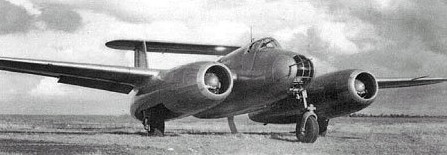
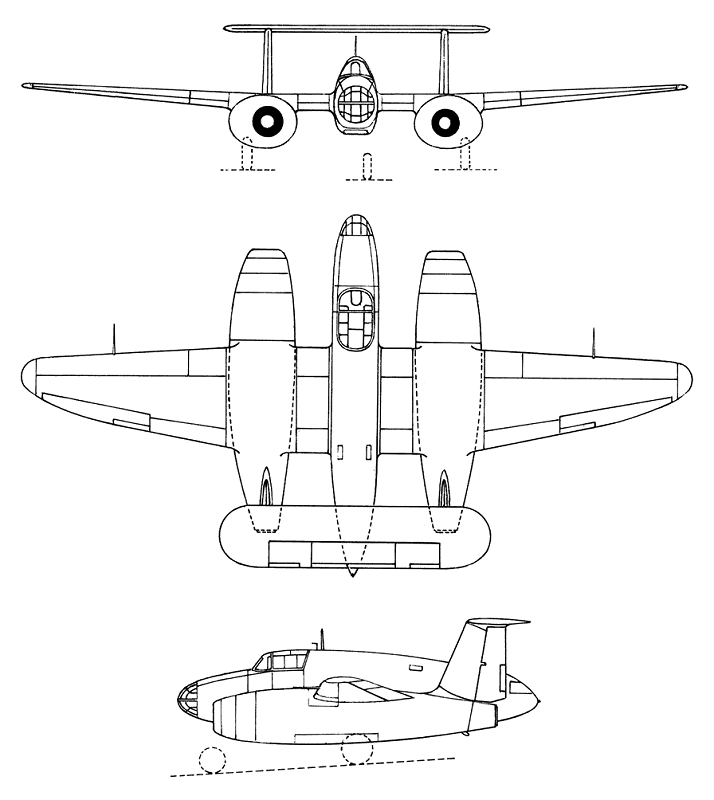
A turbojet-powered derivative of the NC.1070, the NC.1071 had underwing engine nacelles, which also carried the tailfins, connected by a tailplane on top. The first prototype flew on 12 October 1948 but the second prototype was abandoned after suffering structural damage in a flight to Mach 0.7. Aerocentre went into liquidation during 1949 and the project was cancelled in 1951.
Engine: 2 x 2350kg Hispano-Suiza (Rolls Royce) Nene 101
Take-off weight: 13750 kg / 30314 lb
Empty weight: 7980 kg / 17593 lb
Wingspan: 20.0 m / 66 ft 7 in
Length: 10.75 m / 35 ft 3 in
Height: 4.6 m / 15 ft 1 in
Wing area: 50.0 sq.m / 538.20 sq ft
Max. Speed: 800 km/h / 497 mph
Cruise speed: 724 km/h / 450 mph
Ceiling: 13000 m / 42650 ft
Range: 1000 km / 621 miles
Armament: 2 x 20mm cannon, 800kg of weapons