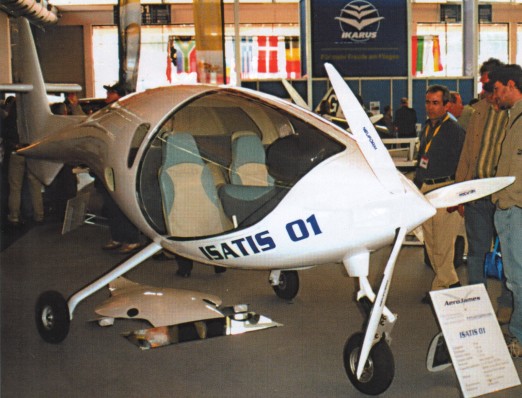
Aérokit Industrie Aérokit

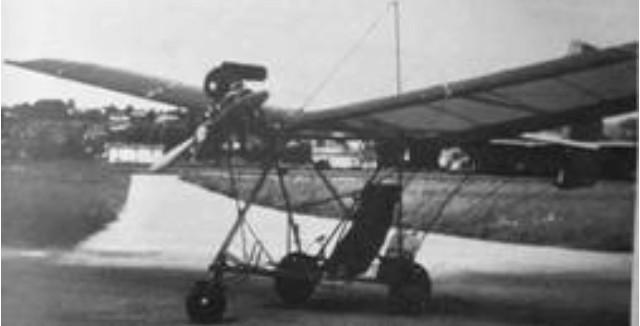
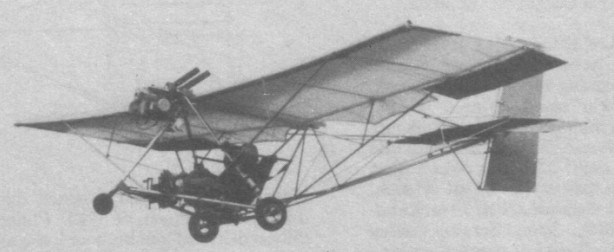
A side by side two seat single engined high-wing monoplane with conventional three axis control. The wing has unswept leading and trailing edges, and constant chord; T tail. Pitch control is by elevator on the tail; yaw control by fin mounted rudder; no separate roll control (roll control by one third span spoilers option¬al); control inputs through stick for pitch/yaw (optional: stick for pitch/roll and pedals for yaw). Wing braced from above by kingpost and cables, from below by cables; wing profile single surface. Undercarriage has three wheels in tricycle formation with additional tailskid; no suspension on any wheels (optional torsion bar suspension on main wheels). No ground steering. Optional brake on nose-wheel. Aluminium tube framework, without pod. Engine mounted below wing driving pusher propeller with V belt reduction.
With a configuration very close to that of the Quicksilver MXII, this Aerokit was only at the prototype stage in 1982. Conceived by Olivier Richard and built with the assistance of Hugues Delebard and Christian Risbourg, this machine is a direct result of experience acquired with other microlights used within the framework of one of the first private flying schools to appear in France, the Cenpre National de Formation ULM at Rustrel, Vaucluse, founded and directed by Serge Pellenc.
The Aerokit can be used either as a two axis control machine with elevators and rudders or as a conventional three axis control aircraft by the addition of spoilers, which are optional. Supplied with a central stick, this side by side two-seater machine can be converted to single seat without any difficulty, as the seats are fitted with Velcro, permitting removal of one seat and the re positioning of the other in the central location. The experience accumulated in the flying school by this manufacturer caused it to fit a wide track undercarriage which is specially reinforced. The axle of the main wheels is made of 1.6 x 0.9 inch (40 x 2.5 cm) Duralumin tube with internal bushes and nylon bearing hubs. As an option, the main wheels can have torsion bar suspension.
The Aerokit in its standard version is fitted with a single fuel tank but this can be increased as an option by fitting two supplementary tanks of the same size, tripling its range. The Aerokit is trailer transportable.

Engine: Hirth 2701R 03, 43 hp at 6750 rpm
Propeller: 55 x 24 in, 1.4 x 0.6m
Reduction ratio: 2.4/1
Max static thrust: 232 lb, 105 kg
Power per unit area: 0.25 hp/ sq.ft, 2.7 hp/sq.m
Fuel capacity: 2.6 US gal, 2.2 Imp gal, 10.0
Optional res fuel capacity: 5.3 US gal, 4.4 Imp gal, 20.0 lt
Length overall: 14.6 ft, 4.43 m
Height overall: 9.0ft, 2.75m
Wing span: 32.8ft, 9.95m
Constant chord: 5.3ft, 1.6m
Dihedral: 11 deg
Sweepback: 0 deg
Tailplane span: 9.3 ft, 2.82 m
Fin height: 4.3ft, 1.3m
Total wing area: 17 sq.ft, 16.0 sq.m
Fin area: 2.2 sq.ft, 0.2 sq.m
Rudder area: 10.0 sq.ft, 0.93 sq.m
Tailplane area: 23.1 sq.ft, 2.14 sq.m
Wing aspect ratio: 6.18/1
Total elevator area: 12.7 sq.ft, 1.18 sq.m
Wheel track: 5.5 ft, 1.65 m
Wheelbase: 5.3ft, 1.60 m
Nosewheel dia. overall : 11 in, 28 cm
Main wheels dia. Overall: 16 in, 40 cm
Empty weight: 291 lb, 132 kg
Max take off weight: 623 lb, 282 kg
Payload: 332 lb, 150 kg
Max wing loading: 3.61 lb/sq.ft, 17.8 kg/sq.m
Max power loading: 14.5 lb/hp, 6.5kg/hp
Load factor: +3.5 ultimate
Max level speed: 50 mph, 80 kph
Never exceed speed: 56 mph, 90kph
Max cruising speed: 42mph, 68kph
Economic cruising speed: 34mph, 55kph
Stalling speed: 23 mph, 38 kph
Max climb rate at SL: 680 ft/min, 3.5 m/s
Min sink speed: 37 mph, 60 kph
Min sink rate: 400 ft/min, 2.0 m/s
Best glide ratio: 6/1 at 44 mph, 70 kph
Take off distance: 130 ft, 40 m
Land¬ing distance: 100 ft, 30 m
Service ceiling: 10,000 ft, 3050 m
Range at ave cruise: 50 mile, 80 km
Aérokart 4320

A two seat, side by side, single engined, high-wing monoplane with conventional three axis control. The wing has unswept leading edge, swept forward trailing edge and constant chord, cruciform tail. Pitch control is by elevator on tail, and yaw control by fully flying rudder; roll control by half span ailerons; control inputs through stick for pitch/roll and pedals for yaw.
The wing is braced from below by struts; with a double surface wing profile. The undercarriage has three wheels in tricycle formation; no suspension on the nosewheel and bungee suspension on the main wheels. Push right go right nosewheel steering is connected to the yaw control. No brakes. An aluminium tube framework, without pod, the engine is mounted below wing driving pusher propeller.
On the two seater Aerokart 4320 the kingpost and wire used on this company’s single seaters is replaced by struts. The horizontal stabiliser, stiffened in flight and landing by cables, has the outer sections of its leading edge joined by tubes to the spars carrying the tail assembly. These tube joints form a structure of high structural integrity rather than low drag.
The 4320 has its motor mounted in front of the wing on silent bloc bushes, driving a twin bladed propeller behind the trailing edge from toothed belt reduction. The 1983 standard power pack for this aircraft was the twin cylinder in line Hirth 2701R of 43hp fitted with a tuned exhaust for each cylinder, this system having been developed by Aerokart.
The hot air from the cooling fan is fed to the carburettor and air filter by a movable flap when atmospheric conditions demand de icing and switched back at other times.
This two seater is delivered in standard form with an electric starter while retaining the capability of manual starting. Electric fuel pump and double surfacing for the wing, ailerons and tail areas, and alloy rims for the main wheels are all standard fittings on the 4320. The machine is transportable on a trailer, folded dimensions being 16.9 x 6.3 x 5.9ft (5.10 x 1.90 x 1.76m).

Engine: Hirth 2701R 03, 43 hp at 6750 rpm
Propeller: 55 x 32 in, 1.40 x 0.80 m
Reduction ratio: 2.5/1
Power per unit area: 0.19hp/sq.ft, 2.2hp/sq.m
Max static thrust: 287 lb, 130kg
Fuel capacity: 5.3 US gal, 4.4 Imp gal, 20.0 lt
Length overall: 19.0ft, 5.8m
Optional fuel capacity: 7.9 US gal, 6.6 Imp gal, 30.0 lt
Height overall: 9.8ft, 2.94m
Wing span: 34.5ft, 10.5m
Chord at root: 6.4 ft, 1.92m
Chord at tip: 6.2ft, 1.89m
Dihedral: 1.5 deg
Sweepback: 0 deg
Tailplane span: 9.1 ft, 3.00 m
Total wing area: 216 sq.ft, 20.0 sq.m
Total aileron area: 12.9 sq.ft, 1.2 sq.m
Rudder area: 12.1 sq.ft, 1.12 sq.m
Tail¬plane area: 21.6 sq.ft, 2.0 sq.m
Total elevator area: 12.3 sq.ft, 1.14 sq.m
Wing aspect ratio: 5.4/1
Wheel track: 5.7ft, 1.70 m
Wheelbase: 5.8ft, 1.72m
Nosewheel dia. Overall: 10 in, 26 cm
Main wheels dia. Overall: 16 in, 40 cm
Empty weight: 322 lb, 146kg
Max take off weight: 707 lb, 320kg
Payload: 385 lb, 174 kg
Load factors: +5.5, 2.5 design
Max wing loading: 3.27 lb/sq.ft, 16.0 kg/m
Max level speed: 56mph, 90kph
Max power loading: 16.4 lb/hp, 7.44kg/hp
Never exceed speed: 75mph, 120 kph
Max cruising speed: 50 mph, 80 kph
Economic cruising speed: 40mph, 65kph
Stalling speed: 22 mph, 35 kph
Max climb rate at SL: 450 ft/min, 2.3 m/s
Min sink speed: 31 mph, 50 kph
Min sink rate: 430 ft/min, 2.2 m/s
Best glide ratio: 7/1 at 45 mph, 65 kph
Take off distance: 230 ft, 70 m
Landing distance: 98 ft, 30 m
Service ceiling: 10,000 ft, 3050 m
Range at ave cruise: 186 mile, 300km.

Aérokart 3315 / 4315

The A Kart 30 was developed into two other prototypes; the tandem 4320 two seater and the single seat 3315, both of which made their first flights at the beginning of summer 1982.
Aerokart continued the trials, refining and developing the machines, until that Septem¬ber, at the first European Microlight Salon at Lyon Bron, it was able to show two pre¬-production machines. The first was a single-¬seater, the type 3315 and the second was the 4320 side by side two seater. Both went on sale in November 1982, though the company has put most of its marketing effort into the Aerokart two seater. This manufacturer uses the first two digits of the type number to indicate the maximum power of the motor used, while the last two numbers indicate the wing area in square metres.
The single seater 3315 uses a Hirth 260R engine of 338 cc developing 33 hp at 7250 rpm, with a 23/1 reduction drive and a 51 inch (1.3m) two blade propeller. The type 4315 is more powerful and is fitted with a Hirth 2701R, 493cc engine developing 43hp at 6750rpm with toothed belt reduction. Of traditional configuration, these machines use of ailerons instead of spoilers, and their engine is fitted inverted in front of the wing below the level of the leading edge. It drives through the reduction drive to a shaft which crosses the wing to connect with a pusher propeller at the trailing edge. Flexible mountings absorb the vibrations caused by using such a long shaft whilst retaining for the Aerokart the advan¬tages of prop wash over the tail surfaces and a well cooled engine.
The machine is trans¬portable on a road trailer.

4315
Engine: Hirth 2701R 03, 43 hp at 6750 rpm
Propeller: 55 x 32 in / 1.4 x 0.8 m
Reduction ratio: 2.5/1
Max static thrust: 287 lb / 130 kg
Power per unit area: 0.27hp/sq.ft / 2.9hp/sq.m
Wing span: 34.5ft / 10.5m.
Fuel capacity main: 5.3 US gal, 4.4 Imp gal, 20.0 lt
Constant chord: 4.8ft / 1.43m.
Fuel capacity reserve: 2.6 US gal, 2.2 Imp gal, 10.0 lt
Dihedral: 1.5 degrees
Total aileron area: 25.9 sq.ft / 2.4 sq.m
Sweepback: 0 degrees
Total wing area: 161 sq.ft / 15.0 sq.m
Tailplane span: 9.1 ft / 3.0 m
Fin area: 7.5 sq.ft / 0.7 sq.m
Rudder area: 12.1 sq.ft / 1.12 sq.m
Tailplane area: 21.6 sq.ft / 2.0 sq.m
Wing aspect ratio: 7.35/1
Total elevator area: 12.3 sq.ft / 1.14 sq.m
Wheel track: 5.7 ft / 1.70 m
Nosewheel dia. overall: 10 in / 26 cm
Wheelbase: 5.8ft / 1.72 m
Main wheels dia. Overall: 16 in / 40cm
Empty weight: 278 lb / 126 kg
Max take off weight: 497 lb / 225 kg
Payload: 219 lb / 99 kg
Max wing loading: 3.07 lb/sq.ft / 15.0 kg/sq.m
Max pwr loading: 11.6 lb/hp / 5.2kg/hp
Load factors: +5.5, 2.5 design
Max level speed: 65 mph / 105 kph
Never exceed speed: 75 mph / 120 kph
Max cruise: 56 mph / 90 kph
Economic cruising speed: 50 mph / 80 kph
Stalling speed: 22 mph / 35 kph
Max climb rate at SL: 600ft/min / 3.0m/s
Take off dist: 165 ft / 50 m
Best glide pwr off: 8/1 at 40 mph / 65 kph
Landing distance: 82 ft / 25 m
Range ave. cruise: 186 sm / 300 km
Service ceiling: 10,000 ft / 3050 m
Min sink rate: 430 ft/min at 31 mph / 2.2 m/s at 50 kph

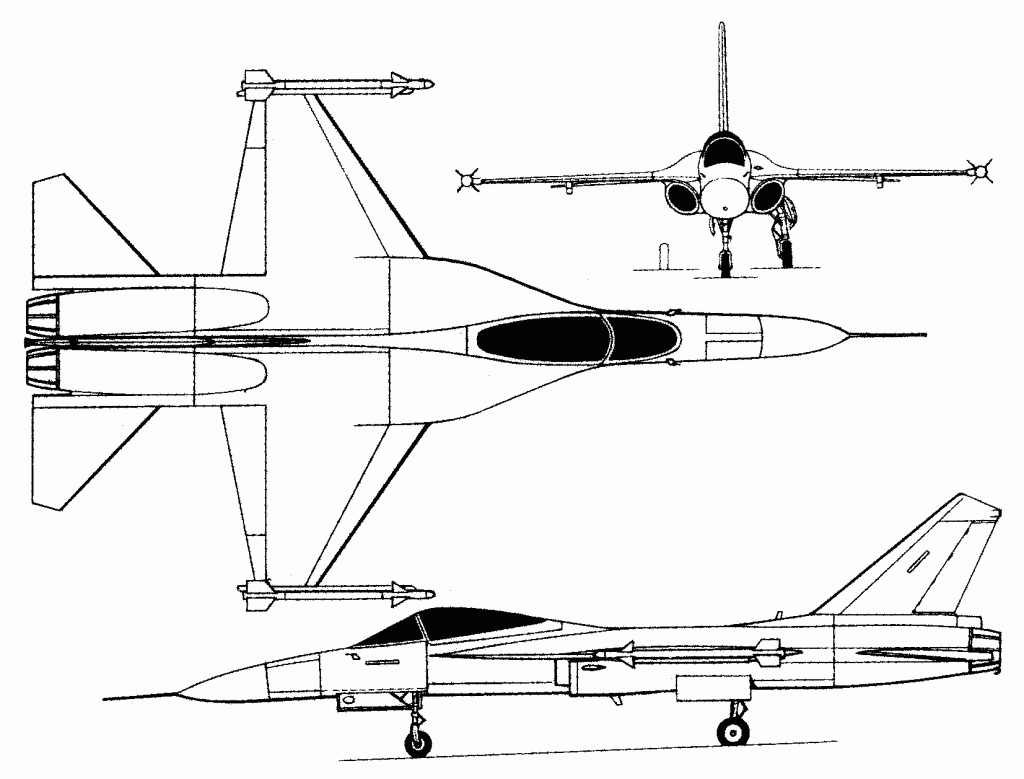
AIDC F-CK / Ching Kuo

In the 1980s the United States of America tried to improve its relations with China, and part of this policy prevented the US government from delivering of the Northrop F-20 Tigershark or General Dynamics F-16 Falcon to Taiwan in 1982.
Taiwan decided to develop a fighter itself to supplement and replace its fleet of F-5E Tiger IIs and F-104s and develop a BVR capability.

AIDC F-CK / Ching Kuo Article

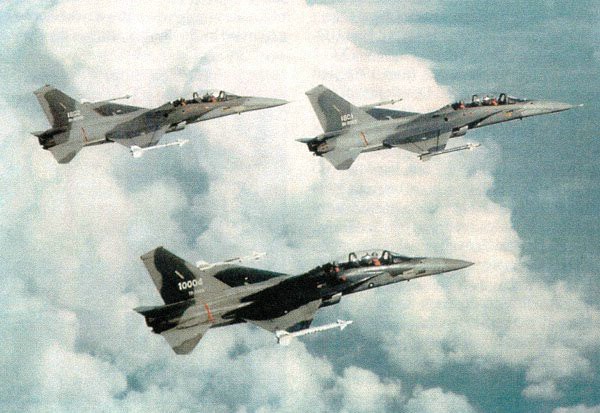
The program, Indigenous Defensive Fighter (IDF), was based on extensive cooperation between the Taiwanese aerospace industry and several US companies, including General Dynamics, Westinghouse, Honeywell and Lear. The Taiching based Aerospace Industrial Development Corporation (AIDC) was the main contractor. Formed for the development of the engine was the International Turbine Engine Corporation (ITEC), a joint venture between AIDC and Allied Signal.
Commencing development in 1982 at the Aero Industry Development Center (AIDC) at Taichung, the Chiang Ching-Kuo indigenous air defence fighter was named F-CK-1 “Ching-Kuo” after a former president of Taiwan.
The aircraft’s primary mission is that of air defense carrying the indigenous Tien Chien (Sky Sword) I Sidewinder-equivalent and the Beyond Visual Range (BVR) Tien Chien II. The multi-role aircraft can also be used in the ground attack role or the martitime attack role using its multi-mode Golden Dragon GD-53 radar, which is a license built version of the Westinghouse AN/APG-67(V). For the martime attack role the aircraft can be equipped with up to three indigenous Hsing Feng II AShM. Internally the Ching-Kuo carries the M61A1 Vulcan 20mm cannon.

Three single-seat F-CK-1A and one two-seat F-CK-1B prototypes were ordered and on 10 December 1988 the first IDF prototype was rolled out. On 28 May 1989 the first, a single-seater, made its first flight. In total four prototypes were built, three single-seat and one two-seat variant. The first (A-1) incurring damage on a very public landing attempt. The second A-2 prototype was lost altogether in a Mach 1 speed trials test. After having completed another 10 pre-production aircraft, full production began and deliveries started early 1994. In December 1994 the first squadron of IDF or Ching-Kuo fighters was formed, achieving initial operational capability in 1995.
The Ching-Kuo fighter was powered by two Garrett TFE 1042-70 turbofans, produced in Taiwan by the International Turbo Engine Company and developed in afterburning form under the Yun Han (Cloud Man) programme, each providing 3783kg with maximum afterburning.
The airframe was developed in collaboration with General Dynamics under the Ying Yang (Soaring Eagle) programme; the avionics were acquired and integrated under the leadership of Lear Siegler under the Tien Lei (Sky Thunder) programme, and the primary missile armament was evolved under the Tien Chien (Sky Sword) programme. The cockpit is equipped with a wide angle HUD, two MFD, a side stick, HOTAS and has a 30 degree declined Martin Baker Mk.12 ejection seat.
Armament consisted of one 20mm M61A Vulcan rotary cannon and, for the intercept role, four Sky Sword I short-range and two Sky Sword II medium-range AAMs, the maximum external stores load being 4082kg. The first of 10 pre-production Ching-Kuos (a two-seater) flew in 1992, when production of up to a further 130 was being planned.

In 1998, in service F-CK-1s were rotated to AIDC for a limited post-production upgrade, including GEC-Marconi Combined Interrogator/Transponder (CIT), Litton Improved Radar Warning Receivers (IRWRs), and Rockwell Collins Instrument Landing System (ILS).

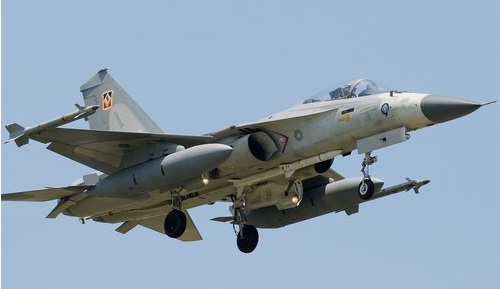
Production ended late 1999 at 130. Reportedly 102 single-seaters and 28 two-seaters had been produced. Taiwan had decided to purchase the F-16 when the Bush administration authorized the sale of more military technology to Taiwan. Having already acquired Mirage 2000 fighter from French to fill the gap, no more IDF aircraft were needed. Subsequently plans for more powerful engines were scrapped.
The 130th aircraft was delivered on 14 January 2000 and entered service in July. Taiwan operated two wings of Ching-Kuo fighters based at Ching Chuan Kang AB (Taicheng) and Tainan AB.
In 2001, AIDC started development of the upgraded F-CK-1C/D. On October 9, 2006, flight testing of the upgraded F-CK-1 IDF began when first single-seat F-CK-1C prototype (10005/958136) undertook its maiden flight from AIDC’s facility at Taichung. On March 27, 2007, the first two-seat F-CK-1D prototype (10006/96-8137) was also unveilled at a ceremony, attended by president Chen Shui-bian, who formally named the new variant Hsung Ying (Goshawk), instead of the earlier announced name of Shiang-Seng.
The F-CK-1C/D upgrade features a new BAE 32-bit flight control computer, improved mission computer and head-up display, advanced fire control radar system and improved weapons capability. Structural enhancements enable it to carry four instead of two Tianchien II (Skysword II) medium-range air-to-air missiles and strengthen the undercarriage. The upgrade also includes two additional fuel tanks in the form of conformal tanks mounted dorsally on the fuselage, first seen on the F-CK-1D prototype.

Gallery

Variants: F-CK-1A, F-CK-1B, F-CK-1C, F-CK-1D

F-CK-1A Ching-Kuo
Engines: 2 x ITEC (Garrett/AIDC) TFE1042-70 (F125) afterburning turbofans, 42.08 kN /9,460 lb st
Length: 15.98m / 46 ft 7.75in
Height: 4.72m /15 ft 6 in
Wing span: 9.42m / 30 ft 10.25in
Wing area: 24.20 sq.m / 260 sq.ft
Empty weight: 6486 kg / 14,300 lb
Max Take-Off: 9.526 kg / 21,000 lb
Maximum Speed: 805mph (1,295kmh; 699kts)
Rate-of-Climb: 50,000ft/min (15,240m/min)
Service Ceiling: 50,000ft (15,240m)
Armament: one M61A1 Vulcan 20mm multi-barrel cannon
Pylons: 4 x underwing, 2 x wingtip, 1 or 2 fuselage stations
Accommodation: 1

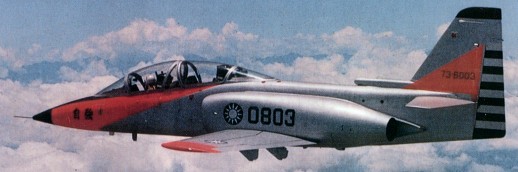
AIDC AT-TC-3 Tse Tchan / AT-3 

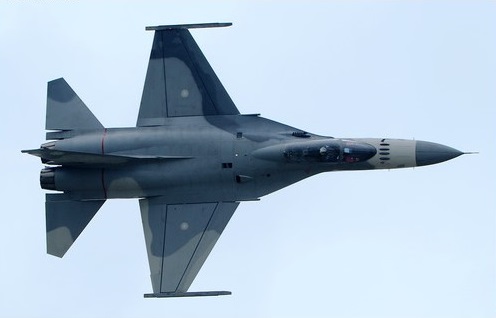
With development and design by AIDC begun in 1975, with assistance from Northrop, the first XAT-3 prototype flew on September 16, 1980. The aircraft is a twin-turbofan tandem-seat trainer with an unswept wing of supercritical section. Power is from two Garrett TFE731 engines, each giving 15.57kN thrust. For weapons training and light attack duties a semi-recessed gun pack with twin 0.5in machine-guns can be installed in a weapons bay beneath the rear cockpit, and external stores can be carried on four under-wing and one under fuselage hardpoints. Wingtip launch rails for AIM-9J Sidewinders are provided. Total external weapons avaiable load is 2,720kg (6,000lb). An A/A37U-15TTS aerial target system can be carried on the centreline pylon.

AIDC AT-TC-3 Tse Tchan / AT-3 Article

Deliveries of the AT-TC-3 to the Republic of China Air Force began in March 1984, and more than 50 were on order for use as basic and advanced trainers, replacing the Lockheed T-33 trainers. Production aircraft totaling 60 were delivered from 1984 through 1990.

AIDC AT-3A Tzu-Chiang
Engine: 2 x Garrett (Honeywell) TFE731-1-2L turbofan, 3,500lbs
Length: 42.32ft (12.9m)
Wingspan: 34.32ft (10.46m)
Height: 14.30ft (4.36m)
Wing area: 235.732 sq.ft / 21.9 sq.m
Empty Weight: 17,505lbs (7,940kg)
Maximum Speed: 562mph (904kmh; 488kts)
Cruising speed: 476 kt / 882 km/h
Landing speed: 90 kt / 167 km/h
Maximum Range: 1,417miles (2,280km)
Rate-of-Climb: 10,100ft/min (3,078m/min)
Service Ceiling: 48,064ft (14,650m)
Armament:
2 x 12.7mm semi-recessed gun packs in internal weapons bay (optional), 1900kg ext
Hardpoints: 6
Accommodation: 2

AT¬-TC-3
Engine: 2 x Garrett TFE731
Installed thrust: 31.1 kN
Span: 10.5 m
Length: 12.5 m
Wing area: 21.9 sq.m
Empty wt: 3855 kg
MTOW: 7485 kg
Warload: 2270 kg
Max speed: 900 kph
Initial ROC: 2440 m/min.
Ceiling: 14,600 m
T/O run: 458 m
Ldg run: 671 m
Fuel internal: 1630 lt
Range: 2297 km
Endurance: 3.2 hr
Hardpoints: 5+2 wingtip
Armament: 1 x .5 in, 2 x AAM.