Airco DH 2

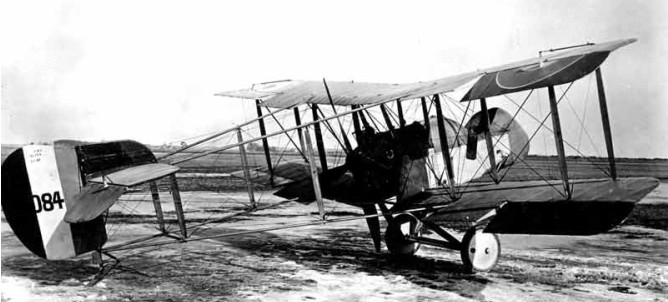
A conventional two ¬bay biplane of pusher configuration, the fuselage was curved along the front and top surfaces with slab sides and a flat underside – and held the armament, pilot, controls, fuel and engine. The pilot sat in an open-air cockpit “tub”. A single machine gun was fitted to the front of the fuselage. Fuel was held directly aft of the pilot in one tank, and ahead of the engine, the latter mounted to the extreme end of the fuselage rear with a two-blade wooden propeller. Wings were in a two-bay with parallel struts additionally held by cabling. Both upper and lower wings sported slight dihedral. The empennage tapered off to become a single vertical tail fin with a high-mounted horizontal plane affixed. The undercarriage was fixed in place and featured two large main landing gear wheels attached to the fuselage underside. The rear of the aircraft was supported by a simple tail skid.

Armament consisted of a single semi-trainable .303 Lewis type machine gun fed by a 47-round drum magazine. The machine gun could be mounted within three pre-set positions, allowing the pilot to fix the weapon at advantageous angles of fire. This proved highly impractical once in action. These three pre-set positions became largely ignored as most pilots soon learned to fix the machine gun in place and aim the entire aircraft at the intended target instead. Major Lance Hawker produced a fixed clip and even revised the gunsight for improved accuracy by allowing for leading of the target. Once enacted, the new clip and gunsight – along with the fixed machine gun – lessened the pilot’s workload substantially.

The prototype first flying in 1915, it began powered by a 100 hp Gnome Monosoupape engine. After trials in Britain, the prototype was issued to No 5 squadron RFC in France for further testing by July of 1915, but was destroyed following enemy action on August 9, 1915.

The D.H.2 was considered worthy of series production and initial deliveries began in late 1915 to No 24 Squadron, which was sent to France in February 1916 with 12 D.H.2s as the first ever British squadron to be equipped with single seat fighters.

With its small speed range and sensitive controls the D.H.2 caused some handling problems for pilots initially, but it was accepted as a highly manoeuvrable little fighter.
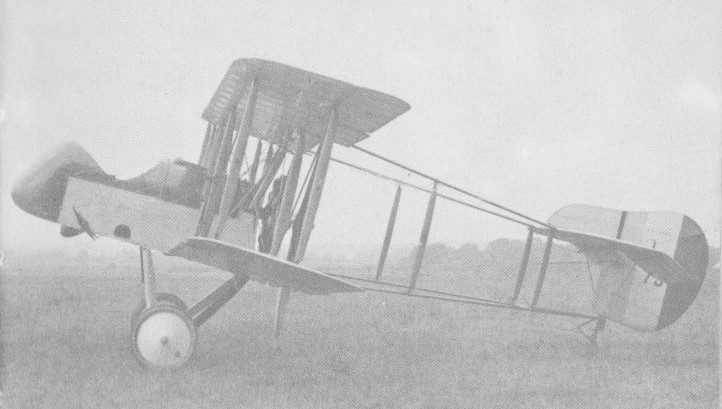
Modifications were made to the nose of the nacelle; the ammunition was carried in drums on external racks on each side of the cockpit; and the revised fuel system comprised a gravity tank fitted either under or on top of the upper mainplane on the port side. Production models retained the Gnome engine, as comparative trials with a 110 hp Le Rhone 9J powerplant revealed that this gave an inferior performance.

At least one DH.2 fell to German guns, but within time, she formed the ranks of No. 24 Squadron who first netted an aerial victory with a DH.2 on April 2nd, 1916. The DH.2 essentially became the Royal Flying Corps (RFC) first “true” dedicated fighter platform.

The first Imperial German Monoplane was downed by a DH.2 on April 25th, 1916. In June alone, DH.2 pilots racked up a further 17 enemy aircraft. A further 15 were counted in August and another 15 were netted in September. Ten more enemy aircraft were tallied in November.

Along the Western Front, the DH.2 had met her match by the new breed of German and Austro-Hungarian fighter by December 1916. On December 20th, 1916, five out of six DH.2s were lost in one aerial fight against just five Albatros D.III series fighters. Phasing out of the D.H.2 began in France in March 1917, though D.H.2s serving in Palestine with No 11 Squadron, and with No 47 Squadron and a joint RFC/RNAS squadron in Macedonia, had a slightly longer service life. Two were evaluated at Home Defence stations in Britain in 1917 but were unable to cope with the Zeppelin raiders.

No fewer than 100 DH.2s were retained on the British mainland to help train a new generation of fighter pilot, where they served until 1918. By the fall of 1918, the DH.2 was officially retired from any active service with the RFC.

The RFC remained the sole operator of the DH.2. She served within squadrons No.5, No.11, No.17, No.18, No.24, No.29, No.32, No.41, No.47 and No.111.

In total 453 D.H.2 were built.
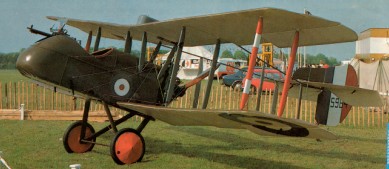
Replica:
Mason DH 2

Airco DH.2
Engine: 1 x Gnome Monosoupape, 100hp
Wing span: 8.61 m / 28 ft 3 in
Length: 7.68m / 25 ft 2½ in
Height: 2.91 m / 9 ft 6½ in
Wing area: 23.13 sq.m / 249 sq.ft
Empty weight: 423 kg / 943 1b
Loaded weight: 654 kg / 1,441 lb
Fuel capacity: 26.3 gallon
Maximum level speed at sea level: 150 km/h / 93 mph / 81 kt
Maximum Range: 249 miles / 400km
Endurance: 2 hours 45 minutes
Rate-of-Climb: 545ft/min / 166m/min
Climb to 1830m /6,000ft: 11 minutes
Service Ceiling: 14,000 ft / 4270 m
Armament: 1 x 7.62mm forward-firing Lewis machine gun on flexible mount.
Crew: 1
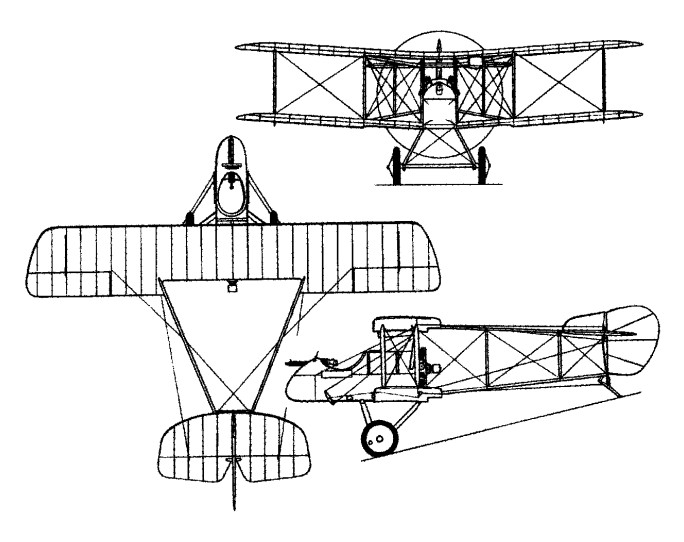
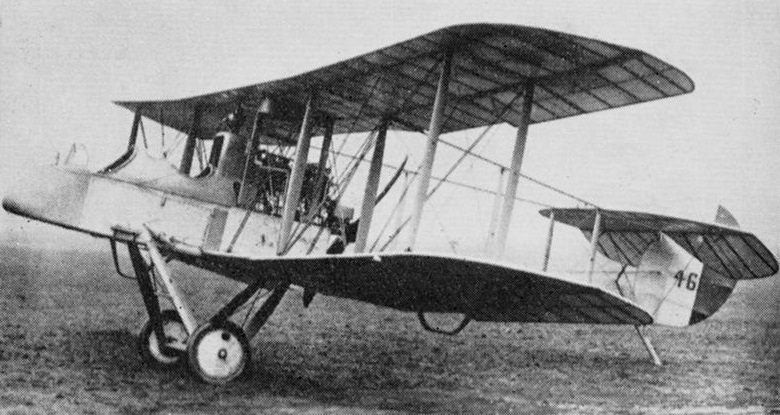
Airco DH.2
Engine: 1 x Le Rhone 9J, 110 hp
Wing span: 8.61 m / 28 ft 3 in
Length: 7.68m / 25 ft 2½ in
Height: 2.91 m / 9 ft 6½ in
Wing area: 23.13 sq.m / 249 sq.ft
Empty weight: 455 kg / 1004 1b
Loaded weight: 702 kg / 1547 lb
Maximum level speed at sea level: 143 km/h / 92 mph
Maximum Range: 249 miles / 400km
Endurance: 2 hours 45 minutes
Rate-of-Climb: 545ft/min / 166m/min
Climb to 1830m /6,000ft: 11 minutes
Service Ceiling: 14,000 ft / 4270 m
Armament: 1 x 7.62mm forward-firing Lewis machine gun on flexible mount.
Crew: 1

Airco DH.2
Engine: 1 x Clerget 9Z, 110 hp
Wing span: 8.61 m / 28 ft 3 in
Length: 7.68m / 25 ft 2½ in
Height: 2.91 m / 9 ft 6½ in
Wing area: 23.13 sq.m / 249 sq.ft
Empty weight: 428 kg / 943 1b
Maximum take-off weight: 654 kg / 1,441lb
Maximum level speed at sea level: 150 km/h / 93 mph / 81 kt
Maximum Range: 249 miles / 400km
Endurance: 2 hours 45 minutes
Rate-of-Climb: 545ft/min / 166m/min
Climb to 1830m /6,000ft: 11 minutes
Service Ceiling: 14,000 ft / 4270 m
Armament: 1 x 7.62mm forward-firing Lewis machine gun on flexible mount.
Crew: 1

Airco DH 1

Geoffrey de Havilland was hired by the Airco firm in June of 1914 as lead designer and began developing the Airco “DH.1”. The DH.1 was a two-seat reconnaissance scout biplane fitted with a water-cooled inline engine in a “pusher” arrangement.

Geoffrey de Havilland piloted the prototype DH 1 fighter and reconnaissance aircraft on its first flight in early 1915. A two seat pusher biplane with the observer in the front cockpit, which also housed a forward firing machine gun, the DH 1 was powered by a 70 hp Renault engine, instead of the originally specified 120 hp Beardmore powerplant and the War Office ordered 49 examples. Appearing at the beginning of 1915, it was tested by Geoffrey de Havilland. Airco was fully committed to building Farman aircraft and employed a sub-contractor, Savages Ltd of Kings Lynn, but because of their inexperience, production of the DH.1 was delayed. An order for 100 was placed with Savages of Kings Lynn and production models differed from the prototype in having dual controls, a modified nacelle, reinforced brac¬ing wires and a simplified undercarriage.

Beardmore engines eventually became more plentiful and with this engine the type was designated DH.1A. With an all up weight increase of nearly 136 kg (300 lb), including a 10% additional fuel load, it was 13 km/h (8 mph) faster than the DH 1 and had a more rapid rate of climb.

At the end of 1915, the first five DH.1s off the production line had been alloated to training units. The remainder of the first batch were fitted with the 120 hp Beardmore and re-designated DH.1a.

Six DH.1a from the first batch saw service in the Middle East, and a further 44 were assigned to Home Defence units. No 14 Squadron had six DH1As which were operational in Palestine from the summer of 1916 on escort duty. The second batch of 49 was again built by Savages Ltd, but only 73 of the total number saw service with RFC units. Some survived in Britain until 1918, but all had been withdrawn from service before the Armis¬tice.

DH 1
Engine: Renault, 70hp
Span: 12.50 m / 41 ft 0 in
Length: 8.82 m / 28 ft 11.25 in
Height: 3.4 m / 11 ft 2 in
Empty weight: 615 kg / 1354 lb
Loaded weight: 927 kg / 2044 lb
Maximum speed: 132 km/h / 80 mph
Ceiling: 4114 m / 13,500 ft
Endurance: 4 hr

DH 1A
Engine: Beardmore, 120hp
Span: 12.50 m / 41 ft 0 in
Length: 8.82 m / 28 ft 11.25 in
Height: 3.4 m / 11 ft 2 in
Empty weight: 1610 lb / 730 kg
Loaded weight: 2340 lb / 1061 kg
Maximum speed: 144 km/h / 90 mph
Ceiling: 4114 m / 13,500 ft
Endurance: 4 hr

DH 1A
Engine: Austro-Daimler, 120hp
Span: 12.50 m / 41 ft 0 in
Length: 8.82 m / 28 ft 11.25 in
Height: 3.4 m / 11 ft 2 in
Empty weight: 1610 lb / 730 kg
Loaded weight: 2340 lb / 1061 kg
Maximum speed: 144 km/h / 90 mph
Ceiling: 4114 m / 13,500 ft
Endurance: 4 hr

Aircraft Holding Corp Murray-Atlas

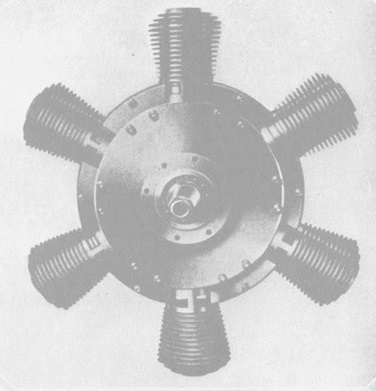
The Murray-Atlas is a 1920s eight cylinder fixed radial, air cooled two stroke aero engine. The cylinders are clamped between the two halves of the crankcase eliminating hold down bolts.

The pistons and cylinder heads can be scraped of carbon through the exhausts without dismantling the engine.

The Murray-Atlas supercharger has variable pressure of 1.5 to 10 /b/sq.in.

A starter and propeller hub were available at extra cost.

Rating: 120 hp at 1400 rpm
Displacement: 646 cu.in
Compression ratio: 6/1
Bore: 4 3/8 in
Stroke: 5 3/8 in
Diameter: 36 in
Length: 26 in
Weight: 260 lb
Fuel consumption: not more than .065 lb/hp/hr
Oil consumption: not more than .04 lb/hp/hr
Lubrication: Force feed, 3 outlet pump; scavenger pump
Ignition: Dual Scintilla
Carburation: Zenith
Spark plugs: 2 per cylinder Bosch
Price: $2700

Aircraft Holding Corp Murray-Ajax

The Murray-Ajax is a 1920s six cylinder fixed radial, air cooled two stroke aero engine. The cylinders are clamped between the two halves of the crankcase eliminating hold down bolts.

The pistons and cylinder heads can be scraped of carbon through the exhausts without dismantling the engine.

The Murray-Ajax supercharger has variable pressure of 1.5 to 10 /b/sq.in.

A starter and propeller hub were available at extra cost.

Rating: 80 hp at 1400 rpm
Displacement: 484 cu.in
Compression ratio: 6-1
Bore: 4 3/8 in
Stroke: 5 3/8 in
Diameter: 36 in
Length: 26 in
Weight: 210 lb
Fuel consumption: not more than .065 lb/hp/hr
Oil consumption: not more than .04 lb/hp/hr
Lubrication: Force feed, 3 outlet pump; scavenger pump
Ignition: Dual Scintilla
Carburation: Zenith
Spark plugs: 2 per cylinder Bosch
Price: $1800

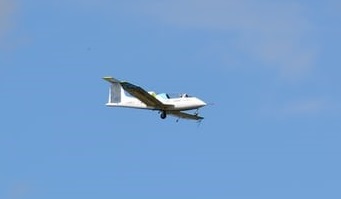
Airbus Industries E-Fan

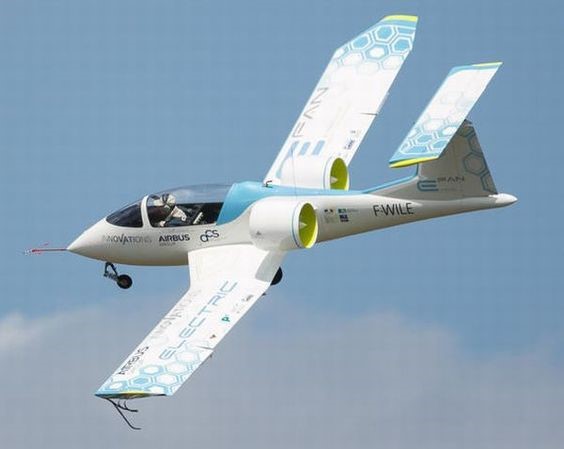
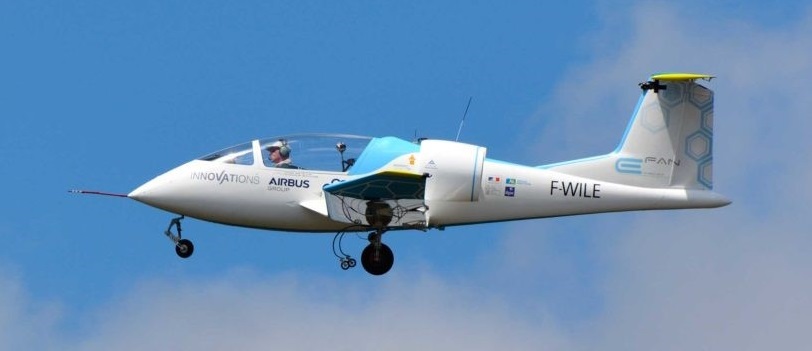
Airbus Group is developing an electric aircraft designed by Didier Esteyne, with Aero Composites Saintonge. The aircraft uses on-board lithium batteries to power the two electric motors and can carry one pilot and one passenger. First flown on 11 March 2014, a test flight was conducted in April 2014 at Mérignac Airport, France, landing in front of a large audience, the French Minister of Industry Arnaud Montebourg being one of them. At the 2014 Farnborough Airshow, Airbus announced that the E-Fan 2.0 will go into production by 2017 with a side-by-side seating layout.

The E-Fan aircraft was developed by Airbus Group in association with other consortium partners. The core development team consisted of ACS, EADS Innovation Works, Astrium, Eurocopter (now part of Airbus Group). EADS Innovation Works provided the overall project management and overall aircraft energy management system, while ACS provided support in the construction of all composite parts and mechanical assembly of the landing gear and flight controls.

Institut Pprime provided support for the design of the aircraft main spar and the wing. A3IP provided design, routing, prototyping and manufacture support in the production of tailor-made printed circuit boards for electrical networks. RF Tronic Ingénierie provided design and integration of the air-to-ground telemetry system and the flight data recorder, and also developed a software to display the technical flight parameters.

C3 Technologies provided spars and wings, while MAPAERO Aerospace Coatings provided high-quality paint for the aircraft. The propulsion systems were provided by Safran, Snecma, Labinal Power Systems and Aircelle.

The project evolved from the Cri-Cri electric plane, which Airbus used as a test bed and flying laboratory for developing the battery and energy management technology used in the E-Fan.

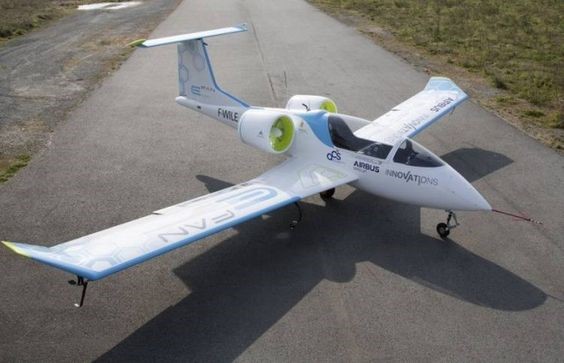
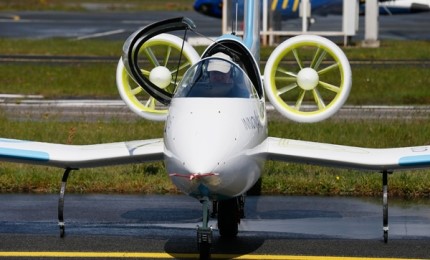
The E-Fan is an all-electric two-seat twin-motor low-wing monoplane of composite material structure. It has a T-tail and a retractable tandem landing gear with outrigger wheels. The two motors are mounted on either side of the rear fuselage.

Two production variants are planned, a two-seater E-Fan 2.0 for use as a trainer, and the E-Fan 4.0 four-seater. The E-Fan 4.0 appears identical to the E-Fan apart from a fuselage stretch. To increase flight duration the E-Fan 4.0 will have a hybrid-electric system that will have a small engine to charge the battery (like a range extender), which will increase its duration from 2 hours to 3.5 hours. First flight of the E-Fan 2.0 was planned for 2017 and the E-Fan 4.0 should follow in 2019.

The E-fan is of all-composite construction and is propelled by two ducted, variable-pitch fans spun by two electric motors totaling 60 kW of power. Ducting increases thrust while reducing noise, and having the fans mounted centrally provides better control. The motors moving the fans are powered by a series of 250-volt Lithium polymer battery packs made by South Korean company Kokam. The batteries are mounted in the inboard section of the wings. They have enough power for one hour and take one hour to recharge. An onboard backup battery is available to make an emergency landing if power runs out while airborne. The E-fan’s landing gear consists of a retractable fore and aft wheel, and a fixed wheel under the wings. Unusually for an aircraft, the main wheel is powered by a 6 kW electric motor, which allows the plane to be taxied without the main motors, and is able to accelerate it to 60 km/h (37 mph; 32 kn) for takeoffs. Having the takeoff run performed by the undercarriage relieves some of the burden on the flight motors.

A key technology on the E-Fan is its E-FADEC energy management system, which automatically handles the electrical systems. According to Airbus, this simplifies system controls and, since E-Fan is a trainer, eases the workload of instructors and students.

In December 2014 Airbus announced that DAHER-SOCATA will complete the design work on the aircraft and certify it. VoltAir, an Airbus subsidiary, developed the initial prototype and will work with Daher-Socata during the testing phase as the project manager. At this point the aircraft became the VoltAir E-Fan. BpiFrance Public Investment Bank will partially provide finance for the development.

On 30 April 2015 the company announced that the aircraft will be produced at Pau Pyrénées Airport, south-west France, at a new facility to be constructed in 2016, that will be near the DAHER-SOCATA plant at Tarbes. First deliveries were expected at the end of 2017 or early 2018.

On 9 July 2015, the E-Fan crossed the English Channel from Lydd Airport to Calais–Dunkerque Airport. It was flown by Didier Esteyne, the chief engineer of the E-Fan. Initially this was claimed as the first electric aircraft to cross the English Channel, but it has since been pointed out that there were previous such flights, including MacCready Solar Challenger as long ago as 1981, and Airbus now say it was the “first all-electric two-engine aircraft” to make the crossing. Siemens has sponsored electric equipment on the E-fan, but not motors.

In March 2017 Airbus abandoned its plan to produce the electric E-Fan two-seater as a ready-for-sale training aircraft. The French company says the pace of development in the electric aircraft field has moved its ambitions onwards. Stefan Schaffrath, media spokesman for Airbus, said “This plane has done its job. Today, a large part of the technologies developed for E-Fan is in new projects.”

Airbus points out that the E-Fan project started three years with two 30kW electric motors. Now Siemens, its partner in the project, is flying an Extra aerobatic aircraft with a 300kW electric motor, a progression of 10x in three years.

Variants

E-Fan
Two-seat concept aircraft ad technology demonstrator, first flown March 2014.
E-Fan 2.0
Proposed all-electric two-seat production variant, to fly 2017.
E-Fan 4.0
Proposed hybrid-electric four-seat variant, to fly 2019; a kerosene fuelled generator will extend endurance from 2 h to 3 h 30 min.
E-Thrust
Proposed 90-seat regional jet based on the principles of the E-Fan.

Specifications
E-Fan
Powerplant: 2 × Electric motor, 30 kW (40 hp)
Props: 2 x eight-blade ducted fans, 0.75 kN (266 lb st), thrust
Battery: Lithium-ion 18650, with 207 Wh/kg per cel, total of 29 kWh
Battery weight: 167 kg
Wingspan: 9.50 m (31 ft 2 in)
Length: 6.67 m (21 ft 11 in)
Max takeoff weight: 550 kg (1,213 lb)
Maximum speed est: 220 km/h (137 mph; 119 kn)
Cruising speed est: 160 km/h (99 mph; 86 kn)
Take-off speed: 110km/h
Endurance: 45 min – 1 hr
Lift-to-drag: 16:1
Crew: one
Capacity: one passenger

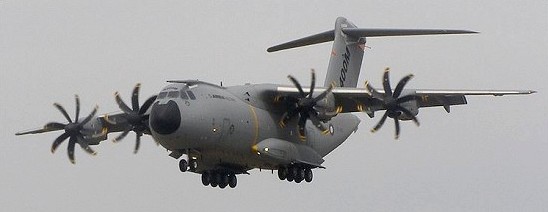
Airbus Industries A400M

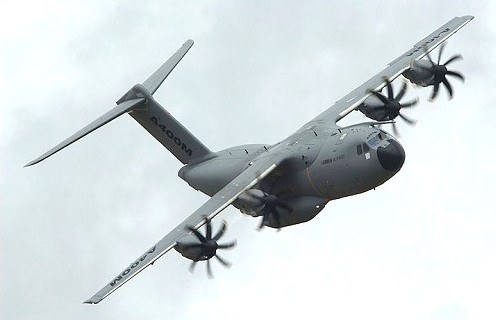
The Airbus A400M, also known as the Atlas, is a multi-national four-engine turboprop military transport aircraft. It was designed by Airbus Military as a tactical airlifter with strategic capabilities. The aircraft’s maiden flight, originally planned for 2008, took place on 11 December 2009 in Seville, Spain.

Gallery

Engines: 4 x 8250kW Europrop TP400-D6 turboprops
Wingspan: 42.4 m / 139 ft 1 in
Length: 45.1 m / 148 ft 12 in
Height: 14.7 m / 48 ft 3 in
Max Take-off weight: 141000 kg / 310853 lb
Empty weight: 76500 kg / 168655 lb
Payload: 37000kg / 81571 lb
Ceiling: 11300 m / 37050 ft
Range w30 tonne: 2450 nm
Range w20 tonne: 3550 nm
Crew: 3-4

A400M
Engines: 4 x Europrop TP400-D6 turboprops, 11,060 hp / 8250kW
Wingspan: 42.4 m / 139 ft 1 in
Length: 45.1 m / 148 ft 12 in
Height: 14.7 m / 48 ft 3 in
Max Take-off weight: 141000 kg / 310853 lb
Empty weight: 76500 kg / 168655 lb
Payload: 37000kg / 81571 lb
Maximum Speed: 485mph (780kmh; 421kts)
Ceiling: 11300 m / 37050 ft
Range w30 tonne: 2450 nm
Range w20 tonne: 3550 nm
Maximum Range: 5,412miles (8,710km)
Crew: 3-4

Airbus Industries A380

After years of research Airbus decided to proceed with the 8.8 billion A380 project in 1999, the final budget settling at about 12 billion. The double-decker layout would provide higher seat capacities and, hence, cost savings over a traditional design.

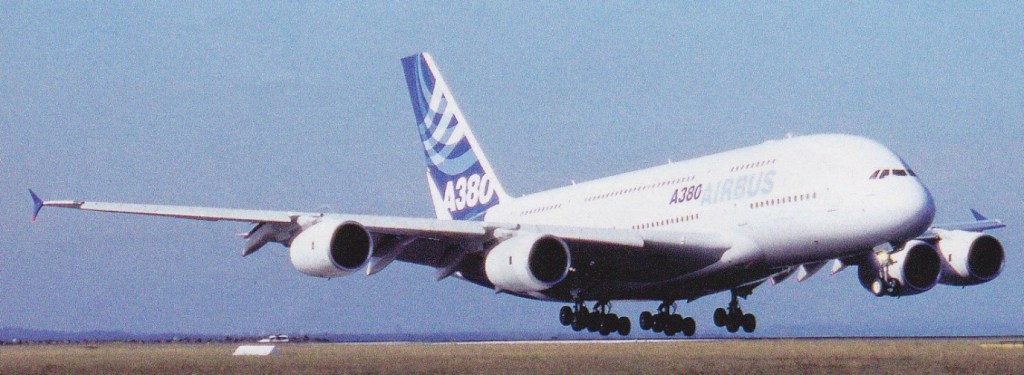
Originally known as the A3XX, the A380 is a double-deck, four-engined airliner. Airbus began engineering development work in June 1994 with key design aims including the ability to use existing airport infrastructure with little modifications to the airports, and direct operating costs per seat 15-20% less than those for the 747-400. With 49% more floor space and only 35% more seating than the previous largest aircraft, Airbus is ensuring wider seats and aisles for more passenger comfort. Using the advanced technologies, the A380 is also designed to have 10-15% more range, lower fuel burn and emissions, and less noise.

Airbus A380 Articles

The A380’s wing has been designed to cope with a MTOW of 590t, albeit with some strenghtening required, allowing for a future stretch. The stronger wing and structure is used on today’s freighter version, the A380-800F. This approach sacrifices some fuel efficiency on the initial passenger model but the sheer size of the aircraft coupled with the significant advances in technology over the years should provide lower operating costs per passenger than the 747.

With orders and options from nine customers (Air France, Emirates (the first customer), Federal Express (the cargo model launch customer), International Lease Finance Corporation, Lufthansa, Qantas, Qatar Airways, Singapore Airlines, and Virgin Atlantic), the Airbus A380 was officially launched on December 19, 2000, and production started on January 23, 2002.

The upper deck extends the entire length of the fuselage allowing for a three-class configuration to seat 555 people, up to maximum of 853 in full economy class configuration. Airbus made the cockpit layout, procedures, and handling characteristics similar to those of other Airbus aircraft to reduce crew training costs. Accordingly, the A380 features a glass cockpit and side-stick flight controller driving the airplane by fly-by-wire technology.

Airbus operates 16 manufacturing sites across Europe, most of which produce parts for the new A380 airliner. First, the front and rear sections of the fuselage are loaded on an Airbus RORO ship, Ville de Bordeaux, in Hamburg, northern Germany, and are shipped to the United Kingdom. There the huge wings, which are manufactured at Filton in Bristol and Broughton in north Wales, are transported by barge to Mostyn docks where the ship adds them to its cargo. In Saint-Nazaire, western France, the ship trades the fuselage sections from Hamburg for larger, assembled sections, some of which include the nose. The ship unloads in Bordeaux. Afterwards, the ship picks up the belly and tail sections in Cadiz, southern Spain, and delivers them to Bordeaux.

From there the A380 parts are transported by barge to Langon, and by road to an assembly hall in Toulouse. New wider roads, extra canal systems, and barges were developed to deliver the massive A380 parts. After assembly the aircraft are flown to Hamburg to be furnished and painted. Final assembly began in 2004, with first aircraft (MSN001) displayed in January 2005. The first A380 prototype was unveiled during a ceremony in Toulouse, on January 18, 2005. Its manufacturer’s serial number is 001, and is registered as F-WWOW.

The airliner took off for its maiden flight at 8:29 UTC (10:29 a.m. local time) on April 27, 2005, from runway 32L of Blagnac International Airport in Toulouse, France, taking off with a flight crew of six, 22 tons of flight test instrumentation and water ballasts.

The crew was made up of French test pilots Jacques Rosay (captain for the take-off and the initial part of the test flight) and Claude Lelaie (captain for the second part of the test flight including the landing), as well as three flight test engineers (Spanish, French, and German), and one French test flight engineer. With the recent Franco-German controversy over the leadership of EADS still fresh in mind, Airbus issued a statement to make it clear that the crew had been chosen not based on nationality, but based on competence.

The takeoff weight of the aircraft was 421 tonnes (464 US tons), or about 75 % of its maximum takeoff weight for commercial flights. This was the heaviest takeoff weight of any passenger airliner ever created. After takeoff the jet headed west toward the Bay of Biscay, then south over the northern Pyrenees Mountains and concluded with a low altitude fly-by over the town of Toulouse. The 233 minute flight involved conducting tests on its engines, hydraulics, and electronics, while the on-board test equipment recorded measurements for 150,000 different parameters and sent data back to computers on the ground.

The A380 was powered by Rolls-Royce Trent 900 engines and by mid-October 2005 had logged more than 100 flights and 350 hours in the air.

The second A380 first flew on 18 October 2005 followed by the third on 3 November.

The A380-800 has a maximum range of 15,000km (sufficient to fly from Chicago to Sydney nonstop), and a cruising speed of 1,050km/h.

The first A380 was revealed to the world in front of 4500 guests at Toulouse on 18 January 2005, dignitaries including the British and Spanish Prime Ministers, French President and German Chancellor.

In March 2006 Airbus successfully completed a passenger evacuation test of the A380 with 853 passengers, two pilots and 18 cabin crew evacuating an aircraft well within the required 90 seconds. The test was conducted in darkness and with half of the doors inoperative. The doors were not known in advance.

The Airbus A380 reached 1000 flying hours, the first aircraft reaching the milestone during a flight test on 27 April 2006. In December 2006 the A380 was awarded joint US and European certification.

Sixteen airlines had ordered the A380 as of June 18, 2005, including an order from AIG’s aircraft leasing unit, ILFC. A380 orders standing at 159, included 27 freighter versions. Break-even was estimated to be at 250 to 300 units. Airbus CEO, Noel Forgeard, had said he expected to sell 750 of the aircraft. Official prices have been withheld but it was estimated at $264 million.

Interestingly, the A380’s horizontal stabilizer measures 30.4 meters (100 feet), during takeoff the A380 wings flex upward by more than 4 meters (13 feet), and the external paint (primer and topcoat) on an A380 weighs 531 kg (1,171 lbs).

A380 F-WXXL cn002 at Sydney November 2006 after non-stop route proving from Johannesburg via the South Pole.

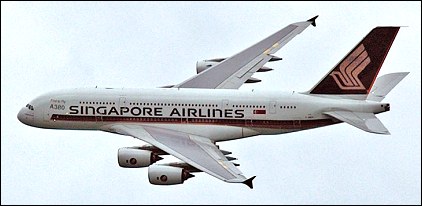
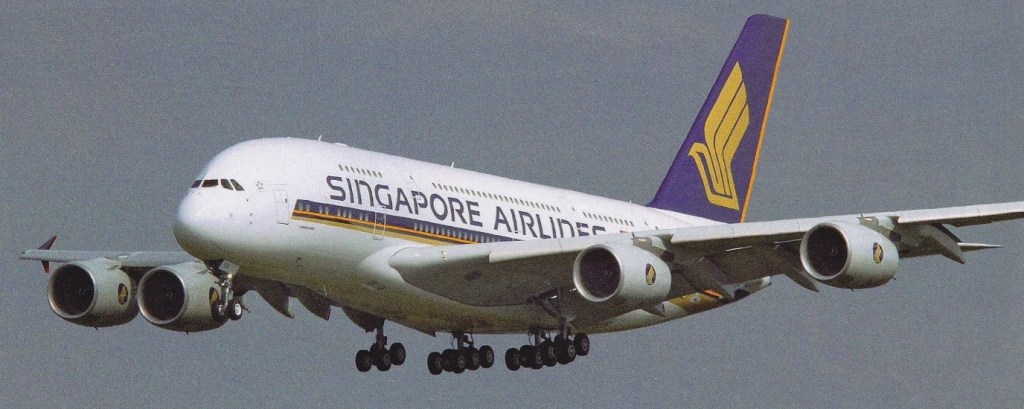
The first A380 commercial service was flown on 25 October 2007 with Singapore Airlines 9V-SKA.

First commercial flight

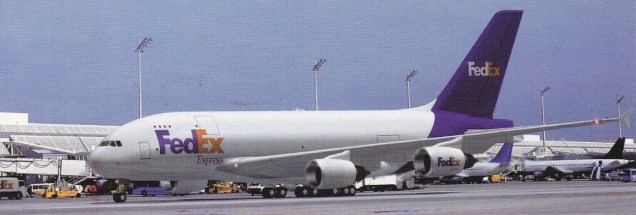
As launch customer for the A380-800F FedEx Express was to take delivery of three aircraft each in 2008, 2009 and 2010 followed by one in 2011.

After producing 251 A380s, production ended in 2021.

Gallery

A380-800
Engines: 4 x Engine Alliance GP7270 or Rolls-Royce Trent 970/B turbofan, 72,000-84,000lb thrust
Wing span: 79.8m / 261ft 10in
Length: 73m / 239ft 6in
Height: 24,1 m / 79ft 1in
Operating weight empty: 275,000kg / 606,000lb
Maximum Take-Off Weight: 1,234,589lbs (560,000kg)
Maximum Speed: 634mph (1,020kmh; 551kts)
Max cruising speed: M 0.88 / 903 kmh / 561 mph
Long range cruising speed M 0.85
Maximum Range: 9,445miles (15,200km)
Initial climb rate: 2,300 fpm
Service Ceiling: 43,028ft (13,115m)
Seats: 555
Cargo capacity: 38 LD3s or 13 pallets.
Crew: 2

A380-800HGW
Max takeoff weight: 560,000kg / 1,235,000lb
Max cruising speed M 0.88
Long range cruising speed M 0.85
Range 15,100km / 8,150nm
Service ceiling: FL430
Crew: 2

A380-800F
Engines: 4 x GE-P&W GP7000