A major European car ferry operator financed the development of the British Thermo Skyship, a saucer shaped airship using helium and super heated air for lift and ducted thrust from turbofan engines for vertical take off and landing and for cruise flight. A 9.14 m (30 ft) diameter model of the ship has flown, from which will be developed a Skyship car ferry capable of carrying 60 passengers and their cars from England to France at 165 kph (103 mph), and 152 and 508 tonne (150 and 500 ton) cargo carrying saucers.
Engines – Power
Airship Club Bournemouth
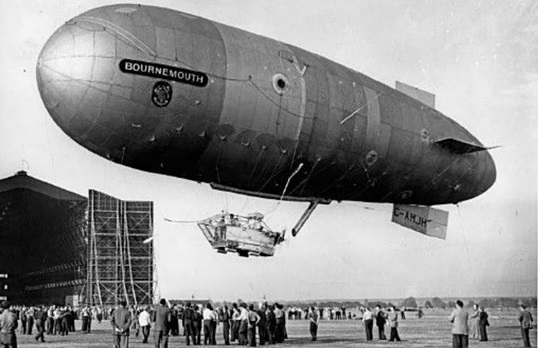
The “Bournemouth” was constructed by the Airship Club launched in 1951. As part of the club, Lord Ventry, Squadron Leader T.P. York-Moore and a small group of enthusiasts wanted to prove that airships could still return after the closure of the British Airship programme in 1932.
Plans were drawn up at Lord Ventry’s Poole home, Lindsay Hall. The little band founded the Airship Club of Great Britain, which they established at Wharncliffe Road, Boscombe. Their premises were formally opened early in 1951 by the Mayor of Bournemouth, Councillor Sydney Thompson. Numerous airship notables lent their support, including former Farnborough superintendent and engineer Major-General Sir John Capper, who had held the first British airship pilot’s licence ever issued. Past head of the Zeppelin company, Dr Hugo Eckener, also joined the club, together with several old airship hands.
The project was funded largely by private enthusiasm, however the Bournemout Corporation made a substantial grant from it’s “Festival of Britain” funds to assist with the completion of the craft and for it’s first flight. This is how the British south coast resort managed to have an airship named after it. The idea being that the completed ship would play a part in the local celebrations of the Festival of Britain year.
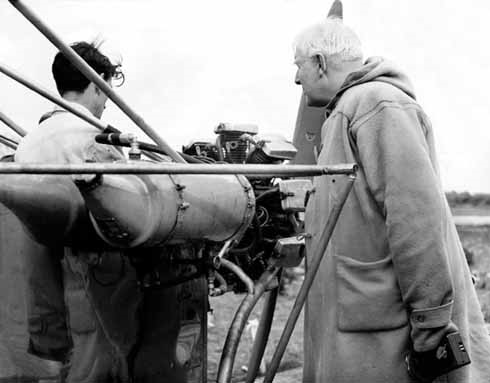
The first airship built in Britain since 1929, the Airship Club built their airship using a gas-bag converted from an old barrage balloon left over from the war. Acquired from the Air Ministry, it set them back £25. The finished airship’s length was just over a hundred feet. Hydrogen was used to inflate her gas-bag and provide lift; although helium was a far safer, non-inflammable gas, none was available. To power the craft through the skies a seventy horse-power Salmson engine from the 1930s was found, and with this it was hoped to achieve a flat-out speed of 35 mph. Suspended beneath the gas-bag by steel cables, the gondola in which pilot and passengers would travel was built from aircraft-gauge steel tube, with a covering of light alloy sheet and clear perspex. The engine was positioned at the rear, a small fuel tank sat on the roof, and four intrepid flyers could be carried.
Although the craft was constructed at Hurn Airport, her hangar there was not available long-term. Drawing on his experience, though, Lord Ventry assured a curious reporter from Flight Magazine that his airship could be safely picketed outside, ideally among trees to protect her from the wind. The plan for Bournemouth, as the craft had been christened, was that she be kept inflated and out-of-doors during all spells of operational activity – and for the flying Lord, this would be as often as possible. Assured by Lord Ventry that an airship is quite amenable to being tethered in the open, and that, with the aid of a protective screen of trees, a small non-rigid can safely ride out a 70 mph gale if properly picketed.
There was some confusion over who was actually allowed to pilot Bournemouth. The Ministry of Civil Aviation was clear on the qualifications for a full airship pilot’s licence, but unsure of the form a provisional licence should take. By 1950 trained airship flyers were very few; as things stood, just a handful of people would be permitted to take charge of Bournemouth, excluding most of the enthusiasts who had helped build her. Meanwhile the government’s Air Registration Board was pondering the safety requirements she should meet, and how to issue a Certificate of Airworthiness for an airship.
The ship was constructed at Cardington, and by mid-1951 the craft was complete, her engine tested in the Hurn workshop, the name and Bournemouth’s coat of arms painted on her gasbag. For flight trials, though, somewhere quieter than Hurn’s airspace was needed. Bournemouth was transported to an old hangar built especially for airships on an RAF base at Cardington in Bedfordshire. It was intended to bring her back to Bournemouth once tests were complete and various sites were considered as potential homes, among them King’s Park, where iron mooring stakes were set into the ground.
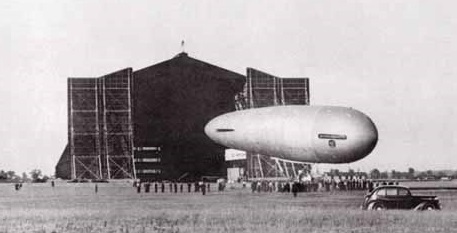
Red tape resolved, the airship received her Ministry registration, G-AMJH, which was painted on her fin. Two more helpers joined: engineers Arthur Bell and Joe Binks, both of whom had survived the 1930 R101 airship disaster. On 21 May, Empire Day, Bournemouth was inflated and it was hoped that the inaugural flight would be in time for Festival of Britain celebrations the following month. But the Salmson engine overheated and it was 19 July before a first flight was made.
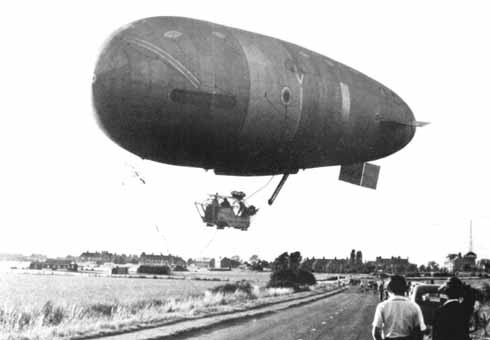
Lord Ventry was unable to ascend that day. With three crewmen he climbed aboard, but the machine refused to rise from the ground – he was simply too heavy. He removed duffle-coat and jacket and emptied his pockets but there was no improvement. Very reluctantly the Lord vacated his gondola, replaced by a slimmer man. He joined a small group of her builders who watched as Bournemouth made a decorous circuit of Cardington’s perimeter and returned safely.
The third flight was not overly successful as the ship crash landed on the hanger roof when a guy rope snagged when coming in to land. With Thomas York-Moore in command, Bournemouth crashed into a field near Cardington after suffering engine overheating and steering failure.
Having a gross lift 3,060lb and useful lift of 13,000lb, the Bournemouth managed three flights in 1951 and then put in for repairs and a chance for the improvements for stability following the crash landing. A further eight flights were managed in 1952. It was found that the first set of steering planes were too small and made her unstable and she had a top plane on the first two testing flights of in 1951, however this was removed. In 1952 a larger set of de Havilland planes were fitted and made the ship quiet controllable. Only eleven flights were made through lack of funds, the last flight made on 16th August 1952, Battle of Britain Day.
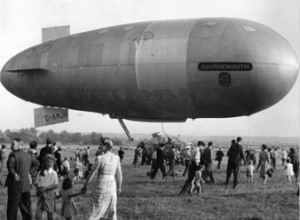
The first flight was shown in newsreels around the world and featured in many newspapers of the day. But Bournemouth’s flight had exposed tail-heaviness, together with steering problems. Following modifications, a second flight on 28 July was commanded by Thomas York-Moore. But again the engine grew too hot and to make matters worse, the steering-wheel mechanism failed. Bournemouth came down unexpectedly in a field near her hangar, but nobody was hurt. Adjusted once again, on 17 August she flew with Lord Ventry for the first time. After a 35-minute tour around the local area she returned to Cardington, although one crewman was hurt during her landing, which involved crashing onto the roof of the station’s gymnasium.
Following that episode Bournemouth was deflated. But repairs and more alterations were made and a Certificate of Airworthiness finally obtained. An ex-Bournemouth Royal Blue motor coach arrived, its job to provide a base for a mast to which the airship could moor.
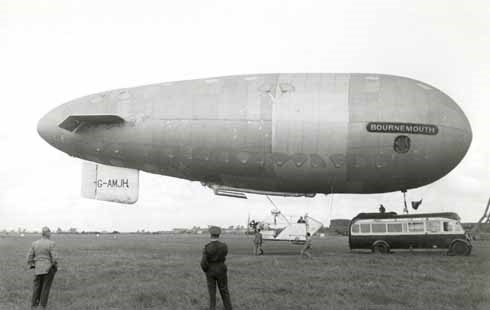
Winter weather interrupted but from spring 1952 several more flights took place. Dogged by incidents, an autumn accident on the ground caused permanent damage to Bournemouth’s gas-bag, which had to be scrapped. By then the Airship Club’s funds were low, and it was decided to wind up the scheme.
Engine: Salmson, 60hp
Length: 108 ft
Diameter: 27 ft
Volume: 45,000 cu.ft
AirScooter Corporation AirScooter

The 2007 AirScooter II is a coaxial design in a modern light-weight craft. By eliminating the need and complexity of swashplates, collective and cyclic control through a coaxial rotor design a number of benefits beyond conventional helicopter designs are immediately realized. First; enhanced, intuitive flight controls are achieved by simple motorcycle-style handlebars and the absence of a tail rotor. To gain altitude, simply throttle up like you would on a motorcycle, turn left or right on the handlebars for craft rotation and move the handlebar assembly as a joystick for directional control (including reverse). No pedal controls are necessary, which means someone without the use of their legs can just as easily fly the AirScooter. Handlebar controls represent the most distinguishable feature of the AirScooter. AirScooter’s patented design also provides an amazing level of stability while in the air and during flight.
The AirScooter falls into the ultralight weight class; requiring no pilot’s license. Weight has been overcome this obstacle by using composite materials.
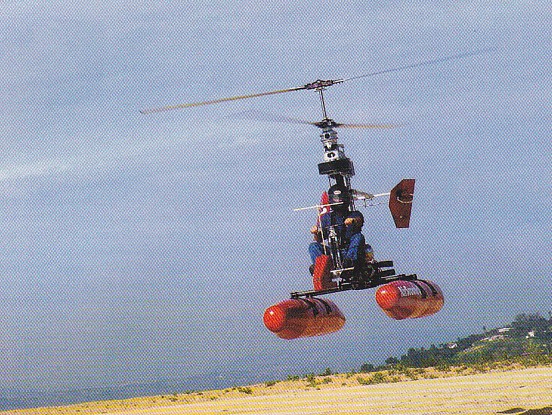
The AirScooter is not a kit. The AirScooter was planned to come completely assembled except for installation of the rotor blades and to include pneumatic floats instead of traditional helicopter skids. This feature further adds to the versatility of the AirScooter to get you wherever you want to go on land or swamp while providing a softer landing.
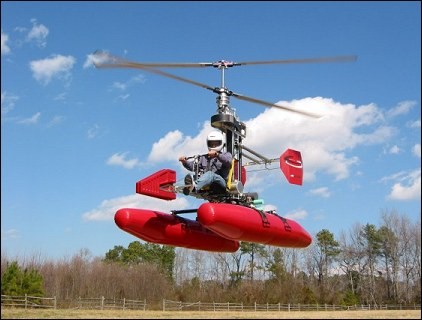
AirScooter II
Engine: 1 x 65hp AeroTwin four-stroke
Rotor diameter: 4.27m
Length: 3.81m
Height: 3.35m
Width: 2.13m
Useful load: 150kg
Max speed: 100km/h
Airplane Builders Air Master
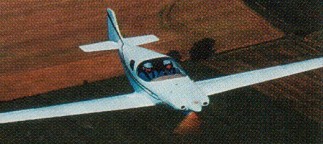
Engine: 160 hp
HP range: 150-200
Height: 6.5 ft
Length: 21 ft
Wing span: 26.5 ft
Wing area: 102.3 sq.ft
Weight empty: 1200 lb
Gross: 1885 lb
Fuel cap: 48 USG
Speed max: 300 mph
Cruise: 200 mph
Range: 1400 sm
Stall: 65 mph
ROC: 2500 fpm
Take-off dist: 1000 ft
Landing dist: 1500 ft
Seats: 2
Landing gear: retractable nose wheel
Airplane Development Corp V-1
Designed by Gerald Vultee, the V-1 was an eight-seat commercial transport, low-wing monoplane. Powered by a 700 hp Wright Cyclone, it had a maximum speed of 225mph (362kmh).
Airo Aviation Airo 5
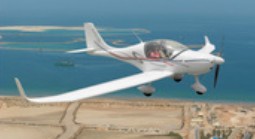
AIRO5 is a two-seat, single-engine, low-wing all-composite aeroplane. The fuselage is made mainly of carbon fibre laminate with sandwich construction. The wing is equipped with slotted flaps, electrically adjustable to 20° for take-off and 45° for landing. The wing is a monospar construction with a sandwich skin composed of two layers of fibreglass and foam. Control surfaces and Empennage is of the same construction.
The undercarriage is three-wheel with a steerable front wheel and braked main wheels.
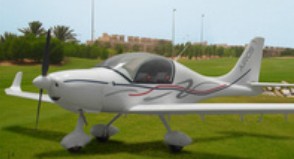
The main carriage legs consist of a laminate spring. Integrated fuel tanks (2 x 50 litres) are located in the wing leading edges. The plane may be equipped with a towing device for sail planes towing with maximum take-off weight of 650 kg. AIRO5 may be equipped with removable wing extensions (optional).
Airo 5 UL
Stall: 35 kt / 40 mph / 65 kmh
Cruise: 119 kt / 137 mph / 220 kmh
VNE: 146 kt / 168 mph / 270 kmh
Empty Weight: 292 kg / 644 lbs
MTOW Weight: 472 kg / 1041 lbs
Take-off distance (50ft obstacle): 490 ft / 150 m
Landing distance (50ft obstacle): 490 ft / 150 m
Airo 5 LSA
Stall: 35 kt / 40 mph / 64 kmh
Cruise: 117 kt / 135 mph / 217 kmh
VNE: 146 kt / 168 mph / 270 kmh
Empty Weight: 293 kg / 645 lbs
MTOW Weight: 600 kg / 1323 lbs
Take-off distance (50ft obstacle): 1610 ft / 490 m
Landing distance (50ft obstacle): 1610 ft / 490 m
Airo Aviation Airo 1
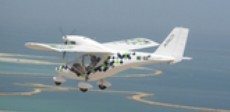
The AIRO1 UL is a light sport aircraft designed for sport/leisure flying, touring, training and aerial photography. With two seats side-by-side and ULSA certified, main structure is made of aluminium and steel with three-wheeled, shock-absorbed landing gear.
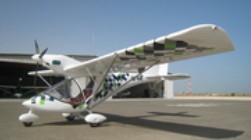
It is a high wing, single engine aircraft mounting powered by a Rotax 912, 4 stroke, 4 cylinders horizontally opposed with 2 constant depression carburettors. A two or three-bladed propeller is driven via an integrated gear box.
Airo 1 UL
Stall: 35 kt / 40 mph / 65 kmh
Cruise: 81 kt / 93 mph / 150 kmh
VNE: 89 kt / 102 mph / 164 kmh
Empty Weight: 297 kg / 655 lbs
MTOW Weight: 472 kg / 1041 lbs
Take-off distance (50ft obstacle): 490 ft / 150 m
Landing distance (50ft obstacle): 490 ft / 150 m
Airo1 LSA
Stall: 35 kt / 40 mph / 64 kmh
Cruise: 83 kt / 95 mph / 153 kmh
VNE: 109 kt / 125 mph / 201 kmh
Empty Weight: 297 kg / 655 lbs
MTOW Weight: 600 kg / 1323 lbs
Take-off distance (50ft obstacle): 1610 ft / 490 m
Landing distance (50ft obstacle): 1610 ft / 490 m
Air Nova Reed Falcon
A single-seat aerobatic biplane
Airmax Seamax
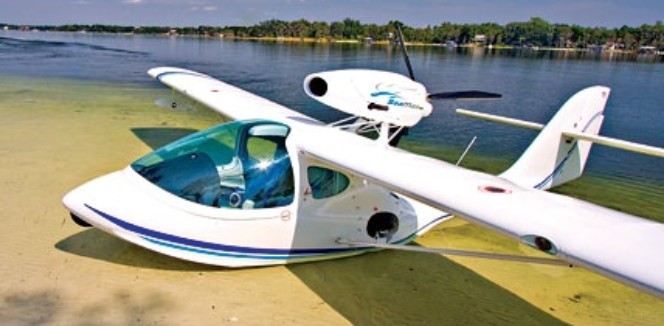
The SeaMax amphibian LSA / Ultralight take off and landing performance is equally good on grass, tarmac and sea. With electrically controlled landing gear retraction, flaps and trim rudders. The cabin is ergonomically designed with a panorama view due to the wing position behind the pilot.
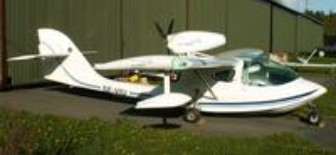
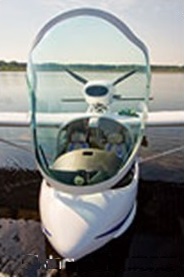
This Brazilian-built all-composite amphibian is Rotax powered. Base price 2012: US$150,000.
Stall: 31 kt / 36 mph / 58 kmh
Cruise: 113 kt / 130 mph / 209 kmh
VNE: 139 kt / 160 mph / 257 kmh
Empty Weight: 300 kg / 661 lbs
MTOW Weight: 520 kg / 1146 lbs
Climb Ratio: 1000 ft/min / 5 m/s
Endurance: 6h
Range: 540nm
Airmaster Inc
Founded 1980 to develop turboprop amphibians. Proof-of- concept Avalon 680 first flew 1983, but anticipated seven-seat Avalon Twin Star 1000 and military A-1200 Guardian were never flown.
1980: Airmaster Inc
pres: Lawrence Matanski,
Renton WA.
USA

