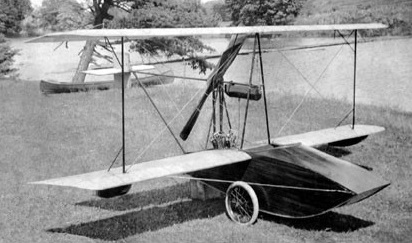
The “Model 1” designation was more symbolic as the ship was built before there was a Waco Company. Designed by Elwood J Junkin and Clayton J Brukner, the 1919 Baby Flying Boat had a mahogany veneer hull, demountable wheels for beaching, and a 6′ propeller.
Notably underpowered, with motor vibrations shaking the craft to an alarming degree, it would not unstick from the Lake Erie, so was retired to its room above a dance hall in Lorain OH, and none of the principals recalls its ultimate fate.
This effort led to the formation of DJB Aeroplane Co which was basis for Weaver Co the following year.
Broadsmith won the 1924 Low-Powered Aeroplane Competition with his design and the second prize was won by L. J. Wackett with his Warbler aircraft, powered by the Wizard engine, also designed by Wackett.
A 1928 five place low wing cabin monoplane powered by a 260hp Salmson “superposed radial”. First flown on 20 April 1928 as NC5246 c/n 51-C, the aircraft was put into storage in Oct 1920 at (Frank) O’Neal Aircraft Co, Vincennes IN, USA.
It was then acquired by O’Neal in a court sale on 2 October 1933 to satisfy a storage bill. It was sold on 15 October 1934 to Peter Soderling Jr, of Petersburg IN, who installed a 360hp Salmson and converted it to three place. The CAA cancelled the registration on 15 November 1937.
The 1941 Vultee-Stinson V-76 NX27772 was a modified Stinson 105 with a 185hp Lycoming O-435 engine. Designed by A P Fontaine, it was first flown on 28 June 1941, piloted by Al Schramm, it was equipped with full-span slots, which created a problem during testing with near-fatal results.
With modification to half-span slots and enlarged tail surfaces it became final prototype for the Stinson L-5.
The 1942 XBT-16 was BT-13A 41-9777 rebuilt with a plastic-impregnated plywood (Duramold) fuselage, tail section, and wing sections by Universal Products Corp, Bristol VA (aka Vidal Research Corp). A wartime experiment to replace vital aluminum with a less expensive material that didn’t prove too successful. It reportedly ended up heavier than the original metal-clad ship. Only one was built.
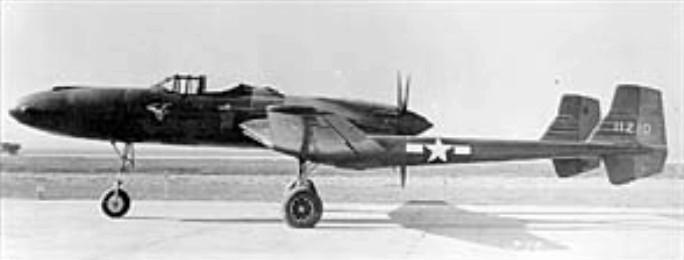
The XP-54, Vultee Model 70, was designed as a fast interceptor using the Pratt & Whitney X-1800-4AG engine. When the engine program was canceled, the aircraft was redesigned for the Lycoming XH-2470 and redesignated Vultee Model 84. With a pressurized cockpit, a pilot emergency ejection was downward, through a hole in the floor.
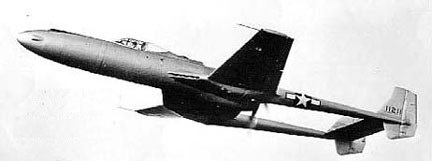
The first of two XP-54s built (S/N 41-1210) made its initial flight on 15 January 1943, piloted by Frank Davis, and flew 86 times before it was grounded by engine problems. The second aircraft (S/N 41-1211) flew only once, on 24 May 1944.
Vultee XP-54 – The only flight of 41-1211
The XP-54 nose section had a very unusual design feature. It tilted slightly upwards when firing its 37mm cannon to increase the firing range while the .50-cal. machine guns were tilted down at the same time. All had compensating gunsights.
Both were eventually scrapped.
XP-54 Span: 53 ft. 10 in. Length: 54 ft. 9 in. Height: 13 ft. 0 in. Weight: 15,262 lbs. empty/18,233 lbs. gross Armament: Two 37mm cannon and two .50-cal. machine guns Engine: Lycoming XH-2470 of 2,200 hp. Maximum speed: 381 mph. at 28,500 ft. Service ceiling: 37,000 ft. Range: 500 miles
The Vultee A-31 Vengeance dive-bomber was designed led by Richard Palmer to meet French air force requirements.
The RA-31 (Model V-72) export model (as prototype V-85) first flew on 30 March 1941 piloted by Vance Breese. There was a second prototype with twin tails, but pilot Vance Breese refused to fly after finding dangerous tendencies during taxi tests, and it was quickly modified with a single tail. It first flew (as Vengeance I) on 30 November 1941, piloted by Moye Stephens.
400 went to the RAF as Vengeance I/IA, subcontracted to Northrop Corp for production during 1941-42, of which 99 went to the RAAF, plus 300 to the USAAF as RA-31 in a special Restricted classification (41-30848 – 41-31047, and 41-31048 – 41-31147), the last batch of 100 built by Northrop; 300 to RAF as Vengeance II, plus 243 to USAAF with type re-designation as model 85 in 1942; 100 as Vengeance III, becoming Army A-31C, with subsequent production as A-35.
Vultee RA-31
The 1942 V-86 was a single place version of the A-31.
The XA-31A Model 85 of 1942 (42-35824) was a test-bed for the 3000hp P&W XR-4360 engine. It was re-designated XA-31B Model 86 for flight tests.
The A-31C of 1942 was t first production of the Vengeance III. One hundred were built; 41-30148 – 41-31147.
The XA-31C of 1942 was a test-bed for the 2200hp Wright R-3350 engine.
Five YA-31C were built in 1942 and went to Wright Field for testing of four-bladed props in the B-29 development program.
The A-35 Vengeance (Model 88) were A-31 for the USAAF, with similar data, but improved armament.
Vultee A-35A 41-31166
The 1942 A-35A were the second production of Vengeance III. Ninety-nine were built; 41-31148 – 42-31246.
781 A-35B of 1942 were built; 41-31247 – 41-31447, 42-94149 – 42-94548, and 42-101236 – 42-101465. Contradicting factory records show 831 A-35Bs built, with 562 going to the RAF and RAAF as Vengeance IV, and 29 to Brazil AF. (67 A-35A and -35B were supplied to the Free French, but it is unclear whether these were culled or a separate production.)
Vultee A-35B
All models were powered by Wright R-2600 Cyclone engine.
The Vultee P-66, P-48, V-48/-61 Vanguard (Models 48, 61) incorporated design elements from the Hughes H-1 racer and detachable outer wing panels for storage.
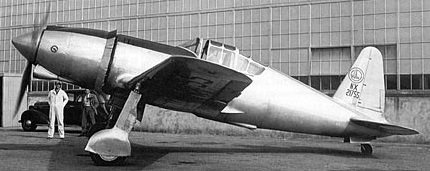
Vultee V-61 Prototype NX21755
Designed by Dick Palmer as a company demonstrator, the V-48 NX21755 c/n 142 first flew on 9 September 1939, piloted by Vance Breese. The V-48 was powered by a P&W R-1830-S Twin Wasp with an extended propshaft in an elongated low-drag cowling. The original proposal included two rear-firing guns aimed with mirrors. The prototype, NX21755 c/n 142, was later re-designated V-61, then P-48X.
The 1940 P-48X was a redesign of the V-61 with a conventional R-1830-S1 engine because of cooling problems. First flown on 11 February 1940, piloted by Vance Breese, and it crash-landed on May 9 after colliding with a camera plane.
Vultee P-48X NX21755
The 1940 V-48C was the V48-X rebuilt and repowered with a R-1830-S2 engine for export to Sweden’s Flygvapen as the J.10. First flown on 6 September 1940, it was re-registered NX19999 c/n 501, and followed by one production prototype, NX28300 c/n 502.
Vultee V-48C / P-48C NX28300
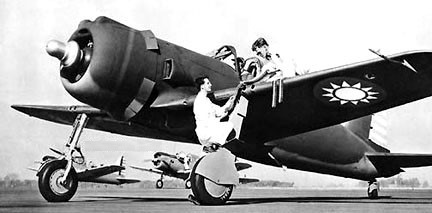
One-hundred and forty-four were built for Sweden (42-6832 to 42-6975), but diverted to the RCAF, who in turn released 129 of them after the outbreak of WW2 as Lend-Lease to China as P-66, and so marked with US insignia. Of the total about 50 were impressed for Army stateside assignment, and 12 transferred to 23 Fighter Group in China.
The BC-3 (Model 51 aka BC-51) Army basic combat trainer first flew on 24 March 1939 (piloted by Eddie Allen). The only one built, 39-720, was tested by the Army, who purchased the test model for upgrading as BC-3, one of the only three BC classifications (the other two were North Americans).
Vultee BC-3 39-720
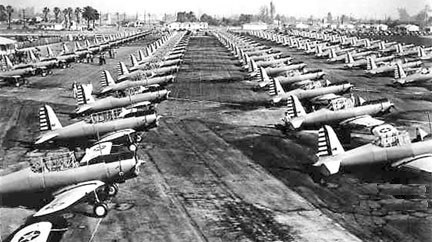
Following 1939 tests with the BC-3 variant with retractable landing gear and a 447-kW (600-hp) Pratt & Whitney R-1320-45 radial, the army opted for the lower-powered Model 54 with fixed landing gear. Designed by Richard Palmer, Walt Hite, and others, the initial contract called for 300 aircraft (40-810-1109).
Vultee BT-13
The 1939 V54 (Model 51D) was a retractable-gear export model demonstrator with a 600hp R-1340-S1 engine. The one prototype built, NX21753 c/n 140, first flew on 15 November 1939 piloted by Gil Clark), but crashed on 16 November 1939.
Vultee V-54 / 51D NX21753
The 1940 V54-A NX21754 c/n 141 was a faired, fixed gear, 450hp R-985-AN-1 powered prototype of the BT-13. It first flew on 28 July 1940.
Vultee V54-A NX21754
The BT-13s were followed by orders for no fewer than 6,407 BT-l3As and 1,125 BT-l3Bs with a 24- rather than 12-volt electrical system.
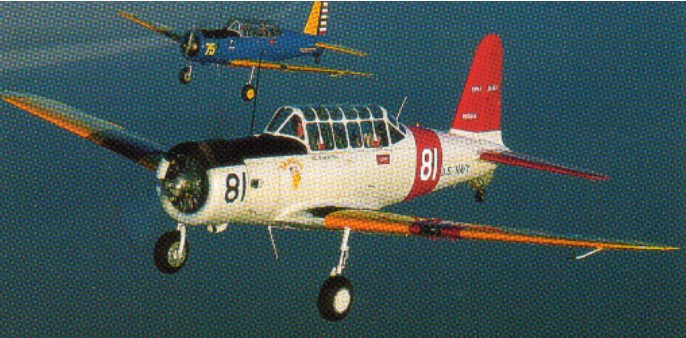
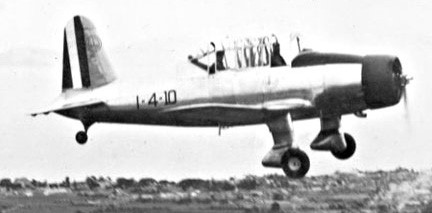
The 1940 BT-13A was powered by a 450hp R-985-AN-1 engine. Gear fairings were deleted in 1941. A total of 7,037 were built: 41-1211-1710, 41-9587-9979, 41-10410-11586, 41-21162-23161, 42-1164-1743, 42-42201-43257, and 42-88674-89573, plus 430 (41-09980-10409) to the USN and USCG as SNV-1, and 12 to the Peruvian AF.
Vultee BT-13A
Vultee 54 Peru export with fairings
The 1941 BT-13B featured a 24v electrical system. 1,125 were built (42-89574-90698, and 44-31511-32160), with the last batch of 650 transferred to USN as SNV-2. Totals of all models include Lend-Lease exports to China, France, Haiti, Indonesia, Israel, the Philippines, and South American nations.
Demand far outstripped engine supplies, however, and in 1941 the USAAF ordered the BT-15 variant with the 336-kW (450-hp) Wright R-975-11 radial, and production of this model totalled 1,263. (41-9980-10409, 42-1744-2063, and 42-41258-42200)
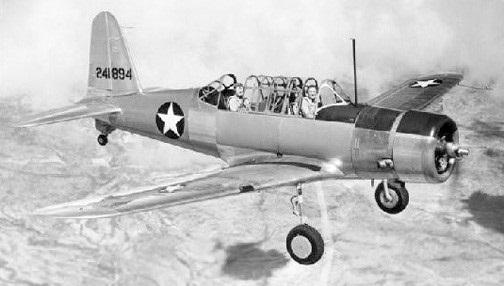
Vultee BT-15 42-41894
The US Navy procurement began with the 1940 US Navy SNV-1, the same as BT-13A. 1,125 (02983-03182, 05675-05874, and 12492-12991) (USN serials total 1,350, but is unexplained—perhaps includes a cancelled batch), with 2 (V222 and V223) to USCG, plus 450 (34135-34584) transferred from USAAF (44-31511-32160, et al) aircraft were retired soon after the war.
Vultee SNV-1 N56319
These were followed by 650 SNV-2s, equivalent to the BT-13B, in 1944. They were BT-13B transferred from the USAAF (44-31511-32010 became 52050-52549, and 32011-32160 became 44038-44187).
Circa 1950 of 3 Vultee BT-13s at Puente Sky Ranch
When production ceased in 1944, 11,537 had been built.