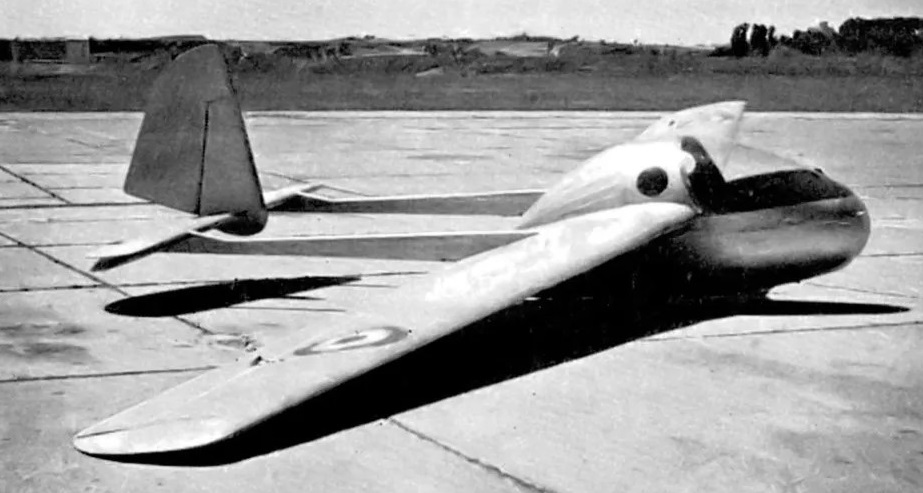
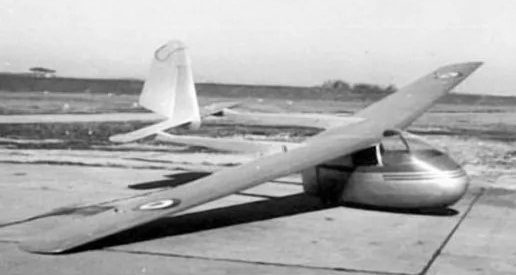
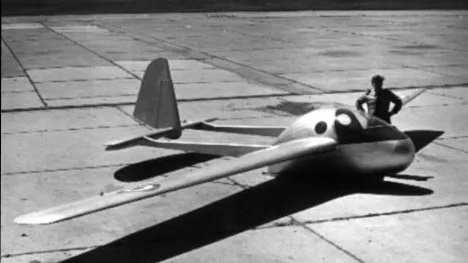
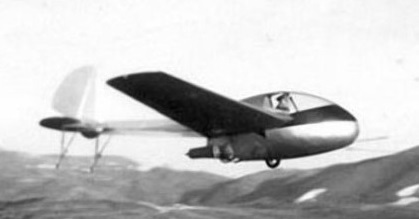
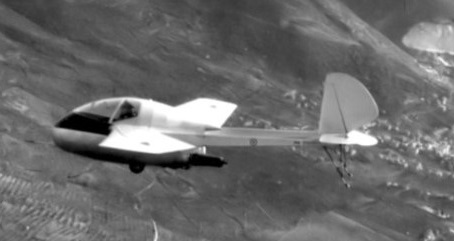
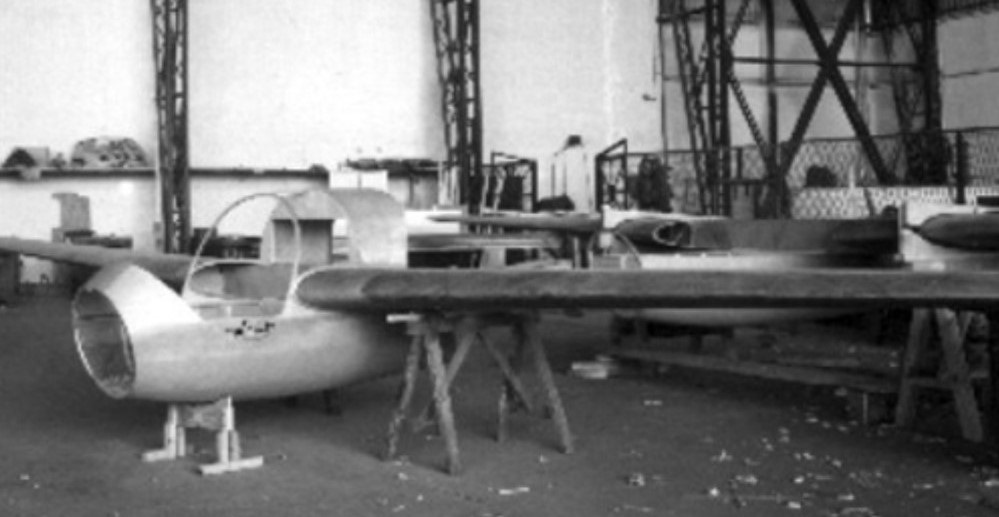
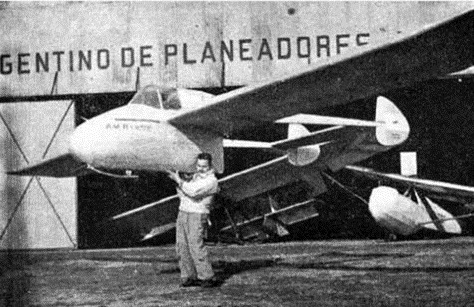
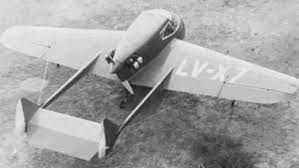
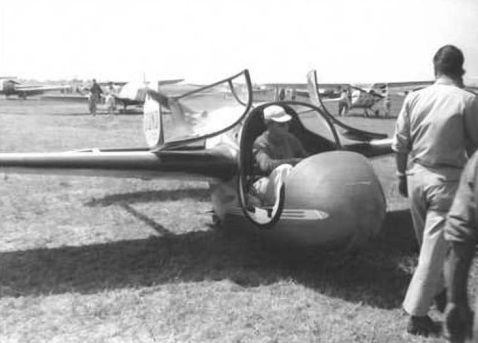
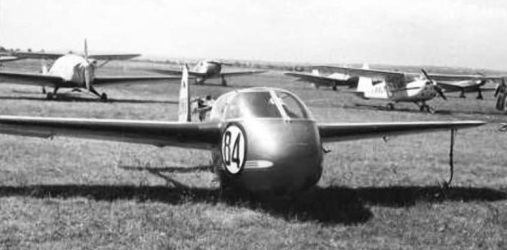
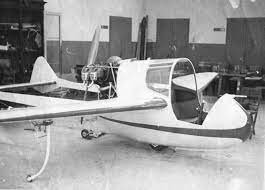
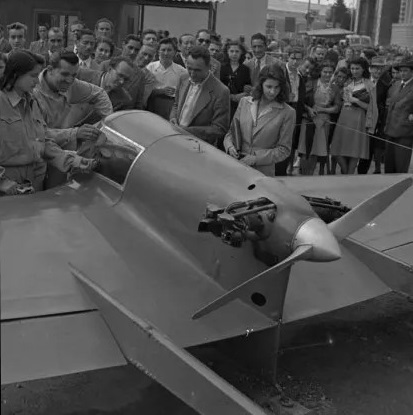
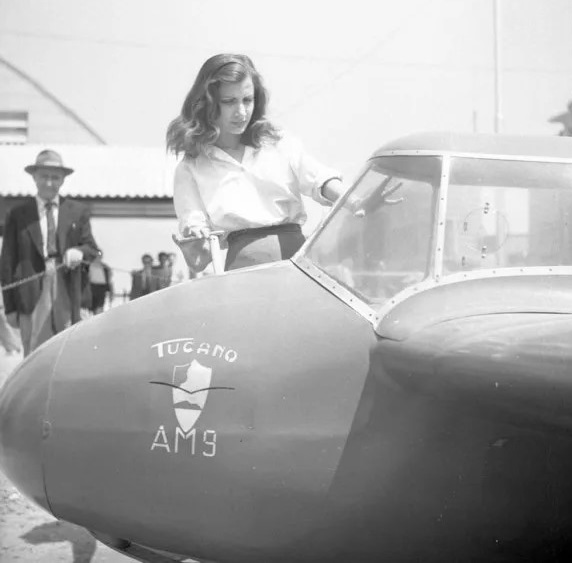
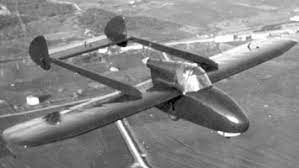
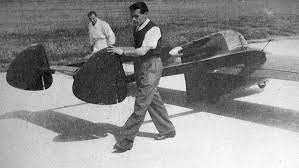
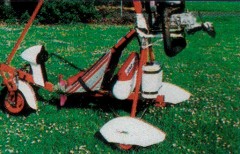
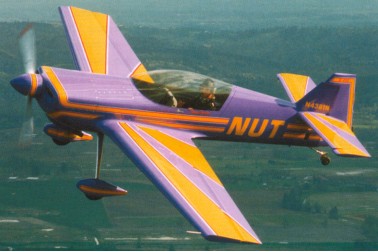
The Alaparma AM-12 was a two-seat aircraft derived from the Am-8/AM-10, but with a new and larger wing to make the type suitable as powered glider. Further changes compared to the AM-8 and AM-10 were a revised u/c arrangement with small tail wheels under the twin vertical tail instead of a single tail wheel under the rear fuselage.
It was first flown on 12 November 1954 as a glider.
Later it received one 75hp Praga D engine.
The aircraft was evaluated by the Italian AF and possibly up to three or four AM-12s were built.
One of the AM-12 after having been re-engined with one 350lb Turboméca Palas turbojet engine as the AM-12P and it was flown in this form in 1962.
AM-12P
Again, the aircraft was evaluated by the Italian AF. Further development of the AM-12 was halted.
AM-12P
The aircraft established several FAI altitude records attaining 28,661ft with Praga D75 engine and 21.981ft with Palas engine.
Wingspan: 39.375 ft Length: 18.042 ft Height: 4.667 ft
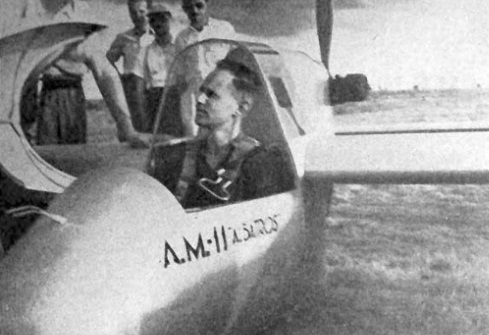
The Alaparma AM-11 Albatross was a single seat largely based on the AM-10.
The prototype was built by Alaparma with one 22hp SAI-Ambrosini P-25 engine.
The A-11 model was also built in Argentina under the name Albatross by OMA (Officina Meccanica Aeronautica) and this aircraft was a prototype only which first flew 28 March 1951 was reportedly powered by one McCulloch two stroke engine.
The AM-11s built in Italy used one Ambrosini P-25 or one 28hp Hirth F-10A engine.
The Alaparma AM.10 was a two-seater designed by Adriano Mantelli.
The AM-10 used the increased area wings as on the AM-9. The prototype was built by Alaparma with one 45hp Praga B-2 engine and was first flown in 1945 or 1946.
The engine was also reported as one 65hp Continental A65 and as CAN C-2 and the name Baldo was also reported for the AM-10.
At least one aircraft was built in Argentina by Mr. Mantelli with help from Mr. Robert Madsen with a Continental A65 engine and registered LV-X7.
This aircraft was referred to as the Trieste and featured twin fins rather than the usual single central fin.
Ultralight designed by Adriano Mantelli and derived from the AM-6, but with slightly larger wings, only 3 examples were built with one 39hp ABC Scorpion, one 38hp CNA C-2 and one 22 hp Macchi B-2 engine respectively.
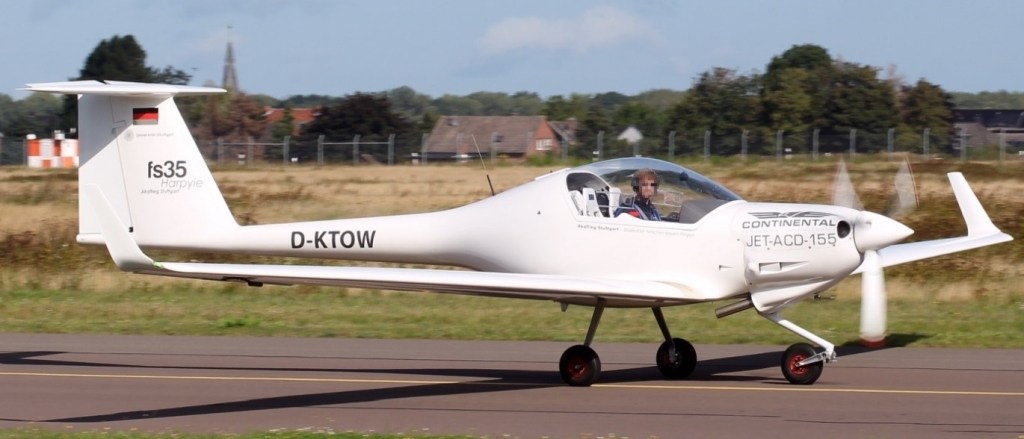
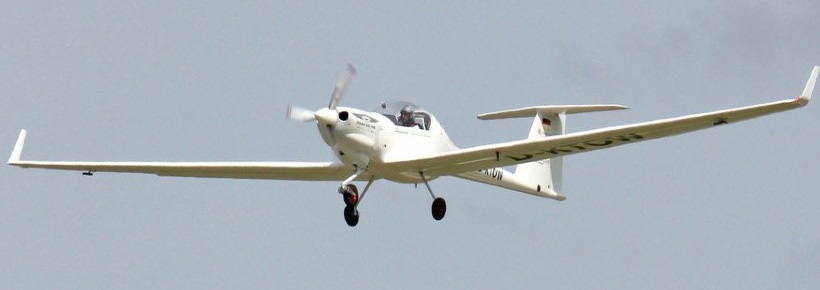
The fs35 Harpyie was created by the Stuttgart Academic Aviation Group in 2003 as a motor glider designed for glider towing with good climbing performance and a large fuel tank, after Porsche had announced the discontinuation of model support for the PFM 3200 aircraft engine for 2005. This engine was installed in the club’s Robin DR 400 tow plane. The following requirements were defined: high aerodynamic quality in aircraft towing in the speed range 90–150 km / h, short take-off roll distance, use of an efficient diesel engine, approval as a motor glider and design as a two-seater with dual controls for training.
The design of the wing began with the assumption of 120% of the fuselage resistance of the Diamond HK36 Super-Dimona and the drive with a Thielert Centurion 1.7 with 125 hp (approx. 90 kW). The two-part Dimona wing was chosen, which was extended inwards, swept and provided with winglets. In April 2007, the moulding of the three-part half-span master model began, and in 2009 the construction of the fracture wing with integrated strain gauges began in the resulting negative form. A load test of this component on November 4, 2010 failed because the wing broke at 80% of the load to be verified. The wing construction began after reinforcement of the original construction and its mathematical proof of strength in April 2011.
The wing consists of a carbon fiber sandwich shell with carbon fiber belts and GRP -Steg. The I-shaped spar merges into a box spar in the spar stub.
The fuselage is also based on the Dimona, but the position of the wing had to be moved forward because of the heavier engine. The four-cylinder in-line engine Centurion 2.0s, now called the Continental CD-155, serves as the drive as a further development of the Centurion 1.7.
The vertical tail of the Dimona was built with the Eppler profile E 522 and increased profile depth as a GRP shell with CFRP belts in the spar. At the end of the fuselage tube, a tow coupling is installed on a boom under the tail unit.
The main landing gear comes from the Van’s Aircraft RV-8, the nose landing gear from the Super Dimona.
The first flight of the aircraft with the aircraft registration D-KTOW took place on August 13, 2019 in Schwäbisch Hall, the tug trials started at the Idaflieg 2020 summer meeting in Stendal-Borstel.
Engine: Continental CD-155, 155 hp (approx. 110 kW) Wingspan: 17.67 m Wing area: 16.9 m² Wing extension: 18.5 Wing profile: FX 63-K-137 (mod) V position: 3° Empty weight: 600 kg MTOW: 850 kg Top speed: 270 km / h Crew: 1 + 1