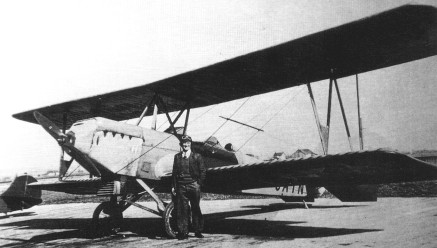
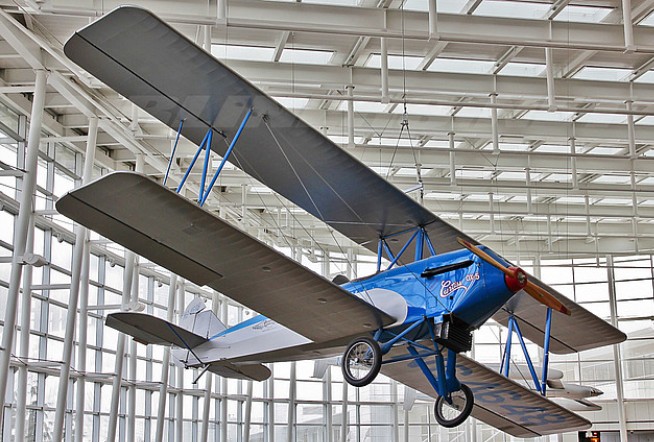
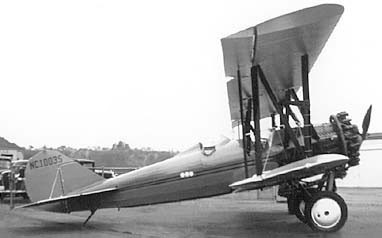
Designed by Daniel Noonan the Eaglerock was extensively redesigned as the A-1 by Al Mooney in 1926. The design had folding wings, and Warren-truss wing struts with no wire rigging, and based on surplus Longren components.
The name came about from an injured Golden Eagle cared for as a pet by factory employees, appended with “Rock,” honoring the nearby Rocky Mountains.
The 1925 Alexander Eaglerock had trouble get¬ting off the ground at Denver, where it was being built, because its wing area was too small. Mooney improved and lengthened the wing. He made the up¬per and lower wings exactly alike and left out the center section. So where the fuselage fitted into the bottom set, it gave them a longer span.
Eaglerock Combo-Wing
First flying on 19 September 1925, powered with a 100 hp Kinner engine the Eaglerock sold at $3907 flyaway factory. The craft was available with $1562.80 down and the balance in twenty semi-monthly installments of $128.94. Powered by a 150 hp Hisso A the flyaway price was $3230, or $1800.00 down and twenty semi-monthly installments of $107.25. Powered by a 165 hp Wright J-6 the flyaway price was $3397, or $2238.80 down and twenty semi-monthly installments of $182.71.
Eaglerock Kinner 100 hp
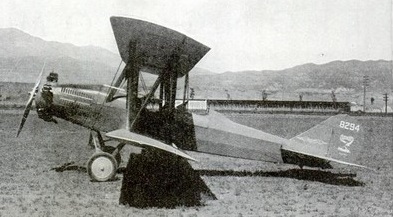
The second Eaglerock design, the 1926 Eaglerock A-1 or New Eaglerock, had 40’0″ lower wing.
Alexander Eaglerock A-1 NC10035
First flying on 7 January 1926, piloted by Capt Cordner, the A-1 sold for $6,500, or $2,250 less motor, receiving DoC approval (ATC 57) in 1928.
895 of all Eaglerocks were built 1927-32. Company records claim a total of about 450 Eaglerock models built by the end of 1928.
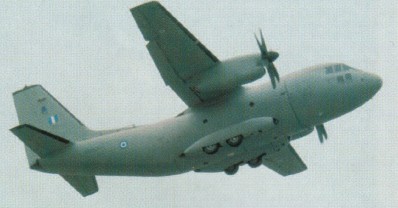
The C 27 J is a joint-venture of Alenia and Lockheed Martin based on the FIAT G222 transport, but with engines and avionics redesigned and made common with the Lockheed C-130J Hercules. The maiden flight of the prototype (I-CERX) took place from Turin, Italy, on September 25, 1999, and lasted 1 hr 32 min. Crewed by Alenia test pilots the prototype reached 15,000 ft. The first and second C-27 were converted G.222 aircraft, the third was the first new build.
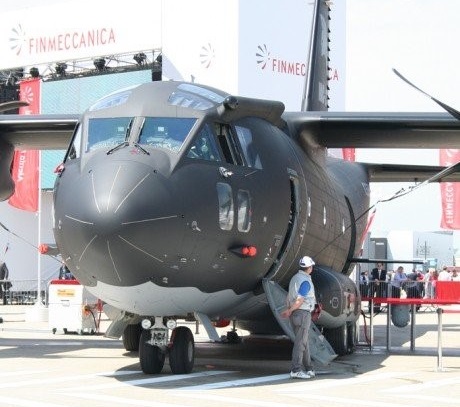
MC-27J is a multimission transport aircraft jointly produced and marketed by Alenia Aermacchi and ATK. It is an armed, roll on/roll off (RO/RO) aircraft based on the C-27J Spartan. Alenia unveiled a new version of the C-27J Spartan battlefield air-lifter, the MC-27J, at the Farnborough International Air Show in July 2012.
The C-27J base platform is slightly modified, while the airlift capabilities of C-27J are retained. The new aircraft is incorporated with pallet-based systems for additional mission-specific capabilities.
The MC-27J can be configured to conduct troop / cargo transport, paratroops / material air-drop, medical evacuation (MEDVAC) and VIP / passenger transport. The gun barrel on the aircraft can be removed to allow reconfigurations for other missions. The aircraft also integrates a fire protection system and an ice protection system.
The two-pilot glass cockpit of the MC-27J is equipped with off-the-shelf avionics and is fully compatible with night vision imaging systems. The avionics suite integrates colour multipurpose displays, multifunction control and display units, optional head-up display units, digital auto-pilot, GPS/INS, identification friend or foe (IFF) transponder, recording systems, terrain awareness warning system (TAWS) and traffic alert and collision avoidance system (TCAS).
The onboard PaWS (palletized weapon system) provides combat capabilities for the MC-27J aircraft. The PaWS is specifically designed for the ATK GAU-23 30mm cannon and other precision guided light munitions. The system minimises collateral damages. The palletised system can be loaded / unloaded through the rear ramp of aircraft. It can be installed in the aircraft within four hours.
MC-27J gunship
The GAU-23 Bushmaster 30mm cannon mounted on the PaWS RO/RO pallet is a chain gun that incorporates features of the M242 and Mk44 25mm cannons. The gun can fire 30mm x 173mm, PGU-13, PGU-15, and PGU-46 ammunition at a rate of 200 rounds a minute. The ammunition is fed into the gun through a dual feed system.
The palletised system also accommodates a reconfigurable mission suite incorporating sensors, communications and mission management system. The aircraft is equipped with electro-optical / infrared targeting sensors, and command, control and communications equipment.
The MC-27J serves as an independent command and control centre interfaced with the ground command network. The aircraft is also equipped to provide signal intelligence (SIGINT) intelligence surveillance and reconnaissance (ISR) capabilities. The target identification systems and weapons systems aboard the aircraft support ground missions.
The MC-27J is powered by two Rolls-Royce AE2100D2A turboprop engines. Each engine, generating 4,637shp power, drives two Dowty six-blade, all-composite propellers. Two full authority digital electronic control units control the engines and propellers.
The onboard electricity is supplied by three generators. The auxiliary power unit (APU) allows the engines to be restarted in flight during emergency conditions.
The fuel system includes four wing tanks and two dedicated fuel feed systems. The aircraft can be optionally fitted with an air-to-air refuelling probe for performing aerial refuelling.
Alenia C 27 J Spartan Engine : 2 x Allison AE 2100 D3, 4142 shp Length : 74.475 ft / 22.7 m Height : 32.152 ft / 9.8 m Wingspan : 94.16 ft / 28.7 m Wing area : 882.648 sq.ft / 82.0 sq.m Max take off weight : 66150.0 lb / 30000.0 kg Weight empty : 36382.5 lb / 16500.0 kg Max. speed : 305 kt / 565 km/h Cruising speed : 270 kt / 500 km/h Initial climb rate : 1968.5 ft/min / 10.0 m/s Service ceiling : 26247 ft / 8000 m Cruising altitude : 19685 ft / 6000 m Wing load : 75.03 lb/sq.ft / 366.0 kg/sq.m Maximum range : 2484 nm / 4600 km Range : 1350 nm / 2500 km Range (max. weight) : 540 nm / 1000 km Crew : 2 Payload : 53 pax (max 10.000kg)
MC-27J Engines: 2 x Rolls-Royce AE2100D2A turboprop, 4,637shp Propellers: Dowty six-blade, all-composite Length: 22.7m Wing span: 28.7m Height: 9.6m Maximum take-off weight: 30,500kg Maximum altitude: 30,000ft Cruising speed: 583km/h Maximum speed: 602km/h Maximum range: 1,852km Ferry range: 5,926km
After working as Lavochkin’s right hand man during World War II, Semyon Mikhailovich Alekseyev was appointed as Chief Designer of OKB-21 at Gor’kiy. The Council of the People’s Commissars directed Alekseyev (among others) to develop jet fighters using more powerful engines than the captured German examples and their Soviet-built copies. The result of Alekseyev’s efforts was the I-21 (istrebitel, fighter) which was planned to be produced in several variants.
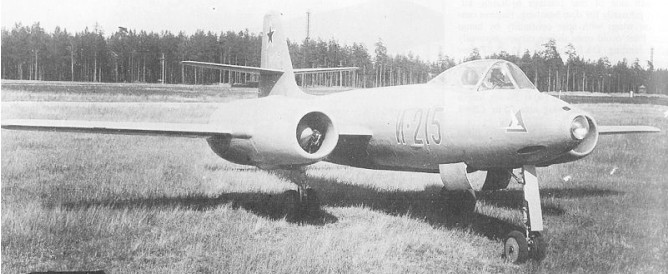
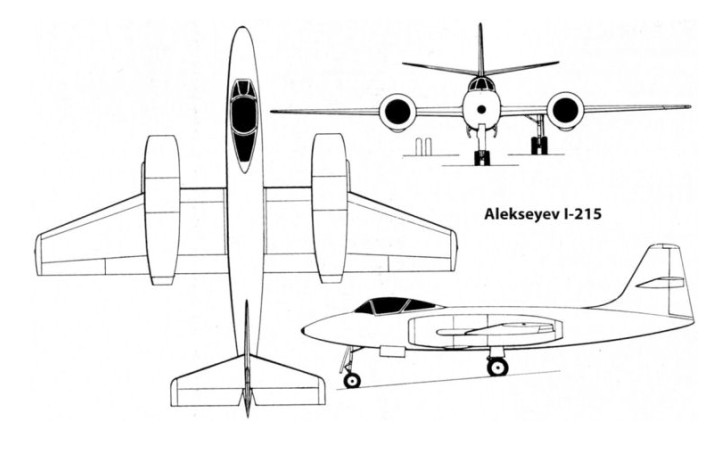
The I-21 was a twin-engined all metal single seat jet fighter, with straight wings, mid-set on a round streamlined fuselage, and engines mounted in front of the wings at about one third span. The slightly swept tail unit was cruciform in layout with the tailplane set at approximately half-fin span with slight dihedral. The aircraft’s structure was constructed from high strength B-95 aluminium alloy, high strength steel for highly loaded parts and “Elektron” magnesium alloy for cast fittings. A hydraulically retractable tricycle undercarriage was fitted, using twin wheels for nose and main undercarriages. Hydraullically actuated airbrakes were fitted either side of the rear fuselage.
Construction of the first two airframes began at the end of 1946, with pressure from the Ministry of Aircraft Production to complete initial flight testing by 1 August 1947, to enable the aircraft to take part in the Aviation Day Flypast at Tushino on 18 August 1947. While one of the two airframes initially produced was used for static testing, the other was completed as the I-211 (I-21 version 1) with Lyul’ka TR-1 turbojet engines. (The Lyul’ka TR-2 was the intended powerplant, but was not available). Despite pressure, the I-211 was unable to participate in the Tushino display.
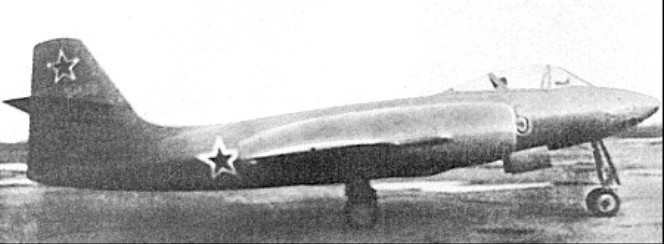
Flight testing started in the Autumn of 1947, but only six test flights had been carried out before the I-211 struck a pothole on landing, which collapsed the undercarriage. Repairs were carried out and the opprtunity taken to replace the TR-1 engines with Rolls-Royce Derwent V engines. The result was the I-215 which had been in development before the first flight of the I-211. Other minor modifications were carried out, the most noticeable being the larger engine nacelles. Despite good results from flight testing the I-215 lost out in production orders to the newer generation of swept winged fighters.
A third I-21 was built as the I-215D (dooblyor, second prototype), with a bicycle undercarriage, using wider-diameter paired wheels in a bicycle arrangement, retracting into the fuselage, along with small outrigger wheels under the engine nacelles which retracted into fairings, to order from OKB-1. This was used to test this arrangement for “Aircraft 150” and other projects (OKB-1 was supervised by Dr. Brunolf Baade, who later designed the VEB type 152 airliner, in the DDR, as a direct descendent of “Aircraft 150”, and indirectly of the I-215D). The main undercarriage of the I-215D also incorporated a kneeling feature which could increase the incidence of the aircraft by 3 degrees to assist take-off. Trials with this undercarriage arrangement proved successful and paved the way for its use in many other Soviet aircraft.
Armament of the I-211 comprised two, three, four, or six cannon in the chin, depending on variant.
Variants: I-210 – The initial version with Tumanskii RD-20 (BMW 003 copy) engines. Not proceeded with due to availability of Lyul’ka TR-1 engines.
I-211 – The first flyable example completed as the I-211 with Lyul’ka TR-1 engines, rebuilt as the I-215.
I-211S – I-211 with swept wing and tail.
I-215 – The re-built I-211 with Rolls-Royce Derwent V engines and other minor modifications.
I-215D – Bi-cycle undercarriage I-215 built to order of OKB-1.
I-216 – Proposed “Heavy” fighter version of the I-215 with two 75mm cannon and modified outer wings.
I-215
Specifications:
I-211 Engines: 2 × Lyul’ka TR-1 jet, 1,300kgp (2,866 lb st) Wingspan: 12.25 m (40 ft 2.28 in) Wing area: 25 sq.m (268.8 sq.ft) Length: 11.54 m (37 ft 11.9 in) Loaded weight: 6.890 kg (15,189 lb) Maximum speed: 970 K/h (524.32 mph) Ferry range: 1,550 km(962 miles) Service ceiling: 13,600 m (44,619 ft) Rate of climb: 27.78 m/s (5416 ft/min) Armament: 2 x 23mm cannon Crew: 1
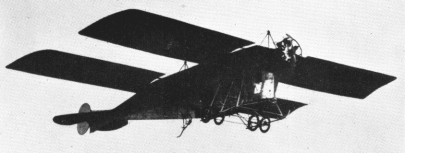
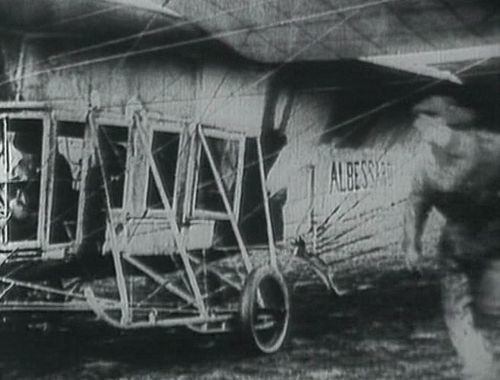
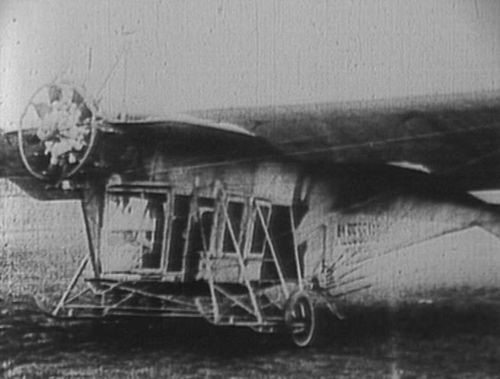
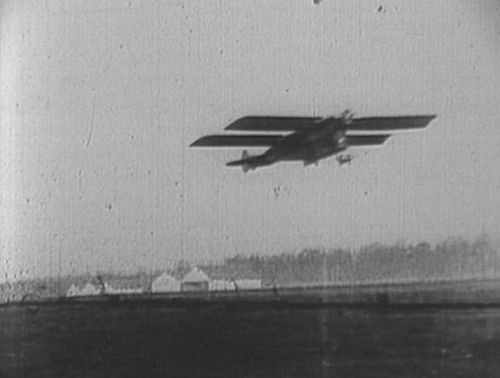
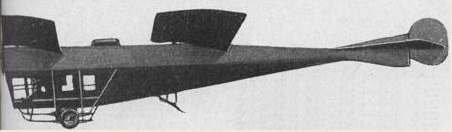
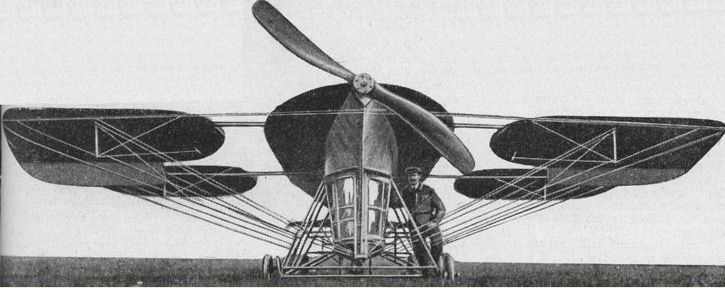
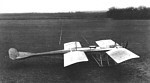
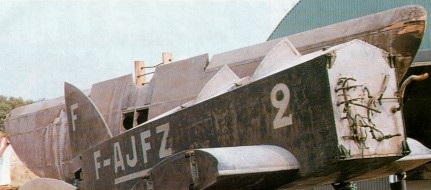
First actual built design of Lucien-Joseph-Antonin Albessard; although not necessarily named “La Balancelle” at the time. Built in 1912, the Albessard La Balancelle experimental aircraft had tandem wings.
Albessard tried to design a comfortable passenger aeroplane that would prevent stalling in alternating wind conditions, therefore he arranged the wings around an enclosed cabin to help keep the aircraft in the stream. Jules Vedrines tested the machine and noted that it was underpowered.
The design “Autostable” was efficient and research continued until 1926.