American Jet Hustler

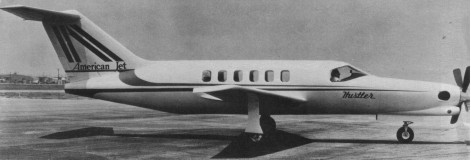
Unveiled at American Jet Industries plant in Van Nuys, California, in October, 1975, the seven place Hustler 400 turboprop/ turbojet has been modified since announcement was made. A major change was the redesign of the tail to a “T” tail configuration, and other changes include an increase of 52 inches in the wing span and installation of double slotted Fowler flaps on the supercritical wing. Sixteen inches have also been added to the fuselage.
An 850 shp United Aircraft of Canada turboprop PT6A 41 in the nose provides power for the Hustler while the Teledyne turbojet engine will be used for standby’ power in the event of an engine failure. According to American Jet’s data the standby engine will enable the aircraft to maintain an airspeed of 170 mph at 13,500 feet with the nose turboprop engine feathered. A top speed of 380 mph for the Hustler is predicted with a maximum range of 2970 miles.
Three prototypes were under construction at the American Jet California facility; two were to be used for flight testing and the third for ground structural testing. The Hustler faces some serious hurdles; for instance, no certificated jet engine of the size required by the design existed. Only various engines used for APUs, missiles or drones. If, on the other hand, a “single engine” classification were sought, the jet engine being viewed merely as a JATO unit, then the Hustler would face the challenge of making the FAA’s 70 mph landing speed requirement with a wing loading of at least 36 pounds per square foot.
The Hustler was powered by a Pratt & Whitney PT6A-41 turboprop in the nose and a standby turbojet in the tail and made its first flight on January 12, 1978.
Gulfstream American decided to replace the 850 shaft horsepower Pratt & Whitney PT6 turboprop engine in the nose of the Hustler with a 900 shp Garrett TPE331. The Pratt & Whitney JT15D remains Gulfstream’s choice for the Hustler’s rear mounted turbofan. Maximum takeoff weight was been increased to 10,000 from 9,500.
Flight testing of the Gulfstream American Hustler 500 began late in January 1981 at Van Nuys, California, and continued at Mojave. This second Hustler prototype was powered by a 900 shp Garrett AiResearch TPE 331 10 501 turboprop in the nose and a 2,200 lb st (1000 kgp) Pratt & Whitney JT15D 1 turbofan in the tail.

Hustler 400 A
Engine: Pratt&Whitney PT6A-41, 838 shp & Teledyne turbojet
Length: 37.795 ft / 11.52 m
Height: 10.761 ft / 3.28 m
Wing span: 32.644 ft / 9.95 m
Wing area: 185.141 sq.ft / 17.2 sq.m
Max take off weight: 7497.0 lb / 3400.0 kg
Weight empty: 3999.9 lb / 1814.0 kg
Cruising speed: 343 kts / 636 kph
Wing load: 40.59 lb/sq.ft / 198.0 kg/sq.m
Range: 1303 nm / 2414 km
Crew: 1
Payload: 6 Pax

Hustler 500
Engine: 1 x Garrett AiResearch TPE 331 10 501, 900 shp turboprop & 1 x Pratt & Whitney JT15D 1 turbofan 2,200 lb st (1000 kgp)
American Homebuilts John Doe

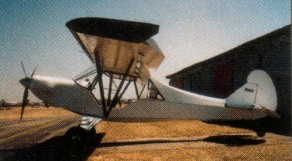
A STOL utility aircraft (LSA) with interchangeable flaps and ailerons, as well as elevators and rudder, and an 18 cu.ft cargo area. First fown in 1994.

The man who designed this airplane was named Steve Nussbaum, he flew out of the airport I worked at, Galt airport 10C. I remember on a good day he could get one of these off the ground in 88 ft. He also designed the ribs to be replaceable in the field if they ever broke during a forced landing.
Ted Domski

Engine: Continental IO-240, 125 hp
Wing span: 30.6 ft
Wing area: 130.6 sq.ft
Fuel capacity: 26 USG
Empty weight: 850 lb
Gross weight: 1400 lb
Height: 6.5 ft
Length: 20.8 ft
Top speed: 140 mph
Cruise: 117 mph
Stall: 30 mph
Range: 500 sm
Takeoff dist: 100 ft
Landing dist: 125 ft
Service ceiling: 12,500 ft
Seats: 2 tandem
Landing gear: tailwheel

Cruise: 100 mph
Stall: 30 mph
Range: 490 sm
Rate of climb: 1000 fpm
Takeoff dist: 120 ft
Landing dist: 120 ft
Engine: Continental O-200, 100 hp
HP range: 100-125
Fuel capacity: 26 USG
Empty weight: 771 lb
Gross weight: 1320 lb
Length: 21.9 ft
Wing span: 30.6 ft
Wing area: 130.5 sq.ft
Seats: 2 tandem
Cockpit width: 28 in
Landing gear: tailwheel

American Helicopter XA-8 / XH-26

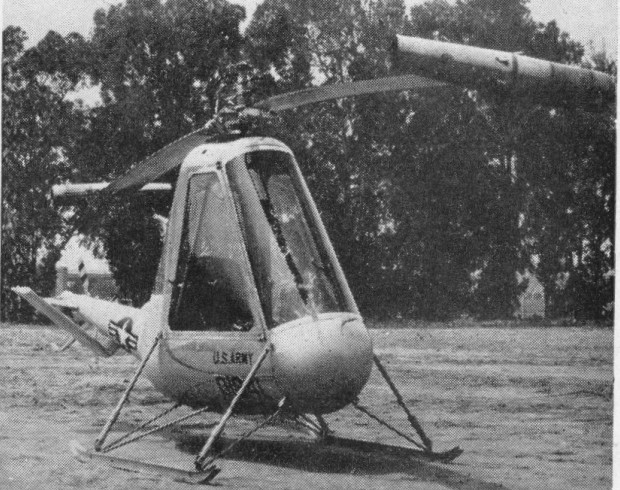
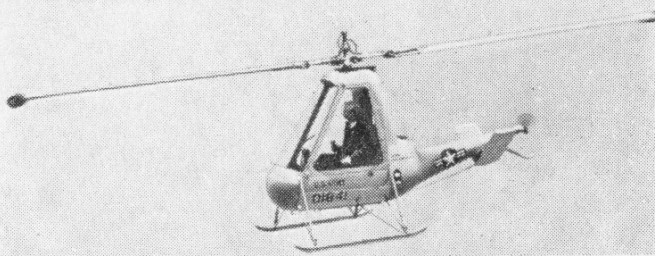
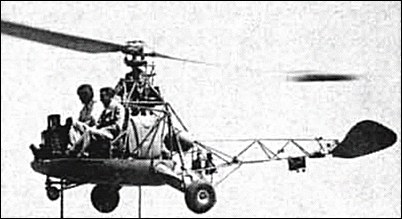
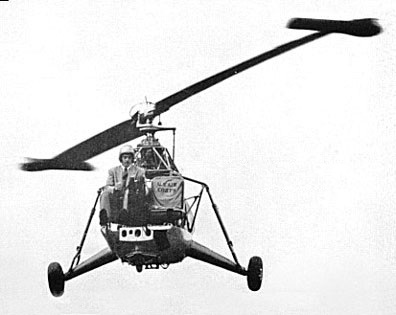
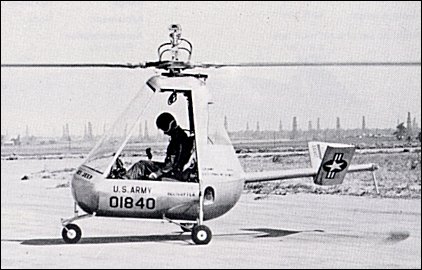
A 1950 Army specification called for a light, collapsible machine which could be used as both a light observation craft and as an air-droppable rescue vehicle for downed aircrew. American Helicopter responded with the Model XA-8 single-seat lightweight helicopter, design of which began in 1951 with the sponsorship of both the Army Transportation Corps and the USAF. American Helicopter was awarded a development contract in June 1951, and the first of a total of five XH-26s flew for the first time in June 1952.

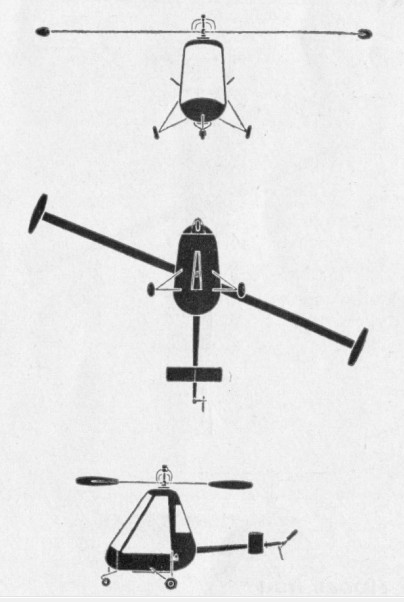
The XH-26 was designed from the beginning to be both collapsible and air-droppable and its construction and size reflected both requirements. Twelve feet long and six feet tall, the helicopter could be transported in a five foot by five foot by fourteen foot container and could be unpacked and assembled by two men in less than thirty minutes. The machine’s fuselage was built primarily of aluminum and fiberglass and featured a glazed, pyramid-shaped cockpit. The XH-26 was powered by two pulse-jet engines, one fixed to the tip of each main rotor blade, and could burn virtually any type of fuel.
The Army and Air Force jointly evaluated the five XH-26 prototypes from 1952 to 1954 but neither service procured the type in quantity.

American Helicopter H-26
Engine: 2 x American Helicopter XPJ49-AH-3 7.5 in pulse-jets, 16.2kg
Main rotor diameter: 8.23m / 27 ft
Rotors: 2-blade, tip-powered main; 2-blade tail.
Fuselage length: 3.73m
Height: 1.88m
Empty weight: 135kg
MAUW: 1,040 lb.
Max speed: 130km/h / 80 mph
Cruising speed: 110km/h
Service ceiling: 2280m
Range: 160km / 105 miles at 70 mph with normal load
Crew: 1

American Helicopter XA-5 Top Sargent

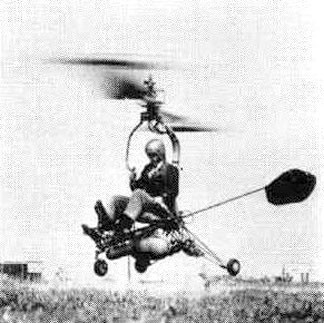
The first project of the American Helicopter company was the two-seat open-cockpit XA-5 “Top Sergeant”, which was based on the lower fuselage and undercarriage of a Sikorsky R-6 with an open rear boom and small rudder. It was driven by two tip-mounted 43kg AJ 8.75 pulse-jet engines driven by a fuselage-mounted compressor, and made its first flight in January 1949.

American Helicopter XA-5

Engines: 2 x 43kg AJ 8.75 pulse-jets
Seats: 2

American Eagle Aircraft Corp American Eaglet

A light parasol monoplane, first two-seat light airplane to be granted Approval Type Certificate by US Department of Commerce. Several hundred Eaglets built before company suspended operations in 1930 Depression.
Victor H. Roos Aircraft Co. succeeded American Eagle-Lincoln Aircraft Corporation in mid-1930s, and continued to produce American Eaglet light monoplane with 45hp Szekely engine.
In 1942 American Eaglecraft Co revived the American Eaglet light monoplane by building a new prototype. Tests postponed until after war. By end of February 1960 had built one Eaglet and was supplying plans for amateur builders. Company later sold to John Spach.