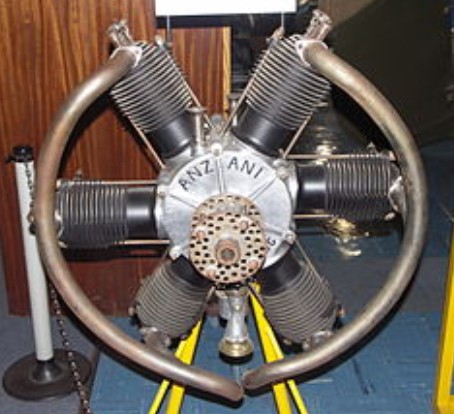
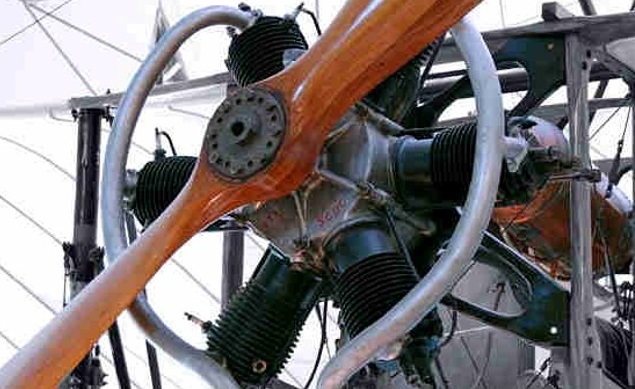
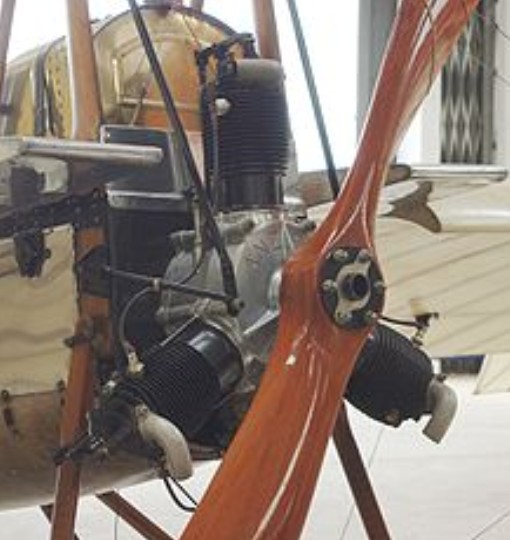
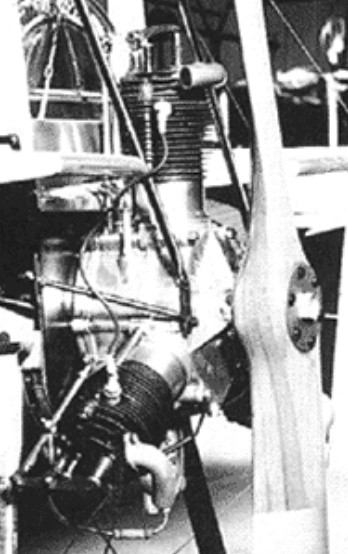
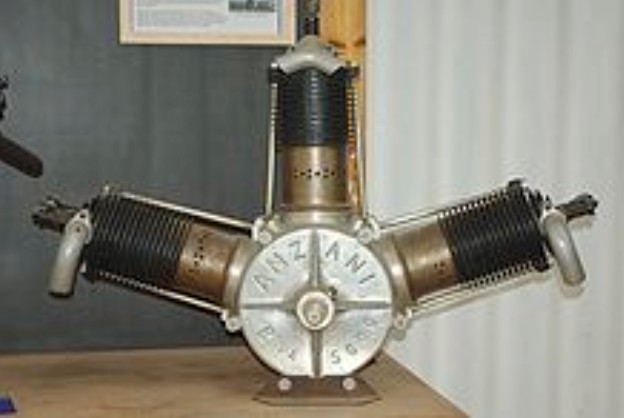
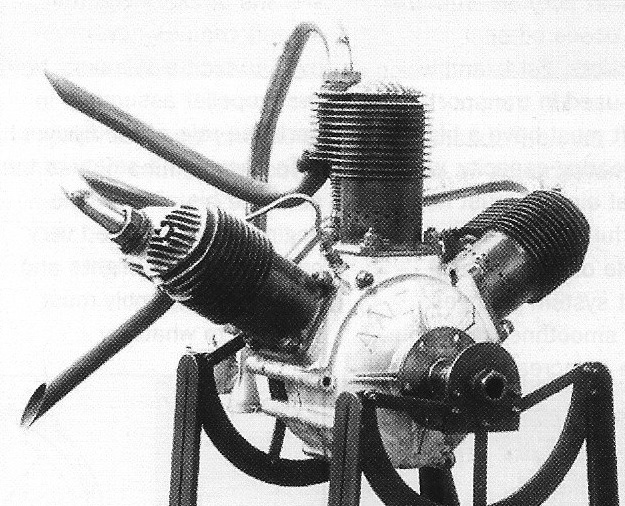
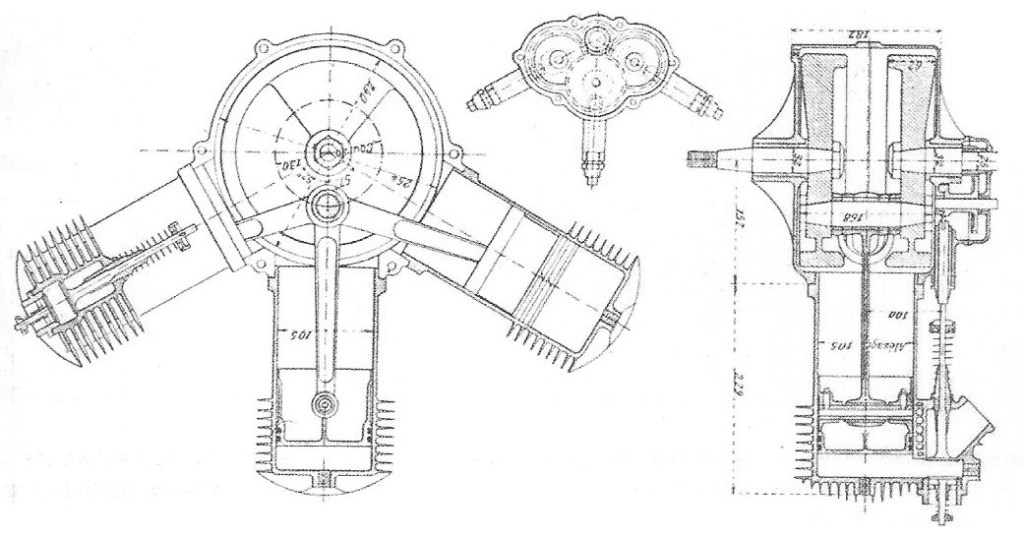
Alessandro Anzani developed the first two-row radial from his earlier 3- cylinder Y engine by merging two onto the same crankshaft with a common crankweb.
By December 1909 Anzani had a 3-cylinder air-cooled true radial engine running, developed from the earlier 3-cylinder fan configuration engines (semi-radials) that had powered Bleriot across the Channel. By about March 1910 he had completed the first two-row radial engine, a 6-cylinder unit made by merging two 3-cylinder units together, one slightly behind the other and at an angle of 60°. The engine therefore had a lot in common with the early 3-cylinder motors: cylinders were a single iron casting with built-in valve cells and ribs, and pistons were steel with cast-iron rings. The early versions were side-valve engines with automatic (atmospheric pressure opened) inlet valves and exhaust valves mechanically operated via cams in the crankcase. By the end of 1912, as with the smaller engines the exhaust valves were moved to the cylinder heads and operated by push-rods and rockers. The exhaust valves were at the front of the engine, with the fuel inlet manifold at the rear. A prominent pair of 150° exhaust tubes were fitted. Plugs were mounted in the cylinder sides, in the plane of the engine and on the upper side to minimise plug fouling by lubricant.
The crankcase was an aluminium casting and in later models contained a fuel mixing chamber. These later versions also used long bolts to attach the cylinders to the crankcase. The engine used a single, kinked crankweb, coupled to slim but broad connecting rods in order to minimise the axial displacement between the two rows. This was less than in more recent double row radials, the rear face of the front row falling on the centre plane of the back row. The engine was not strictly a radial, as the crankweb geometry slightly offset the centres of the two rows, an arrangement best seen from the back of the engine, where the superimposed inlet tubes and push-rods of the later engine highlight the cylinder centre lines. Such an offset between cylinder centre line and crankshaft is often termed désaxé.
The earliest of the 6-cylinder radials had with a bore of 90 mm and stoke of 120 mm giving a displacement of 4.58 litres (280 cu in) and an output of 34 kW (45 hp) at 1,300 rpm. Its weight was 70 kg (154 lbs). A later version produced 45 kW (60 hp) from 6.33 litres (380 cu in).
Variants:
45 hp (34 kW) Anzani’s first two-row radial developed 34 kW (45 hp) from 4.58 L (230 cu in) displacement.
60 hp (45 kW) Larger cylinders gave 45 kW (60 hp) at 1,300 rpm from 6.23 L (379 cu in ) displacement.
TNCA Aztatl A direct copy of the 60 hp 6-cylinder Anzani, produced in Mexico by TNCA (Talleres Nacionales de Construcciones Aeronáuticas – national aviation workshops).
Applications:
Aeromarine EO Austin Whippet Caudron Type N Farman Scout Perry Beadle T.2 Westland Woodpigeon II
Specifications:
60 hp overhead valve Type: 6-cylinder double row air-cooled radial Bore: 105 mm (4.13 in) Stroke: 120 mm (4.72 in) Displacement: 6.23 litres (379 cu in ) Dry weight: 91 kg (200 lb) Valvetrain: automatic inlet valves, mechanical exhaust valves driven by crankcase can operated pushrods and rockers. One inlet, one exhaust per cylinder Fuel system: carburettor, mixing chamber in crankcase. Oil system: splash lubricated Cooling system: air-cooled, finned cylinders Ignition: single magneto, one plug/cylinder Power output: 45 kW (60 hp) at 1,300 rpm Power-to-weight ratio: 0.49 kW/kg (0.30 hp/lb)
Anzani was aware of the weight cost of the counterweight in the fan configuration and by December 1909 he had a symmetric 120° three-cylinder radial engine running. One example was a 3.1 litre (186 cu in) unit producing 22 kW (30 hp) at 1,300 rpm. Although termed the Y engine after its symmetric cylinder arrangement, it ran in an inverted Y position so that the plugs, mounted on the upper in-plane side of the two lower cylinders were less than 30° below the horizontal and less prone to oiling than one serving a piston at 180° from upright. Radials are smoother running than the less symmetric fan engines as well as lower weight but with the low power available from their three cylinders they had limited applications. They led, however, to Anzani’s two-row radial engines, beginning with the 6-cyl radials, two Ys on a common crankshaft.
Applications: Blériot XI Caproni-Pensuti triplane Deperdussin Type A Sikorsky BIS-2 Perry Beadle T.1
Survivors The restored and flyable Blériot XI, registry number N60094 at Old Rhinebeck Aerodrome uses one of these Anzani three-cylinder “true radial” engines for its straight-line, short distance “hop” flights. Another Blériot XI, with British registration G-AANG, is allowed to fly similar short ‘hops’ at the Shuttleworth Collection. Its original “fan-type” Anzani three-cylinder engine is thought to be the oldest airworthy aircraft engine in the world. A 1910 Deperdussin monoplane that is also restricted to straight ‘hops’ uses a ‘Y’ type Anzani engine.
1912 ‘Y’
Specifications:
Channel flight engine Type: 3-cylinder air-cooled fan Bore: 100 mm (3.94 in) Stroke: 150 mm (5.90 in) Output: 30 hp Displacement: 3.53 litres (216 cu in) Dry weight: 65 kg (143 lb) Valvetrain: Automatic inlet valves, mechanical exhaust valves driven from three separate cams in crankcase. One inlet, one exhaust per cylinder Fuel system: Gronville and Arquembourg carburettor, mixing chamber in crankcase. Oil system: Splash lubrication Cooling system: Air, ribbed cylinders Ignition: Battery ignition, one spark plug per cylinder
Alessandro Anzani began building motorcycle engines in France around 1905. His motors were air-cooled, making them light. His first designs were two-cylinder V-engines, and he rode machines powered by them to records and race success in 1905 and 1906. In the same period he had developed a three-cylinder version, more powerful than the twins. Engines with cylinders arranged radially but only in the upper half-circle were termed fan type, or semi-radials; by about 1910 other manufacturers were building e.g. five-cylinder fan engines, most notably R.E.P. Three-cylinder fans were alternatively known as W or W-3 engines. The appeal of the fan configuration was that, because all the cylinder were above the horizontal there was little danger of the plugs being fouled by the lubricating oil. The disadvantage, particularly for an aircraft engine, was the extra weight required to counterbalance the pistons.
In response to the growing interest in aviation in France after the Wright brothers’ visit in 1908, Anzani produced the first of a series of three-cylinder fan flight engines. The cylinders were each a single iron casting and the one-piece crankcase was aluminium. Pistons were steel with cast rings. In most of these the outer cylinders were at 60° to the central one, though a contemporary diagram shows one, described as the cross channel engine, with a 55° angle. They were all air-cooled side-valve engines; each exhaust valve was controlled from below by a cam in the crankcase. Each was mounted in a cell to the side of the cylinder, with the automatic, atmospheric pressure -driven spring-loaded inlet valve immediately above it, partly to minimise volume and partly to help cool the hot exhaust valve. Most contemporary and pre-1921 sources agree that the bores of these early engines were between 100 and 105 mm (3.93 and 4.13 in), but strokes between 120 and 150 mm (4.72 and 5.90 in) are quoted. Most put the output of these engines at about 18 kW (24 hp) at around 1,400–1,600 rpm.
25 hp
It was an engine of this sort that famously powered Louis Blériot’s Type XI monoplane across La Manche (the English Channel) on 25 July 1909. Contemporary sources differ on its bore, stroke and swept volume. The first description of the successful machine in Flight describes the engine as having dimensions of 100 × 150 mm, or a capacity of 3.53 litres. However, a few months later they printed the engineering drawing of the 55° engine, which has dimensions of 103 x 120 mm marked on it, clearly captioned as “used … in the cross-Channel flight”. If their identification was right, then Bleriot used a 3.00-litre engine. A head-on photograph of the cross-channel aircraft also shows a 55° engine.
Even before the channel flight, Anzani was selling more powerful versions with larger bores: a 120 mm bore, 4.4-litre (269 cu in) variant produced 26 kW (35 hp) and a 135 mm bore, 6.4-litre (390 cu in) engine gave 36 kW (45 hp). These fan engines remained in production until at least 1913,[8] though there were important improvements. The exhaust valve was moved to the cylinder head and operated by rockers via push rods, and a mixing chamber was arranged in the crankcase. The 1913 three-cylinder Anzani fan engine had a cylinder separation of 72°, presumably to lighten the counterbalance. By this stage it had its inlet manifold at the rear of the engine to minimise airflow cooling of the fuel air mixture.
Brownback built a 20hp three-cylinder radial licensed version of the Anzani as the Brownback Tiger Kitten.
Variants:
Anzani 3-cylinder fan engines
10-12 hp (7.5-9 kW) Bore x Stroke: 3.35 in × 3.35 in (85 mm × 85 mm) Capacity: 88.5 cu in (1.45 lt)
12-15 hp (9-11 kW) Bore x Stroke: 3.35 in × 3.94 in (85 mm × 100 mm) Capacity: 104 cu in (1.70 lt)
25-30 hp (19-23 kW) Bore x Stroke: 4.13 in × 5.12 in (105 mm × 130 mm) Capacity: 206 cu in (3.38 lt)
40-45 hp (30-34 kW) Bore x Stroke: 5.32 in × 5.92 in (135 mm × 150 mm) Capacity: 393 cu in (6.44 lt)
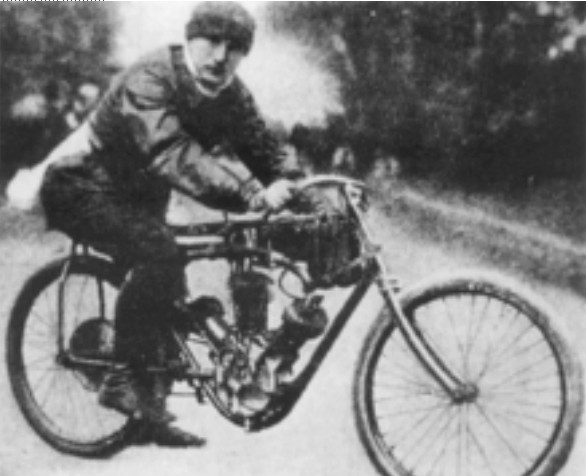
Alessandro Anzani in 1906, on his Fan type-engined motorbike
Anzani was an engine manufacturer founded by the Italian Alessandro Anzani (1877–1956), which produced proprietary engines for aircraft, cars, boats, and motorcycles in factories in Britain, France and Italy.
From his native Italy, Anzani moved to France where he became involved in cycle racing. He moved on to motorcycles and designed and built a record breaking lightweight engine. In 1907, he set up a small workshop in Paris with three staff and while they were building his engines, he designed a hydrofoil powered by one of his engines and propellers. The original Anzani Moteurs d’Aviation was situated at 112 Boulevard de Courbevoie, Courbevoie, Paris.
He supplied one of his engines to Enrico Forlanini and developed it further into a three-cylinder, air-cooled, radial engine ideal for the new aeroplanes. One of the early engines, the 25 hp Anzani W-3 or Fan type, was supplied to Louis Blériot who used it on his successful crossing of the English Channel in 1909.
Demand for the engines continued to grow and the original Paris workshop was replaced by a new factory at Courbevoie, Paris, and one in London was also added as well as licensed production by other makers. Another factory at Monza, Italy was added in 1914.
In 1920, Anzani turned to motor racing and built a small car with one of his 750 cc two-cylinder engines, air-cooled of course, which won several competitions. They also made a 1098 cc cyclecar between 1923 and 1924, as used in the T.B. Sports cyclecar.
On his 50th birthday in 1927, Anzani decided to sell his factories in Paris and London, keeping only the Monza works for sentimental reasons, and managed by Natale Baccanti.
The Antonov An-181 (or product 181, Ukrainian: Виріб 181, Russian: изделие 181) project was terminated because of the lack of funds due to the collapse of the Soviet Union. An interesting feature of the plane is its unusual arc-shaped wing, a so-called Channel wing. The aircraft has two seats next to each other, a conventional fixed landing gear, a V-tailplane, and high-wing equipped with a channel wing in the area of the propellers. Power from the engine is delivered by means of drive shafts and deflection gearboxes to the two-blade propellers. The aircraft received the registration СССР-190101 and is exhibited in the State Museum of Aviation of Ukraine. Willard Ray Custer had previously built aeroplanes with the same wing concept in the USA.
Crew: 2 people Length: 7,31 m Wingspan: 7,3 m Height: 2,5 m Wing area: 7 m² Normal take-off weight: 820 kg Maximum take-off weight: 900 kg Engine: AP LOM M-337A, 6 cylinders, 103 kW Propeller diameter: 1.5 m Maximum speed: 225 km / h Practical range: 530 km Service height: 4200 m Starting distance: 70 m Landing distance: 80 m
The T-2M was developed by the Antonov Design Bureau at the end of the Cold War when it became necessary to explore civil markets for aircraft, including microlights for club flying. Aside from production for recreational purposes, the T-2M was also designed for use by the Russian Special Forces for use on infiltration missions, and as such incorporated a sophisticated wing folding mechanism at their request.
The T-2M features a cable-braced hang glider-style high-wing, weight-shift controls, a two-seats-in-side-by-side configuration open cockpit, tricycle landing gear and a single engine in pusher configuration. The aircraft is made from tubing, with its wing covered in Dacron sailcloth. Its 163 sq ft (15.1 m2) area wing is supported by a single tube-type kingpost and uses an “A” frame control bar. The standard engine supplied was the 64 hp (48 kW) Rotax 582 twin-cylinder, two-stroke, liquid-cooled powerplant. The smaller 50 hp (37 kW) Rotax 503 and the four-stroke 80 hp (60 kW) Rotax 912 were also supplied.
The T-2M introduced two features not found on western trikes. It has side-by-side seating, which offers advantages in flight training and also has a large single piece leaf spring main landing gear, which is simple, light, low drag and eliminates many of the large number of parts that other designs use. The aircraft can be operated on wheels, skis and floats. An agricultural aircraft aerial application package is also available.
The T-2M was sold in North America and a dealer, UK-Air, was based in Mississauga, Ontario, Canada. It sold for US$18,500 in 2000.
T-2M Engine: 1 × Rotax 582, 48 kW (64 hp) Wing area: 15.1 m2 (163 sq ft) Empty weight: 170 kg (374 lb) Gross weight: 352 kg (775 lb) Fuel capacity: 26 litres (5.7 imp gal; 6.9 US gal) Cruise speed: 89 km/h (55 mph, 48 kn) Stall speed: 45 km/h (28 mph, 24 kn) Rate of climb: 5.1 m/s (1,000 ft/min) Crew: one Capacity: one passenger
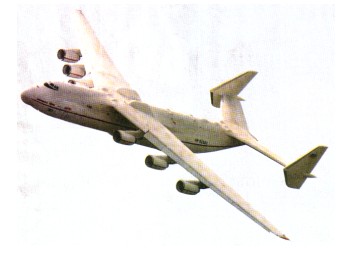
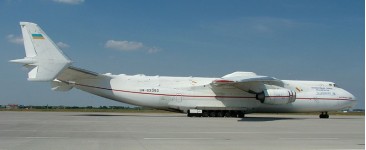
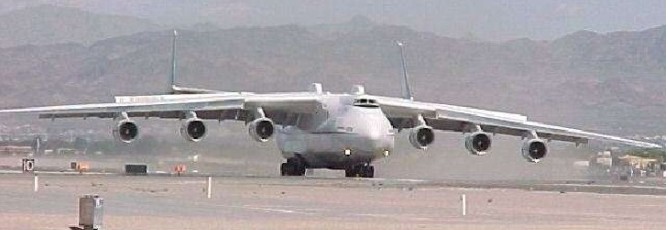
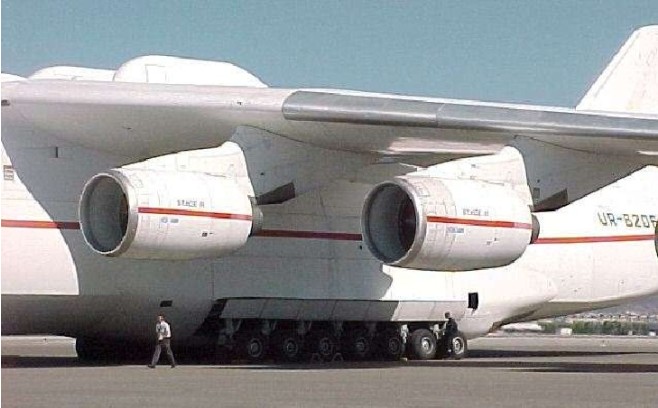
The An-225 Mriya (dream) stemmed from the need to transport large items for the Soviet space programme. In mid-1985 Antonov began the design and the An-124 provided the basis for the new aircraft, Antonov using many of the same components to keep cost and development effort down. Standard An-124, wings are grafted on to a new centre section, thereby increasing the span while keeping the engine installations the same. An additional pair of D-36T turbofans is fitted to the new centre section.
The cabin retains the same cross-sectional dimensions but with increased length, and to save weight the rear loading ramp is removed, but the An-225 retains the nose visor.
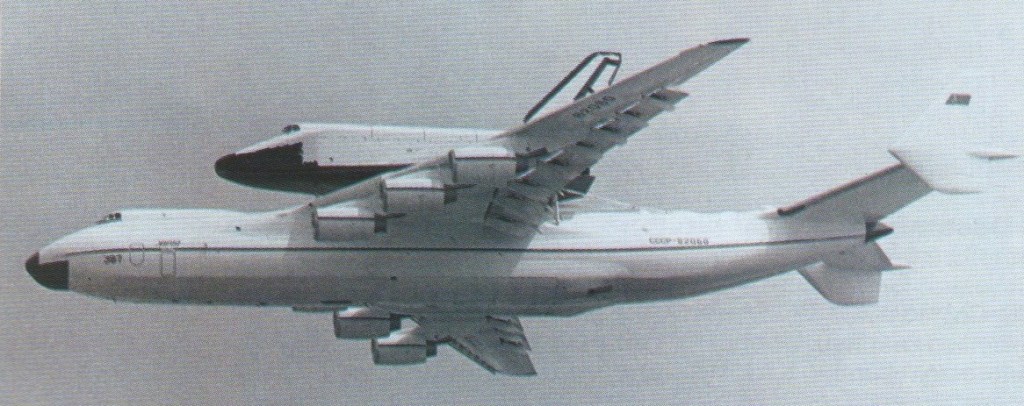
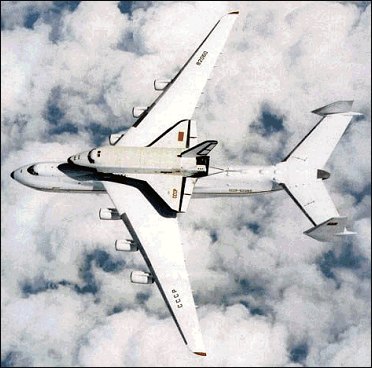
To support the increased weight, seven pairs of wheels are fitted to each side as opposed to five in the An-124. Outsize loads are carried ‘piggy-back’, the load supported on two main attachments above the centre section. These supports and other smaller ones along the fuselage top are faired over when not in use. To avoid buffeting from the ‘piggyback’ load, the An-225 has twin vertical fins mounted on the end of a large tailplane.
The prototype made its first flight on 21 December 1988 from Hostomel Airport outside Kiev, Ukraine, and the first flew with Buran on 13 May 1989 from Baikonur cosmodrome. This combination appeared at the Paris air show in 1989, car¬rying the 62.1 tonne (136,684 lb) Buran on its back.
On 22 March 1989, in the course of a single 3 hr 30 minute flight from Kiev, the An-225 set 105 world and class records. With a payload of 344,576 lb / 156,300 kg, the machine took off at a weight of 1,120,370 lb / 508,200 kg. It proceeded to fly a 1243 mile / 2000 km closed circuit at an average speed of 505.24 mph / 813.09 kph and to reach a maximum altitude of 40,485 ft / 12,340 m.
Typically, the An-225 carries two pilots, two flight engineers and two navigators, the flight system incorporating fly-by-wire controls. NATO name Cossack.
The Antonov An-225 has been extensively modified since 1988 with its six engines being updated and a strengthened fuselage being among the many changes.
The first commercial flight was performed by the An-225 in May, 1990. A T-800 tractor weighing more than 100 tons was delivered from Chelyabinsk to Yakutia.
After the collapse of the USSR the only plane stopped flying in 1994 and some parts were disassembled to be used on other planes. However by the 2000s it was restored by efforts of some Ukrainian companies. The airliner was amended a bit to meet the standards of civil aviation first flying aain on the 7th of May, 2001.
Antonov planned to finish building a second An-225 if they have financial support. 70% was ready; the centre wing-section, fuselage and a wing remained since the Soviet times. If they had a customer they would finish it, requiring $150 million.
An-225 Mriya (Cossack) Engines: 6 x ZMKB Progress (Lotarev) D-18T turbofan, 225140 N / 22950 kp / 51,587lbs thrust Length: 84.0 m / 275 ft 7 in Height: 18.2 m / 59 ft 9 in Wingspan: 290 ft / 88.4 m Wing area: 905.0 sq.m / 9741.33 sq ft Empty Weight: 385,809lbs (175,000kg) Maximum Take-Off Weight: 1,322,774lbs (600,000kg) Max. weight carried: 661500.0 lb / 300000.0 kg Wing load: 128.74 lb/sq.ft / 628.0 kg/sq.m Maximum Speed: 528mph (850kmh; 459kts) Landing speed: 135 kts / 250 km/h Cruising speed: 432 kts / 800 km/h Range w/max.fuel: 15400 km / 9569 miles Range w/max.payload: 4500 km / 2796 miles Service Ceiling: 36,089ft (11,000m) Internal cargo hold: 43m x 6.4m x 4.4m. Crew: 4-6 +23
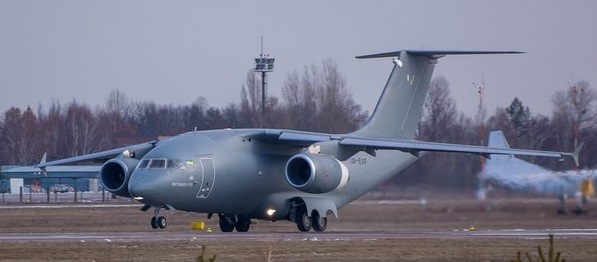
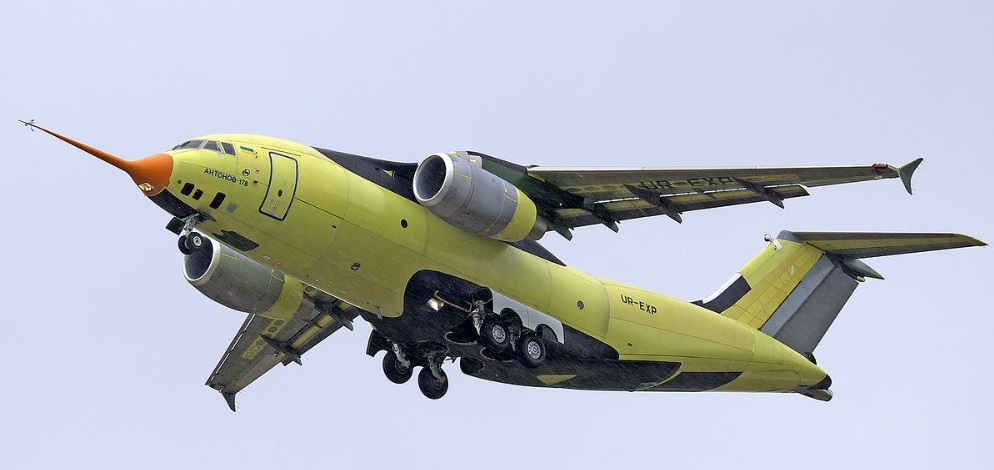
The Antonov An-178 (Ukrainian: Антонов Ан-178) is a short-range medium-airlift military transport aircraft designed by the Ukrainian Antonov company and based on the Antonov An-158 (An-148-200).
An-178 is a high-wing transport aircraft with moderately swept wing, winglets and a T-tail. The wing outer panels (including winglets), front fuselage with cockpit and nosewheel leg come from the An-158. The cargo hold is slightly enlarged, and there is an extra pair of main-wheels on each side. The airframe is made of aluminium alloys and composite materials. The fuselage is semi-monocoque with a circular cross-section. The retractable landing gear consists of two main wheel bogies and a dual nose wheel. The flight control system is dual duplex fly-by-wire system, consisting of two parts: FCS-A and FCS-B, each of which is responsible for two control channels. The flight control surfaces include ailerons near the wing tips, four control spoilers, six lift-dump/speed-brake spoilers, rudder and elevators, with an emergency mechanical cable back-up system. The powerplant consists of two Progress D-436-148FM turbofan engines, mounted on pylons under the wings and an auxiliary power unit. It can shift 18 tonnes over 1,000 km, or 10 tonnes over 4,000 km.
The aircraft was derived from the 99-seat An-158 regional airliner and was fitted with the commonized F1 fuselage nose section with the identical flight deck, wing panels, empennage and most of the onboard systems. The fuselage however was newly created with an enlarged diameter that had grown from 3.35 m to 3.9 m, which has resulted in an enlarged cargo hold – the cargo cabin cross section increased to 2.75 m by 2.75 m. Aside from the wing structure, outer panels (including winglets), front fuselage nose, cockpit and nose landing gear which come from the An-158, there is an extra pair of tandem main-wheels on each side.
The An-178 was previously known as the An-148T. The aircraft made its Western debut at the 2015 Paris Air Show.
It was announced on 5 February 2010, rolled out on 16 April 2015 and the maiden flight was on 7 May 2015.
There are reports that future production-standard aircraft will have a longer wingspan while retaining the organic wing panels of the An-158. Its maximal take-off weight would increase to an estimated 56 tons. Later production variants would need turbofan engines with a thrust of about 9,500 kgf to have the characteristics required. The planned engine may be the new-generation in-development Ivchenko-Progress AI-28 turbofan. The decision was made to fit the An-178 prototype with less powerful D-436-148FM engines in the interim. The D-436-148FM is a derivative of the production-standard D-436-148 with an upgraded fan, which boosted the takeoff thrust to 7,800 kgf and at emergency power rating to 8,580 kgf.
Powerplant: 2 × Progress D-436-148FM Turbofan, 73.55 kN (16,534 lbf) Wingspan: 30.57 m (100 ft 4 in) Length: 32.23 m (105 ft 9 in) Height: 9.57 m (31 ft 5 in) Max takeoff weight: 51,000 kg (112,436 lb) Fuel capacity: 14,650 kg (32,298 lb) Max landing weight: 47,000 kg (103,617 lb) Maximum speed: 990 km/h (620 mph, 530 kn) Cruise speed: 825 km/h (513 mph, 445 kn) Range: 4,700 km (2,900 mi, 2,500 nmi) Ferry range: 5,300 km (3,300 mi, 2,900 nmi) Service ceiling: 12,000 m (39,000 ft) Landing distance: 2,500 m (8,200 ft) Crew: 2 Capacity: 90 soldiers, 70 paratroopers, 48 on stretchers +15 seated, 8 medical modules and 12, or 16 tons of cargo, overload variant 18 tons.
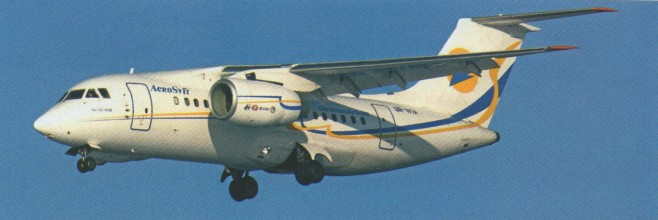
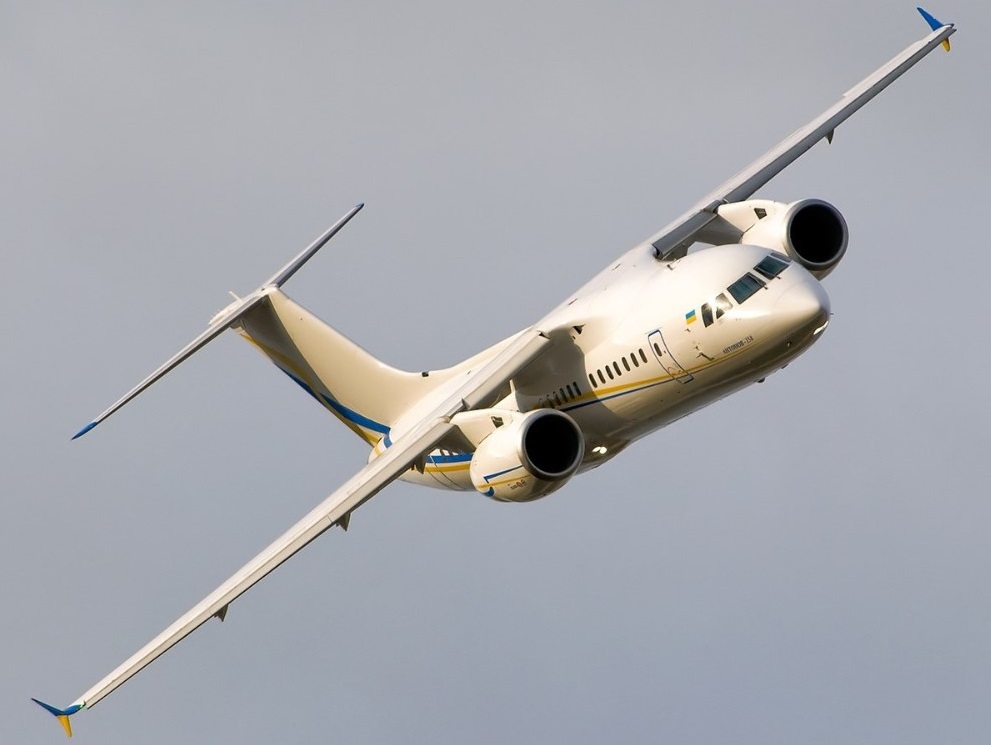
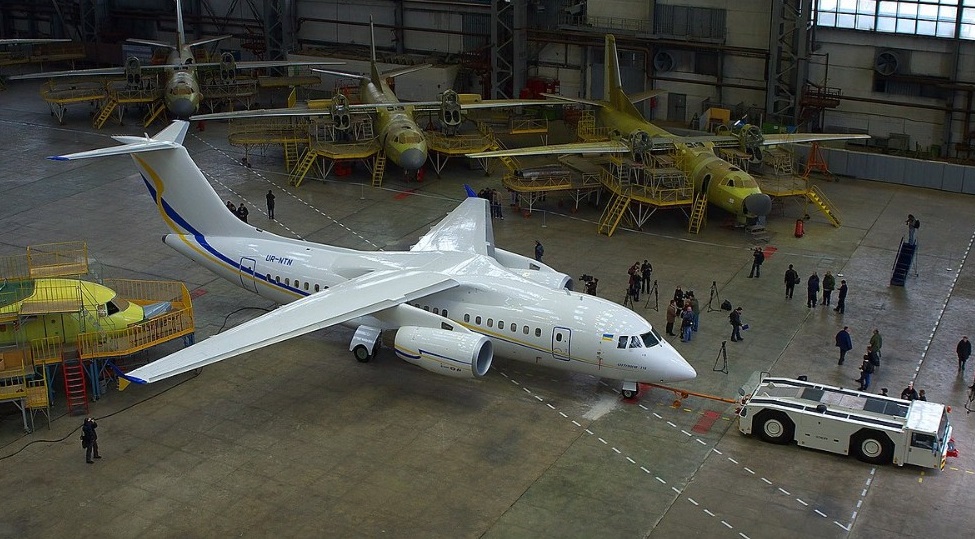
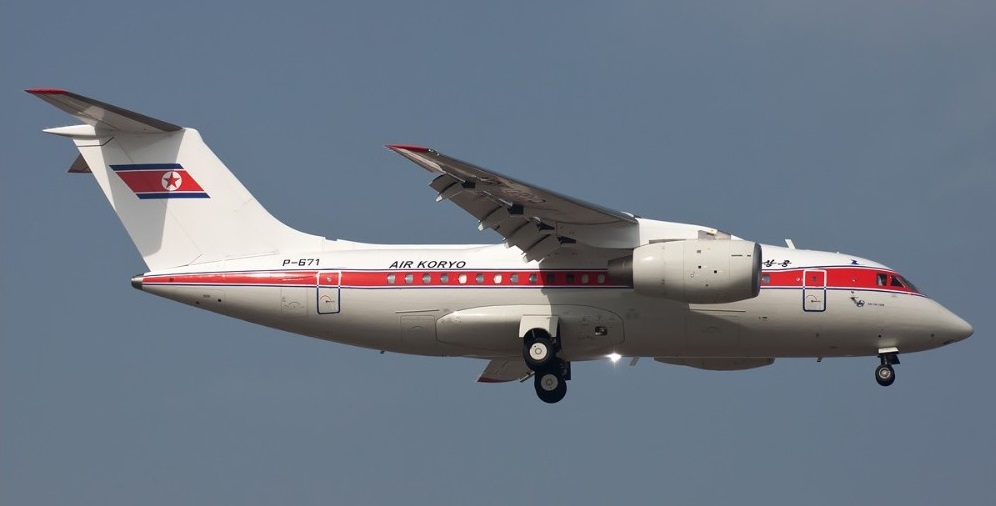
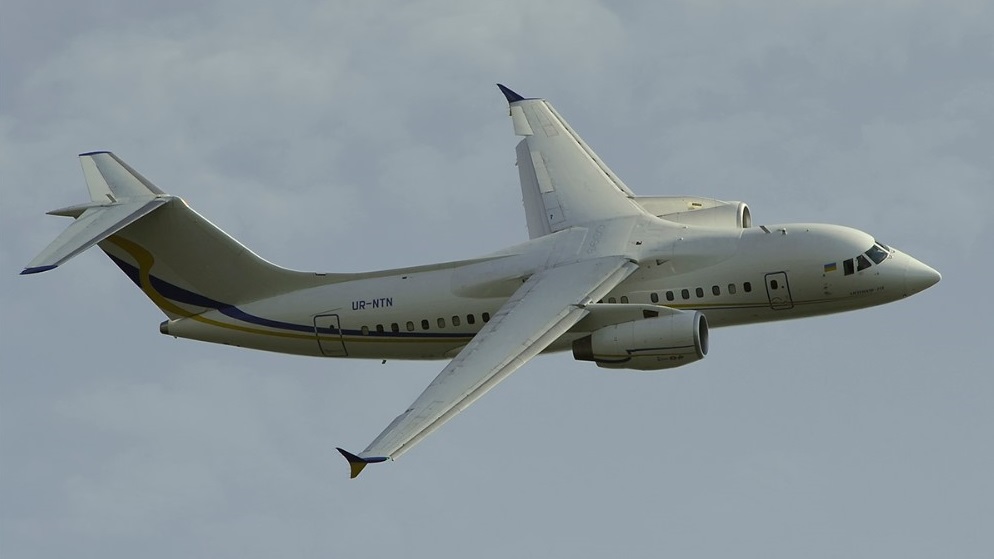
The Antonov An-148 (Ukrainian: Антонов Ан-148) is a regional jet designed and built by Antonov of Ukraine.
The beginning of the An-148 project dates to the early 1990s, when work on the Antonov An-74 passenger modification started, headed by Petro Balabuev. In 2001, the project was renamed An-148. The An-74 fuselage was extended and the new aircraft’s wing design was created from scratch. The developers initially used Motor Sich D-436-148 engines.
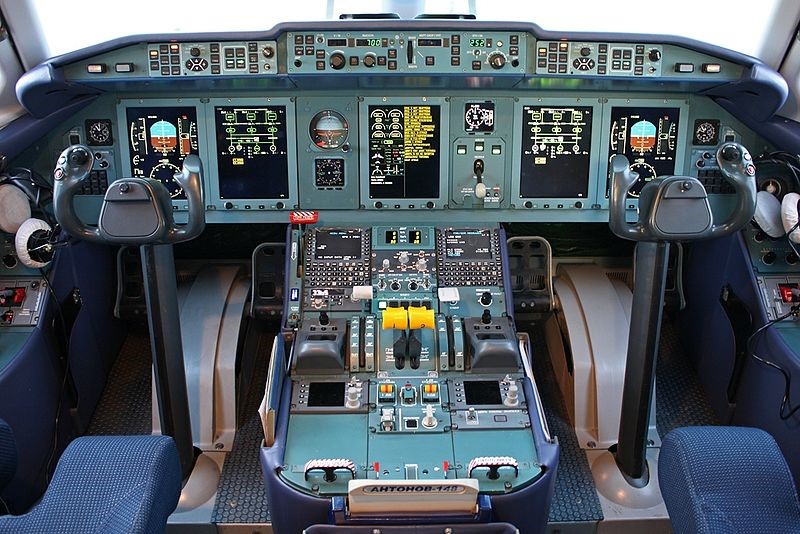
The An-148 aircraft is a high-wing monoplane with two turbofan jet engines mounted in pods under the wing. This arrangement protects the engines and wing structure against foreign object damage. A built-in autodiagnosis system, auxiliary power unit, and the wing configuration allow the An-148 to be used at poorly equipped airfields. Flight and navigation equipment features five 15 by 20 cm (5.9 by 7.9 in) liquid crystal display panels built by Russia’s Aviapribor and a fly-by-wire system.
The main landing gear rotates into the belly of the aircraft when in flight, with partial doors covering the legs, and the sides of the tires remaining exposed. Built-in entrance stairs enable boarding and disembarking the aircraft without extra ground equipment.
The An-148-100 regional aircraft is the main model of the An-148. It seats 70 passengers at 864 mm (34.0 in) or up to 80 passengers at 762 mm (30.0 in) pitch in a one-class 2+3 seating layout. The aircraft is also configurable in a multiple-class layout which can carry fewer passengers, typically with four abreast business class.
In 2002, production of the first three prototypes was begun at AVIANT. On 17 December 2004, the first prototype completed its maiden flight. The second prototype joined the testing programme in April 2005. During the certification programme, the two prototypes performed about 600 flights in total. On 26 February 2007, the aircraft, its D-436-148 engine and the AI-450-МS auxiliary power unit were certified by the Interstate Aviation Committee of Russia and the State Aviation Administration of Ukraine.
The first prototype. It made its maiden flight on 17 December 2004.
The aircraft completed its certification programme on 26 February 2007. The An-148 has a maximum range of 2,100–4,400 km (1,100–2,400 nmi; 1,300–2,700 mi) and is able to carry 68–85 passengers, depending on the configuration.
The An-148 was manufactured by the Ukrainian Kyiv AVIANT plant (now Antonov Serial Production Plant) and Russia’s Voronezh Aircraft Production Association (VASO). On 28 June 2009, the first serially produced An-148, manufactured at VASO in Voronezh, took to the skies. Although numerous companies are involved in the project, at least 70% of the aircraft’s hardware is made by Russian manufacturers. The An-148’s list price is about $24–30 million. The main problem with the project has been increasing the aircraft’s sluggish production rate. The then-independent AVIANT plant initially failed to satisfy to growing orders, leading to VASO’s growing involvement in the aircraft’s assembly. VASO announced in June 2017 that the two final Russian-assembled An-148s would be delivered, and the project would not see further development.
In April 2005, the Ilyushin Finance Leasing Company ordered the first series of An-148 for the Krasair airline. Lease agreement calls for ten aircraft with an option for five units valued at $270 million.
The Antonov An-158 is a stretched fuselage version of the aircraft, accommodating up to 100 passengers.
An-158
The An-158 is a 1.7m stretched fuselage version for 99 passengers in a one-class standard configuration. Other changes include the installation of wingtip fences. The airplane successfully completed its first flight on 28 April 2010, with flight certification tests were planned to be completed before the end of 2010; on 3 March 2011, it was given Russian certification.
After flight and land test in night lands airports of Ecuador (Latacunga / Cotopaxi International Airport, 2806 m AMSL) and Bolivia (La Paz / El Alto International Airport, 4061 m AMSL) in November 2013 prepare documentation for obtaining correspondent supplements to the type certificate of this airplane.
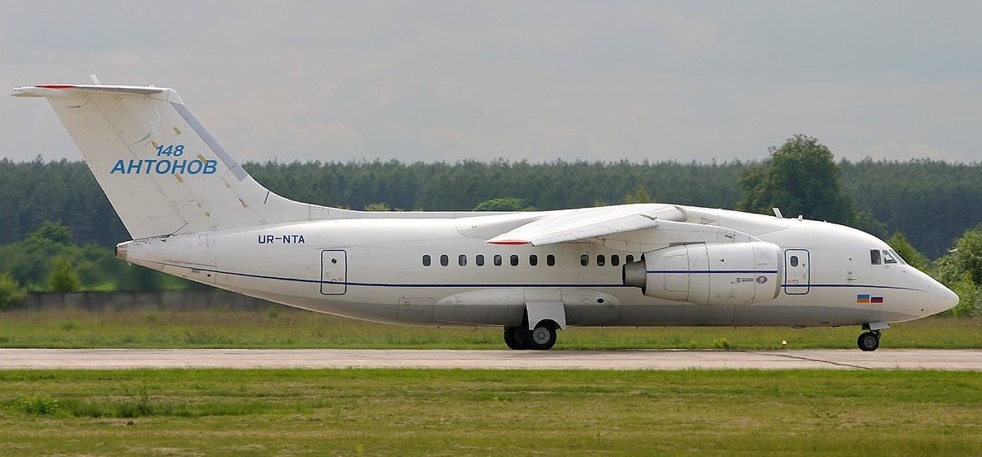
On 2 June 2009, the first An-148 entered commercial service with the Ukrainian carrier Aerosvit. The first passenger flight was from Kharkiv to Kyiv; the aircraft had the civilian registration UR-NTA. By November 2009, Aerosvit was operating the An-148 on the Kyiv–Odessa and Simferopol–Lviv routes, performing two flights a day with the average flight time of 4–5 hours.
On 21 December 2009, the An-148 was put into service in Russia with Rossiya airline. The first passenger flight was FV135 from Pulkovo Airport in Saint Petersburg to Sheremetyevo International Airport in Moscow. By 20 May 2010, Rossiya’s An-148 fleet had accumulated a total of 915 flight hours and performed 710 landings. Rossiya complained that the aircraft experienced some reliability problems. There were some technical problems with the aircraft, and pilot training could not be ramped up fast enough, leading to pilot shortages. However, by 2011 the situation had improved.
On 15 February 2010, the An-148 started international flights to the European Union (Poland) with the Aerosvit airline.
The first An-158 in April 2010
On 18 April 2013, the first serial An-158 version was delivered to the Cuban flagship airline Cubana de Aviación. According to Antonov, Cubana additionally ordered two more aircraft, while other sources report this order to be for ten aircraft. On 28 April 2013, Ukraine’s Antonov aircraft maker handed over a third An-158 passenger airliner to Cuba and signed a contract for the delivery of three more.
Following a crash in February 2018, all An-148 and An-158 in Russia were grounded by the Russian Ministry of Transport. In addition, Cubana grounded its An-158 fleet as of May 2018 due to several technical issues with the aircraft. Until late 2018, the Antonov An-148 aircraft was also being produced in Russia by Voronezh Aircraft Production Association; however, due to the souring political relationship between Ukraine and Russia, production in Russia was discontinued. The last Russian-built An-148 was completed in October 2018.
In April 2016, Indian company Reliance defense limited and Antonov entered into an agreement to construct an aircraft based on An 148/ An 158 for defense and commercial purposes.
In April 2017, Cubana de Aviación suspended its flights between Havana and Guantánamo due to “technical problems” with its An-158 fleet. The route from Havana to Holguín also had problems: of 116 planned flights in the first months of 2017, 38 were cancelled and 36 suffered significant delays. Yoanka Acosta, head of Cubana’s commercial division, explained that the planes were leased from Ukraine but spare parts were sourced from Russia, so the state of conflict between the two countries had affected the supply of parts, making maintenance difficult. In late April, however, representatives from Antonov and Cubana met and signed a service agreement that extended the aircraft’s navigation directives to 3,600 flights and guaranteed the supply of spare parts, although it did not specify a date for normalization.
In March 2018 Rostransnadzor suspended all flights of An-148 in Russia after crash on 11 February 2018.
In May 2018, Cubana de Aviación grounded its An-158 fleet after it received an order from the Cuban National Aviation Authority. The official reason given by the Cuban National Aviation Authority was “multiple and repeating failures have been found in complex systems, built by mechanical, hydraulic and electrical components, as well as computer performance algorithms”, in addition to “evidence of design and manufacturing flaws, serious issues in flight control system, cracks in the structure and engine temperature increase above normal parameters”.
On 5 March 2011, an Antonov An-148 (assembled by VASO) carrying test registration 61708 crashed during a test flight in Russia’s Belgorod Oblast after an inflight breakup, killing all six crew members on board. An investigation commission found that the crew permitted the aircraft to accelerate more than 60 knots above its “Never Exceed” speed in an emergency descent, which led to the inflight breakup. Witnesses on the ground reported a wing had separated from the aircraft in flight. The aircraft was due to be delivered to Myanmar.
On 11 February 2018, an Antonov An-148 operating as Saratov Airlines Flight 703, crashed shortly after takeoff near Ramenskoye, outside of Moscow. The aircraft was carrying 65 passengers and six crew members. There were no survivors. This is the first fatal commercial accident for this aircraft type.
At least 47 were built.
An-148-100B
An-158
Versions
An-148-100A main version of the An-148. It has a passenger capacity of 85 in a one-class dense configuration or 68 in a two-class configuration, and a range of 2,100 km (1,100 nmi; 1,300 mi)
An-148-100B extended-range version, up to 3,500 km (1,900 nmi; 2,200 mi)
An-148-100E extended-range version, up to 4,400 km (2,400 nmi; 2,700 mi) and a maximum takeoff weight (MTOW) of 43.7 t (43,700 kg; 96,000 lb)
An-148-200 unified with An-158 by the rear part of the fuselage. Hence maximum seating capacity is increased to 89 passengers in dense configuration, comparing to 85 for An-148-100. Planned for production in Kyiv with An-158.
An-148-300 previously called An-168, business variant, seating 8-40 passengers, with a range up to 7,000 km (3,800 nmi; 4,300 mi)
Specifications:
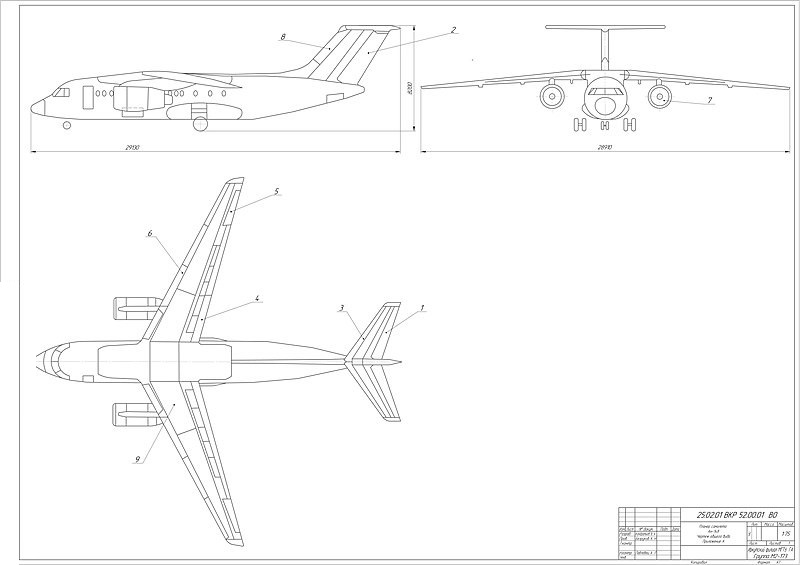
148-100E Engines: 2 x Progress D-436-148, 14,000 lbf; 63 kN Wingspan: 28.91 m (94 ft 10 in) Wing area: 87.32 m2 (939.9 sq ft) Length: 29.13 m (95 ft 7 in) Height: 8.19 m (26 ft 10 in) MTOW: 43,700 kg (96,300 lb) Max. payload: 9,000 kg (20,000 lb) OEW: 22,000 kg (49,000 lb) Max. fuel: 12,050 kg (26,570 lb) Ceiling: 12,200 m (40,000 ft) Cruise: 800 to 870 km/h (430 to 470 kn) Range (75 pax/max): 4,400 km (2,400 nmi) Fuel burn: 1,650 kg/h (3,600 lb/h) Take off run (MTOW): 1,885 m (6,184 ft) Seats: 68–85 Seat pitch: 30–35 in Cargo: 14.60 m3 (516 cu ft) Cabin: 3.15 m (10 ft 4 in) width × 2.00 m (6 ft 7 in) height Cockpit crew: 2
An-158 Engines: 2 x Progress D-436, 15,100 lbf; 67.0 kN Wingspan: 28.91 m (94 ft 10 in) Wing area: 87.32 m2 (939.9 sq ft) Length: 30.83 m (101 ft 2 in) Height: 8.19 m (26 ft 10 in) MTOW: 43,700 kg (96,300 lb) Max. payload: 5,000 kg (11,000 lb) OEW: 22,000 kg (49,000 lb) Max. fuel: 12,050 kg (26,570 lb) Ceiling: 12,200 m (40,000 ft) Cruise: 800 to 870 km/h (430 to 470 kn) Range (75 pax/max): 2,500 km (1,300 nmi) Fuel burn: 1,800 kg/h (4,000 lb/h) Take off run (MTOW): 1,900 m (6,200 ft) Cockpit crew: 2 Seats: 86–99 Seat pitch: 30–34 in Cabin: 3.15 m (10 ft 4 in) width × 2.00 m (6 ft 7 in) height
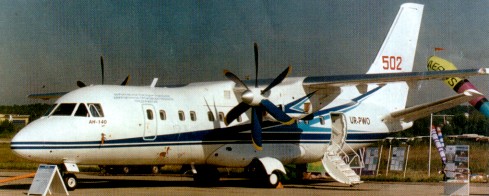
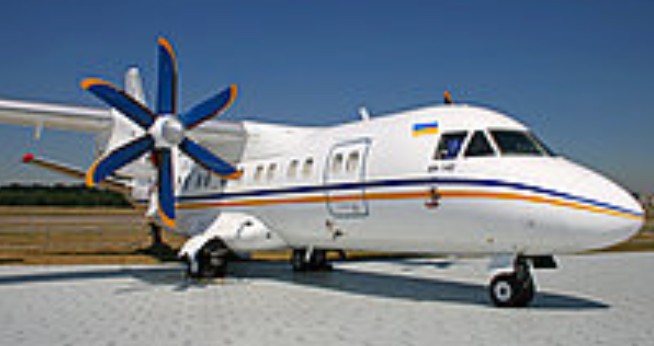
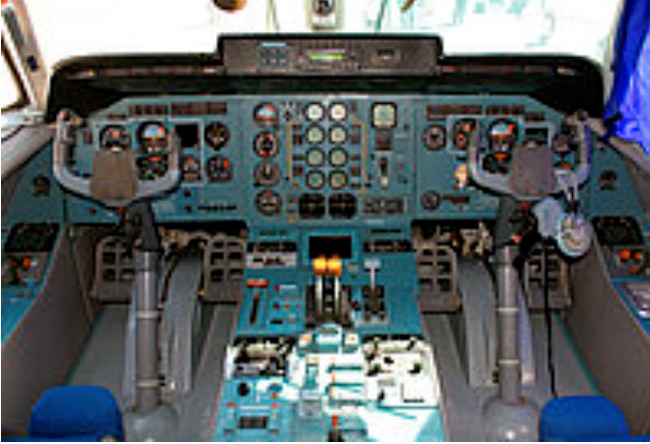
The An-140 (first flown September 1997) short-haul regional airliner was planned to supersede the An-24. An agreement for licence production by Iranian Aviation called ‘Iran-140’ was signed in 1993. The first aircraft, supplied as a kit, flew on 7 February 2001.