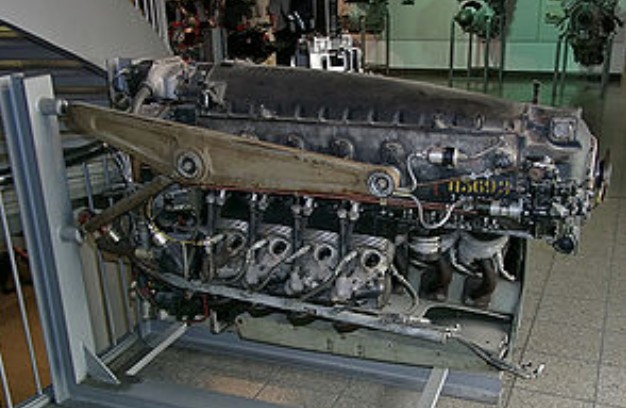
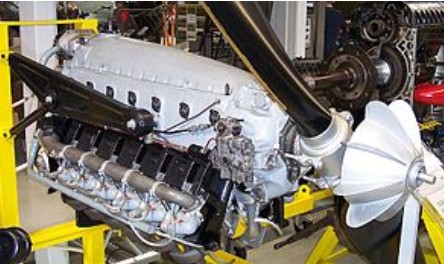
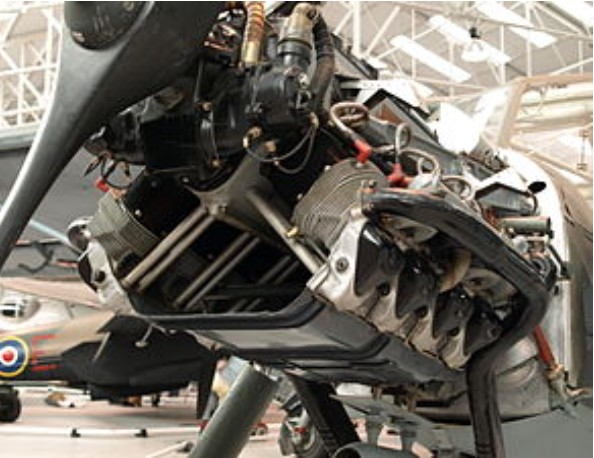
A twelve-cylinder, air-cooled, inverted-V aircraft engine developed by Argus Motoren in Germany during World War II , the As 411 was a refined and more powerful version of the Argus As 410. Most 411 production was undertaken by Renault in occupied Paris, these engines were used to power the Siebel Si 204 and the post war Dassault MD 315 Flamant. It developed 600 PS (592 hp, 441 kW) at 3,300 rpm.
Following the end of World War II, Renault continued to manufacture the engine as the Renault 12S. After merging the French aircraft engine manufacturers into SNECMA in 1945, production continued under the new designation SNECMA 12.
Approximately 2,600 were built.
Variants:
As 411 A refined and more powerful version of the Argus As 410.
Renault 12S Production of the As 411 after WWII in France.
SNECMA 12S; (a.k.a. SNECMA Renault 12T) Designation change on the formation of SNECMA.
SNECMA 12T (a.k.a. SNECMA Renault 12T) Refined version of the 12T with new pistons and cylinders, with a revised induction system.
Applications:
Arado Ar 96 Breguet 892 Mercure (4 × 12S) Dassault MD 315 Flamant Focke-Wulf Fw 189 Pilatus P-2 Siebel Si 204 Sud Ouest S.O.93
Specifications:
As 411 Type: 12-cylinder inverted 60-degree Vee Dry weight: 385 kg (849 lb) Cooling system: Air-cooled Power output: 600 PS (592 hp, 441 kW) at 3,300 rpm Compression ratio: 6.4:1
The engine marked a departure from earlier Argus engines in that it had new construction techniques which gave the engine greater operating speeds and power. The engine featured smaller 105 mm x 115 mm cylinders with deep finned steel cooling slots, aluminum heads, geared supercharger,a steel alloy crankshaft and a magnesium alloy crankcase. The engine weighed approximately 315 kg and produced 465 PS (459 hp, 342 kW) at 3,100 rpm. First run in 1937, approximately 28,700 engines were produced.
A distinctive feature is the finned spinner ahead of the propeller. This is driven by the airflow as a windmill, and used to power the actuator of the variable pitch propeller.
The more powerful and refined Argus As 411 was developed from it.
Applications:
Arado Ar 96 Focke-Wulf Fw 189 Pilatus P-2 Argus Fernfeuer
Specifications:
Argus 410 Type: 12-cylinder air-cooled inverted V engine Bore: 105 mm (4.13 in) Stroke: 115 mm (4.52 in) Displacement: 11.9 L (729 cu in) Dry weight: 315 kg (694 lb) Fuel system: Carburetor Cooling system: air Power output: 465 PS (459 hp, 342 kW) at 3,100 rpm
The Argus As 10 is a German-designed and built, air-cooled 90º cylinder bank angle inverted V8 “low power” inline aircraft engine, used mainly in training aircraft such as the Arado Ar 66 and Focke-Wulf Fw 56 Stösser and other small short range reconnaissance and communications aircraft like the Fieseler Fi 156 Storch during and shortly after WWII. It was first built in 1928.
Approximately 28,700 were built.
Variants As 10C
As 10E Optional output version of the As 10C, delivered with either 240 hp (179 kW) or 270 hp (201 kW) rating (achieved by increasing maximum rpm).
As 401 Supercharged As 10 with rated output at 3,000 m (9,843 ft), also fitted with hydraulically actuated variable pitch airscrew.
Applications:
Arado Ar 66 Arado Ar 76 Dornier Do 12 Fieseler Fi 156 Storch Focke-Wulf Fw 56 Stösser Focke-Wulf Fw 58 Gotha Go 145 Henschel Hs 121 Klemm Kl 151 Messerschmitt Bf 108 Taifun Kayaba Ka-1 Imperial Japanese Army Observation autogiro Rogozarski SIM-XIV-H
Specifications:
Argus As 10 C/3 Type: inverted V-8, air-cooled, 90° piston engine Bore: 120 mm (4.72 in) Stroke: 140 mm (5.51 in) Displacement: 12.667 l (772.99 cu in) Length: 1,105 mm (43.50 in) Width: 880 mm (34.65 in) Height: 936 mm (36.85 in) Dry weight: 213 kg (470 lb) dry Valvetrain: Two valves per cylinder. Fuel system: Two Sun carburetors adapted for aerobatics Fuel type: 80 octane Oil system: Dry sump, one pressure pump and two scavenge pumps Cooling system: Air Power output: 179 kW (240.04 hp) at 2,000 rpm Specific power: 14.8 kW/L (0.31 hp/in³) Compression ratio: 5.9:1 Specific fuel consumption: 235 gr/(hph); 0.518 lb/(hph) Oil consumption: 0.010 kg/kW/hr (0.0176 lb/hp/hr) Power-to-weight ratio: 0.835 kW/kg (0.51 hp/lb)
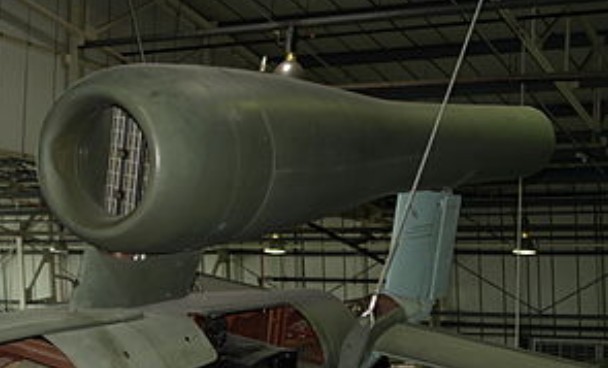
The Argus As 014 (also known as the 109-014 by the RLM) was a pulse jet engine used on the German V-1 flying bomb of World War II, and the first model of pulsejet engine placed in mass production.
The origins of the Argus As 014 lie in 1928, when Munich inventor Paul Schmidt began work on a new design of pulse jet engine. Schmidt received a patent on his design in 1931 and received support from the German Air Ministry in 1933. In 1934, along with Professor Georg Madelung, Schmidt proposed a “flying bomb” to be powered by his pulse jet to the Ministry and received a development contract the following year. In 1938 he demonstrated a pulse jet–powered pilotless bomber, but the project was shelved by the Air Ministry as the prototype lacked range and accuracy and was expensive to construct. That same year, however, the Argus Company began work on a flying bomb using Schmidt’s engine (first running in 1941). Schmidt later joined Argus in 1940.
A model of simplicity and low cost, the engine was made from a sheet of mild steel rolled into a tube. At the front of the engine there was a spring flap-valve grid (shutters), a fuel inlet valve and an igniter. It could run on any grade of petroleum fuel and its shutter system was not expected to last longer than one flight, as it had an operational life of approximately one hour. The engine was a resonant jet which, contrary to popular legend, could operate while the V-1 was stationary on its launch ramp.
Ignition was accomplished by an automotive-type spark plug located about 2.5 ft (0.76 m) behind the shutter system, electricity to the plug being supplied from a portable starting unit. Three air nozzles in the front of the pulse jet were connected to an external high pressure air source which was used to start the engine. Acetylene was used for starting, and very often a panel of wood or similar was held across the end of the tailpipe to prevent the fuel from diffusing and escaping before ignition was complete.
Once the engine had been started and the temperature rose to the minimum operating level, the external air hose and connectors were removed and the resonant design of the tailpipe kept the pulse jet firing. Each cycle or pulse of the engine began with the shutters open; fuel was injected behind them and ignited, and the resulting expansion of gases forced the shutters closed. As the pressure in the engine dropped following combustion, the shutters reopened and the cycle was repeated, roughly 45 to 55 times per second. The electrical ignition system was used only to start the engine – a V-1 carried no coils or magnetos to power the spark plug once launched.
Since the engine was rather simple, low-grade gasoline could be used and a good amount of thrust — 2.7 kN (660 lb) — was produced, but it was inefficient, limiting the range of the V-1 to 150–250 miles. The resonant frequency of this combustion process was around 45 Hz, giving the V-1 its nicknames “buzz bomb” or “doodlebug”, because of the sputtering sound it emitted. The prototype engine was tested while slung below a Gotha Go 145 Luftwaffe training biplane in April 1941 and the first prototype V-1 flew on December 24 of 1942. The As 014, as well as the higher thrust As 044 pulsejet engine, was also under consideration as a power source for various last-ditch German fighters in the closing days of World War II. Production totaled 31,100 units.
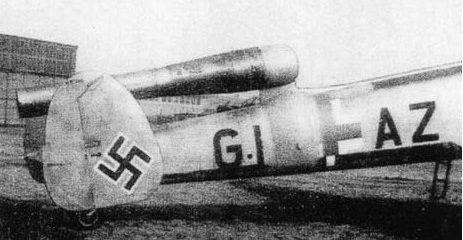
Me-110 fitted with Argus 014 pulsejet
License manufacture of the As 014 was carried out in Japan in the latter stages of World War II, as the Ka10, and as the American-made reverse-engineered Ford PJ31 in the United States, for powering the Republic-Ford JB-2 Loon cruise missile and the experimental USAAF-developed JB-4 television-guided bomb.
After the Second World War the As 014 was reverse-engineered / copied by Soviet Union as the Chelomey D-3 on the 10Kh (Fieseler Fi 103 look-alike).
The Planes of Fame Aeronautical Museum in Chino, California, houses what is believed to be the only operational As 014 in the world. It was restored into full operational status sometime in 2005 and retains the original valve system. The engine was run on a trailer during the annual 2009 Planes of Fame air show, the engine was used to push the trailer and the truck towing it at a speed of around 30 mph.
The V-1 flying bomb held by the London Science Museum features a sectioned As 014 engine.
Applications:
Fieseler Fi 103 Fieseler Fi 103R (Reichenberg) Junkers EF 126 Messerschmitt Me 328
Specifications:
As 014 Type: Pulse jet Length: 3,350 mm (132 in) Diameter: Dry weight: Compressor: None Fuel type: Petrol Maximum thrust: 2.7 kN (660 lbf)
Argus Motoren was a German manufacturing firm known for their series of small inverted-V engines and the V-1 (flying bomb) pulse jet engine.
Started in Berlin in 1906 as a subsidiary of Henri Jeannin’s automobile business, Argus Motoren company spun off entirely in November 1906. Their early products were car and boat engines, but later that year they were contracted to produce engines for the French airship, Ville de Paris, supplying them with a converted boat motor. They turned increasingly to the aviation market, and were widely used by 1910, receiving an order from Sikorsky for one of his large airplanes under construction in Russia. During World War I Argus produced engines for the German army and air corps.
After WWI the company manufactured automobile engines and acquired a majority interest in Horch Automobile in 1919. In 1926 they resumed aircraft engine design, producing a series of inverted inline and V engines. Although all were at the “low-power” end of the market by the start of World War II, they saw extensive use in training aircraft and other utility roles. Most famous of these designs are the Argus As 10, used in the Fieseler Fi 156 Storch, in the Arado Ar 66 and in the Focke-Wulf Fw 56 Stösser; and the Argus As 410, used on many German trainers, including the Arado Ar 96.
The Berlin-Reinickendorf subcamp of Sachsenhausen concentration camp provided labor for the Argus-Werke.
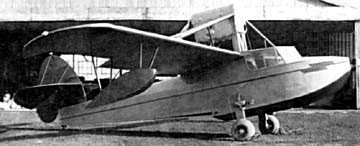
Three-seat monoplane amphibian, with Menasco Pirate engine Donald G. White of Buffalo, New York, formed a White Aircraft Inc in 1939 to continue production, in modified form, of the Pirate amphibian designed and built previously by Argonaut Aircraft Inc.
The 1934 H-20 Pirate three seater prototype NX14760 c/n H20-100 was powered by a 120hp Curtiss Crusader, later 125hp Menasco and cost $4,975.
The one H-24 Pirate NX/NC15682 c/n H24-500 (ATC 650), designed by Howard J Heindell, was built in 1935 and cost $4,995.
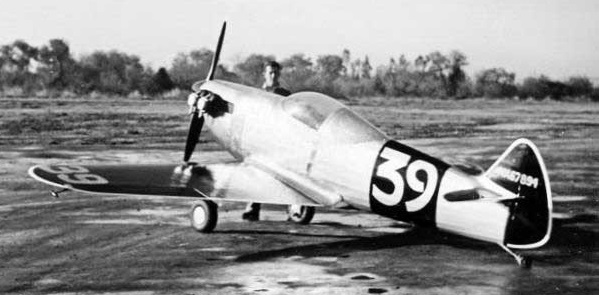
Circa 1947, Mike Argandar at Rosemead Airport behind the midget racer he built.
“Mike Argandar” built a midget racer circa 1947 but at age 31, on July 25, 1948 was killed Rosemead Airfield, Rosemead, Los Angeles County, California, United States, in a crash of that plane.
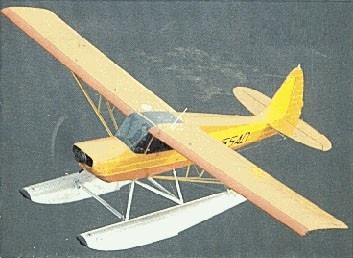
In 1969, production of the Interstate Cadet was resurrected by Bill and Jan Diehl, owners of Arctic Aircraft Co. in Anchorage, Alaska. The one family operation has modified the Cadet to become a lightweight bush plane. Installation of a 150-hp Lycoming engine has markedly increased performance and useful load. Large, high flotation tires permit safe landings on beaches or riverbeds. Construction is of chromoly tubing covered with Dacron. All control cables, brake cables, fuel lines, are completely exposed. The revived Cadet, now dubbed the S2B2, has been certificated for aerobatics, and even snap maneuvers are approved.
Engine: Lycoming 150 hp Gross wt. 1,900 lb Empty wt. 1,100 lb Fuel capacity 40 USG Top speed: 115 mph Cruise speed: 110 mph Stall: 39 mph Range: 650 mi Initial climb rate: 1,000 fpm Takeoff run: 350 ft
A successor to the L6 Grasshopper of WW2, the S.1 BE is a strut-braced high-wing monoplane known as the Arctic Tern, a developed version of the Interstate S.1A, first flown in the 1950s.
The Tern aka Interstate S-1-B2 was 1975 continued production of Interstate L-6 (S-1-B1) revised for bush operations. Tooling and jigs re-acquired by Interstate Co in 1985. (No connection, nor similarity, between this and Rocheville-EMSCO Arctic Tern.)
Interstate S1B2 Tern Engine: Lycoming O-320-A2B, 150 hp. TBO: 2000 hrs. Prop: McCauley 2-blade, 72-in. Length: 24 ft. Height: 7 ft. Wingspan: 36.8 ft. Wing area: 186.2 sq.ft. Maximum takeoff weight: 1850 lbs. Standard empty weight: 1075 lbs. Maximum useful load: 775 lbs. Maximum landing weight: 1850 lbs. Wing loading: 9.97 lbs/sq.ft. Power loading: 12.3 lbs/hp. Maximum usable fuel: 240 lbs. Best rate of climb: 1275 @ 60 kts. Climb gradient: 765 ft/nm. ROC @ 8000 ft: 820 fpm. Service ceiling: 19,000 ft. Maximum speed: 103 kts. Stalling speed clean: 42 kts. Stalling speed flaps down: 28 kts. Turbulent-air penetration speed: 105 kts. Seats: 2. Fixed tail wheel under carriage. First built: 1975.
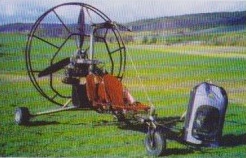
A twin engine two seat paraplane, the AB-Trike Twin is made up of stainless steel welded tubes, with two Solo engines powering one large propeller via a toothed belt. The machine is quiet enough to meet German regulations.
Empty weight: 65 kg Certification: vVz Engine: 2 x Solo 440, 35 hp Seats: 2 Price (1998): 10 900 DM