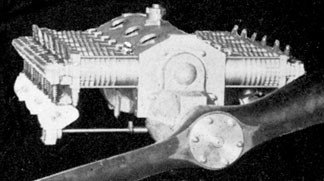
In 1908 the Ashmusen Mfg Co built a twelve-cylinder horizontally opposed, air-cooled aero engine weighing 345 lb dry. Of 596.4ci, it produced 105hp at 1800rpm.
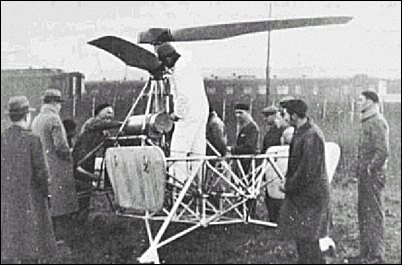
Hungarian engineer Oscar von Asboth, Director of the Austro-Hungarian State Propeller Factory, designed and tested four different helicopters. He worked alongside von Karman, and in particular was responsible for the development work on the rotors for the Petroczy-von Karman helicopter, and between 1928 and 1931, now working in Budapest, von Asboth tested various contra-rotating co-axial two-bladed rotors only 4.35m in diameter. Stability was achieved in the helicopters by the the air which the rotors directed on to six mobile surfaces round the horizontal hinges. These six ‘deflectors’ were operated by the pilot, using traditional aircraft controls. The fourth model, known as AH 4, had, instead of a Le Rhone 110hp rotary, a Clerget 130hp engine, which drove not only the rotors but also a tractor propeller. This rotorcraft in flying condition weighed 410kg, and could climb at a rate of 2m/s. By mid-1930 the aircraft reportedly attained an altitude of 30m and covered 3.2km at about 19km/h. About 1930 two missions, one British, the other French, went to Budapest to von Asboth. An expert in the British mission named Liptrot climbed to a height of 31m, and flew for a distance of 2800m. Von Asboth then completed his research particularly into his rotor system, the blades of which contained a movable part extending from the hub to the middle, and a fixed part from the middle to the tip of the blade. He then went to England, where the Blackburn Company became his licensee.
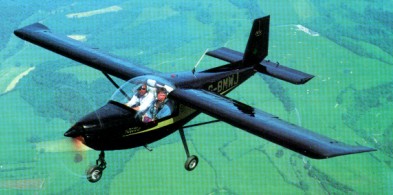
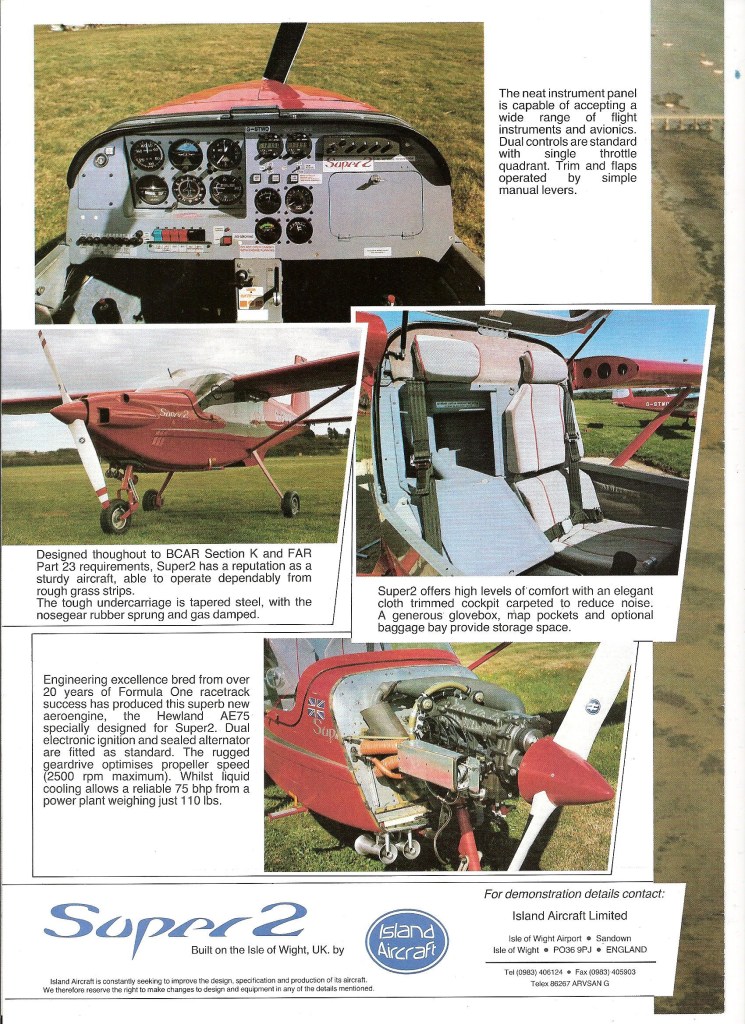
Richard Nobles design team aimed for an aircraft that was inexpensive to fly and buy; have two seats; should have an all-metal airframe; and be available as either factory assembled or as a simply assembled kit. The engine, custom-designed by Mike Hewland, is an inverted, inline three cylinder, 77 hp, water-cooled engine weighs in at 120 lbs with a 14 lb radiator located under the fuselage behind the cabin. It featured electronic ignition. The aircraft has been approved to United States FAR Part 23 requirements. The engine burns a two stroke mixture on a 40-1 ratio although testing has provided satisfactory performance throughout a range of 20-1 to 95-1. Fuel burn is around three gallons an hour, either an avgas or mogas mix with oil. The prototype, G OARV, made its first flight on 1lth March 1985 and was followed into the air by the second aircraft on 12th November. The fourth (004) was delivered in kit form to L.Wensley of Lincoln. The Super 2 was later developed into the Swedish, certificated, Opus 280 by ASL Hagfors. The Super 2 later became the Island Aircraft ARV-1 Super 2, then the Aviation Scotland ARV-1 Super2. Highlander Aircraft Corp offered Highlander two-seat monoplane in kit form circa 1997.
Back of an original sales brochure showing G-POOL – courtesy Martin Southwell
ASL Hagfors Aero AB of Sweden marketed a certificated version of the ARV Super 2 Highlander, as the Opus 280.
ARV Super 2 Engine: Hewland AE75, 77 hp Length: 18.045 ft / 5.5 m Height: 7.546 ft / 2.3 m Wingspan: 28.543 ft / 8.7 m Wing area: 92.57 sq.ft / 8.6 sq.m Max take off weight: 1102.5 lb / 500.0 kg Weight empty: 674.7 lb / 306.0 kg Max. weight carried: 427.8 lb / 194.0 kg Max. speed: 103 kt / 190 km/h Landing speed: 48 kt / 88 km/h Cruising speed: 86 kt / 160 km/h Initial climb rate: 590.55 ft/min / 3.00 m/s Service ceiling: 13123 ft / 4000 m Wing load: 11.89 lb/sq.ft / 58.0 kg/sq.m Range: 367 nm / 680 km Crew: 2