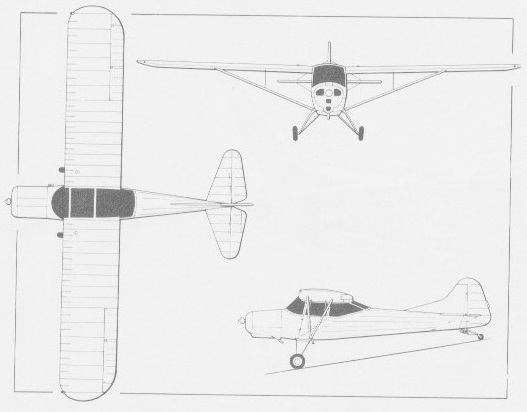
Beagle A.113 Husky / Auster A.113 / Auster D.4 / D.5 / D.6

A new range of Auster lightplanes appeared in early 1960. It included the two-seat D.4/108, three seat D.5/160 and /180 and four-seat D.6, all powered by Lycoming engines and featuring metal spars. The Auster D.6 was developed from the J/5V, but J/5V G-APUW did not have the metal spar and other refinements of the D.6

A total of 157 D.4 and D.5 had been sold by the beginning of March 1964.
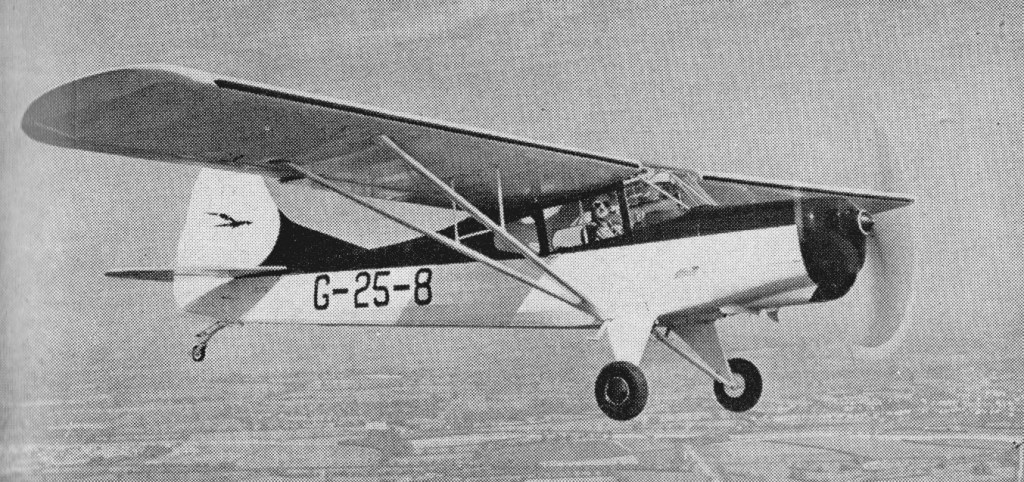
Prototype D.4

The 1961 types in the Auster range – D.4, D.5 and D.6 development of the Auster Alpha were announced with Lycoming engines, but since then the company was taken over by the Pressed Steel Co., Ltd., as part of its Beagle (British Executive and General Aviation, Ltd.) group. Beagle has announced that Rolls Royce/Continental powerplants will be installed in Auster/Beagle aircraft being developed under the direction of Mr. Peter Masefield.

Prototype D.6 / J/5V

The Beagle group had continued production of the Auster D.5/160 and Auster D.5/180, the latter as the A.113 Husky when fitted with a 134kW Lycoming O-360-A1A engine.

A major innovation of the D series was the use of metal wing spars which, with new low-flammability long-weathering plastic-based butyrate dope and paint finishes, made the D entirely suitable for use in the tropics. The D.4 was a two-seater with either a 9.75m or 10.98m wingspan and an 80, 112/119 or 134kW Lycoming engine; the D.5 was a three-seater offering the two wing spans but only the 119 and 134kW engines; and the D.6 was a four-seater with the greater wing span and engines as for the D.5.

The first production D.4/108 flew on 12 February 1960.

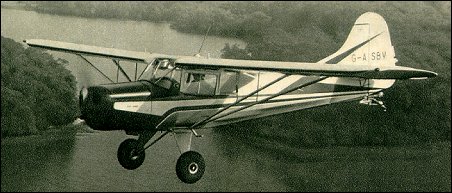
The first D.5/160 on 10 January 1960. Beagle developed the D5/160 as the “Beagle D5/180 Husky” with a 180 hp Lycoming O-360 engine, the first being G-ASBV first flown in 1962. A small number were sold until production was discontinued in 1967.

The first D.6/160 flew on 9 May 1960.
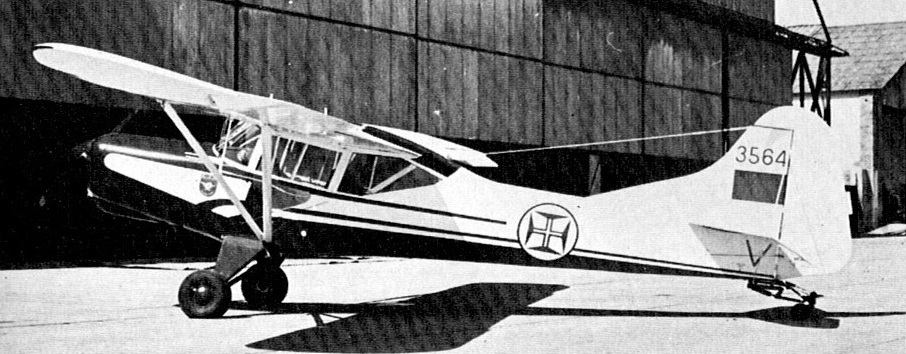
D5/160

133 examples (Auster D.5/160) were built by the Oficinas Gerais de Material Aeronáutico in Portugal from 1961 onwards; and the Portuguese Air Museum preserves two of these; one in flying condition.
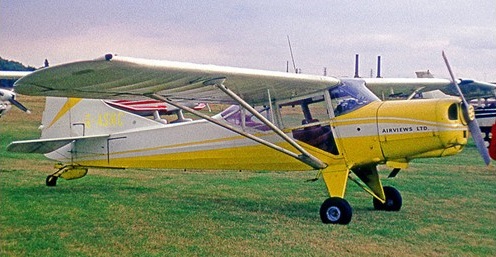
A.113 Husky

The designation “A.113” was only a design number and was not used in promotional material or in aircraft registrations with the Civil Aviation Authority where the term ‘D5/180’ was preferred. Additionally, the name Husky was only given to this version and not to the D5/160.

One Beagle Husky (XW635) was won by Sir Billy Butlin in a raffle and presented to the RAF’s Air Training Corps in 1969. It flew with No. 5 Air Experience Flight, flying air cadets from Cambridge Airport until it was retired in 1989 and sold to a civilian user.

Operators included the Burma Air Force, Portuguese Air Force, and Thai Border Patrol Police – One aircraft only.

Beagle-Auster D.4/108

Beagle-Auster D.5/160
Engine: 1 × Lycoming O-320-A2A, 160 hp (119 kW)
Wingspan: 36 ft 0 in (10.98 m)
Wing area: 185 ft² (17.2 m²)
Length: 23 ft 4½ in (7.13 m)
Height: 7 ft 11 in (2.41 m)
Empty weight: 1,450 lb (659 kg)
Loaded weight: 2,450 lb (1,114 kg)
Maximum speed: 125 mph (109 knots, 201 km/h)
Cruise speed: 108 mph (94 knots, 174 km/h)
Range: 460 mi (400 nmi, 741 km)
Service ceiling: 12,800 ft (3,900 m)
Rate of climb: 640 ft/min (3.3 m/s)
Crew: one pilot
Capacity: 2 passengers

D.5/180 Husky / A.113 Husky
Engine: 1 x Lyc. O-360-A2A, 132kW / 180 hp
Wingspan: 10.97 m / 36 ft 1 in
Length: 7.1 m / 23 ft 4 in
Height: 2.5 m / 8 ft 2 in
Take-off weight: 1090 kg / 2403 lb
Empty weight: 646 kg / 1424 lb
Max take off weight: 2400 lb / 1088kg
Range: 502 nm / 930 km / 580 mi
Max. speed: 206 km/h / 128 mph
Cruise speed: 177 km/h / 110 mph / 96 kt
Max ROC SL: 800 fpm / 245 m/min
Ceiling: 4420 m / 14,500 ft
Seats: 4
4 built

Beagle-Auster D.6/180

A.113
D.5/180 Husky

Beardmore Tornado

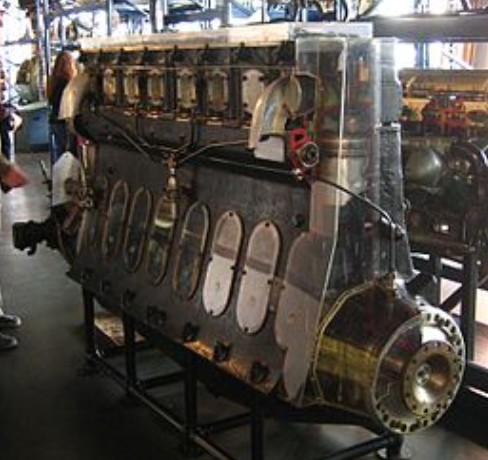
The Beardmore Tornado was an eight-cylinder inline aircraft Diesel engine built in 1929 by William Beardmore and Company of Glasgow, Scotland, and used in the British R101 airship when petrol engines were thought unsafe in the tropics. The model is given as Tornado IIIA or Tornado III C.I. The fuel is described as Diesel heavy-oil.

The engine was designed by combining two four-cylinder units used for railcars into the eight-cylinder (MkI) engine. These were intended to give an output of 700 bhp (520 kW) at 1,000 rpm but in practice had a continuous output rating of only 585 bhp (436 kW) with a maximum of 650 hp. At 17 tons for the five, they were six tons above design weight. The weight with the power car was over three tons per engine. The big end bearings were also found to be prone to early failure, and it was reported gold plating had to be used to lengthen their life. In addition, there were two critical vibration frequencies which coincided with idling and cruising speeds, to unfortunate effect.

The Tornado had steam cooling; water in the cylinder jackets was allowed to come to boiling point, and then condensed in three small triangular radiators on the hull above the power cars, or for the two midships engines was condensed in a retractable radiator and used to heat the passenger accommodation. Running the engines at a relatively high thermal temperature was expected to improve the specific fuel consumption. The Tornado engines used Ricardo petrol starting engines, and there had only been time to replace one with a Beverley heavy-oil starting engine (itself started by compressed air) on one Tornado.

The engines were intended to have reversing propellers, but they failed. At one point during development of R101, one engine was to be used for only astern running, at the start and finish of flights, a decision that astonished Nevil Shute and the other engineers on the R100 team. Later two engines were made reversible by an adjustment to the camshaft.

The R101 had five Tornado engines. The proposed R102 airship was to have seven engines of an improved version of the Tornado, having an output of 850 bhp (630 kW, maximum) or 700 bhp (520 kW, cruising, continuous). But the project was cancelled in 1931 after the crash of the R101. The R100 would have used the Tornado, but petrol engines were chosen to avoid delays.

Specifications:

Tornado III
Type: 8-cylinder liquid-cooled inline upright layout engine
Bore: 8.25 inches (210 mm)
Stroke: 12.0 inches (304.8 mm)
Displacement: 5,130.8 in3 (84.125 L)
Dry weight: 4,733 lb (2150 kg) bare engine, 8,580 lb (3890 kg) installed
Fuel type: Diesel heavy-oil
Cooling system: Water/steam cooling (see above)
Power output: 650 bhp (480 kw) at 935 rpm maximum; 475 bhp (350 kw) at 825 rpm cruise
Compression ratio: 12.25:1
Fuel consumption: 279 lb/hr maximum; 200 lb/hr cruise
Specific fuel consumption: 0.429 lb/bhp/hr maximum, 0.421 lb/bhp/hr cruise

Beardmore 160 hp

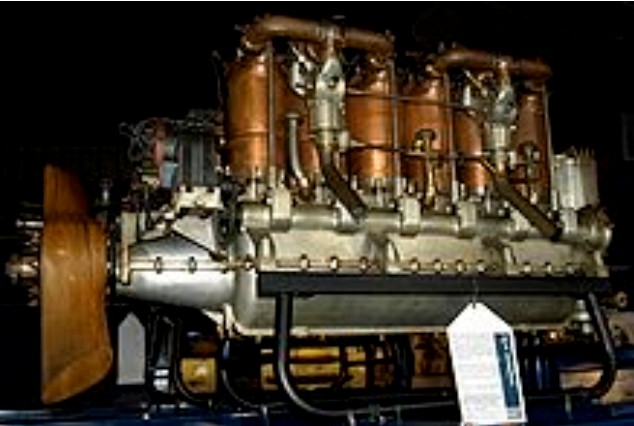
The Beardmore 160 hp is a British six-cylinder, water-cooled aero engine that first ran in 1916, it was built by Arrol-Johnston and Crossley Motors for William Beardmore and Company as a development of the Beardmore 120 hp, itself a licensed-built version of the Austro-Daimler 6.

The engine featured cast iron cylinders and mild steel concave pistons. Produced between March 1916 and December 1918, the design powered many World War I aircraft types. It was noted that the engine was not as reliable as its smaller capacity predecessor and had a unit cost of £1,045. A total of 2556 were built.

A Beardmore 160 hp has been restored to airworthy condition by The Vintage Aviator Ltd, an aircraft restoration company based in Wellington, New Zealand. The engine was found complete and in a preserved condition in a farm shed in Uruguay, after a complete overhaul and ground test runs the engine powered the company’s F.E.2b replica on its maiden flight.

Applications:
Airco DH.3
Armstrong Whitworth F.K.7
Austin Kestrel
Beardmore W.B.II
Beardmore W.B.X
Central Centaur IIA
Marinens Flyvebaatfabrikk M.F.6
Martinsyde G.102
Norman Thompson N.T.2B
Royal Aircraft Factory F.E.2
Royal Aircraft Factory R.E.7
Short Sporting Type
Supermarine Channel
Supermarine Sea King
Vickers F.B.14

Specifications (160 hp)
Type: 6-cylinder, inline, upright piston engine
Bore: 5.59 in (142 mm)
Stroke: 6.93 in (176 mm)
Displacement: 1,020 cu in (16.635 L)
Length: 57 in (1,148 mm)
Width: 19.9 in (505 mm)
Height: 31.9 in (810 mm)
Dry weight: 615 lb (279 kg)
Valvetrain: Overhead valve
Fuel system: Twin Zenith carburettors
Fuel type: Petrol
Oil system: Gear pump
Cooling system: Water-cooled
Reduction gear: Direct drive, right-hand tractor
Power output: 186 hp (139 kW) at 1,450 rpm (maximum power)
Specific power: 0.18 hp/cu in (8.74 kw/L)
Compression ratio: 4.56:1
Specific fuel consumption: 0.57 pints per hp/hr
Oil consumption: 0.3 pints per hp/hr
Power-to-weight ratio: 0.30 hp/lb (0.5 kW/kg)

Beardmore 120 hp

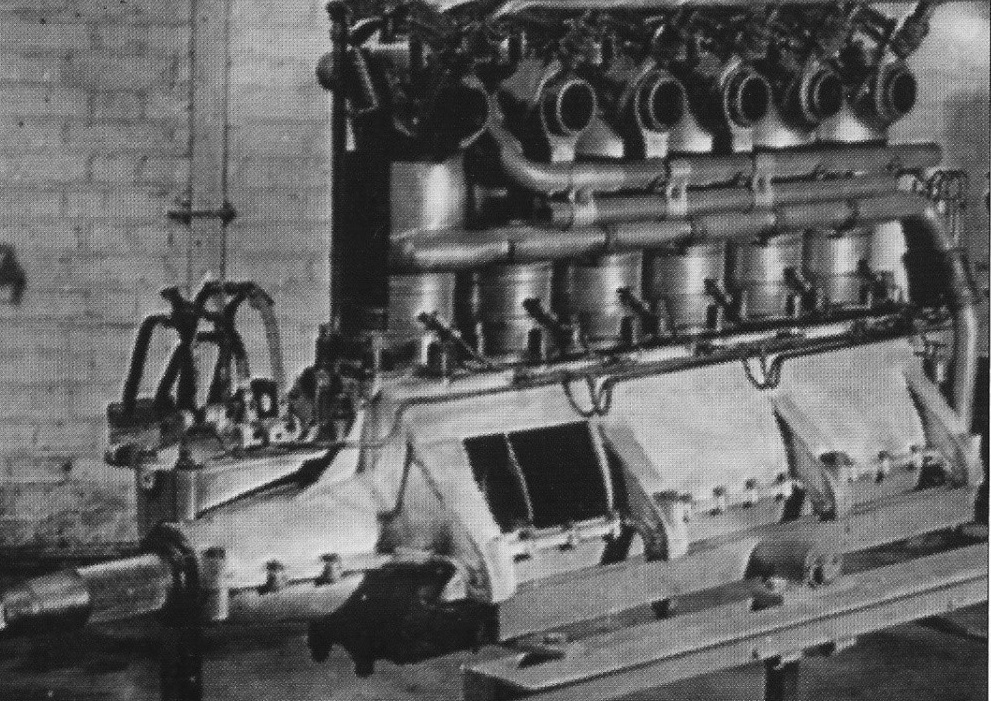
The Beardmore 120 hp was a British six-cylinder, water-cooled aero engine that first ran in 1914, it was built by William Beardmore and Company as a licensed-built version of the Austro-Daimler 6. The engine featured cast iron cylinders and mild steel concave pistons. Produced between August 1914 and December 1918, the design powered many World War I aircraft types.

Applications:
Airco DH.1
Airco DH.3
Armstrong Whitworth F.K.3
Armstrong Whitworth F.K.8
Bristol T.T.A.
Cody V
Martinsyde Elephant
Royal Aircraft Factory F.E.2
Royal Aircraft Factory R.E.5
Royal Aircraft Factory R.E.7
Vickers F.B.14
White and Thompson No. 3

Specifications (120 hp)
Type: 6-cylinder, inline, upright piston engine
Bore: 5.12 in (130 mm)
Stroke: 6.89 in (175 mm)
Displacement: 851 cu in (13.145 L)
Length: 57 in (1,148 mm)
Width: 19.9 in (505 mm)
Height: 31.9 in (810 mm)
Dry weight: 545 lb (247 kg)
Valvetrain: Overhead valve
Fuel type: Petrol
Cooling system: Water-cooled
Reduction gear: Direct drive, right-hand tractor
Power output: 154 hp (115 kW) at 1,400 rpm (maximum power)
Specific power: 0.18 hp/cu in (8.74 kw/L)
Compression ratio: 4.85:1
Power-to-weight ratio: 0.28 hp/lb (0.46 kW/kg)

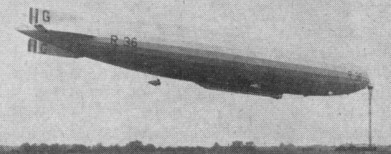
Beardmore R36 / H.M. Balloon Factory R36

R36 was a British airship designed during World War I by the new Airship Design Department, work commencing in November 1917. She was a lengthened version of the R33 class. These had been influenced by the design of the German Zeppelin LZ 76 that had been forced to land in England. The LZ 96, which was forced down at Bourbonne-les-Bains in June 1917, provided yet more input into the design.

The R36, along with a second ship the R37 were to be a stretched version of the R33, getting more lift by adding another 33 feet (10 m) gas bag. Two of her five engines were German Maybach engines, recovered from the downed LZ 113. Construction began before the end of the war, but the design was altered to include accommodation for 50 passengers.

Unlike the R33 class, the control car was not suspended below the hull but directly attached to it, and formed the forward section of the elongated passenger compartment. The engines were housed in five engine cars, one pair (containing the Maybach engines) either side of the hull forward of the control car, a second pair either side of the passenger compartment and the fifth on the centreline in front of the tail surfaces. Unlike previous British airship designs, the fins and horizontal stabilisers were cantilevered structures, with no external bracing.

R36 was launched for her maiden flight on 1 April 1921 from the Beardmore works at Inchinnan near Glasgow. Late the following day she flew on to RNAS Pulham in Norfolk. When she first flew in 1921, it was not in her originally intended role as a patrol aircraft for the Royal Navy, but as an airliner, the first airship to carry a civil registration (G-FAAF).

On 5 April it left Pulham at 07:25am bound for London. After making its appearance over the city it proceeded to Salisbury Plain, where it climbed to 6,000 ft (1800 m) and began manoeuvring trials. Starting a fast turn of 130 degrees it encountered windshear, which overstressed the rudder, damaging the top rudder and starboard elevator. This made the ship adopt a nose down attitude and rapidly lose height, but it was brought under control at around 3,000 feet. Emergency repairs were made to the damaged control surfaces and the ship limped home on her one remaining rudder and elevator, using differential engine control to help with directional control, reaching Pulham at 9.15pm.

After repairs and strengthening work she re-emerged in June for a successful series of test flights, including an endurance trial starting on 10 June which lasted nearly 30 hours, covering 734 miles (1,174 km) over land and sea. She was also used by the Metropolitan Police for observing traffic congestion caused by the Ascot Races. Journalists and senior police representatives were entertained in great comfort on the day, and the journalists stories were dropped by parachute over Croydon airfield.

On 21 June, returning from another trial flight, she suffered damage during landing. The release of emergency ballast caused a sharp pitching up, straining the ship against the mooring line. The nearest unoccupied sheds were at Howden in Yorkshire since the Pulham sheds were holding German Zeppelins handed over as war reparations. The wind increased and it was decided that the LZ 109 (L 64) would have to be sacrificed to save the R36. Within 4 hours L 64 had been cut into pieces and cleared to give enough room for R36. Even then she was damaged by a gust of wind during the manoeuvre into the shed.

Repairs were delayed while policy on airships was reviewed because of the R38 disaster and economic conditions. In 1925 she was refurbished for an experimental flight to Egypt as part of the Imperial Airship Scheme, but calculations cast doubt on her ability to make the trip and in the light of her age and condition she was scrapped in 1926.

Engines: 3 × Sunbeam Cossack, 350 hp (260 kW) each / 2 × Maybach, 260 hp (190 kW) each
Volume: 2,101,000 ft3 (59,500 m3)
Length: 675 ft 0 in (206 m)
Diameter: 78 ft 6 in (23.9 m)
Height: 91 ft 7 in
Maximum speed: 65 mph (105 km/h)
Range: longest flight, 734 miles (1181 km)
Endurance: 29 hours 54 min
Service ceiling: highest attained, 6000 ft (1829 m)
Crew: 28
Capacity: 50 passengers

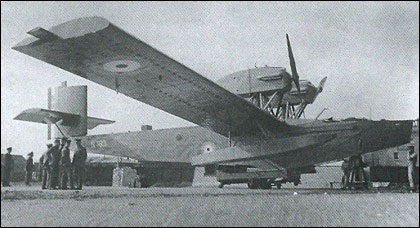
Beardmore Inverness

The Inverness is the Rohrbach RoIV all-metal flying boat designed by Adolf Rohrbach. The first aircraft (N183)was built in the Rohrbach factory in Denmark from parts manufactured in Berlin before being sent to Beardmore. The second aircraft (N184) was built by Beardmore.Both aircraft had short lives and were scrapped in 1925.
The Inverness was equipped with two large masts and sails to get it home in the event of a forced water landing.

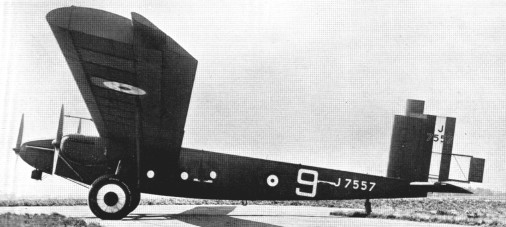
Beardmore Inflexible

The Inflexible was designed by Adolf Rohrbach as the Rohrbach Ro VI. The Beardmore Company (mainly shipbuilders by the 1920s) developed the Inflexible to demonstrate the then-innovative stressed-skin metal construction. Unusually for 1928 it was also a mid-wing monoplane at a time when most large aircraft were still wood and fabric biplanes. With a wingspan of 158 ft it was the biggest aircraft of it’s day. Before being allowed to make the attempt to fly it had to be fitted with support cables from the wing roots to nearly the wingtips. It was also decided that it would need more than the length of the existing airfield at Martlesham Heath to take off and an extra 400 yards of heath was cleared for the initial flight.

The extra 400 yards was not nearly needed and the Inflexible took off well before the end of the existing runway, no strain was evident on the cables and according to those on board, the flight was uneventful and the aircraft flew well.

The Inflexible’s maiden flight proved it was too heavy for its three Rolls Royce Condor engines.

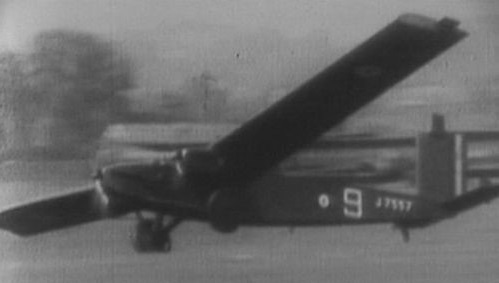
Beardmore Inflexible Serial n° J7557

Within two years its flying career was over and it was dismantled to save space, ending its days in experiments to investigate airframe corrosion.

Gallery

Engines: 3 x Rolls-Royce Condor, 650 hp.
Take-off weight: 16783 kg / 37000 lb
Wingspan: 48.01 m / 157 ft 6 in
Length: 23.01 m / 75 ft 6 in
Height: 6.40 m / 20 ft 12 in
Max. speed: 175 km/h / 109 mph
Crew: 2

Beardmore WB.26

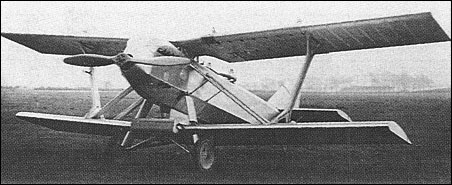
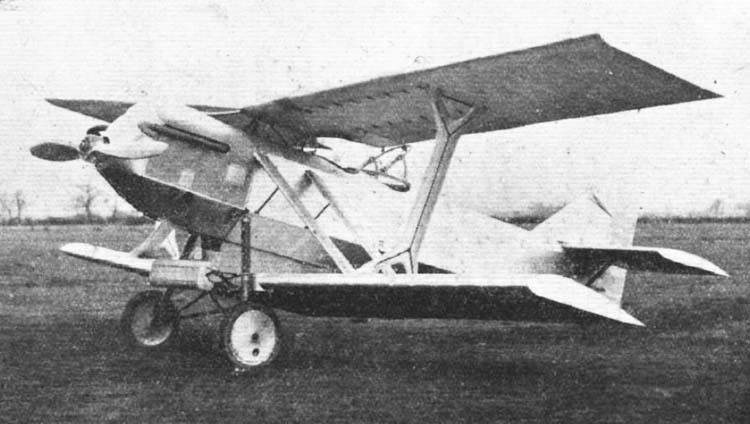
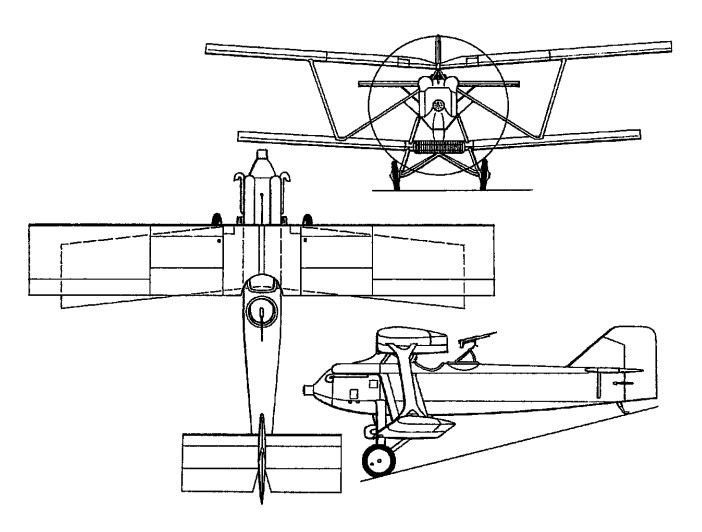
In 1924, the Scottish shipbuilding company of William Beardmore and Company designed a two-seat fighter for Latvia, the W.B.XXVI. Beardmore’s chief designer, W.S. Shackleton produced a wooden single-bay biplane, powered by a Rolls-Royce Eagle engine. The slab-sided fuselage was of hexagonal section, with the crew of two seated in separate cockpits. To reduce drag, the wings had no bracing wires, bracing being solely by means of struts, with a large inter-wing gap. A Lamblin radiator was installed in the leading edge of the lower wing. Instead of the normal Vickers and Lewis machine guns, the aircraft was armed by Beardmore’s own gas-operated Beardmore-Farquhar machine guns.

The prototype first flew some time in 1925. While it proved to be manoeuvrable, it was underpowered, and performance was poor, with the Latvians unwilling to pay for replacement of the Eagle with a more powerful Napier Lion engine. It was sent to Latvia for evaluation in 1926, but was only flown three times in Latvia before it was rejected, and was eventually sent back to Beardmore and scrapped. No more W.B.XXVIs were built.

Engine: 1 × Rolls-Royce Eagle IX, 360 hp (269 kW)
Wingspan: 37 ft 0 in (11.28 m)
Wing area: 356 sq ft (33.1 sq.m)
Length: 27 ft 10½ in (8.50 m)
Empty weight: 2,555 lb (1,162 kg)
Loaded weight: 3,980 lb (1,809 kg)
Maximum speed: 145 mph (233 km/h)
Endurance: 4 hr
Service ceiling: 20,000 ft (6,100 m)
Wing loading: 11.2 lb/sq ft (54.7 sq.m)
Power/mass: 0.09 hp/lb (0.15 kW/kg)
Climb to 15,000 ft: 20 min
Crew: 2
Guns: 2× fixed forward firing Beardmore-Farquhar machine guns and 1 or two flexibly mounted Beardmore-Farquhar machine guns on Scarff ring

Beardmore W.B.XXIV / Wee Bee

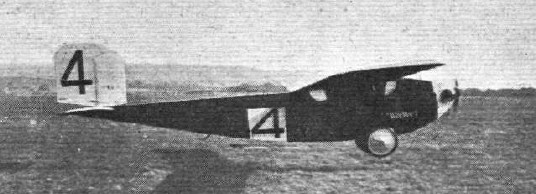
The Beardmore W.B.XXIV Wee Bee I was the company’s winning entrant to the Lympne Aerodrome light aeroplane trials of 1924. The competition rules were framed to encourage more robust designs than those that had competed as “motor-gliders” at Lympne the previous year; they were to be single engined two seaters, with engine capacities up to 1,1000 cc allowed. The total prize money was £3,600; the first prize £2,000.
The Wee Bee was a high wing monoplane designed by W.S.Shackleton, its aerodynamically thick wing divided at the centre and braced, close to the fuselage, by pairs of parallel struts to the lower longerons. The wings were of two spar construction with plywood skinning between the two spars out as far as the bracing; outboard, only the leading edges were plywood covered, with fabric elsewhere. The outboard ailerons were mounted on false spars (stringers). In plan, the wings were almost rectangular, with an aspect ratio of about 5.5.
The fuselage was built up on six spruce longerons, with bulkheads (formers) of spruce and three-ply. The Wee Bee’s decking was concave as it reached the flat fuselage sides, making for a better view from the two tandem cockpits. These were positioned at the leading edge and just behind mid-chord, fitted with dual controls. Both cockpits were semi-enclosed and faired into the upper fuselage/ wing surface. The front one was entered by lifting up a small hinged part of the leading edge, which was locked down for flight; this gave excellent visibility with the help of the “hollow ground” decking. The aft cockpit had a roof hatch with a transparent celluloid window in the upper wings, with good views though openings in the sides below the wing. The 32 hp (24 kW) Bristol Cherub flat twin engine was hung from a duralumin sheet bracket fixed to the engine bulkhead and positioned below with a pair of duralumin tubes, themselves braced to the lower longerons with steel tubes. It was enclosed in a smooth, streamlined cowling, with the upper cylinder heads protruding for cooling.
The fin and tailplane were both integral with the fuselage and narrow in chord, carrying wider control surfaces. Both horizontal and vertical surfaces were rectangular, but the rudder had a noticeable horn balance. The main undercarriage was very simple, with two wheels mounted on a bent chrome-nickel alloy tube which passed through the fuselage bottom. This placed the wheels well clear of the fuselage horizontally (the track was 3 ft 9 in / 1.14 m) but left the Wee Bee sitting close to the ground. Landing loads were absorbed by elastic axle bending.
The only Wee Bee first flew in the late summer of 1924, ready for the Lympne competition. The preliminary trial for this were held at the weekend of 27-8 September, where only seven of the initial nineteen entrants did enough to go to the competition proper. As well as the Wee Bee, the other competitors were the Bristol Brownie, two Hawker Cygnets, the Parnall Pixie, the Cranwell CLA2 and the Westland Woodpigeon. The Wee Bee was flown by Maurice Pearcy.
The aircraft were given marks for four tasks: speed over two sets of five laps, slow speed flying and take off and landing distances. Only the Wee Bee and the Brownie, both Cherub engined, had the reliability to complete the speed tests, in which the Wee Bee achieved 70.1 mph (112.8 km/h), about 5 mph faster than the Bristol. It flew at just under 40 mph (64 km/h) and took off to clear a 6 ft (1.83 m) barrier with a run of 705 ft (215 m). Given the Wee Bee’s clean aerodynamics it was not surprising to find it took to greatest distance to pull up at landing; wheel brakes were not fitted. Despite the long landing, the Wee Bee ended the competition well ahead in marks of the Brownie, its nearest rival, winning the Air Ministry first prize of £2,000.
At Lympne in 1924 the Wee Bee flew as no.4, but at the Royal Aero Club meeting of August 1925, also held at Lympne, it appeared as G-EBJJ. At that meeting, with an aluminium front cockpit hatch in place of the earlier wooden one, it won the light two seater race and came fourth in the Grosvenor Cup, both times piloted by A.N Kingswill. In December 1933 it was sold to Percy Parker of Warrnambool, Victoria, Australia, where it was registered as VH-URJ. Mr. Parker sold it prior to 1939. It flew until 1939 and was then stored, but probably flew again a few years after the end of World War II, though exact dates are uncertain.

Engine: 1 × Bristol Cherub I air cooled flat twin, 32 hp (24 kW)
Length: 22 ft 2 in (6.76 m)
Wingspan: 38 ft 0 in (11.58 m)
Height: 7 ft 2 in (2.18 m)
Wing area: including ailerons 208.5 sq.ft (19.37 sq.m)
Empty weight: 465 lb (211 kg)
Gross weight: 840 lb (381 kg)
Maximum speed: 87 mph (140 km/h)
Crew: 2

Beardmore WB.V

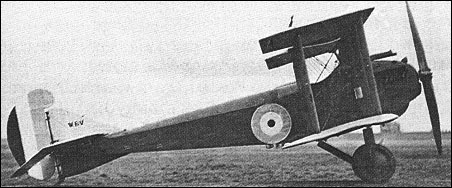
The W.B.V single-seat shipboard fighter was developed in parallel with the W.B.IV. It was intended to carry a 37mm Puteaux cannon between the cylinder blocks of its 200hp Hispano-Suiza eight-cylinder water-cooled engine and featured folding wings, a jettisonable undercarriage and inflatable flotation bags beneath the underside of the leading edge of the lower wing. Three prototypes of the W.B.V were ordered, the first flying on 3 December 1917, but the engine-mounted cannon was removed and a more conventional synchronised 7.7mm Vickers gun and a 7.7mm Lewis gun on a tripod ahead of the cockpit mounted. The second prototype W.B.V was completed and flown in 1918, but further development was abandoned before the end of World War I.

Engine: 200hp Hispano-Suiza
Take-off weight: 1134 kg / 2500 lb
Empty weight: 844 kg / 1861 lb
Wingspan: 10.92 m / 35 ft 10 in
Length: 8.10 m / 26 ft 7 in
Height: 3.61 m / 11 ft 10 in
Wing area: 36.60 sq.m / 393.96 sq ft
Max. speed: 180 km/h / 112 mph