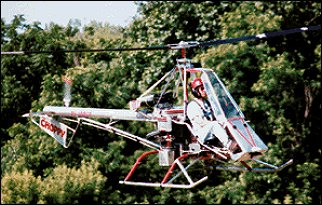
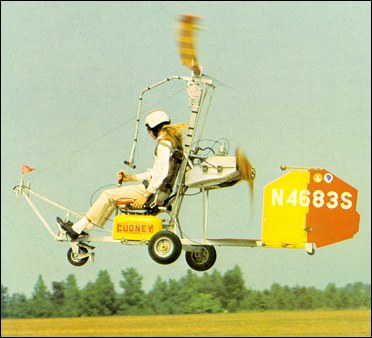
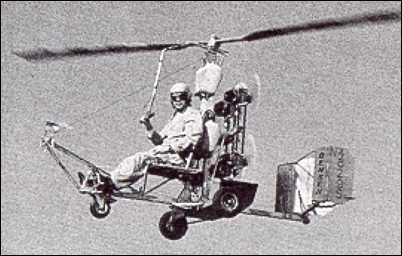
A single seat open frame helicopter. The frame is 4130 steel main frame and bolt-together aluminium tube. A modern version of the Adams-Wilsom Choppy helicopter. Single-seat open-frame helicopter with a Min Speed Hover speed. Video covers flight and testing. All new aluminum tube tail design. New replaceable landing gear. Easy build design for the true homebuilder. Scratch build entirely from plans; CAD plans $95 in 2009. Limited components available.
Engine: 66 hp Rotax 582 or Hirth. Rotor blades: Fleck all 2706 aluminium extrusion Main rotor: 21.5 ft / 6.55m Tail rotor: 36 in Cruise: 65 mph / 105km/h Top speed: 85 mph / 137km/h. Empty wt: 320 lb / 144kg Useful load: 350 lbs. Gross wt: 670 lbs. Width: 5 ft 8 in Height: 6 ft 8 in / 2.03m Length: 15 ft 9 in / 4.80m
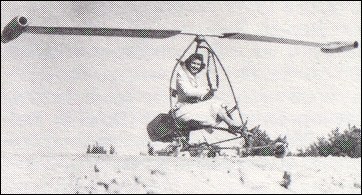
This miniature single-seater helicopter, designed as a private venture mainly for use in the United States Navy, has been simplified to such a degree that its components can be reassembled with hand tools. At each tip of the two-bladed rotor is a ram-jet engine, weighing 2.5 kilos and running on either ordinary petrol or fuel oil. The “Midget” is reported to be able to lift four times its own weight. The initial tests were carried out in 1954.
Engines: 2 x ram-jets equivalent to 40hp Number of seats: 1 Rotor diameter: 4.57m Weight fully loaded: 227kg Empty weight: 45kg Cruising speed: 120km/h
Take-off and flight of the Kopter is under full piston-engine power. Takes off at 30 mph. Cruises at 60 mph, with a high speed of 85+ mph. Climbs at 1,000 fpm and will reach an altitude of 12,000 ft. Engines of as little as 35 hp may be used (with reduction drive), or up to 80 hp. If flown as an ultralight, the B-20 is free of licensing or certification requirements. The B-19 may easily be converted at any time to the powered B-20, as is fully detailed in the same Construction Plans.
Engine (original): McCulloch 4318 Horsepower Range: 45 to 70 Height: 6 ft Length: 10½ ft Width: 5½ ft Empty Weight (minus engine): 150 lbs Empty Weight (with engine): 230 lbs Gross Weight (max): 530 lbs Payload Weight: 300 lbs Rotor Diameter: 21 ft Rotor Chord: 7 in Disc Loading: 1.53 lbs/sq ft Maximum Speed: 90 mph Airframe construction: welded steel tubing Control System: joystick; rudder pedals Cruise Speed: 60 mph Take-off Speed: 30 mph Rate Of Climb: 1,000 fpm Maximum Altitude: 12,000 ft
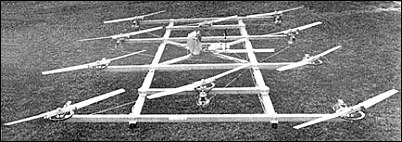
A manned research vehicle for possible agricultural operations. An aluminum framework with 10 McCulloch M75 two-cycle engines and 2.1m rotors; first flown 2 November 1961. Hovered at 6m, flew sideways and backwards with success.
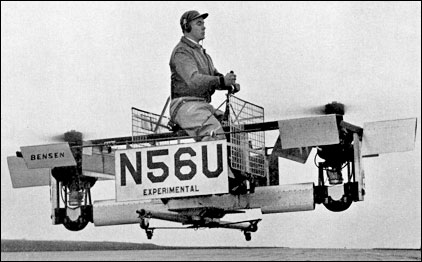
The Bensen B-10 Propcopter consisted of a boxy frame with 1.2 meter (4 foot) props mounted vertically on the front and back of the frame. Each was powered by its own 54 kW (72 HP) McCulloch engine. The Propcopter flew in 1959.
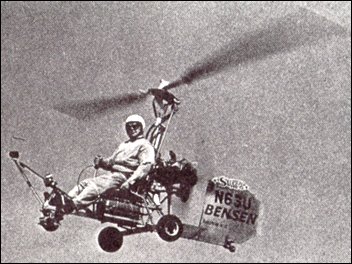
The B-10 was flown in prototype form (N56U) on 6 August 1958 and apparently was tricky to handle. It was not developed further.
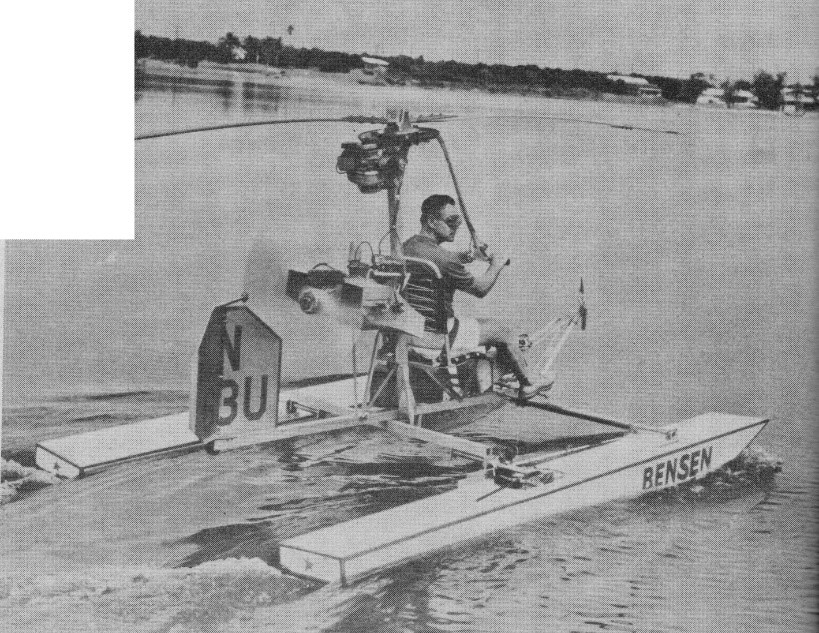
From the B-5 Gyro-Glider factory-built prototype of 1954, Bensen evolved the B-6 and B-7, and from these has come the standard production model the B-8. This has a more sturdy construction and was available as a factory-built machine or in kit form for amateur construction. Two water-borne versions of the B-8 were also available: the B-8B Gyro-Boat which has a boat-type hull and twin outrigged stabilising floats, and the B-8W Hydro-Glider mounted on twin floats. From the reworked B-7M came the B-8M variant, first flying on 8 July 1957 and by the first production B-8M on 9 October 1957. The B-8M is normally powered by a 72hp McCulloch piston engine. Optional features include a 90hp McCulloch engine and a mechanical rotor drive enabling the autogyro to make jump starts.
A float version of the B-8M is known as the Hydro-Copter.
The Gyro-Boat is a variant of the Gyro-Glider, in which the basic free-turning rotor system, known as the Roto-sail, is mounted on any standard small dinghy. The result is literally a flying boat, intended to be towed above water by a motor boat. The two-blade steel and plywood rotor has a diameter of 6.10m and disc area of 29.2sq.m. Each blade has an area of 1.0sq.m. When fitted to a 3.66m aluminium dinghy weighing 45kg, the complete Gyro-boat has an empty weight of 68kg and a loaded weight of 147kg carrying one person or 227kg carrying two people. It takes off when towed at a forward speed of 37km/h, cruises at 55-110km/h and lands at 11km/h. The prototype Gyro-Boat flew for the first time on April 25, 1956, and the first production model on July 8, 1956. The 1959 version can be fitted with stabilizing pontoons on outriggers for rough water operation.
B-8B Gyro-Boat
Designed for home construction from kits or plans, captured a series of international records in 1967, including an altitude of 7,275 ft (2,717 m) and a speed of 79 mph (127.15 kph) over a 15 km course. In early 1968 the USAF ordered three as X-25 to test methods of improving the odds of a downed flyers escape. The X-25A had a more robust structure and a small engine. The two-seat X-25B was originally used un-powered but was later fitted with an engine.
By 1984 there were more than 10,000 active rotorcraft fans in the United States. With purchase of their plans and component kits, it is possible to build a machine in a few weeks of spare time, with only a drill press and a few wrenches. Bensen Gyrocopters can be towed behind a car or boat or flown under their own power. The simple glider models are available as one or two seaters. The powered gyrocopters are available only as single seaters. The Gyrocopter is capable of climbing to 12,500 feet. The powerplant is a 72- to 90-hp McCulloch. Price in 1982: $4,850 (Excludes engine). Units delivered to June 1982: 4,000.
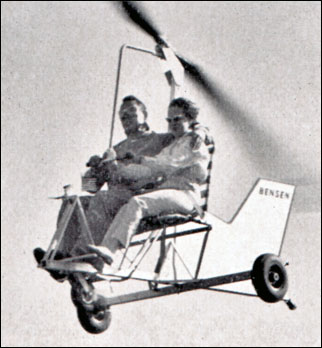
The B-8 Gyro-Glider is a simple unpowered rotor-kite which can be towed behind even a small motor car. It is available as either a completed aircraft or kit of parts for amateur construction. Alternatively, would-be constructors can purchase a set of plans, with building and flying instructions. No pilot’s licence is required to fly it in the United States and many hundreds of kits and plans have been sold. Application was been made for an Approved Type Certificate. The original Model B-7 Gyro-Glider was followed by the Model B-8, which is offered as either a single-seater or two-seater, the latter version being suitable for use as a pilot trainer. The Model B-8 consists basically of an inverted square-section tubular aluminium T-frame structure, of which the forward arm supports the lightweight seat, towing arm, rudder bar and landing gear nose-wheel. The rear arm supports a large stabilising fin and rudder, with the main landing gear wheels carried on a tubular axle near the junction of the T-frame. The free-turning two-bladed rotor is universally-mounted at the top of the T-frame and is operated directly by a hanging-stick control. It is claimed that the entire aircraft can be made from commercial tubing, wood and locally-available materials.
B-8 Gyro-Glider
B-8MH Hover-Gyro
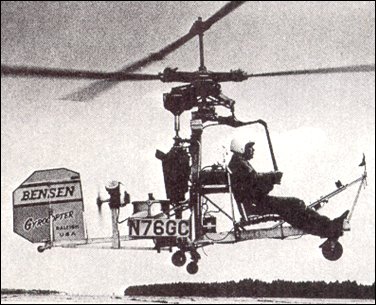
Demonstrated in public for the first time in 1976, the B-8MH Hover-Gyro is described as a ‘Hovering Gyro-Copter’. It was powered by a 70-110hp modified water-cooled outboard engine driving the lower of the two rotors; the upper rotor autorotates. One 14 hp modified air-cooled go-kart engine drives the pusher propeller mounted at rear.
B-8 Super Bug
The B-8 Super Bug was a B-8M modification with two engines installed to spin up the rotor prior to take-off.
B-8HD
The B-8HD was a 1979 Gyro-Copter was based on the Super Bug design. It uses hydraulic drive to feed about 4hp from the engine to the rotor, instead of having a separate engine for pre-rotation. This is reported to give the aircraft a take-off run of less than 61m.
In August/September 1964 the B-8M three-view drawings, photos and specification were available for $2, or the complete construction plans for $30.
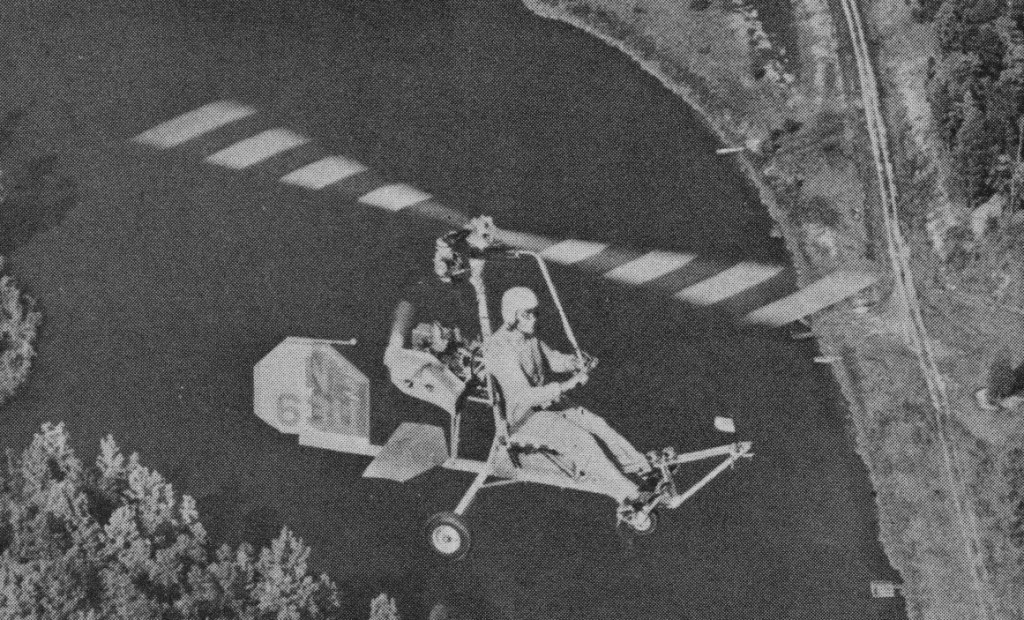
B 8M Engine: McCulloch 4318E 4 cylinder, 72 hp Rotor dia: 20 ft 0 in (6.1 m) Fuselage length: 11 ft 4 in (3.45 m) Height: 6 ft 3 in (1.9 m) Max TO wt: 500 lb (227 kg) Empty Wt. 247 lbs / 112kg Fuel capaci¬ty 6 USG Max level speed: 85 mph (137 kph) Cruising speed: 72km/h Ceiling: 12,000 ft / 3810m Range: 161km
From the B-5 Gyro-Glider factory-built prototype of 1954, Bensen evolved the B-6 and B-7, and from these has come the standard production model the B-8. This has a somewhat more sturdy construction and is available as a factory-built machine or in kit form for amateur construction. Two water-borne versions of the B-8 are also available: the B-8B Gyro-Boat which has a boat-type hull and twin outrigged stabilising floats, and the B-8W Hydro-Glider mounted on twin floats. In 1955 Bensen placed an engine in the B-7 and renamed it the B-7M (“m” for motorised). The B-7M flew for the first time on 6 December 1955. Two years later, in 1957, the B-7M was upgraded to include, among other refinements, a McCulloch 72-hp pusher engine.
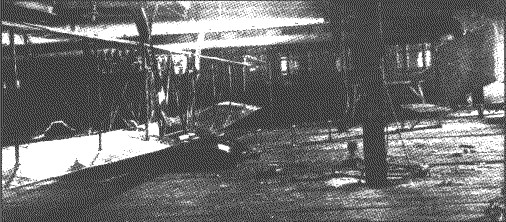
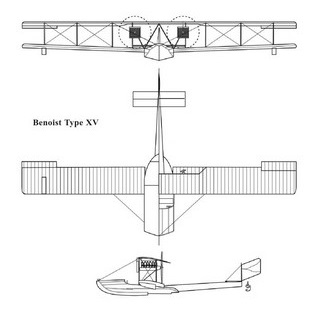
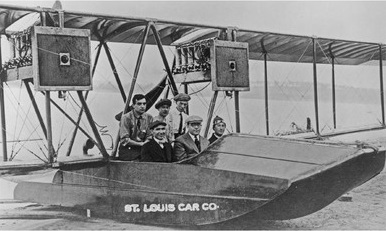
Benoist Type 15 flying boat under construction in St. Louis Car Co. shops, ca. 1915
Basically an enlarged Type 14 with a four-bay wing layout and upper and lower wings of equal span. The two direct-drive engines were strut mounted beneath the upper wing.
When the onset of World War I prevented any attempt at a transatlantic flight, Benoist sought to interest the British government in purchasing the aircraft for use in antisubmarine patrol and went so far as to make arrangements to have the type mass-produced at a plant owned by the St. Louis Car (rail) Company. By this time the British were already committed to flying boat contracts with Curtiss, and no orders for the Type 15 were forthcoming.
Benoist hoped to mass-produce the Type 15 for the British Royal Naval Air Services, but the company ceased operations soon after Benoist’s death in 1917.
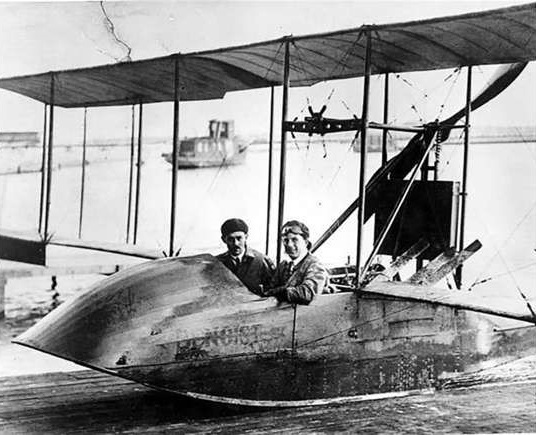
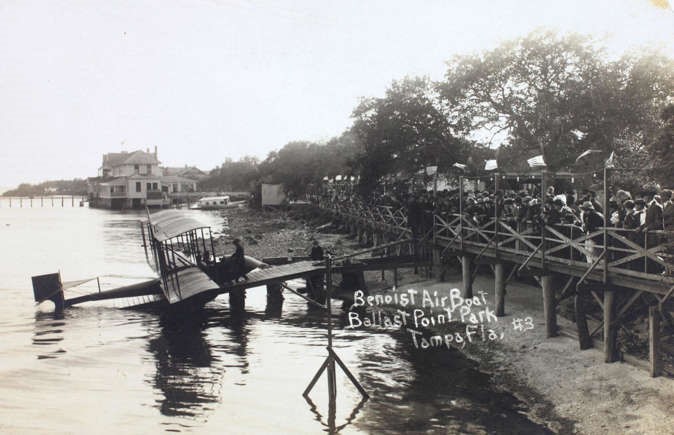
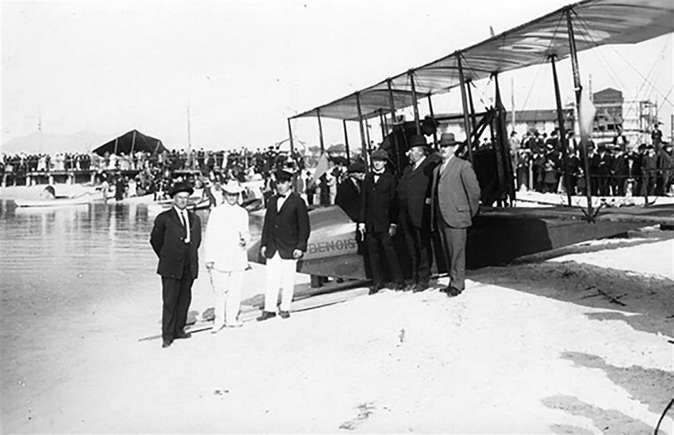
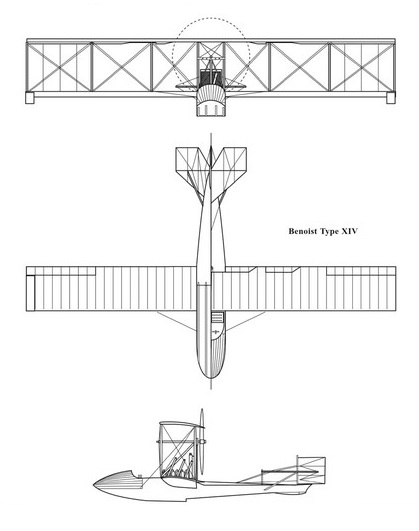
A small biplane flying-boat built in 1914 designed by Thomas W.Benoist and built by Benoist Aircraft Co.
This flying boat conducted the world’s first scheduled airline flight. Designed by Thomas W. Benoist, the Benoist Type XIV first flew from the Florida city of St Petersburg to Tampa in January 1914 and was one of two aircraft belonging to the St Petersburg-Tampa Airboat Line.
In the United States, the St Petersburg-Tampa Airboat Line commenced twice-daily services across Tampa Bay, Florida, using a Benoist flying boat, charging the single passenger US$5 per journey in January 1914.
The aircraft was so small there was space for just one passenger who had to sit next to the pilot, quickly rendering the entire operation an unaffordable venture.
Having carried 1,205 passengers in the space of three months, the airline folded and the Benoist became the plaything of the wealthy. In 1984, a flying replica was built for the 70th anniversary of the flight, which is now on display in the St. Petersburg Museum of History.
Engine: 70 hp Sturtevant or 75 hp Roberts Propeller: pusher Span: 45′ Length: 26′ Range: 175 miles