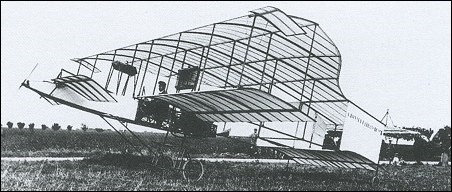
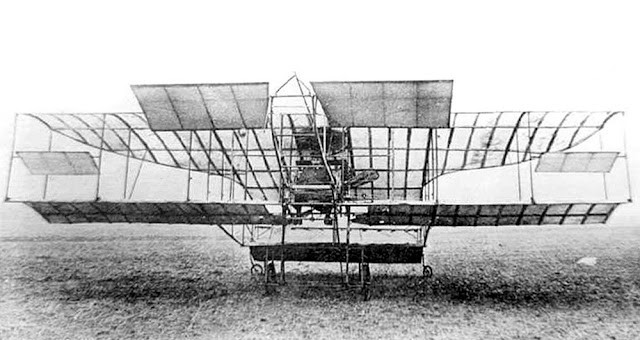
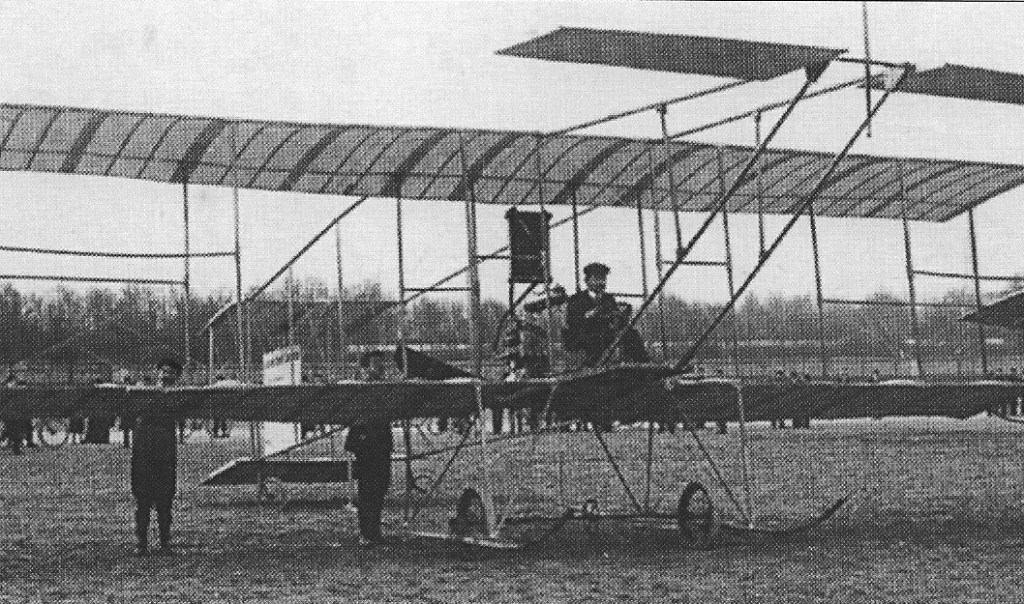
Bonnet-Labranche No. 3 pusher biplane       

The 1909 Bonnet-Labranche No. 3 pusher biplane was designed and built by Brothers Bonnet-Labranche in France.

The Bonnet-Labranche was trialled at Issy-Moulineaux, Paris, in August 1910.

Apparently, this airplane is the device bearing the generic name “1” or “2”, characteristics with their large wing.

Engine: 30 Hp Filtz-Arion
Span: 23′ / 11.50 m
Length: 26’3″ / 12.50m
Weight: 550 lb

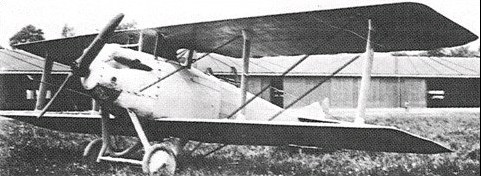
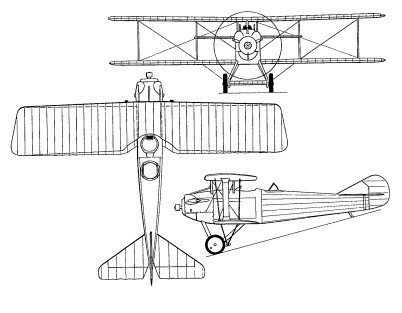
BAJ Type IV

Designed by Charles Audenis and built by the Boncourt- Audenis-Jacob concern at Bron, the BAJ Type IV was a tandem two-seat fighter powered by a 300hp Hispano-Suiza 8Fb eight-cylinder water-cooled engine. The Type IV was armed with one synchronised 7.7mm Vickers machine gun and a pair of 7.7mm Lewis guns on a T.O.3 ring mounting in the rear cockpit. Of relatively clean design, with aerofoil-section single interplane struts and a close-cowled engine, the Type IV was officially ordered on 1 May 1918 by the Aviation Militaire. The first prototype was delivered to Villacoublay for official trials late in November 1918, but these were apparently delayed by the need for modifications which were undertaken by the Hanriot concern and completed on 28 January 1919. The first prototype was returned to the Boncourt-Audenis-Jacob concern for repairs in the summer of 1919, official trials being continued with a second prototype. No production order for the Type IV was placed and no specification for this type has apparently survived

Bombardier CSeries / Airbus A220

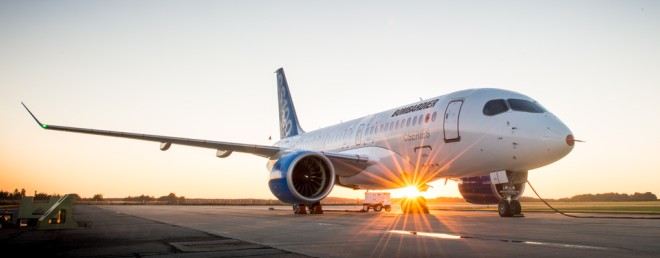
On September 1, 2013 4 Bombardier Aerospace announced that the first CSeries aircraft, Flight Test Vehicle 1 (FTV1), has successfully obtained Transport Canada’s Flight Test Permit, thereby clearing the way for its maiden flight. This follows a series of pre-flight tests including low-speed taxi runs.

“Five years in the making and today, following receipt of Transport Canada’s flight test permit, we are very close to the CSeries airliner’s first flight ” said Mike Arcamone, President, Bombardier Commercial Aircraft.

Designed for the growing 100 to 149 seat market, the 100% new CSeries aircraft family combines advanced materials, leading-edge technology and proven methods to meet commercial airline requirements. Powered by Pratt & Whitney PurePower PW1500G engines, the CSeries aircraft family will offer an extra capacity seating option.

As of June 30, 2013, Bombardier had booked orders and commitments for 388 CSeries aircraft that included firm orders for 177 CSeries airliners.

Bombardier sold the CSeries aircraft to Airbus. The CSeries became known as the A220, the single-aisle jet became a huge success for Airbus.
Bombardier Global 5000

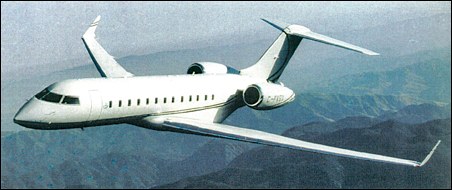
Market and design studies began 1999, announced on 25 October 2001 as the Global 5000. Based on the Global Express, with a 1.83m reduction in fuselage length, and a 2,222km reduction in maximum range, the first flight took place on 7 March 2003
Two aircraft were utilised in the flight test programme.

Bombardier Global 5000
Engines: 2 x 64354 N / 6560 kp
Length: 96.752 ft / 29.49 m
Height: 24.836 ft / 7.57 m
Cabin height: 6.266 ft / 1.91 m
Cabin width: 8.169 ft / 2.49 m
Cabin length: 42.487 ft / 12.95 m
Wingspan: 225.230 ft / 68.65 m
Max take off weight: 87714.9 lb / 39780.0 kg
Cruising speed (mach): 0.89 mach
Range: 4800 nm / 8889 km
Passengers: 19

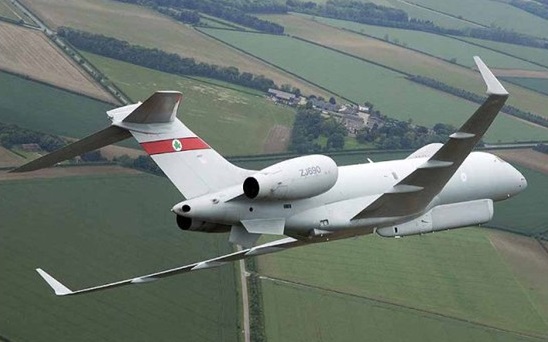
Bombardier BD-700 Global Express / Sentinel

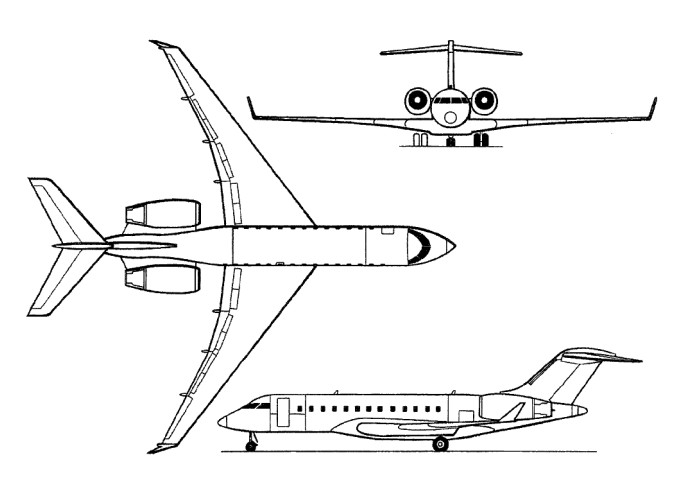
BD-700 Global Express

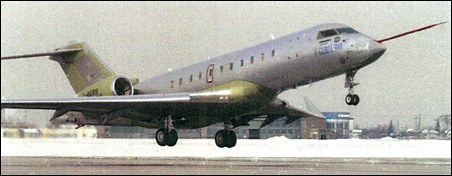
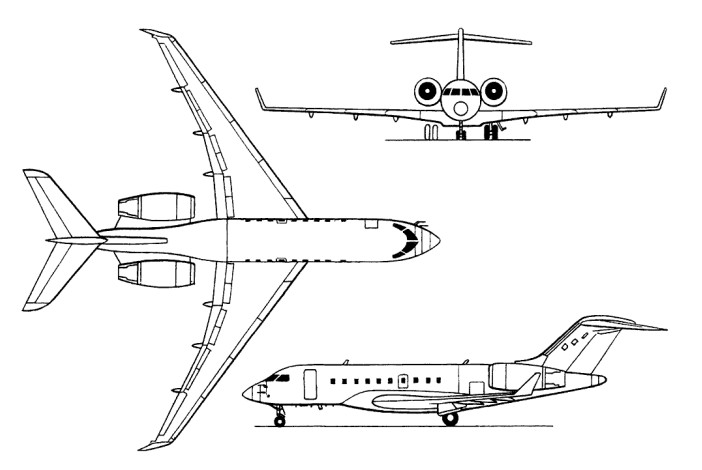
The Bombardier BD-700 Global Express is a twin-engine ultra long range executive jet aircraft with two crew members and up to 19 passengers and 2 flight attendants. Development of the BD-700 started late 1991 and the programme launched on 20 December 1993, the dsign goal was the longest possible range at highest speed from a short runway. A wide-body fuselage, combining the Challenger cabin cross-section with cabin length of the Regional Jet, the prototype rolled out 26 August 1996. Bombardier had 60 firm orders by February 1997.

Bombardier BD-700 Global Express Article

The first prototype flew on 13 October 1996. On 31 July 1998, the Canadian certification was granted and the first customer delivery was completed on 8 July 1999 to AirFlite Inc of Long Beach, California.

The Bombardier Global Express business jet was certified by the European Joint Aviation Authorities on May 7, 1999. The approval was issued under JAR Part 25, through Change 14. Bombardier reported having 80 orders for the twin-engine jet. Transport Canada and the FAA certified the airplane in 1998.

The range of the Global Express is 11,390 km at a cruise speed of 904 km/h.
On 3 August 2001 the first Global Express fitted with the ASTO long range airborne surveillance system flew.
The Bombardier BD-700 Global Express is powered by two Rolls-Royce Deutschland BR-710A2-20 turbofans.
Total of 91 aircraft were in customer service by 30 September 2002.

Bombardier BD-700-1A10 Sentinel R.1 ZJ690

Gallery

Engines: 2 x BMW / Rolls Royce BR 710-48-C2, 66119 N / 6740 kp
Wingspan: 91.896 ft / 28.01 m
Wing area: 1021.934 sq.ft / 94.94 sq.m
Length: 98.983 ft / 30.17 m
Height: 25.0 ft / 7.62 m
Max take off weight: 93395.0 lb / 42356.0 kg
Weight empty: 48510.0 lb / 22000.0 kg
Max. speed: 505 kts / 935 km/h
Cruising speed: 475 kts / 880 km/h
Service ceiling: 51001 ft / 15545 m
Wing load: 91.43 lb/sq.ft / 446.0 kg/sq.m
Maximum range: 6500 nm / 12038 km
Range: 6318 nm / 11700 km
Crew: 2
Payload: 8-19 pax (max. 3266kg)

Bombardier Continental / Bombardier 70 / Challenger             

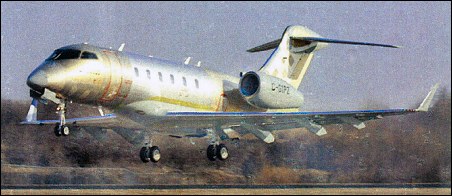
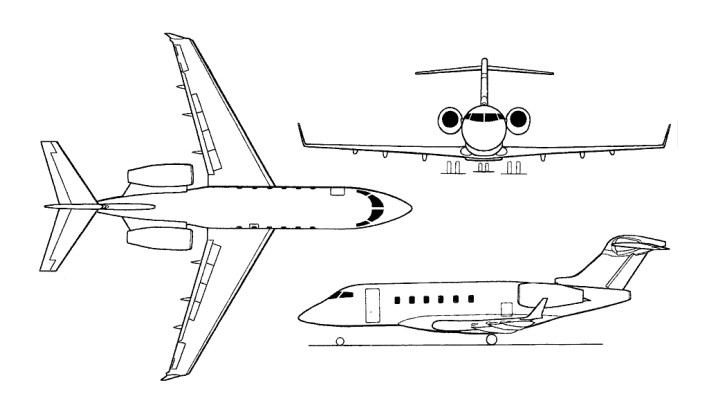
Design study, then known as ‘Bombardier Model 70’, revealed at the Paris Air Show in June 1997; initially named Continental. On 14 August 2001 the first Bombardier Aerospace Continental Jet (factory serial number 20001) took off from Bombardier Learjet facilities at Wichita, and reached 17,500 ft and a speed of 210 kts.
Renamed Challenger 300 on 8 September 2002.

Bombardier Continental Article

Bombardier Challenger 300 LX-PMA

Gallery

Bombardier BD-100 Challenger 300

Bombardier

Bombardier was founded in 1942 to manufacture tracked vehicles for snow travel and broke into the aviation scene in the early 1970s when it acquired the Austrian Lohnewerke GmbH and its subsidiary Rotax-Werk AG (later Bombardier-Rotax GmbH), the supplier of snow mobile and microlight engines. In December of 1986 they acquired Canadair; in October 1989 Short Brothers of Northern Ireland; in June 1990 Learjet Corporation and in 1992 purchased 51 percent of de Havilland Canada. In January 1997, they purchased the remaining 49 percent of DHC from the Province of Ontario.
Bombardier’s aerospace operations delivered 227 regional, business and utility aircraft during the organization’s 1998-99 fiscal year, a 28% increase compared with the previous period. The production rate for the CRJ-100/200 was raised to 7.5 aircraft per month from six.