Westland PV.6 Wallace

Westland PV.6 Wallace Article

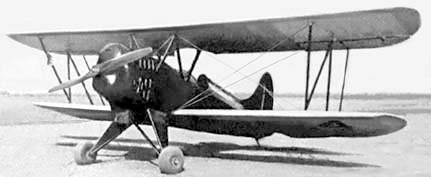
In the year 1931 a British Empire Exhibition was held in Buenos Aires, Argentina, at which Westland was represented by a special A.S. Panther-engined Wapiti, G-AAWA, piloted by Mr. H. J. Penrose. This machine embodied the accumulated experience gained with the first 500 Wapitis constructed, and was fitted with a lengthened fuselage and braked undercarriage.
After a successful tour in South America the machine was returned to Yeovil, where further refinements were made, including the fitting of a divided axle chassis, improvements to the fuselage lines, and the installation of a Pegasus engine with Townend ring. By this time both the performance and the appearance of the aircraft differed considerably from that of the standard Wapiti and it was given the designation P.V.6, under which it successfully completed Air Ministry acceptance trials as a general-purpose machine.
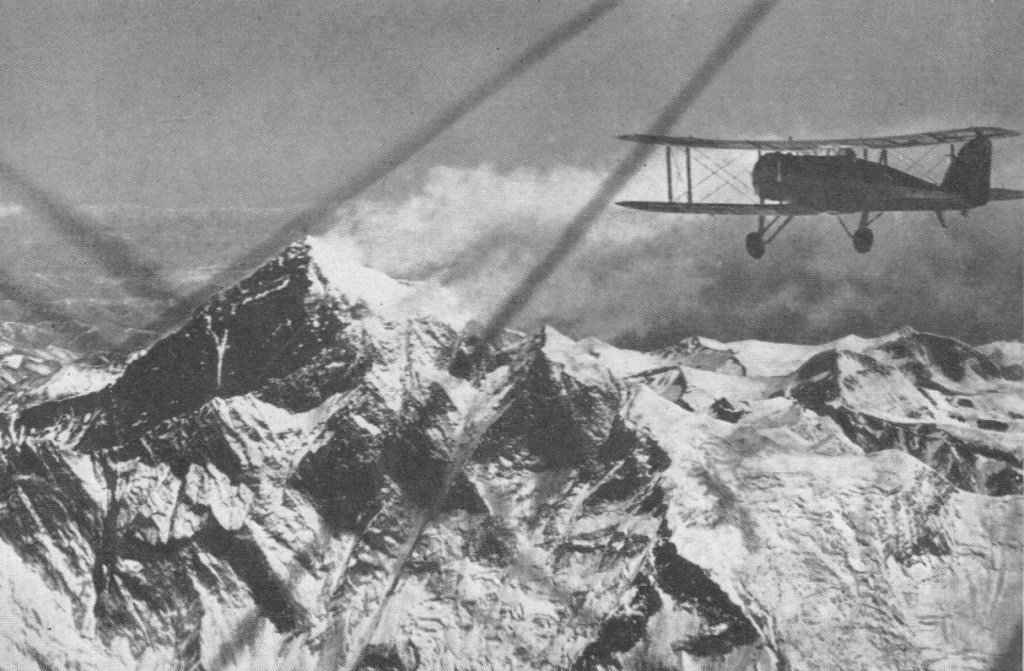
With the placing of a production order the type was given the name of Wallace, but the original machine, again returned to Yeovil, underwent yet another change and was converted for service with the Houston-Mount Everest Expedition.
The very successful realisation of the Expedition’s object brought this veteran aircraft once more into Westland hands, this time to be converted back into a standard Wallace and issued to a Squadron.
On the early Wallace machines the cockpits were of the open type, with a Scarff gun-ring over the rear cockpit, but the type is now best remembered by reason of a later development. This was the fitting of a transparent cabin over both cockpits, thus making it the first R.A.F. aeroplane to be so equipped. Apart from the greatly increased comfort, this enabled the Wallace to use its rear gun with increased accuracy when operating at maximum speed.
The Wallace had a long period of service with the Royal Air Force, and with the various Auxiliary Squadrons, and although succeeded by the Lysander and other general-purpose types.

The Wallace was the last of the inter-war general purpose biplanes, but its useful life was extended, with many being converted into target tugs and wireless trainers.

Engine: 1 x 655hp Bristol Pegasus IV 9-cylinder air-cooled radial
Max take-off weight: 2610 kg / 5754 lb
Empty weight: 1670 kg / 3682 lb
Wingspan: 14.1 m / 46 ft 3 in
Length: 10.4 m / 34 ft 1 in
Height: 3.5 m / 12 ft 6 in
Wing area: 45.4 sq.m / 488.68 sq ft
Max. speed: 289 km/h / 180 mph
Ceiling: 9150 m / 30000 ft
Armament: 1 x Vickers gun + 1 Lewis gun

Westland Wallace Mk. II
Length : 34.154 ft / 10.41 m
Height : 11.516 ft / 3.51 m
Wingspan : 46.424 ft / 14.15 m
Wing area : 488.04 sq.ft / 45.34 sq.m
Max take off weight : 5750.6 lb / 2608.0 kg
Weight empty : 3841.1 lb / 1742.0 kg
Max. speed : 137 kts / 254 km/h
Cruising speed : 117 kts / 217 km/h
Service ceiling : 24098 ft / 7345 m
Wing load : 11.89 lb/sq.ft / 58.0 kg/sq.m
Range : 408 nm / 756 km
Engine : Bristol Pegasus IV, 671 hp
Crew : 2
Armament : 2x cal.303 MG (7.7mm)
Bombload : 263kg

Westland Wallace

Westland PV.3 / Houston-Westland

In the final phase of the biplane era, marked by the successful Wapiti and Wallace machines, the Westland design team produced, as a Private Venture, an aeroplane capable of combining Army Co-operation and General Purpose duties with Fleet Air Arm requirements and, although the type did not go into production, the only example built had an interesting and exciting career.
Known as the P.V.3, the design was based on that of the previous General Purpose and Army Co-operation biplanes, but was arranged to incorporate a wide-track divided type undercarriage – to facilitate the slinging of a 450kg torpedo -and to have folding wings for shipboard stowage.
First flight-tested by Flt.-Lt. Louis G. Paget, A.F.C., in 1931, the P.V.3 was being used for experimental work at the time machines were being sought for the 1933 Houston-Mount Everest Expedition. Investigation showed that, when lightened and fitted with the fully supercharged Bristol Pegasus S.3 engine, its performance was more suited than any other type for this arduous and exacting adventure.
Modifications to the fuselage, involving the removal of military equipment and the conversion of the rear cockpit to a closed cabin, were made with the co-operation of members of the Expedition, and the final tests, made by Mr. H. J. Penrose, were completely successful. On January 25th, 1933, accompanied by Air Commodore P. F. M. Fellowes, D.S.O., leader of the Expedition, he set out from Westland aerodrome to perform a test climb which would prove that Everest could be cleared by a comfortable margin. They returned after an absence of an hour and forty minutes, having taken the P.V.3 to a height of over 10500m, where the temperature was less than -60°C.

For the Expedition the P.V.3 was renamed the Houston-Westland and, with the converted Wallace, made the first historic flights over Mount Everest. With the successful conclusion of the Expedition’s work the Houston-Westland was returned to Yeovil, and later had a long period of service as a flying test-bed for experimental engines of the Bristol Aeroplane Company.

Westland PV.3 Flight Over Everest Article

Engine: 1 x 575hp Bristol Jupiter XFA 9-cylinder supercharged air-cooled radial
Max take-off weight: 2540 kg / 5600 lb
Empty weight: 1569 kg / 3459 lb
Wingspan: 14.17 m / 47 ft 6 in
Length: 10.41 m / 34 ft 2 in
Height: 3.55 m / 12 ft 8 in
Wing area: 46.4 sq.m / 499.44 sq ft
Max. speed: 262 km/h / 163 mph
Ceiling: 7900 m / 25900 ft
Crew: 2
Armament: 1 x Vickers gun + 1 x Lewis gun, 500kg of bombs

Houston-Westland
Engine: Bristol Pegasus I.S.3

Westland PV.3

Westinghouse J40 / 40E

Westinghouse Electric Corporation established the Westinghouse Aviation Gas Turbine Division (AGT) in 1945. The J30 was the first American-designed turbojet to run, and was used in the McDonnell FH Phantom. The enlarged J34 was obsolete when introduced, but moderately successful. A new design following the rapid industry progress was needed.

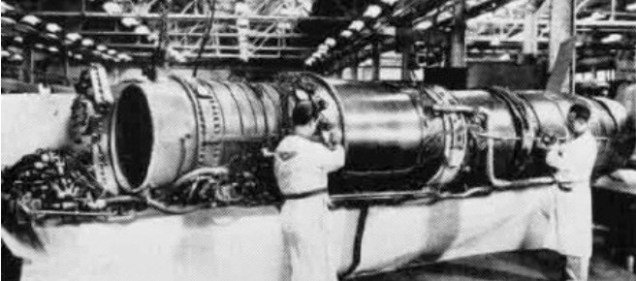
The J40 represented a big opportunity for Westinghouse to become a prominent player in the turbojet engine market. The U.S. Navy showed great confidence in the company when it bet the success or failure of a new generation of jets on Westinghouse over three other engine companies. It was in June 1947 that the Navy’s Bureau of Aeronautics contracted for its development. The prototype engine first ran in November 1948. According to an article in the April 1949 edition of the Naval Aviation Confidential Bulletin by Lieutenant Commander Neil D. Harkleroad of the Bureau of Aeronautics Power Plant Division, “The engine has been operating successfully to date.” As of that writing, the 50-hour flight substantiation test was to have been accomplished by June 1949 and the 150 hour qualification test by December 1949.

The Westinghouse J40 was to be a high performance afterburning turbojet engine was designed to deliver twice the thrust of engines currently in service, allowing the J40-WE-8 with afterburner to power many of the new Navy carrier-based fighters with a single engine. These included the Grumman XF10F Jaguar variable sweep wing general purpose fighter, the McDonnell F3H Demon and Douglas F4D Skyray interceptors.

Growth to over 15,000 lbf (67 kN) of thrust in afterburner was projected. A version without afterburner, the J40-WE-6, was to power the Douglas A-3D Skywarrior twin-engine carrier-based bomber.

The J40-8 was only a little over 40 inches (1,000 mm) in diameter but 25 feet (7.6 m) long, with accessories and including the afterburner. It weighed almost 3,500 pounds (1,600 kg), the -6 being almost seven feet shorter and about 600 pounds (270 kg) lighter, since it did not have an afterburner.

Development of the big engine was protracted. The all-important 150-hour qualification test that was to have been accomplished in December 1949 was not completed until January 1951, a year behind schedule. The afterburner was particularly troublesome – the afterburner version of the engine, the J40-WE-8, did not pass its 150-hour qualification until August 1952. As a result, engines were delivered without afterburners, causing delays in the fighter flight test programs. The XF10F Jaguar had to be tested without an afterburner, and testing had to stop altogether when all J40 powered aircraft were later grounded.

Though the J40 engine had been promised to deliver 10,000 lbf (44 kN) thrust with 15,000 lbf (67 kN) in afterburner for the Demon, actual output was just 6,800 lbf (30,000 N) and the engine was considered unusable because of reliability problems. The A3D would prove successful with alternate engines, but the F3H-1 was relegated to subsonic performance due to the poor performance of this engine. Although considered failures, the F3H-1 could have been competitive with early supersonic Air Force’s Century Series fighters had the original engines delivered on their design specifications.

The F3H Demon single-engine jet fighter was initially a severe disappointment due to the unreliability of the J40. The first production Demons were grounded for a redesign after the loss of six aircraft and four pilots. Time Magazine called the Navy’s grounding of all Westinghouse-powered F3H-1 Demons a “fiasco”, with 21 unflyable planes that could be used only for Navy ground training at a loss of $200 million. One high point of the J40 was the 1955 setting of an unofficial time-to-climb record, in a Demon, of 10,000 feet (3,000 m) in 71 seconds.

A replacement engine could not simply be fit into the old Demons, as both the wings and fuselage would have to be redesigned and enlarged. The F4D Skyray had been designed to accept larger engines in case the J40 did not work out, and was eventually powered by the Pratt & Whitney J57.

In 1953 Westinghouse worked with Rolls-Royce to offer engines based on the Avon, but Westinghouse was out of the aircraft engine business when this engine also failed to find a United States market.

The J40 program was terminated sometime in 1955 after a program cost of $281 million. All the aircraft it was to power were either canceled or redesigned to use other engines, notably the J57 and the J71.

Applications:
Douglas A-3 Skywarrior
Douglas F4D Skyray
Grumman XF10F Jaguar
McDonnell F3H Demon
North American X-10

Specifications:
J40-WE-8
Type: Afterburning Turbojet
Length: 300 in (7.62 m)
Diameter: 40 in (1.0 m)
Dry weight: 3500 lb (1590 kg)
Compressor: Single-Spool, 10 stage Axial
Combustors: Annular
Turbine: Two stage
Maximum thrust: 7,500 lbf (33.4 kN) dry, 10,500 lbf (46.7 kN) afterburning
Overall pressure ratio: 5.2:1
Specific fuel consumption: 0.94 lbf/(lb·h) dry, 2.2 lbf/(lb·h) afterburning
Thrust-to-weight ratio: 2.14:1 dry, 3:1 afterburning

Westinghouse J46

J46-WE-8 cutaway

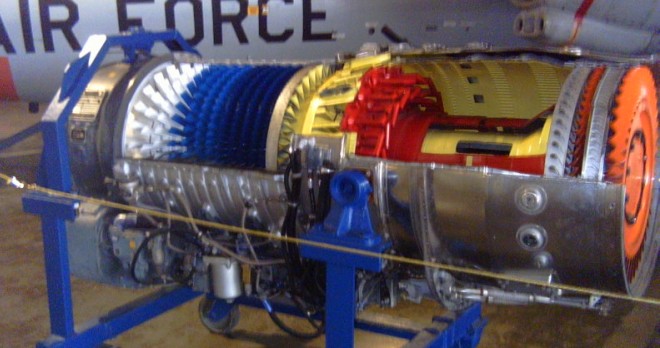
The Westinghouse J46 was an afterburning turbojet engine that was developed to power several United States Navy aircraft in the 1950s. It was intended to power the improved, swept wing, F3D-3 Skyknight (swept-wing version ultimately canceled). It also powered the F2Y Sea Dart and the F7U Cutlass jets, and Walt Arfon’s Wingfoot Express land speed-record car.

The J46 engine was developed as a larger, more powerful version of Westinghouse’s J34 engine, about 50% larger. The development program ran into many problems with this engine, including combustion instability and control issues at altitude.

The engine featured an 11-stage compressor that was driven by two turbine stages on a single spool. The engine also featured an early afterburner, which was a simple “eyelid” design that was actuated by a long control rod that ran the length of the engine.

Variants:
J46-WE-8: This variant powered the F7U Cutlass and produced 4800 lbf (21.4 kN) of dry thrust. The F7U-3 was re-engined with two J46-WE-8B turbojets giving a 680 mph (1,095 km/h) max speed. This variant also powered the Harvey Hustler, a speed boat designed to go faster than 275 mph.

J46-WE-18:This variant would have produced an increased 6100 lbf (27.1 kN) of dry thrust for the proposed A2U attack aircraft, an attack variant of the F7U. This variant was canceled with the aircraft program.

J46-WE-12:This variant powered the F2Y Sea Dart hydroski aircraft. It was equipped with a fresh water spray system that flushed salt deposits out of the engine before takeoff.

Specifications:
J46-WE-8
Type: Afterburning Turbojet
Length: 198 in (5.0 m)
Diameter: 34 in (0.86 m)
Dry weight: 2100 lb (952.5 kg)
Compressor: Single-Spool, 11-stage Axial
Combustors: Annular
Turbine: 2-stage turbine
Maximum thrust: 4800 lbf (21.4 kN) dry, 6,000 lbf (26.7 kN) afterburning
Overall pressure ratio: 6:1
Thrust-to-weight ratio: 2.3:1 dry, 2.9:1 afterburning

Westinghouse 24C / J34

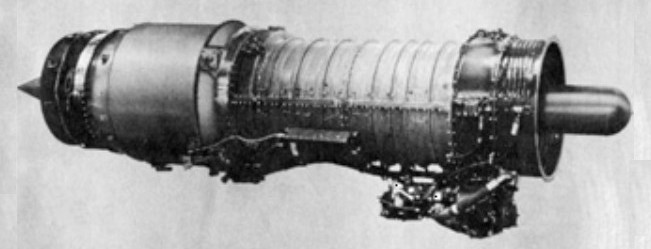
The Westinghouse J34, company designation Westinghouse 24C, was a turbojet engine developed by Westinghouse Aviation Gas Turbine Division in the late 1940s. First run on 11 January 1947, the 24C was essentially an enlarged version of the earlier Westinghouse J30, the J34 produced 3,000 pounds of thrust, twice as much as the J30.

It first flew in 1947. Built in an era of rapidly advancing gas turbine engine technology, the J34 was largely obsolete before it saw service, and often served as an interim engine. For instance, the Douglas X-3 “Stiletto” was equipped with two J34 engines when the intended Westinghouse J46 engine proved to be unsuitable.

J34-WE34

Developed during the transition from piston-engined aircraft to jets, the J34 was sometimes fitted to aircraft as a supplement to other powerplants, as with the Lockheed P-2 Neptune and Douglas Skyrocket (fitted with radial piston engines and a rocket engine, respectively).

Later models produced as much as 4,900 lbs with the addition of an afterburner. The afterburner was developed by Solar Aircraft, the first U.S. company to produce a practical afterburner.

The J46 engine was developed as a larger, more powerful version of Westinghouse’s J34 engine, about 50% larger.

Variants:
J34-WE-2: 3,000 lb (13.4 kN) thrust
XJ34-WE-7: 3,000 lb (13.4 kN) thrust
J34-WE-13: 3,000 lb (13.38 kN) thrust
J34-WE-15: 3,000 lb (13.4 kN) thrust
J34-WE-15: 4,100 lb (18.2 kN) thrust
J34-WE-17: 3,370 lb (15 kN) thrust (4,850 lb (21.6 kN) thrust with afterburner)
J34-WE-19: 3,250 lb (14.5 kN) thrust
J34-WE-22: 3,000 lb (13.3 kN) thrust
J34-WE-30A: 3,150 lb (14.0 kN) thrust (4,224 lb (18.78 kN) thrust with afterburner)
J43-WE-32: 3,000 lb (13.3 kN) thrust
J43-WE-32: 3,400 lb (15 kN) thrust
J34-WE-34: 3,250 lb (14.5 kN) thrust
J34-WE-34-1: 3,000 lb (13.3 kN) thrust
J34-WE-36: 3,400 lb (15 kN) thrust
J34-WE-36: 4,000 lb (17.8 kN) thrust
J34-WE-36-1: 3,400 lb (15 kN) thrust
J34-WE-38: 3,600 lb (1,630 kg) thrust
J34-WE-40: 3,000 lb (13 kN) thrust
J34-WE-41: (with afterburner)

Applications:
Fairchild C-119 Flying Boxcar (civilian variant modification)
Convair F2Y Sea Dart
Curtiss-Wright XF-87 Blackhawk
Douglas F3D Skyknight
Douglas Skyrocket
Douglas X-3 Stiletto
Lockheed XF-90
Lockheed P-2E/G/H Neptune
McDonnell 119/220
McDonnell F2H Banshee
McDonnell XF-85 Goblin
McDonnell XF-88 Voodoo
Ryan FR Fireball
Vought F6U Pirate
Vought F7U Cutlass

Ken Warby’s Spirit of Australia jet boat
Shockwave (Jet Truck)
Pyro (Jet Truck)

Specifications:
J34-WE-36
Type: Turbojet
Length: 112 in (2.84 m)
Diameter: 27 in (0.69 m)
Dry weight: 1207 lb (547.5 kg)
Compressor: Single-Spool, 11-stage Axial
Combustors: Annular
Turbine: 2-stage turbine
Maximum thrust: 3400 lbf (15.12 kN)
Overall pressure ratio: 4.35:1
Specific fuel consumption: 1.04 lb/hr-lb
Thrust-to-weight ratio: 2.82:1

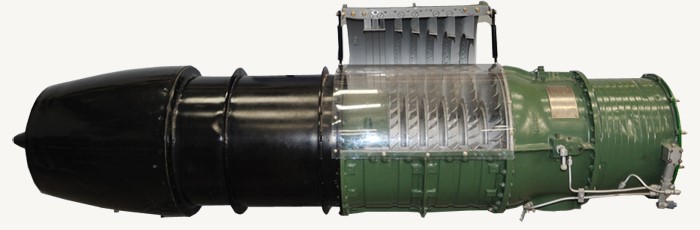
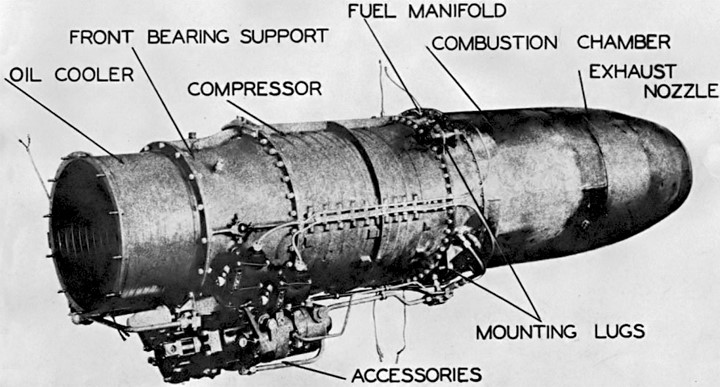
Westinghouse J30 / 19 / 19B / 19XB

Westinghouse 19A

combustion chamber and a single stage turbine.

On 19 March 1943, the first run was made. The static thrust developed being 515 kg (1,135 lb). On 21 January 1944 the second prototype was flown for the first time, under a Vought FG-1 Corsair. It was developed into the smaller J32, and the Westinghouse J34, an enlarged version which produced 3,000 pounds of thrust.

Six 19A were built all together. It initially gave 1,200 pounds of thrust but improved to 1,600 in production versions.

The 19B was to have a static thrust of 613 Kg (1350 lb) and be used as the main propulsion engine for an aircraft, rather than just a booster. The layout of the compressor and turbine was similar to the 19A, but 4 extra stages were added to the compressor to give ten in all. The previous cannular combustion chamber was replaced by an annular one.

First flight was made on 28 September 1944, using a JM-1 Marauder as a test-bed.

The McDonnell XFD-1 Phamtom powered by two 19Bs made its first flight on January 26, 1945. The Northrop XP-79B was also powered by two 19Bs, but crashed on its first flight on September 12, 1945.

A total of 28 19B were ordered.

Westinghouse submitted to the Navy a proposal for improving the performance and decreasing the weight of the 19B. This reconfigured engine was designated 19XB. The 1,600 lb thrust of the 19XB was achieved primarily by adding 4 additional axial-flow compressor stages.

The 19XB was used in the Grumman WTB3F-1, Douglas XB-42A (as auxiliary engines) and the Northrop X-4. The primary application for the 19XB engine was the McDonnell FH-1 Phantom.

A total of 261 19XB engines were made.

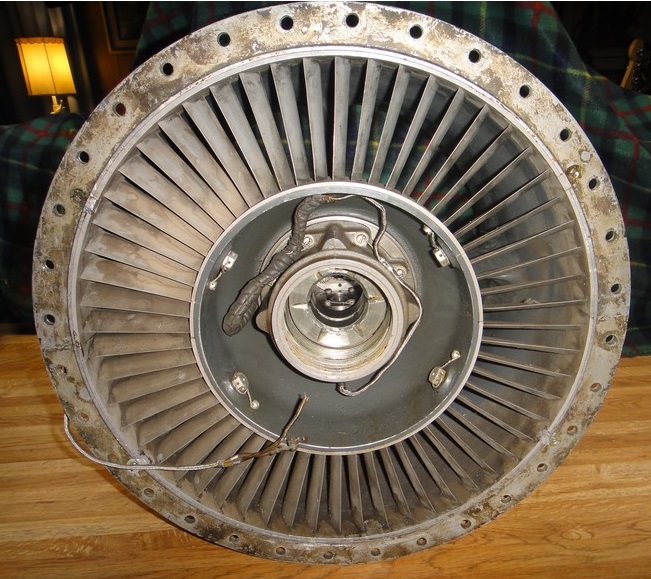
Inside/Rear view of 19XB2B Inlet
specific model: J30-P-20
Engine Spec Number: WAGT-19XB2B-102D
Accepted 12-23-47
(Courtesy Doug Colosio)

Variants:
19A
Prototypes and initial production

19B
Increased mass flow version delivering 1,400 lbf (6.23 kN) at 18,000 rpm at sea level

J30-WE-20
production engines delivering 1,600 lbf (7.1 kN) thrust

Applications:
Convair XF-92
McDonnell FH Phantom
Northrop XP-79
Northrop X-4 Bantam

Specifications:
Westinghouse 19A
Type: Axial flow turbojet
Length: 100 in (2,540.0 mm)
Diameter: 19 in (482.6 mm)
Dry weight: 830 lb (376.5 kg)
Compressor: 6-stage axial
Combustors: Annular stainless steel
Turbine: Single-stage axial
Fuel type: 100/130 gasoline
Oil system: pressure spray at 40 psi (275.8 kPa) dry sump, 60 S.U. secs (10.2 cs) (AN-0-6A) grade oil
Maximum thrust: 1,360 lbf (6.05 kN) at 18,000 rpm at sea level
Overall pressure ratio: 3:1
Turbine inlet temperature: 1,500 °F (816 °C)
Specific fuel consumption: 1.35 lb/lbf/hr (137.6 kg/kN/hr)
Thrust-to-weight ratio: 1.639 lbf/lb (0.016 kN/kg)
Normal thrust, static: 1,160 lbf (5.16 kN) at 18,000 rpm at sea level
Military thrust, flight: 660 lbf (2.94 kN) at 17,200 rpm at altitude
Normal thrust, flight: 570 lbf (2.54 kN) at 16,260 rpm at altitude

Westinghouse 19B
Type: Axial flow turbojet
Length: 104.5 in (2,654.3 mm)
Diameter: 19 in (482.6 mm)
Dry weight: 809 lb (367.0 kg)
Compressor: 6-stage axial
Combustors: Annular stainless steel
Turbine: Single-stage axial
Fuel type: 100/130 gasoline
Oil system: pressure spray at 40 psi (275.8 kPa) dry sump, 60 S.U. secs (10.2 cs) (AN-0-6A) grade oil
Maximum thrust: 1,400 lbf (6.23 kN) at 18,000 rpm at sea level
Overall pressure ratio: 3:1
Turbine inlet temperature: 1,500 °F (816 °C)
Specific fuel consumption: 1.28 lb/lbf/hr (130.48 kg/kN/hr)
Thrust-to-weight ratio: 1.724 lbf/lb (0.0169 kN/kg)
Normal thrust, static: 1,170 lbf (5.20 kN) at 17,000 rpm at sea level
Military thrust, flight: 525 lbf (2.34 kN) at 18,000 rpm at altitude
Normal thrust, flight: 465 lbf (2.07 kN) at 17,000 rpm at altitude

Westfall Sport

Westfall Sport N13954

The first Westfall Sport (N13954) was rebuilt c.1957 with a Continental A-75 and was active into the ’70s.

Westfall Sport with 90hp Ken-Royce

The second Sport was built in 1937 with a 65hp LeBlond engine.

An unknown number were built by others from marketed plans.

Engine: 40hp Ford A
Wingspan (upper): 25’0″
Wingspan (lower): 23’0″
Length: 15’4″
Max speed: 98 mph
Stall: 30 mph
Ceiling: 14,000′
Seats: 1

Engine: 65hp LeBlond
Useful load: 274 lb
Max speed: 115 mph
Cruise speed: 100 mph
Stall: 25 mph
Range: 315 mi

Western Airplane Sport

The 1928 Western Airplane & Supply Co Sport three seat open cockpit biplane was possibly designed or constructed by secretary-treasurer W W Wright, who was also credited with the Wright Light Sport of the same year.

Only the one was built, N4225, and the registration was cancelled in 1930.

Engine: 90hp Curtiss OX-5
Wingspan: 34’0″
Length: 33’6″
Seats: 3