Built by Gordon W. Westphal, the Rose Parakeet replica N16N sn GW-100 was first registered on 23 February 1976. Classified as an amateur built experimental, it was powered by a Lycoming O-290 engine.
Engines – Power
Westland-Cierva C.29 / Cierva C.29
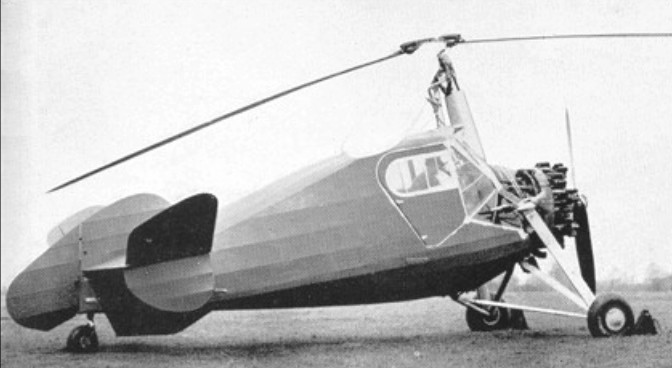
In 1934 the Westland design staff, in co-operation with the Cierva Autogiro Company, produced a large five-seat cabin autogiro in Duralumin tubing, powered with a 600hp Armstrong Siddeley Panther engine.
The fuselage was of square-section steel and duralumin tubing, arranged in the characteristic Westland style, with composite stringers and formers to give a deep oval section. The fabric-covered tailplane and vertical and oblique fins were built up of duralumin tubing and pressings, the aerofoil section of the port half of the tailplane being inverted, to offset airscrew torque effect. The seating in the cabin was arranged in the 2-3 plan.
It was much larger and heavier than anything of its kind previously attempted. The Cierva Company was responsible for the rotors and rotor mechanism, the direct control system being employed, while the airframe was designed and built by Westland.
Test of this machine, which was known as the C.29 Autogiro, disclosed vibration problems with the rotor system, which could not be immediately solved. In the circumstances it was decided to shelve this particular design, until further experience had been gained with other experimental autogiros, but the untimely death of Senor Cierva ultimately prevented development of this work. This aircraft never flew.
Westland-Cierva C.29
Engine: Armstrong Siddeley Panther, 600hp
Rotor diameter: 15.23m
Length: 11.58m
Height: 3.88m
Loaded weight: 2268kg
Empty weight: 1461kg

Westland-Cierva CL-20 / Cierva CL-20
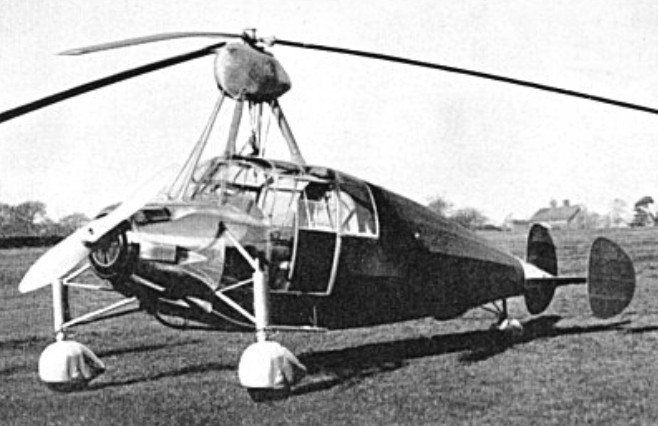
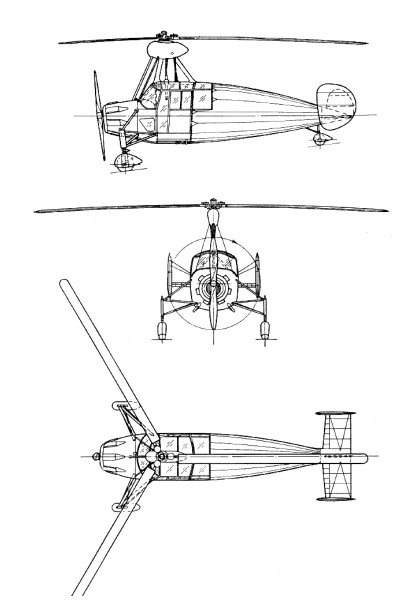
Westland, in conjunction with the Cierva Company and M. Lepere, produced the C.L.20 Autogiro, a two-seat side-by-side cabin machine. Lepere was at that time working with Liore and Olivier, holders of the Cierva licences for France. The fuselage was of welded seamless steel tubing, triangulated and faired to a streamline form by the use of stringers and fabric covering. A large door was fitted on either side of the cockpit and transparent panels, running right down to the bottom longeron, gave a forward and downward range of vision. The three-blade direct control rotor was arranged to fold, to facilitate parking and storage. It had a rotor with a direct-control head consisted of three untapered blades on flapping and drag hinges. Three vertical fins gave directional stability, while the tailplane was designed so that the aerofoil section of one half was inverted, and set at a negative angle of incidence, to counteract airscrew torque.
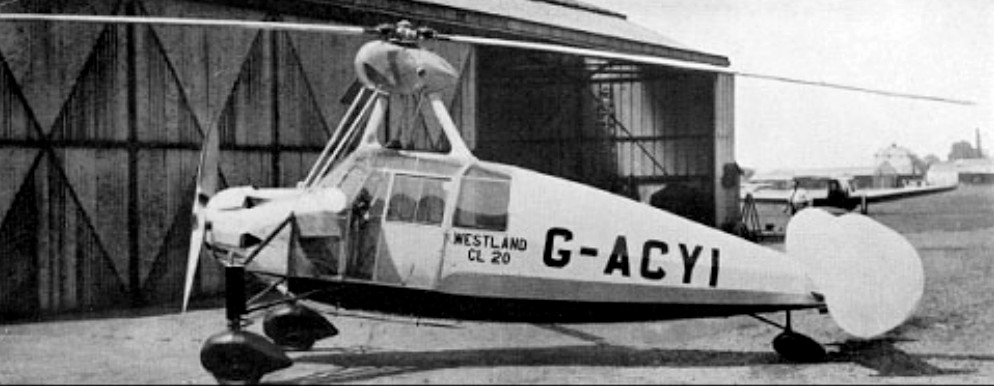
The earliest flights were in 1935.This experimental aircraft was successfully flight-tested by the Cierva Company’s pilot, R. A. C. Brie, but the shadow of impending hostilities prevented its production in quantity and closed Westland interest and activity in autogiros.
Westland CL.20
Engine: One 90hp Pobjoy Niagara S
Rotor diameter: 9.75m
Length: 6.17m
Height: 3.12m
Loaded weight: 635kg
Empty weight: 381kg
Speed: 170km/h
Landing speed: 40km/h
Westland Westminster
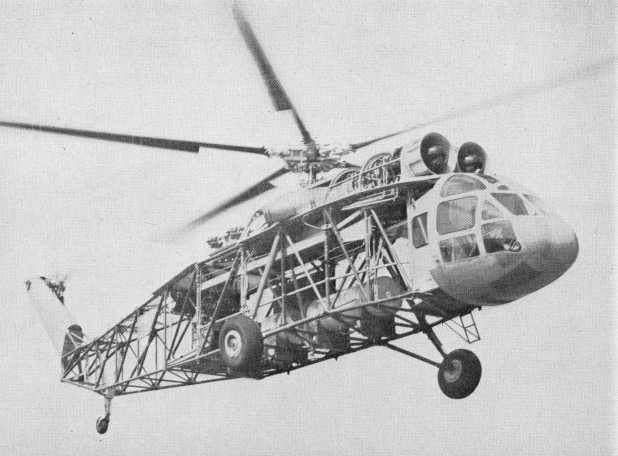
A private venture by Westland, based on the single main 5-blade rotor, gearbox, and hydraulic controls from the Sikorsky S-56 Mojave, Westland redesigned the fuselage using steel tube construction to create a medium sized troop and passenger carrying helicopter, witth tailwheel u/c. Up to 40 passengers were to be carried, with metal cladding for passenger role or open frame for utility/crane role.

First flown at Yeovil on 15 June 1958 (G-APLE), the prototype Westland Westminster was powered by two 2920shp Napier Eland E220 turboshafts. Two prototyprs were built.
After the type’s appearance at the 1960 Farnborough Air show, it was cancelled in September of that year.

The Westminster appeared in June 1960 with its fuselage framework faired in. Late a six-blade rotor was fitted.
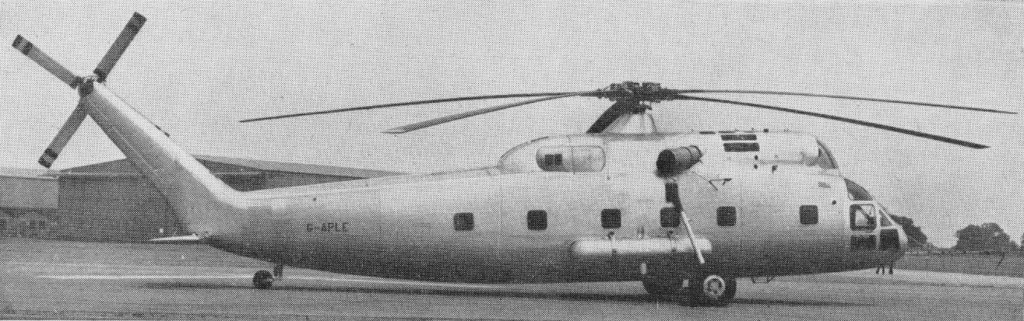
Westminster
Engines: 2 x Napier Eland E.229A turboshaft, 2090kW
Rotor diameter: 21.95m
Length: 27.4m
Max take-off weight: 14965kg
Empty weight: 10125kg
Max speed: 241km/h
Cruising speed: 184km/h
Hovering ceiling, IGE: 2750m
Range: 330km
Crew: 2
Passengers: 40
Westland P.10 / W.34 Wyvern / W.35 Wyvern
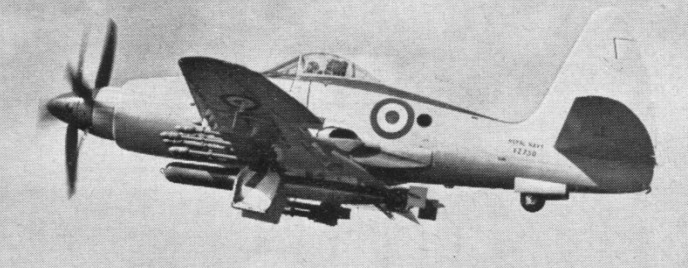
Under the project designation P.10, Westland began to study early in 1944 a long-range shipboard day fighter for Naval use, with the added capability of carrying a torpedo, rockets or bombs for anti-shipping strikes. Around this proposal, Specification N. 11/44 was written, and, in November 1944, a contract was confirmed for six prototypes (including two in land-based RAF configuration to Spec F.13/44). Redesignated W.34, and subsequently named the Wyvern TF Mk 1, the Westland aircraft was a low-wing monoplane of relatively conventional layout, but larger and heavier than any previous British single-seat Naval fighter. It had upward-folding outer wing panels with hinged tips, and a 3500hp Rolls-Royce Eagle 24-cylinder liquid-cooled H-type engine driving eight-blade contraprops. Provision was made in the design for the later introduction of a turboprop engine, such as the Rolls-Royce Clyde. Basic armament comprised four 20-mm Hispano Mk V cannon in the wings, with the possibility of carrying a 46cm Mk VIII torpedo under the fuselage three 464kg bombs or eight 27kg rocket projectiles.

Only 15 aircraft were built with the Rolls Royce Eagle (2700 hp) fitted.

In August 1946, an order for 20 pre-series Wyverns with Eagle engines was confirmed, but a planned batch of 10 for the RAF was dropped, together with the F.13/44 prototypes. Subsequently, the pre-production batch was halved.
The first of six prototypes flew on 16 December 1946. However, a turboprop version with the Armstrong Siddeley Python had meanwhile been given the go-ahead and the Wyvern TF Mk 1s were assigned to various development tasks, never becoming operational. All six prototypes were flown, as were six pre-series TF Mk 1s, but the final four of the latter, although built, remained unflown as all development effort switched to the TF Mk 2.
Following the RAF’s decision to pro¬ceed no further with this project the Royal Navy opted to concentrate all future development around the Arm¬strong Siddeley Python turboprop en¬gine.
The Naval Air Staff ordered three prototypes of the (W.35) Wyvern TF Mk 2, to Specification N.12/45. Two were to be powered by the Armstrong Siddeley Python and the third by a 4500hp Rolls-Royce Clyde. In the event, the former engine was to be preferred for production aircraft. In overall configuration and armament the Wyvern TF Mk 2 closely resembled the Mk 1, although there were differences in detail, and the first flight of the Clyde-engined prototype was made on 18 January 1949, followed by the first with a Python on 22 March 1949.
Flight testing soon showed the need for modifications, noticeably to the tail unit with the progressive introduction of a larger tailplane, more fin area, dihedral on the tailplane and, eventually, finlets. Prolonged testing and development also proved necessary to achieve a satisfactory engine/propeller/throttle response system for the special demands of carrier landings, involving the two Python prototypes and most of 20 pre-series TF Mk 2s ordered in 1948 (together with a single W.38 Wyvern T Mk 3 two-seat training version).
The first pre-series TF Mk 2, with a Python 2, flew on 16 February 1950, and, in June that year, became the first British turboprop aircraft to engage in carrier deck landings, aboard HMS Illustrious. Carrying a belly torpedo and 16 RPs it was a single seat strike/intruder fighter.
The final seven pre-series aircraft were completed as Wyvern S Mk 4s, this being the designation of the definitive variant with all the handling and engine modifications, and the primary mission changed to strike. The S Mk 4 was powered by a Python 3 rated at 3670hp plus 535kg residual thrust.
The principal production model was the Wyvern S.Mk 4, 94 being built in the early to mid-1950s, and these were augmented by a number of Wyvern TFMk 2 aircraft modified to Wyvern S.Mk 4 standard. Deliveries to the first FAA squadron (No 813) began during 1953. In addition, a solitary Wyvern T.Mk. 3 trainer was also completed although no production orders were forthcoming.

In September 1954, 813 embarked with their Wyverns on HMS Albion for carrier-based service in the Mediterranean. The Wyvern soon showed a worrying habit for flameout on catapult launch; the high G forces resulting in fuel starvation. A number of aircraft were lost off Albion’s bows and Lt. B. D. Macfarlane made history when he successfully ejected from under water after his aircraft had ditched on launch and been cut in two by the carrier. 813 did not return to Albion until March 1955 when the problems had been resolved.
830 Squadron was re-equipped with new aircraft before embarking in HMS Eagle on April 19, 1956. These aircraft were still designated Wyvern S.Mk4 and differed slightly in external appearance. The modifications which were visible from external inspection were:
(i) A modified cockpit canopy. This was the same shape as the previous canopy but it was a completely clear hood and did not have the metal bracing strut just aft of the pilot’s head.
(ii) The airbrake was re-designed and this can be seen from an underside view of the aircraft.
(iii) The folding wingtip facility was modded out.
Three other squadrons subsequently flew the Wyvern S Mk 4, front-line service continuing until March 1958. Operational use of the Wyvern during the Suez campaign in 1956 marked the only occasion on which British turboprop-powered aircraft saw combat use.
830 Squadron aircraft were flown ashore to Stretton and to Lee-on-Solent on January 3, 1957, and the squadron was officially disbanded from HMS Eagle in Devonport dockyard on January 5 1957.
Wyvern TF Mk 1
Max take-off weight: 9924 kg / 21879 lb
Empty weight: 7005 kg / 15443 lb
Wingspan: 13.42 m / 44 ft 0 in
Length: 11.96 m / 39 ft 3 in
Height: 4.72 m / 16 ft 6 in
Wing area: 32.98 sq.m / 354.99 sq ft
Max. speed: 734 km/h / 456 mph
Ceiling: 9785 m / 32100 ft
Range: 1908 km / 1186 miles
Wyvern S.Mk 4
Engine: one 4,110-eshp (3065-ekW) Armstrong Siddeley Python ASP3 turboprop
Maximum speed 616 km/h (383 mph) at sea level
Service ceiling 8535 m (28,000 ft)
Range 1455 km (904 miles) with auxiliary fuel
Weight empty 7080 kg (15,608 lb)
MTOW 11113 kg (24,500 lb)
Wing span 13,41 m (44 ft 0 in)
Length 12.88 m (42 ft 3 in)
Height 4.80 (15 ft9 in)
Wing area 32.98 sq.m (355 sq ft)
Armament: four 20-mm cannon
Bombload: 1361 kg (3,000 lb)


Westland WS-30 / WG.30 / T30 / TT300

Under the designation Westland 30 (initially WG 30 Super Lynx), the company developed an enlarged, twin-engined transport version of the Lynx, beginning in 1976, when Westland was studying the possibility of a replacement for the Wessex and Whirlwind which were then in service with various civil and military operators.
After considering a civil version of the Lynx, the British company favoured a larger machine using many of the components of the military helicopter. Accordingly, the Westland 30 has the transmission, rotor blade structure, some systems and many instruments and accessories of the Lynx, but the fuselage is entirely new and is bigger, even if it resembles the Lynx aerodynamically. It is made wholly of aluminum with a traditional type of structure and skin, while composite materials are used in the tail boom. The landing gear is fixed and the main units are housed in two fairings at the sides of the aft fuselage. The fuel system comprises two 630 liter tanks in the fuselage. The hydraulic system is similar to that of the Lynx as is the instrument panel with a few additions. The larger rotor should have a much longer service life than that of the Lynx on account of its slower rotational speed. Care has been taken to reduce vibrations in the fuselage.
The Westland 30 was originally intended for military use in the tactical transport and air ambulance roles, but the design has proved equally suitable for the civil market. In this role, the helicopter is approved for instrument flight, has optional airstair or sliding doors, and can take up to 22 passengers in the high density version in a comfortable, soundproofed cabin. Behind the cabin, which can be furnished to customers’ requirements to carry VIPs, executives or freight, there is an ample baggage compartment reached from the rear of the fuselage. The capabilities of the Westland 30 for offshore work are particularly interesting: with a 250km radius of action and 227kg fuel, the initial W30-100 variant can carry nine passengers on the outward journey and 13 on the homeward one. This type has been ordered by British Airways. In the military version, the same aircraft can carry 14 equipped troops or 17 without equipment, or six stretchers plus medical attendants.
The prototype of the Westland 30 (G-BGHF) made its first flight on 10 April 1979 in time for a successful appearance at the Paris Air Show that year. Production and delivery of W30-100 aircraft began in 1981. This version was superseded by the W30-160 with uprated Gem 60 engines. CAA and FA A type certification of the basic production version, the Series 100, powered by a pair of 846kW Rolls-Royce Gem Mk 41-1 turboshafts, was granted in 1982. In January 1984 the Series 100-60 appeared, powered by two 940kW Gem 60-3 engines. Westland was test-flying the W30-200 prototype, powered by 1277kW / 1700shp General Electric CT-7-2B engines. This version first flew in 1983. The Series 300 of 1986 offered a General Electric CT7 or Rolls-Royce Turbomeca RTM 322 powerplant, and also had an increased maximum take-off weight, composite BERP rotor blades, considerably reduced noise and vibration levels and an optional EFIS cockpit.
Two military tactical transport versions were also developed, the TT30 and the TT300, but these met with even less success than the civilian versions.
The TT300, which first flew in February 1986, is powered by twin 1,277kW General Electric CT7 turboshafts, and has a maximum all-up weight of 7,257kg.

British Airways ordered two helicopters, for delivery in 1982, and obtained a third the following year. Sixteen further aircraft were spread among several operators in the United States, such as PanAm/Omniflight (for services between John F. Kennedy, Newark and downtown New York) and Airspur. These aircraft were largely Series 100s and 100-60s, operated on lease. By early 1984 only 19 orders had been received. In 1986 the Westland 30 received its last, and largest, order for 21 Series 100-60s from the Helicopter Corporation of India, financed largely by UK government assistance. Production ended in January 1988 with the completion of the 38th airframe. The Helicopter Corporation of India became Pawan Hans and its 19 surviving Westland 30-160s are stored at Delhi and Bombay, the company having failed to sell them on several recent occasions.
Westland 30-100
846kW Rolls-Royce Gem Mk 41-1 turboshafts
WS.30 100-60
Engine: 2 x R-R Gem 60-3, 940kW / 1006kW
Installed pwr: 1880 kW
Rotor dia: 13.31 m
No. Blades: 4
Length with rotors turning: 15.91m
Height: 4.74m
Width: 3.1m
Empty wt: 3165 kg
MTOW: 5600 kg
Max speed: 245 kph
Cruising speed: 222km/h
ROC: 660 m/min
Ceiling: 3030 m
HIGE: 1160 m
HOGE: 790 m
Fuel cap: 1310 lt
Range: 750 km
Crew: 2
Pax: 22
WS.30 200
1277kW / 1700shp General Electric CT-7-2B
WS.30 300
General Electric CT7 or Rolls-Royce Turbomeca RTM 322

Westland Scout / Wasp / Sprite
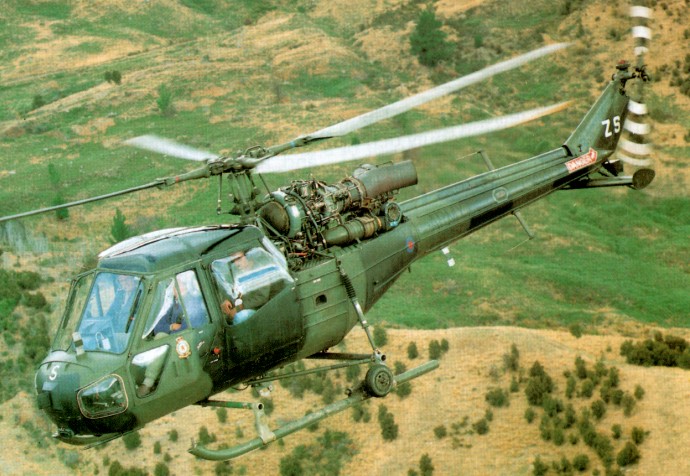
The Westland Scout and Wasp originated in November 1957 when Saunders-Roe Ltd. began its design of a private venture for a Skeeter development and replacement. Two prototypes of the aircraft, then known as the Saro P.531 Sprite, were begun early in 1958, the first (G-APNU) flying on 20 July and the second (G-APNV) on 30 September 1958.

Several Skeeter components were used in their construction, including the tailboom, short-legged tricycle undercarriage and rotor blades (the P.531 having a 4-blade assembly). Both prototypes were powered by Blackburn-built Turmo 603 shaft turbines, derated to 325shp.
The fuselage is a conventional aluminium alloy stressed skin structure. Front section forms the cabin, fuel tank bays and aft compartment. Rear section is a tapered boom terminating in a fin which carries the tail rotor. Horizontal stabiliser of light-alloy construction mounted on starboard side of fin opposite tail rotor. Four-blade main rotor, with all-metal blades carried on fully articulated hub. Torsion blade suspension system. Two-blade tail rotor with metal blades. Rotors driven through steel shafting. Primary gearbox at rear of engine, secondary gearbox at base of pylon, angle gearbox at base of fin, tail rotor gearbox at top of fin. Main rotor/engine rpm 1:71. Tail rotor/engine rpm ratio 1:15.
Controls have main rotor hub has drag and flapping hinges. Rotor brake standard. Tail rotor has flapping hinge.
Landing gear is a non-retractable four-wheel type. All four wheels castor and are carried on Lockheed shock-absorber struts. All wheels and tubeless tyres are Dunlop, size 15 x 4.75-6.5, pressure 4.22kg/cm2. Dunlop dog clutch brakes. Flotation gear standard.
The engine is mounted above fuselage to rear of cabin. Fuel in three interconnected flexible tanks in fuselage below main rotor, with total capacity of 705 litres. Refuelling point on starboard side of decking. Oil capacity 7 litres.
Two seats side by side at front of cabin, with bench seat for three persons at rear. Four doors, by front and rear seats on each side of cabin. Rear seats removable for cargo carrying. Heater standard.
Systems include Delaney Galley/Westland 1 kW cabin heating and windscreen demisting system. Hydraulic system, pressure 73.9 bars, operating servo jacks for rotor head controls and rotor brake. No pneumatic system. 28V DC electrical supply from engine-driven generator. Limited supply by 15 or 23 Ah battery. Three-phase 115V 400Hz AC provided by inverter.
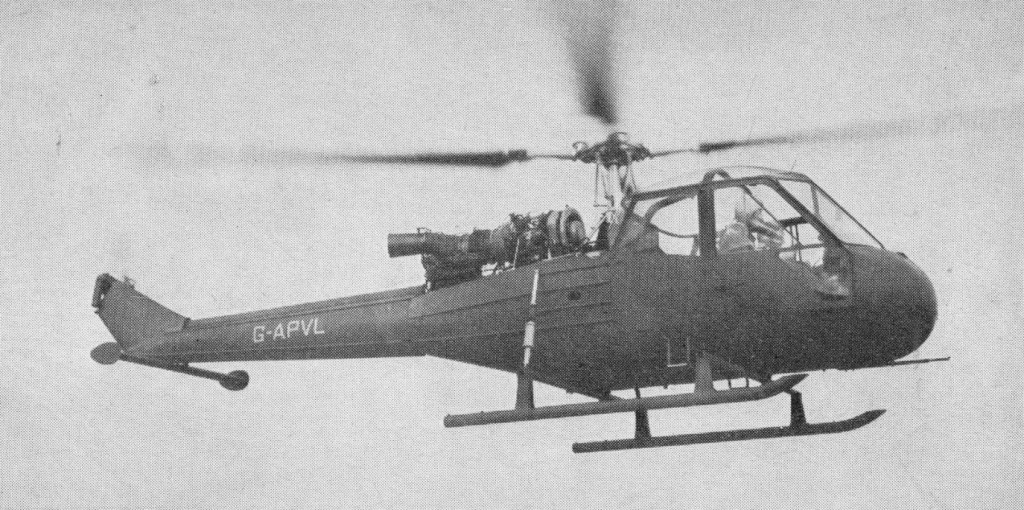
The first firm order for this general purpose helicopter came from the Army Air Corps, a pre-series batch of P.531-2 Mk.1’s basically similar to G-APVL being ordered in 1959. The first of these was flown on 4 August 1960, and in the following month an order for 66 of the P.531-2 Scout AH Mk.1 with 968shp Rolls-Royce Nimbus turbine engines (derated to 685shp) Army order was placed for the type as the Scout AH Mk.1. Delivered from spring 1963, these are 5-seaters with Nimbus 101 or 102 engines and skid landing gear. They replaced the Skeeter both at home and abroad and were employed for duties that include passenger or freight transport, liaison, search and rescue, and training. The Scout can also be used for casualty evacuation, carrying 2 stretchers inside the cabin and 2 more supported externally.
Up to the spring of 1968 about one hundred and fifty Scouts had been built, these including deliveries to the Royal Australian Navy (two for shipborne survey work), Royal Jordanian Air Force (three), and the police departments of Bahrain (two) and Uganda (two). King Hussein of Jordan had a Scout for his own personal use.

Another order was placed for 40 helicopters in September 1964.
The only Scout operator in 1993 was the British army. Thirty-eight active AH.Mk Is, with more in storage, remained in use with Nos 658 Sqn at Netheravon, 660 Sqn at Hong Kong and Brunei, and 666 Sqn (TA) at Middle Wallop.
Parallel development of the Wasp anti-submarine version took longer, due to exhaustive Naval trials carried out from November 1959 with a modified G-APNV and two specially-built P.531-0/N’s powered by Nimbus turbine engines, but were fitted with a long-stroke quadricycle wheel undercarriage as well as landing skids. The Wasp is designed to operate from platforms on the rear decks of frigates, primarily as an extension of the ship’s ability to attack submarines, but carrying no search gear. Three aircraft performed take-off and landing trials from the escort vessel HMS Undaunted in November 1959.
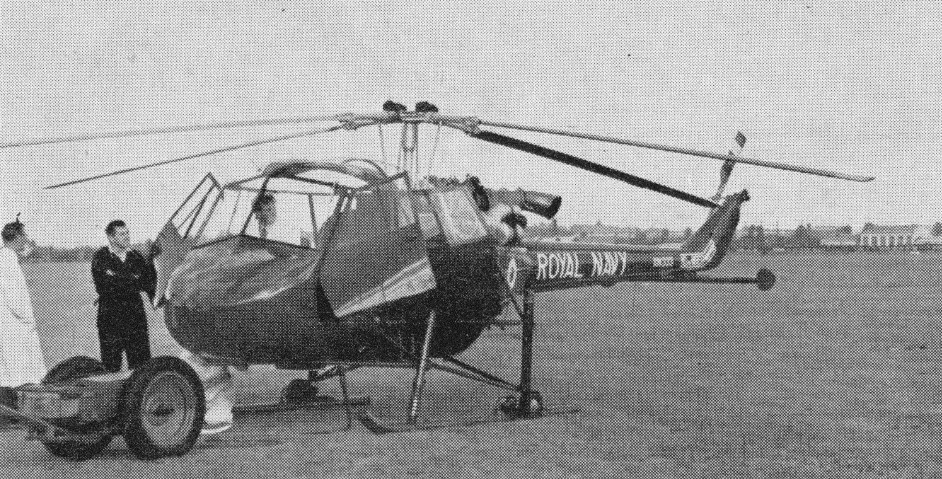
These were similar to the two original prototypes with Blackburn Turmo engine.

Intended for ASW from frigates of the Tribal and Leander classes and similar vessels, it could carry one or two 122kg torpedoes or 250kg of depth charges. In September 1961, the type was ordered for the Royal Navy under the name Wasp HAS Mk.1 (the first flew on 28 October 1962 with a 968shp Nimbus engine derated to 710shp).
Production Wasps differ from the Scout in having the 710shp (derated) Nimbus 103 or 104 engine, long-stroke, fully-castoring wheel undercarriage (but no skids) and a half-tailplane at the top of the tail rotor pylon on the starboard side. (The Scout has a full tailplane below the tailboom.) The Wasp’s main rotor blades and its entire tail section can be folded for stowage on ship. A weapon load of some 244kg can be attached to the underside between the undercarriage legs; this may comprise two Mk.44 homing torpedoes or an equivalent weight of depth charges or bombs. Wasp deliveries began in 1963 after more than 200 test deck landings had been completed.
First Wasp HAS. Mk 1 for Royal Navy flew 28 October 1962, and entered service in October 1963. The first production machines were allocated to No.829 Squadron and deployed singly aboard the Royal Navy’s seven Tribal class and seven Leander class frigates. Other Wasps have been ordered by the navies of Brazil (three), the Netherlands (twelve), New Zealand (two) and South Africa (ten). Two Australian Scouts were ordered in 1964 and delivered on 20 March 1963.
In the anti surface vessel role the Wasp is autonomous, and though it has no radar it can steer the AS.12 wire guided missile under visual conditions over ranges up to 8 km (5 miles). Outboard it can carry a Mk46 torpedo or two depth charges or one of each as well as underwater sound signal grenades, both smoke and flame marine markers and night illumination flares. For the utility role a winch is fitted as well as a cargo hook.
Duties include SAR (search and rescue), liaison, VIP ferrying, casualty evacuation with two internally carried stretchers, ice reconnaissance and photography/survey. The cockpit is equipped for bad weather operation with auto stabilization, radar altimeter, beacon receivers, UHF radio and UHF homer, and in RN service limited EW provisions. The quadricycle landing gear has wheels that castor so that, while the machine can be rotated on deck, it cannot roll in any direction even in a rough sea. Sprag (locking) brakes are fitted to arrest all movement.
The Wasp was replaced by the Lynx in the Royal Navy and Indonesia purchased ten second-hand aircraft from Holland (after refurbishment by Westland) when the latter’s navy replaced its Wasp fleet with the Westland Lynx. The Royal Navy received a total of 98 Wasps; the last was retired in 1988.
Nine ships operated Wasps during the Falklands War of 1982. Wasp HAS. Mk Is operated from eight ships in that campaign, all assigned to RN No. 829 Squadron. They flew almost 1,000 hours in 912 combat sorties during which they made no fewer than 3,627 deck landings. Most were used in reconnaissance and utility missions, though several operated in the casevac role. Three, two from HMS Endurance and one from the frigate HMS Plymouth, engaged the Argentine submarine Santa Fe and holed its conning tower with AS.12 missiles. A Scout pilot won the Distinguished Flying Cross in tho Falklands for flying under fire to rescue a severely injured soldier. Wasps flew in support of British expeditions in Antarctica and the Empire Test Pilot School at Boscombe Down flew a Scout in their ‘raspberry ripple’ colour scheme.
Scout AH-1 RAAF
Engine: One 685 shp Bristol Siddeley Nimbus 102 turboshaft
Rotor Span: 32 ft 3 in / 9.83 m
Length: 30 ft 7 in / 9.3m
Height: 8 ft 11 in / 2.64 m
Empty weight: 3,084 lb
Loaded weight: 5,300 lb
Crew: 1
Initial Rate of Climb: 1,700 ft/min
Ceiling: 15,400 ft
Speed: 132 mph (max sea level), 122 mph (cruising)
Range: 322 miles / 274 nm / 507 km
Armament: Nil
Seats: 6
Westland Wasp
Engine: 1 x Bristol Siddeley Nimbus 101 turboshaft, 530kW
Main rotor diameter: 9.83m
Length with rotors turning: 12.29m
Fuselage length: 9.24m
Height: 3.43m
Width: 2.64m
Max take-off weight: 2495kg
Empty weight: 1651kg
Max speed: 193km/h
Cruising speed: 177km/h
Rate of climb: 7.3m/s
Service ceiling: 3720m
Range: 435km
Normal load: two Mk 44 torpedo
Wasp
Engine: 1 x Rolls-Royce/Bristol Nimbus 103 or 104 turboshaft, 783kW
Maximum speed: 193km/h at sea level
Scout AH.Mk 1
Engine: 1 x 685 shp Rolls Royce Bristol Nimbus 101 or 102 turboshaft
Width: 2.59m
Loaded weight: 2405kg
Empty weight: 1465kg
Max speed: 211km/h
Max cruising speed: 196km/h
Max rate of climb: 8.5m/s
Service ceiling: 4085m
Range: 510km
Wasp HAS.1
Engine: RR Bristol Nimbus 503 turboshaft, 710 shp
Crew: 2
Range: 180nm
Cruise: 90 kt
Armament: 2 x Mk 44 AS torpedoes or two AS.12 anti ship missiles
Fuselage length: 9.3m (30 ft 4 in)
No. blades: 4
Main rotor diameter: 9. 83 m (32 ft 3 in)
Length overall 12.29 m (40 ft 4 in)
Height 3.56 m (11 ft 8 in)
Main rotor disc area 75.90 sq.m (816.86 sq ft)
Maximum speed with weapons 193 km/h (120 mph)
Cruising speed 177km/h (110mph)
Range 435 km (270 miles)
Empty weights: 1566 kg (3,452 lb)
Maximum take off 2495 kg (5,500 lb)
Wasp HAS.1
Engine: RR Bristol Nimbus 503 turboshaft, 685 shp
Main rotor diameter: 9. 83 m (32 ft 3 in)
No. blades: 4
Fuselage length: 9.3m (30 ft 4 in)
Height 3.56 m (11 ft 8 in)
Main rotor disc area 75.90 sq.m (816.86 sq ft)
Empty weights: 3139 lb
Normal take off weight: 5,500 lb
Fuel capacity: 155 Gal.
Maximum speed SL: 138 mph
Cruising speed: 132 mph
Max range: 320 miles
Wasp HAS.3
Wasp HU.5

Westland WG.13 Lynx

One of the three helicopters included in the Aerospatiale/Westland co-production agreement confirmed 2 April 1968, Westland given design leadership, the Westland Lynx was designed initially for naval and civil roles, but early appreciation of its suitability for a wide range of military operations has led to an expanded development programme under the titles Army and Navy Lynx. Production was shared 70% by Westland and 30% by Aerospatiale.
From the start of Westland Helicopters planing for what in the early 1960s was called the WG.13 (the name Lynx coming later), every effort was made to find a basic formula that would appeal to the greatest number of operators, both military (including naval) and commercial. New technology enabled the original Lynx first flown on 21 March 1971, to be the most modern in the world, typical features being the all new Rolls Royce Gem three shaft engines, the conformal gear main gearbox giving amazing compactness (with a much shallower powerplant group above the cabin than in rival designs) and the four blade rotor with a semi rigid hub forged from a single slab of titanium. This hub is one of the parts made in France by Aerospatiale, which was brought in at the start of the project under the terms of the 1967 Anglo French helicopter programme. Modified Westland Scout helicopters were used to test the Lynx’s main rotor system.
Engine options include two Rolls-Royce Gem 42-1 turboshafts, each rated at 835kW, or two LHTEC CTS800-4N, each rated at 995kW. Transmission rating 1,372kW. Exhaust diffusers for IR suppression optional on Battlefield Lynx.
Two Rolls-Royce Gem 2 turboshafts, each with maximum contingency rating of 671kW in original Lynx AH. 1, HAS. 2 and early export variants. Later versions have Gem 41-1, 41-2, or 42-1 engines, all with maximum contingency rating of 835kW. Transmission rating 1,372kW. Engines of British and French Lynx in service were converted to Mk 42 standard during regular overhauls from 1987 onwards. Danish, Netherlands and Norwegian Lynx similarly retrofitted. Fuel in five internal tanks; usable capacity 957 litres when gravity-refuelled; 985 litres when pressure-refuelled. For ferrying, two tanks each of 441 litres in cabin, replacing bench tank. Maximum usable fuel 1,867 litres. Engine oil tank capacity 6.8 litres. Main rotor gearbox oil capacity 28 litres.
All versions equipped as standard with navigation, cabin and cockpit lights; adjustable landing light under nose; and anti-collision beacon. For search and rescue, with three crew, both versions can have a waterproof floor and a 272kg capacity clip-on hydraulic hoist on starboard side of cabin. Cable length 30m. Electric hoist on CTS800-powered aircraft.
Features a manually folding tail pylon on naval versions; single four-blade semi-rigid main rotor (foldable), each blade attached to main rotor hub by titanium root plates and flexible arm; rotor drives taken from front of engines into main gearbox mounted above cabin ahead of engines; in flight, accessory gears (at front of main gearbox) driven by one of two through shafts from first stage reduction gears; four-blade tail rotor, drive taken from main ring gear; single large window in each main cabin sliding door; provision for internally mounted armament, and for exterior universal flange mounting each side for other weapons/stores.
Super Lynx has increased take-off weight; all-weather day/night capability; extended payload range; swept-tip BERP composites main rotor blades offering improved speed and reduced vibration; and reversed direction tail rotor for improved control.
The rotor head controls actuated by three identical tandem servojacks and powered by two independent hydraulic systems; control system incorporates simple stability augmentation system; each engine embodies independent control system providing full-authority rotor speed governing, pilot control being limited to selection of desired rotor speed range; in event of one engine failure, system restores power up to single-engine maximum contingency rating; main rotor can provide negative thrust to increase stability on deck after touchdown on naval versions; hydraulically operated rotor brake mounted on main gearbox; sweptback fin/tail rotor pylon, with starboard half-tailplane.
The structure is a conventional semi-monocoque pod and boom, mainly light alloy; glass fibre access panels, doors, fairings, pylon leading/trailing-edges, and bullet fairing over tail rotor gearbox; composites main rotor blades; main rotor hub and inboard flexible arm portions built as complete unit, as titanium monobloc forging; tail rotor blades have light-alloy spar, stainless steel leading-edge sheath and rear section as for main blades.
The general purpose military version landing gear is non-retractable tubular skid type. Provision for a pair of adjustable ground handling wheels on each skid. Flotation gear optional. Battlefield Lynx and AH.Mk 9 equivalent have non-retractable tricycle gear with twin nosewheels. Naval versions have a non-retractable oleo-pneumatic tricycle type. Single-wheel main units, carried on sponsons, fixed at 27° toe-out for deck landing; can be manually turned into line and locked fore and aft for movement of aircraft into and out of ship’s hangar. Twin-wheel nose unit steered hydraulically through 90° by the pilot to facilitate independent take-off into wind. Sprag brakes (wheel locks) fitted to each wheel prevent rotation on landing or inadvertent deck roll. These locks disengage hydraulically and re-engage automatically in event of hydraulic failure. Maximum vertical descent 2.29m/s; with lateral drift 0.91m/s for deck landing. Flotation gear, and hydraulically actuated harpoon deck lock securing system, optional.
Pilot and co-pilot or observer on side-by-side seats. Dual controls optional. Individual forward-hinged cockpit door and large rearward-sliding cabin door on each side; cockpit doors jettisonable; windows of cabin doors also jettisonable. Cockpit accessible from cabin area. Maximum high-density layout (military version) for one pilot and 10 armed troops or paratroops, on lightweight bench seats in soundproofed cabin. Alternative VIP layouts for four to seven passengers, with additional cabin soundproofing. Seats can be removed quickly to permit carriage of up to 907kg of freight internally. Tiedown rings provided. In casualty evacuation role, with a crew of two, Lynx can accommodate up to six Alphin stretchers and a medical attendant. Both basic versions have secondary capability for search and rescue (up to nine survivors) and other roles.
Two independent hydraulic systems, pressure 141 bars. Third hydraulic system provided in naval version when sonar equipment, MAD or hydraulic winch system installed. No pneumatic system. 28V DC electrical power supplied by two 6kW engine-driven starter/generators and an alternator. External power sockets. 24V 23Ah (optionally 40Ah) Ni/Cd battery fitted for essential services and emergency engine starting. 200V three-phase AC power available at 400Hz from two 15kVA transmission-driven alternators. Cabin heating and ventilation system. Optional supplementary cockpit heating system. Electric anti-icing and demisting of windscreen, and electrically operated windscreen wipers, standard; windscreen washing system.
Avionics common to all roles (general purpose and naval versions).
Comms: Collins VOR/ILS; DME; Collins AN/ARN-118 Tacan; I-band transponder (naval version only); GEC-Plessey PTR 446, Collins APX-72, Siemens STR 700/375 or Italtel APX-77 IFF.
Flight: Marconi duplex three-axis automatic stabilisation equipment; BAe GM9 Gyrosyn compass system; Decca Tactical Air Navigation System (TANS); Decca 71 Doppler, E2C standby compass. Marconi Mk 34 AFCS. Additional units fitted in naval version, when sonar is installed, to provide automatic transition to hover and automatic Doppler hold in hover.
(Army): Flight: Decca Doppler 91 and RSN252 navigation; Honeywell/Smiths AN/APN-198 radar altimeter; Rockwell Collins 206A ADF and VIR 31A VOR/ILS on latest versions.
Mission: British Army Lynx equipped with TOW missiles have roof-mounted Hughes sight manufactured under licence by British Aerospace. Roof sight upgraded with night vision capability in far infra-red waveband; first test firing of TOW with added Marconi thermal imager took place in October 1988. Optional equipment, according to role, can include lightweight sighting system with alternative target magnification, vertical and/or oblique cameras, flares for night operation, low-light level TV, infra-red linescan, searchlight, and specialised communications equipment. Some have infra-red formation flying lights and provision for crew’s NVGs. For surveillance, some AAC Lynx carry Chancellor Helitele in external (port) ball housing, complete with datalink.
Self-defence: Sanders AN/ALQ-144 infra-red jammer installed beneath tailboom of some British Army Lynx from 1987; later augmented by exhaust diffusers. Requirement for RWR satisfied by 1989 selection of Marconi AWARE-3 (ARI23491) system; Marconi Sky Guardian Mk 13 (later Mk 15) on some aircraft from 1990.
(Navy): Comms: Rotal Navy helicopters have two GEC-Marconi AD 3400 VHF/UHF transceivers, Dowty D403M standby UHF radio, Collins 718U-5 HF transceiver, Plessey PTR446 D-band transponder and Pilkington ARI 5983 I-band transponder.
Radar: Marconi ARI5979 Sea Spray Mk 1 lightweight search and tracking radar, for detecting small surface targets in low-visibility/high-sea conditions in original versions. Super Lynx has Sea Spray Mk 3000 or AlliedSignal RDR 1500 360° scan radar in chin fairing. UK Mk 8 upgraded with Sea Spray Mk 3000 below fuselage.
Flight: GPS on Royal Navy and Netherlands Lynx from 1997.
Self-defence: Tracor M-130 chaff/flare dispensers and Ericsson Radar Electronics AN/ALQ-167(V) D- to J-band anti-ship missile jamming pods installed on Royal Navy Lynx patrolling Arabian Gulf, 1987. Two Loral Challenger IR jammers above cockpit of Royal Navy Lynx during 1990-91 Gulf War. RWR in Netherlands SH-14Ds from 1996.
The first flight of the first of 13 prototypes (XW835) 21 March 1971 (six prototypes, seven pre-production prototypes). It was followed by four more aircraft in two basic configurations: the AH Mk.1 for the Army and the HAS Mk.2 for the Navy. First flight of fourth prototype (XW838) 9 March 1972, featuring production type monobloc rotor head; first flights of British Army Lynx prototype (XX153) 12 April 1972, French Navy prototype (XX904) 6 July 1973, production Lynx (RN HAS. Mk 2 XZ229) 20 February 1976.
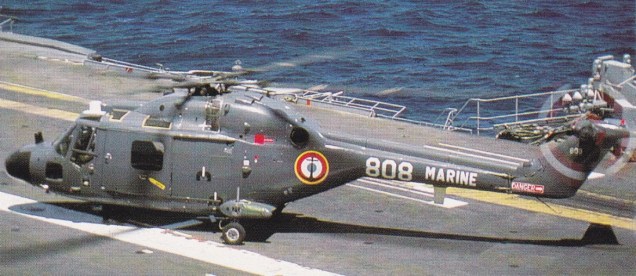
Standard power plant consists of two Rolls Royce BS 360 07 26 Gem turboshaft engines, each of which has a maximum rating of 900 shp. Army versions can be configured for many roles including anti tank, command post, reconnaissance, SAR, and tactical troop transport duties. For such roles that require weapons, armament can include a 20 mm cannon, rocket pods, six AS.11 or up to eight HOT or TOW air to surface missiles. Naval versions are intended for such duties as ASW, ASV, communications, reconnaissance, SAR, troop trans¬port, and vertical replenishment. Equipment can include dipping sonar and search radar, and weapons such as depth charges, homing torpedoes, and air-¬to surface missiles can be deployed. This latter category of weapon includes the new British Sea Skua, an all weather, sea skimming, semi active homing anti ship missile which became operational in 1980. Differing versions of the Lynx were in service with the armed forces of the Argentine, Brazil, Denmark, Egypt, France, Germany, the Netherlands, Norway, and Qatar, in addition to those which serve with the Royal Navy and the RAF.
For armed escort, anti-tank or air-to-surface strike missions, army version can be equipped with two 20mm cannon mounted externally so as to permit carriage also of anti-tank missiles or pintle-mounted 7.62mm machine gun inside cabin. External pylon can be fitted on each side of cabin for variety of stores, including two Minigun or other self-contained gun pods; two rocket pods; or up to eight HOT, Hellfire, TOW, or similar air-to-surface missiles. Additional six or eight missiles carried in cabin. For ASW role, armament includes two Mk 44, Mk 46, A244S or Sting Ray homing torpedoes, one each on an external pylon on each side of fuselage, and six marine markers; or two Mk 11 depth charges. Alternatively, up to four Sea Skua semi-active homing missiles; on French Navy Lynx, four AS.12 or similar wire-guided missiles. Self-protection FN HMP 12.7mm machine gun pod optional on Royal Navy Lynx.
The Lynx demonstrated its capabilities by the records achieved in the summer of 1972. Piloted by Westland’s chief test pilot Roy Moxam, it broke the world record over 15/25km by flying at 321.74km/h, also setting a new 100km closed circuit record shortly afterwards by flying at 318.504km/h.
Service trials began first in 1976 with No. 700L Naval Air Squadron at RNAS Yeovilton, Somerset, this being a joint Royal Navy and Royal Netherlands navy operational evaluation unit; similarly, an Army Aviation trials unit was established at Middle Wallop, Hampshire, in mid-1977.
Deliveries of production aircraft to operational units began following completion of the latter trials in December 1977, the Lynx entering service first with Army Aviation squadrons in West Germany. The first Royal Navy unit (No. 702 Sqn, at Yeovilton) became operational in December 1977.
The original naval model, the Lynx HAS.2 for the Royal Navy, was actually the first production variant to fly, on 10 Febru¬ary 1976. The Lynx HAS.Mk 2 is powered by the 750 shp (559kW) Gem 2 with contingency rating of 900 shp (671 kW) and entered service with a gross weight of 4309 kg (9,500 lb). Subsequently this has been increased to 4423 kg (9,750 lb), and it is at this weight that the 60 Lynx HAS.Mk 2s of the Royal Navy were operating. The designation Helicopter Anti Submarine does not preclude many other missions, such as anti ship missile attack, all forms of rescue and a variety of liaison, surveillance and transport duties. This has a gross weight of 4309 kg (9,500 lb), a crew of two (three in the ASW or SAR roles) plus all equipment for ASW, SAR, ASV (anti surface vessel) search and strike, reconnaissance, troop transport (typically 10 troops), fire support, communication, and fleet liaison and vertrep (vertical replenishment) duties. Equipment of all these models includes a search radar which in the 60 Lynx HAS. Mk.2s of the RN is the Ferranti Seaspray; the equivalent machines of the French Aeronavale have the OMERA Segid ORB 31W. In the ASW search role other sensors can include Bendix or Alcatel dipping sonars or a TI MAD (magnetic anomaly detector). This model was characterized by wheeled landing gear, with a castoring and steerable (± 90 degrees) twin wheel nose unit and single wheel main gears which can be toed out 27 degrees to the sides for stability on pitching decks.
In 1979 the Royal Netherlands navy be¬gan receiving the upgraded Lynx Mk 27, first of a Mk 2 family with Gem 41 1 engines and weights ranging from 4763 to 4990 kg (10, 500 to 11, 000 lb). The first configured for ASW op¬erations, the Royal Netherlands Navy designated them SH 14B (previously the UH 14A multi role search/rescue and trainer model had been supplied). The SH 14B was designed to carry heavier loads, including Alcatel dunking sonar and two homing torpedoes or depth charges. These raise equipped empty weight from about 3266 kg (7,200 lb) to 3650 kg (8,047 lb). Westland accordingly strengthened the transmission and introduced a modified main gearbox in which the third pinion, instead of merely extracting power for the tail rotor, is in fact an input gear through the use of a balancing geartrain. This opened the way to greater input power, and the Gem 41 1 is installed, rated for contingency at 1,120 shp (835 kW). This enabled gross weight to be in¬creased successively to 4536, 4763 and then 4876 kg (10,000, 10,500 and then 10,750 lb).
The Royal Netherlands Navy upgraded five UH-14As and eight SH-14Cs to SH-14D standard, with Alcatel dipping sonar, UHF radios, RWR, FLIR Systems Inc 2000HP FLIR, Trimble Type 2200 GPS, new radar altimeter, composites rotor blades and Mk 42 Gem power plants. Nine SH-14Bs, already with sonar, raised to SH-14D standards, but in interim SH-14Cs upgraded to SH-14B through deletion of MAD and addition of sonar. UH-14As are first full SH-14D conversions, from 1990; programme designated STAMOL (Standaardisatie en Modernisering Lynx); standard fleet comprising 16 with sonar and six with provisions for sonar installation. Completed early 1993.
Almost all export Lynxes were at this standard, known as Lynx 2 to Westland, and the two original customers also received up¬rated Lynx 2 machines, the Royal Navy taking 23 Lynx HAS, Mk 3 (three are replacements for the machines lost off the Falklands), and the French Aeronavale a further 14 Lynx Mk 4 (FN) to add to the original 26 Lynx Mk 2(FN),
The initial HAS Mk.2 version was ordered by both the Royal Navy and the French Aeronavale, although they differed in their avionics, ASW equipment, and their armament (the former has four Sea Skua anti-ship missiles and the latter AS.12 missiles). Uprating and other changes subsequently resulted in two distinct new variants, the HAS Mk.3 for the Royal Navy and the Mk.4 for the Aeronavale. Similar uprating for the British Army version has resulted in the AH Mk.5.
The Lynx HAS. Mk 3 used by Armilla Patrol in Arabian Gulf modified to HAS. Mk 3GM (Gulf Mod), with better cooling, or HAS. Mk 3S/GM, also with Mk 3S modifications (to which standard all 3GMs converted). Augmenting new-build Mk 3Ss, 36 modified by Royal Navy Aircraft Yard at Fleetlands from April 1989; Mk 3S is Phase 1 of Mk 8 conversion programme, involving GEC-Marconi AD 3400 secure speech radios (blade aerial beneath mid-point of tailboom) and upgraded ESM; programme continues, including Mk 3S/GM. Phase 2 is Lynx HAS. Mk 3CTS, adding RAMS 4000 central tactical system; prototype (XZ236 ex-Mk 3) flew 25 January 1989; further six for Royal Navy trials (one ex-Mk 3; five ex-Mk 3S); deliveries to Operational Flight Trials Unit, Portland, from April 1989. CTS service clearance granted August 1991; Mk 3CTS has flotation bag each side of nose.
After evaluation, it was chosen by the German Navy (12 ordered in 1981) for use on their new frigates, and six SAR and 18 ASW models were ordered by the Royal Netherlands Navy. Other operators of the Lynx include Argentina, Brazil, Denmark, Norway, Nigeria and Qatar.
Denmark upgrading its eight Mk 80A and Mk 90A Lynx to Super Lynx standard; includes building of replacement airframes for integration with existing fleet’s engines, transmission, rotor system, flying controls, hydraulic systems, avionics and electrical systems, upgrade and modifications of main rotor blades, tail rotor and fuel systems. Completion was due in 2004, and to be known as Mk 90B when upgraded.
GBP80 million contract awarded in June 1998 for upgrading 17 German Navy Mk.88 Sea Lynx to Super Lynx standard, following on from a GBP100 million order for seven new Super Lynx Series 100s. The modification includes fitting the Marconi Sea Spray 3000 radar, Racal Doppler 91, RNS 252 and Rockwell Collins GPS. It will be fitted to accommodate the FLIR system fitted to the new aircraft and will also be capable of deploying the Sea Skua air-to-surface missile. GKN Westland was to carry out the first trial installation, with Eurocopter Deutschland subcontracted to modify the remaining 16 aircraft. Trial installation was scheduled for mid-2001.
The first flight of South Korean Super Lynx was on 16 November 1989 (also first Lynx with Sea Spray Mk 3).
By 1993, 380 Army and Navy versions had been completed for customers in 17 nations.
The availability of the three pinion gearbox and Gem 41 Series engine opened the way to what became the Westland 30, with a very large new fuselage making possible an in¬crease in cabin volume from 5.21 m3 (184 cu ft) to 13,03 m3 (460 cu ft).
The Westland Lynx Mk.21 for the Brazilian navy is based on the Royal Navy HAS.Mk.2 with Seaspray surveillance radar, various anti¬submarine devices and Sea Skua anti ship missiles.
The first Lynx airframe modified to Lynx 3 standard flew in June 1984. Changes include the installation of 832kW Gem 60 engines, composite main rotor blades with-paddle tips, and a lengthened fuselage faired into a Westland 30 tailboom. Lynx 3 development to 5443 kg (12,000 lb) has been completed, and the maximum take-off weight is increased to 5,896kg. Lynx 3 is offered in both Army and Navy versions.
Lynx 4 will take the weight to 6577 kg (14,500 lb) using a five blade rotor.
The initial Army variant, the AH.1, is generally armed with eight TOW missiles aimed via a roof sight.
The British Army ordered over 100 Lynx AH.1 for a variety of roles, from tactical transport to armed escort, antitank warfare (with eight TOW missiles), reconnaissance and casualty evacuation. A Marconi Elliott AFCS system is fitted to the Army’s version of the Lynx, which gives automatic stabilization on three axes and can also be used as an autopilot during extended flights.
The production version of the Lynx for the British Army is the AH.7. The first for the Army, which has ordered an initial batch of five, ZE376 flew at Yeovil on 7th November 1985. As well as the uprated Gem 41-1 engines of the earlier AH.5 and a.u.w. increased to 10,750 lb., the Lynx W.7 has improved transmission and a new composite tail rotor, operating clockwise and mounted on the port side. Lynx AH.Mk 1s were converted to AH.Mk 7 standard by the Royal Navy.
Several naval versions of the Lynx are in service, including the Royal Navy’s HAS.2 and HAS.3, powered by Gem 2s and Gem 41-is respectively. All can carry up to four Sea Skuas plus various homing torpedoes.
The first production example (XZ227) of the Westland/Aerospa¬tiale Lynx HAS.Mk 2 for the Royal Navy was flown at Yeovil, Somerset on 10 February 1976. Following intensive navy trials, No. 702 (Training) Squadron was the first to be equipped; the Lynx was embarked subsequently on ‘Lean¬der’ class and Type 21 frigates, and on Type 22 and Type 42 destroyers.
The Battlefield Lynx mockup displayed at 1988 Farnborough Air Show (converted demonstrator G-LYNX), featuring wheeled landing gear, exhaust diffusers and provision for anti-helicopter missiles each side of fuselage; first flight of wheeled prototype (converted trials AH. Mk 7 XZ170) 29 November 1989.
The Lynx HAS Mk 8 ASW/ASV helicopter has a central tactical system (CTS) which processes all sensor data and presents the information on multi-function displays; BERP blades; increased weights and a passive identification system. Armament includes up to four BAe Sea Skuas. The South Korean Navy has ordered the export Super Lynx version of the HAS Mk 8. Powerplants are Rolls-Royce Gem 42-1 turboshafts rated at 1,135 shp (846 kW).
The Super Lynx is based on the Mk.8 and fitted with aerodynamic composite rotor blades to enhance its response time during manoeuvres. Automatic flight controls help the pilot position the aircraft exactly, and it can carry equipment ranging from infrared viewing devices to Sea Skua missiles. Super Lynx as standard naval Lynx, including four Sea Skua or two Penguin, or Marte Mk.2/s anti-ship missiles.
GKN Westland rolled out the first of 7 new Mk.88A Super Sea Lynx for the Germany Navy in 1999. The Lynx Mk.88 has a Bendix AN/AQS-18 sonar and Gem 41-2 engines. The Mk.88A is powered by Rolls-Royce GEM-42 engines.
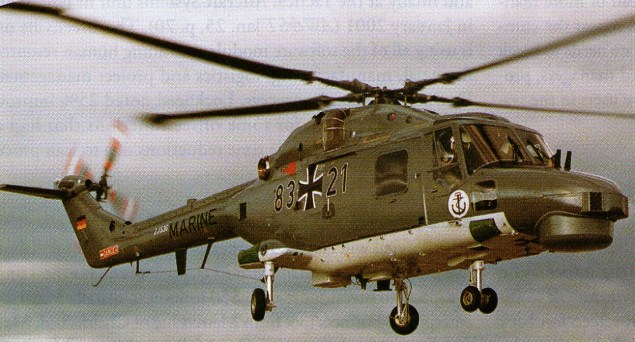
Variants:
Lynx AH.Mk 1
General-purpose/ utility version for the British army with skid landing gear, able to operate in roles that include anti-tank, strike, armed escort, casualty evacuation, command post, logistic support, reconnaissance, tactical transport and SAR; 113 built; most converted to Mk 7.
AH.Mk 1GT
Interim version before AH.Mk 7 conversion
Lynx HAS. Mk 2
Version for Royal Navy with non-retractable tricycle landing gear and foldable tail rotor pylon, for advanced shipborne anti-submarine and other duties. Gem 2 engines. Ferranti Sea Spray search and tracking radar in modified nose. Total of 60 delivered, plus 26 to French Navy, designated HAS. Mk 2(FN). First production aircraft (XZ227) flown on 20 February 1976. By 1989, all 53 active Royal Navy first-series Lynx had been modified to Mk 3 or later standards.
Lynx Mk 2 (FN)
Version for French navy, generally similar to HAS.Mk 2
Lynx HAS.Mk 3
Second antisubmarine version for Royal Navy similar to Mk 2, with uprated powerplant and transmission; equipped with two 835kW Rolls-Royce Gem 41-1 turboshaft engines, and GEC-Marconi Seaspray radar in modified nose; 23 delivered between March 1982 to April 1985; seven more in HAS. Mk 3S configuration; first flight, ZF557, 12 October 1987. 53 surviving HAS.Mk 2s converted to HAS Mk 3 standard by 1989; further improved version designated HAS.Mk 3S
This version has two GEC-Marconi AD3400 UHF radios with secure speech facility; additionally, ZD560 built in approximately Mk 7 configuration, delivered to Empire Test Pilots’ School. Further 53 obtained through modification of all existing HAS. Mk 2s. Lynx HAS. Mk 3ICE is Mk 3 lacking some operational equipment for general duties aboard Antarctic survey vessel, HMS Endurance; three converted, of which two to Mk 3SICE.
Lynx HAS.Mk 3 ICE
Two aircraft converted for Arctic use by Royal Navy
Lynx HAS.Mk 3 GM
Unofficial designation for 19 Gulf Modification aircraft originally delivered for use by Armada patrol, involving secure comms, tactical navigation and ESM fit
Lynx HAS.Mk ACTS
Phase two of upgrade programme featuring addition of RAMS 4000 central tactical system
Lynx HAS.Mk 4 (FN)
Version for French navy with powerplant of Lynx HAS.Mk 3
Lynx Mk 4
Second batch of 14 aircraft ordered for French Navy in May 1980 with Gem 41-1 engines and uprated transmission to permit an increase in AUW to 4,763kg. All supplied ‘green’ for equipment installation by Aerospatiale and subsidiaries.
Lynx AH. Mk 5
Similar to AH. Mk 1 with uprated Gem engines. Two trials aircraft ZD285 and ZD559. Nine AH. Mk 5s ordered for Army Air Corps. Initial example (ZE375) flew on 23 February 1985 and was used for engine trials. Remainder transferred to AH. Mk 7 contract, although ZE376 flew initially as Mk 5.
Lynx AH.Mk 7
Uprated British Army version, with improved systems, reversed-direction tail rotor with improved composite blades to reduce noise and enhance extended period hover at high weights; 13 ordered, eight from Mk 5 contract (two cancelled); first flight (ZE376) 7 November 1985; seven converted to Mk 9. Royal Navy workshops at Fleetlands converted Mk 1s to Mk 7s; first (XZ641) redelivered 30 March 1988; box-type exhaust diffusers added from early 1989; last conversion mid-1994. Interim version was Lynx AH. Mk 1GT with uprated engines and rotors, but lacking Mk 7’s improved electronic systems; first conversion (XZ195) 1991. GEC-Marconi AWARE-3 radar warning receiver selected 1989 for retrofit, designated ARI23491 Rewarder; Mk 1 XZ668 to Westland for trial installation 22 November 1991. (GEC-Marconi Sky Guardian Mk 13 installed in some Lynx AH. Mk 7s for Gulf War, 1990-91; later uprated to Mk 15.) BERP (extended tip chord) blades retrofitted to Mk 7 from 1993.
Lynx HAS.Mk 8
Version for Royal Navy featuring 15 new-build and 45 converted airframes featuring increased weights, internal MAD, improved rotors, avionics and ESM systems; Seaspray radar relocated to chin position and GEC-Marconi Sea Owl thermal imager fitted to nose instead; initial deliveries scheduled for early 1994; export version designated
Lynx Mk 8 HMA
Formerly known as HAS. Mk 8: Entered service with Royal Navy 1995. Equivalent to export Super Lynx; passive identification system; 5,125kg maximum T-O weight; improved (reversed-direction) tail rotor control; BERP composite main rotor blades; Racal RAMS 4000 central tactical system (CTS eases crew’s workload by centrally processing sensor data and presents mission information on multifunction CRT display; 15 systems ordered 1987, 106 September 1989); original Sea Spray Mk 1 radar repositioned in new chin radome; GEC-Marconi Sea Owl thermal imager (x5 or x30 magnifying system on gimballed mount, with elevation +20 to -30° and azimuth +120 to -120°; ordered October 1989) in former radar position; MIR-2 ESM updated; three Mk 3s used in development programme as tactical system (XZ236), dummy Sea Owl/chin radome (ZD267) and avionics (ZD266) testbeds.
Definitive Mk 8 (Phase 3)
Conversions begun 1992 with addition of Sea Owl, further radar and navigation upgrades, (including RACAL RNS252 ‘Super TANS’), composites BERP main rotor blades and reversed-direction tail rotor. Conversion programme covers 44 aircraft in two phases. All conversions due to be completed by the year 2003.
Lynx AH. Mk 9
UK Army Air Corps equivalent of export Battlefield Lynx; tricycle wheel landing gear which precludes carriage of TOW missiles; maximum T-O weight 5,125kg; advanced technology composites main rotor blades; exhaust diffusers; first flight of prototype (converted company demonstrator XZ170) 29 November 1989; 16 new aircraft (beginning ZG884, flown 20 July 1990) ordered for delivery from 1991, plus eight Mk 7 conversions (contract awarded November 1991); some outfitted as advanced command posts, remainder for tactical transport role. Deliveries from 22 May 1991.
Lynx Mk 21
Version for Brazilian navy similar to Lynx HAS.Mk 2
Lynx Mk 22
Unbuilt version for Egyptian navy
Lynx Mk 23
Version for Argentine navy similar to Lynx HAS.Mk 2
Lynx Mk 24
Unbuilt version for Iraqi army
Lynx Mk 25
Version for Royal Netherlands navy, which designated them UH-14A; similar to Lynx HAS.Mk 2
Lynx Mk 26
Unbuilt, unarmed version for Iraqi army
Lynx Mk 27 / SH-14B
Version for Royal Netherlands navy which designated them SH-14B; uprated Gem engines and equipped for ASW role with sonar; nine delivered
Lynx Mk 28
Version for State of Qatar police; generally as Lynx AH.Mk 1 but with uprated Gem 47-1 turboshafts and special equipment, including flotation gear
Lynx Mk 80
Version for Royal Danish navy, similar to Lynx HAS.Mk 2; eight built
Lynx Mk 81 / SH-14C
Version for Royal Netherlands navy which designated them SH-14C; uprated Gem engines and magnetic anomaly detection (MAD) gear, some converted to SH-14B standard through deletion of MAD and addition of sonar; eight built
SH-14D
Conversion of five Dutch navy UH-14As and eight SH-14Cs with Alcatel dipping sonar, UHF radios, RWR, FLIR, GPS, radar altimeter, composite blades and Gem Mk 42 engines
Lynx Mk 82
Unbuilt version for Egyptian army
Lynx Mk 83
Unbuilt version for Saudi army
Lynx Mk 84
Unbuilt version for Qatari army
Lynx Mk 85
Unbuilt version for UAE army
Lynx Mk 86
Version for Royal Norwegian air force coast guard; similar to Lynx HAS.Mk 2, but with uprated Gem engines and non-folding tail rotor pylon; six built
Lynx Mk 87
Embargoed version for Argentine navy, similar to Lynx Mk 23 but with uprated engines
Lynx Mk 88
Version for the Federal German navy similar to Lynx Mk 86; equipped with sonar; 19 built
Lynx Mk 89
Version for Nigerian navy; equipped for ASW/SAR roles; three built
Lynx Mk 90
Single follow-on aircraft for Danish navy assembled in Denmark; delivered in 1988
Super Lynx
Export model approximately equivalent to Mk 8 HMA. Lynx Mk 21A: Five remaining Brazilian Navy Lynx Mk 21 upgraded to Super Lynx Mk 21A standard. Contract placed in February 1994 includes nine new-build aircraft.
Super Lynx Mk 95
Five aircraft for Portuguese navy; equivalent to HAS. Mk 8; deliveries commenced in 1993
Super Lynx Mk 99
12 aircraft for South Korean navy; delivered between 1989 and 1991; equivalent to HAS.Mk8
Super Lynx Series 100
Upgraded export naval Lynx introduced in September 1996, powered by Rolls-Royce Gem 42-1 turboshaft engines, approximately equivalent to Lynx. Mk 8 HMA; operated by South Korean, Portuguese and Brazilian navies and applied to new Mk 88As sold to Germany.
Super Lynx Series 200
More powerful alternative option with 1,007kW LHTEC CTS800 engine with dual-channel Full Authority Digital Electronic Control (FADEC), LCD flat panel electronic power system displays, but otherwise conventional cockpit of Series 100.
Super Lynx Series 300
Also powered by the LHTEC CTS800, but with full ‘glass’ cockpit with six LCD colour flat panel displays, night vision goggle-compatible, and digital core avionics based around dual-redundant MIL-STD-1553B and ARINC 429 databuses; includes new navigation system, attitude and heading reference system and communications suite. Mission sensors and systems can be integrated into the avionics system and controlled via control and display units.
Demonstrator made its first flight with CTS800-4N turboshaft engines at Yeovil on 12 June 2001.
Battlefield Lynx 800
Upgraded export army Lynx; approximately equivalent to Lynx AH. Mk 9. Demonstrator AH Mk 9 G-LYNX fitted with two 1,007kW LHTEC T800 turboshafts as Battlefield Lynx 800 private venture (LHTEC funding power plants and gearboxes, Westland providing airframe for full flight demonstration programme); first flight 25 September 1991; programme terminated early 1992 after 17 hours.
Spacifications:
Lynx (Naval)
Engine: 2 x R-R Gem 41
Installed pwr: 1670 kW
Rotor dia: 12.8 m
Fuselage length (folded): 10.6 m
No. Blades: 4
Empty wt: 2740 kg
MTOW: 4763 kg
Cruise speed: 232 kph
ROC: 350 m/min
HOGE: 2575 m
Fuel cap: 733 kg
Range: 595 km
Crew: 2
HAS.2
Type: multi role shipboard helicopter
Powerplant: two 750/900 shp (559/671 kW) Rolls Royce Gem 2 turboshafts
Main rotor diameter 12.80 m (42 ft 0 in)
Main rotor disc area 128.71 sq.m (1,385.4 sq ft)
Length overall 15.16 m (49 ft 9 in)
Height 3.60 m (11 ft 9.75 in)
Width: 2.94m
Empty weight 2740 kg, (6,040 lb)
Max take off (early machines) 4309 kg (9,500 lb) or (later machines) 4763 kg (10, 500 lb)
Max speed: 144 mph / 232 kph at SL
Max cruising speed 232km/h (144mph)
Initial ROC: 2170 fpm / 661 m/min
Hover ceiling: 8450 ft / 2575 m
Time on ASW hover at 93 km (58 miles) 2 hours
Normal range: 368 mi / 592 km
Ferry range 1046 km (650 miles)
Armament: two torpedoes, or four BAe Sea Skua anti ship missiles, or two Mk 11 depth charges
HAS.3
Engine: 2 x R-R Gem 60
Installed pwr: 1664 kW
Rotor dia: 12.8 m
Fuselage length: 13.8 m
No. Blades: 4
MTOW: 5895 kg
Payload: 1532 kg
Max speed: 306 kph
Fuel cap: 1000 kg
Range: 705 km
Crew: 2
Pax: 9
HAS.35
HMA.8
Battlefield Lynx
Engine: 2 x RR Gem 42-1
Instant pwr: 835 kW
Rotor dia: 12.8 m
MTOW: 5126 kg
Payload: 1948 kg
Max speed: 160 kts
Max cruise: 137 kts
Max range (with aux fuel): 992 km
HIGE: 8859 ft
HOGE: 6,726 ft
Service ceiling: 12,000 ft
Crew: 2
Pax: 10
Super Lynx
Engine: 2 x RR Gem 42-1
Instant pwr: 835 kW
Rotor dia: 12.8 m
MTOW: 5126 kg
Payload: 1702 kg
Max speed: 160 kts
Max cruise: 137 kts
Max range (with aux fuel): 992 km
HIGE: 8859 ft
HOGE: 2726 ft
Service ceiling: 12,000 ft
Crew: 3
Pax: 10
Super Lynx 300
Engines: LHTEC CTS800.
Lynx AH.Mk 1
Rotor dia: 42 ft 0 in (12,8 m)
Undercarriage: Skid.
Length: 40.486 ft / 12.34 m
Height: 11.253 ft / 3.43 m
Max take off weight: 8551.0 lb / 3878.0 kg
Weight empty: 5298.6 lb / 2403.0 kg
Max. speed: 160 kts / 296 km/h
Cruising speed: 140 kts / 259 km/h
Maximum range: 999 nm / 1850 km
Range: 999 nm / 1850 km
Range (max. weight): 859 nm / 1590 km
Engine: 2 x Rolls Royce BS 360-07-26, 888 shp
Crew: 2
Payload: 12 Pax / 1242kg
AH.5
Undercarriage: Skid.
AH.7
Undercarriage: Skid.

Westland F.29/27 C.O.W. Gun fighter
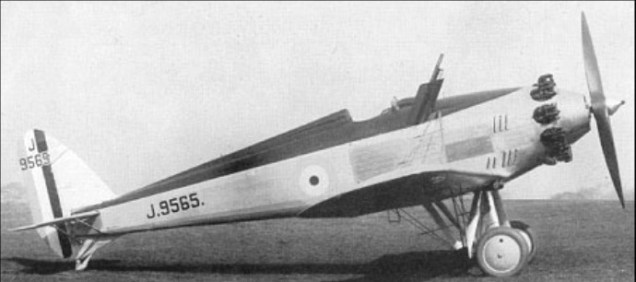
Usually known as the COW-Gun Fighter, this prototype monoplane was one of two ordered by the Air Ministry (with the unorthodox Vickers Type 161) in fulfilment of Specification F.29/27. This called for an aircraft armed with the 37mm Coventry Ordnance Works (COW) cannon that had been evolved during World War I and was thought to have potential as an anti-bomber weapon. The COW gun was to be mounted at an upward angle of at least 45 degrees from the horizontal, with the idea that the fighter would approach enemy bombers from below and astern. The Westland prototype was, in effect, an enlargement of the F.20/27 prototype, and had the COW gun mounted to fire upwards at 55 degrees, with the breech casing in the starboard side of the open cockpit. Aiming was by means of a periscopic sight, and a special “ammunition dispenser” carried 39 rounds. The fighter was of similar all-metal construction to the F.20/27 and, like the latter, was first flown with a small fin and rudder which later had to be considerably enlarged to obtain satisfactory spinning characteristics. Powered by a 485hp Bristol Mercury IIIA nine-cylinder air-cooled radial, the F.29/27 first flew in December 1930, but the RAF quickly lost interest in the COW gun. With a Mercury IVA, the COW-Gun Fighter remained at the A & AEE until July 1934.
Max take-off weight: 1762 kg / 3885 lb
Empty weight: 1186 kg / 2615 lb
Wingspan: 12.45 m / 41 ft 10 in
Length: 9.09 m / 30 ft 10 in
Height: 3.22 m / 11 ft 7 in
Wing area: 20.62 sq.m / 221.95 sq ft
Max. speed: 296 km/h / 184 mph
Ceiling: 8900 m / 29200 ft

Westland Pterodactyl / Hill Pterodactyl I

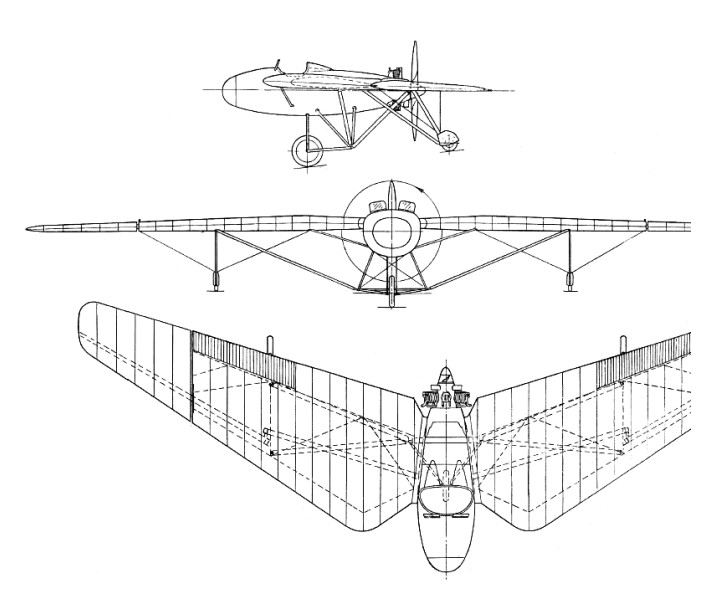
In the early 1920’s Captain (now Professor) G. T. R. Hill began a study of aeroplane design, with the object of discovering a means of securing safety in flight. This was to be achieved by improving stability and control at low speeds, and even below stalling speed, so that the fatal spin, all too common in those days, would never occur.
Captain Hill’s investigations eventually led him to evolve a tailless form of aircraft in which the wings were arranged roughly in the form of a blunt arrow-head and, it was built in his home with Mrs. Hill’s assistance, he built a prototype as a glider, naming it after that pre-historic reptile the Pterodactyl, in view of its wing-tip control.
Successful tests on the South Downs demonstrated to the Air Ministry the practicability of the design, and they, in view of its possible military advantages, co-operated with Captain Hill to fit the machine with a small 34hp Bristol Cherub engine.
The first power flight of the Pterodactyl took place at the Royal Aircraft Establishment, Farnborough in December 1925, and, after final demonstrations before Sir Samuel Hoare, then Secretary of State for Air, the Westland Works took over the development of the type, Captain Hill joining the staff for this purpose.
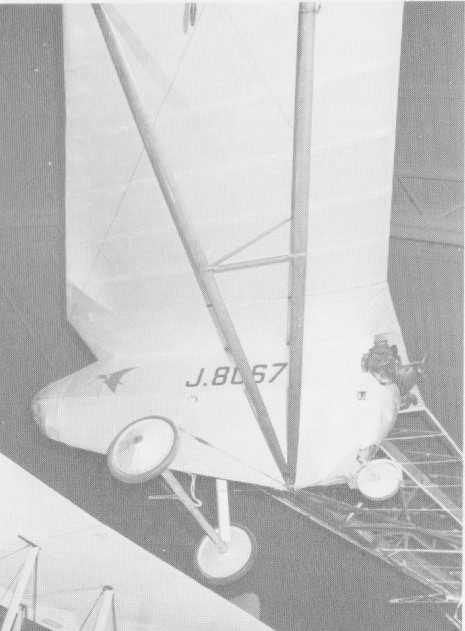
The Pterodactyl I was flown until superseded by the IA in 1928 and was subsequently stored by Prof Hill. He presented the machine to the Science Museum in 1951.
The first Westland-Hill production was a side-by-side two-seater J9251, with wings differing in plan-form considerably from those of the original machine. It was designated the Mk. IA when fitted with a 34hp Bristol Cherub engine and first flown in 1928.
After the Cherub engine was replaced by a 70hp Armstrong Siddeley Genet, and small rudders were fitted, it was given the mark number IB.
With a re-designed undercarriage it was re-designated IC.
The design was important, since it successfully demonstrated that a wing loading far greater than that of the prototype did not affect the solutions of stability and control evolved by Captain Hill. Originally flown by Flt.-Lt. L. G. Paget, A.F.C., and with Flt.-Lt. F. J. Brunton carrying out some of the later work, this Pterodactyl was used for a great number of investigations and, as a result, it was possible to proceed with complete confidence to other designs, of which the Pterodactyl Mk. IV was the next to be built. The Pterodactyl IV K1947 of 1931 was a three seat, larger version powered by a 120-hp Gipsy III.
Hill and Westland had plans for a whole series of the Pterodactyls, includ¬ing a flying boat and an airliner, but only four were built, the last being the Pterodactyl Mark V which had a 600 hp Rolls-Royce Goshawk steam cooled engine and was intended as a fighter. The theory was that the tailless configuration would give the rear gunner an almost unlimited field of fire with his pair of synchronized Vickers guns.
Test pilot Harald Penrose was soon demonstrating the Pterodactyl’s stability, and even performing aerobatics as well as flying it inverted. But a landing accident damaged the sole Mark V and further work on Hill’s designs was abandoned in the mid 1930s.
Hill I
Wingspan: 13.72 m / 45 ft 0 in
Wing area: 20.62 sq.m / 233 sq.ft
Empty weight: 207.7 kg / 458 b
Mk. IA
Engine: 1 x 32hp Bristol Cherub
Wingspan: 13.86 m / 45 ft 6 in
Wing area: 18.58 sq.m / 199.99 sq ft
Length: 5.18 m / 17 ft 0 in
Height: 2.03 m / 7 ft 8 in
Max take-off weight: 408 kg / 899 lb
Speed: 70 mph
Mk. IB
Engine: 1 x 70hp Armstrong Siddeley Genet
Mk. IC
Engine: 1 x 70hp Armstrong Siddeley Genet
Mk.IV
Engine: 120-hp Gipsy III
Seats: 3
Mk. V
Engine: 600 hp Rolls-Royce Goshawk
 All Aero