The Cessna Citation Mustang, Model 510, is a “very light jet” (VLJ) class business jet. In its standard configuration it has four passenger seats in the aft cabin, toilet and seating for two in the cockpit. Like most other very light jets, the Mustang is approved for single-pilot operation.
The Citation Mustang was first announced in 2002 and 23 April 2005 marked the first flight. FAA certification was achieved on 8 September 2006.
Citation Mustang PH-ORJ
It utilises glass cockpit technology, having a central mounted mulitifunction display and dual primary flight display units on the instrument panel. The engines are fully FADEC equipped. April 2007 was the first retail delivery.
Engines: 2 x 660kg Pratt & Whitney Canada PW615F turbofan Take-off weight: 3930 kg / 8664 lb Empty weight: 3062 kg / 6751 lb Wingspan: 13.16 m / 43 ft 2 in Length: 12.37 m / 41 ft 7 in Height: 4.09 m / 13 ft 5 in Cabin height : 4.495 ft / 1.37 m Cabin width : 4.659 ft / 1.42 m Cabin length : 8.99 ft / 2.74 m Max. speed: M0.63 Cruise speed: 340 kts / 630 km/h / 391 mph Ceiling: 12500 m / 41000 ft Rate of climb: 917 m/min / 3000 ft/min Range: 2160 km / 1342 miles Crew: 1-2 Passengers: 4-5 Cost : 2,395,000 USD (2004)
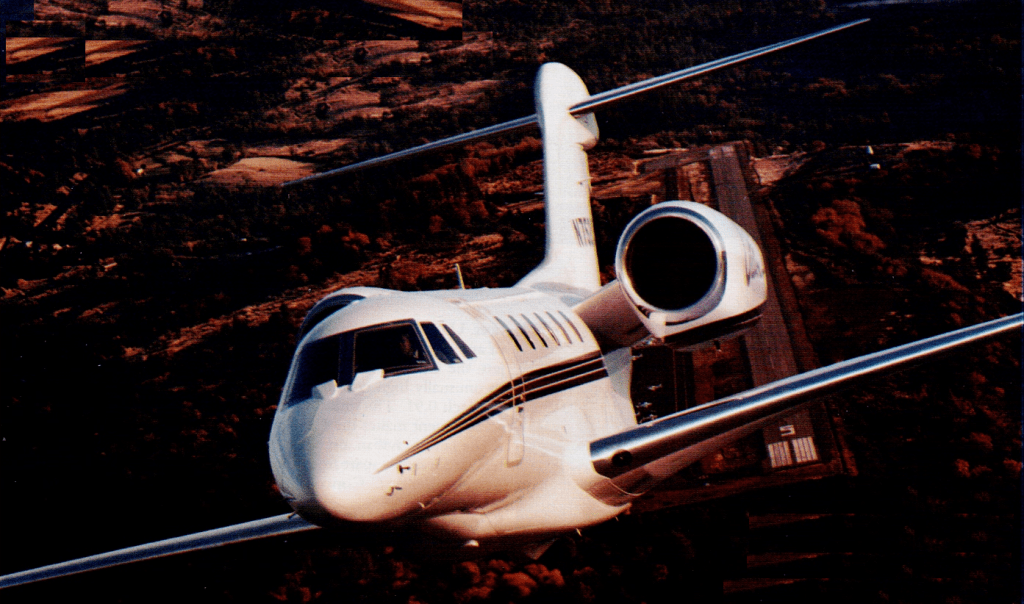
Skipping the unused Citation VIII and IX designations, the company announced in May 1990 the development of a ‘larger mid-size’ long range executive transport. The aircraft, heavily promoted by Cessna as the world’s fastest business jet, was publicly launched as the Model 750 Citation X at the NBAA Convention in New Orleans in October 1990. 1.5m longer than the III, the Xs powered by two GM/Allison GMA-3007A turbofans, each rated at 2720kg, enabling the new aircraft to fly 6111km at a cruising Mach number of 0.88 at 11278m. Improvements to to Citation X announced by Cessna are the result of increasing the power of the engines, RR AE 3007C-1s from 6442 to 6764 lbs thrust. This increases the allowable MTOW by 400 lbs.
The first Citation X was delivered to Arnold Palmer on 29 August 1996.
The Citation X (Model 750) became the fastest civil airplane in service with the retirement of the Concorde. The 750 can fly from LA to New York in just over four hours, and cruises at 51,000′ where conflicts with other air traffic are improbable.
Cessna 750 Citation X Corporate Jet, USA, 1993 Engine : 2 x Rolls Royce AE3007C1, 6764 lbs / 3067 kp Length : 72.178 ft / 22.0 m Height : 19.029 ft / 5.8 m Cabin height : 5.577 ft / 1.7 m Cabin width : 5.577 ft / 1.7 m Cabin length : 28.215 ft / 8.6 m Wingspan : 63.648 ft / 19.4 m Wing area : 527.005 sqft / 48.96 sq.m Max take off weight : 36106.9 lbs / 16375.0 kg Max ramp weight : 36404.6 lbs / 16510.0 kg Max landing weight : 31804.9 lbs / 14424.0 kg Max zero fuel weight : 24404.9 lbs / 11068.0 kg Weight empty : 21703.8 lbs / 9843.0 kg Total operating weight empty : 22102.9 lbs / 10024.0 kg Payload with full fuel : 1360.5 lbs / 617.0 kg Max. speed : 528 kts / 977 km/h / M0.92 Cruising speed : 460 kts / 851 km/h Initial climb rate : 4409.45 ft/min / 22.40 m/s Service ceiling : 51001 ft / 15545 m Cruising altitude : 36991 ft / 11275 m Wing load : 67.04 lb/sq.ft / 327.0 kg/sq.m Range : 3390 nm / 6278 km Crew : 2 Payload : 8-12 pax (max. 1179kg) Takeoff distance 5,140 ft Landing distance 3,400 ft
The first production Citation CJ4 took it’s first flight on August 19, 2008.
Producing an entry-level jet, the CJ1, and the progressively larger and more powerful 2 and 3 models, have proven even more successful than the original Citation. All CJs are powered by Williams Rolls-Royce engines.
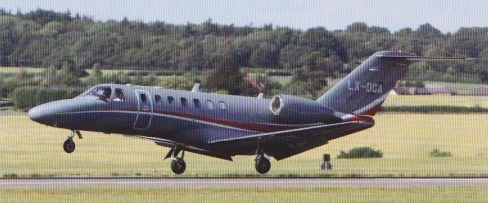
The Citation CJ3 was first announced in 2002 and the first delivery was in December of 2004. Producing an entry-level jet, the CJ1, and the progressively larger and more powerful 2 and 3 models, have proven even more successful than the original Citation. All CJs are powered by Williams Rolls-Royce engines.
Cessna CitationJet 3 Engines two 2,780-lb. Williams Rolls-Royce FJ44-3A turbofans Length : 51.214 ft / 15.61 m Height : 15.157 ft / 4.62 m Cabin height : 4.757 ft / 1.450 m Cabin width : 4.692 ft / 1.43 m Cabin length : 20.833 ft / 6.35 m Wingspan : 52.920 ft / 16.13 m Empty wt. 8,160 lb. Max take off weight : 13871.7 lbs / 6291.0 kg Cruising speed : 417 kts / 772 km/h Stall speed 86 kts. Ceiling 45,000 ft Range : 1900 nm / 3518 km Crew : 2 Passengers : 6 Cost : 5,995,000 USD 2004
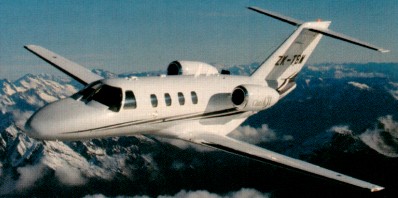
Cessna’s new CitationJet made its first flight on 29 April 1991 from Wichita, powered by two Williams Rolls FJ44 advanced turbo¬fan engines; claimed as providing all the benefits of a turbofan at more favourable economics than a turboprop. The six pas¬senger, T tailed fanjet is the first business jet to use a true natural laminar flow wing which assists with achieving a 437 mph cruise over a maximum range of over 1,500 nm 10 percent further than the Citation 1, using 19 percent less fuel. At 10,000 lbs, the takeoff weight of the CitationJet is nearly a ton lighter than the Citation 1 and should be able to take off from runways as short as 2960 feet. Cessna forecast 1000 deliveries over the next ten years following FAA certification in late 1992. The 1,900 lbs thrust FJ44 engine is the result of co-operation between Williams International and Rolls Royce. The Citation Jet (with 360 sales) remained Cessna’s entry level jet until 2000 when, with top of the range avionics and slightly increased take-off weight, the Citation CJ1 entered production, certified for single pilot operation.
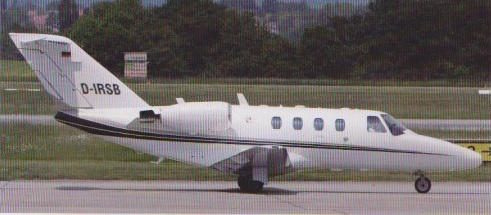
Cessna Citation CJ1 D-IRSB
The Citation CJ1+ was first announced in 2004 and October 2004 marked the first flight. The Citation CJ2, was Cessna’s response to customer requests for an improved CitationJet with higher cruise speeds, more cabin room and greater range, made its first flight ahead of schedule on April 27, 1999. Powered by a pair of Williams Rolls FJ44 2C engines, the CJ2 prototype took off from Wichita’s McConnell Air Force Base and flew a 65 minute test program, after which it landed at Mid-Continent Airport where Cessna’s main facility is located. During the flight the CJ2 climbed to 10,500 feet, where it performed stability and control tests, including cycling the gear, flaps and speeds.
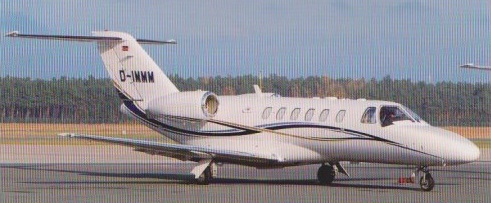
Cessna Citation CJ2 D-IMMM
The new CJ2 delivers cruise speeds of up to 400 knots (460 mph). A range of more than 1,935 statute miles, and the freedom to get in and out of runways shorter than 3,500 feet. The Citation CJ2+ was first announced in 2004 and the first delivery was in 2006.
CE-525 CJ-1 Engines: 2 x Williams-Rolls FJ44 turbofan, 8446 N / 1900 lb. Length : 42.585 ft / 12.98 m Height : 13.681 ft / 4.17 m Wingspan : 46.752 ft / 14.25 m Wing area : 240.037 sqft / 22.3 sq.m Max take off weight : 10401.0 lb / 4717.0 kg Weight empty : 6275.4 lb / 2846.0 kg Landing speed : 82 kts / 152 km/h Cruising speed : 383 kts / 709 km/h Take off distance : 3081 ft / 939 m Landing distance : 2749 ft / 838 m Initial climb rate : 3543.31 ft/min / 18.00 m/s Service ceiling : 41011 ft / 12500 m Cruising altitude : 35007 ft / 10670 m Wing load : 43.46 lb/sq.ft / 212.00 kg/sq.m Maximum range : 1485 nm / 2750 km Range : 1076 nm / 1992 km Crew : 2+6
Cessna 525A CitationJet 2 / CJ2 Business Jet, USA, 1999 Engine : 2 x Rolls Royce Williams FJ44 2C, 10301 N / 1050 kp Length : 46.916 ft / 14.3 m Height : 13.911 ft / 4.24 m Wingspan : 49.508 ft / 15.09 m Max take off weight : 12427.4 lbs / 5636.0 kg Cruising speed : 400 kts / 741 km/h Service ceiling : 41011 ft / 12500 m Range : 1680 nm / 3111 km Crew : 2 Payload : 6 pax (max. 272kg)
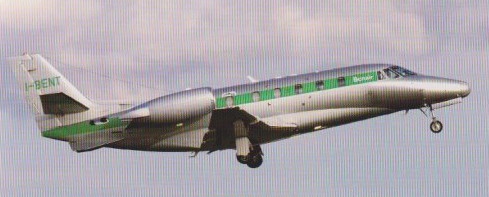
Ultimately the 600 series Citations translated to the Model 680 Sovereign. The Citation Sovereign was first announced in 1998 and the first delivery was in September of 2004. First flown on 27 February 2002, the eight seat Sovereign has a 2500 nm range and a fully integrated avionics system, with four large active matrix colour liquid crystal displays.
Cessna 680 Citation Sovereign Engines two 5,690-lb / 2580 kp Pratt & Whitney PW 306C turbofans. Length : 61.713 ft / 18.81 m Height : 19.193 ft / 5.85 m Wingspan : 63.123 ft / 19.24 m Wing area : 510.214 sqft / 47.4 sq.m Gross wt. 30,000 lb. Max. speed : 443 kts / 820 km/h Initial climb rate 4,100 fpm. Service Ceiling 47,000/ 14325 m. Cruising altitude : 35105 ft / 10700 m Range : 2484 nm / 4600 km Payload : 10 pax (max. 1134kg)
In August 1987, Cessna flew an engineering prototype of the eight-seat Model 560 Citation V This is essentially a development of the S/II equipped with 2,900 lb st / 1315kg JT15D-5A engines, and a longer fuselage fitted with a seventh cabin window. The type was certificated on 9 December 1988, first delivery made the following April and by the end of 1989 the company had delivered 33 and claimed a full orderbook for the US $3.8M Citation V to the end of 1991. More than 60 had been delivered by 1990.
Production ended in 1994 as the model morphed once again into the Citation Excel (XLS).
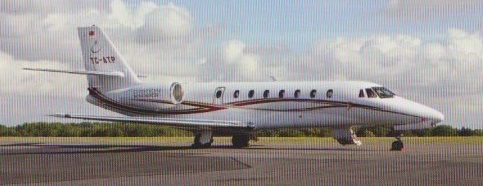
The Citation XLS+ was first announced in 2006. The first flight was in 2007.
The first new Cessna Citation Encore entered service on 29 September 2000 for customer demonstrations.
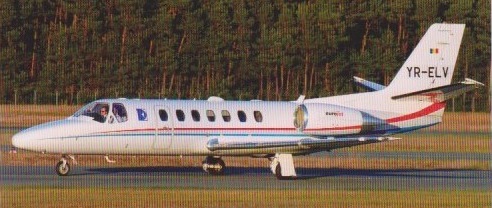
Citation Encore YR-ELV
The Citation Encore+ was first announced in 2005.
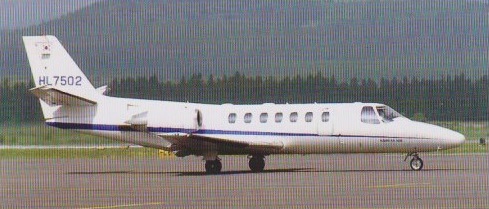
Citation Ultra HL7502
CE-560 Citation V Engines: 2,900 lb st / 1315kg JT15D-5A
CE-560 Encore Engines two 3,360-lb. Pratt & Whitney PW535 A turbofans. Seats 7-8. Gross wt. 16,630 lb. Empty wt. 9,977 lb Max cruise 431 kts. Initial climb rate 4,100 fpm. Range 1,700-1,960 nm. Ceiling 45,000.
CE-560 XLS Engines two 3,804-lb. Pratt & Whitney PW545 A turbofans. Seats 6-10. Gross wt. 20,200 lb Empty wt. 11,910 lb Max cruise 429 kts. Initial climb rate 4,100 fpm. Range 1,700-2,080 nm. Ceiling 45,000.
The Model 670 Citation IV was revealed in 1989 as a 10-seat development of the III powered by 1815kg TFE 731-4 turbofans giving increased range and airfield performance. However, further development of the Model 670 was terminated by Cessna in May 1990 in favour of the Citation VI and VII.
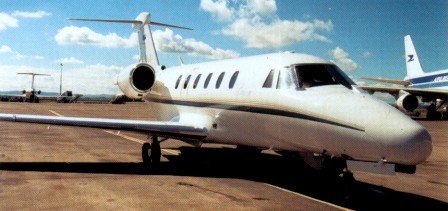
Cessna’s Citation III business jet made its first flight on 30 May 1979. The aircraft, powered by dual 1655kf Garrett AiResearch TFE 731-3-100S turbofans, was scheduled for certification in in April 1982 and first deliveries made in the spring of 1983.
Apart from the rear-mounted engines, the Citation III bears little visual similarity to Cessna’s other Citation designs. The Citation III is a completely new design using no major components of the Citation I or II. As the company’s ‘top of the range’ biz-jet, the Model 650 Citation III was certificated by the UK’s CAA in 1988 and by most European countries as well as the USA. More than 160 had been delivered by 1990. The two engines are 3,650 lb st (16,24 kN) Garrett TFE731-313-1005 turbofans and the cabin has standard seating for six passengers and two crew. Incorporates a swept super critical wing and T-tail, the Citation III first flew on 30 May 1979 and deliveries began in late 1982. The Citation III is a totally new airplane which takes advantage of many technological developments, including a high aspect supercritical wing, upgraded fanjet engines, and lighter weight structure, which give it the capacity to caxpy its passengers in extraordinaxy comfort at 540 mph with range to cross a continent or an ocean. Certification of the Citation III was obtained on 30 April 1982, under FAA Part 25 plus extra special conditions to cover altitudes up to 51,000 ft / 15,550 m. More than 1700 hrs were flown by the two prototypes prior to certification. Powered by Garrett TFE-731-3B-100S engines, the Citation III seats up to 10 passengers and a crew of two; cruising at up to 540 mph / 869 kph, it has a range of more than 2500 nm / 4630 km.
In July 1982 the Citation III backlog was more than 140, the current price quoted at $5.196m / £2.89m in 1981 dollars.
Citation VI and VII were developed as lower-cost derivatives for 1992 delivery. The Citation IV as a lower priced version of the III by standardising systems. The VII is a higher powered version of the III using Garrett TFE731 4 engines. Cessna Citation III’s cruise speed is 540 mph. Standard range is 2,875 statute miles. And with the long range option (its extra tankage does not reduce the cabin size) Citation III will cover 3,450 miles non stop. Citation III is designed to cruise at 50,000 feet, and can take off, fully loaded, in only 3,900 feet of runway. The primary controls are manual (only the stabilizer and spoilers are mechanically assisted). There are no “stick pushers stick pullers” or other mechanical augmentation systems. The Citation III set time-to-climb records, performance not immediately associated with the original Citations. By the end of 1989 174 had been delivered. The 8-10 seat Citation VI and VII were announced in May 1990, both based on the Citation III airframe but with factory-installed interior and avionics package. The ‘simpler’ and thus lower priced $8.6M Citation VI features a ‘low speed’ wing and a modified undercarriage bestowing and the ability to operate from grass fields. Powered by two Garrett TFE 731-3B-100 turbofans, the Citation VI is designed to cruise at 874km/h at 15500m. The longer range Citation VII version of the III is high powered with 1850kg thrust TFE 731-4 turbofans offering improved performance. First models were priced at US$8.6M.
CE-650 Citation III Engines: 2 x Garrett TFE 731-3B-100S, 3650 lbs / 1624 kp thrust. Seats: 8/10. Length: 55.5 ft / 16.9 m. Height: 17.3 ft. Wingspan: 53.5 ft / 16.3 m. Wing area: 312.156 sqft / 29.0 sq.m Wing aspect ratio: 8.9. Maximum ramp weight: 20,200 lbs. Maximum takeoff weight: 20,000 lbs. Standard empty weight: 10,951 lbs. Maximum useful load: 9249 lbs. Zero-fuel weight: 13,700 lbs. Maximum landing weight: 17,000 lbs. Wing loading: 64.1 lbs/sq.ft. Power loading: 2.7 lbs/lb. Maximum usable fuel: 7155 lbs. Best rate of climb: 4140. Certificated ceiling: 51,000 ft / 15545 m. Max pressurisation differential: 9.5 psi. 8000 ft cabin alt @: 51,000 ft. Initial climb rate : 3681.10 ft/min / 18.70 m/s SE Rate of Climb; 1,006 ft @ 129 kts. SE Climb Gradient; 476 ft/nm. SE Ceiling; 25,000 ft. Maximum speed: 467 kts. Normal cruise @ 45,000ft: 423 kts. Fuel flow @ normal cruise: 992 pph. Stalling speed gear/flaps down: 89 kts Stall Clean; 111 kts. Turbulent Air Penetration Speed; 200 kts. Landing speed : 97 kts / 180 km/h
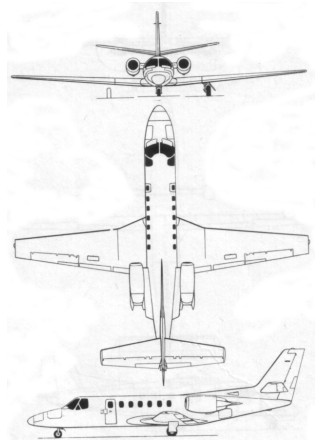
The success of the first Citation led Cessna to look at building larger and faster versions and development continued with the Model 550 Citation II. Announced in September 1976, the prototype first flew on 31 January 1977. Powered by two 1130kg JT15D-4 engines, the 8-12-seat aircraft featured a nearly 4 feet lengthened fuselage, increased span wings and more fuel and baggage space. Certification followed in March 1978.
In October 1983 the revised Citation S/ll was announced and the first production aircraft made its initial flight on 14 February 1984, with deliveries following soon after. This version has the JT15D-4B engine giving more power at higher altitudes, a new aerofoil section wing, leading-edge extensions, modified engine pylons and increased cabin headroom and baggage capacity. The Citation II/SP was cleared for single-pilot operation in July 1984. A modified version of the Model 552 Citation S/ll was selected in May 1983 by the US Navy for training radar intercept operators designated T-47A. These have shorter span wings to increase rate of climb and maximum speed at altitude and more powerful 1315kg JT15D-5 engines. The T-47A first flew on 15 February 1984. Delivery of 15 T-47A was completed in May 1985. The T-47s are used to train aircrew in the operation of radar in both air-to-air and air-to-surface modes, and are equipped with nose-mounted Emerson APQ-159 radars. The US Customs Service operates seven Citations fitted with Westinghouse APG-66 (F-16A) radar. These are used to intercept and track drug smuggling aircraft. The Citation II was taken out of production in 1984 when 503 had been built, but resumed in 1987. By the end of 1989 667 plus 15 T-47As had been delivered, making the Model 550 the best selling business jet. The Citation II has now become Cessna Bravo.
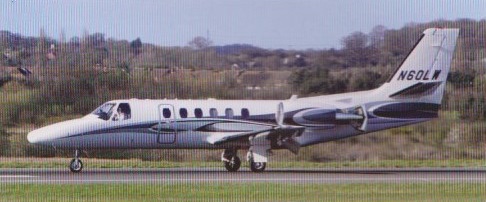
Citation Bravo N60LW
1979 Citation II Engines: 2 x Pratt & Whitney JT15D-4, 2,500 lb thrust. Cruise speed: 385 kts. Max range: 1,903 nm. Max usable fuel: 742 USG. ROC: 3,370 fpm. ROC SE: 1,055 fpm. Max Cert Alt: 43,000 ft. Max cert alt SE: 25,200 ft. Balanced field length: 2,990 ft. Max ramp wt: 13,500 lbs. Max zero fuel wt (opt): 11,000 lbs. Useful load: 6,400 lbs. Seats: 12.
CE-550 Citation II Engines: 2 x P&W JT15D-4, 2,500 lbs thrust. Seats: 8/10. Length: 47.2 ft. Height: 14.8 ft. Wingspan: 51.7 ft. Wing area: 323 sq.ft. Wing aspect ratio: 8.3. Maximum ramp weight: 13,500 lbs. Maximum takeoff weight: 13,300 lbs. Standard empty weight: 7196 lbs. Maximum useful load: 6104 lbs. Zero-fuel weight: 11,000 lbs. Maximum landing weight: 12,700 lbs. Wing loading: 41.2 lbs/sq.ft. Power loading: 2.7 lbs/lb. Maximum usable fuel: 5009 lbs. Best rate of climb: 3370. Certificated ceiling: 43,000 ft. Max pressurisation differential: 8.7 psi. 8000 ft cabin alt @: 43,000 ft. Maximum single-engine rate of climb: 1055 fpm @ 114 kts. Single-engine climb gradient: 555 ft/nm. Single-engine ceiling: 25,200ft. Maximum speed: 385 kts. Normal cruise @ 37,000ft: 369 kts. Fuel flow @ normal cruise: 990 pph. Stalling speed clean: 95 kts. Stalling speed gear/flaps down: 81 kts. Turbulent-air penetration speed: 180 kts.
Citation II Engines: P&W JT15D-4B of 2,500 lbs / 1135 kp thrust. Seats: 8/10 Length: 14.39 m / 47 ft 3 in Height: 4.57 m / 15 ft. Wingspan: 15.9 m / 52 ft 2 in Wing Area: 342.6 sq.ft. Wing Aspect Ratio: 7.8. Max Ramp Weight: 14,900 lbs. Max Take-off Weight: 14,700 lbs. Std Empty Weight: 7,716 lbs. Max Useful Load: 7,184 lbs. Zero-Fuel Weight: 11,000 lbs. Max Landing Weight: 14,000 lbs. Wing Loading: 42.9 lbs/ sq.ft. Power Loading: 2.9 lbs/lb. Max Usable Fuel: 5,638 lbs. Max Rate of Climb: 3,100 fpm. Ceiling (certificated): 43,000 ft. Max Pressurisation Differential: 8.8. 8,000 ft Cabin Altitude at: 43,000 ft. SE Rate of Climb: 930 fpm. SE Ceiling; 26,000 ft. Speed, Max: 403 kts. Normal Cruise 37,000 ft: 399 kts. Fuel Flow at Normal Cruise: 1,092 pph. Stall Speed, Clean: 95 kts. Stall Speed, Flaps/Gear Down: 81 kts. Turbulent Air Penetration Speed: 180 kts. Range: 1807 nm / 3347 km


 All Aero