The Convair Model 7 submission was ordered in prototype form as the XF-92 to be powered by a 1600-lb (726-kg) thrust Westinghouse 130 turbojet supplemented for take-off and combat by a 6000-lb (2722-kg) thrust Reaction Motors LR-11 liquid-propellant rocket. This was a tailless delta type with mixed powerplant, and its wing was designed with the aid of Dr Alexander Lippisch. This would have been a very fast point-defence interceptor with exceedingly limited range and duration.
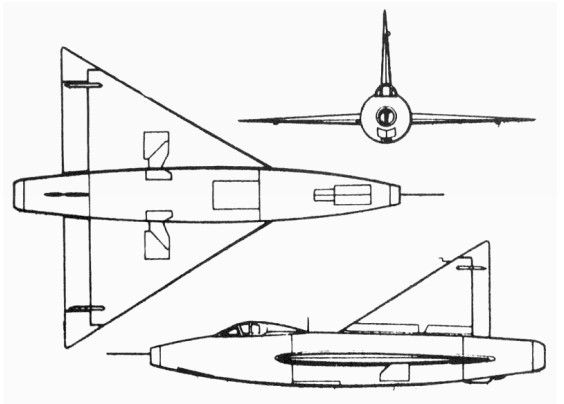
Validation of the basic design’s 60 degree swept delta wing (complete with full-span elevons for pitch and roll control) was entrusted to a smaller-scale aeroplane, the Model 7-002, which used components from five other aircraft and was powered by an Allison J33-A-23 turbojet. The Model 7-002 was generally successful, and development of the XF-92 proceeded without undue problems. In June 1949 the XF-92 was cancelled, but the Model 7-002 was kept in development as the XF-92A high-speed research aeroplane. Re-engined with the 6800-lb (3084-kg) J33-A-29 afterburning turbojet, the XF-92A eventually reached a speed of Mach 0.95 at 40,000-ft (12,190-rn). Meanwhile the LTSAF was completing the competition for the fire-control system originally specified for the XF-92, and this was later installed in the modestly supersonic F-102 Delta Dagger interceptor that was evolved as the Convair Model 8 on the aerodynamic basis of the XF-92A with the advanced Pratt & Whitney J57 afterburning turbojet.
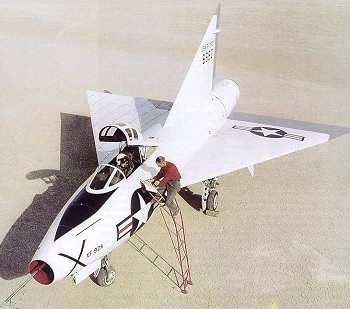
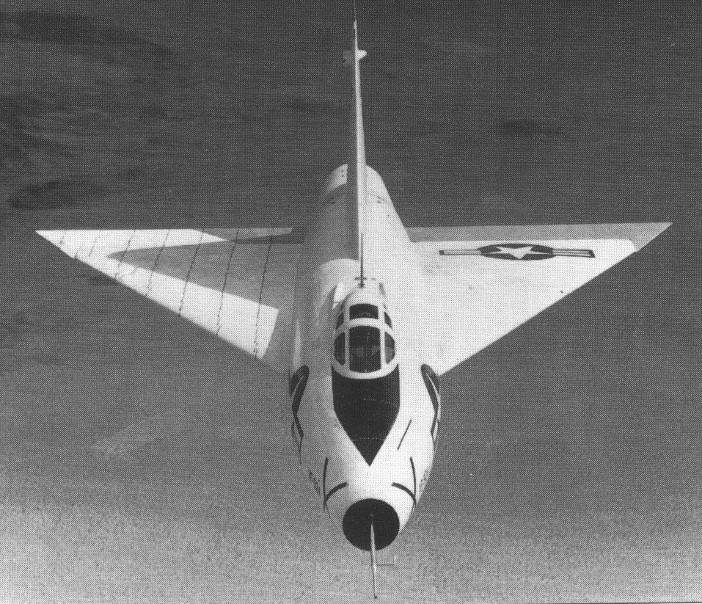
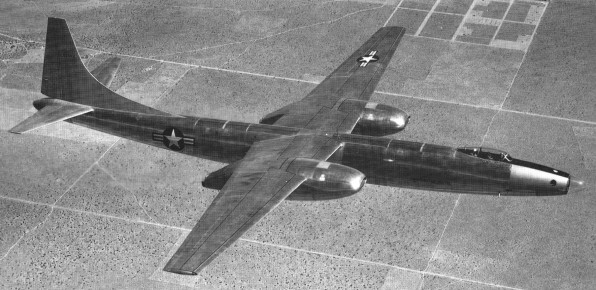
The Convair made its first flight on 8 June 1948. This was a simple airplane with latticed canopy cover, nose air inlet, and through-flow arrangement for its 2358kg thrust Allison J33-A-23 turbojet. Its delta wing was swept 60 degrees. When the fully-fledged rocket-powered XF-92 design was cancelled because of its obviously limited military application, the model 7002 was redesignated XF-92A.
The XF-92A originally flew without afterburning. During continuing tests at Edwards AFB it was re-engined and its fuselage lengthened to provide reheat for the new 3402kg afterburning thrust Allison J33-A-29. At the same time, the natural-metal XF-92A was painted gloss white.
Always a research aircraft rather than a fighter, the XF-92A was turned over to NACA for tests before its flight career ended in 1953.
Since it had been intended only as a flying mock-up for the cancelled machine, the XF-92A was never a candidate for a production order, though it performed valuable, if unintended, service as a testbed for the company’s F-102 interceptor.
XF-92A Engine: 1 x 3402kg afterburning thrust Allison J33-A-29 turbojet Max take-off weight: 6800 kg / 14992 lb Wingspan: 9.5 m / 31 ft 2 in Length: 12.9 m / 42 ft 4 in Wing area: 39.0 sq.m / 419.79 sq ft Max. speed: 1000 km/h / 621 mph Crew: 1
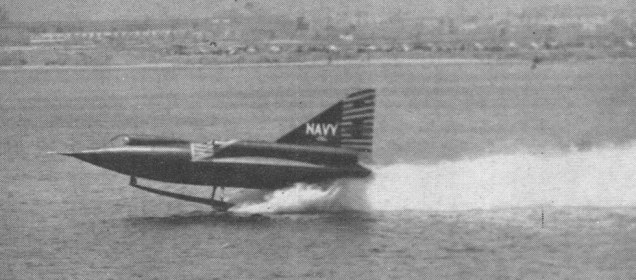
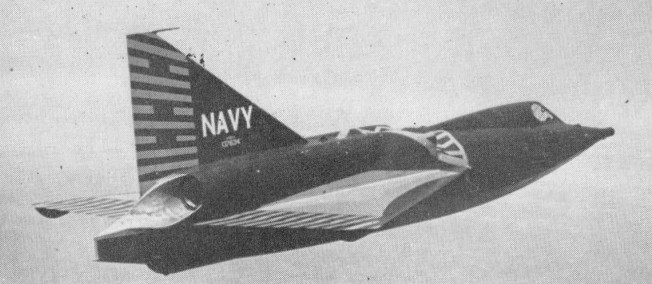
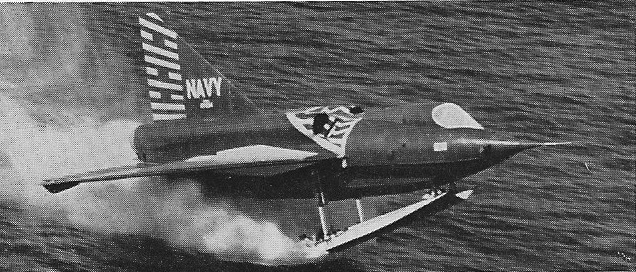
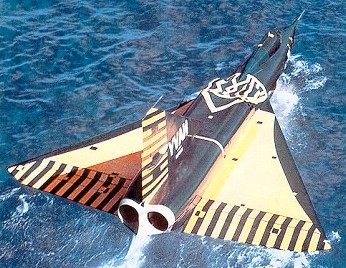
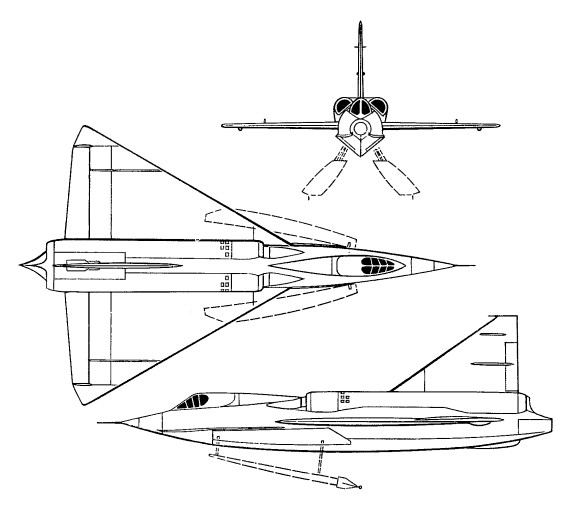
Convair was selected to produce a waterplane interceptor, and the result was XF2Y Sea Dart. The company was instructed to investigate the ‘blended hull’ concept, in which the hull rode so low in the water that the wings provided part of the required buoyancy until the aeroplane had accelerated sufficiently to rise onto a planing bottom, while the National Advisory Committee for Aeronautics (from 1958 the National Aeronautics and Space Administration) investigated the hydro-ski concept. When extended, the hydro-skis lifted the accelerating aeroplane onto the surface of the water, where the skis planed and so allowed the aeroplane to reach take-off speed; and when retracted they formed the lower surface of the fuselage without creating any drag.
The inlets for its two 3400-lb (1542-kg) thrust Westinghouse J34-WF-32 turbojets located in the dorsal position where they would be shielded from spray.
YF2Y-1
The concept embodied in the Convair Model 2-2 proposal was sufficiently interesting for the US Navy to award a contract for a prototype XF2Y-1 on 19 January 1951, followed by an order for 12 production F2Y-1 fighters on 28 August 1952; to this was added subsequently four YF2Y-1 pre-production aircraft.
First flown on 9 April 1953, the prototype offered performance much below expectations and this factor, coupled with serious vibration problems with the hydro-skis, led to the XF2Y-1 and the production F2Y-1s being cancelled.
During test runs there was considerable vibration and pounding from the two hydro-skis and these were replaced by a single V-shaped ski. More power was needed than the 1542kg thrust provided by each of the Westinghouse J34-WE-32 turbojets installed in the prototype and the first YF2Y-1. This latter aircraft was re-engined with two J46-WE-2s, the rear fuselage being modified to accommodate the engine afterburners and the same powerplant was installed in the remaining three YF2Y-1s. On 3 August 1954 the YF2Y-1 exceeded a speed of Mach 1 in a shallow dive, the first seaplane to become supersonic, but only two of these aircraft were used in a limited test programme that was terminated finally during 1956.
YF2Y Sea Dart Engines: 2 x Westinghouse J46-WE-32, 2722kg Wingspan: 10.26 m / 33 ft 8 in Length: 16.03 m / 52 ft 7 in Height: 6.32 m / 20 ft 9 in Wing area: 52.30 sq.m / 562.95 sq ft Max take-off weight: 7495 kg / 16524 lb Empty weight: 5739 kg / 12652 lb Max. speed: 1118 km/h / 695 mph Ceiling: 16705 m / 54800 ft Range: 826 km / 513 miles Crew: 1
YF2Y-1 Engines: 2 x Westinghouse J46-WE-8 turbojets, 4,800 lb. thrust Wingspan: 30 ft. 6 in Length: 41 ft. 2 in Loaded weight: approx. 22,000 lb. Armament: 4×20 mm. cannon Crew: 1.
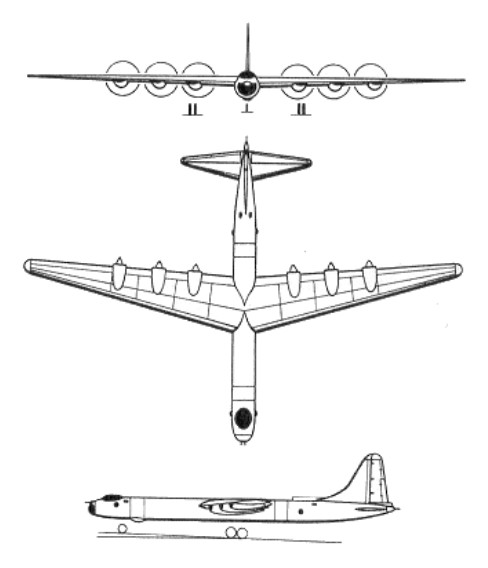
In April 1945 the USAF’s predecessor, the USAAF, had issued its specification for a B-35/B-36 replacement with turbine propulsion. The Convair submission to the 1945 requirement was the Convair YB-36G, which was in essence the B-36 recast with flying surfaces swept at 35 degrees and with a powerplant of eight Pratt & Whitney J57-P-3 turbojets. The type was redesignated YB-60 before two prototypes were ordered on 15 March 1951. They retained the basic fuselage of the B-36 with a modified nose and generally similar wing centre-section and landing gear offering a 75 per cent structural commonality with the B-36. The first was flown on 18 April 1952, but the type failed to gain a production contract, the USAF ordering instead the Boeing B-52. In addition to its new wings and tail, the YB-60 had a revised landing gear arrangement and a considerably larger fuel capacity. Maximum speed was 550 mph (885 km/h) at 55,000 ft (16765 m), but in all operational aspects the competing Boeing aeroplane was superior, as well as offering far greater development potential.
Engines: 8 x 4080kg J57-P-3 Max take-off weight: 300000 kg / 661390 lb Empty weight: 150000 kg / 330695 lb Wingspan: 206 m / 675 ft 10 in Length: 171 m / 561 ft 0 in Height: 50 m / 164 ft 1 in Max. speed: 520 km/h / 323 mph Ceiling: 45000 m / 147650 ft Range: 8000 km / 4971 miles Crew: 10
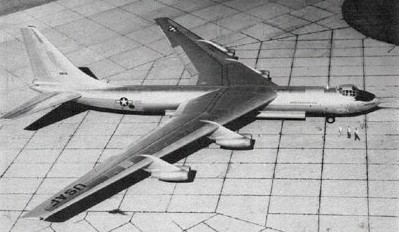
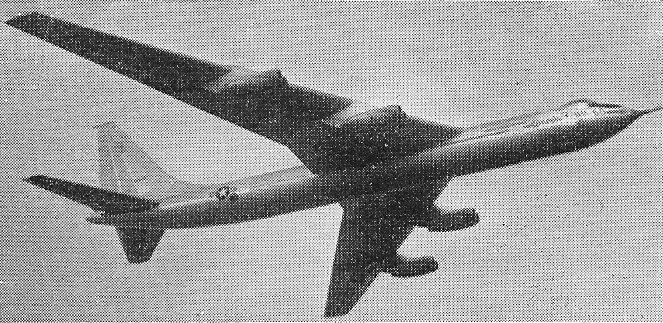
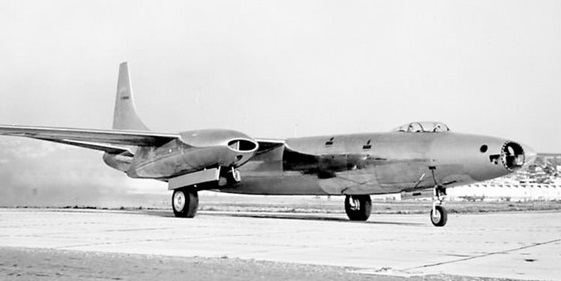
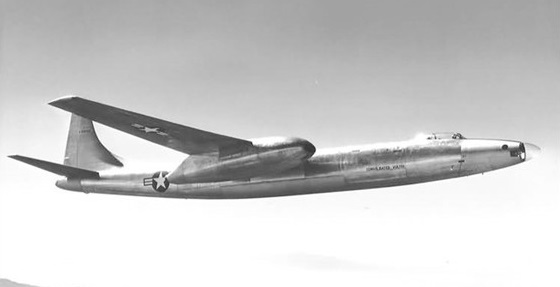
By December 1944 proposals had been received from Boeing, Convair, Martin and North American for medium axial turbojet-powered bomber for tactical- and operational-level use. Convair gained a contract for three XB-46 prototypes from the US Army Air Force.
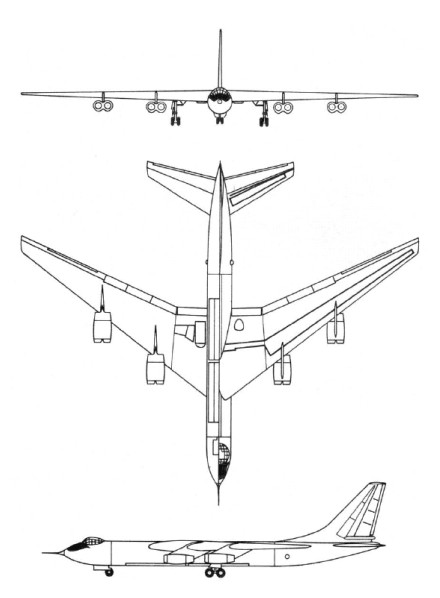
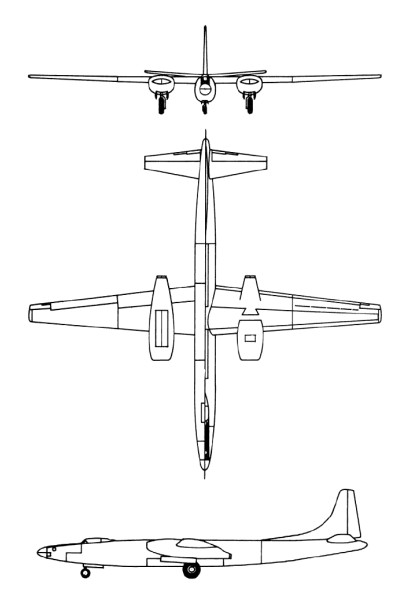
Of all-metal construction, the XB-46 was of high-wing cantilever monoplane configuration, had a slim oval-section fuselage, conventional tail unit, retractable tricycle landing gear and was designed to accommodate a crew of three. Power was provided by four General Electric TG 180 turbojet engines, these being mounted in pairs.
First flown on 2 April 1947, the XB-46 was handed over to the newly-formed US Air Force in late 1947, attaining an average speed of 858km/h during its delivery flight to Wright Field at Daytona, Ohio. Despite this performance the XB-46 remained a one-off prototype, cancelled in 1947, the USAF ordering the Boeing B-47 Stratojet into production.
Engines: 4 x turbo-jet General Electric TG-180(J35), 1814kW Empty weight: 21782 kg / 48021 lb Wingspan: 34.44 m / 112 ft 12 in Length: 32.24 m / 105 ft 9 in Height: 8.53 m / 27 ft 12 in Wing area: 102.1 sq.m / 1098.99 sq ft Max take-off weight: 41278 kg / 91003 lb Max. speed: 813 km/h / 505 mph Cruise speed: 700 km/h / 435 mph Ceiling: 13105 m / 43000 ft Range: 4820 km / 2995 miles Bomb load: 9000kg Crew: 3
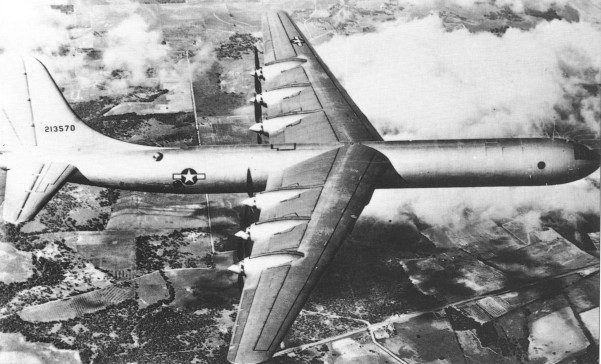
The first intercontinental bomber, the Convair B-36 originated from a US Army Air Force specification issued on 11 April 1941 which called for an aircraft with ability to carry a maximum bombload of 72,000 lb / 32659kg and to deliver 10,000-lb / 4536kg of bombs on European targets from bases in the United States. A radius of 5000 miles / 8047 km. An unrefuelled range of 16093km was a prime requirement, with a maximum speed of 386-483km/h and ceiling of 35000 ft / 10670m.
A number of designs were submitted and the winner was selected in November 1941 the month before the USAs entry into World War II. It was the Consolidated Model 37, which was ordered in prototype term as the XB-36, becoming the developmental YB-36 trials model, finally built by Convair, as Consolidated became known after its merger with Vultee.
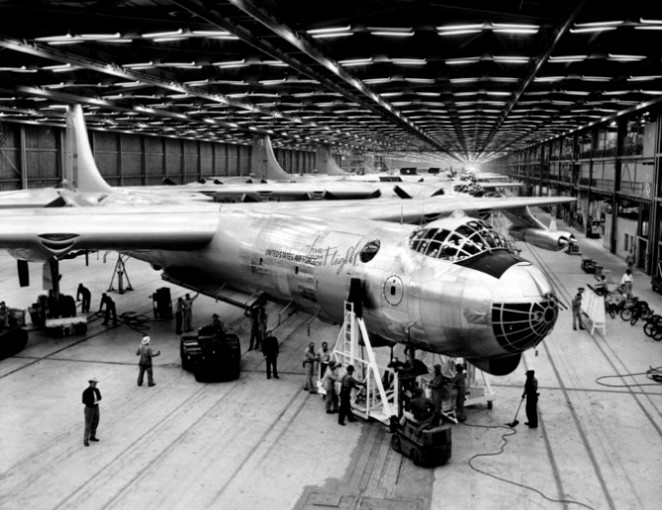
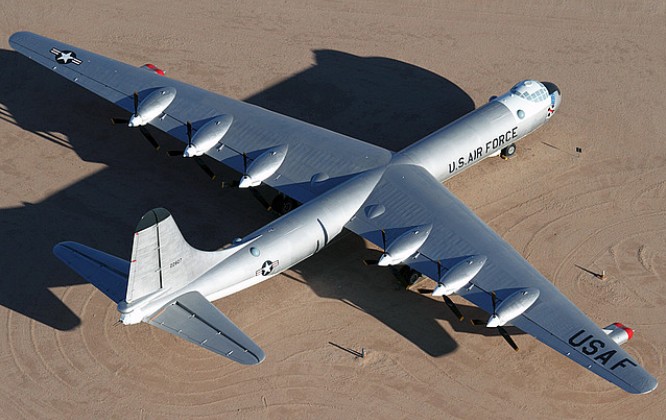
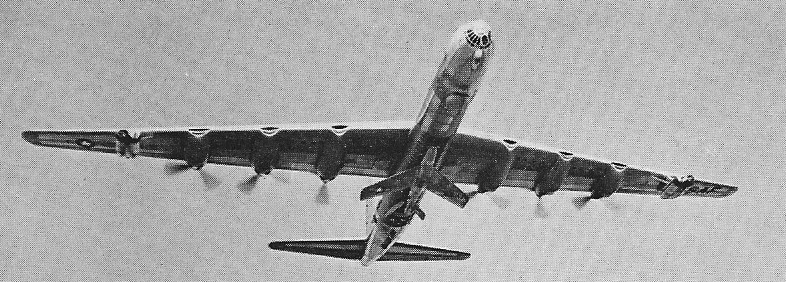
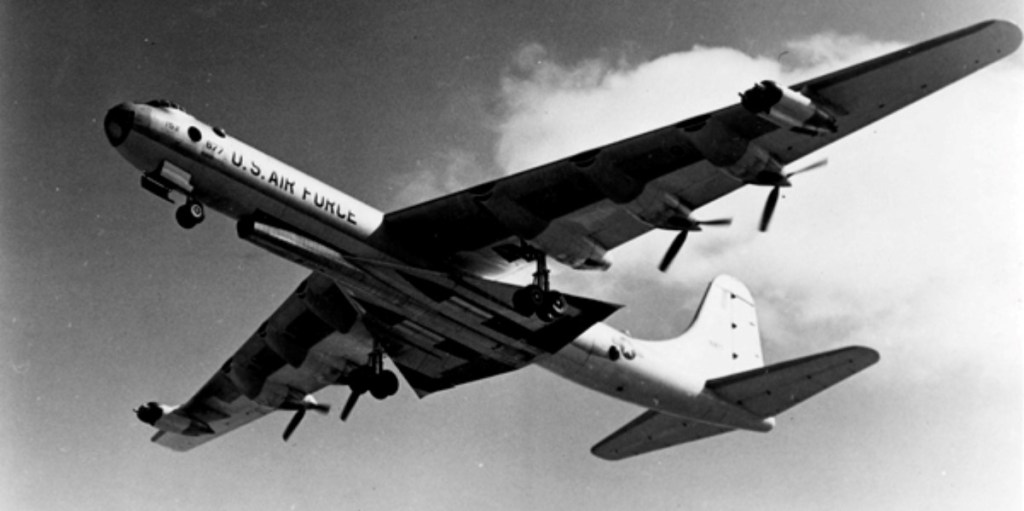
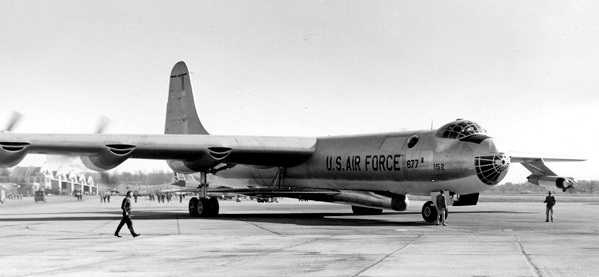
The design was basically conventional by the standards of the time, but with a span of 230 ft (74.10 m) the aeroplane was exceptionally large weighing 102 tonnes (100 tons). The tyres on the prototypes main landing gear were 2.74 m (9 ft) in diameter (they also concentrated too much weight on the run¬ways of the day, and were replaced on production aircraft by four wheel bogie units). The type did introduce some novel features, however, including a slightly swept wing, a fuselage whose two main pressurized compartments were connected by an 80-ft (24.4m) tunnel containing a wheeled cart, and propulsion by six pusher propellers driven by radial engines buried in the thick wings. The wings had a root thickness of 1.83m to permit in-flight access to the six pusher engines. The B 36 used the “wet fuel tankage” pioneered by Consolidated with their B~24 liberator no fuel tanks as such, just big areas of the wing structure sealed and filled with fuel.There were leakage problems. The aircraft was designed originally with twin fins and rudders, but by the time the XB-36 prototype was ready to be rolled out at Fort Worth, on 8 September 1945, single vertical tail surfaces had been substituted. The aircraft’s tailfin was so tall that the nosewheel had to be jacked up to lower the rear and clear the top of the doors.
B-36 Peacemaker required a crew of 11 personnel to maintain all systems and weaponry on the aircraft with 4 ‘relief’ personnel flying along as well. There were high maintenance costs. Every flight up to 40 hours aloft cost thousands of man hours on the ground. For instance, every flight began with a new set of spark-plugs in the engines: 336 of them in 168 cylinder heads on six engines.
Defensive armament consisted of sixteen 20mm cannon emplacements in the nose, tail and throughout the fuselage in barbettes – though this defensive armament was not added till the B-36B models.
The prototype programme was initially slowed by World War II’s demands for current aircraft, but then placed at the highest priority in 1943 when the USA realized that strategic blows against Japan could only be struck by long-range strategic bombers.
First flown on 8 August 1946, the XB-36 had single 2.79m diameter main wheels, also a feature of the YB-36 second prototype on which they were replaced later by the four-wheeled bogies adopted for production aircraft. The original single wheel main undercarriages smashed up run way surfaces. In this form the aircraft was designated YB-36A and also differed from the first aircraft by introducing a raised cockpit roof. On 23 July 1943 100 aircraft were ordered but it was more than four years before the first of the 22 unarmed crew-trainer B-36A models took off on its maiden flight, on 28 August 1947. The Convair B-36 Peacemaker entered service with the United States Air Force’s 7th Bombardment Wing (Heavy) on 2 June 1948.
In 1949 cargo carriers were developed by Convair for carriage in the B-36 bomb-bay. One B-36 could carry six containers, each of about 100 cu.ft and maximum load of 14,000 lb. As a tanker, the B-36 could carry four 3000 USG tanks.
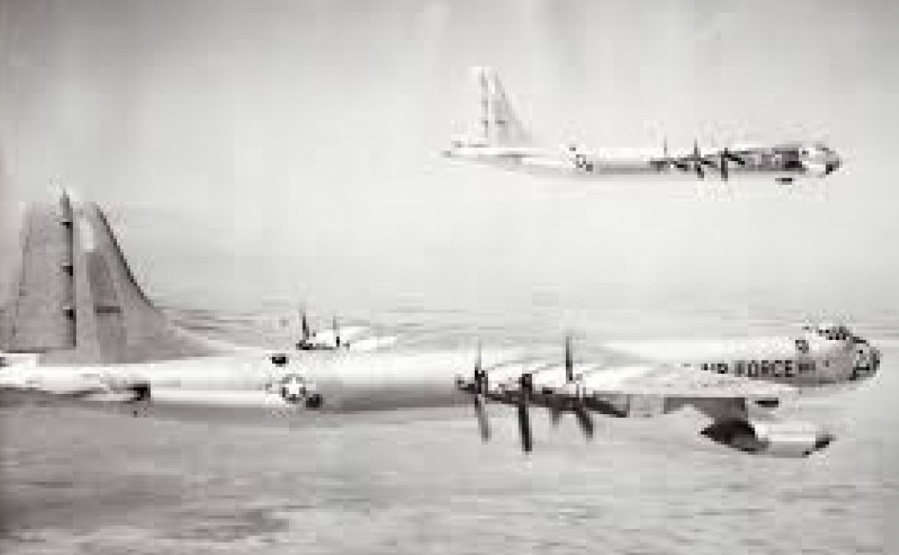
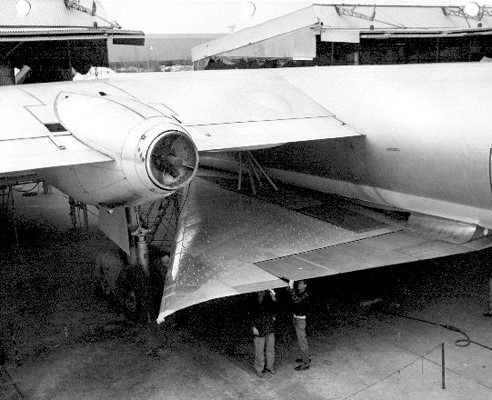
From 1950 the over target height and speed were boosted by adding four 2360 kg (5200 lb) thrust J47 jet engines in under slung pods to boost performance; with the six piston engines also uprated to 3800 hp each. Missions could last up to 50 hours without using the inflight refuelling capability. Complete wings were based in the UK, Morocco, Guam and other areas, as well as in the USA until February 1959. No missions were flown ‘in anger’.
In its final production version the B 36 had a combat overload weight of 208 tonnes (205 tons), more than double that of the prototype, and a maximum flight duration of 42 hours. An arsenal of 16 guns was carried, and crews numbered between 13 and 22 men, depending on the model and type of mission, some of which involved high altitude over-flights of the Soviet Union.
The B 36 was used as an extreme range spy plane (the version carried a photographic work shop instead of the usual bombload). A small number of ‘featherweight’ B-36s – aircraft without their usual armament and other non-essential equipment – with a small crew could fly at extreme altitudes, so keeping out of range of the MiG-15 interceptors. The regular B-36s, equipped with 14 cameras and electronic eavesdropping equipment, could reach 50,000 ft / 15,000 m while the ‘featherweight’ could cruise above the Soviet Union and China at more than 58,000 ft.
The last B-36J was delivered in September 1953 and the ultimate operational B-36 was retired in August 1959.
The GRB-36 operated as an airborne aircraft carrier. When the Convair B 36 Peacemaker bomber went into service with the United States Air Force’s Strategic Air Command, plans were laid for two hook on projects. The first of these was a fighter called the McDonnell XF 85 Goblin, which was 4.57 m (15 ft) long. The Goblin was to have been carried in the B 36’s bomb bay ready for launching in the event of fighter attack. Having won the ensuing dogfight it would then rejoin the mother ship for it did not give it any landing gear of its own.
Convair B-36J Peacemaker
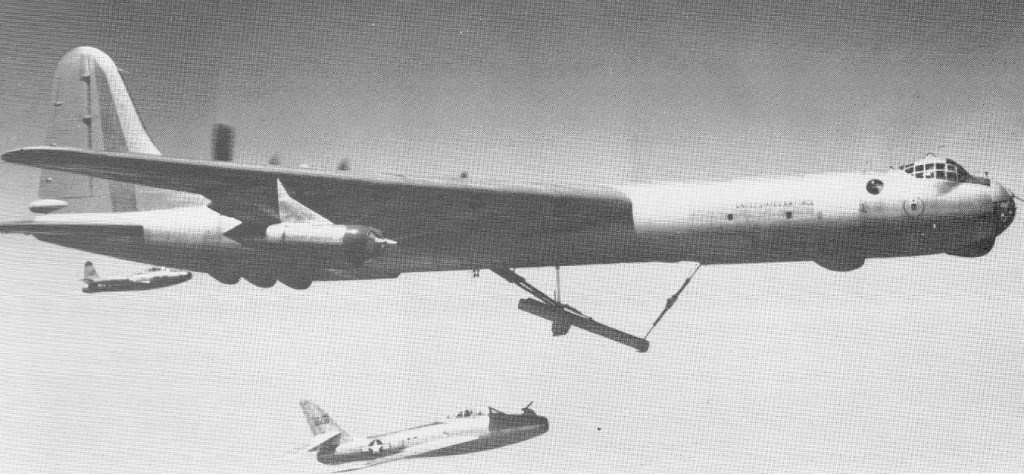
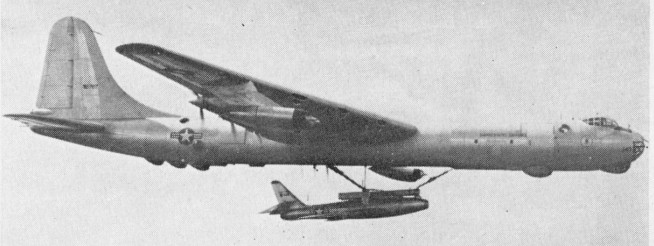
The second attempt to use the B 36 as an aircraft carrier took place in 1955 and 1956. Seeking a reconnaissance aircraft with suffi¬cient range to reach the Soviet Union, the USAF came up with FICON, which stood for Fighter In CONvair.
By hitching a Repub¬lic RF 84 Thunderflash to a B 36, the photo-¬reconnaissance jet’s range could be extended from 3220 km (2000 miles) to 19,310 km (12,000 miles).
The parasite’s pilot could transfer to the bomber’s interior, fly in the pressurised cabin until the area to be photographed was approached (because the B-36 had a range of at least 9300 miles / 15,000 km and this could take many hours), then go down to his own cockpit to be released above enemy territory.
SAC had a number of Peacemakers modified to GRB-36 mother aircraft and ordered 25 Republic RF-84K Thunderflash to hitch a ride. During 1955-56 several operational missions were flown from Fairchild and Larson airbases in Washington State.
Some thought was also given to a nuclear bomb equipped Thunderstreak substituting for the Thunderflash, but the arrival of the U-2 and RB-57D ended the project.
GRB-36J
Twenty five RF 84Fs were modified for parasite duty. On a typical mission the mother ship B 36 would depart from Fairchild Air Force Base, Spokane, Washington to be joined in the air by an RF 84K (as the parasite Thunderflashes were designated) from Moses Lake Air Force Base. The fighter would be hoisted into the B 36’s bomb bay.
GRB-36J
In April 1945 the USAF’s predecessor, the USAAF, had issued its specification for a B-35/B-36 replacement with turbine propulsion, and the USAF pushed this programme with considerable vigour. The failing submission to the 1945 requirement was the Convair YB-36G, which was redesignated YB-60 before two prototypes were ordered in March 1951,
Two Convair X-6s were ordered to evaluate the operational practicality of airborne nuclear propulsion systems prior to committing to building a prototype of a dedicated military design. The specific areas to be tested included crew shielding, propulsion, radiobiology, and the effects of radiation on various aircraft systems. In addition to the X-6s, a single NB-36H was ordered to serve as an early flyable testbed. In the NB-36H, the nuclear reactor was functioning but provided no power to the aircraft itself. The X-6s would have been powered by a prototype airborne nuclear propulsion system installed in the aft bomb bays.
In the end, the X-6 program was cancelled before either of the two aircraft were built. The NB-36H was completed, however, making its first flight in September 1955. After conducting tests for approximately two years, the nuclear reactor was removed and the NB-36H was scrapped at Carswell AFB, Texas.
Production of the B-36 continued for almost seven years, the last of 385 examples being delivered to Strategic Air Command on 14 August 1954, and the type was retired finally on 12 February 1959.
B-36 transporting the XB-58 airframe using eight of ten engines (note both of the inboard propellers have been removed for this flight)
Convair easily transported the XB-58 prototype by air from Ft. Worth TX to Wright-Patterson Air Force Base (AFB) in Ohio for testing with the use of a modified Peacemaker bomber.
B-36 and XB-58 airframe mating, note the strut assembly joining the two wings together has been removed from the wing’s inboard engine as well as the prop.
The left and right inboard engines had their propellers removed, along with the bomb bay doors since they did not clear the wings of the XB-58 which was mounted underneath the bomber.
Since the airframe was the subject of testing the XB-58 did not have the engines attached and the vertical fin assembly was left off, as well.
Engines: 6 x P+W R-4360, 2575kW Wingspan: 70.1 m / 229 ft 12 in Length: 49.4 m / 162 ft 1 in Height: 14.3 m / 46 ft 11 in Wing area: 443.3 sq.m / 4771.64 sq ft Max take-off weight: 162162 kg / 357508 lb Empty weight: 72051 kg / 158846 lb Max. speed: 696 km/h / 432 mph Cruise speed: 362 km/h / 225 mph Ceiling: 13700 m / 44950 ft Range w/max.fuel: 16000 km / 9942 miles Armament: 12-16 20mm machine-guns, 32600kg of bombs Crew: 16
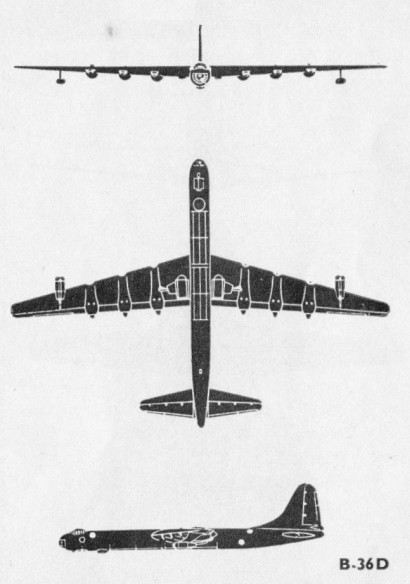
Convair B-36D Peacemaker Engines: 6 x 3,500 hp Pratt & Whitney R-4360-41 radials + 4 GE J47-GE-19 turbojet, 5,200 lb. thrust Length: 162.07ft (49.4m) Width: 229.66ft (70.00m) Height: 46.75ft (14.25m) Maximum Speed: 439mph (706kmh; 381kts) Maximum Range: 7,500miles (12,070km) Service Ceiling: 45,197ft (13,776m; 8.6miles) Armament: 12 x 20mm cannons in nose, tail and fuselage barbettes Up to 86,000 lbs of bombs internally. Accommodation: 15 Empty Weight: 171,035lbs (77,580kg) Maximum Take-Off Weight: 418,878lbs (190,000kg)
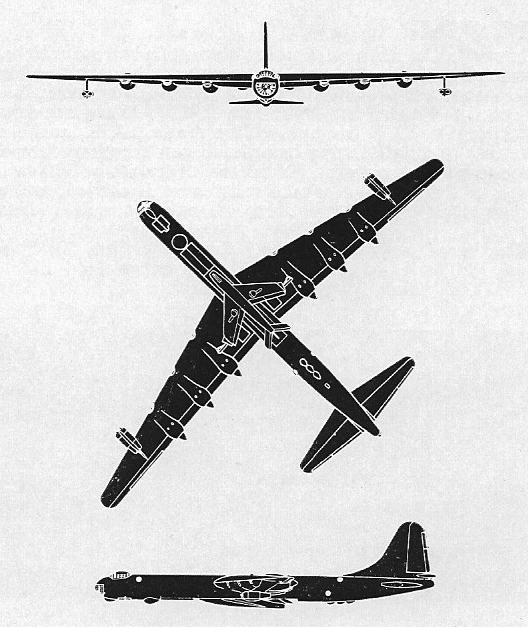
B 36J Peacemaker Engines: 6 x Pratt & Whitney R 4360 53 Wasp Major 28 cylinder radial, 3,800 hp (2834 kW) and 4 x General Electric J47 GE 19 turbojets, 2359 kg (5.200 lb). Max speed: 661 km/h (411 mph) at 11095 m (36,400 ft). Over target height: up to 12160 m (39,900 ft). Range with 4990 kg (11,000 lb) bombload: 10944 km (6,800 miles). Empty weight: 77581 kg (171,035 lb) Maximum take off weight: 185976 kg (410,000 lb). Wing span 70,10 m (230 ft 0 in). Length 49.40 m (162 ft 1 in). Height 14.23 m (46 ft 8 in). Wing area 443.3 sq.m (4,772.0 sq ft). Armament: 16 x 20 mm cannon in 8 turrets Bombload: up to 39010 kg (86, 000 lb).
GRB-36J Engines: 6 x Pratt & Whitney R-4360-53, 3800 hp & 4 x General Electric J47-GE-19, 5200 lb Wingspan: 230 ft Length: 162 ft 1 in Height: 46 ft 9 in Wing area: 4772 sq.ft Empty weight: 145,000 lb Loaded weight: 408,000 lb Max speed: 436 mph Cruise: P&W eng. Only: 290 mph at 40,000 ft Max range: 10,000 mi
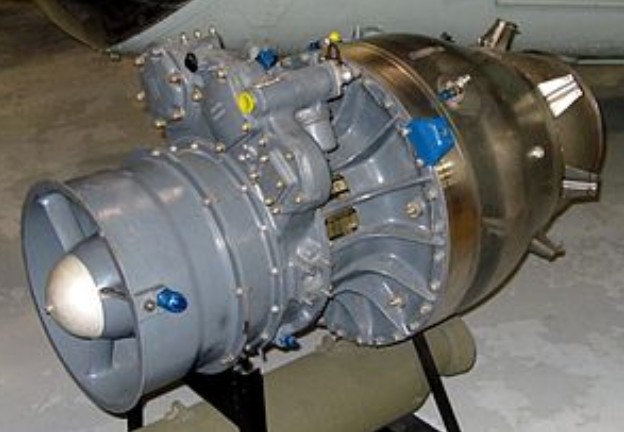
The Teledyne CAE J69 was a small turbojet engine produced by Continental Aviation and Engineering (CAE) under license from Turbomeca. A development of the Marboré II, the J69 powered a number of US drones, missiles and small aircraft. Later produced by Teledyne CAE, the J69 was also developed into the J100 turbojet optimized for higher altitudes
The Continental CAE T51 was a small turboshaft engine produced by Continental Aviation and Engineering (CAE) under license from Turbomeca. A development of the Artouste, it was followed by three additional turboshaft engines, the T72, the T65, and the T67. However, none of these engines, including the T51, entered full production. CAE abandoned turboshaft development in 1967 after the XT67 lost to the Pratt & Whitney Canada PT6T (T400) to power the Bell UH-1N Twin Huey.
Variants and derivatives:
XT51-1 (Model 210) Based on the Artouste I; 280 shp.
XT51-3 (Model 220-2) Based on the Artouste II; 425 shp.
XT72 (Model 217-5) Based on the Turbomeca Astazou; 600 shp.
XT65 (Model 217-10) A scaled-down version of the Astazou; competed against the Allison T63 to power the Light Observation Helicopter; 305 shp.
XT67 (Model 217A) two engines driving a common gearbox; based on the Astazou X and T72; 1,540 shp.
Founded in 1929, Continental Motors, Inc. is an aircraft engine manufacturer located at the Brookley Aeroplex in Mobile, Alabama. Although Continental is most well known for its engines for light aircraft, it was also contracted to produce the air-cooled V-12 AV-1790-5B gasoline engine for the U.S. Army’s M47 Patton tank and the diesel AVDS-1790-2A and its derivatives for the M48, M60 Patton and Merkava main battle tanks. The company also produced engines for various independent manufacturers of automobiles, tractors, and stationary equipment (pumps, generators and machinery drives) from the 1920s to the 1960s.
In 1929, Continental introduced its first aircraft engine, a seven-cylinder radial designated as the A-70, with a displacement of 543.91 cu in (8.91L) that produced 170 hp (127 kW). In August 1929, the Continental Motors Company formed the Continental Aircraft Engine Company as a subsidiary to develop and produce its aircraft engines.
During the late 1930s, early 1940s the Gray Marine Motor Company adapted Continental engines for maritime use. On 14 June 1944 the company was purchased by Continental for US$2.6 million. John W. Mulford, the son of one of Gray’s founders was appointed general manager of Gray by Continental. Gray’s continued to make marine engines in the post-war period until its closure by Continental in about 1967.
As the Great Depression unwound, 1930 saw the company introduce the 37 hp (28 kW) A-40 four-cylinder engine. A follow-on design, the 50 hp (37 kW) A-50 was introduced in 1938 and was used to power the Taylor Cub and derivative Piper Cub. As the Second World War started in 1939 Continental commenced building aircraft engines for use in British and American tanks. Continental formed Continental Aviation and Engineering (CAE) in 1940 to develop and produce aircraft engines of over 500 hp (373 kW) Continental ranked 38th among United States corporations in the value of wartime production contracts.
During the late 1930s, early 1940s the Gray Marine Motor Company adapted Continental engines for maritime use. On 14 June 1944 the company was purchased by Continental for US$2.6 million. John W. Mulford, the son of one of Gray’s founders was appointed general manager of Gray by Continental. Gray’s continued to make marine engines in the post-war period until its closure by Continental in about 1967.
During the 1950s, the A-65 was developed into the more powerful 90 hp (67 kW) C-90 and eventually into the 100 hp (75 kW) O-200. The O-200 powered a very important airplane design milestone: the Cessna 150. By the 1960s turbocharging and fuel injection arrived in general aviation and the company’s IO-520 series came to dominate the market.
In 1969, Teledyne Incorporated acquired Continental Motors, which became Teledyne Continental Motors (TCM). That same year, the Continental Tiara series of high output engines were introduced, although they were dropped from the line after 1978. The company brought the TSIO-520-BE for the Piper PA-46 to market in 1984 and it set new efficiency standards for light aircraft piston engines. Powered by a liquid-cooled version of the IO-240, the Rutan Voyager was the first piston-powered aircraft to circumnavigate the world without refueling in 1986.
NASA selected Continental to develop and produce GAP in 1997, a new 200 hp (150 kW) piston engine to operate on Jet-A fuel. This was in response to 100-octane aviation gasoline becoming less available as a result of decreased demand, due to smaller turboprop engines becoming more prevalent.
In 2008, Teledyne Continental’s new president, Rhett Ross announced that the company was very concerned about future availability of 100LL avgas and as a result would develop a diesel engine in the 300 hp (220 kW) range for certification in 2009 or 2010. By the fall of 2009 the company was feeling the effects of the economic situation and the resulting reduced demand for aircraft engines. The company announced that it would close its plant for two one-week periods in October 2009 and January 2010. Salaried employees would move to a four-day work week with one week vacations for Thanksgiving and Christmas, with the aim “to protect as much of our valuable employee base as possible”.
On December 14, 2010, Continental’s parent Teledyne announced that Teledyne Continental Motors, Teledyne Mattituck Services and its general aviation piston engine business would be sold to Technify Motor (USA) Ltd, a subsidiary of AVIC International, for US$186 million in cash. AVIC is owned by the Chinese government. In May 2011, the transaction was reported as complete and the company renamed Continental Motors, Inc.
Diesel engines are manufactured in Germany by Continental Motors Group, Ltd., an AVIC International Holding Corporation company. Previously the company was known as Centurion Aircraft Engines before its 2013 acquisition by Continental. Several diesel engines were available from Continental in 2016: the CD-135 and CD-155 four cylinders and V6 CD-300, producing 310 hp.
Diesel engines are manufactured in Germany by Continental Motors Group, Ltd., an AVIC International Holding Corporation company. Previously the company was known as Centurion Aircraft Engines before its 2013 acquisition by Continental. Several diesel engines were available from Continental in 2016: the CD-135 and CD-155 four cylinders and V6 CD-300, producing 310 hp.
A pressurized business and commuter rear-winged turbojet aircraft, triple-engined Contender 606 for up to 33 passengers in a wide-body commuter layout.
 All Aero