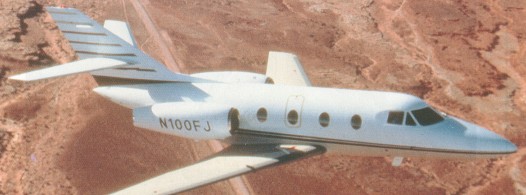
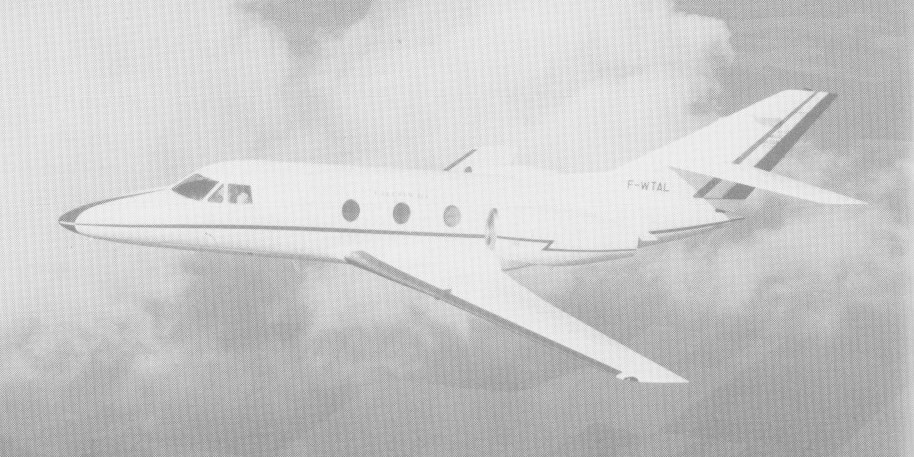
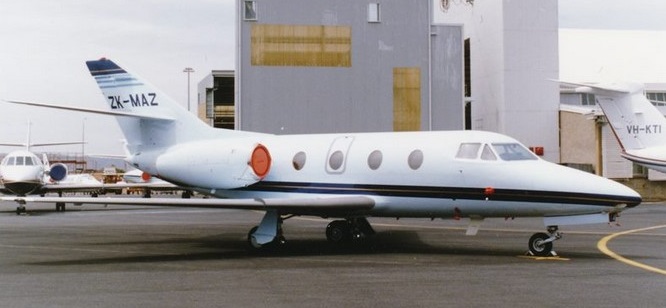
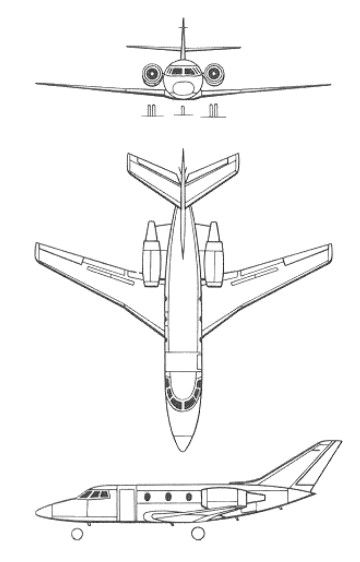
A new business jet project announced for 1982 was the Falcon 100, which was essentially a re¬fined version of the Falcon 10. To supersede the Falcon 10 and certificated in December 1986, the basic airframe remained unchanged, but the Series 100 featured increased weights (Ramp and Max. Take-off), a fourth cabin window on the starboard side, bigger luggage compartment and a ‘glass cockpit’.
The design of the Falcon 100 features no life limited parts. The airplane can fly at Mach .87 and the flight controls are driven by push rods that are boosted by dual hydraulic actuators. An artificial feel computer, called the “Arthur Q,” compensates the control boost for airspeed, so that the Falcon 100 feels the same at all speeds. Should both hydraulic actuators fail, the pilot can continue to fly using the basic mechanical control linkage.The Falcon 100 also has single point pressure refuelling, which is standard on all large jets. To refuel, a hose connects to an outlet in the tailcone, and fuel is pumped into the tanks without the need for an onboard electric pump. Because fuel heaters prevent fuel ice formation, there is no requirement to treat the Falcon 100’s fuel with an anti ice additive. When production ceased in 1989 223 Falcon 10/100s had been delivered to customers in 24 countries.
Falcon 100 Engines: 2 x Garrett TFE 731-2, 3230 lbs / 1465kg thrust. Seats: 8/10. Length: 13.86 m / 45 ft 6 in Height: 4.61 m / 15 ft 1 in Wingspan: 13.08 m / 42 ft 11 in Wing area: 24.1 sq.m / 259.41 sq ft Wing aspect ratio: 7.1. Maximum ramp weight: 18,740 lbs. Maximum takeoff weight: 18,740 lbs. Standard empty weight: 10,800 lbs. Maximum useful load: 7940 lbs. Zero-fuel weight: 13,560 lbs. Maximum landing weight: 17,640 lbs. Wing loading: 72.2 lbs/sq.ft. Power loading: 2.9 lbs/lb. Maximum usable fuel: 5910 lbs. Best rate of climb: 4450. Certificated ceiling: 45,000 ft. Max pressurisation differential: 9.1 psi. 8000 ft cabin alt @: 45,000 ft. Maximum single-engine rate of climb: 1050 fpm @ 183 kts. Single-engine climb gradient: 345 ft/nm. Single-engine ceiling: 18,000 ft. Maximum speed: 487 kts. Max operational speed Mach .87. Normal cruise @ 39,000ft: 454 kts. Fuel flow @ normal cruise: 1200 pph. Stalling speed clean: 123kts. Stalling speed gear/flaps down: 93 kts. Turbulent-air penetration speed: 250 kts. Crew: 2
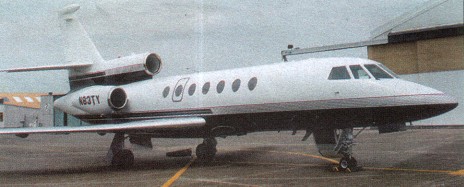
Development of the new Falcon 50 began in May 1974 with some components modelled after those of the earlier Falcon 20, including the front and centre fuselage sections. The Falcon 50 makes use of double-slotted trailing-edge flaps advanced high-lift devices. Powered by three Garrett AiResearch TFE 731 3 turbofan engines, each flat-rated at 3,700 lbs. s.t. (1680 kgp) for takeoff. Two are mounted separately in pods on each side of the rear fuselage; the third is located in the tailcone with its intake just forward of the base of the vertical stabilizer. In order to make room for this third engine, the fuselage was lengthened and the fin was enlarged over that of the Falcon 20.
Dassault Breguet flew the prototype (F WAMD) on 7 November 1976 and, with fully developed supercritical wing, on 6 May 1977. The second prototype made its first flight in February 1978. The airplane’s gross weight was increased from 37,480 to 38,800 pounds, including an additional 400 pounds of fuel; and the range went from 3,040 to 3,500 nm at Mach 0.73. The French (27 February 1979) and U.S. Governments certificated the Dassault Breguet Falcon 50 three engine business jet in 1979. The first production Falcon 50 flew on 7 March 1979. The three-engine Falcon 50 was designed for long range jet transport (originally 3,500 nm), and Dassault continued to refine that theme.
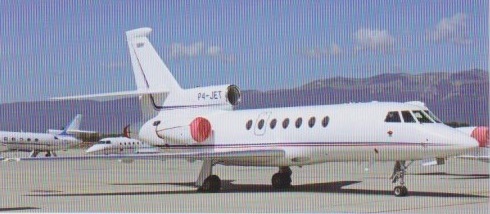
Dassault Falcon 50EX P4-JET
In 1995 Dassault announced the longer range Falcon 50EX featuring TFE73140 engines which added another 400 nm to the airliner’s range. The first models came off the production line in 1996. The Falcon 50EX has more fuel efficient engines and greater range as well as a full EFIS cockpit display.
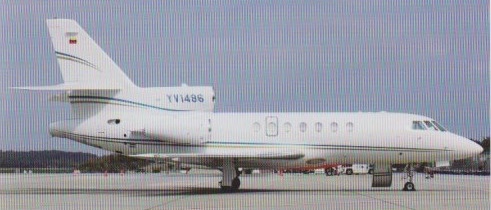
Falcon 50 YV1496
Falcon 50 Engines: 3 x Garrett TFE 731-3, 3700 lbs thrust. Seats: 12/14. Length: 60.8 ft. / 18.52 m Height: 22.8 ft. / 6.97 m Wingspan: 61.8 ft. Wing area: 504 sq.ft. / 46.8 sq.m Wing aspect ratio: 7.6. Maximum ramp weight: 38,800 lbs. Maximum takeoff weight: 38,800 lbs. Standard empty weight: 20,240 lbs. Maximum useful load: 18,560 lbs. Zero-fuel weight: 24,225 lbs. Maximum landing weight: 35,715 lbs. Wing loading: 77 lbs/sq.ft. Power loading: 3.5 lbs/lb. Maximum usable fuel: 15,520 lbs. Best rate of climb: 3526 fpm. Certificated ceiling: 45,000 ft. Max pressurisation differential: 8.8 psi. 8000 ft cabin alt @: 45,000 ft. Maximum engine out rate of climb: 2125 fpm @ 210 kts. Engine out climb gradient: 610 ft/nm. Engine out ceiling: 25,200 ft. Maximum speed: 482 kts. Normal cruise @ 39,000ft: 447 kts. Fuel flow @ normal cruise: 1856 pph. Stalling speed clean: 128 kts. Stalling speed gear/flaps down: 95 kts. Turbulent-air penetration speed: 280 kts. Crew : 2 Payload : 10 Pax
Falcon 50EX Engines: 3 x Allied Signal TFE73140 turbofans, 3,700-lb. Gross weight: 39,700 lb Empty weight: 21,270 lb Max cruise: 475 kts. Ceiling: 45,000 ft Takeoff run: 5,415 ft Landing roll: 3,280 ft Seats: 12-19.
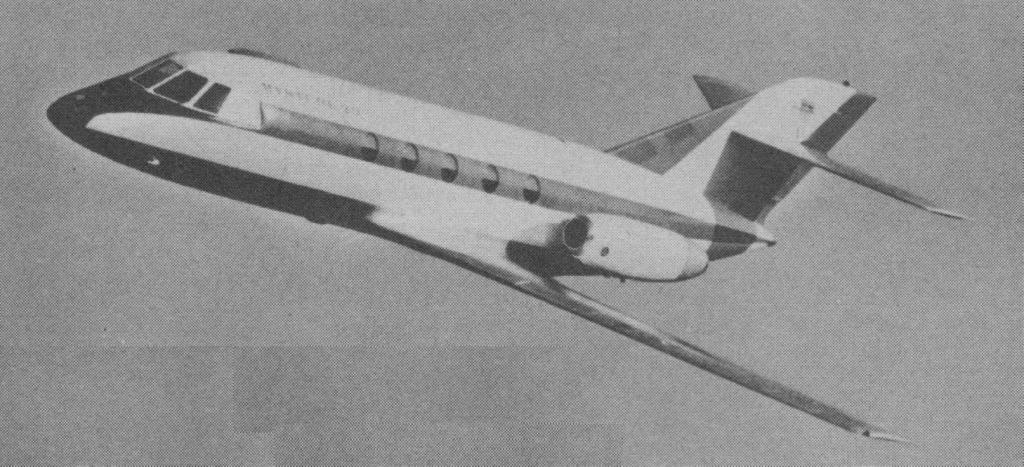
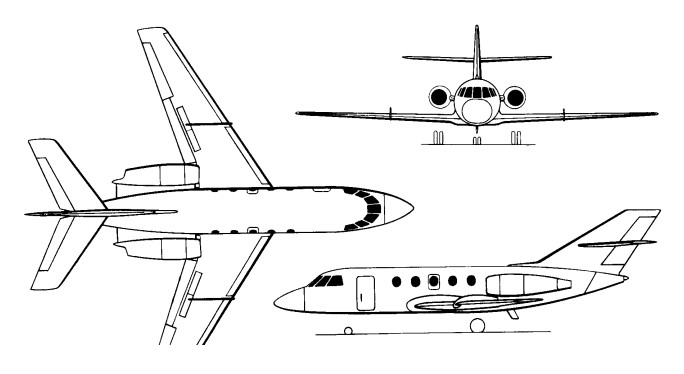
Designed jointly by Dassault and Sud Aviation, the Mystere 20 was based on the proven wing of the Dassault Mystere family of fighter aircraft. The original Dassault biz jet known as the Mystere XX, was designed 1960/61, and the first metal was cut February 1962. The prototype Mystere 20 (Mystere in France, and Falcon for export sales), registered F-WMSH, flew on 4 May 1963 with 3,300 lbs. s.t / 1497kg Pratt & Whitney JT12A turbojets, but these were later changed to General Electric CF700s, and in this form flew on 10 July 1964. A cantilever low-wing monoplane with swept wings and tail surfaces, a circular-section fuselage and retractable tricycle landing gear, the prototype had a fuselage built by Dassault and wings and tail unit by Sud-Aviation. However, for production aircraft Dassault builds the wings and Aerospatiale the fuselages and tail units. The first production Mystere 20 flew on 1 January 1965. Deliveries began in 1965, and Pan American placed the first orders. Several versions were built, differing by more powerful engines.
Mystere 20
Built by Avions Marcel Dassault at Bordeaux, the Mystere aircraft is universally known as the Fan Jet Falcon, this title strictly applies only to the aircraft sold by Pan American. In 1963 Pan American ordered 40 Mystere 20 with option on 120 more. The deal was for $128,000,000 at $800,000 per unit. To the manufacturer the type is still the Mystere 20.
Following certification the Business Jets Division of Pan American World Airways (now known as Falcon Jet Corporation) became interested in this aircraft for sale in North America, where they were marketed under the name Fan Jet Falcon. Newark Air Service Inc was named East Coast maintenance centre for the Mystere 20 in 1964.
The Falcon C original production variant had 4,125 lb st (1870 kgp) CF700 2C turbofans ( 2D or 213 2 later, by retrofit), and a gross weight of 26,450 lb (12 000 kg). First flown on 1 January 1965, the Falcon C was certificated on 9 June 1965.
The first production series became identified as the Standard Falcon 20. From this was developed a version with increased fuel capacity, available as the Falcon 20C with the same 1871kg thrust General Electric CF700-2C powerplant as the Standard Falcon, or as the Falcon 20D with the more powerful CF700-2D with a thrust rating of 1928kg. The introduction of 2041kg thrust CF700-2D-2 engines resulted in a version designated Falcon 20E, and the addition of high-lift devices to improve take-off and landing performance and a further increase in fuel capacity were identifying features of the Falcon 20F.
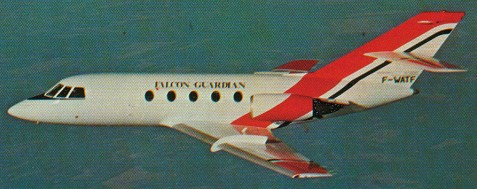
The F model was introduced at Pan Am’s request in 1970 to meet a need for a short field capability, featuring full span drooping leading edges, being heated by engine bleed air and increased fuel capacity. First flown May 1969 and certificated (to FAR Part36) on 20 January 1970. Standard passenger accommodations provide seating for 8 to 10, while a maximum of 12 to 14 is optional. The static vents of the F are mounted in a small square plate on the fuselage sides below the cockpit side windows. A succession of development problems has delayed the ATF3 programme and up to February 1981 the company had been unable to complete the 150 hr endurance test required before the FAA would issue a certificate. This in turn imposed serious delays upon delivery of the Coast Guard HU 25As. As the higher power of the new engines is matched by increased fuel capacity in the Falcon 20G, the better specific consumption and better specific air range (in terms of miles per lb of fuel) produce a significant increase in actual range: the improvement is of the order of 27 per cent at low altitude in typical search missions and over 20 per cent at high altitudes cruising at Mach= 0. 7. The extra fuel, totalling 130 Imp gal (590 lt), is carried in an auxiliary tank in the rear fuselage, immediately behind the aft cabin bulkhead, and brings total fuel capacity to 1,270 Imp gal (5770 lt). The engines for the HU 25A are identified as ATF3 6 2Cs, variants of the ATF3 6 that are specially adapted for the Coast Guard aeroplanes. The special features of the 2C version are an additional 6,000 rpm drive in the accessory pack to power a second hydraulic pump (required to drive an additional electrical generator) and the use of aluminium instead of magnesium for the accessory pack easing, to improve corrosion resistance in the overwater environment in which the Guardian will spend much of its time. Airframe changes to allow the Falcon to meet the Coast Guard mission, apart from the extra fuel tank and the new engine installation, are relatively minor, and comprise the installation of a wide vision search window each side at the front of the cabin (in place of the standard windows), provision of a hatch in the cabin floor for the dropping of survival kits, fitting a side looking camera port and providing hardpoints under the wings and fuselage to carry sensor pods. Two wing points are stressed for loads of 1,450 lb (660 kg) each, and two for 1,120 lb (507 kg); there are also four strong points under the fuselage, two stressed for 1,100 lb (500 kg) each and two for 440 lb (200 kg) each. The aircraft gross weight is increased from the 28,660 lb (13 000 kg) of the Falcon 20F to a maximum of 32,000 lb (14 500 kg). Internally, the Coast Guard’s HU 25A is laid out to be operated by a five man crew, comprising two pilots, an SSO (surveillance system operator) and two observers, seated alongside the enlarged windows. With most of the starboard side of the cabin occupied by radio and avionics equipment, there is space to port for a three seat couch for additional passengers. The first Gardian flew in April 1981. Deliveries to the French Navy began in 1983, and were completed in the following year. Generally similar for the French Navy and the Japanese Maritime Safety Agency. Powered by two 5,538 lb thrust Garrett-AiResearch ATF 3 6 2C turbofan engines, these aircraft carry advanced electronics for their maritime surveillance role. Several military roles have been developed for the Mystère 20 biz-jet, examples of which are in service as VIP transports and communications aircraft with a number of air forces throughout the world.
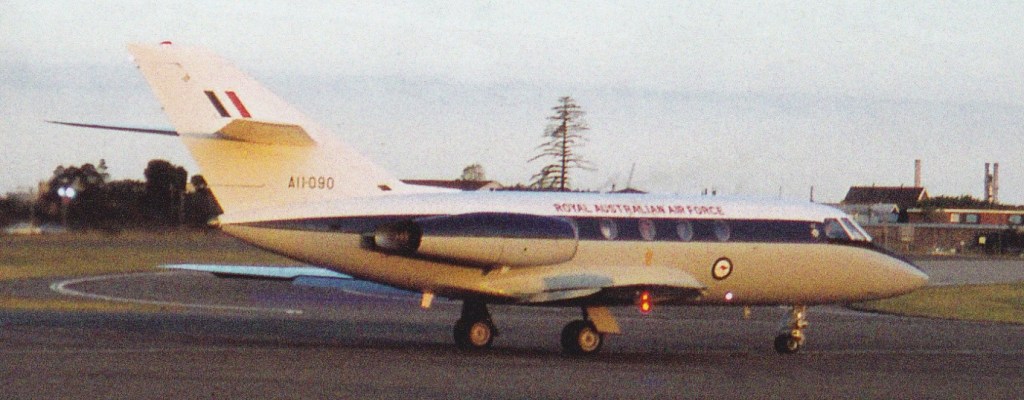
The RAAF operated three Falcon 20 as VIP transports between 1967 and 1989, the last, A11-090, delivered in August 1967. The serial suffix was the manufacturer’s construction number.
RAAF Falcon 20 A11-090
Dassault Breguet first indicated its intention to introduce a version of the Falcon with new turbofans in the 5,000 lb st (2 268 kgp) class during 1975, when the designation Falcon 20G was applied. The prototype of the Dassault-Breguet Mystere Falcon 20G (F-WATF) which had been selected by the US Coast Guard to meet its medium range surveillance aircraft requirement (known as project HX-XX) was flown for the first time in prototype form on 28 November 1977, being a standard production Falcon 20F fitted with Garrett AiResearch ATF3 engines. It was later fitted with the enlarged observation window at the front of the cabin. Powered by 5,440 1b (2468 kg) thrust Garrett ATF 3-6-2C turbofans, 41 had been ordered for the Coast Guard for a medium range surveillance role on 5 January 1977, which allocated the designation HU 25A Guardian, the first of 41 entered service in 1982.
In USCG service the HU-25A is used in the search and rescue role, HU-25B is the pollution control version, and the FLIR-equipped HU-25C modified for the drug interdiction role using a Westinghouse APG-66 search radar.
After the US Coast Guard bought 41 Mystêres as Guardians, Dassault-Breguet developed the Mystère 20H Gardian to meet Aéronavale needs for maritime surveillance in the Pacific. Before commercial deliveries of the Falcon 20H began, Dassault Breguet was committed to the delivery of five examples ordered in 1977 by the Aeronavale (French Navy) in the maritime surveillance role for service in the Pacific. These aircraft have been given the name Gardian by Dassault Breguet and differ from the Coast Guard’s Guardian in several important respects in addition to the larger fuselage fuel tank. Observation windows and ventral drop hatch are the same in both aircraft, but the Gardian’s external stores provision comprises only four wing stations two outboard stressed for 1,430 lb (650 kg) each and two inboard for 1,650 lb (750 kg) each. Like the HU 25A, the Gardian is powered by ATF3 6 2C engines to take advantage of the additional constant speed drive for a hydraulic motor to drive a 20 kVA alternator, but there is a further increase in gross weight, to a permissible maximum of 33,510 lb (15 200kg). The basic layout of the Gardian fuselage differs in detail from that of the HU 25A, and provides for an operational crew of six plus a four seat couch. In addition to two pilots and two visual observers, the crew includes a navigator and a radar operator, seated side by side at the rear of the cabin and facing the main equipment consoles on the right hand side. Without major difficulty, an additional four seat couch can be fitted, to bring total occupancy to 14; alternatively, two stretchers can be carried in place of the two couches, or four VIP seats and removable tables can be fitted in the central cabin area, in all cases without removing the rear equipment consoles or the forward observation seats. A number of airframes have been used by Dassault Breguet, FJC and Garrett AiResearch in the development of the Falcon 20G, 20H and Guardian variants. On 28 November 1977, Falcon 20F No 362 was flown for the first time, at Bordeaux, in the guise of the Falcon 20G prototype, fitted with a pair of ATF3 engines (the first time these engines had flown). To increase the engine development flying, a Falcon 20C (No 137) was acquired by Garrett AiResearch in 1977 and first flew on 17 June 1978 after being fitted with an ATF3 on the starboard side only, retaining the standard CF700 to port. The Falcon 20G designation is applicable only to the HU 25A Guardian for the US Coast Guard. It has been superseded commercially by the Falcon 20H, announced in mid 1979. Using the same basic engine installation as the Falcon 20G, the 20H differs in having a number of features that the company has meanwhile developed in the course of design and production of the three engined Falcon 50. Most significant of these features is the rear fuselage tank, which in the Falcon 20H has a capacity of 189 Imp gal (860 lt) the same as that used in the Falcon 50 and substantially larger than the new tank introduced in the Falcon 20G. Also based on the Falcon 50 experience, the systems in the Falcon 20H have been extensively modified for improved performance, greater reliability, easier maintenance and reduced weight. Complete spares interchangeability between Falcon 50 and Falcon 20H is achieved by introducing, in the latter, a new duplicated hydraulic system with separate pumps; two segregated electrical systems of increased power; a new ABG/SEMCA air conditioning system; an automatic stability system, Mach trim, yaw damper and flap asymmetry limiter; and, as options, a Solar T62 APU and the Collins APS 80 autopilot already specified for the HU 25A Guardian. Gross weight of the Falcon 20H is increased, like that of the 20G, to 32,000 lb (14 500 kg), and the aft limit CG position is moved back from 28 to 35 per cent, thanks to the introduction of a system that automatically extends the inboard wing leading edge slats at high angles of incidence. The cabin of the Falcon 20H is unchanged in size from that of the earlier aircraft, and various layouts for 8 to 14 passengers were available. First flown 30 April 1980. The first of five Dassault-Breguet Gardians for Aeronavale made its maiden flight on 15 April at Bordeaux-Merignae, and a second flight was made the same day to ferry the aircraft to Istres. The Gardian is a maritime patrol version of the Mystere-Falcon 20H, carrying Thomson-CSF Varan radar and a new Crouzet navigation system. It has an air-openable forward door to allow large items, such as rescue rafts, to be dropped, and four wing hardpoints for various loads such as sensor packs, target-towing equipment, weapons and ECM pods. The first Falcon 20 to undergo conversion into a Falcon Cargo was scheduled to begin certification flight trials on March 1, 1972. A cargo loading door has been substituted for the normal entrance in the port forward fuselage during modification by Little Rock Air¬motive to a Pan Am Business Jet requirement. The Canadian Armed Forces operated the Falcon 20 as the CC-117 until 1988.
The Mystere-Falcon 20 found employment for both civil and military use with orders approaching 500.
The Falcon 200 replaced the Falcon 20F on the production line in 1983, after 473 Falcon 20s had been delivered. Originally designated Falcon 20H the prototype 200, fitted with less powerful 2360kg thrust ATF 3-6A-4C engines, bigger fuel tanks in the rear fuselage, some systems’ changes and redesigned wing root fairings, flew for the first time on 30 April 1980. Announced at the 1981 Paris Air Salon the Falcon 200 was certificated by the DGAC on 21 June 1981 and deliveries began in 1982. By 1989 35 had been delivered to 11 countries. The maritime patrol and enforcement version of the Falcon 200 is marketed as the Gardian 2, and has a Thomson-CSF Varan search radar, two Exocet sea-skimming air to surface missiles mounted on underwing pylons, electronic surveillance and countermeasures equipment and target-towing capability. Five were in service with the French navy. The Falcon 200 has a max cruising speed of 531 mph and an economic cruise of 475 mph over 2590 miles. The last Falcon 200 was produced in 1988.
The three RAAF aircraft were Mystere 20C models, with the capability to deploy a drag chute on landing. The 400 series constructor numbers indicate built to FAA certification.
In July 1982 Dassault-Breguet indicated performance improvements for the Falcon 200, recently certificated with Garrett ATF3 engines incorporating the new E-6 fan section. The aerodynamic improvements combined with the new engines give the Falcon 200 a range of 2550 nm / 4725 km with eight passengers an NBAA VFR reserves. An improvement of 150 nm / 278 km from previously announced and 720 nm / 1335 km better than the Falcon 20F. Take-off distance with full fuel and eight passengers has been reduced from 5250 ft / 1600 m to 4650 ft / 1420 m.
Standard Falcon 20 Engines: 2 x General Electric CF700-2C, 1871kg / 4,315-lb. s.t. thrust Gross wt. 28,660 lb Empty wt. 15,970 lb Fuel capacity 1,385 USG Seats 8-14 Top speed: 465 mph. Cruise speed: 405 mph Stall: 95 mph. Range 2,200 miles Ceiling: 2,000 ft Takeoff distance (35 ft): 3,790 ft Landing distance (50ft): 1,930 ft
Falcon 20C Engines: 2 x General Electric CF700-2C turbofans ( 2D or 213 2 later, by retrofit), 1871kg / 4,125 lb st thrust Wing span: 16.3m / 53 ft 6 in Length: 17.15m / 56 ft 3 in Height: 5.32m / 17 ft 5 in Empty weight: 7000 kg / 15,430 lb Gross weight: 27,115 lb / 12,300 kg Max speed below 23,500 ft: 425 mph / 684 kph Max speed above 23,500 ft: M0.88 Ceiling; 42,000 ft / 12,800 m Stall: 99 mph / 160 kph Max range at 20,000 ft: 870 nm / 1610 km Passenger capacity: 8
Falcon 20D Engines: 2 x CF700 2B, 4,250 lb st (1930 kgp). Total cabin volume: 700 cu ft (20 cu.m). Forward baggage compartment: 35cu ft (1cu.m). Aft baggage compartment: 15 cu ft (0.4cu.m). Total fuel cap: 1,100 imp gal (1,315 US gal, 5,000 lit). Unusable fuel: 32 imp gal (38 US gal, 145 lit). Gross weight: 27,337 lb (12 400 kg).
Falcon 20D Engines: 2 x CF700-2D, 1928kg
Falcon 20E Engines: 2 x General Electric CF700-2D-2, 4,315 lb st (1960 kgp) Total cabin volume: 700 cu ft (20 cu.m). Forward baggage compartment: 35cu ft (1 cu.m). Aft baggage compartment: 15 cu ft (0.4 cu.m). Total fuel cap: 1,148 imp.gal (1,372 USgal, 5,220 lit). Unusable fuel: 32 imp gal (38 US gal, 145 lit). Gross weight: 28,660 lb (13 000 kg).
Falcon 20F Engines: 2 x GE CF700-2D-2, 4,315 lb, 19.2kN thrust Overall wingspan: 53ft 6in (16.3m). Overall length: 56ft 3in (17.15m). Overall height: 17ft 5in (5.32m). Wheelbase: 18ft 11in (5.77m). Wheel track: 11 ft 6 in (3.5 m). Wing area: 440sq ft, 41sq.m. Wing aspect ratio: 6.4. Maximum ramp weight: 28,660 lbs. Maximum takeoff weight: 28,660 lb / 13,000kg Standard empty weight: 17,060 lbs. Maximum useful load: 11,600 lbs. Zero-fuel weight: 19,600 lb / 8,900kg Maximum landing weight: 27,320 lb / 12,380kg Wing loading: 65.1 lbs/sq.ft. Power loading: 3.2 lbs/lb. Total fuel cap: 1,148 imp.gal (1,372 USgal, 5,220 lit) / 9,240 lb, 4,180kg Unusable fuel: 32 imp gal (38 US gal, 145 lit). Best rate of climb: 3650 fpm Certificated ceiling: 42,000 ft. Max pressurisation differential: 8.3 psi. 8000 ft cabin alt @: 42,000 ft. Maximum single-engine rate of climb: 900 fpm @ 203 kts. Single-engine climb gradient: 266 ft/nm. Single-engine ceiling: 15,000 ft. Maximum speed: 453 kts. Normal cruise @ 37,000ft: 432 kts. Fuel flow @ normal cruise: 1930 pph. Stalling speed clean: 119 kts. Stalling speed gear/flaps down: 93 kts. Turbulent-air penetration speed: 250 kts. VMO SL: 350kt, 650krn/hr VMO 23,000ft: 390kt, 720krn/hr MMO Mach 0.88 VFE 190kt, 355km/hr VLO 190kt, 355km/hr VLE 220kt, 410km/hr VMCA 98kt, 182km/hr Balanced field length: 5,300ft at max weight ISA SL. Passenger accommodation: 8-10 / 12-14 option Total cabin volume: 700 cu ft (20 cu.m) Forward baggage compartment: 35cu ft (1 cu.m) Aft baggage compartment: 15 cu ft (0.4 cu.m).
Falcon 20G / HU 25A Guardian Engines: 2 x Garrett ATF 3-6-2C turbofans, 5,440 1b (2468 kg) thrust Length: 56 ft 3 in / 17.14 m Height: 17 ft 5 in / 5.2 m Wingspan: 53 ft 6in / 16.3 m Wing area: 449.935 sq.ft / 41.8 sq.m Aspect ratio: 7.02: 1 Empty weight: 19,000 lb (8 620 kg) Equipped empty, 5 crew: 20,890 lb (9 475 kg) Max take off weight: 32,000 lb (14 515 kg) Max zero fuel: 22,520 lb (10215 kg) Max landing, 27,580 lb (12 510 kg) Wing load: 67.86 lb/sq.ft / 331.0 kg/sq.m Total fuel capacity: 1,270 Imp gal (5770 lt / 10,220 lb / 4 636 kg Max. speed: 469 kts / 869 km/h Max cruising speed: M = 0. 80, 531 mph (855 km/h) at 40,000 ft (12200 m) Economical cruising speed, M=0.72 Minimum low altitude manoeuvring speed, 173 mph (278 km/h) Take off run, max weight, ISA at SL: 4,050 ft (1235 m) Max range with crew of five, 5 per cent fuel res plus 30 min: 2,590 mls (4170 km) Undercarriage track: 12 ft 1.25 in (3,69m) Wheelbase: 18 ft 10 in (5,74 m) Crew: 5, two pilots, an SSO (surveillance system operator) and two observers. Passengers: 3 Hardpoints: 2 x wing points 1,450 lb (660 kg) each, 2 x wing points 1,120 lb (507 kg); 2 x fuselage 1,100 lb (500 kg) each, 2 x fuselage 440 lb (200 kg) each.
Falcon 20G / HU-25B Engines: 2 x Garrett ATF 3-6-2C turbofans, 5,440 1b (2468 kg) thrust Length: 56.234 ft / 17.14 m Height: 17.06 ft / 5.2 m Wingspan: 53.478 ft / 16.3 m Wing area: 449.935 sq.ft / 41.8 sq.m
Falcon 20G / HU-25C Engines: 2 x Garrett ATF 3-6-2C turbofans, 5,440 1b (2468 kg) thrust Length: 56.234 ft / 17.14 m Height: 17.06 ft / 5.2 m Wingspan: 53.478 ft / 16.3 m Wing area: 449.935 sq.ft / 41.8 sq.m
Falcon 20H / Mystère 20H Gardian Engines: 2 x Garrett ATF 3-6-2C turbofans, 5,440 1b (2468 kg) thrust Span: 16.3 m. Length: 17.2 m. Wing area: 41 sq.m. Empty wt: 8700 kg Gross weight: 33,510 lb (15 200kg). Hardpoints: four wing two outboard 1,430 lb (650 kg) each and two inboard 1,650 lb (750 kg) each. Warload: 1640 kg Max speed: 860 kph. Ceiling: 13,700 m. Fuel internal: 6000 lt. Range: 4490 km. Air refuel: No Operational crew: 6 Passengers: 4 Total seating: 14
Falcon 20H Engines: 2 x Garrett ATF 3-6-2C turbofans, 5,440 1b (2468 kg) thrust Wing span: 53 ft 6 in (16.3 m) Gross weight: 32,000 lb (14 500 kg) Max cruise: 531 mph (855 km/h). Hardpoints: 4
In 1968, Avions Marcel Dassault, decided to build a smaller version of the 20. Scaled down to 70 percent of the 20’s size, possibly with U.S. powerplants and marketed through Pan American, would capitalize on the engineering and sales know how learned from the Falcon 20 program. The result would be the Falcon 10, hopefully with a lower acquisition cost. Whereas the Falcon 10 wingspan, fuselage length and tail height all would be the desired 70 percent of the original Falcon 20 size, the volume inside the wing and fuselage available to carry fuel would only be 34 percent of that used in the 20. As a scaled down Falcon, the 10 would only hold 470 gallons of fuel.
To solve the problems Dassault would design a new, advanced wing, thick enough to hold sufficient fuel in internal tanks, yet still able to retain the high, critical Mach number and reasonable drag rise characteristics associated with more conventional, thin airfoils.
It was decided that the Falcon 10 wing should be 13.5 percent thick at the root, retain much of its thickness (10 percent) up to the wing fence, and then slope to seven percent at the tip.
1st prototype
The first Falcon 10 (F-WFAL), powered by GE CJ610-1 engines, flew on December 1, 1970, and on June 1, 1971, set a 1,000 km closed circuit speed record of 502.2 knots. A second prototype, with the Garrett TFE 731 2 engine, flew for the first time on October 15, 1971, and the number three Falcon 10 set a 2,000 km speed rec¬ord in May 1973. In April 1973 the first production aircraft was flown.
The engineering team also incorporated advanced high lift devices in the Falcon 10’s wings to compensate for higher wing loading. (The Falcon 10’s wing area is only 59 percent of the 20’s, while the 10 lifts 64 percent of the 20’s takeoff weight.) Full¬span leading edge devices, plus double slot¬ted Fowler flaps, combined with the advanced supercritical wing to produce a maximum lift capability for the Falcon 10 wing that is seven percent greater than the Falcon 20Fs and 35 percent greater than the Falcon 20E’s.
Leading edge slats and double slotted Fowler flaps allow the Falcon 10 to operate out of many airports too small for either airliners or competitive corporate jets. FAR 36 noise standards are met, thanks to the quiet Garrett 731 2 turbofans. The airplane is certificated without the need for stick pull¬ers to protect from overspeed, and stick shakers or pushers to protect against stall. Because the extras that Dassault included were expensive, the Falcon 10’s price was higher than its light business jet competition.
Several of these aircraft are operated by the Aeronavale designated Falcon 10MER. They are used in general communications and liaison duties, as well as to give training to pilots of the Dassault Super Etendard carrier-based fighter. The Aeronavale’s aircraft serve with ES3 at Hyeres and ES57 at Landivisiau.
Introduced in 1985 to supersede the Falcon 10 and certificated in December 1986, the Series 100 featured increased weights (Ramp and Max. Take-off), a fourth cabin window on the starboard side, bigger luggage compartment and a ‘glass cockpit’. When production ceased in 1989 223 Falcon 10/100s had been delivered to customers in 24 countries.
1st prototype Engines: 2 x Garrett AiResearch TFE 731-2 turbofan, 3230 lb / 1465 kg st Wingspan: 42 ft 11 in / 13.08 m Length: 45 ft 5 in / 13.85 m Empty weight: 10,416 lb / 4725 kg Max payload: 1945 lb / 886 kg Max Mach: 0.87 Range 4 pax 45min res: 1800 nm / 2070 mi / 3330 km Crew: 2-3 Passenger capacity: 7 Pax cabin length: 16 ft 5 in / 5.00 m Pax cabin max width: 4 ft 9 in / 1.46 m Pax cabin max height: 4 ft 11 in / 1.50 m Pax cabin volume: 264.6 cu ft / 7.50 cu m Front baggage: 12.35 cu ft / 0.35 cu m Rear baggage: 24.7 cu ft / 0.70 cu m
Falcon 10 Engines: Garrett TFE 731 2, 3,230 lbs. thrust. Length: 45 ft. 4 in. Height: 14 ft. 6 in. Wingspan: 42 ft. 11 in. Aspect. ratio: 7. Wing area: 259 sq. ft. Wing loading: 70.7 lb/sq.ft. Seats: 8. Operating weight: 10,875 lbs. Useful load: 7,425 lbs. Payload with full fuel: 1,515 lbs. Takeoff weight: 18,300 lbs. Zero fuel weight: 12,460 lbs. Power loading: 2.8 lb/lb. Fuel capacity: 882 USG/5,910 lb. Baggage capacity: 680 lbs. Baggage area: 32 cu.ft. Cabin pressure differential: 8.8 psi. Cabin altitude at 45,000 ft: 8,000 ft. Balanced field length: 4,300 ft. Initial rate of climb: 4,200 fpm. Gross takeoff climb gradient, one engine: 3.2 degrees. Maximum operating altitude: 45,200 ft. Maximum cruise (at 39,000 ft. and 16,000 lbs): 459 knots. Normal cruise (at 39,000 ft. and 16,000 lbs.): 428 knots. Long range cruise (at 39,000 ft. and 6,000 lbs.): 428 knots. Maximum range, full fuel (45 min res): 1,800 nm. Stall speed (clean): 121 knots. Stall speed (gear, slats and flaps extended): 92 knots. Crew: 2
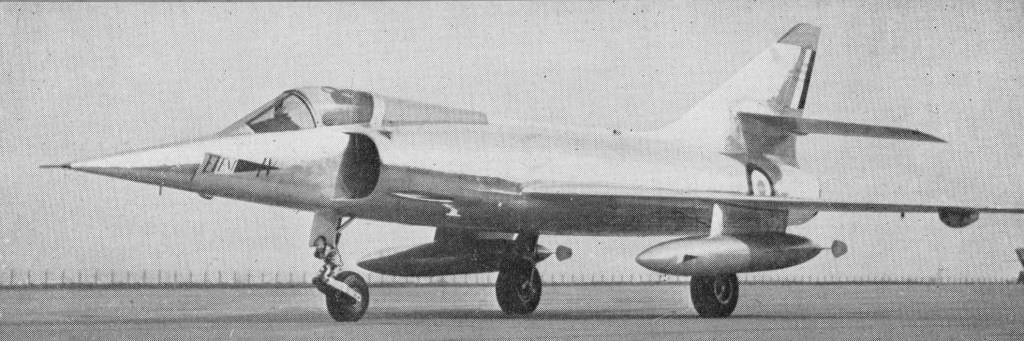
Developed as a private venture, the Milan (Kite) was a progressive development of the basic delta-winged Mirage and was intended primarily as a single-seat strike fighter. The distinguishing feature of the Milan was provided by two small retractable foreplanes which were referred to colloquially as “moustaches”. These were developed by Dassault in collaboration with the Swiss aircraft industry and were intended to improve low-speed control and take-off performance, to increase the suitability of the basic design for the low-level role. Work on a prototype Milan, modified from a Mirage IIIE, began mid-1968, and the initial test phase, with non-retractable foreplanes, was completed in March 1969. A fully-equipped pre-series prototype, the Milan S-01, first flew on 29 May 1970. Representative of the proposed series Milan S, this was powered by a SNECMA Atar 9K-50 providing an afterburning thrust of 7200kg. The series Milan S, which was offered for delivery from early 1972, was intended to be fitted with a nav/attack system similar to that of the Jaguar strike aircraft, and internal armament was to have comprised two 30mm cannon, with external ordnance loads up to 4000kg distributed between seven hardpoints. No orders were placed for the Milan, and further development was discontinued in 1972, the prototype being adapted as that of the Mirage 50.
Engine: SNECMA Atar 9K-50, 7200kg afterburning Take-off weight: 14000 kg / 30865 lb Loaded weight: 7000 kg / 15432 lb Wingspan: 15.90 m / 52 ft 2 in Max. speed: 2337 km/h / 1452 mph Ceiling: 12000 m / 39350 ft
In the mid 1950s NATO (North Atlantic Treaty Organisation) issued a specification for a lightweight strike fighter powered by a single Orpheus turbojet. In France, the Ministere de l’Air drew up a parallel specification for an aircraft which differed essentially from that called for by NATO in having paired lightweight turbojets. Dassault prepared a basic design to meet both requirements, and evolved a third version of the design as a private venture.
The three versions of the aircraft were designated Etendard (Standard) II, IV and VI, and the first to commence its flight test programme was the Etendard II. Three prototypes had been ordered by the French government and the first of these flew on 23 July 1956. Competing with the Breguet 1100, the Etendard II was powered by two 940kg Turbomeca Gabizo turbojets and proposed armament included two 30mm cannon which were to be installed as a pack interchangeable with one containing 32 Matra 105 68mm rockets. It was intended to fit the Gabizo engines with afterburners, but as these were producing 160kg less dry thrust than promised and aircraft performance was, in general, disappointing, the programme was discontinued in November 1956, the second and third prototypes being cancelled. The second prototype was to have had 1200kg SNECMA R-105 engines.
Developed in parallel with the Etendard II and VI as a private venture, the Etendard IV light tactical fighter powered by a 3400kg SNECMA Atar 101E-4 was first flown on 24 July 1956. The Etendard IV featured larger overall dimensions, including 1.4sq.m more wing area, cabin pressurisation and longer-stroke main undercarriage members with larger wheelbase and track. There was provision for increased internal fuel capacity. The armament of the sole prototype Etendard IV comprised two 30mm DEFA cannon. Several variants of the Etendard IV were planned, including a tandem two-seat conversion trainer, a tactical reconnaissance model and a shipboard multi-role fighter version.
Etendard IV
Intended to meet the NATO requirement for a light tactical fighter, the Etendard VI was flown for the first time on 15 March 1957, three prototypes having been ordered in July 1955. Initially, the first prototype was powered by a 1700kg Bristol Siddeley Orpheus BOr 1 turbojet, but this was later to be replaced by a BOr 3 of 2200kg. Armament consisted of four 12.7mm machine guns and up to 540kg of ordnance could be carried on wing pylons. The second prototype, powered by the BOr 3 from the outset, had enlarged air intakes and an internal armament of two 30mm cannon, and was first flown on 14 September 1957. Both Etendard VIs participated in the NATO Concours at Bretigny-Chateauroux, from which the Fiat G.91 emerged as the winning contender. Construction of the third prototype, which was to have had a 2700kg BOr 12 engine with provision for afterburning and a fully area-ruled fuselage, had been terminated in June 1957. Both prototypes subsequently participated in the Etendard IVM development programme.
It was for the shipboard multi-role Etendard IV fighter that Dassault received a contract for the further development to meet the Aeronavale’s requirements. An order was placed in December 1956 for a semi-navalised prototype, this being followed on 31 May 1957 by a contract for five fully-navalised pre-production examples under the designation Etendard IVM.
Etendard IV
The prototype flew on 21 May 1958, followed by the first pre-production example on 21 December, both were powered by the 9,700 lb / 4400kg SNECMA Atar 08B turbojet. The pre-series Etendard IVM featured folding wingtips, a strengthened, long-stroke undercarriage, an extendable nosewheel leg, catapult spools and an arrester hook. Speed was in excess of Mach 1 at optimum altitude, and armament includes one or two 30 mm cannon and up to 3,000 lb (1,360 kg) of bombs, rockets, AS.30 air to surface or Side¬winder air to air missiles carried underwing. By comparison with the original Etendard IV, the IVM had 15.5% more wing area and a larger rudder. The second pre-production aircraft was completed with an 5080kg Rolls-Royce Avon 51 engine and blown flaps as the Etendard IVB.
Early in 1960, a series of catapult take-off and deck-arrester trials was carried out at RAE, Bedford, with the Avon-powered Etendard IVB. The fin-like antenna under the nose is associated with the guidance system for the beam-riding Nord 5103 missile.
Etendard IVB
In 1960, 100 Atar-powered Etendard IVMs were on order for service aboard the new French carriers Clemenceau and Foch.
Delivery of this version to the French Navy began in June 1978. Powered by an 11,025 lb thrust SNECMA Atar 8K 50 turbojet engine, it incorporates advanced high lift devices and a highly sophisticated electronics system. Armament includes two 30-mm cannon and up to 4,630 lb (12,100 kg) of air to air/air to surface missiles, bombs, etc. Normal powerplant for l’Aeronavale is the 9,700 lb. s.t. SNECMA Atar 8 turbojet, and the excess power of the Avon-¬engined Etendard is used for leading and trailing edge flap blowing for operation from smaller aircraft carriers than the new French types, if required. One additional pre-production aircraft was ordered in September 1959 and completed with a camera nose as an Etendard IVP.
During flight trials, the Etendard has flown up to M1.44 in a dive. Level flight speed is just over M1, and the practical limit is M1.3 or 670 knots. In addition to its fixed guns, the Etendard has four under¬wing attachment points for bombs, rocket pods, Nord ASMs, fuel tanks or other external stores, and the IVB has provision for an additional pylon beneath the fuselage. With two 1,000 lb bombs and cannon armament and full internal fuel of 660 Imp gal., the Etendard takes off in 1,650 ft. at 21,000 lb., or has a catapult end speed of 116.5 knots, and has a 400nm radius of action.
Maximum weight of the Etendard IVB is 22,500 lb., and it climbs to 40,000 ft. in 4 min. 20 see. Acceleration from 250 600 knots requires only 53 sec, and normal NATO naval strike equipment is fitted, including LABS and TACAN.
First flying on 21 May 1958, sixty-nine IVMs (plus 21 IVP tactical reconnaissance aircraft) were delivered between June 1961 and 1965, for both intercept and tactical strike roles from French carriers Clemenceau and Foch. Armament consisted of two 30mm cannon and a variety of underwing ordnance.
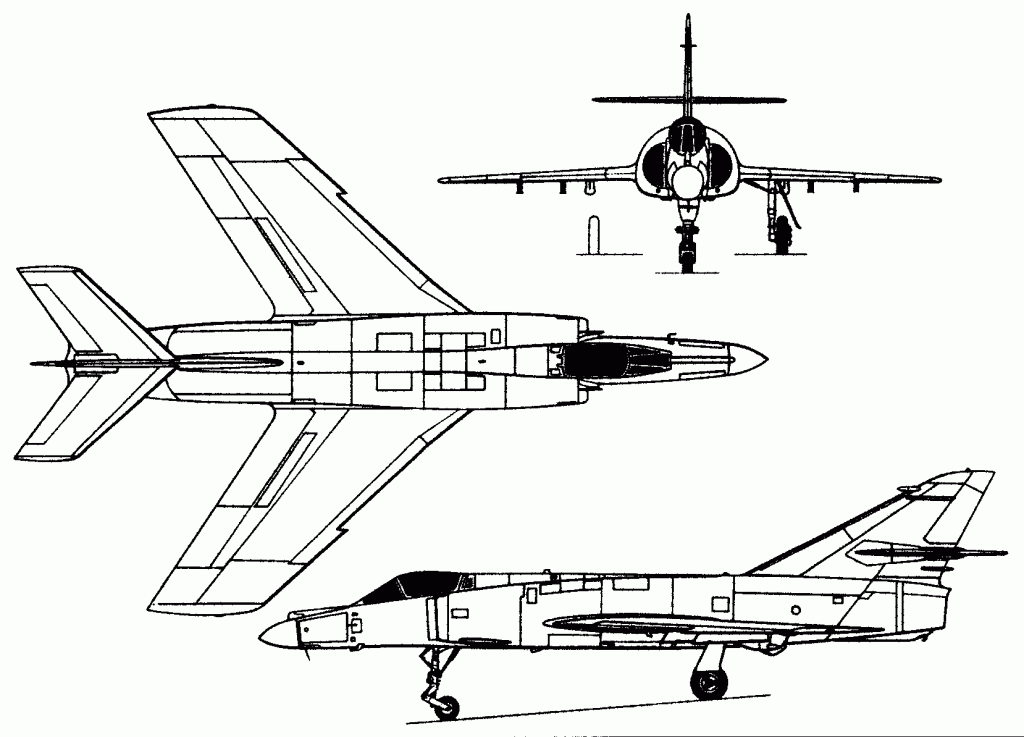
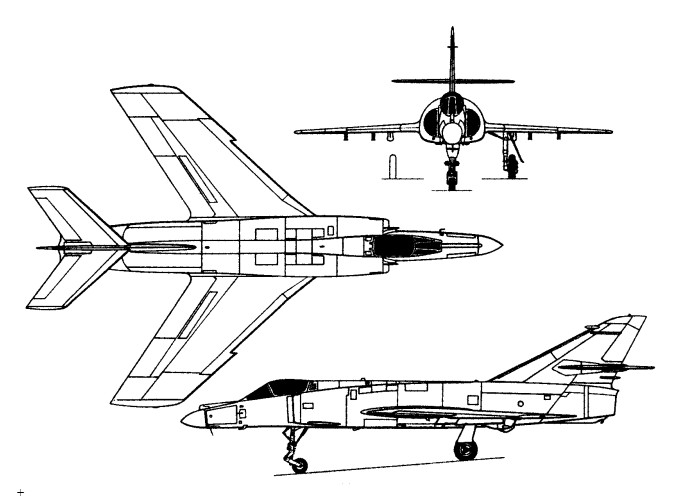
The mid-wing has 45 deg sweepback and drooping ‘dog-tooth’ leading edges and folding tips, inset ailerons, and trailing edge flaps. The tricycle undercarriage, with single wheels on each unit, retracts inwards into the fuselage, and nose wheel retracts forward. A stabilising fin is fitted under the nose.
Etendard IVM
The Etendard IVM remained in Aeronavale service until 1991, being succeeded by the Super Etendard.
To complement the Etendard IVM, the French navy needed a photo-reconnaissance version. This was the Etendard IVP that first flew in November 1960, and production totalled 21 aircraft for Flottille 16F. In the Etendard IVP, the attack fighter’s Electronique Serge Dassault Aida ranging radar and Saab toss-bombing computer are replaced by a nose installation of three Omera cameras, while another two cameras replace the attack fighter’s two ventrally mounted 30-mm cannon and their ammunition. The Etendard IVP is equipped with a nose-mounted inflight refueling probe, and can also carry a Douglas-designed “buddy” refueling pack on the centerline under the fuselage for the support of other Aeronavale fixed-wing aircraft, notably the Super Etendard development of the Etendard IVM.
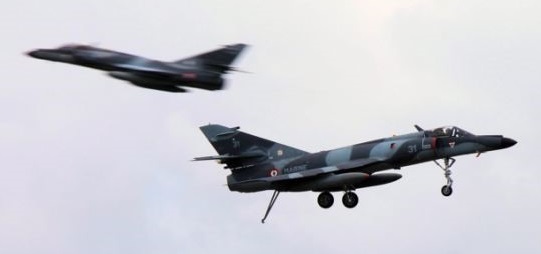
Super Etendard, Aeronautique Navale, 11 Flotille
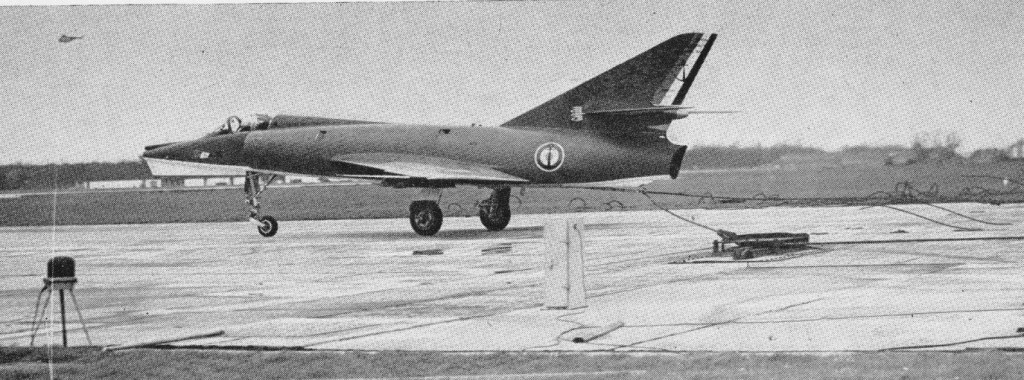
The first of three development aircraft for the Etendard IVM carrierborne attack fighter (converted from Etendard IVM airframes) flew on 28 October 1974, with revised powerplant, comprehensive high-lift devices and inflight-refuelling capability. The first pro¬duction example of the Super Eten¬dard single seat carrier based strike fighter on 24 November 1977. Initial deliveries to the Aeronavale began on 28 June 1978. The Super Etendard had a built-in armament of two 30mm cannon and various external ordnance loads on five stores stations.
By comparison with the Etendard IV-M from which it was developed, the Dassault Super Etendard introduced more advanced high-lift devices, a 5000kg SNECMA Atar 8K-50 turbojet of increased power, Agave radar in an enlarged nose and an entirely new nav/attack system with the AM.39 Exocet missile. French Navy Super Etendards were to be modified to carry the ASMP nuclear missile, and 50 aircraft were scheduled for completion by the end of 1988. Fourteen were ordered by Argentina and the Super Etendard was employed operationally from shore bases in May 1982 during the Falklands conflict. Seventy-one Super Etendards were supplied to the Aeronavale, production terminating in 1983.
The prototype of an upgraded version of the Super Etendard was flown on 5 October 1990, when it was proposed that a further 54 would be upgraded to similar standards (two by Dassault and 52 by Aeronavale’s Cuers workshops) at a rate of 15 annually from 1992, to extend the service life of the Super Etendard to the year 2008. The upgrade programme included both airframe modifications and avionics updating.
Etendard II Engines: two 940kg Turbomeca Gabizo turbojets Max take-off weight: 5650 kg / 12456 lb Empty weight: 4210 kg / 9282 lb Wingspan: 8.74 m / 28 ft 8 in Length: 12.89 m / 42 ft 3 in Height: 3.80 m / 12 ft 6 in Wing area: 24.2 sq.m / 260.49 sq ft Max. speed: 1054 km/h / 655 mph
Etendard IV Engine: 1 x 3400kg SNECMA Atar 101E-4 Wingspan: 9.04 m / 29 ft 8 in Length: 13.40 m / 43 ft 12 in Height: 4.30 m / 14 ft 1 in Wing area: 25.60 sq.m / 275.56 sq ft Max take-off weight: 850 kg / 17306 lb Empty weight: 5060 kg / 11155 lb Max. speed: 1100 km/h / 684 mph Armament: two 30mm DEFA cannon.
Etendard IVB pre-production Engine: 1 x 5080kg Rolls-Royce Avon 51
Etendard IVB Engine: 1 x 11,025 lb thrust SNECMA Atar 8K 50 turbojet Takes off run 21,000 lb: 1,650 ft Catapult end speed 21,000 lb: 116.5 kt Radius of action 21,000 lb: 400nm Maximum weight: 22,500 lb Climbs to 40,000 ft: 4 min. 20 see. Acceleration 250 600 kts: 53 sec Hardpoints: 4 Armament: two 30-mm cannon / 4,630 lb (12,100 kg) of external ordanace
Etendard IVB Engine: 1 x 9,700 lb. s.t. SNECMA Atar 8 turbojet Takes off run 21,000 lb: 1,650 ft Catapult end speed 21,000 lb: 116.5 kt Radius of action 21,000 lb: 400nm Maximum weight: 22,500 lb Climbs to 40,000 ft: 4 min. 20 see. Acceleration 250 600 kts: 53 sec Hardpoints: 4
Etendard IVM Engine: 1 x 9,700 lb / 4400kg SNECMA Atar 08B turbojet Wingspan: 9.60 m / 31 ft 6 in Length: 14.35 m / 47 ft 1 in Height: 3.90 m / 12 ft 10 in Wing area: 28.40 sq.m / 305.69 sq ft Max take-off weight: 10200 kg / 22487 lb Empty weight: 5897 kg / 13001 lb Fuel capacity: 726 Gal Underwing fuel capacity: 2 x 132 gal Max. speed: 713 mph / Mach 1.08 at 36,000 ft Cruising speed: 443 kts / 820 km/h Initial climb rate: 19685.04 ft /min / 100.0 m/s Service ceiling: 50853 ft / 15500 m Cruising altitude: 36089 ft / 11000 m Wing loading: 72.57 lb/sq.ft / 354.0 kg/sq.m Range: 378 nm / 700 km Range w/max.fuel: 3300 km / 2051 miles Armament: one or two 30 mm cannon / up to 3,000 lb (1,360 kg) external stores
Etendard IVP Engine: one 9,700-lb (4,400-kg) thrust SNECMA Atar 8B turbojet. Wing span: 31 ft 6 in (9.60 m) Length: 47 ft 8 in (14.53 m) Height: 14 ft 2 in (4.30 m) Wing area: 312.16 sq ft (29.00 sq.m) Empty weight: 13,007 lb (5,900 kg) Maximum take-off 22,486 lb (10,200 kg). Maximum speed: 683 mph (1,099 km/h) at sea level Initial climb rate: 19,685 ft (6,000 m) per minute Service ceiling: 50,850 ft (15,500 m) Radius: 186 miles (300 km). Armament: none.
Etendard VI 1st prototype Engine: 1700kg Bristol Siddeley Orpheus BOr 1 turbojet, later BOr 3 of 2200kg. Armament: four 12.7mm machine guns, up to 540kg of ordnance
Etendard VI 2nd prototype Engine: Bristol Siddeley Orpheus BOr 3, 2200kg Wingspan: 8.16 m / 26 ft 9 in Length: 12.40 m / 40 ft 8 in Wing area: 21.0 sq.m / 226.04 sq ft Max take-off weight: 5860 kg / 12919 lb Empty weight: 3720 kg / 8201 lb Max. speed: 1116 km/h / 693 mph Armament: two 30mm cannon
Super Etendard Engine: 1 x Snecma Atar 8K50. Installed thrust: 49 kN. Span: 9.6 m. Length: 14.3 m. Height: 12.631 ft / 3.85 m Wing area: 306.774 sq.ft / 28.4 sq.m. Max take off weight: 26460.0 lb / 12000.0 kg Weight empty: 14222.3 lb / 6450.0 kg Max. speed: 648 kt / 1200 km/h Wing loading: 86.31 lb/sq.ft / 421.0 kg/sq.m Warload: 2270 kg. Initial ROC: 6000 m / min. Ceiling: 13,700 m. T/O run: 700 m. Ldg run: 500 m. Range: 443 nm / 820 km Combat radius hi-lo-hi: 720 km. Fuel internal: 3270 lt. Air refuel: Yes. Armament: 2 x 30 mm DEFA 552A, 2 x AAM Hard points: 5. Crew: 1
Further development of the MD.550 Mirage I was required to produce an effective machine, and after the Mirage II project with twin Turbomeca Gabizo turbojets had been abandoned, the company produced the Mirage III supersonic fighter.
The MD 550 was designed to meet the requirements of a 1954 specification calling for a small all-weather interceptor fighter capable of attaining an altitude of 18,000m within six minutes and sustaining a speed in excess of M=1.0 in level flight. Initially known as the Mystere-Delta, it was competing with the SE.212 Durandal and the SO.9000 Trident. To attend the Armée de L’Air requirements, the Marcel Dassault company presented the project MD.550, a delta wing configuration, with a 5% chord (ratio of airfoil thickness to length) and 60 degree sweep. A tailless delta layout, the MD 550 was powered by two MD 30R (Armstrong Siddeley) Viper turbojets each rated at 980kg with afterburning, and first flew on 25 June 1955.
With the original delta vertical tail replaced by swept back surfaces and a 1500kg thrust SEPR 66 bi-fuel auxiliary rocket motor installed, the MD 550 was renamed Mirage I, and, on 17 December 1956, attained M=1.3 in level flight without rocket power and M=1.6 with the rocket lit.
Intended armament was a single Matra or Nord AAM carried externally. However, it was concluded that the Mirage I was too small to carry an effective military load, and a slightly enlarged version, the Mirage II with a pair of Turbomeca Gabizo turbojets, was proposed. This proposal was eventually discarded in favour of the Mirage III.
Engine: 2 x M.D. 30R (Armstrong Siddeley) Viper turbojets, 980kg and 1 x 1500kg thrust SEPR 66 rocket motor Max take-off weight: 5070 kg / 11177 lb Empty weight: 3330 kg / 7341 lb Wingspan: 7.30 m / 23 ft 11 in Length: 11.10 m / 36 ft 5 in Wing area: 27.10 sq.m / 291.70 sq ft Max. speed: 1700 km/h / 1056 mph
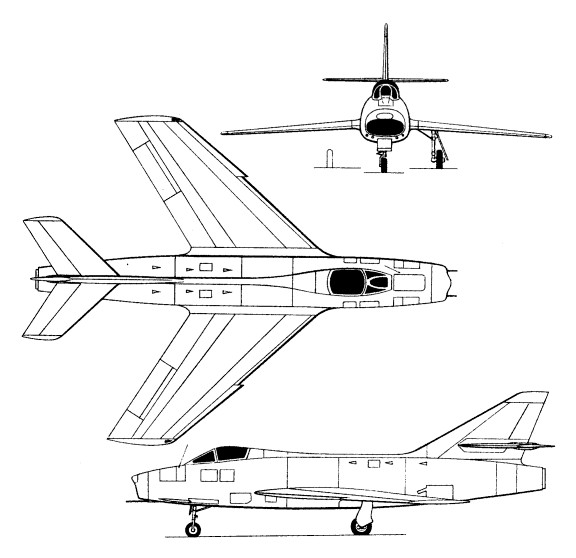
The Super-Mystere shared only a common design origin with the Mystere fighter series, being an entirely new type. The first prototype, designated Super-Mystere B1 and powered by a Rolls-Royce Avon RA 7R with an afterburning thrust of 4330kg, was flown on 2 March 1955. In March 1955, the B1 became the first production standard European fighter to achieve more than Mach 1 in level flight.
The Super-Mystere has low-mid wings, swept-back at 45°, with dog-tooth leading edges. The tail-surfaces are swept with the tailplane mounted part way up the fin. Control is by conventional ailerons, rudder, and all-moving tailplane. Split trailing-edge flaps are fitted. Air brakes are on each side of the rear fuselage. The tricycle undercarriage has a single wheel on each unit. The main wheels retract inward into the fuselage and the nose wheel retracts rearward.
The first of five SNECMA Atar-powered pre-production Super-Mystere B2s followed, flying on 15 May 1956. Production was ordered for the Armee de l’Air, the first series Super-Mystere B2 flying on 26 February 1957, and a total of 180 were built of which 36 were bought by Israel in 1958.
The Super-Mystere B2 was powered by an Atar 101G-2 or -3 of 3375kg dry thrust and 4460kg with maximum afterburning. Armament consisted of two 30mm cannon and 35 internally-housed 68mm rockets (the rockets being discarded at an early service stage), external loads including two Sidewinder AAMs, two 400-500kg bombs or rocket pods.
Mystere B.2 EC 1/12 at Greenham Comon Tigermeet 1977
The Armee de l’Air Super Mystere were phased out in 1959 in favour of the Mirage IIIC.
Two examples were completed as Super Mystere B4s in 1958, these having Atar 9B engines rated at 6000kg with afterburning. During Israeli service, the Super-Mystere B2s were re-engined with a non-afterburning Pratt & Whitney J52-P-8A turbojet of 4218kg. In 1977, 18 of these aircraft were sold by Israel to Honduras where the last surviving examples were withdrawn from service in 1989.
Super-Mystere B1 Engine: Rolls-Royce Avon RA 7R, afterburning thrust 4330kg
Super-Mystere B2 Engine: SNECMA Atar 101G-2 or -3 of 3375kg dry, 4460kg / 9700 lb afterburning Wingspan: 10.52 m / 34 ft 6 in Length: 14.13 m / 46 ft 4 in Height: 4.55 m / 15 ft 11 in Wing area: 35 sq.m / 376.74 sq ft Max take-off weight: 10000 kg / 22046 lb Loaded weight: 6932 kg / 15283 lb Empty weight: 15,400 lb Max speed: 605 kt / 1195 km/h / 743 mph / M1.125 at 36,000 ft Max ROC: 17,500 fpm Service ceiling: 44948 ft / 13700 m Range: 870 km / 541 miles Range w/max.fuel: 1790 km / 1112 miles Armament: two 30mm DEFA cannon, 35 x 68mm rockets External load: two Sidewinder AAMs, two 400-500kg bombs or rocket pods. Crew: 1
Super-Mystere B2 Engine: Pratt & Whitney J52-P-8A turbojet, 4218kg thrust Wingspan: 10.52 m / 34 ft 6 in Length: 14.13 m / 46 ft 4 in Height: 4.55 m / 14 ft 11 in Wing area: 35 sq.m / 376.74 sq ft Armament: two 30mm cannon, 35 x 68mm rockets Crew: 1
Super Mystere B4 Engine: Atar 9B, 6000kg afterburning Wingspan: 10.52 m / 34 ft 6 in Length: 14.13 m / 46 ft 4 in Height: 4.55 m / 14 ft 11 in Wing area: 35 sq.m / 376.74 sq ft Armament: two 30mm cannon, 35 x 68mm rockets Crew: 1
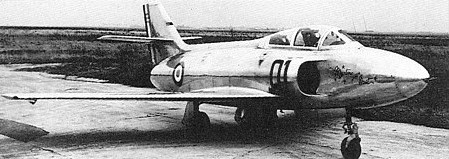
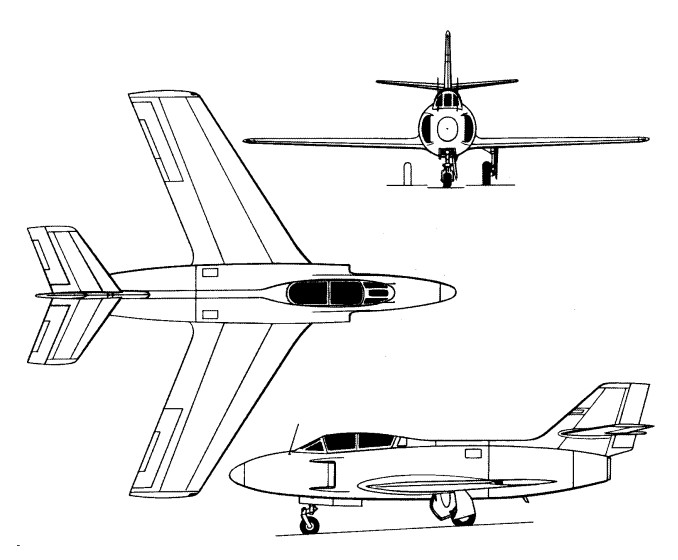
The development of a night fighter based on the MD.450 Ouragan day fighter was begun early in the evolution of the latter as the tandem two-seat MD.451 Aladin. It was proposed to install AI Mk 17 or APG 33 intercept radar in the extreme nose, leading to the adoption of lateral intakes. The 11th pre-series Ouragan was completed with the lateral air intakes plus twin 30mm cannon in place of the standard quartet of 20mm weapons, and flown on 24 January 1952 as the MD.450-30-L (signifying 30mm cannon and lateral intakes). Development of the MD.451 was discontinued in favour of an essentially similar two-seat night fighter derivative of the Mystere II designated MD.453 Mystere IIIN, or Mystere denuit. With lateral air intakes and a 2850kg Hispano-Suiza Tay 250 engine, the first of three prototypes ordered was flown on 18 July 1952. No radar was installed and the second and third prototypes were cancelled. The sole Mystere IIIN prototype flown had completed 146 flight tests by December 1953, when the programme terminated, the aircraft subsequently being used to test ejection seats.
Take-off weight: 7335 kg / 16171 lb Loaded weight: 5915 kg / 13040 lb Wingspan: 11.62 m / 38 ft 1 in Length: 12.86 m / 42 ft 2 in Height: 4.47 m / 14 ft 8 in Wing area: 31.90 sq.m / 343.37 sq ft Max. speed: 1080 km/h / 671 mph










 All Aero