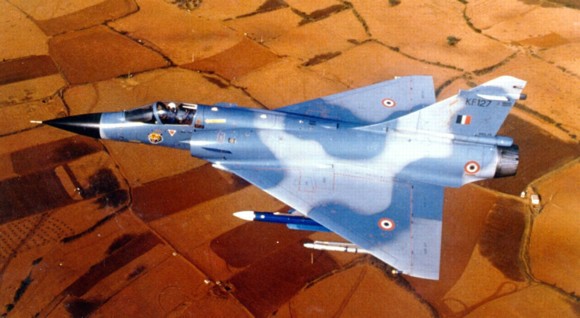
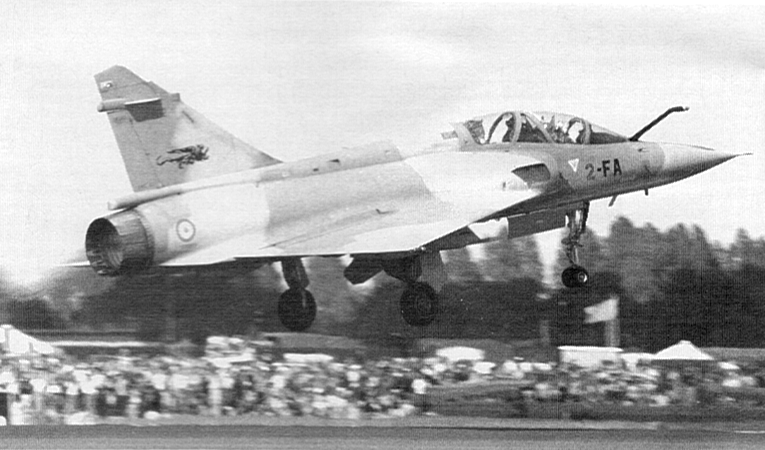
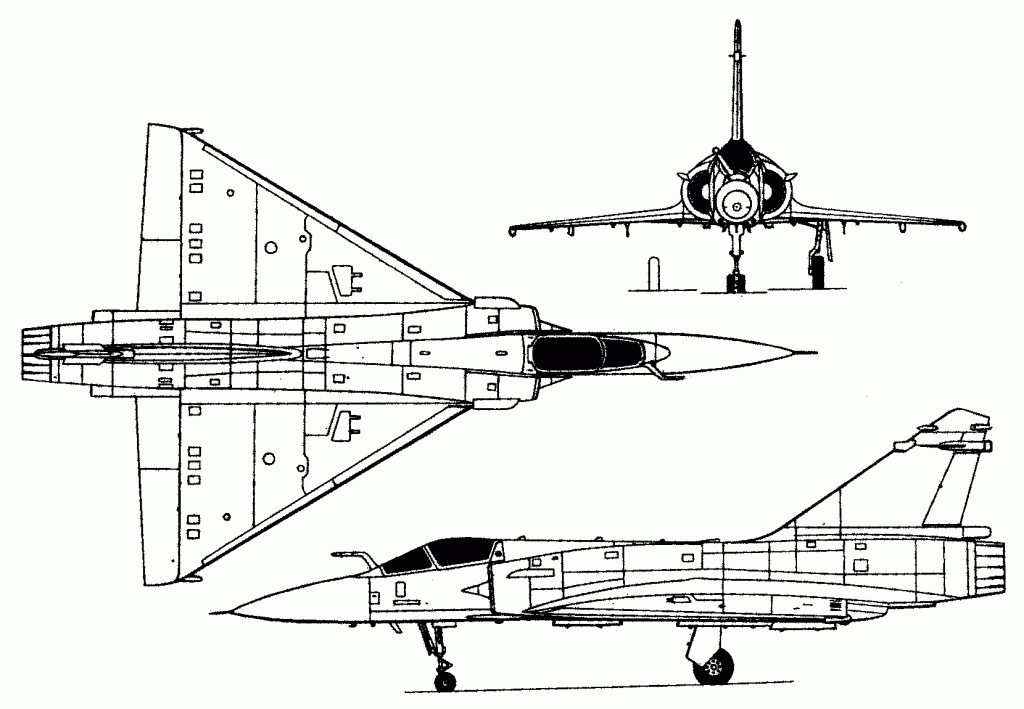
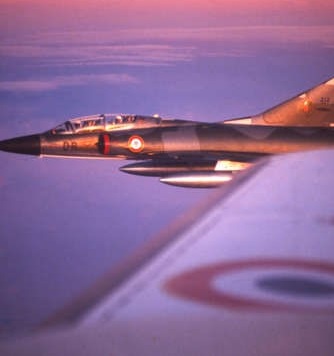
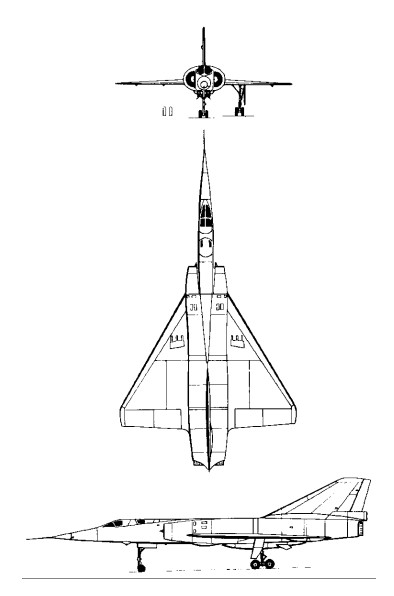
The Mirage 2000 high-performance fighter delta wing used a design with relaxed stability, a variable-camber (produced by two-section leading-edge slats and trailing-edge elevons) and a “fly-by-wire” computerized control system in an airframe that makes extensive use of composite materials. Developed initially as a single-seat interceptor and air superiority aircraft designated 2000C, the first of four prototypes was flown on 10 March 1978. A company-funded fifth prototype, in tandem two-seat trainer 2000B form, flew on 11 October 1980. The Mirage 2000 was chosen on 18 December 1975 to become the next primary combat aircraft of the Armee de l’Air, to replace the Mirage III is the interceptor role.
The first production Mirage 2000C flew on 20 November 1982 with a SNECMA M53-5 rated at 5547kg dry and 8790kg with afterburning, this being replaced from the 38th Armee de l’Air Mirage 2000C by the M53-P2 turbofan producing 6557kg dry and 9687kg with afterburning. Armament consisted of two 30mm cannon with a typical intercept weapons mix comprising two Matra 530D or 530F AAMs inboard and two Matra 550 Magic missiles outboard under the wings. For an attack mission, up to 6300kg of ordnance could be distributed between nine external stations. Deliveries of the initial 37 Mirage 2000C to the first of four Escadres de Chasse began in the summer 1983, this attaining operational capability on 2 July 1984.
The dedicated air-defense Mirage 2000C with an advanced electronic countermeasures system, a “look-down/shoot-down” radar, and a mix of air-to-air missiles with infra-red or semi-active radar guidance, with an active radar-guided type to follow, can also be used in the attack role. The 2000C was also produced in a number of differently suffixed sub-variants for export. Mirage 2000C aircraft have flown CAP missions during the Gulf War alongside other coalition fighters. The Mirage 2000 also saw action over Bosnia and Kosova in support of NATO. In 1987, the Dassault company offered a private venture two-phase Mirage 2000 update programme. The first phase, the Mirage 2000-3 with Rafale-type cockpit multifunction displays, flew on 10 March 1988, and the addition of a new central processing unit, an updated head-up display and Thomson- CSF RDY multi-mode radar resulted in the second phase Mirage 2000-5, flown on 24 October 1990.
In 1990 a major upgrade of the 37 Mirage 2000C design resulted in the multi-role Mirage 2000-5F which was first flown on 24 October 1990 and was also ordered by Taiwan. The 2000-5 is a multi-role variant capable of using the Super 530D or Sky Flash air-to-air missiles.
In 1979 Dassault was contracted to build two prototypes designated Mirage 2000P, later Mirage 2000N. The 2000P was being developed for the low-altitude tactical nuclear strike mission to replace the fleet of nuclear-armed Mirage IVPs. The Mirage 2000N made its first flight on 3 February 1983. Based on the Mirage 2000B two-seat trainer variant, the 2000P has a revised avionics suite and strengthened fuselage for the low-altitude role and the Antilope 5 nose radar optimised for terrain following, ground mapping and navigation and has additional air-to-air and air-to-sea modes. The rear seat is occupied by a WSO which has twin inertial platform navigation systems, a radar altimeter, ECM, a vertical camera, and an additional moving map. The aircraft configured with only the ASMP missile and 2 Magic AAMs is designated 2000N-K1, while the K2 configuration can also carry alternative loads.
Lessening tensions in Europe in the late 1980s reduced the need for nuclear capable aircraft and the orders for the Mirage 2000N were reduced to 75 aircraft. Delays with the Rafale program resulted in a need for additional aircraft with a capability for conventional weapons. This resulted in the Mirage 2000D originally known as Mirage 2000N’ (or N Prime). Developed from the 2000N-K2 is the Mirage 2000D, equipped with GPS it is developed for the use of laser guided weapons, but is not capable of carrying the ASMP missile. The 2000D-R1N1L is equipped with laser guided weapons and Magic AAMs only, while the R1 configuration can be equipped with the full range of conventional weapons. The R2 configuration is upgraded with a fully integrated self-defence suite and is compatible with the Apache stand-off weapons dispenser.
The first Mirage 2000D was flown on 19 February 1991 and the first of 86 aircraft ordered entered service in April, 1993. Mirage 2000D aircraft flew combat missions over Afghanistan equipped with laser targeting pods and laser guided bombs or free fall 250kg bombs. The export model of the Mirage 2000D is designated 2000S, where the S stands for Strike. Mirage 2000-9 is the designation for the upgraded version of the Mirage 2000 export models of the United Arab Emirates. Dassault marketed the Mirage 2000-5 Mk.2 either as a new aircraft or retrofitted from currently operated Mirage 2000Cs or 2000Es. It features an integrated mission system with a glass cockpit, digital modular avionics and enhanced communications.
Mirage 2000G
A cockpit development aircraft was designated BX1. To 1990, more than 260 have been delivered, including the two-seat B and N variants, and more than 160 export Mirage 2000s had been ordered by six nations. The Mirage 2000 single-seat fighter export customers included Abu Dhabi (22 2000EADs), Egypt (16 2000EMs), Greece (36 2000EGs), India (42 2000Hs), and Peru (10 2000Ps). At the beginning of 1993, planned Armee de l’Air procurement of the Mirage 2000 totalled 323 aircraft, including 136 single-seat Mirage 2000Cs.
Dassault Mirage 2000 Engine: SNECMA M53-5, 88290 N / 9000 kp Length: 50.295 ft / 15.33 m Wingspan: 29.528 ft / 9.0 m Wing area: 430.56 sq.ft / 40.0 sq.m Max take off weight: 33075.0 lb / 15000.0 kg Max. speed: 1320 kts / 2445 km/h Wing load: 76.88 lb/sq.ft / 375.0 kg/sq.m Range: 378 nm / 700 km Crew: 1 Armament: 5000 kg. ext. 9 Pods.
Mirage 2000 Engine: 1 x Snecma M53-P2. Installed thrust (dry / reheat): 64.5 / 95 kN. Span: 9 m. Length: 14.4 m. Wing span: 29.5ft (9m). Wing area: 41 sq.m. Empty wt: 7500 kg. MTOW: 17,000 kg. Warload: 6300+ kg. Max speed: 2.2 Mach. Initial ROC: 18,000 m / min. Ceiling: 18,000 m. T/O run: 430 m. Combat radius: 740+ km. Fuel internal: 3800 lt. Air refuel: Yes. Armament: 2 x 30 mm, 4 x AAM Hard points: 9
Mirage 2000C Engine: one SNECMA M53-P2 turbofan, 21,385-lb (9,700-kg) reheated thrust. Maximum speed 1,453+ mph(2,338+ km/h) or Mach 2.2+ at 36,090 ft (11,000 m) Initial climb rate 56,000 ft (17,060 m) per minute Service ceiling 59,055 ft (18,000 m) Range 920 miles (1,480 km) Range w/max.fuel: 3335 km / 2072 miles Empty weight 16,534 lb (7,500 kg) Maximum take-off 37,480 lb (17,000 kg) Wingspan 29 ft 11.5 in (9.13 m) Length 47 ft 1.25 in (14.36 m) Height 17 ft 0.75 in (5.20 m) Wing area 441.3 sq ft (41.00 sq.m) Armament: two DEFA 554 30-mm cannon (125 rounds/gun), up to 13,890 lb (6,300 kg) of disposable stores. Hardpoints: 9
Mirage 2000N-K2 Engine: one SNECMA M53-P2 turbofan 95.1 kN (21,385 lb st) afterburning Length 14.55m (47 ft 9 in) Height 5.15m (16 ft 10¼ in) Wing span 9.13m (29 ft 11½ in) Empty weight 7600 kg (16,755 lb) Max Take-Off Weight 17.000 kg (37,480 lb) Max level speed at 11.000m (36,069 ft) Mach 2.2 or 2338 km/h (1,453 mph) Service ceiling 16,460m (54,000 ft) Armament: one 900kg (1,984lb) ASMP tactical nuclear missile; up tp 6300 kg (13,889 lb) of ordnance Hardpoints: 9
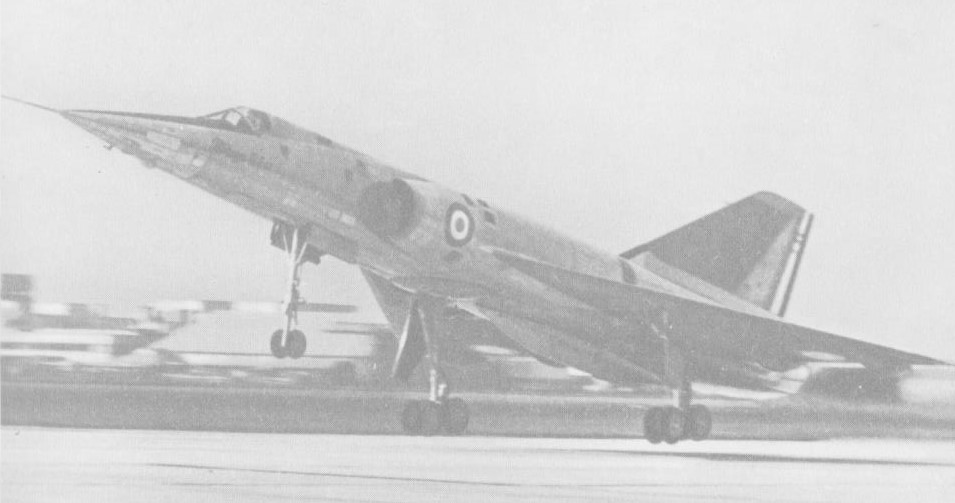
In 1954 the French Government elected to create their own nuclear deterrent force. Development of a launch platform for the weapons was headed by Dassault with a requirement for a long-range high-speed mission to be met. Basically a scaled-up Mirage III, the project redesign considered many changes in size and powerplant, but the solution was found with inflight-refuelling.
The first Dassault Mirage IVA prototype flew on 17 June 1959, then powered by two 13,225 lb / 6000kg SNECMA Atar 09 augmented turbojets. On its 14th test flight during July1959 it reached Mach 1.9, and attained Mach 2 on its 33rd flight. The prototype set up an international speed record of 1132 mph over a 620 mile circuit in 1960.
Mirage IV prototype
Three pre-production prototypes followed, the first of which flew on 12 October 1961. Powered by a pair of 6400kg Atar 9Cs, this aircraft was larger and more representative of the production Mirage IVA, incorporating a large circular radome under the centre fuselage forward of the semi-recessed nuclear free-fall bomb.
The first of these pre-production aircraft was used for bombing trials and development at Colomb-Bechar; the second similar aircraft was used to develop the navigation and inflight-refuelling systems; and the third, a completely operational model with Atar 9Ks, full equipment including nose-probe for refuelling and armament, flew on 23 January 1963.
The French air force ordered 50 production aircraft for delivery in 1964-5, with a repeat order for a further 12 placed later for the French Air Force’s Force de Frappe.
The useful radius of 1,000 miles (1,610 km) can be extended by in flight refuelling. By 1967 all had entered French Air Force service, each carrying a free fall nuclear bomb under the fuselage.
By 1985, about 50 IV As remain operational. Most deployed as tactical bombers with strategic capability, carrying either a nuclear weapon or 1,000 lb of bombs, although a very small number have been mod strategic reconnaissance aircraft.
The IV A has received in-service modifications permitting it to be used for low level as well as high level bombing missions.
Dassault is converting 18 Mirage IVAs to carry the medium-range air-to-surface (ASMP) nuclear missile as Mirage IVPs. An avionics upgrade, including the fitting of a Thomson-CSF Arcana pulse-¬Doppler radar and dual inertial systems, improved navigation and attack capabilities. The Mirage IVP will also have an improved elec¬tronic warfare system with upgraded jamming pods and chaff dispensers carried on the outer wing pylons. The last of nine Mirage IVA strategic bomber units disbanded in July 1988 with passing of the French nuclear deterrent to silo-based S-3 strategic missiles. However, two units still operate remaining Mirage IVPs (P= Penetration) of 18 upgraded between May 1983 and December 1987 to carry the ASMP medium-range nuclear-tipped air-to-surface missile. Mirage IVPs have Arcana pulse doppler radar, dual inertial navigation systems, a Thomson-CSF Barem self protection jamming pod, a BOZ-100 chaff/flare pod and Thomson-CSF Serval radar warning receivers. Eighteen unconverted Mirage IVAs remained in store.
Production totaled 62 aircraft plus four prototypes.
The Mirage IV was retired from operational service in 2005.
Engine: 2 x SNECMA Atar 09K-50 afterburning turbo¬jet, 15400 lb (7000kg) thrust. Wing span: 38 ft 10.5 in (11.85 m). Length: 77 ft 1 in (23.50 m). Wing area: 840 sq ft (78.0 sq.m). Height: 5.4 m / 17 ft 9 in Empty weight: 14500 kg / 31967 lb Gross weight: 69,665 lb (31,600 kg). Max speed: 1,450 mph (2,335 km/h) at 36000 ft (11 000 m). Cruise speed: 1966 km/h / 1222 mph Ceiling: 20000 m / 65600 ft Range: 2480 km / 1541 miles Range w/max.fuel: 4000 km / 2486 miles Armament: 1 x 60kt nuclear bomb or 7260kg of weapons Crew: 2.
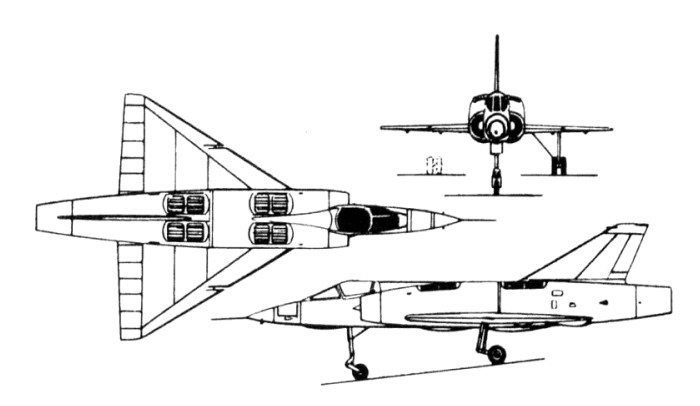
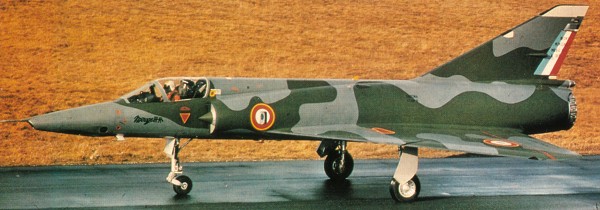
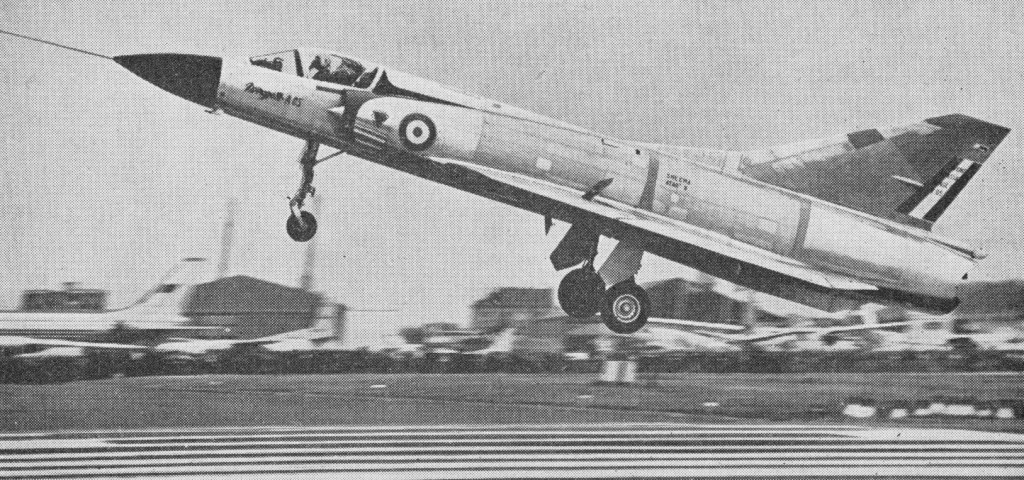
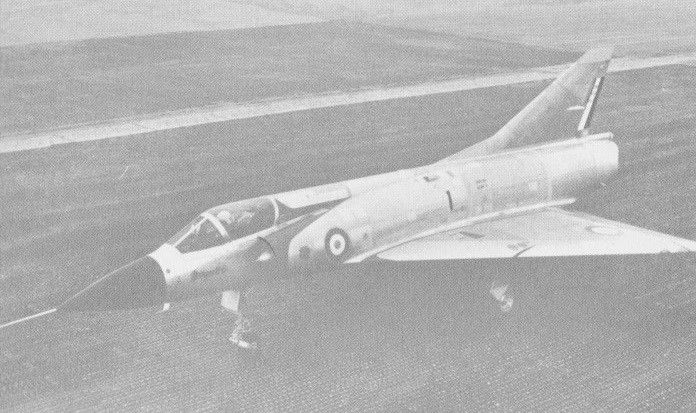
The Dassault Balzac test programme confirmed the viability of the lift/propulsion arrangement, and Dassault moved forward to the Mirage III-V based on the Mirage IIIE strike fighter with its fuselage lengthened to accommodate eight 3525-lb (1600-kg) thrust Rolls-Royce RB.162-1 lift jets.
Evolved to meet the requirements of NBMR (NATO Basic Military Requirement) 3, and the first of two Mirage IIIV-01 prototypes effected its first hovering trial at Melun-Villaroche on 12 February 1965, in a tethered flight later followed by a free flight. The first IIIV was powered by a SNECMA modified Pratt & Whitney JTF10 turbofan redesignated TF-104B and providing (18,520-lb /8401-kg) cruise thrust. The eight RB162 engines mounted in pairs in the centre fuselage. Wing root chord was increased by comparison with that of the non-VTOL Mirage, resulting in compound sweep. Following replacement of the 6300kg TF-104 by the TF-106A3 offering 7600kg, the IIIV effected its first transition to horizontal flight on 24 March 1966 and reached speeds up to M1.35. The second prototype was flown on 22 June 1966. This was powered by an 8400kg TF-30 propulsion turbofan, and side-hinged doors rather than aft-hinged grills covered the lift engines. On 12 September 1966, this second aircraft attained M=2.04 in level flight, but 11 weeks later, on 28 November, it was destroyed in a crash. The development programme was suspended after the loss of the second aircraft, but was finally abandoned in favour of the Mirage Fl, that had been produced to test the armament and propulsion systems for the planned Mirage III-V variant.
Mirage IIIV-01 Engines: 1 x SNECMA modified Pratt & Whitney TF-104B turbofan, 18,520-lb /8401-kg 8 x thrust Rolls-Royce RB.162-1 3525-lb (1600-kg) lift jets Wing span: 28 ft 7.5 in (8.72 m) Length: 59 ft 0.5 in (18 m) Height: 5.55 m / 18 ft 3 in Max TO wt: 29,630 lb (13,440 kg) Empty weight: 10000 kg / 22046 lb
Mirage IIIV-01 Engines: 1 x SNECMA modified Pratt & Whitney TF-106A3 turbofan, 7600-kg 8 x thrust Rolls-Royce RB.162-1 3525-lb (1600-kg) lift jets Wing span: 28 ft 7.5 in (8.72 m) Length: 59 ft 0.5 in (18 m) Height: 5.55 m / 18 ft 3 in Max speed: M1.35
Mirage IIIV-02 Engines: 1 x TF-30 turbofan, 8400kg 8 x thrust Rolls-Royce RB.162-1 3525-lb (1600-kg) lift jets Max speed: M2.04
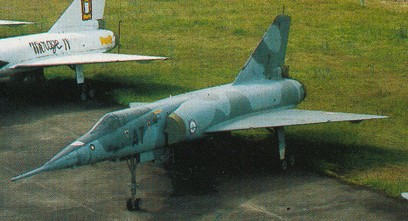
Dassault started work on vertical take-off and landing (VTOL) at the beginning of the 1960s and elected to modify the original Mirage III-001 prototype for VTOL research. This used the cockpit, wings and vertical tail of the Mirage III married to a similar but new fuselage containing a 4850-lb (2200-kg) thrust Bristol Orpheus turbojet for forward propulsion and eight 2160-lb (980-kg) thrust Rolls-Royce RB.108 turbojets mounted vertically for direct lift. These were installed in four groups of two on each side of the centreline fore and aft of the centre of gravity. These lift engines featured retractable intake grilles and the exhausts were covered by fairing doors during normal forward flight.
After tethered hovering trials, the Balzac – as it was renamed – made its first free hovering flight on October 13, 1962 and its first transition on March 18, 1963.
Its career was interrupted by a crash landing on January 10, 1964 but it was subsequently repaired and flew again by the next August. The Balzac provided Dassault with a great deal of information on stabilization in hovering flight and led to the Mirage III-V.
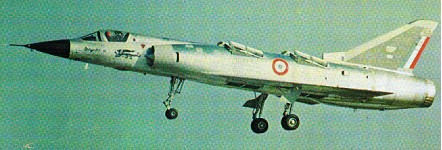
With the Mirage II project abandoned, the Dassault engineers used the preview experience with the MD.550 and designed a bigger aircraft designed later Mirage III-001. Essentially an extrapolation of the Mirage I and retaining the 5% thickness/chord ratio 60° delta wing, the Mirage III was substantially larger and some 30% heavier. The new wing was based on the “area ruling”. It was powered by a SNECMA Atar 101G-1 turbojet with an afterburning thrust of 4400kg and had provision for a 1500kg SEPR 66 rocket. First flown on 17 November 1956, the single seat Mirage III prototype attained Mach=1.52 at 11600m during its sixth flight on 30 January 1957. After the installation of the SEPR rocket motor and introduction of manually-operated half-cones in the air intakes, the speed of Mach=1.8 was reached on 19 September 1957.
To reach Mach 2 modifications were necessary. The wing was redesigned and the aircraft fitted with one SNECMA Atar 9B with 6.000 Kg thrust and the SEPR 841 liquid-fuel rocket motor with 1.689Kg of auxiliary thrust. The new aircraft received the designation Mirage IIIA and 10 units were produced. These were almost two metre longer (6.6 feet) than the Mirage III prototype, had a wing with 17.3% more area and the chord reduced to 4.5%.
Equipped with an SEPR 84, the first Mirage IIIA flew on 12 May 1958, this model eventually attaining Mach=2.2, and the tenth and last joined the test programme on 15 December 1959. The aircraft were fitted with Thompson-CSF Cyrano Ibis air intercept radar, operational avionics, and a drag chute to shorten landing roll. The Mirage IIIA was the first European aircraft to exceed Mach 2 in level flight. A number of prototypes of the Mirage IIIA single seat interceptor were demonstrated at the 1959 Paris Air Show.
5th prototype of Armée de l’Air initial production series
One pre-series Mirage IIIA was fitted with a 7258kg Rolls-Royce Avon 67 as the prototype Mirage IIIO for Australian evaluation and first flew on 13 February 1961.
The Mirage IIIA led to the Mirage IIIC and followed by its training and conversion version, the two-place Mirage IIIB.
Mirage IIIC
Almost identically to the Mirage IIIA, the C version was almost half meter (1.6 feet) longer and was fitted with the SNECMA Atar 9B-3 turbojet engine with 6200 kg thrust, featuring an “eyelet” style variable exhaust, and a SEPR 841 rocket. The armament was two 30mm cannons DEFA fitted in the belly with the gun ports under the air intakes. Early Mirage IIIC production had three stores pylons, one under the fuselage and one under each wing, but a second outboard pylon was added to each wing, for a total of five. The outboard pylon was intended to carry an AAM missile. With a delta wing of 60 deg 34 sec sweep-back, the first example of the IIIC flew on 9 October 1960. A small air-brake is fitted above and below each wing near the leading edge. The tricycle undercarriage, with a single wheel on each unit, the mains retract inwards into the fuselage and nose-wheel retracts rearward.
In total, 95 Mirage IIICs and 64 Mirage IIIBs were ordered by the Armée de L’Air, with the deliveries beginning in July 1961. The type was also exported to Switzerland (one IIICS); South Africa (16 IIICZ) and Israel (72 IIICJ). The Armée de L’Air used his IIICs until 1988, when the last operational aircrafts where retired.
The Mirage IIIB two-seat trainer had the fuselage lengthened 23.6in over pre-production IIUA. Power was a 13,225 lb Atar 9B plus the 3700 lb auxiliary SEPR 841 rocket.
Mirage IIIB
In 1964 Switzerland, to offset unexpectedly high costs of modifying Mirage III-C it was buying from France, was to settle for 57 aircraft instead of 100 on original order. Because of special radar equipment specified by Swiss defense officials for inclusion in its III-C’s to be assembled in Switzerland, per unit costs had risen 60% over the original estimate of $200 million. Curtailment of order will keep the total outlay at approximately initial budget figures.
In 1967 the Israelis used their Mirage IIICJ fighters against his neighbour’s enemies on the “Six-Day War”. On the morning of June 5, 1967, the Heyl Ha` Avir (Israeli Air Force) performed pre-emptive strikes on the Syrian, Egyptian and Jordanian air forces, destroying aircraft on the ground with cannon fire and breaking up runways with French “runway dibber” bombs.
In December 1982, 19 Mirage IIICJs, all re-engined with Atar 9C turbojets, were transferred from Israel to Argentina where some remained in service in the early 1990s as the last of the IIIC sub-type of the Mirage.
Mirage III DS
With the Mirage IIIC in production, Dassault was also considering a multirole / strike variant of the aircraft, which materialised as the Mirage IIIE. The most obviously difference of the Mirage IIIE from the IIIC is an extension of 30 cm (1 foot) on the forward fuselage, increasing the size of the avionics bay behind the cockpit. The fuel capacity was also increased as the Mirage IIIC had marginal range and improvements were needed. Visually, the bottom edge of the canopy on a Mirage IIIE ends directly above the top lip of the air intake, while on the IIIC it ends visibly back of the lip. The Mirage IIIE received the Thompson-CSF Cyrano II dual mode air / ground radar; a radar warning receiver (RWR) system with the antennas mounted in the tailfin; and an Atar 09C engine, with an afterburning thrust of 60.8 kN (6,200 kgp) with a petal-style variable exhaust. Armament is twin 30 mm DEFA-552 cannon, and five stores pylons, with a total store capacity of 4.000 kg. The first of three prototypes flew on April 1, 1961. Depending on its variant, many Mirage IIIE were also fitted with a Marconi continuous-wave Doppler navigation radar radome on the bottom of the fuselage, under the cockpit. Optional equipment was a HF antenna that was fitted as a forward extension to the tailfin. On some Mirages, the leading edge of the tailfin was a straight line, while on those with the HF antenna the leading edge had a sloping extension forward. The Armée de L’Air received its first Mirage IIIEs on 14 January 1964, and a total of 192 aircrafts entered in French service while 331 more aircraft were exported. The customers were Argentina, Brazil, Lebanon, Pakistan, South Africa, Spain, and Venezuela.
The Australian version, designated Mirage IIIO, was based on the French IIIE and incorporated 178 engineering changes to the aircraft, though most were of a minor nature. Two versions delivered to the RAAF were the IIIO(F) primarily for the intercept role, and the IIIO(A) for the attack task. Dassault supplied two pattern IIIO(F) aircraft (A3-1 & 2), the first of which flew on 14 March 1963 in France. After shipment to Australia it first flew in Australian airspace at Avalon in January 1964. A3-3 to A3-8 were also built in France but assembled in Australia, A3-3 taking to the air in November 1963. A3-9 & A3-15 were supplied with decreasing amounts of French componentry with A3-16 onward being regarded as Australian built. Some mid-production Mirage IIIOs had French built fuselages, due mainly to union problems at the Government Aircraft Factory (GAF) delaying production. The 100th and last Mirage IIIO was delivered to the RAAF in December 1968. 16 Mirage IIID (A3-101 to A3-116) dual seat combat proficiency trainers were also delivered between 1963 and 1974. The Mirage IIIO entered squadron service with the RAAF in August 1965 with 75 Squadron at Williamtown NSW. 76 Squadron took delivery of its first Mirages in September 1966, 3 Squadron & 77 Squadron both taking delivery in February 1979 and finally 79 Squadron being equipped in 1986. The Mirage was the first supersonic aircraft to serve with the RAAF and was the replacement for the Sabre as the service’s front line fighter. Mirages operated from bases at Williamtown, Darwin and Butterworth (Malaysia). The introduction of the F/A-18 Hornet in1985 marked the beginning of the end of the Mirage in RAAF service, and by 1988 only 2 squadrons were still so equipped, 75 Squadron at Darwin and 79 Squadron at Butterworth. The last official flight by a RAAF Mirage was on 8th February 1989 when A3-101 was flown to Woomera in SA to be put into storage. All IIIO(F) aircraft were converted to IIIO(A) configuration 1967-79 and were finally withdrawn from service in 1988, the 50 surviving examples being procured by Pakistan in 1990.
After acquiring a single Mirage IIIC for trials, Switzerland built 36 Mirage IIIS interceptors (plus 18 IIIRS reconnaissance aircraft), these entering service in 1966 with the Flugwaffe, and, in the early ‘nineties, the 30 surviving IIIS fighters were being rotated through an upgrade programme (including the provision of canards) at Emmen.
Switzerland, after considering the Grumman F-11F to update its air force, decided on the Mirage IIIC, primarily because of lower cost. But the sought to incorporate F-11F radar systems in Mirages built in Switzerland. Costs originally estimated at less than $200 million for 100 Mirage III-C had by August 1964 costs had risen to well over $300 million, with the first plane not yet delivered.
Exports by Dassault were: Argentina (17 IIIEAs), Brazil (20 IIIEBRs), Lebanon (10 IIIELs), Pakistan (18 IIIEPs), South Africa (17 IIIEZs), Spain (24 IIIEEs) and Venezuela (10 IIIEVs). The Brazilian IIIEBRs, ordered in 1970, were upgraded with canards, pressure refuelling, etc, from 1989, and the total quoted includes four ex-Armee de l’Air delivered in 1988 in the upgraded configuration. The South African IIIEZs were rebuilt to Cheetah EZ standard by Atlas Aircraft. In 1989, Dassault Aviation offered an upgrade of ex-Armee de l’Air aircraft as the Mirage IIIEX, this having canards, flight refuelling capability and a lengthened nose.
Responding to Israeli suggestions, Dassault-Breguet produced a simplified (and cheaper) version of the Mirage III, designated Mirage 5, making its first flight on 19 May 1967 using the same airframe and power plant as the Mirage IIIE. Optimized for visual ground attack and interception, the aircraft lacked several features including the Cyrano II nose-mounted radar (replaced by a simple radar rangefinder) and other avionics. Retaining Mach 2 performance and the ability to operate from semi-prepared strips, the Mirage 5 emerged with certain enhancement, such as greater range, easier maintenance and seven weapon attachment points beneath its fuselage and wings with a 4000kg weapon capability. No sooner had this simplification been achieved, and the first of many orders booked, than the process began of developing a family of aircraft based on the Mirage 5 and incorporating various degrees of sophistication according to customer preference The Mirage 5 was evolved initially to meet an Israeli requirement, but 50 aircraft originally ordered for Israel’s Defence Force/Air Force were, in the event, absorbed by France’s Armee de l’Air (as Mirage 5Fs). After the camera-nosed Mirage 5R and two-seat Mirage 5D trainer came versions equipped with SAGEM inertial navigation and nav/attack systems incorporating a head-up display and the choice of Aida II radar and an air-to-surface laser ranger or Agave multi-purpose radar. These options produced a plethora of sub-marks, such as the Egyptian Mirage 5E2 which incorporate the nav/attack system of the Alpha jet MS2.
Customers for the single-seat fighter version of the Mirage 5 were: Abu Dhabi (12 5ADs and 14 5EADs), Belgium (63 5BAs), Colombia (14 5COAs), Egypt (51 5SDEs and 16 5E2s), Gabon (three 5Gs and four 5G2s), Libya (53 5Ds and 32 5DEs), Pakistan (28 5PAs and 30 5PA2s and 5PA3s), Peru (32 5Ps and 5P3s), Venezuela (four 5Vs) and Zaire (14 5Ms). The equipment fit of the Mirage 5s varied widely, according to customer requirements, the Mirage 5E, (eg, 5DE and 5SDE), for example, having a similar equipment standard to that of the Mirage IIIE.
Mirage 5-BA, May 1987
The Egyptian government ordered 16 Mirage 5SDEs for 1983 delivery, supplementing 28 5SDEs and two-seat 5DDEs, and thirty-eight IIIs in the 1981 Egyptian inventory.
Ten Mirage 5Ps were transferred to Argentina from Peru in June 1982, and production of an essentially similar aircraft was undertaken during 1970-72 in Israel as the IAI Nesher. Total production of the Mirage 5 (including tactical reconnaissance and two-seat training versions) amounted to 531 aircraft.
Deriving its designation from its SNECMA Atar 9K-50 engine, the Mirage 50 retained the basic airframe of the Mirage III and 5, and the prototype – previously that of the Milan – was flown on 15 April 1975. Apart from the engine, providing an afterburning thrust of 7200kg, the Mirage 50 introduced revised air intakes to cater for this engine’s greater mass flow and some equipment repositioning to allow for the 160kg engine weight penalty. By comparison with earlier first-generation Mirage deltas, the Mirage 50 offered a 15% decrease in take-off distance, a 35% improvement in initial climb, an improved ceiling and enhanced manoeuvrability. With a built-in armament of two 30mm cannon, it was suited for air superiority missions with dogfight missiles, air patrol and supersonic interception, and ground attack combined with self-defence capability. It was offered with Agave or Cyrano IVM multi-function radar and it could carry the full range of operational stores developed for the Mirage III and 5. Also becoming available were the non-radar Mirage 50FC and radar-equipped Mirage 50C delivered to Chile. The first customer for the Mirage 50 was Chile which ordered 14 (plus two two-seat trainers). The first eight supplied in 1980 as Mirage 50FGs were, in fact, refurbished and re-engined ex-Armee de l’Air Mirage 5Fs. The remaining six single-seaters which followed in 1982-83 were new-build Mirage 50CHs, these and the earlier 50FCs being upgraded as ENAER Panteras in the early ‘nineties. During 1990, Dassault initiated the upgrading of Venezuela’s surviving 10 Mirage IIIEVs and 5Vs to Mirage 50EV standard, six new-build 50EVs (plus one two-seat 50DV) for Venezuela bringing production of the first-generation Mirage delta to an end in 1991 with 1,422 aircraft delivered. Models offered by Dassault included the Mirage 3-50 and Mirage 5-50 versions of the Mirage III and Mirage 5, both of which are powered by Atar 9K-50 engines.
Evolved from the Mirage IIIE, the Mirage IIIR first flew in prototype form on 31 October 1961.
Like most photographic/reconnaissance derivatives of fighter aircraft, the Mirage IIIR has a redesigned nose section, deletion of the Cyrano II fire-control radar permitting the installation of up to five (forward, downward and sideways-looking) cameras for day or night operation. To permit armed reconnaissance missions to be undertaken, the Mirage IIIR can be equipped with two 30-mm DEFA cannon, and it is also able to carry various types of ordnance underwing, the pilot being provided with a reflector gun sight and low-altitude bombing system equipment to assist in weapons delivery,
Production aircraft began to replace the Republic RF-84F Thunderflash in Armee de l’Air service at Strasbourg during 1963, all three escadrons of the parent wing eventually converting by the mid-1960s,
Mirage IIIR
On 14 June 1963 Jacqueline Auriol set the ladies’ 100km closed-course speed record at 1259.25 mph in a standard production IIIR, powered by an Atar 9C engine.
An initial batch of 50 aircraft was acquired by the French air force, these later joined by 20 examples of the Mirage IIIRD, this latter variant featuring a number of detail changes over the original production model, such as an improved navigation radar. These aircraft were progressively replaced by the newer Mirage F.1CR. In addition to those aircraft acquired for service with the French air force, reconnaissance models of the Mirage have found favour overseas, close to 100 being built for the export market. These include variants of the Mirage IIIR for Pakistan (13 Mirage IIIRP aircraft), South Africa (eight Mirage IIIRZ aircraft) and Switzerland (18 Mirage IIIRS aircraft) plus numerous examples of reconnaissance-configured Mirage 5s, the latter being a simplified Mirage intended specifically for export. Customers for the Mirage 5R include Abu Dhabi, Belgium, Colombia, Egypt, Gabon and Libya which between them have taken delivery of approximately 50 aircraft.
The prototype Mirage IIING (Nouvelle Generation) flew on December 21, 1982. Based on the standard Mirage 111/5/50 airframe, it is fitted with fixed intake-mounted canards, swept wing-leading-edge extensions, fly-by-wire flight controls, and an Atar 9K50 engine. The weapons systems comprises a Cyrano IV or Agave radar, INS, and a headup display. The fly-by-wire control system was derived from that of the Mirage 2000, plus provision for in-flight refuelling, a SNECMA Atar 9K-50 turbojet affording a full afterburning thrust of 7200kg. The maximum take-off weight was increased by comparison with the Mirage IIIE or 5, four lateral stores stations were introduced on the fuselage, and performance improvements included (by comparison with the IIIE) a 20-25% gain in take-off distance, 40% in time to altitude, a 3050m increase in supersonic ceiling, a three-minute improvement in intercept time and comparably impressive gains in acceleration, instantaneous turn rate and combat air patrol time. No production order was placed for the Mirage 3 NG and only one prototype was tested.
Israel developed some local variants of the Mirage 5, the IAI Nesher and the IAI KfirC2 and C7.
Mirage IIIB Engine: SNECMA Atar 9B-3 turbojet, 6200 kg and SEPR 841 rocket. Seats: 2 Armament: two 30mm cannons DEFA Pylons: 3 later 5
Mirage III BS Engine: SNECMA Atar 09 C3, 41693 N / 4250 kp Length: 50.525 ft / 15.4 m Height: 14.764 ft / 4.5 m Wingspan: 26.969 ft / 8.22 m Wing area: 374.587 sq.ft / 34.8 sq.m Max take off weight: 23814.0 lb / 10800.0 kg Weight empty: 14332.5 lb / 6500.0 kg Max. weight carried: 9481.5 lb / 4300.0 kg Max. speed: 1296 kts / 2400 km/h Initial climb rate: 12992.13 ft/min / 66.0 m/s Service ceiling: 59055 ft / 18000 m Wing load: 63.55 lb/sq.ft / 310.0 kg/sq.m Range: 1080 nm / 2000 km Endurance: 1 h Crew: 2
Mirage III C Engine: SNECMA Atar 09B, 41693 N / 4250 kp Length: 48.556 ft / 14.8 m Height: 14.108 ft / 4.3 m Wingspan: 26.969 ft / 8.22 m Wing area: 374.587 sq.ft / 34.8 sq.m Max take off weight: 25357.5 lb / 11500.0 kg Weight empty: 13759.2 lb / 6240.0 kg Max. weight carried: 11598.3 lb / 5260.0 kg Max. speed: 1296 kts / 2400 km/h Initial climb rate: 12992.13 ft/min / 66.0 m/s Service ceiling: 59055 ft / 18000 m Wing load: 67.65 lb/sq.ft / 330.0 kg/sq.m Range: 648 nm / 1200 km Endurance: 1 h Crew: 1 Armament: 2 MK 30mm DEFA 552, 2 AIM9 Sidewinder, 1 Matra R530 / 1800kg Bomb
Mirage IIIC Engine: SNECMA Atar 09C, 14,110 lb.s.t w/reheat Wingspan: 27 ft Wing area: 374.587 sq.ft / 34.8 sq.m Length: 43 ft 10 in Height: 14 ft 8 in Weight empty: 13550 lb Max take off weight: 27,700 lb Max. speed: 1420 mph / M2.15 at 35,000 ft Range:939 mi Wheel track: 10 ft 10 in Wheelbase: 15 ft 9 in Armament: 2 MK 30mm DEFA 552, 2 AIM9 Sidewinder Bomb Load: 1 Matra R530 / 1800kg Bomb Crew: 1
Mirage IIICJ re-engined with Atar 9C turbojets
Mirage III DS Powerplant: 1 × SNECMA Atar 09C turbojet Dry thrust: 41.97 kN (9,436 lbf) Thrust with afterburner: 60.80 kN (13,668 lbf) Wingspan: 8.22 m (26 ft 11⅝ in) Wing area: 34.85 m² (375 ft²) Length: 15.03 m (49 ft 3½ in) Height: 4.50 m (14 ft 9 in) Empty weight: 7,050 kg (15,600 lb) Loaded weight: 9,600 kg (21,164 lb) Max. takeoff weight: 13,700 kg (30,203 lb) Maximum speed: Mach 2.2 (2,350 km/h, 1,268 knots, 1,460 mph) at 12,000 m (39,370 ft) Combat radius: 1,200 km (647 nmi, 746 mi) Ferry range: 4,000 km (2,152 nmi, 2,486 mi) Service ceiling: 17,000 m (55,775 ft) Rate of climb: 83 m/s+ (16,405 ft/min) Crew: 1
Mirage IIIE Engine: Atar 09C engine 6200-kg (13,668-1b) afterburning thrust Wing span: 26 ft 11.5 in (8.22 m) Length: 15.03 m / 49 ft 4 in Height: 4.25 m / 13 ft 11 in Wing area: 34.85 sq.m / 375.12 sq ft Max take-off weight: 13700 kg / 30203 lb Empty weight: 7050 kg / 15543 lb Max speed: Mach 2.2 / 2350 km/h / 1460 mph Range: 2400 km / 1491 miles Armament: 2 x 30 mm DEFA-552 cannon Hardpoints: 5 External load: 4000 kg
Mirage IIIO Engine: One SNECMA Atar 9C turbojet, 13,670 lb Thrust: 9,430lbs (dry) : 13,670lbs (reheat) Wing span: 26′ 11.5″ (8.22 metres) Length: 49′ 3.5″ (15.03 metres) Height: 14′ 9″ (4.50 metres) Empty weight: 15,450 lb (7,049 kg) Max loaded weight: 30,200 lb (13,699 kg) Max speed (sea level): mach 1.14 (760 knots/1,390 km/h) Max speed (36,000 ft): mach 2.2 (1,269 knots/2,350 km/h) Service ceiling: 55,755 ft (16,994 metres) Combat radius: 647nm (1200 km)
Mirage IIIR Engine: one SNECMA Atar 9C turbojet, 6200-kg (13,670-1b) afterburning Maximum speed at sea level 1390 km/h (863 mph) or Mach 1.14 Maximum speed at altitude 2350 km/h (1,460 mph) or Mach 2.2 Range clean condition 1600 km (1,000 miles) Ferry range external fuel 4000 km (2,485 mile) Empty weight 6600 kg (14,550 lb) Maximum take-off 13500 kg (29,760 lbs) Wingspan 8.22 m (27 ft 0 in) Length 15.50 m (50 ft 10¼ in) Height 4.25 m (13 ft 11 ½ in) Wing area: 35.00 sq.m (377 sq.ft) Armament: two 30-mm DEFA cannon
Mirage 5 Max take-off weight: 13700 kg / 30203 lb Loaded weight: 7150 kg / 15763 lb Wingspan: 8.22 m / 26 ft 12 in Length: 15.56 m / 51 ft 1 in Height: 4.25 m / 13 ft 11 in Wing area: 34.85 sq.m / 375.12 sq ft Max. speed: 2335 km/h / 1451 mph Range: 2500 km / 1553 miles
Mirage 50 Engine: 1 x SNECMA Atar 9K-50 turbojet, 7200kg Max take-off weight: 13700 kg / 30203 lb Loaded weight: 7150 kg / 15763 lb Wingspan: 8.22 m / 26 ft 12 in Length: 15.56 m / 51 ft 1 in Height: 4.5 m / 14 ft 9 in Wing area: 35 sq.m / 376.74 sq ft Max. speed: 2.2M Ceiling: 18000 m / 59050 ft Range: 1300 km / 808 miles Armament: 2 x 30mm cannon
Mirage 50DV two-seat
Mirage 3-50 Engine: 1 x SNECMA Atar 9K-50 turbojet
Mirage 5-50 Engine: one 7200-kg (15, 873-1b) thrust SNECMA Atar 9K-50 afterburning turbojet. Wing span 8,22 m (27 ft 0 in) Length 15. 56 m (51 ft ½ in) Height 4.50 m (14 ft 9 in) Wing area 35.00 sq.m (376,7 sq ft) Maximum speed 2350 km/h (1,460 mph) or Mach 2,2 at altitude Maximum speed 1390 km/h (863 mph) or Mach 1.13 at sea level Initial climb rate 11100 m (36,415 ft) per minute Service ceiling 18000 m (59,055 ft) Combat radius lo-lo-lo with 800 kg (1,764 lb) bomb: 630 km (391 miles) Empty weight: 7150 kg (15,763 lb) Normal take-off, clean: 9900 kg (21,825 lb) Maximum take-off: 13700 kg (30,203 lb) Armament: two 30-mm DEFA cannon (with 125 rpg) in fuselage five weapon pylons for 4000 kg (8,818 lb)
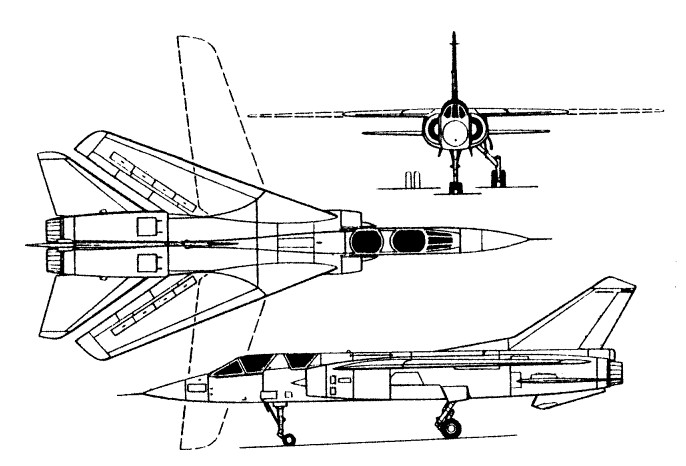
On 13 October 1965, Avions Marcel Dassault received a contract to design and build one prototype of a two-seat variable-geometry fighter, the Mirage G, embarking on a low budget swing wing prototype. In May 1967 the company pulled out of a two year partnership with the British Aircraft Corporation aimed at producing a joint Anglo French swing-¬wing combat aircraft the so called AFVG. Political difficulties had arisen over the design leadership, which the French had originally agreed to give the British in exchange for their partnership in the Jaguar supersonic strike/trainer. Powered by a single SNECMA (Pratt & Whitney) TF-306E turbofan rated at 9300kg with afterburning and owing much to the design of the Mirage F2, wing sweepback could be varied between 23 degrees and 70 degrees.
One of the main reasons for the delay in the first flight of the Mirage G prototype was a re-examination of tailplane strength and flutter characteristics following the loss of the Mirage F.1 prototype in May 1967.
The Mirage G was first flown on 18 November 1967, maximum sweep being achieved in flight within a week of the commencement of trials and a speed of M=2.1 being attained within two months. Trials were to continue until 13 January 1971, when the Mirage G was lost in an accident, 400 hours of flying having been accumulated in 316 flights. In 1968 two additional prototypes had been ordered, these being powered by two 7200kg SNECMA Atar 9K-50 turbojets. After a succession of designation changes, these emerged as Mirage G8s, the two-seat first prototype flying on 8 May 1971, and the single-seat second prototype following on 13 July 1972. The Mirage G8 was envisaged as a multi-role fighter and was fitted with Cyrano IV multi-purpose radar, a low-altitude nav/ attack system, a laser rangefinder, Doppler radar and a bombing computer. The Armee de l’Air concluded that the disadvantages of variable-geometry outweighed its advantages, and after study of a fixed-geometry version with 55 degrees of sweepback (Mirage F8), further development was discontinued.
Mirage G Engine: 1 x SNECMA (Pratt & Whitney) TF-306E turbofan, 9300kg Wing sweep: 23-70 degrees Seats: 1
Mirage G8 Engines: 2 x SNECMA Atar 9K-50 turbojets, 7200kg / 15,875 lb Wing span: 42 ft 8 in (13 m). Length: 55 ft 1 in (16.8 m). Height: 17 ft 6.5 in (5.35 m). Wing area: 37.0 sq.m / 398.26 sq ft Max TO wt: 44,092 lb (20,000 kg). Max level speed: M2.5. Seats: 1-2
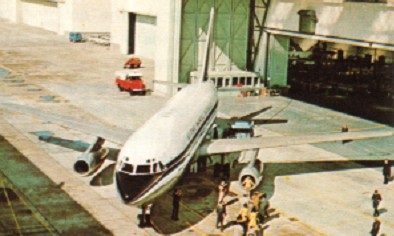
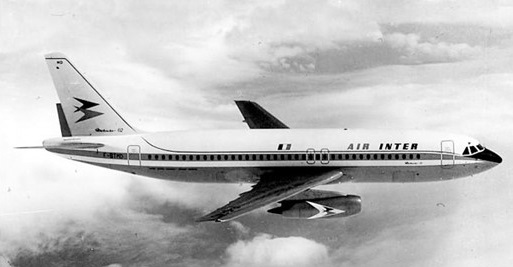
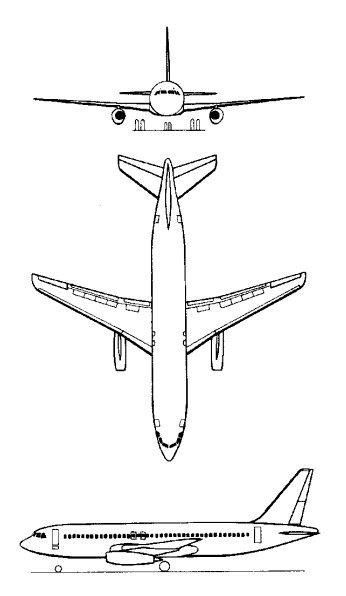
The early sales success of its Mystere-Falcon 20 series led Dassault to investigate the market prospects for a new short-range airliner. Known as the Dassault Mercure, and generally similar in size and external configuration to the Boeing 737, Dassault aircraft was of low-wing monoplane configuration with a circular-section pressurised fuselage providing accommodation for 120-150 passengers, or a maximum of 162 in a high-density arrangement. The tail unit was conventional, and the tricycle landing gear had twin wheels on each unit. Like the Model 737 the Mercure had two Pratt & Whitney JT8D turbofans, these being of the Dash-15 series which was one of the options available for the Model 737. The cost of launching the project was beyond the resources of Dassault, but the company was to obtain from the French government loan support to 56% of the estimated initial cost of 1,000 million francs. Dassault put in 14% of the total, the balance coming from risk-sharing partners. The initial prototype Mercure (F-WTCC) flew for the first time on 28 May 1971 powered by two Pratt & Whitney JT8D-11 engines, each of 6804kg thrust, the last three letters of this specially chosen registration representing Transport Court-Courrier (short-range transport). The second prototype (F-WTMD), flown on 7 September 1972, had more powerful JT8D-15s.
Production began after the receipt of an order for 10 aircraft from Air Inter, a French domestic airline, on 29 January 1972. Delivered in May 1974, the first aircraft went into service on 4 June 1974 and the 10th in December 1975.
Ten years later, in April 1985, the second prototype was refurbished and added to the Air Inter fleet. Designated the Mercure 100, the 156-passenger airliners, operated with an annual subsidy from the French government to offset the extremely high cost of spares. The Mercure 200 higher capacity version seating 186 passengers and powered by SNECMA CFM56 turbofan engines was projected but did not proceed.
Dassault Mercure Engine: 2 x Pratt & Whitney JT8D-15 turbofans, 68974 N / 7031kg Wingspan: 30.56 m / 100 ft 3 in Length: 34.84 m / 114 ft 4 in Height: 11.37 m / 37 ft 4 in Wing area: 116.0 sq.m / 1248.61 sq ft Max take off weight: 124582.5 lb / 56500.0 kg Empty weight: 31800 kg / 70107 lb Max. speed: 513 kts / 950 km/h Cruise speed: 858 km/h / 533 mph Range: 594 nm / 1100 km Range w/max.payload: 756 km / 470 miles Crew: 3+162
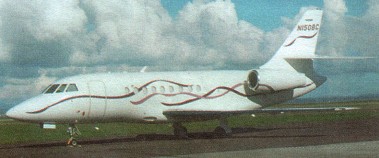
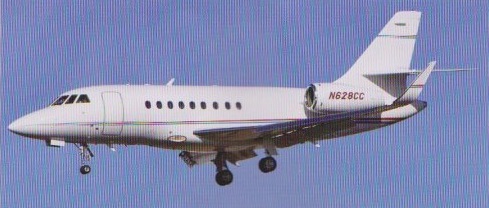
The Falcon 2000 derived from the Falcon 900, but was designed as a smaller transcontinental jet with a reduction in range. That factor allowed Dassault to remove one engine, and make the Falcon 2000 more economical to operate and maintain. Its two remaining engines were developed in partnership with General Electric and Allied Signal specifically for the new jet design.
First flew in March 1993, with 3815 lbs of additional fuel, the 2000EX has a range of 3800 sm.
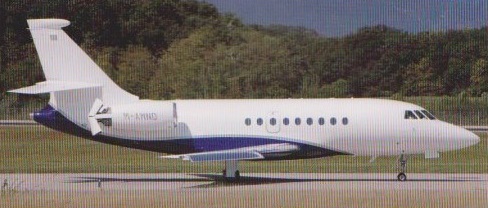
Dassault Falcon 2000E M-AMND
Falcon 2000 Engine: 2 x General Electric / Garrett CFE 738 1-1B, 25467 N / 2596 kp Length: 66.371 ft / 20.23 m Height: 23.163 ft / 7.06 m Wingspan: 63.419 ft / 19.33 m Wing area: 527.651 sq.ft / 49.020 sq.m Max take off weight: 35809.2 lb / 16240.0 kg Weight empty: 20738.0 lb / 9405.0 kg Cruising speed: 488 kts / 903 km/h Initial climb rate: 3425.20 ft/min / 17.40 m/s Service ceiling: 46916 ft / 14300 m Cruising altitude: 39009 ft / 11890 m Wing load: 67.86 lb/sq.ft / 331.0 kg/sq.m Range: 2999 nm / 5555 km Range (max. weight): 999 nm / 1850 km Crew: 2 Payload: 8-19pax
The Dassault Falcon 900 tri-jet was announced in May 1983, initially as the Mystere-Falcon 900, to compete with the Challenger and Gulfstream long-range corporate jets. Roll-out of the prototype took place in May 1984 and the first (F-WIDE) was first flown on 21 September 1984, from Bordeaux-Merignac. With a similar configuration to the smaller Falcon 50, the 900 has a wider cabin which can seat up to 19 passengers (three abreast) over transcontinental ranges. The three engines are 4,500 lb st (20 kN) Garrett TFE731-5AR-1C turbofans which give a cruising speed of 500 kts; (927 km/h) at 27,000 ft (8 230 m). To demonstrate its even more improved long range capability, in 1985, Dassault flew a prototype of the Falcon 900 non-stop from Paris to Little Rock, Arkansas. DGAC and FAA certification followed in March 1986 and the first customer delivery made in December 1986. A number of governments have bought Falcon 900s for VIP use including France, Nigeria, Malaysia, Spain and Australia. In September 1987 the Japanese Maritime Safety Agency ordered two specially-adapted long-range maritime surveillance versions of the Falcon 900 fitted with an operations control station, special communications equipment, observation hatches and sonobuoy, marker and flare dropping chutes. The aircraft entered service in September 1989. Eighty-three had been delivered by the beginning of 1990, all but two for export.
Falcon 900B
In 1991, the Falcon 900B became the standard production model, with an increase in power and range. The model B was upgraded to the model C in 2000, and the Falcon 900EX in 2004. The primary changes offered more sophisticated avionics.
Falcon 900 YK-ASC
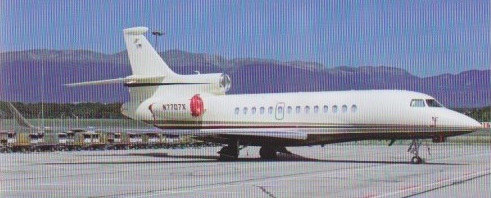
The Dassault Archange electronic reconnaissance aircraft for the French Aerospace Forces has taken to the skies for the first time. The aircraft is being developed jointly by Dassault Aviation, the developer and manufacturer, and Thales France, the company responsible for the supply of electronic systems. The basis for the future electronic reconnaissance aircraft is the Falcon 8X civilian aircraft, which made its maiden flight on July 25, 2025 from Bordeaux-Mérignac Airport.
Dassault Aviation Falcon 8X ‘ARCHANGE’.
The aircraft is to fill the gap created by the decommissioning of the C160 Gabriel aircraft, which were used for such missions as part of the 1/54 Dunkerque squadron and were withdrawn from service in 2022. The delivery of the Archange aircraft is expected to take place between 2026 and 2028.
Falcon 900 Engines: 3 x Garrett TFE731-5AR turbofans, 2041kg / 4500 lb each Wingspan: 19.33 m / 63 ft 5 in Length: 20.21 m / 66 ft 4 in Height: 7.55 m / 24 ft 9 in Wing area: 49.0 sq.m / 527.43 sq ft Max take-off weight: 20640 kg / 45504 lb Empty weight: 10240 kg / 22575 lb Empty wt equipped: 22,575 lbs Cruise speed: 927 km/h / 576 mph Economical cruise: M0.75 Ceiling: 15500 m / 50850 ft Range: 7840 km / 4872 miles Range, max payload: 3460nm Crew: 2. Capacity: max 18 pax.
900B Engines: 3 x 4750 lb Garrett TFE731-5B.
Falcon 900 C Engine: 3 x AlliedSignal TFE 731 5AR, 19620 N / 2000 kp Length: 66.273 ft / 20.2 m Height: 24.934 ft / 7.6 m Wingspan: 63.32 ft / 19.3 m Wing area: 527.436 sq.ft / 49.0 sq.m Max take off weight: 45511.2 lb / 20640.0 kg Weight empty: 22424.9 lb / 10170.0 kg Max. weight carried: 23086.4 lb / 10470.0 kg Max. speed: 491 kts / 910 km/h Landing speed: 79 kts / 147 km/h Cruising speed: 448 kts / 830 km/h Initial climb rate: 5905.51 ft/min / 30.0 m/s Service ceiling: 51017 ft / 15550 m Wing load: 86.31 lb/sq.ft / 421.0 kg/sq.m Range: 3780 nm / 7000 km Crew: 2 Payload: 19pax
Falcon 900EX Engines: 3 x 5,000-lb. Allied Signal TFE731-60 turbofans Gross weight: 48,300 lb Empty weight: 23,875 lb Max cruise: Mach 0.80. Range: 3,840-4,500 nm. Ceiling: 51,000 ft Seats: 8-15.




 All Aero