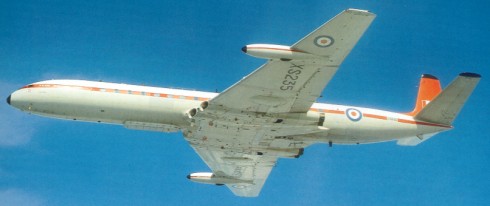
de Havilland DH 106 Comet / Nimrod

Comet 4C

The Comet resulted from the wartime Brabazon Committee’s recommendations for the Type IV North Atlantic turbojet mail plane, which led to numerous studies including a 20-passenger aircraft with three rear-mounted Goblin engines.
The final design emerged as an orthodox low-wing monoplane with 20 degree leading-edge sweep-back and four 19.8kN de Havilland Ghost centrifugal-flow turbojets buried in the wing roots. Initial accommodation was for 36 passengers in two cabins, pressurised to provide internal pressure equivalent to 2,438m when flying at 12,192m. Cruising speed was about 788km/h.

DH 106 Comet Article

The prototype Comet made its first flight on 27 July 1949.
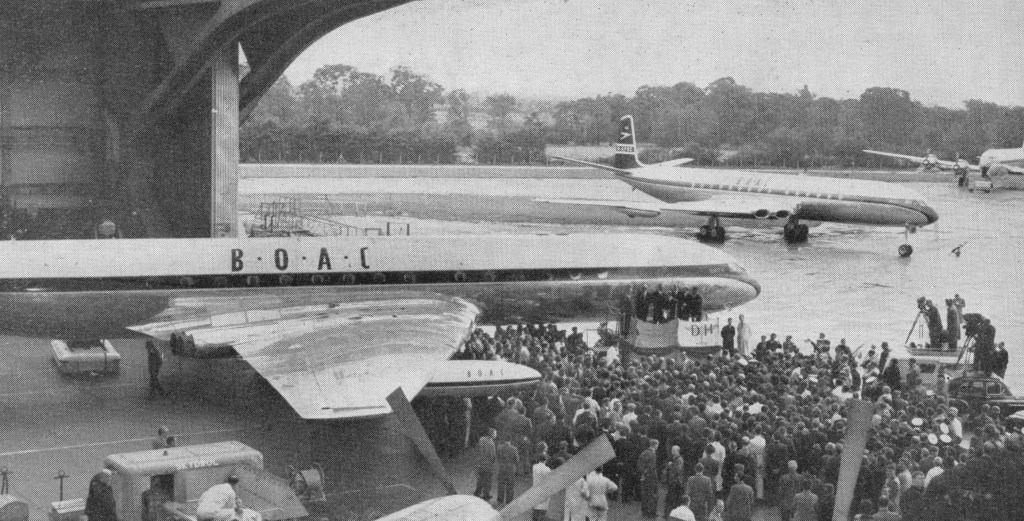
The first two BOAC Comet 4C delivered to London Airport from Hadfield, 30 September 1958

BOAC received a fleet of ten Comet Is and on 2 May 1952 inaugurated the first passenger services to be operated by turbojet aircraft – on the London-Johannesburg route, covering the 10,821km in 23 hr 34 min. Comets were subsequently introduced on a number of routes, bringing drastic cuts in journey time: such as the reduction from 86 to 33 1/4 hours between London and Tokyo. Air France and UAT soon began Comet services and there were a number of airline orders for Comet 1s when one broke up near Calcutta exactly a year after its introduction; in January and April 1954 two more suffered inflight structural failure, resulting in the type being withdrawn.
In October 1952, a Comet broke up in flight near Calcutta. Modifications were made, but when, on April 8, 1954, the fifth Comet accident occurred, all Comets were withdrawn from service and production was halted.

Salvage and careful investigations showed that fatigue failure of the cabin was the cause of the crashes, and the fuselage was redesigned. Painstaking detective work by scientists and engineers had established that the Comet ls had suffered metal fatigue, causing explosive decompression of the pressurized fuselage.

DH COMET SITUATION – Flight 7 May 1954


A great deal of structural knowledge was gained through the accidents of four of the original nine Comet I models. This knowledge was later tested on the model 3 and applied to the model 4.
The Avon-powered Comet 2s on order for BOAC were strengthened and some delivered to the RAF.

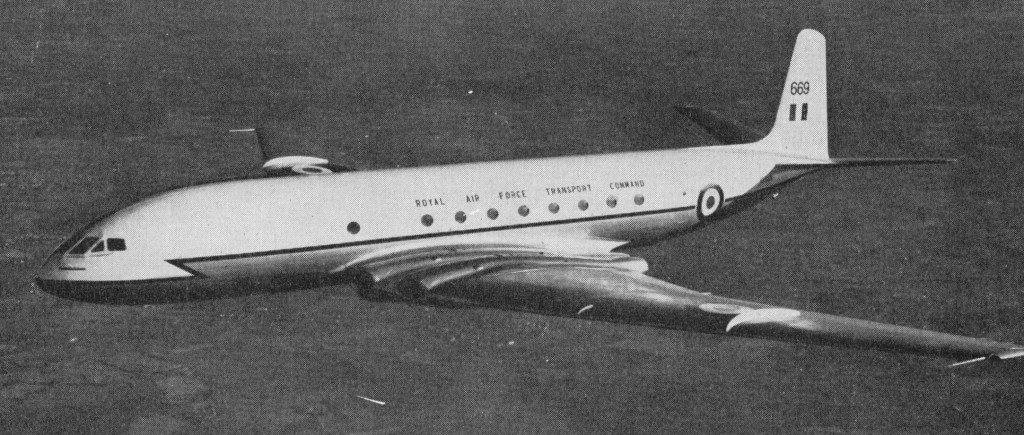
No.216 squadron of RAF Transport Command was equipped with Comet 2 from 1956 in order to operate a courier service between Britain and the Long-range Weapons Establishment at Woomera, Australia. Operated with full C of A, they were modified and powered by Rolls-Royce Avon 117/118 turbojets.
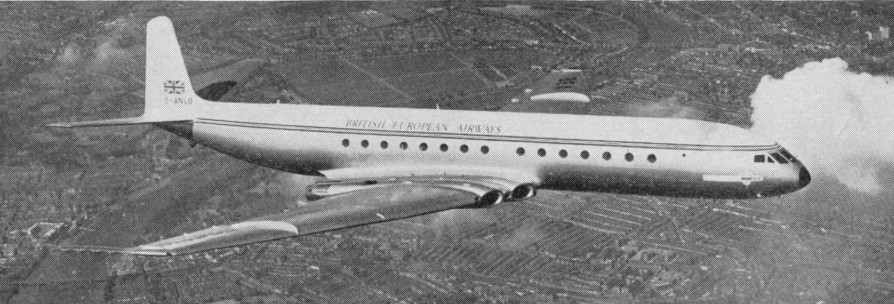
A longer-fuselage long-range Comet 3 had been developed and in the light of the inquiry into the Comet 1s disasters it was redesigned, first flying on 19 July 1954. It did not go into production but made a round-the-world flight and served as a test vehicle.
Comet 3B

Most of the flight tests for the Comet 4 were conducted on the one and only Comet 3 built by Hawker.

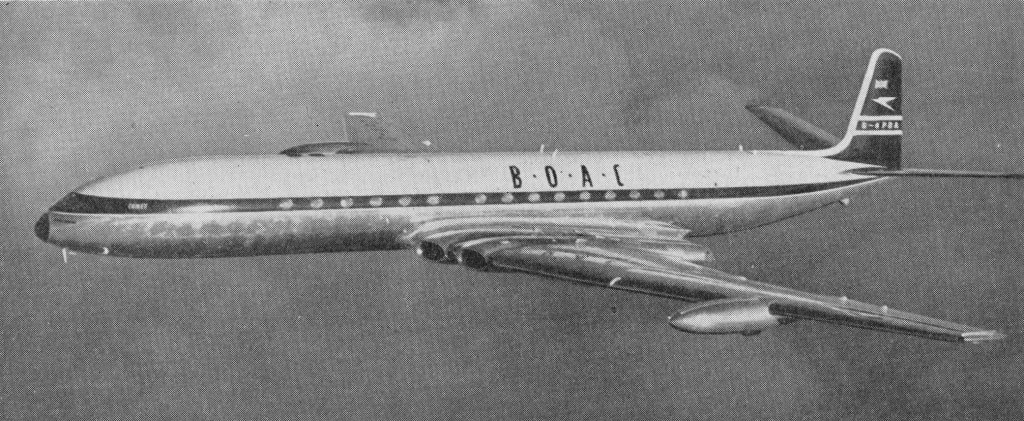
In 1957 it was decided that Comets would be reinstated and BOAC ordered 19 Comet 4s. These were powered by 46.71kN Rolls-Royce Avon 524, had longer fuselages than the Comet 1 and could carry 60-81 passengers. The first Comet 4 flew on 27 April 1958 and on 4 October BOAC Comets inaugurated North Atlantic jet services over the London-New York route when Comet 4s of BOAC (G APDB and G APDC) made simultaneous crossings in opposite directions. BOAC bought 19 larger, more powerful Comet 4s, and successfully operated the first London/New York jet service from 1958. On 1 April 1959 Comets were put back on the London-Tokyo route.
First BOAC Comet 4

It was a long range version of the basic Comet design and was recognized by the projection of the two-pod fuel tanks on the leading edge of each wing. Following the model 4, the Comet 4B was produced for intermediate-range flights carrying a high-density passenger load.
The model C-2 was a military cargo airplane and was structurally far superior to the original Comet 1.

Comet C4

Transport Command’s Comet 4 took 76 passengers, the C2 44 and the Comet T2s, which were often pressed into service could carry 36.

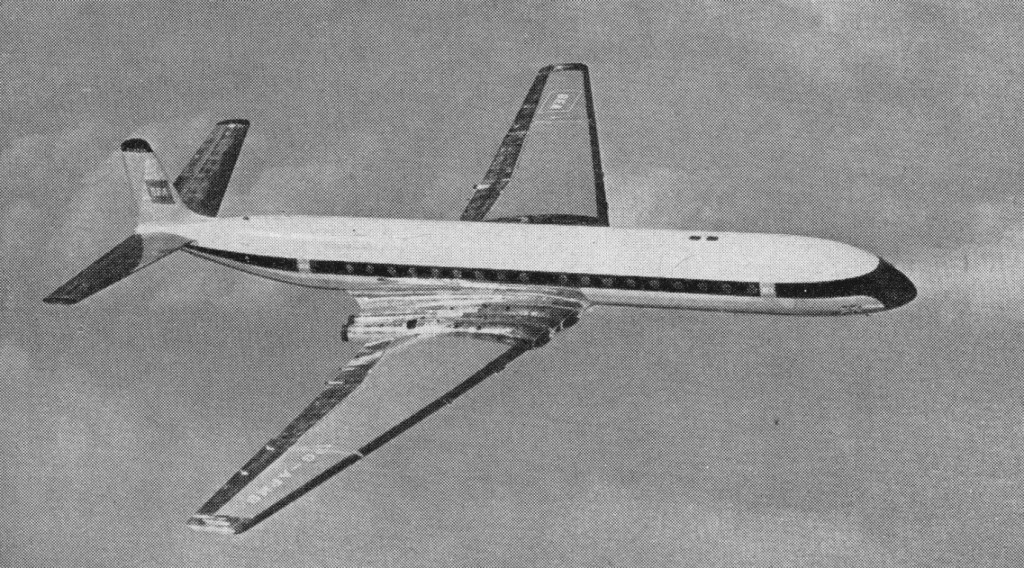
From that time Comets took over much of BOAC’s network. Other Comet 4s were used by Aerolineas Argentinas, East African Airways and the RAF. From this version were developed the Comet 4B and 4C which first flew on 27 June and 31 October 1959 respectively. The Comet 4B had a 1.98m increase in fuselage length, a 2.13m reduction in span and was intended for high-speed operation over shorter stages. It could carry up to 101 passengers and was not fitted with wing-mounted external fuel tanks. The main operators of Comet 4B were British European Airways and Olympic Airways.

Characteristics of the Comet 4B used by BEA were the longer fuselage and the shorter wing, without the external nacelle fuel tanks, when compared with the BOAC Comet 4. Olympic Airways also started operating the Comet 4B during 1960.
Comet 4B

The Comet 4C combined the long fuselage of the Comet 4B with the standard Comet 4 wing. This version was ordered by several airlines and went into service in 1960. A total of 112 Comets were built including 74 Series 4 aircraft; and the type was subsequently developed into the RAF Nimrod.

The DH Comet was designed and built all 113 of them over 15 years at Hatfield.

The HS.801 Nimrod was originally designed by Hawker-Siddeley, but was also a product of BAE Systems. First flying on 23 May 1967, the Nimrod serves the RAF in two variants: the R1 variant in a reconnaissance and electronic intelligence gathering capacity (ELINT), and the MR2 variant in the Maritime Reconnaissance role.

Test Flying the Nimrod


Ordered by the RAF to replace the Shackleton MR.Mk.3s, the Nimrod is said to have begun in June 1964 when Hawker Siddeley at Woodford began work on the HS.801. Its true origin is in the de Havilland Comet, two Nimrod prototypes were made from unsold Comet Mk.4C airframes, with many changes involved in producing a maritime reconnaissance version. The second prototype (XV148) was converted to HS.801 standard, four Rolls-Royce RB.168 turbofans replacing the Comet’s original four R-R Avons. Its maiden flight was on 23 May 1967, with the second, Avon-powered, aircraft flying two months later.

In mid-1965 a contract to build 38 Nimrod MR.Mk.Is was placed, and the first flew at Woodford on 28 June 1968. All were built as new airframes and delivered by September 1972, although a further eight were completed three years later. In service with RAF Strike Command since late 1969, the Nimrod MR.1 is based on the airframe of the Comet 4C Main difference are a power plant of four Spey turbofan. In addition of an unpressurised pannier beneath the pressurised main fuselage to house the operational equipment and weapons; and modified tail design incorporating an ECM pod and MAD stinger.
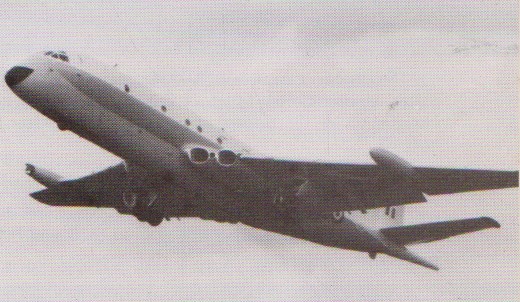
Nimrod MR.1

DH Nimrod Article October 1967

Subsequent plans were to upgrade 35 aircraft to Mk.II standard (by the installation of new communication systems and advanced tactical sensors), with 11 for the new AEW Mk.3 programme, and the last of the Mk.IIs was completed in 1985. The conversion added some 6000 lbs to the empty weight, and external signs of change were a reduction in cabin windows, new intakes and ducts around the rear fuselage. Other MR.2 modifications include the provision of in-flight refuelling probes, Harpoon anti-shipping missiles, and AIM-9 Sidewinder AAMs for self-defence. Loral early-warning support measures pods (EWSM) are mounted on the wing tips, and minor airframe changes have been made, comprising the introduction of larger finlets to the tailplanes and a new ventral fin. The Nimrod R.1 is a specialised Elint variant.
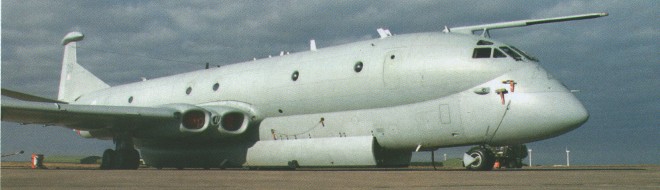
Nimrod MR.2

The AEW.3 conversion programme was scrapped in 1986 after the con¬version of eleven Nimrods at a cost of around NZ$2,700 million.
The UK Ministry of Defence decided drop the Nimrod AEW.3 project in favour of Boeing E-3A Sentry purchase. The planned Nimrod AEW.3 was a conversion of an MR.1 airframe to accept an AEW mission system comprising radar, IFF, ESM, and datalink.
Nimrod R Mk2 – The RAF has three of these specially-equipped versions of the MR Nimrod to fulfil its requirement for long-range electronic reconnaissance missions.
The next changes came in 1982 with the Falklands War, when the Nimrods were required to operate up to 6440 km from their advance base at Ascension Island and carry the Marconi Stingray torpedo, 1000 lb bombs and the AGM-84A Harpoon anti-ship missile. Even air-to-air armament was added in the form of AIM-9G Sidewinders. Another large installation was an inflight refuelling probe to extend its endurance up to 19 hours, which saw large hoses laid over the floor inside the cabin. Placed under the floor when the conflict ended, this gave the Nimrod Mk.IIP code. At the same time GPS was installed in RAF aircraft. The AEW version was plagued with problems and never entered service, being placed in outside storage.
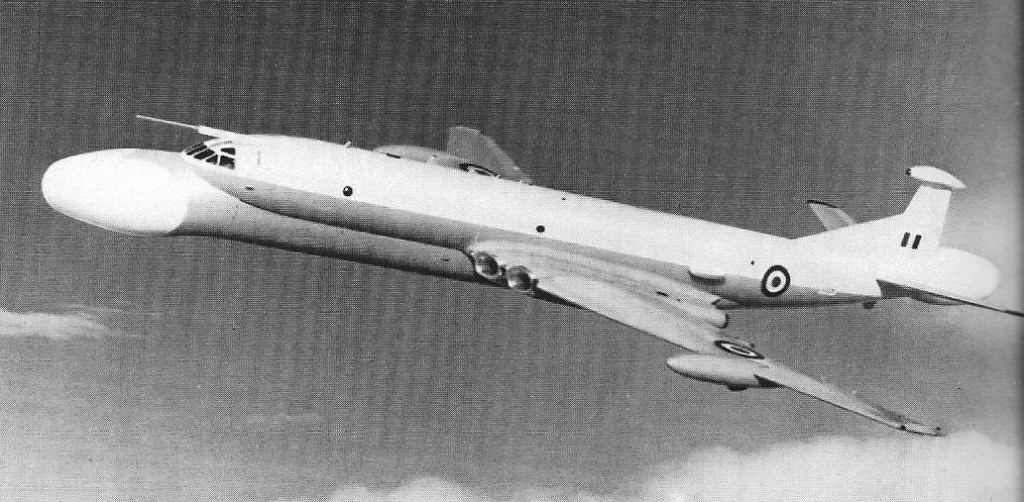
Models offered up four additional hardpoints externally to field even more potent air-to-surface missiles and
mine dispensing munitions. Crew accommodations vary per model. The MRA.Mk 4 (or “Nimrod 2000”) can house a base flight crew of two personnel along with 7 specialists in designated roles. Additionally, up to 13 relief crew members can be carried aboard for extended flights. The Nimrod MRA.4 can operate a 15 hours of endurance time.

Gallery

Comet 1
Engines: 4 x Ghost 50 turbojets, 4,450 lb. (2,020 kg.) thrust.
Range loaded with res: 2,030 sm.
Capacity payload: 14,000 lb.
Fuel cap: 7,050 Imp.G.
Max range with res: 2,610 sm.
Length 93 ft. (28.35 m.)
Wing span 115 ft. (35 m.)
Weight 105,000 lb. (45,540 kg.)
Pax cap: 36 44.
Max cruise speed: 490 m.p.h. (790 km.p.h.).
Cruise alt: 35,000 ft. (11,000 km.) fully loaded.
Range: 1,750 miles (2,800 km.).

De Havilland DH 106 Comet 1 A
Engines: 4 x DeHavilland Ghost 50 Mk 2, 22249 N / 2268 kp
Length: 93.012 ft / 28.35 m
Wingspan: 114.993 ft / 35.05 m
Max take off weight: 115021.6 lb / 52164.0 kg
Max. speed: 459 kts / 850 km/h
Range: 1728 nm / 3200 km
Crew: 3
Payload: 44 pax

Comet 2
Engines: 4 x Avon turbojets.
Range loaded with res: 2,610 sm.
Capacity payload: 14,000 lb.
Fuel cap: 7,050 Imp.G.
Max range with res: 3,700 sm.
Block speed: 444 mph.

Comet 4
Engines: 4 x RR Avon RA.29, 10,500 lb.
Wing span: 115 ft 0 in (35 m).
Length: 111 ft 6 in (33.99 m).
Height: 28 ft 4.5 in (8.65 m).
Max TO wt: 152,500 lb (69,235 kg).
Max level speed: 500 mph ( 800 kph).
Cruise speed 489 mph

Engines: 4 x Rolls-Royce Avon 525B, 46.7kN
Max take-off weight: 73482 kg / 162001 lb
Empty weight: 36430 kg / 80315 lb
Wingspan: 35.0 m / 114 ft 10 in
Length: 36.0 m / 118 ft 1 in
Height: 9.0 m / 29 ft 6 in
Wing area: 197.0 sq.m / 2120.49 sq ft
Cruise speed: 865 km/h / 538 mph
Ceiling: 10000 m / 32800 ft
Range w/max.fuel: 6700 km / 4163 miles
Range w/max.payload: 5350 km / 3324 miles
Crew: 4
Passengers: 72-102

Nimrod MR.1
Engines: Four 11,500 lb (5 217 kg) st Rolls Royce RB.168 Spey turbofan. ¬
Wingspan: 114 ft 10 in (35.0m).
Length: 126 ft 9 in (38.63m).
Wing area: 2121 sq.ft (197.0 sq.m).
Height: 29 ft 8.5 in (9.01 m).
Max TO wt: 192,000 lb (87090 kg).
Max cruising speed: over 500 mph (805 kph).
Max endurance: 12-14 hr.
Crew: 12.
Max level speed: 575 mph (926 kph).

Nimrod MR.2
Engine: 4 x R-R Spey 250 turbofan.
Installed thrust: 216 kN.
Span: 35 m.
Length: 38.6 m.
Wing area: 197 sq.m.
Empty wt: 39,000 kg.
MTOW: 80,500 kg.
Warload: 6100 kg.
Max speed: 930 kph.
Ceiling: 13,000 m.
T/O run: 1460 m.
Ldg run: 1620 m.
Fuel internal: 48,780 lt (+8590 lt).
Endurance: 12+ hr.
Air refuel: Yes.
Armament: Stingray torpedo or AGM-84 Harpoon.

Nimrod Mk.IIP
Engines: 4 x Rolls-Royce RB.168-20 Spey Mk.250 turbofans, 12,140 lb.
Span: 114 ft 10 in (35 m).
Length: 129 ft (39.31 m).
Empty wt: 86,000 lbs (39,009 kg).
MTOW: 192,000 lbs (87,090 kg).
Max speed: 500 kt.
Service ceiling: 42,000 ft.
Max Op alt: 37,000 ft.
Normal transit speed: 425 kts.
Ferry range: 9254 miles.
Endurance: 12 hr.
Crew: 13.

BAe / Hawker Siddeley Nimrod MRA.4
Engines: 4 x Rolls-Royce BR710 Mk 101 turbofan, 15,500lbs / 66218 N / 6750 kp thrust
Length: 126.74ft (38.63m)
Wingspan: 127.00ft (38.71m)
Wing loading: 91.23 lb/sq.ft / 445.00 kg/sq.m
Height: 31.00ft (9.45m)
Wing area: 2538.151 sqft / 235.8 sq.m
Empty Weight: 102,515lbs (46,500kg)
Max take off weight: 231271.4 lb / 104885.0 kg
Fuel capacity: 2959 gal / 11200 lt
Maximum Speed: 575mph (926kmh; 500kts)
Maximum Range: 6,903miles (11,110km)
Service Ceiling: 42,000 ft (12,802m)
Endurance: 15 h
Accommodation: 9 + 13
Hardpoints: 4
Payload: max 5500kg
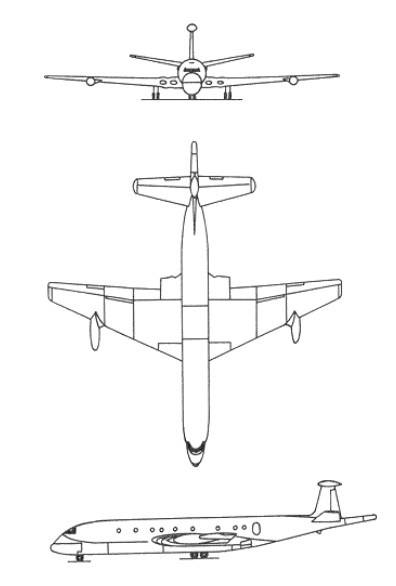
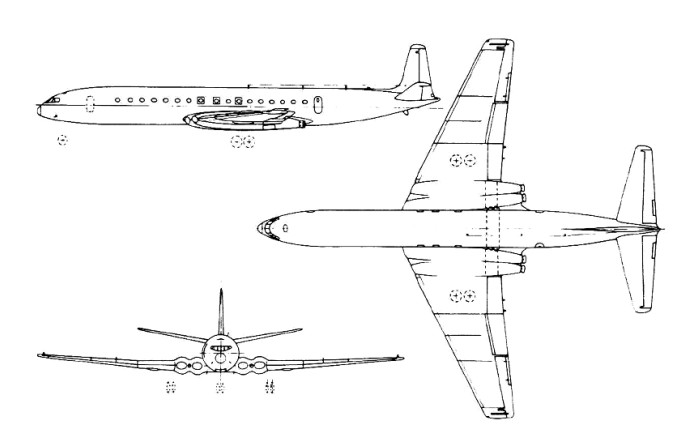
Nimrod
DH-106 Comet

de Havilland DH 100 Vampire / Sea Vampire / Sud-Est SE 530 / 535 Mistral

Vampire FB.6

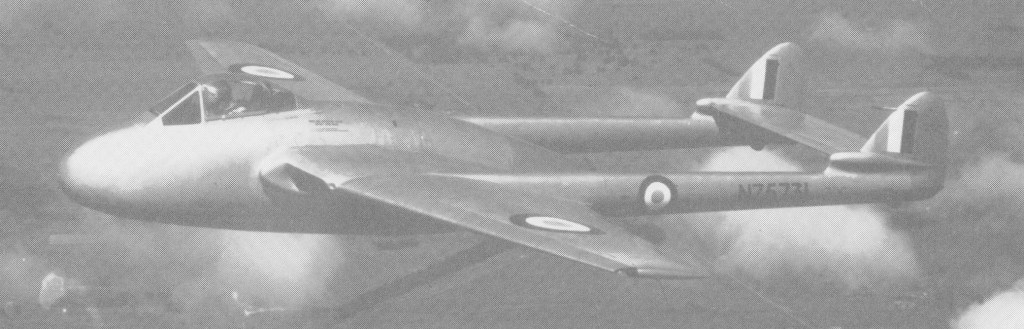
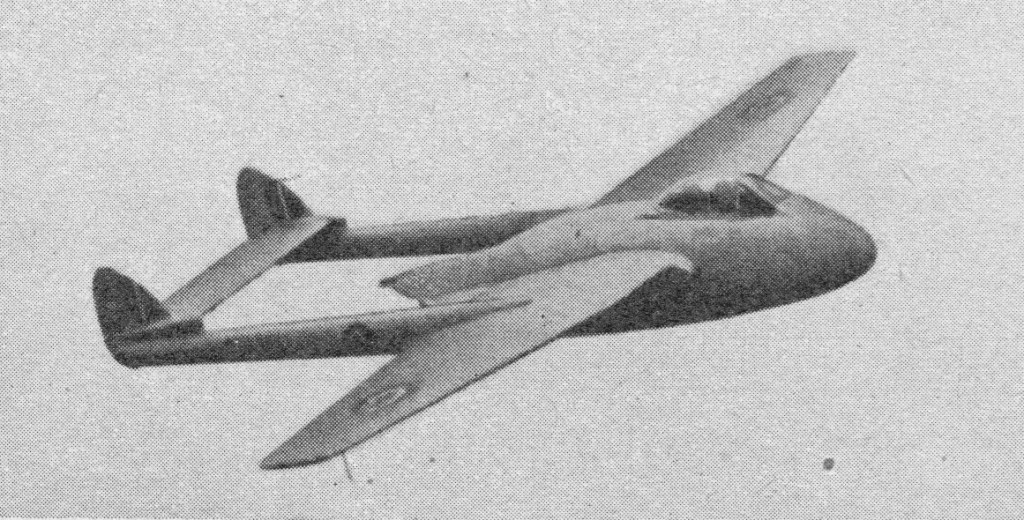
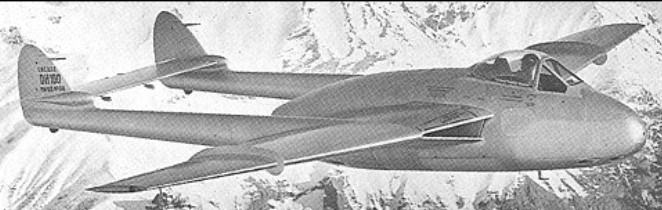
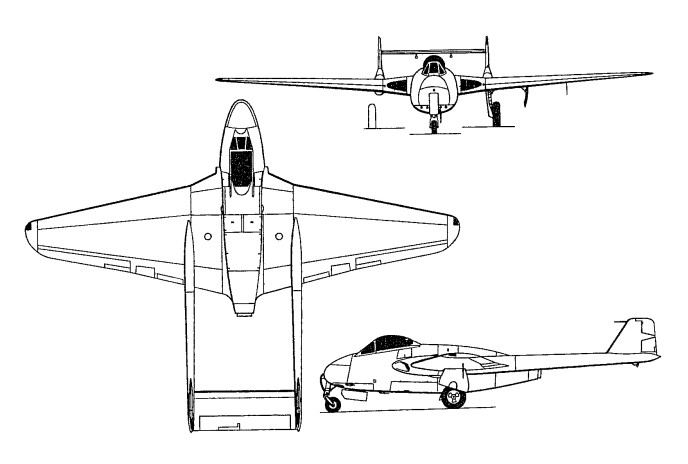
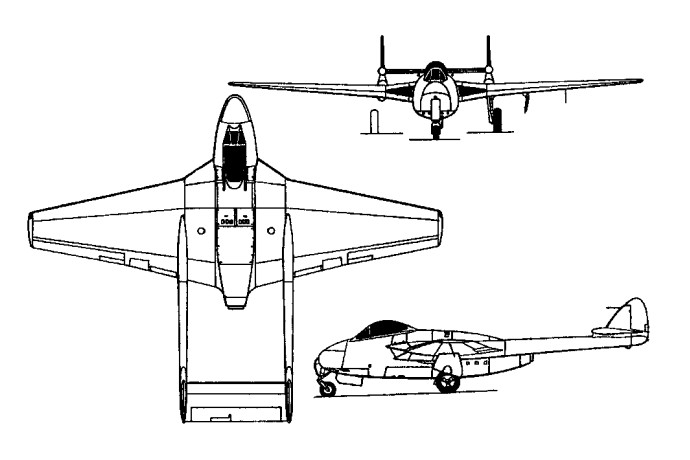
The design began in 1941, to satisfy Air Ministry Specification E.6/41 for an interceptor fighter to be powered by the then-developing Halford-designed de Havilland H-1 Goblin turbojet of 2,700 lb St (1 226 kgp), the twin-boom configuration of this aircraft was virtually dictated by the chosen power plant. This was because a single turbojet was to provide the total thrust; as this was very limited in early engines, it was necessary to ensure that power loss from the jet tailpipe was restricted to an absolute minimum by keeping the tailpipe as short as possible.

DH 100 Vampire Article

The first flight of the prototype, made by Geoffrey de Havilland jr, took place at Hatfield in Hertfordshire on 20 September 1943 powered by a 12kN de Havilland Goblin turbojet, just 16 months after the start of design the aircraft (LZ548/G) featuring pointed fins. Two further prototypes (LZ551/G and MP838/G) quickly joined the flight programme, the latter car¬rying the planned armament of four 20 mm Hispano cannon under the nose which, like the Mosquito, was of plywood and balsa construction, the remainder of the aircraft being metal. Like the Mosquito’s fuselage, this was built in two half-shells which were joined top and bottom. The monoplane wing was an all-metal structure, incorporating the engine air intakes in the wing roots, split trailing-edge flaps, air brakes and ailerons. The pilot, was seated well forward in the central nacelle beneath a three-piece canopy (replaced later by a bubble canopy).

The name was changed from Spider Crab to Vam¬pire when on 13 May 1944 a contract for 120 production examples of the Vam¬pire F.Mk 1 (later increased to 300) was placed for manufacture by the English Electric Company, Preston. The first production aircraft (TG274/G), with square cut fins and Goblin turbojet (as the Halford engine was named) was flown at Samlesbury on 20 April 1945, becoming the first British fighter with a speed of over 805 km/h (500 mph). Pre service and handling trials occu¬pied the remainder of 1945, however, and the Vampire saw no operational service during the war.

The first production F.1 Vampire was powered by the same engine as the prototype, as were the next 39 aircraft. Subsequent F.1 had 3,100 lb / 13.8kN Goblin Gn.2 engines and a pressurised cockpit, the first 50 production Vampires lacking this feature. Entering service too late to make a contribution to World War II, the first squadron to operate the Vampire was 247 Squadron at Chilbolton in Hampshire, taking delivery of their first aircraft in March 1946 and becoming operational in April.

Production of the Vampire F Mk I, with 3,100 lb St (1407 kgp) Goblin II, was undertaken by English Electric, which built a total of 174 for the RAF and 70 for Sweden’s Flygvapen, delivered from 1946; Switzerland’s Flugwaffe acquired four Vampire Is for evaluation in 1946 and El Cuerpo de Aviaçion Militar of Dominica acquired 25 from Flygvapnet in 1952. One supplied to RCAF.

In 1948 John Cunningham established an altitude record in the Ghost-Vampire at 59,492 feet.

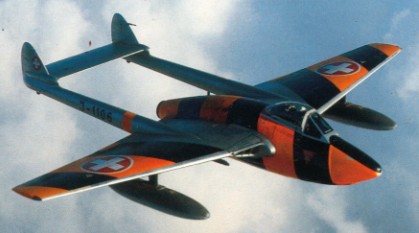
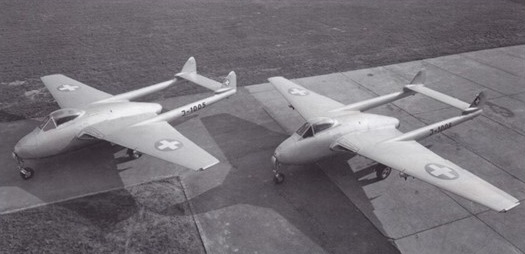
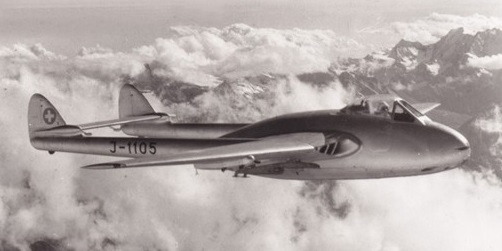
The Vampire 6 was specially evolved to meet Swiss requirements. This variant had clipped wings and powered by a Goblin 3 of 3300 lb thrust. It was designed for combined fighter and ground attack roles.

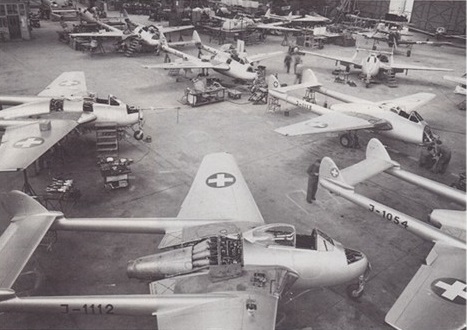
Based on the positive test results achieved with the DH-100 Mk 1, the decision for a new combat aircraft foe the Swiss Air Force was at the end of 1948 and a series of 75 DH-100 MK6s were ordered. In May 1949, the first aircraft were taken over and replaced obsolete Me109 E-1/3 and Morane D-3800/01. All airplanes were flown to Switzerland from Hatfield, England to Emmen without any incidents. The 75 aircraft (J-1005 to J-1079) were delivered in the years 1949 and 1950.

A year later licence production of a second series of 100 aircraft by FFA began. The 100 licence built DH-100 Mk 6 Vampire (J-1101 to J-1200) were in service from 1951 onwards. Until 1960, all vampires were still in operation without Martin Baker’s seats. Against the heat in the summer, due to the insufficient air conditioning, a light flightsuit and white helmets were introduced. At the beginning of the 1960s, the vampires were equipped with a Martin Baker sling seat, an emergency package, a new joystick and a new cabin roof with single glazing.

The DH-100 Mk 6 Vampire were operational from 1949 to 1973, but most aircraft were retired during 1968/1969. In Switzerland, they were in use from 1949 to 1990. On 12th June 1990, the last Vampire at the Emmen airfield were taken out of the pilot school. A respectable number was written off in 1974, but liquidations were still carried out until 1988. From 1953, two-seater (DH-115) were also used.

The Vampire F Mk 3 was similar to the Mk I but carried 100-imp gal (454-l) drop tanks and had a revised tail unit with lower tailplane, rounded rudders and a tailplane/fin acorn fairing. Production by EEC totalled 117 for the RAF and 85 for the RCAF. The RNoAF evaluated four Mk 3s and the Fuerza Aérea Mexicana acquired 15 from the RCAF in 1961. To adapt the Vampire for ground attack duties, de Havilland introduced a strengthened and clipped wing (first flown on a Mk I airframe on 29 June 1948) to produce the FB Mk 5. With the basic airframe of the F Mk 3 and a 3,100 lb st (1 407 kgp) Goblin 2 or 4,400 lb st (1 998 kgp) Goblin 2/2 turbojet, the Vampire FB Mk 5 had a longer-stroke undercarriage and in addition to the four 20-mm British Hispano cannon could carry, on wing strong points inboard and outboard of the booms, eight 60-lb (27-kg) RPs and two 500-lb (227-kg) or two 1,000-lb (454-kg) bombs, or two 200 Imp gal (9091) drop tanks. The first of 888 FB Mk 5s for the RAF flew on 23 June 1948; some of these were diverted either new or secondhand to the RNZAF, SAAF, Armée de lAir, Aeronautica Militare Italiana and the Lebanon Air Force. Specific export versions similar to the FB Mk Shad the 3,350 lb st (1 521 kgp) Goblin 3 and improved performance; these included the FB Mk 50 for Sweden’s Flygvapnet and the FB Mk 52 built for Egypt, Finland, Iraq, India, New Zealand, Norway and Venezuela.

In New Zealand it became the RNZAF’s first jet fighter, with 58 examples serving between 1951 and 1972 before their replacement by the Strikemasters and Skyhawks.

In the early 1950s, De Havilland produced a two-seat night-fighter version, the NF10, and these aircraft formed the backbone of the RAF’s night-fighter force until the arrival of the Meteor NF11. A total of 95 two-seat NF.10 Vampire night-fighters also served in an interim capacity with the RAF from 1951, pending the introduction of Meteor and Venom night fighters.

The T11 trainer version was a development of the NF10 and the type continued in service until well into the 1980s.

The last major variant was the Vampire T.11 two- seat trainer, over 800 of which were built.

The Royal Navy had a small number of F.20 Sea Vampires, generally similar to the RAF’s FB.5, and 74 T.22 two-seat trainers derived from the T.11.

Sea Vampire F.20 1948

Earlier Sea Vampire were hooked Mk.1, and although the F.20 is virtually a hooked Mk.3, the wings have been clipped, and the aircraft modified to full Naval standard.

Foreign licence production comprised 100 FB Mk 6 by FFA in Switzerland; 80 FB Mk 52A by Macchi and Fiat in Italy; 183 by SNCASE in France in addition to 67 assembled from British components and 281 by HAL in India including 34 from imported components.

Production of single-seat Vampires for the RAF ended with 381 FB Mk 9s, essentially a FB.Mk.5 with cockpit air conditioning for Far East service and 3350 lb thrust. Seventeen ex-Swedish FB Mk 50s were transferred to Dominica in 1956, and ex-RAF Mk 9s went to Rhodesia (5), Jordan and Ceylon.

Three Vampire Is were fitted with 4,500 lb St (2043 kgp) Rolls-Royce Nene 1 engines to Specification F. 11/4S for evaluation but no production of the proposed F Mk II to this standard was undertaken in the UK. After further modification by Boulton Paul to enlarge the wing-root air intakes, one of the three Nene-engined aircraft was shipped to Australia to become the pattern aircraft for 57 Vampire F Mk 30s built by de Havilland for the RAAF. With a 5,000 lb st (2270 kgp) Nene 2-VH assembled in Australia by CAC, the first Vampire 30 flew on 29 June 1948, this and subsequent aircraft having the same tail unit as the British Mk 3 and “elephant ear” intakes above the rear fuselage. Twenty-three FB Mk 31s had a similar airframe to that of the RAF’s FB Mk 5, and 28 Mk 30s were converted to the same standard. Two examples in 1951 became F Mk 32s with cockpit air conditioning, as in the British Mk 9, and ejection seats. The Mk T.35 Vampire was licence built at Bankstown during the 1950s for the Royal Australian Air Force and is outwardly identical to the de Havilland T.11 Vampire. One major difference is that the T.35 has hydraulic “maxaret” anti skid brakes compared to the T.11 s pneumatic system, and the engine is slightly different, being a Mk.5 Goblin compared to the Mk.11 engine. The Mk.T.35 was equipped with Martin Baker Mk.IB ejection seats.

On 14 July 1948 six Vampire 3s of No.54 Squadron became the first ever jet aircraft to fly across the Atlantic under their own power.

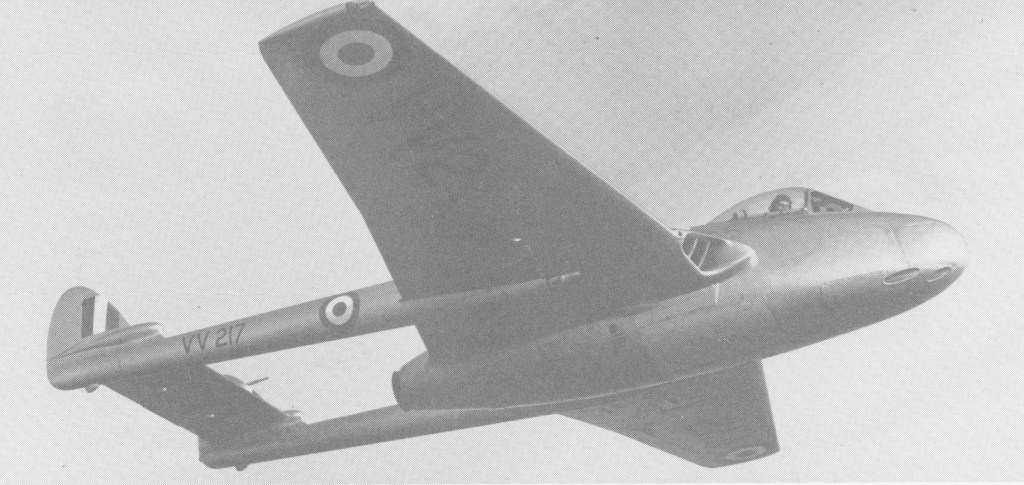
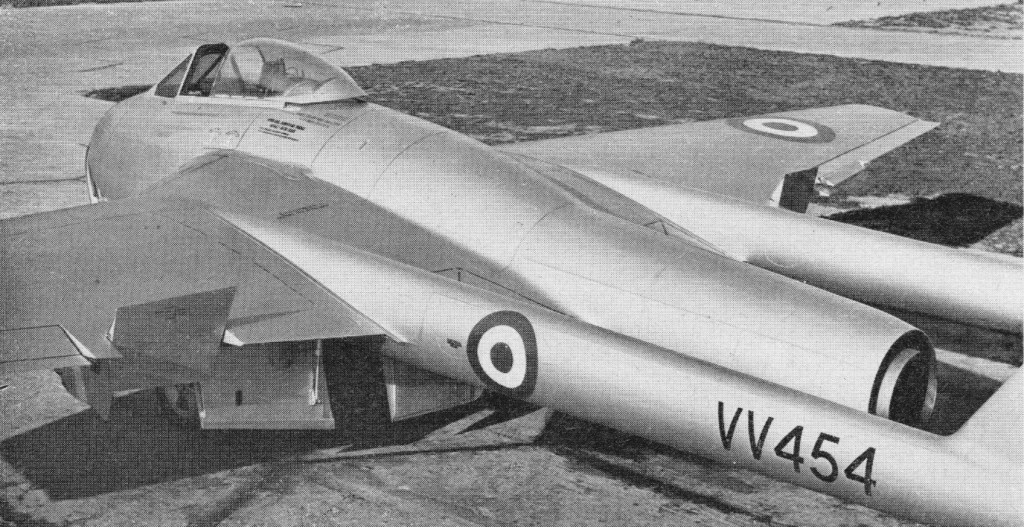
Vampire FB.5 VV454 was fitted with an extended jet pipe to test a reheat (afterburner) system for the Goblin 2, with extended tail bumpers to stop the jet pipe touching the ground.

FB.5 VV454 testing reheat

Only the F. 1, and the Nene powered F.2 (not adopted by the RAF, but later Nene powered aircraft were built under licence in Australia and France, the latter being named Mistral) had the original, squared off style tail. The F.3 had a smaller, more rounded type of a shape that was almost a De Havilland trademark. As for the two seaters: these initially had a tail similar to the F.3, etc, but with taller rudders, latter the acorn fairing was deleted and the fin area increased so it extended forward in a gentle curve. Up to the F.3 the wingtips were rounded, but on the FB.5 fighter-bomber the rounded portion was deleted, the result being a “clipped” wing of slightly reduced span.

After assembling 67 Vampire FB Mk 5 single-seat fighters from British-supplied components and licence-building a further 120 aircraft in their entirety, the Societe Nationale de Constructions Aeronautiques de Sud-Est (SNCASE) began production of a more powerful version of the basic aircraft. Assigned the designation Vampire Mk 53 by the parent company and given the appellation of SE 530 by Sud-Est, this was developed for the Armee de l’Air. It utilised the basic Mk 5 airframe mated with the 2270kg Hispano-built Nene 102, the wing root intakes being enlarged and the split-trunk intake of the Hawker P.1040 being adapted to provide the extra air demanded for the rear face of the Nene’s double-sided impeller. Fuel tankage was increased, cabin pressurisation introduced and the pilot was provided with an SNCASO ejection seat. A pre-series of four aircraft was built, the first of these flying on 1 April 1951. Baptised Mistral, the type entered series production in SE 532 form, the first flying in December 1951 and 97 being built. These were followed by 150 examples of the SE 535, the last of which was delivered on 25 March 1954. The SE 535 was powered by the Nene 104 with similar rating to the Nene 102B of the SE 532, and, in addition to its four 20mm HS 404 cannon, could carry eight T-10 or HVAR rockets, or two 450kg bombs. The Mistral internal fuel tanks in the fuselage and wings can be supplemented by two large underwing tanks. The Mistral entered Armee dl’Air service in 1952 and was finally withdrawn in 1961.

Deck-landing trials with one of the prototype D.H. 100 Vampire fighters began aboard HMS Ocean as early as 3 December 1945, these being the first-ever carrier operations by a pure jet aircraft. Successful trials with two fully-navalised Vampire I conversions led to an order for 30 Sea Vampire F Mk 20s, the first of which flew in October 1948. Armed with four 20-mm cannon and with the basic airframe of the Vampire FB Mk 5, they served primarily in a training role to give Fleet Air Arm pilots jet experience. Six RAE Vampire F Mk 3s were converted to Sea Vampire 21s, with reinforced undersides and armament removed, for use in flexible deck landing trials at RAE Farnborough and on HMS Warrior in 1947-55.
The total built include 804 in UK, fifty in India and 109 in Australia.
The Sea Vampire T.22 land-based pilot trainer was ordered in 1952 by the RAAF. Thirteen were delivered, the first in June 1954 and the last in August 1959.
A total of 85 Vampires were delivered to the RCAF between 1948 and 1950. They were built for the RCAF in a contract dated June 13, 1946, the first aircraft flying on June 3, 1947. Construction of the entire batch was carried out by English Electric at their Preston, Lancashire, plant with test flying undertaken at Samlesbury. They received RCAF numbers 17001 to 17042 and 17044 to 17086. After their retirement, 27 were sold to Fliteways Inc at West Bend, Wisconsin, possibly in early 1958.
The President of Fliteways Ine, Merle C Zuelilke, wanted to introduce these former military jets onto the private market as fast hacks or executive aircraft some had already been sold to private owners. However, the American Federal Aviation Administration (FAA) was not keen on the idea of Cessna/Piper Cub pilots zipping about in jets, and so introduced a number of restrictions. New Vampire F.3 owners suddenly found that they could only register them in the experimental/exhibition category as was the case with N6877D (formerly 17069, constructor’s number EEP 42387) which meant that every flight had to be authorised ahead of time, be made under Visual Flight Rules conditions, and be registered on a flight plan. Intended destinations, be they airports or runways, also had to be approved by an FAA safety agent before a flight could take place. Not surprisingly the FAA killed the market stone dead in the US, leaving Fliteways with a number of Vampires it could not sell.
At about the same time (1960) the Mexican Air Force was looking for a fighter aircraft.
The aircraft were flown to Mexico in groups initially by Minnesota Air National Guard pilots, but this idea was abandoned after the local ANG Commanding Officer suffered an engine blow out in FAM 4 (N6875D, formerly RCAF 17019). This was later repaired at a cost of $9,000 for a new wing, nose landing gear, new engine, electrical system and hydraulic system. It is reported that Mr Leo Geib of West Bend ferried most of the aircraft in Mexico and helped to check out the Mexican pilots. One group of FAM Vampires (FAM 13, FAM 6 and FAM 1) were photographed during their stopover at Love Field, Dallas, Texas in February 1961, as they made their way to Mexico.
It was reported in the Mexican Air Force magazine Anuahuac, that by February 14, 1961, 12 of the 15 Vampires had been delivered to BAM 1 (Base Aerea Militar Military Air Base No 1) at Santa Lucia, outside Mexico City. Eventually all 15 were delivered, but it appears that one was damaged en route at Acapulco, Gueffero repairs to FAM 6 cost $2,000 and required, among other things, new landing gear. Only 14 Vampires were flown operationally, the 15th aircraft was possibly used as a spares source. The number FAM-15 was later allocated to one of the two Mk 11 trainers. The Escuadron Aireo 200 was chosen to receive the Vampires.
One thing that the Escuadron Aireo Jet de Pelea 200 lacked was a suitable training aircraft to convert pilots to the Vampires. By 1962 the Mexican Air Force had acquired two de Havilland Vampire T.11 two seat trainers, one being WZ414 which was the first production Mk 11 to enter service in the RAF in 1952. It had been built by de Havilland at Christchurch and spent some time at the Aeroplane & Armament Experimental Establishment at Boscombe Down and with the Empire Test Pilot School. It was declared a non effective airframe on January 29, 1960 and sold to Shackleton Aviation on January 5, 1962. The other was XD439 (built by de Havilland at Chester) which was delivered to the RAF in 1954, and had once served at the Central Navigation and Control School at Shawbury. It was retired to 19 Maintenance Unit at St Athan on May 11, 1959 and was sold to Shackletons on the same date as WZ414. Their date of arrival in Mexico is not known.
In 1970 fears over safety, grounded the Vampires even the Mk 11 trainers were considered to be unsafe as there were no more stocks of cartridges for their ejection seats. This occurred during the tenure of Gral Brig P A Jose Vergara Ahumada, as chief of the air force. For many years the surviving F.3s and the two T.11 s were stored in one of the hangars at BAM 1. It was later reported that some of the F.3s were sent as training aids to the Aviation Mechanic School at BAM 5 at Zapopan, Jalisco. Others provided background scenery for the 1969 Mexican movie Aguilas de Acero (Iron Eagles) filmed at BAM 1.
Years later some of the aircraft were scrapped one of the Mk.IIs met a similar demise, but the cockpit section went to a private collector in Mexico City. The other Mk 11 is preserved at the main army base inside Mexico City where, for many years, there was also Mk 3 No 5 acting as gate guard, wearing an incorrect camouflage scheme. It was removed in 1992, restored and, then put on display in the grounds of the new Mexican Air Force HQ building in Mexico City. No 13 is on display at the Military Aviation School (Colegio del Aire) at BAM-5 at Zapopan, as a tribute to the first jet fighters of the Fuerza Airea Mexicana.

3268 DH-100 Vampires were built, a quarter of them under licence.

Gallery

Vampire
Engine: one 1225 kg (2,700 lb) thrust de Havilland Goblin 1 centrifugal-flow turbojet.
Max speed 824 km/h (512 mph) at 10365 m (34,000 ft)
Initial climb 1235 m (4,050 ft) per minute
Service ceiling 12620 m (41,400 ft)
Range 1190 km (740 miles)
Empty weight 2803 kg (6,180 lb)
Maximum take off 4627 kg (10,200 lb)
Wing span 12.19 m (40 ft 0 in)
Length 9.37 m (30 ft 9 in)
Height 2.69 m (8 ft 10 in)
Wing area 24.71 sq.m (266.0 sq.ft)
Armament: four 20 mm Hispano cannon

Vampire 1
Engine: 1 x de Havilland Goblin 2 engine, 3,100 lbst (1,407kgst).
Max take-off weight: 3890 kg / 8576 lb
Empty weight: 2890 kg / 6371 lb
Wingspan: 12.2 m / 40 ft 0 in
Length: 9.4 m / 30 ft 10 in
Height: 2.7 m / 8 ft 10 in
Wing area: 24.7 sq.m / 265.87 sq ft
Max. speed: 869 km/h / 540 mph
Range w/max.payload: 1175 km / 730 miles
Crew: 1
Armament: 4 x 20mm cannons

Vampire 1
Engine: 1 x de Havilland Goblin, 2700 lbst
Wingspan: 11.58 m / 38 ft 0 in
Length: 10.49 m / 34 ft 6 in
Max. speed: 885 km/h / 531 mph
Crew: 1

F Mk 3
Engine: One 3,100 lb thrust de Havilland Goblin D.Gn.2 turbojet
Span, 40 ft 0 in (12,20 m).
Length, 30 ft 9 in (9,37 m).
Height, 6 ft 3 in (1,9 1 m).
Wing area, 266 sq ft (24,71 sq.m).
Empty weight, 7,134 lb (3239 kg).
Normal loaded weight, 12,170 lb (5 525 kg).
Maximum weight: 11,970 lb (5429 kg)
Max speed, 531 mph (854 km/h) at sea level and 505 mph (813 km/h) at 30,000 ft (9 145 m).
Range, 1,145 mls (1 842 km) at 30,000 ft (9 145 m) at 350 mph (563 km/h).
Initial climb, 4,375ft/min (22,2 m/sec).

FB Mk 5
Engine: de Havilland Goblin turbojet, 3100 lb thrust.
Max speed, 530 mph (846 km/h) at sea level, 540 mph at 20,000 ft, 482 mph (772 km/h) at 40,000 ft (12200 m).
Range, 1,145 mls (1 842 km) at 30,000 ft (15 150 m) at 350 mph (563 km/h).
Empty weight, 7,253 lb (3 310 kg).
Max loaded weight, 12,360 lb (5632 kg).
Span, 38 ft 0 in (11,50 m).
Length. 30 ft 9 in (9,37 m).
Height, 6 ft 3 in (1,91 m).
Wing area, 261 sq ft (24,25 sq.m).
Armament: 4 x 30mm mg + 2000 lb disposable stores.

Vampire Mk. 6
Engine: de Havilland Goblin 2, 3,100lbs (1,405kg)
Wing Span: 40ft (12.2m)
Length: 30ft 9in (9.4m)
Height: 8ft 10in (2.7m)
Speed: 531mph (855km)
Ceiling: 43,500ft (13,260m)
Max ROC: 15,0 m/s
Endurance: 1 hr

FB Mk.9:
Engine: 3350 lb thrust.

Vampire Mk.35
Engine: Goblin centrifugal flow.
Mo: 0.78M.
Seats: 2

Vampire T.11
Engine: 1 x 3,500 lbs.t. (1588 kgp) de Havilland Goblin 35.
Max speed, 549 mph (883 kph) at 20,000ft (6 096 m)
Cruise, 403 mph (649 kph)
Initial climb, 4,500 fpm. (22.86 m/sec)
Range, 853 mls (1373 km).
Empty weights: 7,380 lb (3 347 kg)
Loaded weight: 12,920 lb (5 860 kg).
Wingspan 38 ft (11.58 m)
Length, 34 ft 5 in (10.49 m)
Wing area, 262 sq.ft (24.33 sq.m).
Armament: Two 20 mm cannon.

Sea Vampire F.Mk.20
Span, 38 ft 0 in (11,50 m).
Length. 30 ft 9 in (9,37 m).
Height, 6 ft 3 in (1,91 m).
Wing area, 261 sq ft (24,25 sq.m).
Max speed, 526 mph (846 km/h).
Time to 25,000 ft (7620 m), 10 min.
Range, 1,145 mls (1 842 km) at 30,000 ft (9 144 m) at 350 mph (563 km/h).
Loaded weight, 12,660 lb (5 748 kg).

Sea Vampire T.22
Engine One 3,500lb thrust De Havilland Goblin 35 centrifugal turbojet
Empty weight 7,380 lb
Loaded weight 12,920 lb
Wing Span: 38 ft 10 in
Length: 34 ft 5 in
Height: 6 ft 2 in
Crew 2
Initial Rate of Climb: 4,500 ft per minute
Ceiling: 43,000 ft
Speed: 538 mph
Range: 623 miles
Armament 2 x 20 mm cannon , 8 x 60lb rockets

SNCASE SE 535 Mistral
Engine: Hispano-built RR Nene 104, 5000 lbst
Span: 38 ft 0 in (11,50 m).
Length: 30 ft 9 in (9,37 m)
Height: 6 ft 2 in
Wing area: 262 sq ft (24,25 sq.m).
Empty weight: 7,665 lb (3840kg).
Loaded weight (with drop tanks): 12,643 lb (5740 kg).
Max take-off weight: 13,448 lb / 6100 lb
Max speed: 575 mph (925 km/h) at sea level and 557 mph (896 kmh) at 19,685 ft (6000 m).
Initial climb: 7,086 ft/min (36 m/sec).
Service ceiling: 49,200 ft
Range w/max.fuel: 1118 miles / 1800 km
Armament: 4 x 20 mm cannon
Hardpoints: 2 x 1000 lb

Sud-Est SE 530 Mistral

de Havilland PS.23 / PS.52 Gyron / Halford H-4

de Havilland Gyron

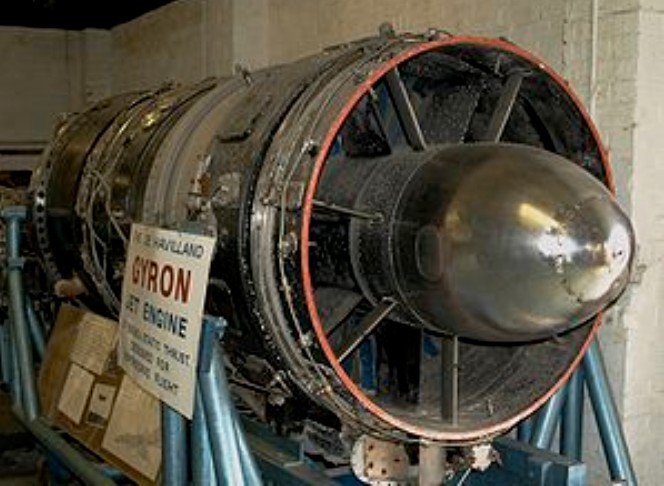
The de Havilland PS.23 or PS.52 Gyron, originally the Halford H-4, was Frank Halford’s last turbojet design while working for de Havilland. Intended to outpower any design then under construction, the Gyron was the most powerful engine of its era, producing 20,000 lbf (89 kN) “dry”, and 27,000 lbf (120 kN) with afterburner.

The Gyron was Halford’s first axial-flow design, a complete departure from his earlier centrifugal-flow engines based on Whittle-like designs, the Goblin (H-1) and Ghost (H-2). The Gyron was also one of the first engines designed specifically for supersonic flight.

The Gyron first ran in 1953. Flight testing started in 1955 on a modified Short Sperrin (a bomber design that was instead turned into an experimental aircraft), replacing the lower two Rolls-Royce Avons with the much larger Gyrons. Flight rating was 18,000 lbf (80,000 N). In 1955 the DGy.1 received an official rating of 15,000 lbf (67,000 N). Addition of a reheat section boosted output to 20,000 lbf (89,000 N) and then 25,000 lbf (110,000 N) in the Dgy.2

The Gyron was selected for a number of projects, most notably the Hawker P.1121 (sometimes referred to as the Hurricane) supersonic attack aircraft that was to have been the replacement for the Hawker Hunter. However, this project was eventually cancelled. Another design potentially based on the Gyron was the Operational Requirement F.155 interceptor, which optionally used the Rolls-Royce RB.106. F.155 was also cancelled, part of the 1957 Defence White Paper. Government financial support of the Gyron project itself was cancelled in March 1957, at a reported total cost of £ 3.4 million.

The engine was actually too large for most roles and saw no production use. It was later scaled down to 45% of its original size to produce the de Havilland Gyron Junior, which was somewhat more successful.

Specifications

Gyron D.Gy.1
Type: Turbojet
Length: 155.5 in
Diameter: 55.2 in
Dry weight: 4,270 lb
Compressor: Seven stage axial flow
Turbine: Two-stage
Maximum thrust: 20,000 lb
Overall pressure ratio: 5.6
Specific fuel consumption: 1.04 Ib./hr/lb at maximum thrust

de Havilland Ghost / Halford H-2 / Svenska Flygmotor RM2

Swedish licensed-built de Havilland Ghost – RM 2

The Ghost came about when de Havilland started work on what was to become the Comet in 1943. Frank Halford’s first design, the H-1, was just entering production and he was able to meet the power requirements of the Comet by simply scaling up features of the H-1. The resulting H-2 also used ten larger flame cans in place of the Goblin’s sixteen smaller ones, using “split intakes” to each can to feed in more air, as if there were twenty cans feeding off the compressor. While the prototype was being built, de Havilland bought Halford’s firm and reformed it as the de Havilland Engine Company, renaming the H-1 and H-2 as the Goblin and Ghost respectively.

The Ghost was already being tested in 1944, and flew on 2 September 1945. This was long before the Comet or Venom was ready for flight. By this point the Ghost had been selected for the Swedish “JxR” fighter project, which eventually turned into the Tunnan. During the design of the Tunnan, Sweden received German data on swept wing designs via Switzerland and redesiged the plane to incorporate this planform. The Tunnan first flew in this form in 1948. For production versions of the Tunnan, the Ghost was built under licence by Svenska Flygmotor (later to become Volvo Aero) as the RM2.

The Ghost would next be seen when the Comet finally took to the air on 27 July 1949. This prototype was powered by the 5,000 lbf (22 kN) Ghost 50, although this was an interim measure while more powerful engines could be developed. The “real” version of the aircraft would be the Rolls-Royce Avon-powered Comet 2, but these engines were not yet ready for flight. In order to make up for the low thrust of the Ghost, the Comet was lightened by using thin-gauge skinning. It was this thin skin that was later found to be a contribution to the cause of a number of infamous crashes, due to metal fatigue. Several versions of the Ghost 50 were produced, ending with the Ghost 50-Mk.4 mounted on the Comet 1XB that was built to test new fuselage construction techniques to address the problems in the Comet 1.

During development, the Royal Air Force also asked for an improved version of the de Havilland Vampire with greater load carrying capacity and thus a larger engine. The resulting design was known as the Venom, and shared many features with the earlier Vampire. The Ghost first flew in the Venom on 2 September 1949. By this point the engine had been running for some time and was already at the Mk.103 model of 4,850 lbf (21,600 N). The Venom was used primarily as a fighter bomber, although some were also produced as night fighters. The Venom was later selected by the Fleet Air Arm for their interceptor needs, and was widely used as the Sea Venom.

Variants:
Ghost 45, rated at 4,400 lbf (19.7 kN)
Ghost 48, rated at 4,850 lbf (21.6 kN)
Ghost 50 Mk 1, rated at 5,000 lbf (22.2 kN) at 10,000 rpm with a weight of 2,011 lb (912 kg)
Ghost 50 Mk 2, rated at 5,125 lbf (22.8 kN)
Ghost 103, rated at 4,850 lbf (21.6 kN)
Ghost 104, rated at 4,950 lbf (22.0 kN)
Ghost 105, rated at 5,150 lbf (22.9 kN)

Applications:
de Havilland Comet
de Havilland Venom
de Havilland Sea Venom
“Ghost-Lancastrian”
Saab Tunnan
Crusader (speedboat)

Specifications:

Ghost 50
Type: Turbojet
Length: 121 in
Diameter: 53 in
Dry weight: 2,218 lb
Compressor: Single stage centrifugal flow
Combustors: 10 chambers
Turbine: Single-stage
Fuel type: Kerosene
Maximum thrust: 5,000 lbf at 10,250 rpm
Overall pressure ratio: 4.6
Specific fuel consumption: 1.02 lb/hr/lbf

Dechaux Helicop-Jet        

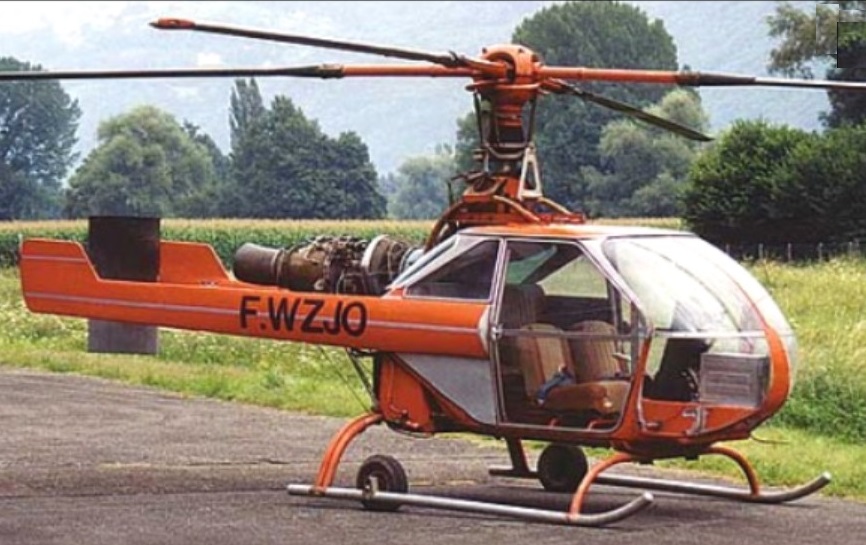
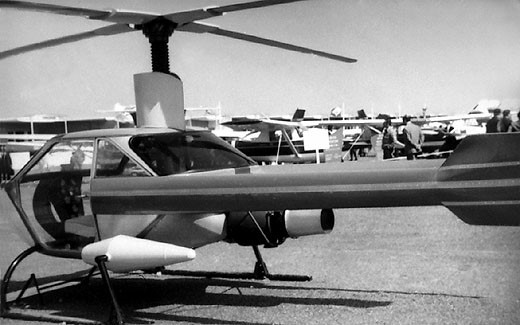
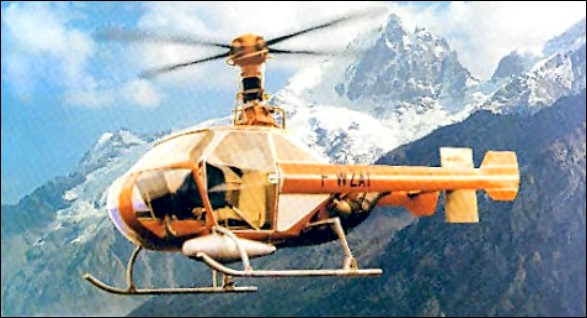
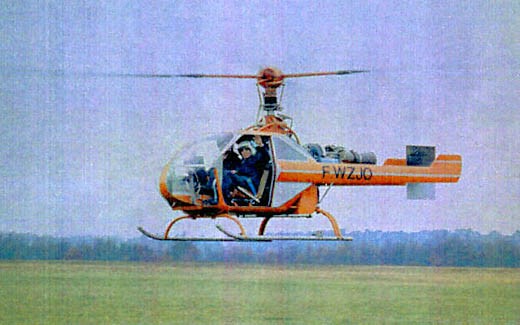
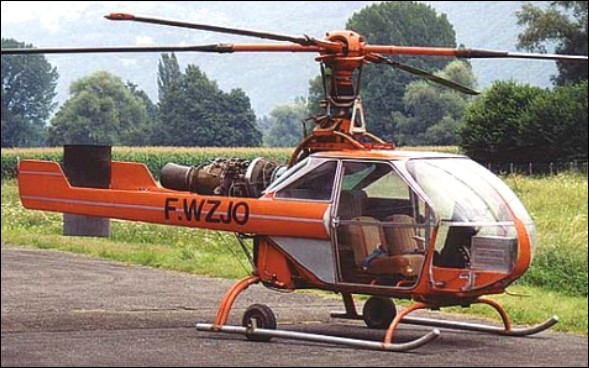
The Hélicop-jet was an original design helicopter of Mr. Charles Déchaux and employed the so called pressure-jet principle (compressed air from turbine engine was channelled to exhaust nozzles at the tips of the rotor blades and extreme tail). The aircraft had a rotor as used in the Sud Aviation SO-1221 Djinn and also featured a twin tail boom configuration and used cabin doors of the Panhard PL-24c car.

A full-size model was exhibited at the 1969 Paris Air Show.

mock up in Salon du Bourget 1969

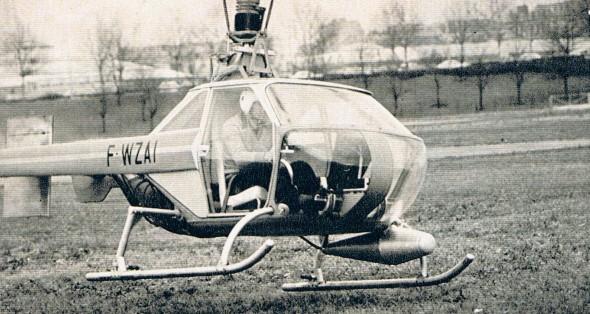
The first example of the Hélicop-jet, F-WZAI, had one 250-260hp Turboméca Palouste IV turbine and it made the first flight in December 1976 at the Issy-les-Moulineaux heliport with Mr. Heurtau, technical director of Héli-Union at the controls.

Trials with this first aircraft showed that only the pilot could be lifted.

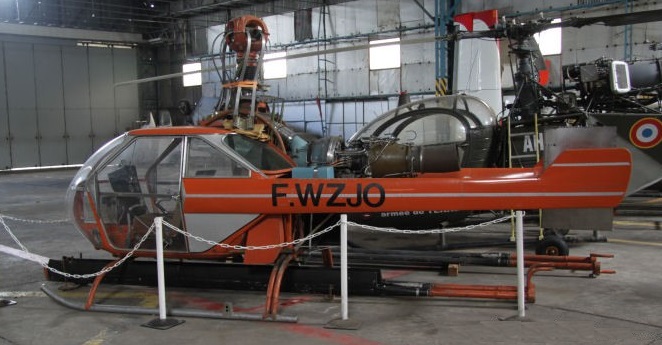
The second prototype, F-WZJO made its maiden flight on December 12, 1984, still in Issy-les-Moulineaux. This time it is equipped with a Turbomeca Astazou IIIA 600 hp turbine and a more rounded windshield.

Tests continued at La Ferté-Alais, under the direction of engineer Jean Richard and piloted by Philippe Fouquaux. As with the first prototype, the second seemed largely underpowered. The tests of no 2 ceased in 1985.

Hélicop-Jet Project Management Co was formed in Montreal in 1984 with the objective the production of a helicopter derived from the Hélicop-Jet, without success. Plans for versions with Turboméca TM.319, P&W PT6 and Allison 250 turbine engines were abandoned.

The prototype no 2 was given to CELAG (Center for Studies and Leisure Aerospace Grenoble) in July 2001. Since July 2007, it has been exhibited in the collections of the Lyon-Corbas Aviation Museum. This prototype arrived at the CELAG on July 25, 2001, after a long period of immobilization at Ferté-Alais, where it had been stored by 1985. It was in excellent state, and almost complete.

Gallery

No 2 prototype, F-WZJO
Engine: Turbomeca Astazou IIIA 600 hp
Rotor diameter: 10.08 m
Number of blades: 4
Fuselage length: 5.30 m
Height: 2.72 m
Empty weight: 450 kg
MTOW: 1060 kg
Cruise speed: 200 km / h
Range: 450 km
Seats: 4

Dassault-Breguet / Dornier Alpha Jet

On 10 July 1969 a project called Alpha Jet was started by the governments of Germany and France to cooperatively create a light aircraft for advanced jet training and for the tactical support role. The contenders were the following: Dassault-Brequet joined up with Dornier with the TA-501, Aérospatiale with MBB with the E-650 Eurotrainer and VFW with their own T-291 project. On 23 July 1970, the TA-501 project from Dassault-Dornier was selected, a tandem seat twin-engined jet trainer and light attack aircraft.

Dassault-Breguet / Dornier Alpha Jet Article

Dassault-Brequet was responsible for building the front fuselage and assembly of the trainer variant as well as the export orders. Dornier in Germany produced the rear fuselage, the tail, wings and assembled the attack variants. The Alpha Jet is power by two Larzac jet engines, which were designed by Turbomecca, SNECMA, MTU and KHD. On 30 November 1972 the first mock up was accepted by both governments and a contract for the production of four prototypes.
On 26 October 1973 prototype 01 made the first flight, sixth months ahead of the contract scheduled date. The official presentation flight was flown on 23 November in 1973 at Isres, France.
On 9 January 1974, the second prototype made its maiden flight, followed by prototype 03 on 4 May and prototype 04 on October 11th. Alpha Jet E entered production in 1977. The first production Alpha Jet E 1 was flown at Istres, France, on 4 November 1977. The aircraft features a DEFA 30mm cannon.

The German Alpha Jet A entered production a year later. Production aircraft were delivered starting in 1978, with French aircraft operating as pure trainer aircraft, while German aircraft were employed as light attack aircraft. The two types can be distinguished visually by the rounded nose of the French aircraft compared with the pointed nose of German aircraft. The aircraft feature a simple but sophisticated design, utilizing fixed leading edges and air intakes, and an area ruled fuselage to minimize transonic drag. The Alpha Jet was also designed to be turned between sorties quickly, and features single-point refueling, and no required ground-support equipment. Alpha Jet A was the light attack variant for the Luftwaffe designed to replace the Fiat G.91R/3s in the light attack and close air support role. The A is therefor equipped with a more advanced nav/attack system including HUD, Doppler navigation radar and twin-gyro INS. The German versions were equipped with a 27mm Mauser cannon, replacing the French DEFA. Alternatively a Super Cyclone recce pod could be carried on the centeline station.

Principal customers were the air arms of the partner countries, the French Air Force taking 176 between 1978 and 1985, and the Luftwaffe 175 between 1979 and 1983.

The Alpha Jet E was produced for the French Air Force and several export customers, including Egypt, where it is known as the MS1.

Alpha Jet E

The Arab Organisation for Industrialisation’s Helwan factory assembled 37 Alpha Jets from CKD kits between 1982 and 1985, and also produced some components under licence. The Egyptian Air Force also received eight aircraft assembled in France.
The close-support version (Alpha Jet A) was built for the West German Air Force; while the alternative close support version, with a new navigation/attack system, was sold to the Cameroon and Egypt as the M52. The Alpha Jet Nouvelle Generation pur l’Ecole et l’Appui (NGEA), now known as the Alpha Jet 2, incorporates the navigation/attack system of the M52 together with uprated Larzac 04-C20 engines and Magic 2 AAMs. No NGEA sales have been achieved, but Egyptian M52s are to be upgraded to NGEA standard. The fifth version, announced in 1985, is the Alpha Jet Lancier. Derived from the NGEA, the Lancier is intended for day/night ground attack, anti-shipping strikes, and anti-helicopter duties. In addition to the NGEA systems it has a Flir, Thomson-CSF Agave multimode radar, active and passive ECM, anti-shipping missiles, and laser guided bombs. No orders for the Lancier have been achieved to date. The Alpha Jet 3 is an advanced training version for use with FLIR, laser and ECM systems.

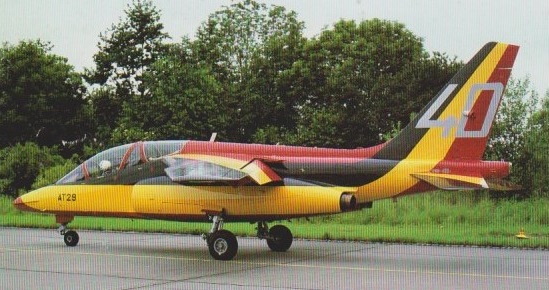
Alpha Jet AT-29, June 1987

Under an independent programme, the Luftwaffe is retrofitting more powerful Larzac 04-C20 engines to boost performance. A limited armament and avionics upgrade had been approved for the Luftwaffe’s Alpha jet fleet for service from 1992.
By early 1986 more than 480 Alpha Jets had been delivered, against orders for 501 for ten customers.
The German Luftwaffe was the sole operator of the Alpha Jet A light attack version until the 1990s. The first production aircraft flew in 1979 and three years later Dornier closed the production line. The 175 Luftwaffe Alpha Jets replaced the Fiat/Aeritalia G.91R, of which 300 were operated in the tactical support and light attack role. In the 1990s the Alpha Jet was slowly withdrawn from service, the last example being officially retired on 31 December 1998. A large number of aircraft was sold to other nations and about 40 aircraft were put into storage at Fürstenfeldbruck. Two examples have been bought and restored for flying with the Flying Bulls, a display team sponsored by Red Bull.

The Alpha Jet E trainer version for France entered service with the Armée de l’Air replacing the Fouga Magister, Lockheed T-33 and the Dassault Mystère IVA.

The Belgian Air Force needed an advanced trainer and was interested in the development of the Alpha Jet since the start of the project. Belgium operated 28 aircraft, which have been upgraded prolonging their service life until at least 2015. The upgrade was carrier out by SABCA (Société Anonyme Belge de Constructions Aéronautiques), the first upgraded example being delivered back to the air force on 21 April in 2000. The upgrade features a new flightstick, advanced HUD, GPS, ILS and a multi function display in the rear cockpit.
In 1994 50 ex-Luftwaffe Alpha Jets were sold to the Portuguese Air Force. In service with Squadrons 103 Caracóis (Snails) for complementary flying training and operational conversion training and with Squadron 301 Jaguares (Jaguars) on the offensive air support role, both squadrons operated from Beja airbase.

Operators: Belgium, Cameroon, Egypt, France, Ivory Coast, Marocco, Nigeria, Portugal, Qatar, Thailand, Togo.

In 2017 Alpha Jets were still in service with the militaries of France, Belgium, Egypt, Portugal, Thailand, and are operated by EPNER and Empire Test Pilot School.

Gallery

Breguet Alpha Jet
Engines: 2 x SNECMA / Turboméca Larzac 04-C5, 13244 N
Length: 40.322 ft / 12.29 m
Height: 13.747 ft / 4.19 m
Wingspan: 29.888 ft / 9.11 m
Wing area: 188.37 sqft / 17.5 sqm
Max take off weight: 13230.0 lb / 6000.0 kg
Weight empty: 6945.8 lb/ 3150.0 kg
Max. speed: 535 kts / 991 km/h
Initial climb rate: 11614.17 ft/min / 59.00 m/s
Service ceiling: 44948 ft / 13700 m
Wing load: 70.32 lb/sq.ft / 343.00 kg/sq.m
Range: 680 nm / 1260 km
Range (max. weight): 432 nm / 800 km
Crew: 2
Armament: 1x MK 30mm, 2500kg ext.
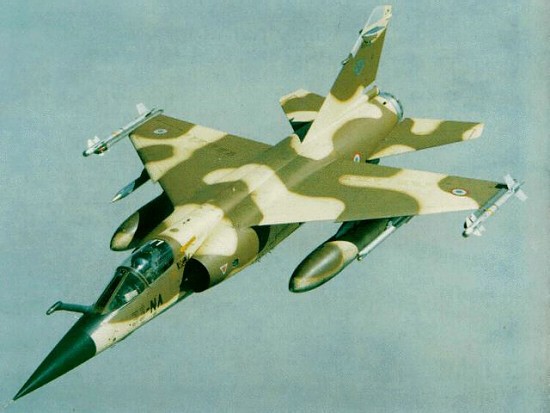
Alpha Jet
Engine: 2 x Snecma/Turbomeca Larzac 04-C6.
Installed thrust: 26.5 kN.
Span: 9.1 m.
Length: 12.3 m.
Wing area: 17.5 sq.m.
Empty wt: 3855 kg.
MTOW: 7940 kg.
Warload: 2720 kg.
Max speed: 1000 kph.
Initial ROC: 3420 m / min.
Ceiling: 14,600+ m.
T/O run: 410 m.
Ldg run: 610 m.
Fuel internal: 1900 lt.
Range/Endurance: 1230 km / 3.5 hr.
Combat radius: 350-1075 km.
Armament: 1 x 27/30 mm, 2 x AAM.
Hardpoints: 4/5.

Alpha Jet
Max Speed: 550 KIAS / .95 M
Ceiling: 47,000 ft
G-Limits: +8 / -5
Payload: 1,360 lb on each inner pylon, 635 lb on each outer pylon
EW: Wired for ALQ-167 and ALQ-188
Endurance: 2.5+ hr with 2 drop tanks
Empty Weight: 7,850 lb
Useful load: 8,600 lb

Alpha Jet E
Engines: two 13.24 kN (2,976 lb st) SNECMA/Turbomecca Larzac 04-C6 non-afterburning turbofan
Wing span 9.11 m (29 ft 10¼ in)
Wing area: 188,4 sq,ft / 17,50 sq m
Length 11.75m (38 ft 6½ in)
Height 4.19m (13 ft 9 in)
Empty weight 3345 kg (7,374 lb)
Max Take-Off Weight 8.000 kg (17,637 lb)
Max level speed at sea level 1000 km/h (621 mph)
Service ceiling 14,630m (48,000 ft)
Climb to 30,000ft/9145m: 7 min 0 sec
Radius: 764 mi / 1230 km
Armament: one Mauser 27mm or DEFA 30mm ventral cannon pod with 125 rpg
Ordnance: 2500 kg (5,511 lb)
Hardpoints: 4

Dassault Rafale

France originally was part of the EFA (European Fighter Aircraft) project, which would result in the Eurofighter. In 1985 France left the project and started its own development of a fighter, which led to the ACX or Rafale A.

Dassault Rafale Article

The Rafale (‘Squall’) was originally conceived to demonstrate technologies applicable to a French air force Jaguar replacement (ACT= Avions Combat Tactique) and a French navy Crusader and Super Etendard replacement (ACM= Avion de Combat Marine).
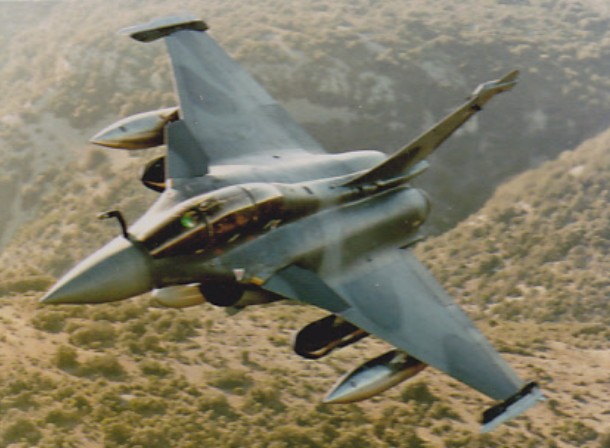
It is a single-seat aircraft with a compound-sweep delta wing, an all-moving canard, a single fin, and semi-vented intakes. It incorporates digital fly-by-wire, relaxed stability, a reclined pilot’s seat, a wide-angle headup display, and composite components are used extensively in the airframe. Provision has been made for the introduction of fibre-optics, voice command, and voice warning systems.
Equipped with the multi-mode RBE2 radar which has full air-to-air and air-to-ground capability, it can carry a wide range of weapons, including the APACHE stand-off munitions dispenser and the ASMP nuclear missile.
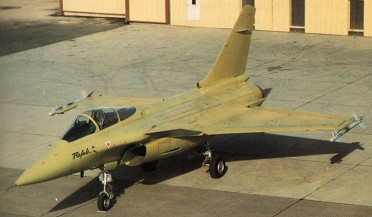
The Rafale A technology demonstrator, A 01, powered by two General Electric F404 turbofans, was rolled out of the Saint-Cloud factory on 14 December 1985,
First flying on 4 July 1986, Mach 1.3 was exceeded during the flight.
In May 1987 the Rafale A prototype successfully completed a series of approaches to the carrier Clemenceau to establish the feasibility of carrier operations.
In April 1989 the aircraft was laid-up for the substitution of a SNECMA M88-2 augmented turbofan in the port engine bay and flew in this configuration on 27 February 1990. The M88 is the selected engine for production versions of the Rafale.
Developed from the Rafale A was the single seat Rafale C that first flew on 19 May 1991.

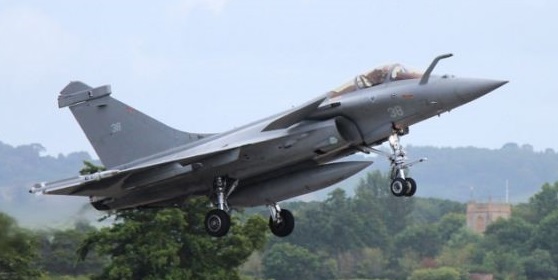
The two-seat Rafale B was designed as a dual control conversion trainer for the single seat Rafale C. But the Rafale B has developed as a fully operational variant with full combat capability. Either an instructor, a second pilot or a WSO can assist the pilot from the rear seat. The Rafale B and C aircraft were planned to enter Armée de l’Air (French Air Force) service from 2002 onwards to replace its older Mirage variants and Jaguars. The first production aircraft Rafale B1 flew for the first time on 4 December 1998 and was delivered to the French Air Force.
On April 20, 2001, a Rafale B fitted with conformal fuel tanks made its first flight.

Designed especially for the Aeronavale (French Navy Air Arm) is the carrier capable Rafale M. A fully navilised version first flying on 12 December 1991. The Rafale M has for 80% the same structural design and for 95% the same systems as the Rafale C. It has strengthened main undercarriage, extended nosewheel suitable for catapult launch, hydraulically operated arrester hook, but has no folding wings. The centreline pylon has to be removed because of the longer nosewheel undercarriage. The first production Rafale M aircraft replaced the remaining F-8E(FN) Crusaders in the fighter role. Subsequent deliveries were to replace the Super Etendard and Etendard IVP in the attack and recconnaissance roles.

Dassault Rafale-M

A fourth variant developed for the French Navy, is the two-seat Rafale N to enter service in 2008. The Rafale will become the only combat aircraft in the French Navy when all aircraft are delivered.
The original plan was to order a total of 94 Cs, 78 Ms and 140 Bs.
On December 1, 2001, the French carrier Charles de Gaulle departed to support the war on terrorism with on board seven Rafale M fighters. Although the aircraft did not take part in the large-scale air combat operation over Afghanistan, they flew combat air patrols and were able to practise and test out new tactics.

Gallery

Prototype
Engines: 2 x Snecma M88-2, 16,870 lb thrust
MTOW: 43,000 lb

Rafale A
Engine: 2 x General Electric GE F404-GE-100, 69847 N
Length : 51.837 ft / 15.8 m
Height: 17.06 ft / 5.2 m
Wingspan: 36.745 ft / 11.2 m
Wing area: 505.908 sq.ft. / 47.0 sq.m
Max take off weight: 44100.0 lb / 20000.0 kg
Weight empty: 20947.5 lb / 9500.0 kg
Max. weight carried: 23152.5 lb / 10500.0 kg
Max. speed: 1147 kt / 2124 km/h
Landing speed: 120 kt / 223 km/h
Wing load: 87.33 lb/sq.ft / 426.0 kg/sq.m
Fuel capacity: 1123 gal / 4250 lt
Crew: 1
Armament: 1x MK 30mm DEFA 554, max 12x AIM.

Rafale C
Engines: 2 x SNECMA M88-2 turbofans, 7500kg, 16,500 lb
Max take-off weight: 19500 kg / 42990 lb
Empty weight: 9060 kg / 19974 lb
Wingspan: 10.9 m / 35 ft 9 in
Length: 15.3 m / 50 ft 2 in
Height: 5.34 m / 17 ft 6 in
Max. speed: 2070 km/h / 1286 mph
Armament: 1 x 30mm cannon
Hardpoints: 14

Rafale M
Engines: 2 x SNECMA M88-3 afterburning turbofans, 86.98 kN (19,555 lb st)
Length 15.30m (50 ft 2½ in)
Height 5.34m (17 ft 6¼ in)
Wing span (over AAMs) 10.90m (35 ft 9¼ in)
Empty weight equipped 9670 kg (21,319 lb)
Max Take-Off Weight 21.500 kg (47,399 lb)
Max level speed at 11.000m (36,069 ft) Mach 2.0 or 2125 km/h (1,321 mph)
Service ceiling 16,460m (54,000 ft)
Armament: one DEFA 791 B 30mm cannon; up to 6000 kg (13,228 lb) ordnance
Hardpoints: 13

Dassault Mirage 4000

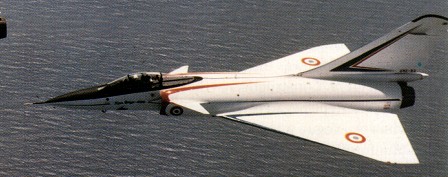
Intended as a multi¬role fighter, the private venture Mirage 4000 prototype was originally known as the Super Mirage 4000.
Powered initially by two SNECMA M53-2 turbofans with afterburning thrust of 8500kg, the Mirage 4000 introduced extensive use of boron and carbonfibre composites for structures, and computer-derived aerodynamics and a fly-by-wire active control system making possible a rearward CG. Built-in armament consisted of two 30mm cannon and external ordnance loads in excess of 8000kg could be distributed between 11 external stations.
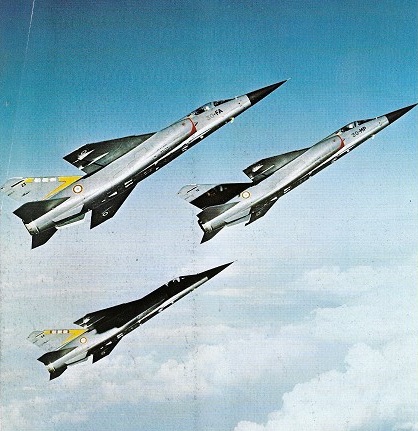
First flown on 9 March 1979, the Mirage 4000 achieved Mach=1.6 during its first flight and Mach=2.2 five weeks later, on 11 April, during its sixth flight.
The single prototype was re-engined with M53-5 turbofans with afterburning thrust of 8790kg during the course of its flight test programme. No production contract was placed for the Mirage 4000, but in 1986, the prototype was re-engined with M53-P2 engines and participated in the Rafale programme.

Mirage 4000
Engine: 2 x SNECMA M53 turbofans, 10000kg
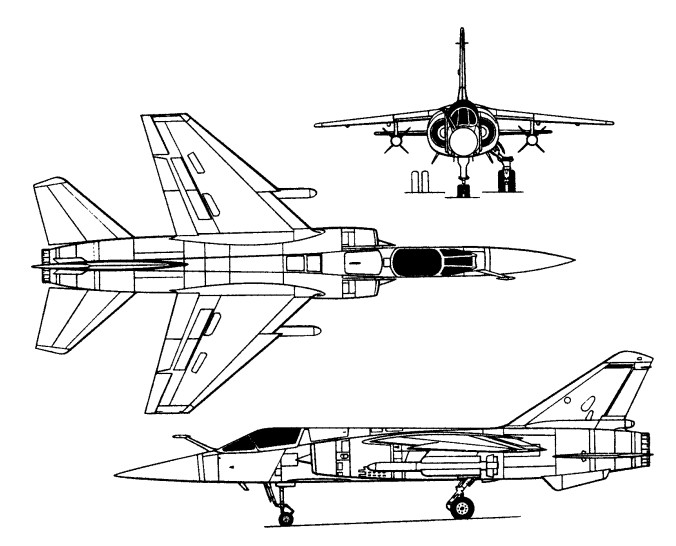
Wingspan: 12.0 m / 39 ft 4.5 in
Length: 18.7 m / 61 ft 4 in
Wing area: 73.0 sq.m / 785.76 sq ft
Max. speed: 2333 km/h / 1450 mph
Ceiling: 20000 m / 65600 ft
Range w/max.fuel: 3700 km / 2299 miles
Armament: 2 x 30mm cannons
Hardpoints: ten

Dassault Mirage F.1

Mirage F.1

In the 1960s Dassault designed the Mirage F1 as a successor for the Mirage III family. Loss of energy in low-level manoeuvring flight of the delta-winged Mirage III led to development of a traditional layout for the wing.
Evolved in parallel with the Mirage F2 as a scale-down, multi-role single-seat fighter employing a SNECMA Atar turbojet, the Mirage F1 was the subject of a government contract awarded in 1964. Possessing a conventional sweptback wing equipped with high-lift devices, and conventional swept tail surfaces, the private venture prototype F1 flew on 23 December 1966.

On 23 December 1966 the first prototype made its maiden flight. Three pre-series aircraft were ordered in September 1967, the first of these flying on 20 March 1969.

Dassault Mirage F.1 Article

The initial production model for France’s Armee de l’Air was designated F1C, placed emphasis on the intercept mission, was powered by an Atar 9K-50 turbojet affording 7200kg with afterburning, and had an armament of two 30mm cannon, two Matra 550 Magic and two Matra R 530 or Super 530 AAMs. An initial order for the F1C for the Armee de l’Air was placed in 1969, 162 being procured by that service (plus 64 recce F1CRs and 20 two-seat F1B trainers), initial operational capability being achieved in 1974. Many of the Armee de l’Air aircraft were delivered in, or retroactively modified to, F1C-200 standard with an 8cm fuselage plug to accommodate a removable flight refuelling probe.

The Mirage F.1C entered service with France’s air defence command (CAF-DA) in 1973, equipped with Thomson-CSF Cyrano IV all-sector fire-control radar. This type has also met with considerable success on the export market, customers including Ecuador, Greece, Iraq, Jordan, Kuwait, Libya, Morocco. South Africa and Spain. Production of 81 of this variant was followed by 89 Mirage F.1C-200 fighters fitted with a fixed inflight-refuelling probe at the base of the windscreen. The F.1-CR-200 became operational in July 1983, and carries cameras and infrared sensors internally with additional sensors in an under-fuselage pod. Improved navigation systems, radar, and a flight refuelling probe fitted as standard.

The Armée de l’Air (French Air Force) operated the F1C as its main interceptor fighter until the service entree of the Mirage 2000 in 1984.

The first flight was made by the Dassault Mirage F.1B two seat dual role trainer/tactical aircraft on 26 May 1976. Twenty Mirage F.1B conversion trainers (based on the Mirage F.1C but lacking its internal cannon) have also been received. It proved attractive to overseas customers, initial orders being received from Ecuador, Iraq, Jordan, Kuwait, Libya, Morocco and Spain.

F.1B

Single-seat aircraft, including the F.1A with its slightly increased fuel tankage, have a notional maximum weapon-carrying capacity of 13,889 lb (6 300 kg), excluding the fitted cannon. This total is made up of 4,630 lb (2 100 kg) on the centreline; 220 lb (100 kg) of chaff/flare dispensers on the fuselage shoulder; 2,866 lb (1 300 kg) at the inner wing; 1,213 lb (550 kg) on the outer wing pylons, and 331 lb (150kg) on the wing-tip AAM positions. Maximum FIC/E internal fuel capacity is 946 Imp gal (4 300 1) or 7,568 lb (3 433 kg) of Jet A-1 /Avtur whilst three external tanks can hold a further 1,012 Imp gal (4 600 1) or 8,096 lb (3 672 kg). Fuel and weaponry must be traded-off between the confines of a 16,314 lb (7 400 kg) empty weight and 35,715 lb (16 200 kg) max take¬off weight.

French Air Force F.1-Cs were delivered as or converted to F.1-C-200s by the installation of detachable flight refuelling probe.

The Mirage F1E was a dedicated strike and attack aircraft which incorperated upgraded systems, including radar. Dassault also designed a two-seat version of the F1E for training, designated F1D.

A simplified version, lacking certain avionics such as the Cyrano radar, was produced for South Africa (F1AZ and F1CZ for the interceptor variant) and Libya for the clear-weather attack role with ranging radar as the Mirage F.1A, with Aida radar in a slimmer nose filled with much of the electronics previously located behind the cockpit, where more fuel could now be stored. Other additions were Doppler navigation, an inertial platform. and a laser rangefinder. Libya, together with Iraq, Jordan, Morocco, Qatar and Spain, also bought the multi-role Mirage F.1E. An export model, the Mirage F.1E, is based on the F.lC with upgraded Cyrano IVM radar offering terrain-avoidance, air-to-surface ranging, and look-down capability. The model also has an inertial platform, digital computer, and improved head-up display. The Mirage F.1E entered service in 1976, and offered multi-role capability, including anti¬ship attack with the AM.39 Exocet missile.

According to Dassault data the Mirage F1E’s LO-LO combat radius with one centreline Exocet, two Magics, two ECM pods and two 264 Imp gal (1 200 1) external tanks is 435 mls (700 km), including the missile’s range of 37-43 mls (60-70 km). This is achieved at a cruising speed of 400 kts (742 km/h), apart from the first 59 mls (95 km) of the homeward flight, which are flown at 550 kts (1 019 km/h). Radius can be increased to 559 mls (900 km) with one “buddy” refuelling. A larger, 484 Imp gal (2 200 lt), tank is also available, but can be fitted only singly on the centreline pylon and has hitherto been employed mainly for ferrying. With one large and two small tanks and a H1-LO-HI mission profile, the Mirage F.IE’s radius may be increased to 870 mls (1 400 km), but only if the Magics and ECM pods are left at home and the weapon load reduced to just two 250-kg (55l-lb) bombs.
Production of the AM.39 Exocet armed Mirage F.1-EQ6 for the Iraqi Air FoU continued until late 1988. The French Air Force has received the last of its Mirage F.1-CR-200 reconnaissance fighters.
The specialized reconnaissance model is the Mirage F.1CR (based on the Mirage F.1C-200 and with a secondary attack capability) and this replaced the 50 or so Mirage IIIR/RD aircraft which equiped the 33e Escadre at Strasbourg, the French air force’s sole tactical reconnaissance unit. Selected in February 1979, two Mirage F.ICR prototypes were produced for test duties, the first making its maiden flight on 20 November 1981. These two machines being followed by 62 production examples. Mission-related equipment includes OMERA cameras carried internally together with an infra-red sensor, while additional electromagnetic or optical sensors can be housed in an external pod fitted beneath the aircraft’s belly. Air-to-air missiles can also be carried for defensive purposes, while inflight-refuelling gear is also fitted as standard.

First flown on 22 December 1974, and built as an engine test bed under official contract, the Mirage F1.M53 was also envisaged as the basis for a contender in the contest to find a successor for the Lockheed F-104G in service with Belgium, Denmark, the Netherlands and Norway. Evolved from the basic Atar 9K-50 turbojet-powered Mirage F1C, the Mirage F1.M53 – referred to for a brief period as the “F1E”, the suffix letter signifying Exportation and the designation subsequently being reassigned – was powered by the SNECMA M53 turbofan rated at 5550kg dry and 8500kg with maximum afterburning. M53 installation involved significant fuselage structural redesign, and to provide suitability for ground attack and long-range interdiction tasks in addition to that of interception, provision was made for multi-role avionics. By comparison with the F1C, the F1.M53 had increased fuel capacity, enlarged engine air intakes and strengthened undercarriage. The nose profile was revised to provide for the introduction of a retractable flight refuelling probe. The installed armament remained two 30mm cannon and it was proposed to distribute up to 4000kg of ordnance between seven external stations. The other contenders for the multi-national fighter contract were the Saab 37 Viggen and the General Dynamics F-16. With choice of the F-16 as winner of the competition, plans to produce a second prototype F1.M53 for testing and integration of systems were discarded.

Variants of the basic aircraft offered for export, in addition to the F1C, were the F1A with simplified avionics for operation under VFR conditions and the F1E multi-role air superiority/ground attack/reconnaissance version. Export customers were Ecuador (16 F1AJs), Greece (40 F1CGs), Iraq (113 F1EQs), Jordan (17 F1CJs and 17 F1EJs), Kuwait (27 F1CKS), Libya (16 F1ADs and 16 F1EDs), Morocco (30 F1CHs and 20 F1EHs), Qatar (12 F1EDAs), South Africa (32 F1AZs and 16 F1CZs) and Spain (45 F1CEs and 22 F1EEs). Production of the Mirage F1 was completed in 1990 with 731 built (including F1B and F1D two-seat trainers and F1CR reconnaissance aircraft). In 1991, work began on the adaptation of 30 F1C-200S as F1CT ground attack fighters.

In the 1991 Gulf War, the Mirage F1 was operated on both sides. In the 1980s Dassault sold a large number of Mirage F1E and some F1B aircraft to Iraq (designated F1EQ and F1BQ respectively). When coalition forces struck numerous hardened aircraft shelters to neutralize the Iraqi Air Force in support of operation Desert Storm, many of these aircraft were destroyed. Taking part in the coalition was France, supporting air operations with F1CR and F1CT aircraft.

The last French F1 Mirage was retired from active service in June 2014, and stored at Châteaudun air base, near Paris, while waiting for a buyer. Replaced in the French Armée de l’air by the Dassault Mirage 2000 and Dassault Rafale, it was still in use in five air forces around the world. Draken International was after the retired French planes. Instead, in December 2017, it acquired 22 Mirage F1 fighter jets from the Spanish Air Force.

Gallery

Mirage F1C
Powerplant: one 70.21 kN (15,873 lb st) SNECMA Atar 9K-50 turbojet
Length 15.23m (49 ft 11½ in)
Height 4.50m (14 ft 9 in)
Wing span (over tip missiles) 9.32m (30 ft 10 in)
Wing area: 25 sq.m / 269.10 sq ft
Empty weight: 7400 kg / 16314 lb
Max Take-Off Weight 16.200 kg (35,714 lb)
Max level speed at 12,000m (39,370 ft) Mach 2.2 or 2350 km/h (1,460 mph)
Landing speed: 124 kts / 230 km/h
Cruising speed: 478 kts / 885 km/h
Initial climb rate: 41338.58 ft/min / 210.0 m/s
Service ceiling 20,000m (65,615 ft)
Range w/max.payload: 900 km / 559 miles
Armament: two DEFA 553 30mm cannons (135 rounds/gun), up to 4000 kg (8,818 lb) ordnance
Hardpoints: 7
T/O run: 670 m.
Ldg run: 610 m.
Combat radius lo-lo-lo: 740 km.
Fuel internal: 4300 lt.
Air refuel: Yes.
Crew: 1

Mirage F.1CR
Powerplant: one SNECMA Atar 9K-50 turbojet rated at 7200-kg (15,873-lb) afterburning thrust.
Maximum speed at sea level 1475 km/h (917 mph) or Mach 1.2
Maximum. speed at altitude 2335 km/h (1450 mph) or Mach 2.2
Ferry range 300 km (2,050 miles)
Empty weight 7400 kg (16,314 lb)
Maximurn take-off 16200 kg (35,715 lb)
Wingspan 8.40 m (27 ft 6¾ in)
Length 15.00 m (49 ft 2½ in)
Height 4.50 m (14 ft 9 in)
Wing area 25.00 sq.m (269.1 sq.ft)

Mirage F.1E
Engine: one 15,873-lb (7,200-kg) reheated thrust SNECMA Atar 9K-50 turbojet.
mximum speed, clean Mach 2.2 speed (1,321 mph / 2,125 km/h) at 36,090 ft (11,000 m)
Initial climb rate 39,370 ft (12,000 m) per minute
Service ceiling 20000 m (65,615 ft)
Endurance 3 hours 45 minutes
Radius 265 miles (425 km) on a hi-lo-hi mission with a 7.716-lb (3,500-kg) warload.
Empty weight 7400 kg (16,314 lb)
Maximum take-off 16200 kg (35,714 lb)
Wingspan 8.40 m (27 ft 6 ¾ in)
Length 15.00 m (49 ft 2 ½ in)
Height 4,50 m (14 ft 9 in)
Wing area 25.00sq.m (269.1 sq ft).
Armament: two 30-min DEFA 553 cannon (125 rpg) up to 4000 kg (8,818 lb) ordnance

F1.M53
Max take-off weight: 15200 kg / 33510 lb
Empty weight: 8024 kg / 17690 lb
Wingspan: 8.45 m / 27 ft 9 in
Length: 15.53 m / 50 ft 11 in
Height: 4.56 m / 14 ft 12 in
Wing area: 25.00 sq.m / 269.10 sq ft
Max. speed: 2335 km/h / 1451 mph
Range: 1200 km / 746 miles

Dassault Mirage F.2          

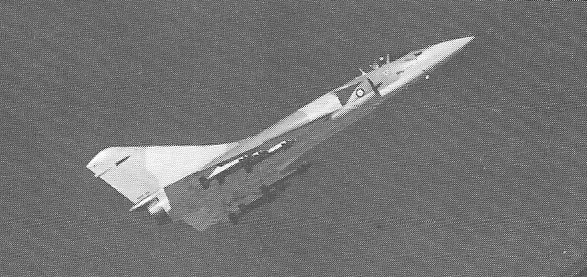
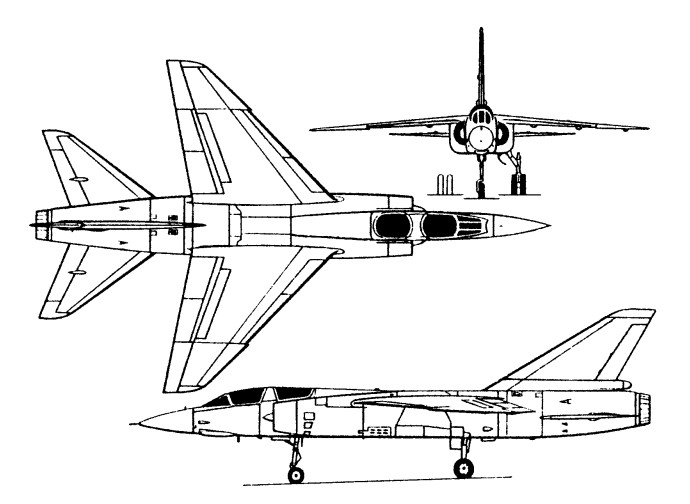
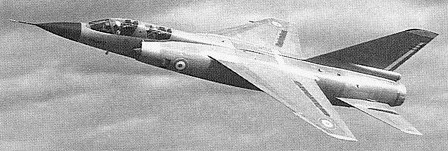
In 1964 Dassault received a contract to develop a successor to the Mirage III for the low-altitude penetration role, and an order followed for a single prototype of a tandem two-seat aircraft. The intended powerplant was a SNECMA (Pratt & Whitney) TF-306 turbofan. The new fighter featured a high-mounted swept wing with horizontal tail surfaces, and was assigned the designation Mirage F2. It was first flown on 12 June 1966 with a Pratt & Whitney TF30 turbofan rated at 8400kg with afterburning. After being re-engined with a TF-306 of 9000kg, it attained M=2.0 on its second flight, on 29 December 1966.
Work had begun on a single-seat version, the Mirage F3 with a 10350kg TF-306E engine, but changes in Armee de l’Air requirements saw interest transferred to a simpler version of the basic Mirage F1. Development of which had been pursued in parallel by Dassault, and further development of the Mirage F2 was discontinued.

Engine: 1 x Pratt & Whitney TF30 turbofan, 9000kg
Take-off weight: 18000 kg / 39683 lb
Empty weight: 9500 kg / 20944 lb
Wingspan: 10.5 m / 34 ft 5 in
Length: 17.6 m / 57 ft 9 in
Height: 5.8 m / 19 ft 0 in
Max. speed: 2333 km/h / 1450 mph
Ceiling: 20000 m / 65600 ft