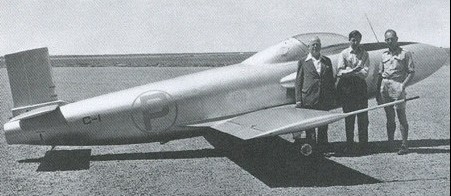
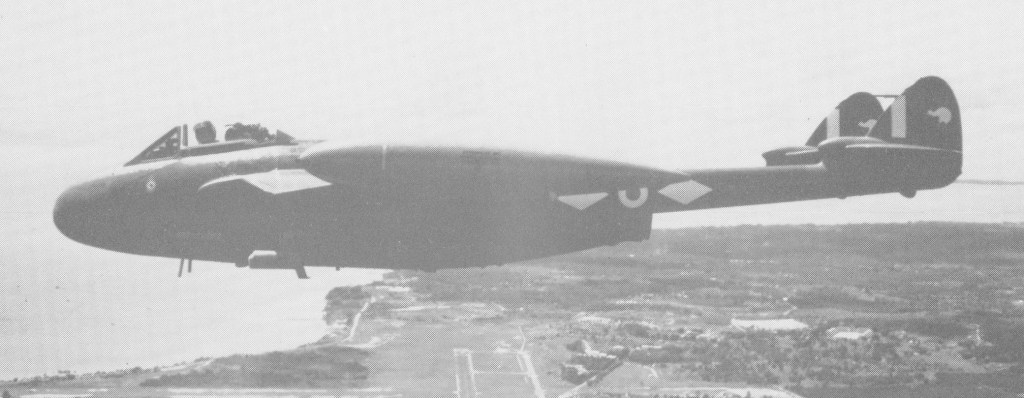
Manned prototype of the Jindivik target drone built by Department of Aircraft Production of Australia, later renamed GAF (Government Aircraft Factories).
Two were built.
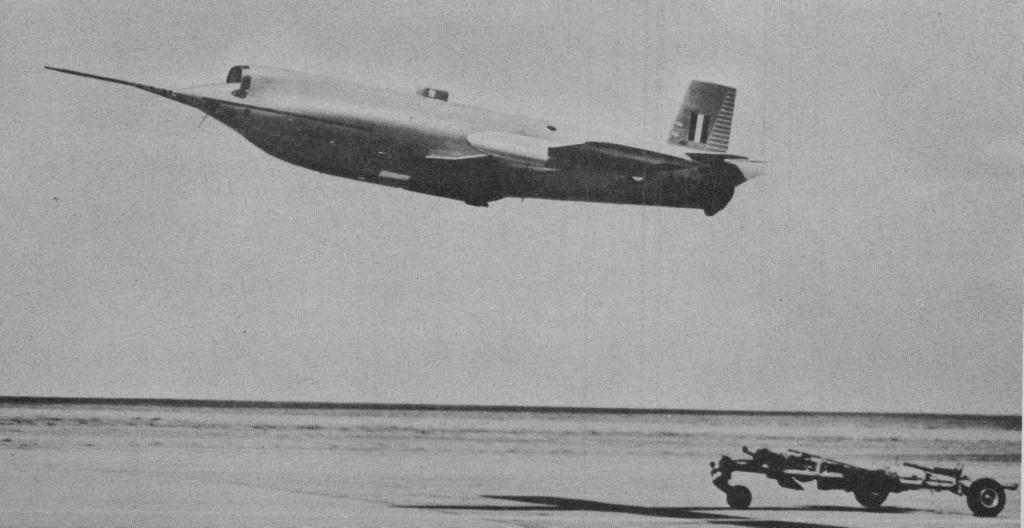
Manned prototype of the Jindivik target drone built by Department of Aircraft Production of Australia, later renamed GAF (Government Aircraft Factories).
Two were built.
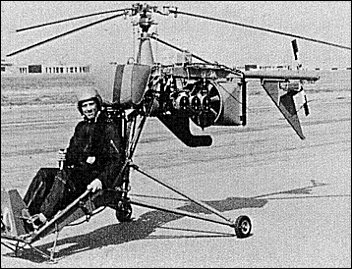
Del Mar Engineering Laboratory was a weapons system support and training systems designer/manufacturer of Los Angeles, California; produced a series of very original experimental ultralight helicopters from 1940, as well as a helicopter training system. Production ended by 1974.
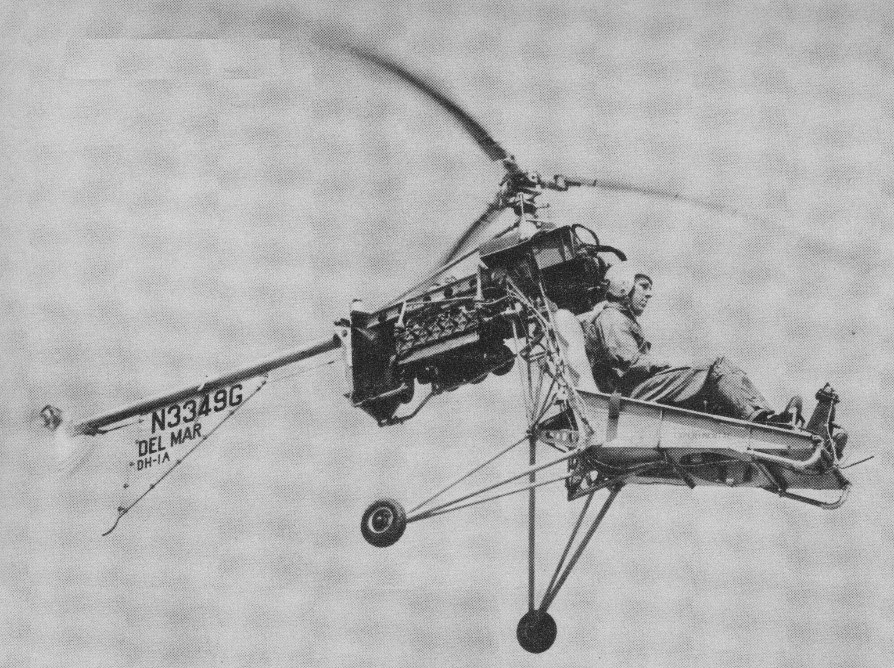
Engine: 60 hp Mercury outboard or 65 shp Solar Titan turbine
Gross weight: 550 lb
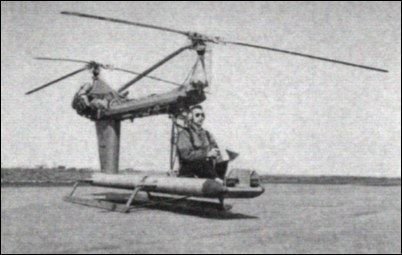
The DH-20 helicopter was tested in 1968. No series production.
Engine: 2 x AiResearch GTP-30-100 turboshafts
Rotor diameter: 4.88m
Take-off weight: 500kg
Max speed: 135km/h
Range: 180km
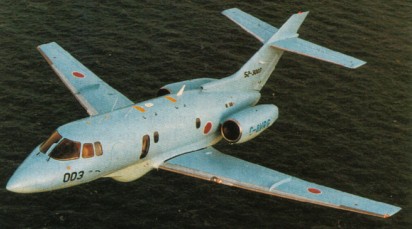
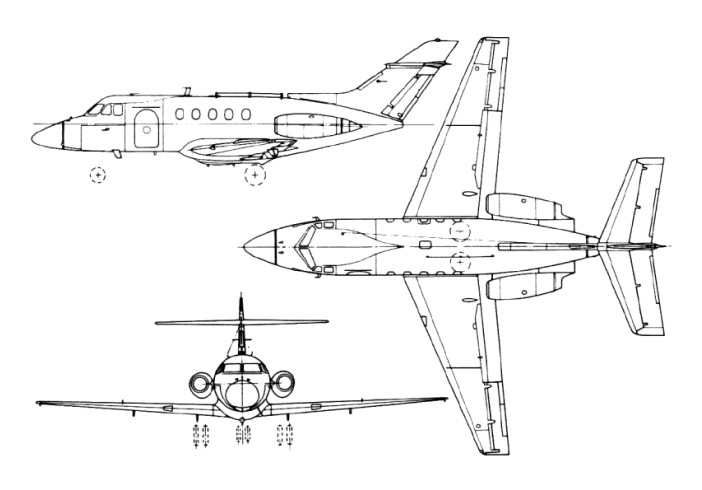
In 1961, with thoughts of reviving a pre-war name for the jet replacement to the Dove, the 125 was originally billed as the de Havilland Jet Dragon in the early sixties. Designed specifically for the business aircraft category, the DH 125, accommodates a crew of two and from six to twelve passengers. The first of two prototypes flew on 13 August 1962, as the DH.125, with Rolls-Royce Viper 20 engines producing 1350kg of thrust each. The first production aircraft had a 0.9m greater wingspan and 1.2m longer fuselage as well as Viper 520 engines.
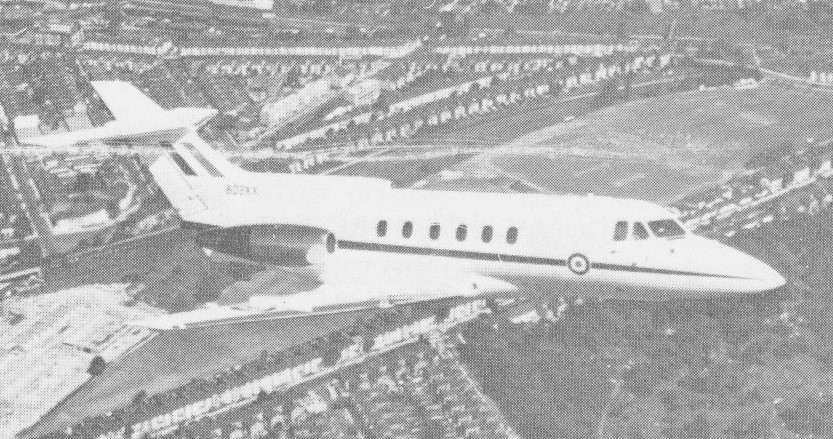
The original DH 125 was marketed by de Havilland, Hawker Siddeley, Beechcraft-Hawker and finally British Aerospace.
In 1963 the DH.125 was to be sold in the US by Atlantic Aircraft Sales Corp and AiResearch Aviation Services for a fully equipped price of US$740,000.
In 1965 Hawker Siddeley’s DH 125 flew one-stop from Wilmington, Del. To Los Angeles in 6 hr 50 min against headwinds of 110 mph following a 17 day US tour during which it made 107 demonstration flights. IIt flew at 35-39,000 ft with one stop at Wichita, Kan. AiResearch, the US distributor had the basic price at $575,000 and completely equipped at $750,000.
The original DH 125 evolved through the 1A, 3ARA, to the 400 Series.
Twenty Srs.2s were equipped as Dominie navigation trainers for the Royal Air Force.
The more significant changes took place from the advent of the 400 series. It was at this point that the Beech Aircraft Corporation took over the marketing of the 125 in North America between 1968 and 1972. The Series 400, since 1970, was marketed in the United States as the Beechcraft Hawker BH 125. It featured a centre cabin aisle recessed below the level of the floor supporting the seats on either side. This gave sufficient cabin height to allow a passenger stand-up headroom.
Their big contribution was a major improvement to the cockpit layout and ergonomics of the 400. The 600 series saw a two foot extension to the fuselage with corresponding benefits in passenger appeal. and first flew on 21 January 1971.
The 700 series brought the switch from straight jet Viper power to the fanjet power of the Garrett TFE 731-3.
Hawker Siddeley continued to build the jet in Great Britain, but its agreement with Beech was terminated in middle of 1975.
Continued development of the BAe 125 led to the Srs 800, which made its first flight on 26 May 1983, and the BAe 1000. The BAe 125-800 is an extensively revised development of the earlier -700 series, featuring more powerful engines (two Garrett TFE731-5R-1H turbofans) and new longer span outboard wing sections. Capable of 533 mph maximum cruising speed, the -800 has an economy cruise of 461 mph at 40,000 feet over 3454 miles (5560 km). Latest state of the art aerodynamic design theory has been incorporated in the 10 foot outboard wing panel, increasing the span by 4 foot 4½ inches. Fuel tankage has increased from 9440 lbs to 10,000 lbs with a corresponding increase in NBAA VFR range from 2660 nm in the 700 to 3000 nm in the 800 model. Digital autopilot and avionics allow the 800 to join the “glass cockpit” group. Numerous other 800 improvements include a new acrylic windshield, deletion of the ventral fin, nose wheel doors closed when gear down and architectural changes in the cabin area giving increased width and height.
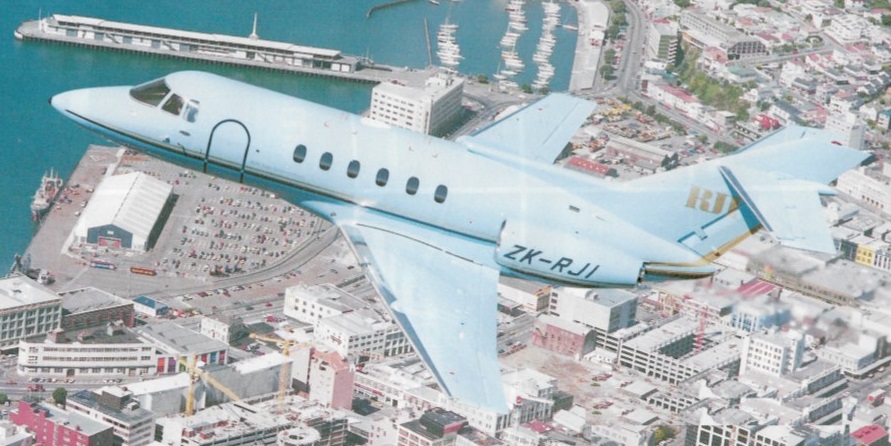
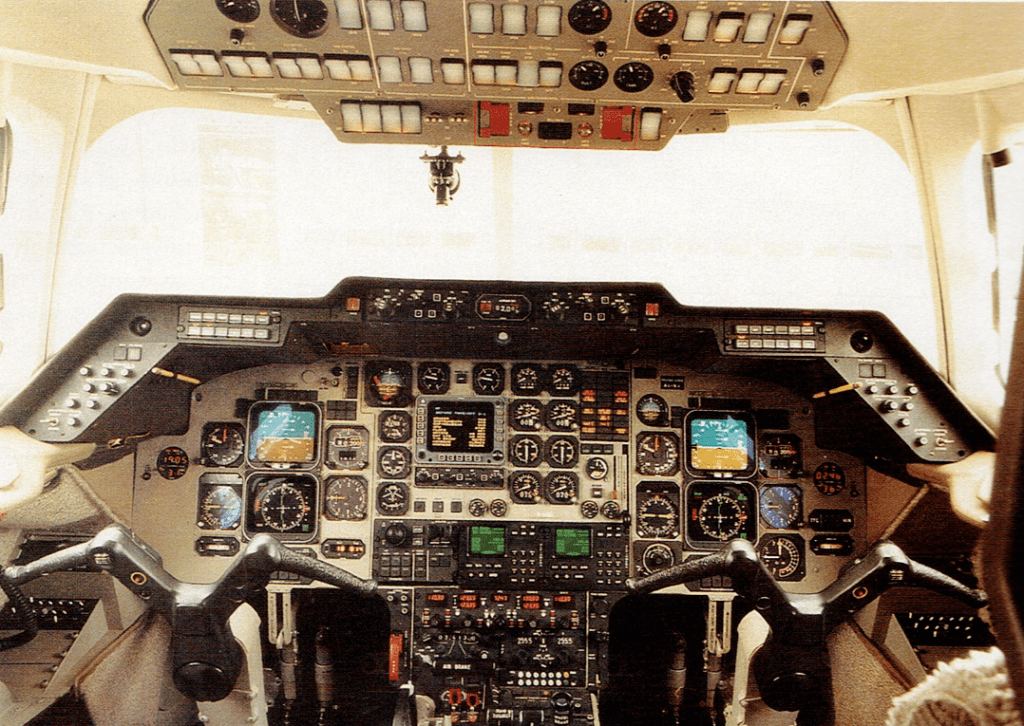
By 1985, 585 DH125 derivatives had been ordered.
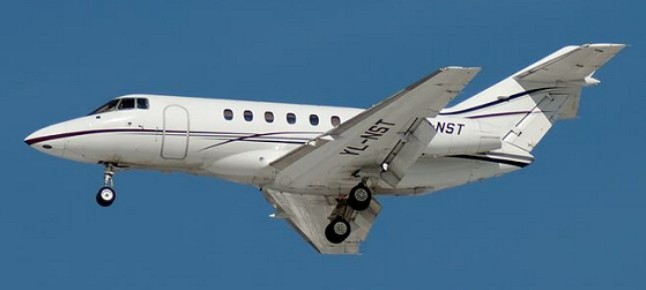
The series 800 Hawkers were built in the UK until Raytheon purchased the production rights from Hawker Siddeley in 1993, and two years later the 800XP went into service. Over 1,000 of both models flying. The 800XP got an interior upgrade in 1999. Pilots got the Honeywell SPZ 8000 avionics suite or can choose the Rockwell Collins EFIX-86 system as an option. The Hawker 800XP has been extremely well received for fractional aircraft ownership programs, as well as finding service with the U.S. Air Force, the Republic of China and in Japan.
After the purchase of the BAe Corporate Jets division by Raytheon, the BAe 125-800 was renamed the Hawker 800, and the BAE 125-1000 renamed the Hawker 1000. Hawker 1000 variant production ended in 1998.
The Japanese Air Self Defence Force have selected three BAe 125 800s for flight inspection duties in 1989, the first time in the history of the JASDF that a non American, foreign-built aircraft has been ordered. These were designated U-129As.
Orders exceed 187 by 1990, in addition to 573 of earlier versions, and the USAF took delivery of six BAe 125-800s, designated C 29A, for flight inspection duties in 1989.
In 1996, production was transferred to United States.
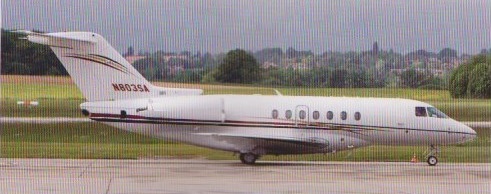
HS125 Srs 400
Engines: Two 3,360 lb (1,525 kg) st Rolls Royce Bristol Viper 522 turbojet.
Wing span: 47 ft 0 in (14.33 m)
Length: 47 ft 5 in (14.45 m).
Wing area: 353 sq ft (32.8 sq.m).
Gross weight: 23,300 lb (10,568 kg).
Max cruising speed: 510 mph (821 kph) at 31,000 ft (9,450 m).
Typical range: 1,762 miles (2,835 km).
Accommodation: 12 passengers
Crew: 2
DH125-600
Engines: 2 x Rolls Royce Vi¬per 601 turbofans, 3,750 lb.
Wing span: 47 ft 0 in (14.33 m).
Length: 50 ft 5.75 in (15.39 m).
Height: 17 ft 3 in (3.51 m).
Max TO wt: 25,000 lb (11,340 kg).
Empty wt. 12,700 lb
Max level speed: 345 mph (555 kph).
Stall 94 mph
Initial climb rate 4,500 fpm
Ceiling 41,000 ft.
Fuel cap: 9,450 lb.
Max range 45min res: 1,570 nm.
Max operating speed: 345 mph (555 km/h) IAS.
Takeoff distance (50′) 5,350 ft.
Landing distance (50′) 2,550 ft.
Seats 9
BAe125-700
Engines: 2 x Garrett TFE 731-3R, 3700 lbs thrust.
Seats: 8/14.
Length: 50.8 ft.
Height: 17.6 ft.
Wingspan: 47 ft.
Wing area: 353 sq.ft.
Wing aspect ratio: 6.3.
Maximum ramp weight: 25,000 lbs.
Maximum takeoff weight: 24,800 lbs.
Standard empty weight: 13,700 lbs.
Maximum useful load: 11,300 lbs.
Zero-fuel weight: 16,050 lbs.
Maximum landing weight: 22,000 lbs.
Wing loading: 70.3 lbs/sq.ft.
Power loading: 3.4 lbs/lb.
Maximum usable fuel: 9450 lbs.
Best rate of climb: 3000.
Certificated ceiling: 41,000 ft.
Max pressurisation differential: 8.4 psi.
8000 ft cabin alt @: 41,000 ft.
Maximum single-engine rate of climb: 1350 fpm @ 195 kts.
Single-engine climb gradient: 415 ft/nm.
Single-engine ceiling: 21,600 ft.
Maximum speed: 450 kts.
Normal cruise @ 37,000ft: 428 kts.
Fuel flow @ normal cruise: 1450 pph.
Stalling speed clean: 119 kts.
Stalling speed gear/flaps down: 83 kts.
Turbulent-air penetration speed: 230 kts.
BAe125-800
Engines: 2 x Garrett TFE 731-5R-1H turbofans.
Max cruise: 533 mph.
Economy cruise: 461 mph at 40,000 feet over 3454 miles (5560 km).
Pax cap: 14.
Hawker 800XP
Engines two 4,669-lb. Honeywell TFE731-5BR turbofans
Gross wt. 28,120 lb.
Empty wt. 16,245 lb.
Fuel capacity 1,492 gal
Max cruise 447 kts
Long range cruise 402 kts
Range 2,285-2,621 nm.
Ceiling 41,000 ft
Takeoff distance 5,030 ft
Landing distance 2,650 ft
Seats 8-15
Hawker Siddeley HS 125 Dominie T. Mk 1
Engine : Bristol Siddeley Viper 301, 13342 N / 1360 kp
Length : 47.408 ft / 14.45 m
Height: 16.503 ft / 5.03 m
Wingspan : 47.014 ft / 14.33 m
Wing area : 352.952 sqft / 32.79 sq.m
Max take off weight : 21201.1 lb / 9615.0 kg
Weight empty : 11404.3 lb / 5172.0 kg
Max. speed : 435 kts / 805 km/h
Service ceiling : 41011 ft / 12500 m
Wing load : 60.07 lb/sq.ft / 293.0 kg/sq.m
Range : 1477 nm / 2736 km
Crew : 2
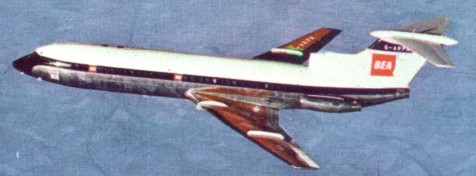
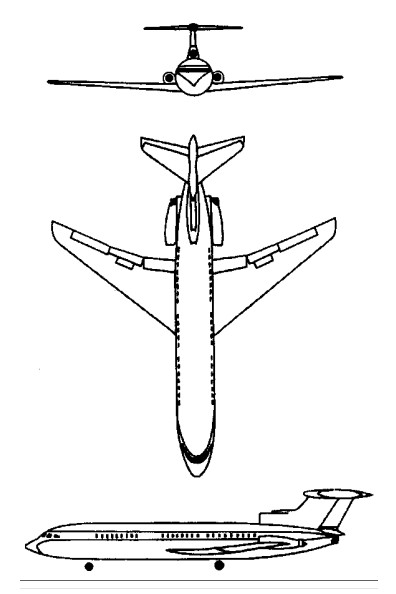
The British Trident began life in 1958 as the de Havilland 121. Designed to cruise at over 600 mph, this aircraft has a T-tail, triplex powered controls (three separate power units driving each control surface), four small wheels on each main landing-gear leg, and an offset sideways-retracting nose gear. The Trident pioneered truly blind autolanding, and was the first airliner in the world to be certificated for automatic landing in passenger service, a year after beginning scheduled flights with BEA in April 1964. The advanced flight control system, together with the Smiths autopilot, enables the aircraft to lock onto ground radio beams and, using auto-throttle to control airspeed, descend along the glidepath to touchdown.
The world’s first fully automatic landing by a passenger-carrying jet was made in 1965 by a BEA Trident at London’s Heathrow Airport in daylight.
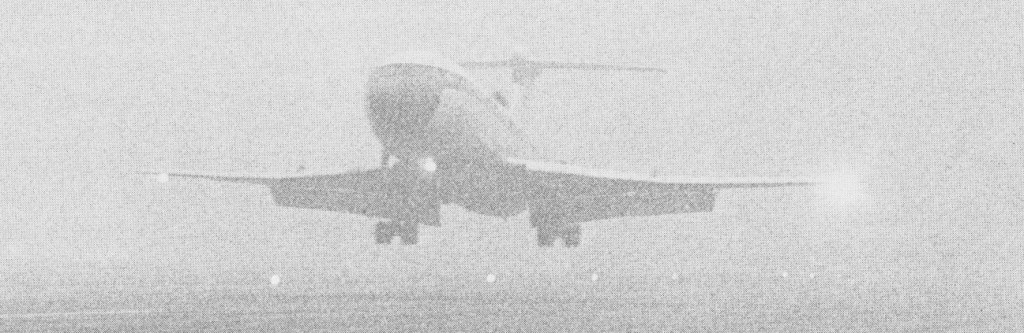
The first flew on January 9, 1962. It has been produced in four models. The IE featured accommodations for a maximum of 115 passengers and was powered by 11,400-lb. s.t. turbofans.
The 2E was the long range version with more fuel, operating non stop between London and the Middle East. The 2F featured increased fuel capacity and takeoff weight and was fitted with 11,960-lb. s.t. turbofans. The 3B was a high capacity short-haul transport with a lengthened fuselage and the addition of a 5,250-lb. s.t. turbojet in the tail for better takeoff performance. The Super 3B was an upgraded version of the 3B.
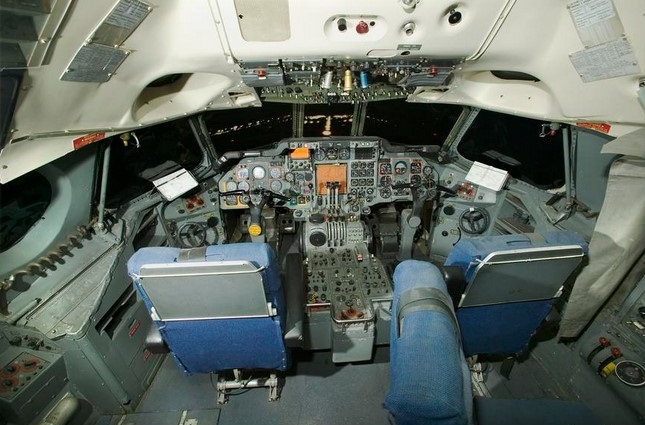
117 Tridents, including over 30 of the stretched long-range 3B, were sold.
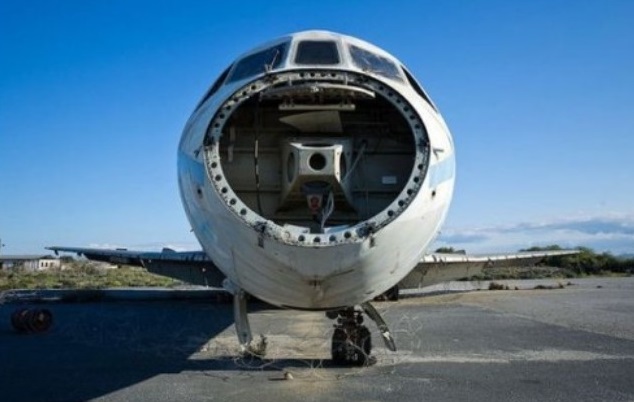
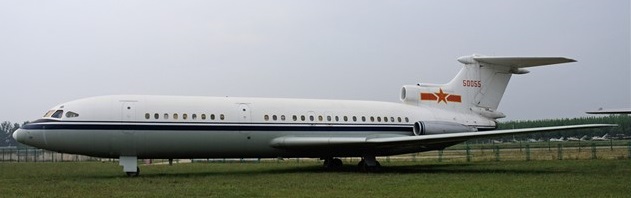
Over a dozen of Hawker Siddeley HS.121 Tridents were used by the Peoples Republic Air Force.
De Havilland DH 121 Trident
Length: 114.829 ft / 35.0 m
Height : 26.903 ft / 8.2 m
Wingspan : 89.895 ft / 27.4 m
Wing area : 1358.417 sq.ft / 126.2 sq.m
Max take off weight : 115030.4 lb / 52168.0 kg
Weight empty : 67473.0 lb / 30600.0 kg
Max. payload weight : 20316.9 lb / 9214.0 kg
Max. weight carried : 47557.4 lb / 21568.0 kg
Max. speed : 529 kt / 980 km/h
Cruising altitude : 29528 ft / 9000 m
Wing load : 84.67 lb/sq.ft / 413.0 kg/sq.m
Maximum range : 2484 nm / 4600 km
Range : 2484 nm / 4600 km
Range (max. weight) : 1577 nm / 2920 km
Engine : 3 x Rolls Royce Spey RB 1631, 43831 N
Crew : 3 + 77-103 pax
Trident IE
Engines: 3 x 11,400-lb. s.t. turbofans.
Accommodation: 115
Trident 2E
Engines: 4 x Rolls-Royce Spey RB.163-25 Mk 512-5W turbo-fans, 53.2kN / 11,930 lb. (5,410 kg.)
Max take-off weight: 65318 kg / 144002 lb
Empty weight: 33203 kg / 73200 lb
Wingspan: 29.87 m / 97 ft 12 in
Length: 34.98 m / 114 ft 9 in
Height: 8.23 m / 27 ft 0 in
Wing area: 135.26 sq.m / 1455.93 sq ft
Cruise speed: 974 km/h / 605 mph
Ceiling: 9100 m / 29850 ft
Range: 3965 km / 2464 miles
Crew: 3
Passengers: 140
Trident 2F
Engines: 3 x 11,960-lb. s.t. turbofans.
Trident 3B
Engines three 11,960-lb. s.t. turbofans and one 5,250-lb. s.t Rolls-Royce Spey turbojet.
Wing span: 98 ft 0 in (29.87 m).
Length: 131 ft 2 in (39.98 m).
Height: 28 ft 3 in (8.61 m).
Max TO wt: 150,000 lb (68,040 kg)
Empty wt. 81,778 lb
Fuel capacity 6,750 imp Gal.
Max level speed: 605 mph (972 kph).
Cruise speed 533 mph.
Stall 129 mph.
Range 1,785 miles.
Takeoff distance (35′) 8,900 ft.
Seats 97-180.

DH 113 Vampire / DH 115 Vampire two-seaters Article
In 1953, the RAF introduced two new trainers into service, the piston engined Percival Provost T.1, which replaced the Prentice, and the jet powered DH Vampire T.11 which replaced the Harvard and the Meteor T.7 with the Advanced Flying Schools. The DH. 115 Vampire T.11 was based upon the earlier two seat DH.113 Vampire night fighter variants, but deleted the radar and introduced dual controls. All the control surfaces are cable-operated through a series of pulleys, only the flaps, airbrakes and undercarriage are hydraulic—even the wheel brakes are pneumatic. One of Vampire’s features is its composite wood and metal construction. Between the first bulkhead and the fourth (which is just forward of the engine) the fuselage is wood and fabric. The rest of the fuselage, as well as the wings, booms and tail, is flush-riveted aluminium. The Goblin engine has a total oil loss design, which means that there is no oil scavenger pump, oil filter, cooler and so on. The engine is a centrifugal-flow turbojet, about 3,000 lbs of thrust.
de Havilland DH 115 Vampire Article
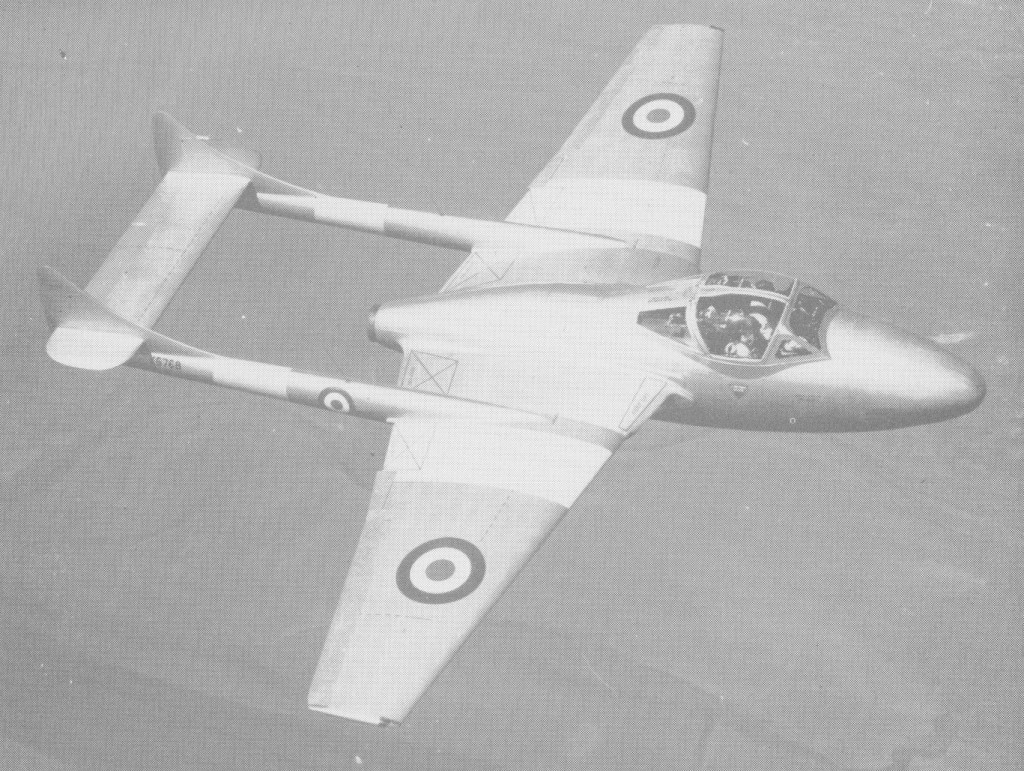
Vampire production terminated with the Vampire T.Mk.11 and Vampire T.Mk.22 two-seat trainers for the RAF and Fleet Air Arm, 804 being completed between 1951 and 1958; this mark also achieved considerable export success.
The T.55 being the export version of the RAF’s T.11. Some operated by Zimbabwe.
In 1964, DH-115 Vampire T35 A79-617 was fitted with Sidewinder missile guidance equipment.
DH-115 Vampire T35
Engine: De Havilland Goblin 35 Centrifugal flow turbojet, 3500lb (1588kg)
Fuel: Aviation Turbine Fuel (Jet Fuel)
Centre Tank Capacity: 96 ImpGal / 436 Lt / 115 USG
Wing Tank Capacity (2): 52 ImpGal / 236 Lt / 62 USG
Leading Edge Tank Capacity (2): 65 ImpGal / 296 Lt / 78 USG
Drop Tank Capacity: 100 Impl Gal / 454 Lt / 120 USGs
Wingspan: 38 ft 0 in / 11.58 m
Length: 34 ft 9 in / 9.37 m
Wing Area: 262 sq. ft / 24.34 sq. m
Height: 6 ft 2 in / 1.88 m
Empty weight: 7,253 lb / 3,290 kg
Max Takeoff weight: 12,360 lb / 5,606 kg
Armament: two or four 20mm Hispano Cannons, two 500 or 1,000lb (227 or 454 kg) bombs or eight 60lb (27kg) rocket projectiles.
Maximum Speed: 461 kt / 531 mph / 855 km/h
Cruise Speed: 275 kt / 316 mph / 509 km/h
De Havilland DH 115 Vampire T.Mk 55
Engine: De Havilland Goblin 35b, 14911 N
Length : 34.416 ft / 10.49 m
Height : 6.594 ft / 2.01 m
Wingspan : 37.992 ft / 11.58 m
Wing area : 271.468 sq.ft / 25.22 sq.m
Max take off weight : 13613.7 lb / 6174.0 kg
Weight empty : 7902.7 lb / 3584.0 kg
Max. weight carried : 5711.0 lb / 2590.0 kg
Max. speed : 454 kts / 840 km/h
Initial climb rate : 3346.46 ft/min / 17.0 m/s
Service ceiling : 32808 ft / 10000 m
Wing loading: 50.23 lb/sq.ft / 245.0 kg/sq.m
Range : 324 nm / 600 km
Endurance: 1 h
Crew: 2
Armament: 2x MK20mm Hispano 404; 2 Bomb 227kg
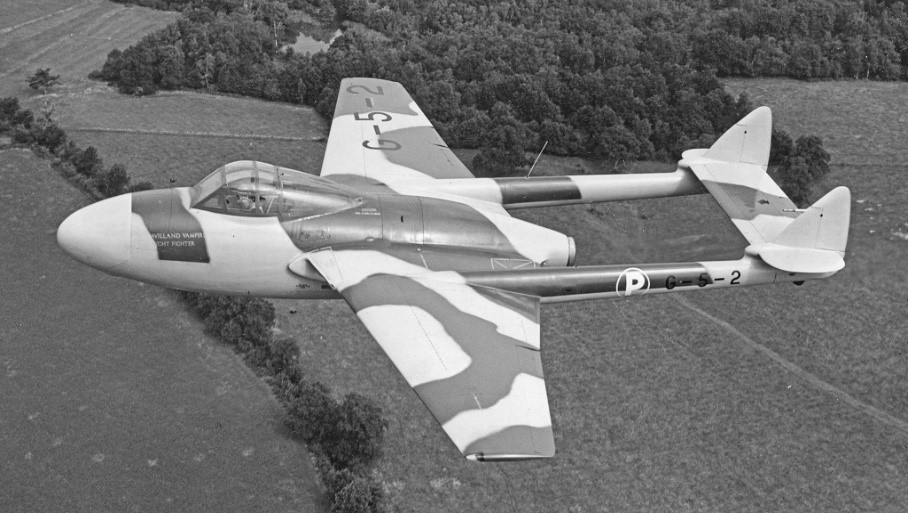
Although developed earlier than the Venom, the DH113 Vampire Night-Fighter (NF) had a later type number in the company sequence by the time it was produced. It was developed from the single-seat Vampire FB.5 as a private venture low-cost Night-Fighter for the export market. It featured lengthened and wider two-seat, side-by-side arrangement and a wooden fuselage nacelle with AI Mk.10 radar within a nose radome. A more powerful 3,350 lb Goblin 3 engine was fitted and first flight was from Hatfield on 28th August 1949 by Geoffrey Pike.
de Havilland DH 113 Vampire Article
The first prototype DH Vampire NF10 (G-5-2) was flown for the first time at Hatfield on 28th August 1949 with test pilot Geoffrey Pike at the controls. Nine days later it made its public debut at the SBAC Show at Farnborough and just a month later Egypt became its first customer when it ordered 12 aircraft. This order was never fulfilled due to a UK Government enforce embargo due to the increasing hostilities between Egypt and Israel.
DH 113 Vampire / DH 115 Vampire two-seaters Article
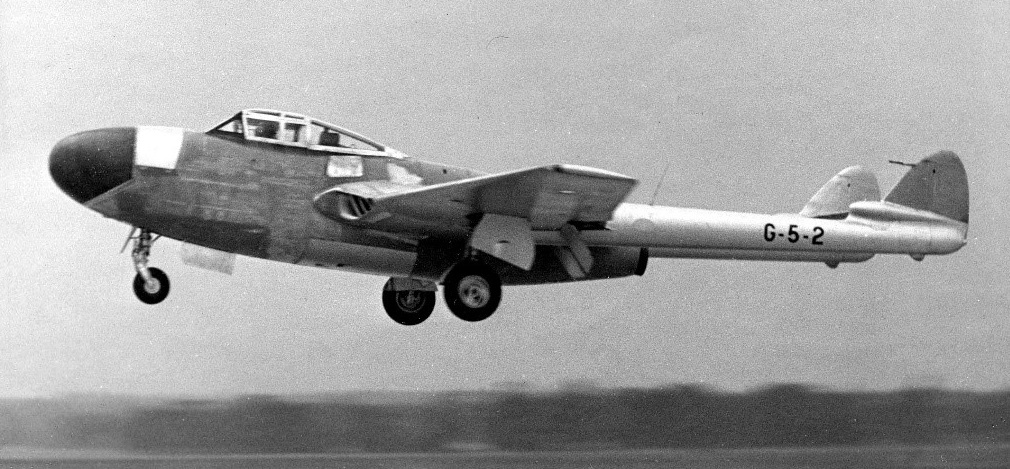
The enlarged nose section resulted in concerns over both directional and longitudinal stability as well as overall control and because of this the prototype was test flown with enlarged triangular tail fins.
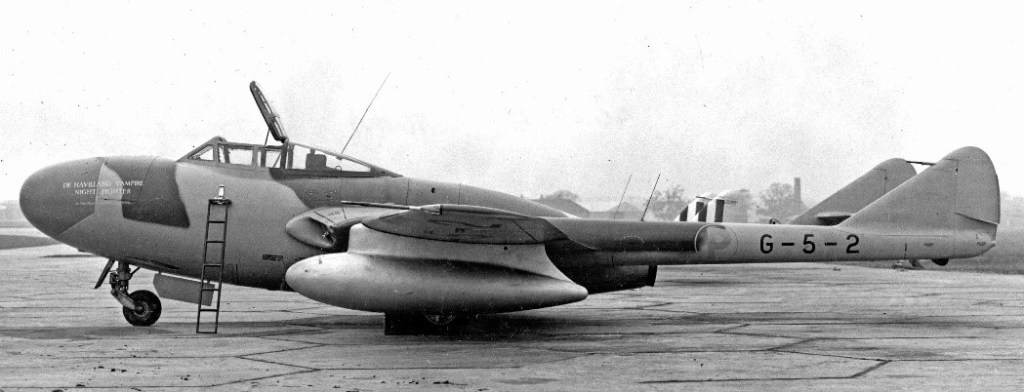
These were later found not to be necessary and were not fitted to production aircraft. An increase in tailplane span was required however and this is a characteristic feature of production two-seat Vampires. The extended tailplane was also used by the DH112 Venom and Sea Venom.
The RAF took over the Egyptian Air Force order and put them into service as an interim measure between the retirement of the de Havilland Mosquito night fighter and the full introduction of the Meteor night fighter.
Three prototypes were built, the third of which was completed as the prototype night fighter, the DH112 Venom. The DH113 was originally designed utilising the wings and tail of the single-seat vampire day-fighter which could accommodate a side-by-side configuration, albeit slight offset behind the pilot.
Those DH113 Vampire NF10 aircraft that were originally ordered by Egypt were taken into RAF service in the UK as the NF.Mk.10 and this then led to the further procurement of additional RAF aircraft. Initial service deliveries of the NF.10 were in the spring of 1951. Crews were never happy about the lack of ejection seats. Only 78 NF.10s were built, and they only remained in front-line service to 1954.
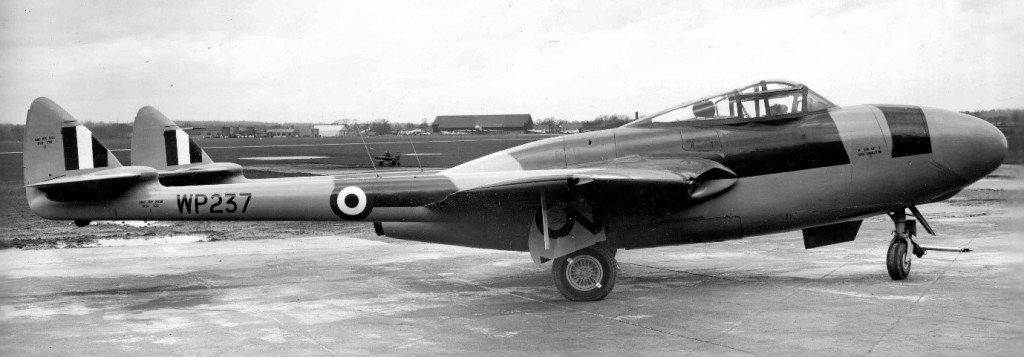
The aircraft became the first RAF jet Night-Fighter when the initial Vampires replaced Mosquitos of 25 Squadron at West Malling in July 1951, two other home-defence units (RAF Coltishall and RAF Leuchars) were also equipped with this aircraft. By November 1953 the short operational life began coming to an end with the arrival of the Venom NF.2s for 23 Squadron.
Equipped with an AI Mk X radar, the type was also operated by the Indian and Italian Air Forces.
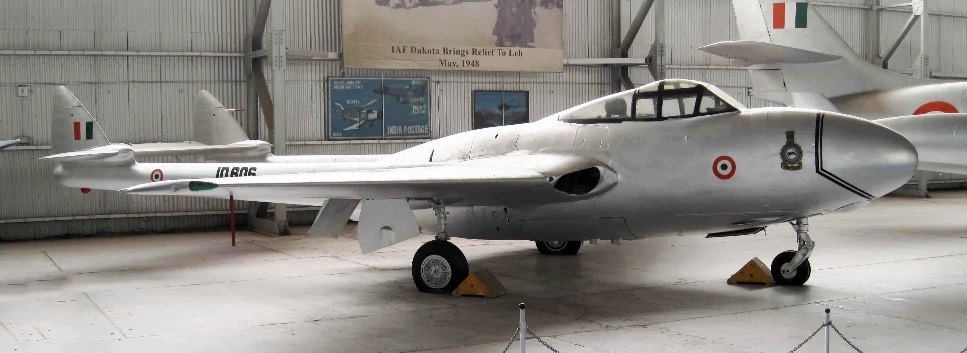
Export sales were to Switzerland, who had one example for evaluation, and Italy, followed by India who acquired surplus RAF aircraft. Thirty-six NF.10s were converted to a navigation trainer and redesignated “Vampire NF(T).10”. The AI.X radar was replaced by ballast in the form of concrete blocks, and the navigation kit was upgraded. They were modified for navigation training with a clear-view canopy, but still without ejector seats. These aircraft were used by 1 ANS at Topcliffe, 2 ANS at Thorney Island and the Central Navigation & Control School (CNCS) at Shawbury, the last retiring in September 1959.
Total production was of 93 aircraft, comprising three prototypes, 76 aircraft for the RAF and 14 Vampire NF54 aircraft for the Italian Air Force. De Havilland built an export variant of the NF.10 designated the “Vampire NF.54”. A total of 14 was built for Italy and delivered in 1952:1953; 30 retired NF.10s were also refurbished to the NF.54 configuration for India, with deliveries from 1954 to 1958.
Removal of the radar from the night fighter and fitting of dual controls resulted in a jet trainer model of the aircraft, the DH.115 Vampire which entered British service as the Vampire T.11.
Surviving DH 113 are Vampire NF10 ID606 at the Indian Air Force Museum, Palam, New Delhi, India, and Vampire NF54 MM6152 at the Italian Air Force Museum, Vigna di Valle, Italy.
Engine: De Havilland Goblin 35 B, 14911 N / 3,350 lbst
Length: 34.613 ft / 10.55 m
Height: 6.562 ft / 2.0 m
Wingspan: 38.025 ft / 11.59 m
Wing area: 262.642 sq.ft / 24.4 sq.m
Max take off weight: 13119.8 lb / 5950.0 kg
Weight empty: 7673.4 lb / 3480.0 kg
Max. weight carried: 5446.4 lb / 2470.0 kg
Max. speed: 454 kts / 840 km/h / 538 mph at sea level
Initial climb rate: 3346.46 ft/min / 17.0 m/s
Service ceiling: 32808 ft / 10000 m
Wing load: 50.02 lb/sq.ft / 244.0 kg/sq.m
Range: 324 nm / 600 km
Range with drop tanks: 1,220 miles
Endurance: 1 h
Crew: 2
Armament: four 20mm Hispano cannon
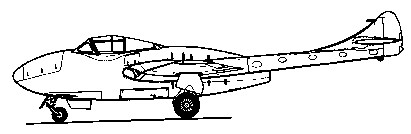
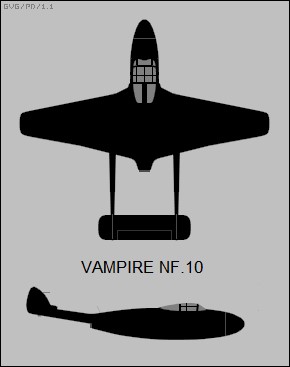
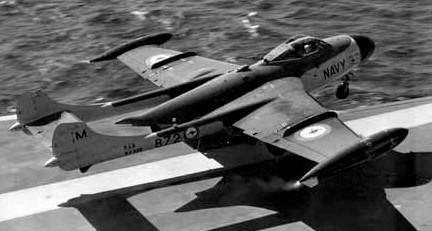
The Venom was a development of the Vampire, designed to accommodate the de Havilland Ghost engine and with aerodynamic refinements enabling it to take full advantage of the increased power. The nacelle and tail assembly were substantially similar to those of the Vampire, but the wings were entirely new, with square tips, very thin section and jettisonable long-range wingtip tanks. Fences were incorporated into the top surface of the wings to direct airflow, and wingtip fuel tanks were fitted as standard.
Originally designated the Vampire FB Mk.8, the Venom FB.1 was the first version for the RAF: a day fighter and fighter-bomber with provision for bombs and rockets in addition to the standard four 20 mm Hispano Mk 5 cannon in the nose. The prototype of this version flew for the first time on 2 September 1949 and entered squadron service in September 1952. A total of 373 FB.1 were built, powered by one de Havilland Ghost 103 turbojet of 4850 lbs thrust.
Built by the Swiss under licence in the early 1950s, the FB.Mk.1 designated by the Swiss Flugwaffe as the FB.Mk.50.
Fences were incorporated into the top surface of the wings to direct airflow, and wingtip fuel tanks were fitted as standard. The Venom FB 1 had four Hispano 20mm cannon in the nose and hard points under the wings for up to 2,000lb of bombs or rockets.
Introduced in 1955 was the single seat Venom, the FB. 4 (D.H. Ghost 103), with powered ailerons, an ejection seat and under wing fuel tanks in addition to the tip tanks. These new external tanks have a very high fineness ratio and a minute tailplane for stability. The FB.4 also had completely revised fin outlines, with both the front bullet fairing of the earlier Venoms and the rear bullet fairing of the Sea Venoms.
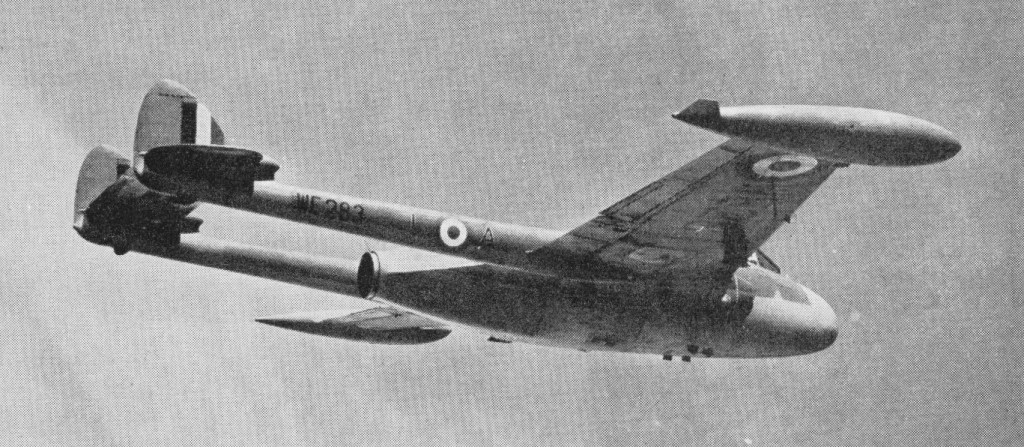
A two-seat night fighting version of the single-seat Venom fighter was evolved in the same way that the Vampire night fighter was derived from the original Vampire, and a company-funded prototype was first flown on 23 August 1950. The front fuselage was lengthened and widened to accom¬modate Al Mk 10 radar and crew of two side-by-side, the remainder of the airframe being basically as Venom 1 and the engine being the 4,850 lb st (2200 kgp) Ghost 104. Ninety similar Venom NF Mk 2s (first flight 4 March 1952) were delivered to the RAF from 1953 onwards, many later being modified to NF Mk 2A standard with revised tail units, including dorsal fins and acorn fairings, and clear-view canopies.
Further tail unit changes distinguished the Venom NF Mk 3, first flown on 22 February 1953; 129 were built for the RAF with Al Mk 21 radar, powered ailerons, 5,150 lb st (2338 kgp) Ghost 105 engine and other changes. Sweden’s Flygvapnet bought 62 Venom NF Mk 51s, similar to the NF Mk 2s and powered by Swedish-built Ghost RM 2A engines; they served from 1953 to 1960.
Following the evaluation of a standard RAF Venom NF.Mk 2 night-fighter during the course of 1950, the Royal Navy ordered three fully navalized prototype aircraft to Specification N.107, as the de Havilland Sea Venom NF. (later FAW, for Fighter, all-weather) Mk 20, the first of which made its maiden flight on 19 April 1951. Principal Naval features were a V-type arrester hook, strengthened longer-stroke undercarriage, catapult pick-up points and (from the third prototype onwards) folding wings with tip tanks of revised design.
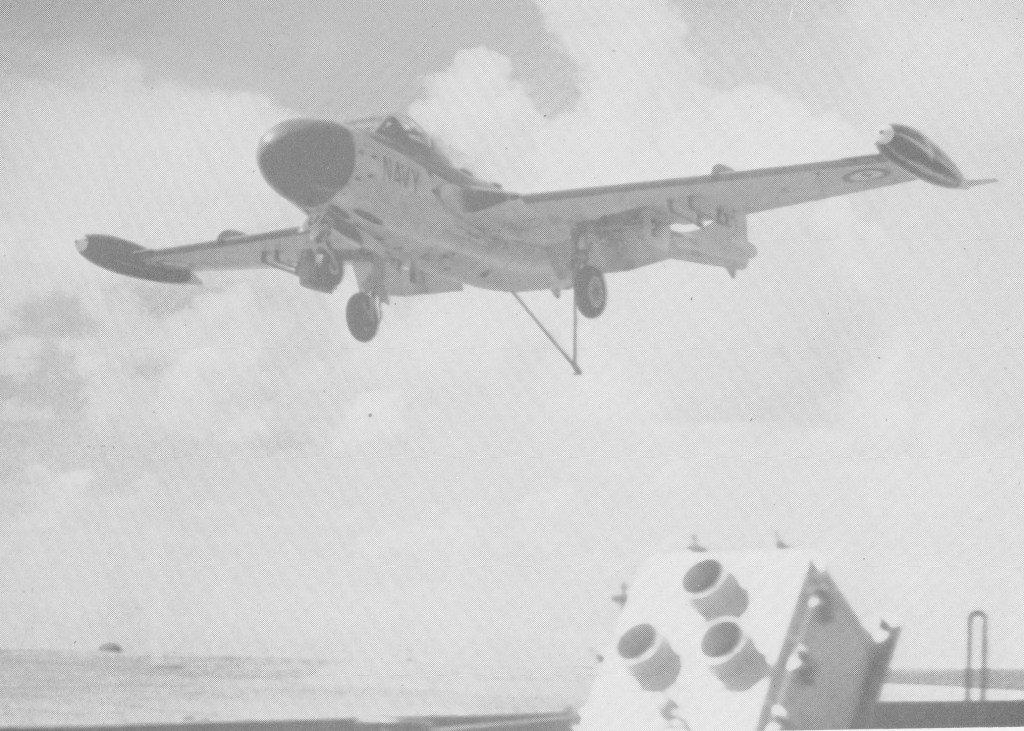
Subsequent carrier compatibility trials conducted aboard HMS illustrious showed that the type possessed considerable promise, and an initial batch of 50 production Sea Venom NF.Mk 20s was contracted, deliveries getting under way during the mid-1950s. Attaining operational status with No. 890 Squadron aboard HMS Albion in July 1955
Following the NF.Mk 20 was the Sea Venom FAW.Mk 21, which used the more powerful Ghost 104 turbojet engine, Martin-Baker ejection seats and which was also fitted with American APS-57 airborne interception radar. Deliveries of the Sea Venom FAW.Mk 21 began before the Sea Venom NF. Mk 20 became operational, the delivery beginning in May 1955 of what eventually became the most widely used version, a total of 167 being built for service with the Fleet Air Arm.
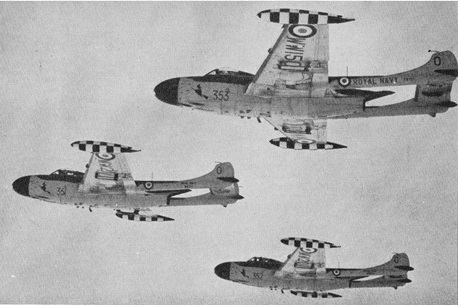
Production of the Sea Venom was completed with 39 examples of the Sea Venom FAW.Mk 23, which dif-fered mainly by virtue of being pow¬ered by the Ghost 105 turbojet.
Sea Venoms were also operated by the Royal Australian Navy which received 39 NF.53 (similar to F(AW).21) from 27 February 1955. British-operated Venoms and Sea Venoms were withdrawn from operational service in 1962 and 1960 respectively.
Failure of the shipboard fighter requirement issued by the Service Technique Aeronautique in June 1946 (and which had resulted in Aerocentre NC 1080, Arsenal VG 90 and Nord 2200 prototypes being built) led to consideration being given to adoption by the Aeronavale of the Grumman F9F-5 Panther. In January 1951, however, the Ministere de la Marine announced the decision to adopt the de Havilland Sea Venom Mk 20, which was being developed for the Royal Navy as a side-by-side two-seat shipboard all-weather fighter and had yet to enter flight test. Four aircraft were supplied to the SNCASE in knocked down form for assembly as a “pre-series”, the first of these flying on 31 October 1952, and the name Aquilon (North Wind) being adopted. A fifth “pre-series” aircraft and 25 production aircraft employing sub-assemblies provided by Airspeed, the first known as Aquilon 20s and subsequentl aircraft as Aquilon 201s, the first of these flying on 24 March 1954 (The designation Sea Venom NF Mk 52 referred to a version licensed for production by SNCASE). These were powered by the 4,850 lb st / 2200kg Fiat-built de Havilland Ghost 48 Mk 1, armament comprising four 20mm cannon. Non-availability of the intended Thomson AI radar restricted the Aquilon 201s to diurnal operation, the same restriction being imposed on the next 25 aircraft which, delivered as Aquilon 202s, were entirely manufactured in France and differed in having ejection seats, an aft-sliding rather than aft-hinged cockpit canopy and a strengthened undercarriage. A decision was taken to adopt the Westinghouse APQ 65 AI radar, but, without major redesign of the airframe, it was found impossible to fit this equipment in the ejection seat-equipped two-seater. Production therefore continued with the Aquilon 203 single-seater, the last 25 of the 40 production examples of this version being equipped with APQ 65 radar as were the six two-seat Aquilon 204 radar trainers (not fitted with ejection seats) that brought production to an end, the last of these being flown at the beginning of 1958. The Aquilon was flown operationally by Flottilles 11F and 16F, eventually serving in the fighter training role and being phased out during 1964-65.
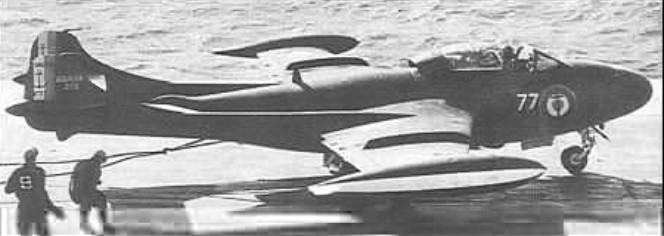
During 1955-58 sixteen served with the Royal New Zealand Air Force.
de Havilland DH112
Engine: de Havilland Ghost 103 turbojet, 4850 lbf thrust
Length: 31 ft 10 in (9.7 m)
Wingspan: 41 ft 8 in (12.7 m)
Maximum speed: 640 mph (1030 kph)
Range: 1080 miles (1730 km)
Service Ceiling: 39,400 ft (12,000 m)
Venom FB.1 / FB.50
Engine: De Havilland Ghost 48 Mk I, 21778 N
Length: 32.087 ft / 9.78 m
Height: 6.168 ft / 1.88 m
Wingspan: 41.732 ft / 12.72 m
Wing area: 279.003 sq.ft / 25.92 sq.m
Max take off weight: 15655.5 lb / 7100.0 kg
Weight empty: 8820.0 lb / 4000.0 kg
Max. weight carried: 6835.5 lb / 3100.0 kg
Max speed: 640 mph below 20,000 ft.
Initial ROC: 7230 fpm.
Service ceiling: 39370 ft / 12000 m
Wing load : 56.17 lb/sq.ft / 274.0 kg/sq.m
Range : 378 nm / 700 km
Endurance : 1 h
Armament: 4 x 20mm mg, 2000 lbs of bombs or 8 x 60 lb rockets.
Range (max): 1075 mile.
Crew: 1
Venom FB.4
Engine: one 2336-kg (5,150-tb) thrust de Havilland Ghost 105 turbojet.
Maximum speed 961 km/h (597 mph) at sea level
Initial climb rate 2204 m (7,230 ft) per minute
Service ceiling 14630 m (48,000 ft)
Range 1730 kin (1,075 miles).
Empty weight 3674 kg (8,100 lb)
MTOW: 7180 kg (15,830 lb)
Wingspan 12.70 m (41 ft 8 in)
Length 10.06 m (33 ft 0 in)
Height 2.03 m (6 ft 8 in)
Wing area 25.99 sq.m (279.75 sq ft)
Armament: four 20-mm Hispano cannon, 907 kg (2,000 lb) of external stores
Venom NF Mk 3
Engine: DH Ghost 104.
Max speeds, 576 mph (927 km/h) at sea level,
555 mph (893 km/h) at 30,000 ft (9145 m)
529 mph above 40,000 ft (12 200 m).
Initial climb rate, 6,280 ft/min (31,9 m/sec).
Patrol duration, 1.85 hrs.
Loaded weight, 14,400 lb (6538 kg).
Span, 42 ft 10 in (13,06 m).
Length, 36 ft 8 in (11,17 m).
Height, 6 ft 6 in (1,98 m).
Wing area, 279.75 sq ft (25,99sq.m).
Sea Venom FAW Mk 20
Engine: Ghost 103.
Sea Venom FAW.Mk 21
Engine: one 2245-kg (4,950-lb) thrust de Havilland Ghost 104 turbojet.
Maximum speed 1014 km/h (630 mph) at sea level
Service ceiling 14995 m (49,200 ft)
Range 1609 km (1,000 miles)
Maximum take-off 7212 kg (15,900 lb)
Wingspan 13.08 m (42 ft 11 in)
Length 11.15 m (36 ft 7 in)
Height 2.59 m (8 ft 6 in)
Wing area 25.99 sq.m (279.75 sq ft).
Armament: four 20-mm cannon, 907 kg (2,000 lb) of external ordnance
Sea Venom FAW Mk 22
Engine: de Havilland Ghost 104, 4850 lb
Span: 42 ft 10 in (13,06 m).
Length: 36 ft 8 in (11,17 m).
Height: 8 ft 6¼ in (2,62 m).
Wing area: 279.75 sq ft (25.99 sq.m).
MTOW: 15,400 lb (6980 kg).
Max speeds: 576 mph (926 km/h) at sea level
555 mph (893 km/h) at 30,000 ft (9150 in).
Initial climb rate: 5,750 ft/min (29,2 m/sec).
Service ceiling: 37,000 ft
Patrol duration: 1.73 hrs.
Armament: 4 x 20mm cannon
Sea Venom F.A.W. Mk 53
Engine One 5,300lb thrust De Havilland Ghost 105
Wing Span: 42 ft 10 in
Length: 36 ft 8 in
Height: 8 ft 6.25 in
Weight 15,000 (loaded)
Initial Rate of Climb: 5,900 ft per minute
Ceiling: 40,000 ft
Speed: 575 mph
Range: 705 miles
Armament
Guns: 4 x 20 mm (150 rounds per gun)
Bombs: 8 x 60lb rockets
Crew 2
Aquilon 203
Loaded weight: 5500 kg / 12125 lb
Wingspan: 13.07 m / 43 ft 11 in
Length: 11.17 m / 37 ft 8 in
Height: 2.60 m / 9 ft 6 in
Wing area: 26.00 sq.m / 279.86 sq ft
Max. speed: 935 km/h / 581 mph
Range w/max.fuel: 1557 km / 968 miles
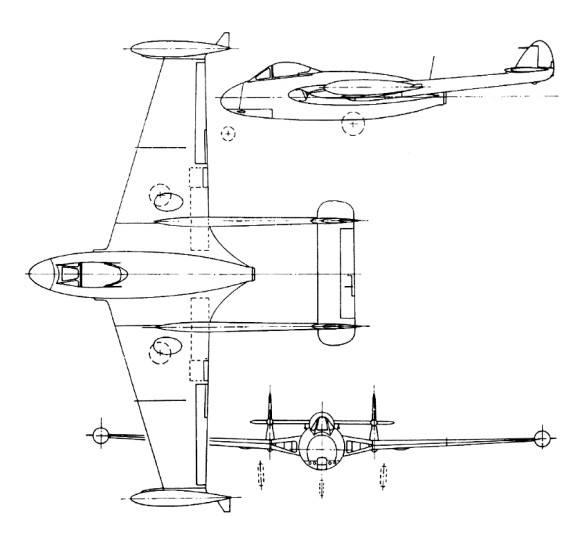
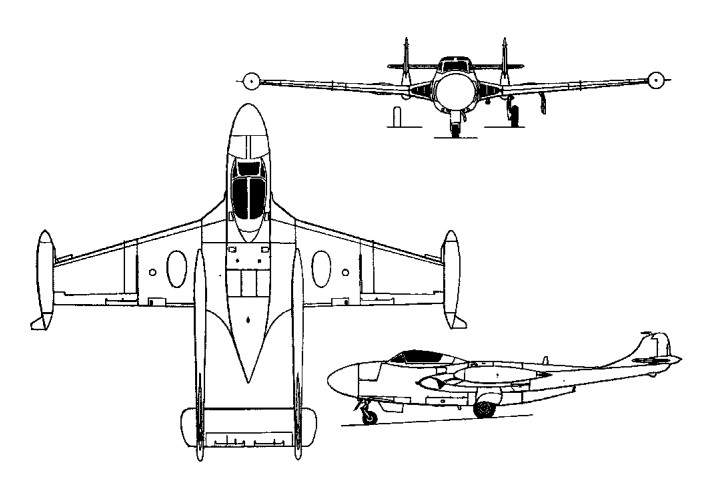
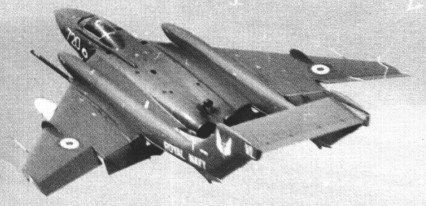
The D.H.110 was designed during 1946 to meet the requirements of the Royal Navy for an advanced carrier-based all-weather fighter (Specification N.40/46) and of the RAF for a night fighter (F.44/46). In 1949, orders were placed for seven night fighters and two long range fighter prototypes for the RAF and two night fighter and two strike fighter prototypes for the RN, but the Naval version was later cancelled and the RAF order reduced to two (to Specification F.4/48) on economy grounds.
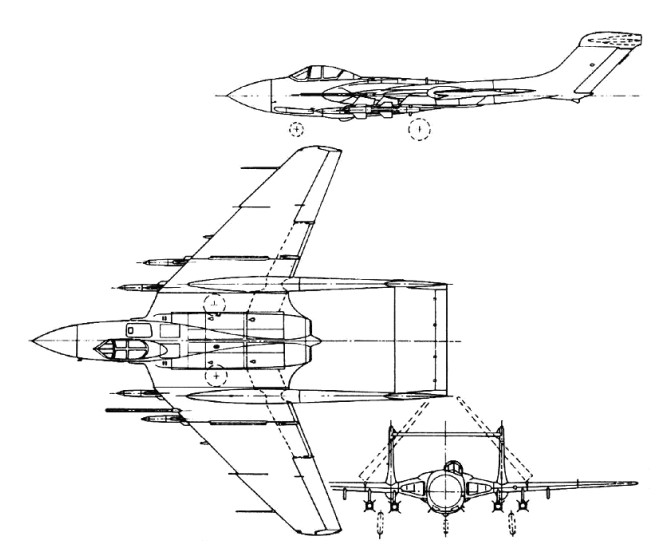
The mid-set wings have 40 degrees sweepback and conventional ailerons, rudders and Fowler flaps are fitted. The rear portion of the all-moving tailplane is deflected upward separately to avoid trim changes when the flaps are lowered. ‘Dog-tooth’ wing leading edges, air intakes in the wing roots and a large air-brake under the centre-fuselage are fitted.
The tricycle undercarriage has a single wheel on each unit. The main wheels retract inward into the wings, and the nose wheel retracts rearward.
A fire-control radar is fitted in the nose.
de Havilland DH 110 Sea Vixen article
The prototypes first flew on 26 September 1951 and 25 July 1952, powered by 7,500 lb st (3405 kgp) Avon RA7s. The pilot occupied a single cockpit offset to port, with the observer alongside in the fuselage nacelle; provision was made for radar in the nose and four 30 mm Aden cannon in the fuselage. After the loss of the first prototype and selection of the Gloster Javelin to meet the F.4/48 requirement, the second D.H.110 was modified to have an all-flying “slab” tailplane, variable gearing in the aileron and tailplane primary control circuits, reduced ventral fin area and cambered leading edge extensions outboard of the wing fences.
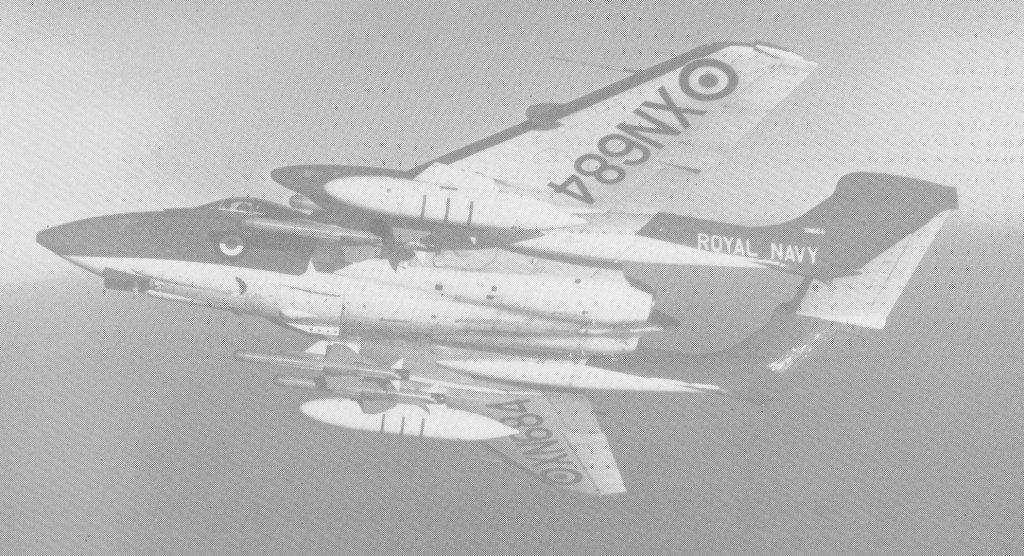
Royal Navy interest in the D.H.110 revived in 1952 and while the second prototype was used for preliminary deck landing trials, a new semi-navalised prototype was built as the Mk 20X, making its first flight on 20 June 1955.
The first production Sea Vixen flying on 20 March 1957. It was followed by the fully-navalised Sea Vixen FAW Mk 1 which had folding wings, revised tail unit, longer stroke undercarriage, new GEC radar, nosewheel steering, ejection seats, 11,230 lb st (5 100 kgp) Avon 208s, and armament of 28 x 2-in (5,08-cm) rockets in retractable packs in the nose plus four Firestreak JR AAMs or rocket pods or two 1,000-lb (454-kg) bombs under wings. An intensive period of flying trials was undertaken in the first half of 1959 by the Sea Vixen FAW.1 in the hands of No.700 “Y” Flight at RNAS Yeovilton.

114 Sea Vixen FAW Mk 1s were built and the first Royal Navy squadron (No 892) was formed on 2 July 1959. This version subsequently equipped five other squadrons, including No 766 all-weather training and No 899 HQ Squadrons
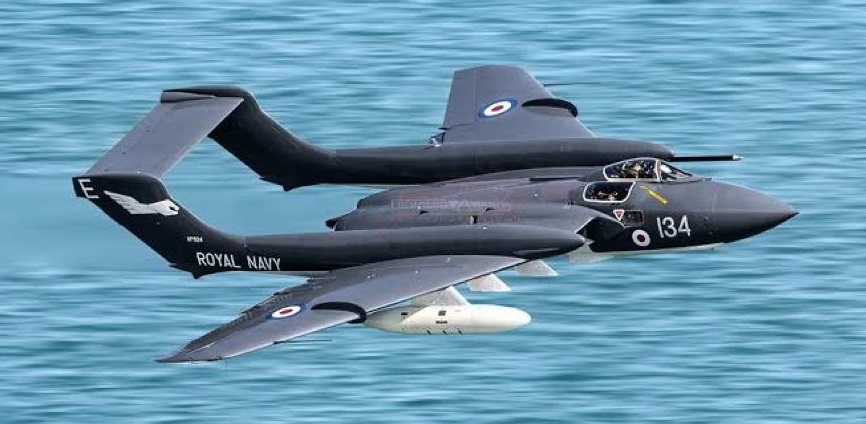
The Sea Vixen FAW Mk 2 differed in having extra fuel in forward extensions of the tail booms and provision to carry Red Top AAMs in place of Firestreaks. Prototypes flew on 1 June and 17 August 1962, and were followed in 1963-66 by 29 new production Mk 2s and 67 converted Mk 1s. Service use continued until 1972, after which about two dozen Sea Vixens were converted to pilotless drones for use as targets at the Aberforth range.
Prototype
Engines: 2 x 7,500 lb st (3405 kgp) Avon RA7
FAW Mk 1
Engine: 2 x Rolls-Royce Avon RA 208, 11,230 lb st (5100 kgp)
Wingspan: 15.2 m / 49 ft 10 in
Length: 16.3 m / 53 ft 6 in
Height: 3.4 m / 11 ft 2 in
Wing area: 60.2 sq.m / 647.99 sq ft
Max. speed: 1158 km/h / 720 mph
Ceiling: 14630 m / 48000 ft
Armament: 28 x 2-in (5,08-cm) rockets, four Firestreak JR AAMs or rocket pods or two 1,000-lb (454-kg) bombs
Crew: 2
Sea Vixen FAW Mk 2
Engine: 2 x RR Avon 208, 11250 lb.
Span, 51 ft 0 in (15,54 m)
Length, 55 ft 7 in (16,94 m).
Height, 10 ft 9 in (3,28 m)
Wing area, 648 sq ft (60,19 m).
Loaded weight 41,575 lb (18875 kg).
Max speed, 690 mph (1110 km/h) at sea level.
Initial climb 1½ min to 10,000 ft (3050 m), 5 min to 42,500 ft.
Service ceiling, 48,000 ft (21792 m).

de Havilland considered a radical new design shape for its futuristic DH106 jet airliner. It proposed a highly swept, tailless airliner of 75 0001b all-up weight to the Brabazon Committee, which was investigating the needs of British commercial aviation after the Second World War. This design envisaged an aircraft with wing sweepback of 40 degrees and a thickness/chord ratio at the wing root of eleven per cent. The four de Havilland Ghost engines were to be mounted beneath the wing near the trailing edge.
Practical experience was required before this design could be proceeded with, and de Havilland successfully tendered to Specification E18/45 for the construction of two prototype DH108s. The primary purpose in building these aircraft was to provide a half scale representation of the
proposed Brabazon 4 tailless civil jet airliner on which could be measured in-flight performance, stability and control and aerodynamic pressures on representative sections of the wing. Following this, less specialised research was to be undertaken to explore the characteristics of the swept wing at all speeds.
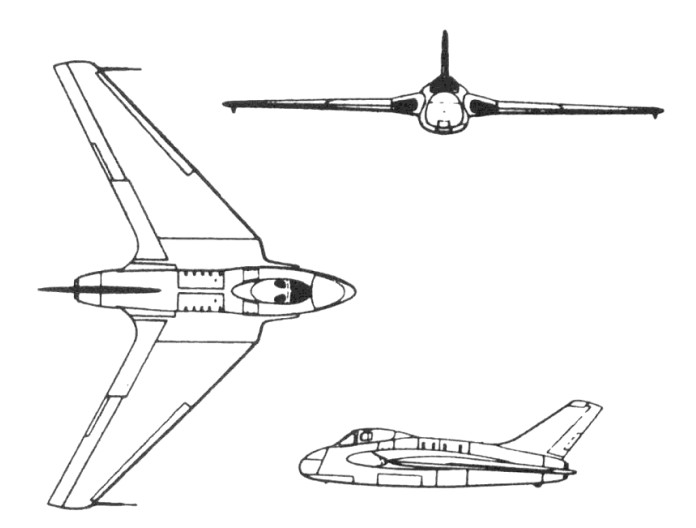
To facilitate production the DH108 was designed around the complete fuselage nacelle of the Vampire Fl, and two fuselages, TG283 and TG306, were taken from the Vampire production lines at English Electric, Preston, during the autumn of 1945. To these fuselages were added 43 degree swept-back wings of metal construction and a swept fin and rudder. Within seven months, the first of these research aircraft was completed and rolled out at Hatfield for engine runs and taxiing tests on Sunday, April 28, 1946. The first prototype was a low-speed test vehicle with a maximum speed of 451km/h.
As Hatfield was still only a grass airfield, the prototype was dismantled and loaded on to two “Queen Marys ” which left by road on May 5 for the emergency RAF airfield at Woodbridge where it began taxiing trials and hops six days later. The wheel brakes overheated and delayed the first flight by Geoffrey de Havilland until May 15 when the DH108 became the first jet aeroplane with swept wings to fly successfully. It was also the first tailless jet aircraft to fly.
The need for horizontal tail surfaces was avoided by the provision of elevons, a combined aileron and elevator control situated on the wing trailing edge in the usual aileron position. The first prototype was powered by a de Havilland Goblin 2 engine of 3 000 lb st and was to be used for low speed research covering the handling and stability of the aircraft. The RAE Farnborough had warned de Havilland of the possibility of dutch rolling or wing drop at low speeds with complete loss of control, from its wind tunnel tests. Therefore anti-spin parachutes were fitted at the wingtips, together with fixed Handley Page slots along the outboard section of the wing leading edge. However, when the aeroplane flew their fears proved unfounded and the aircraft had no trouble flying alongside a Proctor for air-to-air photography.
The new prototype returned to Hatfield from Woodbridge on May 19 when it showed its easy manouvrability while being demonstrated over the airfield by Geoffrey de Havilland.
This aircraft was joined by the second prototype which made its first flight from Hatfield on August 23, 1946, and was shown publicly for the first time at the SBAC display at Radlett on Friday, September 13. The second prototype differed from the first in having a modified 45 degree swept wing with powered flying controls, automatic slots on the wing leading edge, and the more powerful Goblin 3 engine giving 3300 lb st. This prototype was intended for high-speed research, concentrating on pressure plotting and performance. After only a few weeks of flying the DH108s it was decided that as far as the projected DH106 jetliner was concerned, the tailless layout was uneconomical. The use of ailerons as elevators, with their small lever arm moment from the centre of gravity, limited the effectiveness of the flaps. This meant that for a given wing area and runway length, the take-off and landing weights had to be less than if a normal tailplane and elevator layout were used. The sweepback itself also proved uneconomical at this stage, partly because of the lower maximum lift coefficient and the higher structural weight for a given span. Eliminating the sweepback almost doubled the prospective Atlantic payload with the comparatively low power available.
Despite these results the DH108 still had a great deal of valuable research work to do, particularly with respect to high-speed flight. The second prototype appeared a very promising vehicle in this respect and after its Radlett appearance began a concentrated programme of increased speeds.
It was not intended to exceed Mach 0.87 without power-boosted controls, this speed having been attained without difficulty, but it was soon found that the aircraft was well capable of overtaking the current absolute speed record of 616mph reached by a Meteor not long before. The aircraft was cleaned up and prepared for the record attempt, followed by a programme of several dives to determine handling, first at high equivalent airspeed, secondly at high Mach number, and finally a combination of the two.
On September 26, 1946, a level speed of 637mph was attained at 9 000ft, and on the following day, when weather conditions appeared smooth, Geoffrey de Havilland took off for the final practise flight before going to Tangmere for attempts over the official course. He was planning to undertake two tests to embrace all the conditions for the record attempt. Initially he was to dive the aircraft from around 10 000ft at a high Mach number so as to check its behaviour and controllability in these conditions. He was also planning to fly level at high power near the sea to check the speed and behaviour in record attempt conditions. He took off from Hatfield at about 5.30pm with fuel for about an hour’s flying. It was a perfect evening with a slight haze, very little cloud and the air was believed to be relatively free from bumps. He had indicated that the tests would be flown over the Thames estuary.
When his colleagues waiting at Hatfield began to realise the aircraft was overdue, messages were received through air traffic that an aircraft had been seen to break up in mid-air and fall in the Thames near Egypt Bay, just north of the village of Cliffe and north-east of Gravesend. Despite fog and low cloud, the wreckage was found the following day and the majority, including the engine, was recovered.
An investigation into the accident began immediately, and although taking some time to complete, did allow a statement to be released on October 7, ten days after the loss of this short-lived prototype. This stated that it was clear from the evidence available after a thorough inspection that the engine was not responsible for the accident. Sir Geoffrey de Havilland announced in the same statement that the de Havilland Aircraft and Engine Companies intended to continue with the full effort of the research work in the DH108 and that John Cunningham had been appointed to succeed Geoffrey de Havilland as chief test pilot of the de Havilland Aircraft Company.
The speed record attempt had been only incidental to the programme of experimental work which was in hand. It had been found desirable to obtain precise measurements of the speed of the DH108 by utilising the accurate timing apparatus set up on the south coast of England for the Gloster Meteor speed-record attempts and it had been decided to make an attack on the record at the same time.
The accident investigation found that wind tunnel tests combined with the structural evidence showed that the aircraft had suffered a sudden catastrophic disintegration during low level flight. Gusts had proved a problem at low altitude, a horizontal one of only 15mph encountered at M 0.87 would instantly raise the Mach number to 0.89. This is only a very moderate gust and such do abound at times at low altitudes. With this sudden increase in Mach number, tunnel tests showed that the aircraft would be in a very dangerous condition. It was noted that gusts had been experienced on an earlier flight that day. This sudden change could have given the aircraft a nose-down pitching moment combined with low stability, causing it to pitch down in a shock stall with ensuing failure of the wings.
Meetings were soon in hand to discuss the provision of a third prototype E18/45 (DH108) to replace the one so suddenly lost. de Havilland had requested immediately after the accident a go-ahead with this third aircraft and a meeting was held at Thames House on November 15, 1946, to work out the details.
Pilot ejection capability was to be built-in, using the then relatively new Martin-Baker equipment. Provision was to be made for a tailplane on the lower part of the fin, but a decision to fit it left until a later date. The power plant was to be a de Havilland Goblin 4 of 37501b / 1701kg st, although a Ghost engine was considered. An important addition was the fitment of power boost control to the elevators, five months after the first flight, to help the pilot overcome some of the excessive loads expected at high speeds.
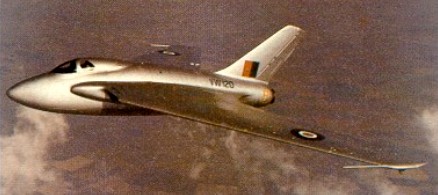
As before, the fuselage was taken from the Vampire production line at Preston, which by now was producing FB Mk5s, and it was allocated the serial number VW120. This third prototype differed from its predecessors in having a more streamlined canopy (tried out on Vampire TG443), lowered pilot’s scat, more pointed nose (tried out on Vampire TG281), better shaped rudder horn and a strengthened structure. It was rolled out for engine runs on July 21, 1947, and made its first flight three days later (24 July 1947), piloted by John Cunningham. It appeared publicly at the SBAC display at Radlett from September 9 to 12 and continued with the first prototype in its original programme of research into the characteristics of the swept-back wing.
The next milestone attained by the DH108 was on Monday, April 12, 1948, when VW120 raised the international speed record around a 100 kilometer closed circuit to 605.23mph (974.0259km/hr) flown at the time by John Derry. This speed was 40mph (64km/hr) better than the previous holder of the record, the Supermarine Attacker, which in turn had stolen the record from the Gloster Meteor. The de Havilland aircraft in fact employed considerably less power than either of the aircraft which it outclassed.
Only six flights in the 108 were found to be necessary before the actual record attempt and they provided all the confirmation the aerodynamics department needed for its preparation of an efficient flight plan. On the day of the attempt it was decided to do a final flight at midday to check for any snags and to make one final run round. Immediately after take off a paraffin leak developed, causing a cloud of vapour to form in the cockpit. The vapour eventually cleared sufficiently for a landing to be made and repairs were made by late afternoon.
It had been decided before the attempt that owing to the difficulties of flying in bumpy air at over 600mph the attempt should not be made before 4.30pm. At 5.00pm a further check flight round was made, but although the 108 was fully serviceable, the air was very bumpy, so a decision was made to wait an hour before John Cunningham made a final cheek in a Vampire. This time the air was found to be quite smooth apart from some isolated spots and visibility was fair though poor on the second leg. Since better conditions could not be expected that day it was decided to make the attempt.
After take-off a climb to 1500ft was made towards Elstree and a turn over Harrow to head for the starting point at Brookmans Park. The line was crossed as close as possible to the aerial masts at about 300ft above the ground with a speed of about 620mph. On settling down on the first leg towards the Puckeridge aerial the air was found to be smooth making a high speed more feasible. The next leg was more hazy making the identification of landmarks difficult and consequently seconds were lost on course correction, but after the brickworks corner the haze cleared and the ASI showed 635mph as the next turn at Sundon cement works was approached, level at 500ft. From here it was possible to see the smoke markers at Gaddesdon Row indicating the last turn, before turning into the final straight over the north of St Albans, past the end of Hatfield’s runway and on towards the BBC masts at Brookmans Park.
On landing back at Hatfield one of John Derry’s colleagues thrust a note in his hand giving the speed and time and proving the success of the team effort in gaining the FAI Class C record.
During the work up to the speed record John Derry discovered a phenomenon which in retrospect was found to be the true cause of the disaster to Geoffrey de Havilland. When high IAS and Mach numbers were combined, an unstable pitching oscillation developed which was too rapid for the pilot to control, so that at around M 0.88 at sea level divergent oscillations powerful enough to break the wings could develop in less than one second.
Following this demonstration of high speed of the DH108 John Derry continued the programme of increasing the speed throughout the summer of 1948. The ultimate was reached on September 6 when, for the first time in the United Kingdom, the speed of sound was exceeded. Since the Goblin engine in the ‘108 was of insufficient power to propel it at high speeds in level flight, the high speeds had to be investigated in dives from high altitude. In building up to Mach 1.0 John Derry had reached M 0.91 to 0.95 in successive flights during the previous days. The flight commenced at 10.00am on September 6 with a take-off from Hatfield for a flight which lasted 45 minutes. On this occasion while flying between Farnborough and Windsor the aircraft was climbed to 45 000ft, the pilot wearing a pressure waistcoat and mask. After being flown level to obtain the maximum level speed of M 0.85, owing to engine temperature limitations a dive of about 30 degrees was commenced. At M 0.95 the engine was opened up to 10750rpm but there was no increase in Mach number due to the large increase in drag. In fact it was necessary to move the stick forward slightly to prevent the Mach number from decreasing. Eventually a point was reached at which a very small elevon movement caused a sudden, but not violent nose-down pitch. The first nose-down pitch was over and the aircraft back in a 30 degree dive before an attempt could be made to hold a steeper angle. This small stick movement was repeated a second time, giving a more violent nose down pitch with a return to 30 degrees. On the third attempt a much more violent pitch down was experienced, which was similar to a half bunt and put the aircraft over the vertical. An immediate pull-out was started, but during this the Mach number increased rapidly until 0.97 was indicated. As the aircraft reached a 60 to 80 degree dive with Mach still increasing, the stick force rose rapidly until it became impossible to hold the aircraft, which took over and increased the dive angle to the vertical. At this point M 1.0 was reached and passed.
The engine was throttled back as soon as recovery became impossible and full strength with both hands failed to make any impression on the aircraft. In spite of the power being shut off the Mach number stayed in excess of 1.0 and little time was wasted when once it was realised that the elevons were immovable. The only apparent hope of recovery was then tried and full trim flap was applied at once. Almost immediately a very gradual recovery began until at M 0.94 the aircraft finally levelled out at 23 000ft, giving an indicated airspeed of just under 500mph. The small split flap was set somewhat forward of the trailing edge of the inboard wing and in this position fortunately helped the recovery, although normally it was only used for landing.
During this dive the aircraft appeared extremely stable, being rock steady and no buffet of any kind was experienced in spite of large amounts of negative ‘ g’. The original intention of the flight had been to take pressure plotting shots with trim flap up and down at varying Mach number, increasing to a maximum of 0.96, but being so near to the sound barrier plans can always change.
Following this unprogrammed flight in excess of the speed of sound a further series of tests was set up to approach the problem more slowly. Mach 1.0 was again achieved on March 1, 1949, in the same aircraft, VW120, by John Derry in a flight of 40 minutes.
With the now familiar nose-down pitch in the high M dive, when 0.99 was reached and just before trim flap was applied for recovery a further steepening of the dive occurred. Full trim flap was selected with no effect at all on this occasion. The engine was throttled. Negative ‘ g ‘ increased and a slight roll to port developed. The stick was held on the stops with both hands, and because the rolling was steepening the dive full opposite aileron was applied which was partially effective in levelling the aircraft laterally. However, by now the dive was beyond 60 degrees and although recovery appeared in sight, the aircraft again rolled slowly but uncontrollably to port until, after 90 degrees of roll and considerable negative ‘g’, it was in a true vertical dive. There was now absolutely no control, even the lateral control having been lost. From a vertical attitude the negative ‘ g ‘ now increased even more and the spiralling had almost stopped. The aircraft completed on its own the latter half of a bunt and then rolled slowly round at the bottom so that it became laterally level in a shallower dive. Having lost an enormous amount of height it suddenly began to respond again to the controls and recovered from spiralling into level flight and very shortly into a climb as the trim flaps and elevons became effective. The aircraft was finally levelled out at 29 000ft and a return made to Hatfield.
Mach 1.0 was exceeded during this uncontrollable dive, but it was noticed that control was always regained at about 26 000ft, which of course pointed the way to the realisation that recovery was probably due not to trim flap or luck, but to the increased drag with increased air density at lower altitudes, which also in effect reduced the Mach number to a safe figure.
By this time, when trials were complete and the aerodynamic characteristics of the swept wing had been fully investigated the first prototype, TG283, had been transferred to the RAE, Farnborough, in October 1948. Here it continued further investigations into stability, control and landing trials and when fitted with the longer stroke undercarriage from a Sea Vampire to avoid hitting the tailpipe on the runway, landings were made as low as 95 knots in February and March 1950.
These low-speed trials abruptly ceased on May 1, 1950, when the aircraft crashed near Hartley Wintney, Hants, during stalling tests, killing the pilot, Squadron Leader G. E. C. Genders, AFC, DFNI. The aircraft had apparently entered a spin from which it failed to recover.
Towards the end of 1949 the third prototype, VW120, had joined the first aircraft at Farnborough when, amongst other tests, it was used to investigate longitudinal stability at high speeds. Shortly after its arrival this last prototype was lost on February 15, 1950, when it crashed near Birkhill, Bucks, killing the pilot, Squadron Leader J. S. R. MullerRowland. This accident was apparently due to lack of oxygen for the pilot as no fault was found in the aircraft and no break up had occurred.
The DH 108 was found to be a pleasant aircraft to fly, with d nose-high approach and rate of sink fairly close to the stall. Although this was thought a little alarming at the time it was in fact only exhibiting the modem tendencies of the swept wing. It was a remarkably clean design which was demonstrated by the fact that it could attain high speeds on very low-power. VW120 was easily capable of maintaining Mach 0.88 at 35000ft. Both TG283 and VW120 were fitted with large wing fences, TG283 having two on each wing in November 1947. The wing of TG283 was also given dihedral for a while, making its first flight in this configuration on September 16, 1948.
Despite all three prototypes ending their careers in accidents, the DH108 made some remarkable advances in aviation in the UK. This was not just restricted to pure high-speed research. The powered controls were similar to the ones destined for the DH106 Comet and were developed on this aircraft. The experience gained with the swept wing was used to benefit the development of the DH110. This later became the Sea Vixen all-weather fighter with the Fleet Air Arm today.
First Flights, TG283 – 15.5.46, TG306 – 21.8.46, VW120 – 24.7.47.
Prototype 1
Engine: de Havilland Goblin 2, 3000 lb st
Wing span: 39ft.
Length: 25ft 10in.
Wing Area: 328 sq ft.
Prototype 2
Wing span: 39ft.
Length: 24ft 6in.
Wing Area: 328 sq ft.
Prototype 3
Engine: de Havilland Goblin 4 turbojet, 3,750 lb (1,701 kg) st.
Wing span: 39 ft 0 in (11.89 m).
Length: 26 ft 9.5in (8.17m).
Wing area: 328 sq ft (30.47sq.m).
Max take-off weight: 4064 kg / 8960 lb
Max level speed: approx 560 mph (900 km/h) at 45,000 ft (13,720 m) (Mach 0.85)
Max attained speed: Mach 1 in a dive between 40,000 ft (12,200 m) and 30,000 ft (9,145 m).
Crew: 1.
 All Aero