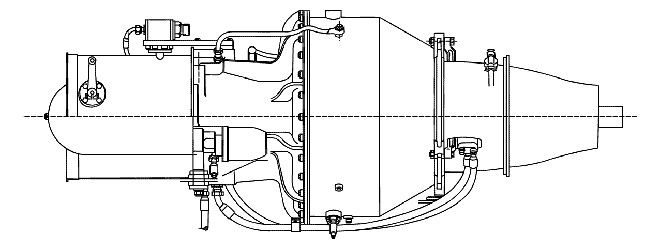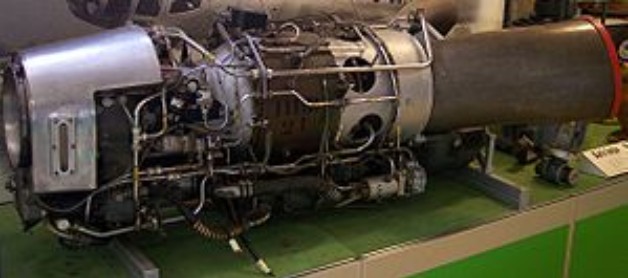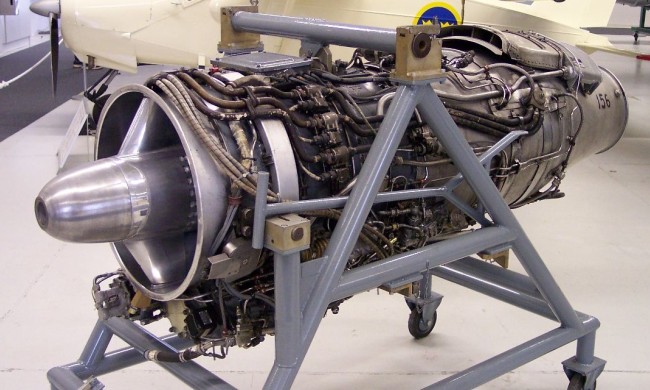
Turbomeca Aubisque / RM9

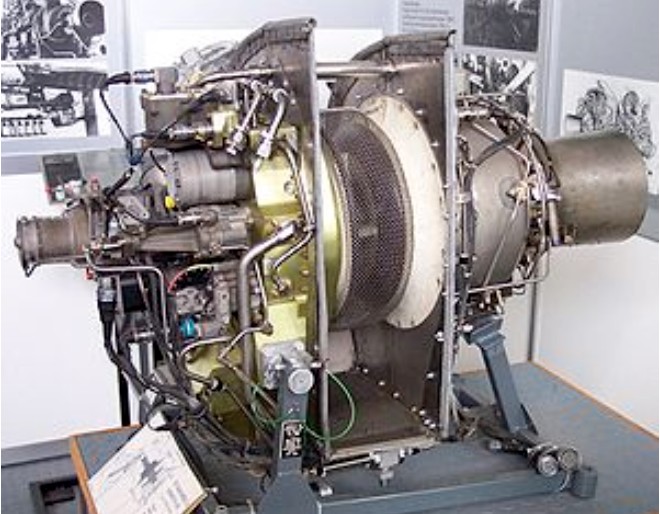
The Turbomeca Aubisque was a small turbofan engine designed and produced by Turbomeca andfirst run in 1961. Its only application was the Saab 105 military trainer aircraft as the RM9.

The engine is named after the Col d’Aubisque in the Pyrenees mountains, in line with company tradition.

The earlier Turbomeca Marboré turbojet was originally intended for the Saab 105, but when Saab needed more thrust than the Marboré produced, Turbomeca offered the Aubisque turbofan. Basically a turbofan version of the Turbomeca Bastan turboprop, the Aubisque went into the production for the Saab 105. About 300 were produced. They were in service for 30 years until replaced in the mid-90’s, by the Williams FJ44 turbofan, for the remaining Swedish Air Force Saab 105s.

Aubisque
Type: Low-bypass turbofan
Length: 2,067 mm (81.4 in)
Diameter: 564 mm (22.2 in)
Dry weight: 243 kg (535.7 lb)
Compressor: Geared fan stage + single stage axial + single stage centrifugal
Combustors: Annular chamber
Turbine: Two stage
Maximum thrust: 6.9 kN (1,543 lbf) at 32,500 rpm
Overall pressure ratio: 6.9:1
Fuel consumption: 420 kg (925.9 lb)/hr
Thrust-to-weight ratio: 0.062 kN/kg (2.88 lbf/lb)
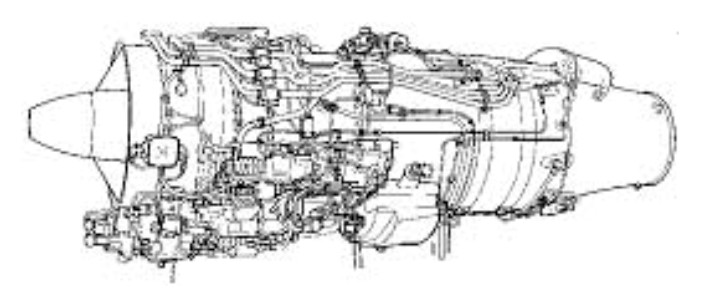
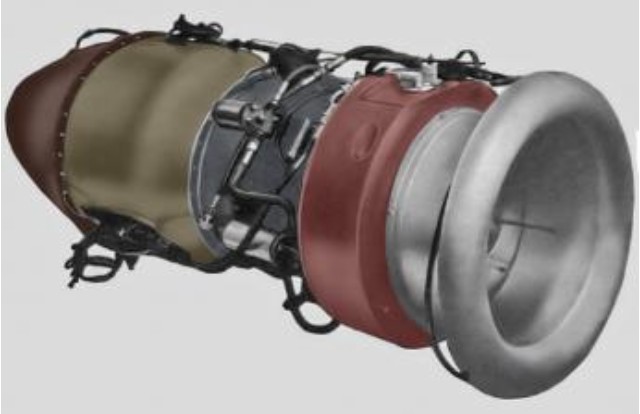
RM9B Turbomeca Aubisque

Turbomeca Aspin

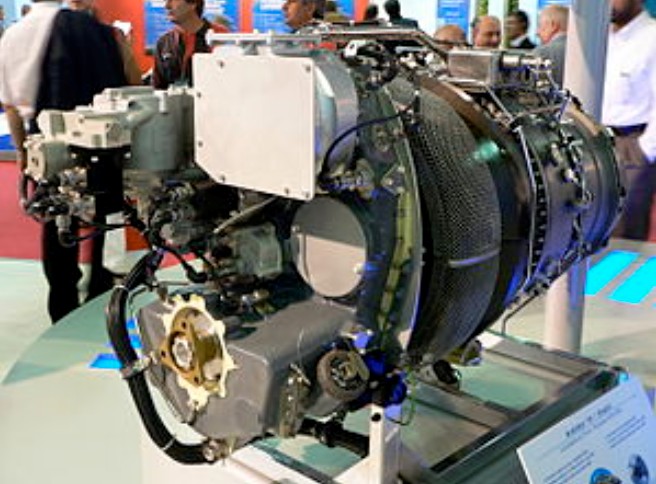
The Turbomeca Aspin was a small French turbofan engine produced by Turbomeca and first run in 1951. This geared turbofan design was the first turbofan to fly, powering the Fouga Gemeaux test-bed aircraft on 2 January 1952.

Fixed inner cone, annular turbine nozzle and outer pipe wherein the jet efflux and by passed secondary air mix. Annular air entry containing one row of variable-incidence entry vanes, a single stage compressor fan and one row of fixed straightening vanes. Fan is driven by compressor shaft through coupling and reduction gear. After fan the air is divided into primary and secondary flows, the former passing to the power section and the latter by-passing that section in an annular casing to the tailpipe where it mixes with the primary jet efflux.

A single-stage centrifugal compressor, with single-sided impeller, and the combustion chamber is annular type, with rotary fuel injection. The turbine is two-stage axial flow turbine, and the jet pipe has a fixed inner cone, annular turbine nozzle and outer pipe wherein the jet efflux and by passed secondary air mix.

Single throttle lever determine the fuel flow and position of variable incidence vanes. Egine speed controled by centrifugal governor. For rapid manoeuvrability a push button operates and electro-hydraulic servo-motor with over-rides manual control and at maximum rotation speed the throttle lever can be used solely to control the entry vanes to obtain rapid variation of thrust without having to oercome the inertia of the rotating assembly.

Throttle at “starter” setting only controls fuel delivery. Entry vanes are closed and engine speed governor is ineffective. Normal starter spins rotating assembly. When engine reaches a rotating speed of 70 per cent. of maximum governor and vane become operative.

Variants:
Aspin I
200 kg (440 lb) thrust

Aspin II
350 kg (770 lb) thrust

Specifications:
Aspin I
Type: Geared turbofan
Maximum thrust: 200 kg (441 lb)
Diameter: 600 mm / 23.6 in
Length: 1210 mm / 47.5 in
Weight with accessories: 127 kg / 279 lb
Fuel burn: 0.628 kg/kg (0.628 lb/lb) trust/hr

Turbomeca Artouste / Marcadau / Continental 231 / T-51

Turbomeca Artouste IIIB

The Turbomeca Artouste is an early French turboshaft engine, first run in 1947. Originally conceived as an auxiliary power unit (APU), it was soon adapted to aircraft propulsion, and found a niche as a powerplant for turboshaft-driven helicopters in the 1950s.

Artoustes were licence-built by Bristol Siddeley in the UK, Hindustan Aeronautics Limited in India, and developed by Continental CAE in the USA as the Continental T51. Power is typically in the 300 kW (400 hp) range.

Variants:
Artouste I
Artouste II
Artouste IIB
Artouste IIC – 373 kW (500 hp)
Artouste IIC6
Artouste IIIB – 410 kW (550 hp)
Artouste IIID

Continental T51
Licence production and development of the Artouste in the United States

Turbomeca Marcadau
A turboprop variant, the Marcadau was a development of the Artouste II, producing 1300 kW (402 hp) through a 2.3:1 reduction gearbox.

Applications:
Artouste –
Aérospatiale Alouette II
Aérospatiale Alouette III
Aerospatiale Lama
Aerotécnica AC-14
Atlas XH-1 Alpha
IAR 316
IAR 317
Handley Page Victor – as APU
Hawker Siddeley Trident – as APU
Piasecki VZ-8 Airgeep
Vickers VC10 – as APU
SNCASO Farfadet

Marcadau –
Morane-Saulnier Epervier

Specifications:
Artouste IIC
Type: Turboshaft
Length: 1,440 mm (56.7 in)
Diameter: 545 mm (21.5 in) – height, 390 mm (15.4 in) – width
Dry weight: 115 kg (253.5 lb) – dry
Compressor: Single stage centrifugal
Combustors: Annular combustion chamber
Turbine: Three stage turbine
Fuel type: Aviation kerosene to AIR 3405
Oil system: Oil grade AIR 3512, pressure lubrication
Maximum power output: 500 hp (372.85 kW) at 34,000 rpm for take-off
Fuel consumption: 153 kg (337.3 lb)/hour at maximum continuous power
Power-to-weight ratio: 3.24 kW/kg (1.972 hp/lb)

Turbomeca Arriel / Safran Arriel

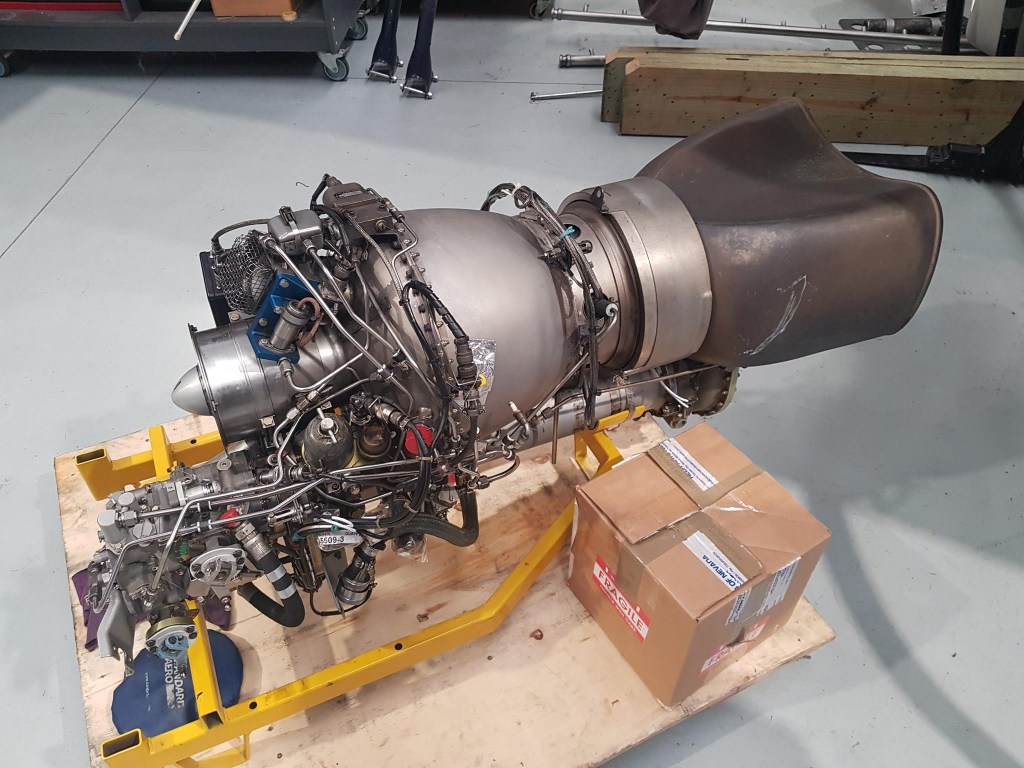
The Turbomeca Arriel is a series of French turboshaft engines that first ran in 1974. Weighing 109 kg (240 lb), the Arriel 1 has a power output of 520 kW (700 hp). 10,000 examples had been produced by 2012.

Arriel IB

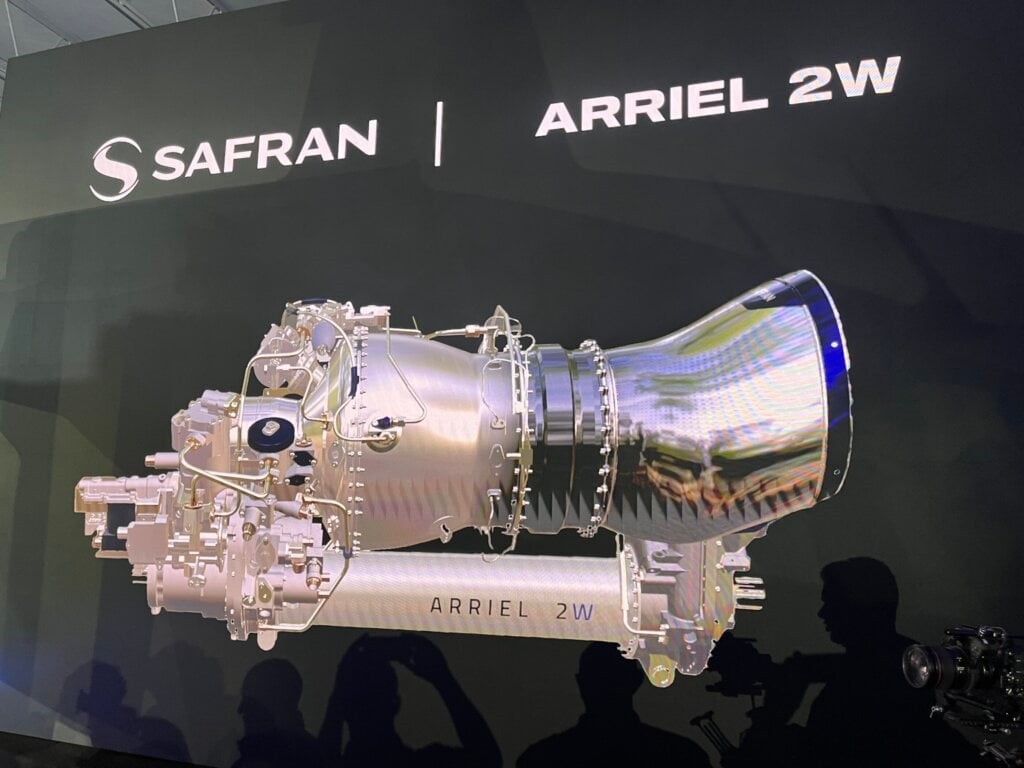
The Robinson R88 is powered by a Safran Arriel 2W engine — marking a first partnership between Robinson and Safran.

Applications:
Agusta A109
Eurocopter Dauphin
Eurocopter Ecureuil
MBB/Kawasaki BK 117
Eurocopter EC145
Sikorsky S-76

Gallery

Specifications:
Arriel 1
Type: Twin-spool free turbine turboshaft
Length: 44.2 in
Diameter: 23.5 in
Dry weight: 245 lb
Compressor: Single-stage axial plus single-stage centrifugal
Combustors: Annular combustion chamber
Turbine: Single-stage power turbine, two-stage gas generator turbine
Fuel type: Jet A1
Maximum power output: 681 shp (508 kW)
Turbine inlet temperature: 840 C

Turbomeca Arrius

Turbomeca Arrius 1B

The Turbomeca Arrius is one of a family of turboshaft engines for helicopter use, first produced in 1981. As of 2012, some 2,700 units had been sold. Power ranges between 357 kW (479 shp) and 530 kW (716 shp) for different versions. Following Turbomeca tradition, the Arrius was named after a Pyrenean peak (pic d’Arrius), located in the Ossau Valley near Pau.

Variants:
Arrius 1A
Arrius 1A1
Arrius 1M
Arrius 2F
Arrius 2G2
Arrius 2B1
Arrius 2B1A
Arrius 2B2
Arrius 2K1
Arrius 2K2

Applications:
Turboshafts –
Agusta A109 Power (2 x Arrius 2K1/2K2)
Bell SLS (1 x Arrius 2R)
Eurocopter AS355 N Ecureuil 2 (2 x Arrius 1A)
Eurocopter AS355 NP Ecureuil 2 (2 x Arrius 1A1)
Eurocopter AS555 Fennec (2 x Arrius 1M)
Eurocopter EC135 T1 (2 x Arrius 2B1/2B1A)
Eurocopter EC135 T2 (2 x Arrius 2B2)
Eurocopter EC635 T1 (2 x Arrius 2B1/2B1A)
Eurocopter EC635 T2 (2 x Arrius 2B2)
Eurocopter EC120B Colibri (1 x Arrius 2F)
Kamov Ka-226T (2 x Arrius 2G1)
Mil Mi-34S2 (1 x Arrius 2F)

Gas generator –
SNCASO Farfadet

Specifications:
Arrius 1A
Type: Twin-spool free turbine turboshaft
Length: 63 in (1601 mm)
Diameter: 17.2 in (436 mm)
Dry weight: 223.3 lb (101.3 kg)
Compressor: Single stage centrifugal
Combustors: Annular reverse flow combustion chamber
Turbine: Single stage power turbine, single stage gas generator turbine
Maximum power output: 520 shp (388 kW)
Turbine inlet temperature: 870 C

Turbomeca Ardiden / Hindustan Aeronautics Limited (HAL) Shakti

Turbomeca Ardiden

In 1961, Turbomeca granted a manufacturing license for the Artouste turboshaft engine to equip the Indian Chetak and Cheetah helicopters. The development of the Shakti/Ardiden 1H project was initiated in 1999 by HAL and Turbomeca to power the HAL Dhruv helicopter. However, several factors including the US embargo following India’s 1998 nuclear tests forced the project to run behind schedule. Hence, early models of the Dhruv used the less powerful Turbomeca TM 333-2B2 engine as a contingency. The first test flight of the Dhruv with the new Shakti engine took place on 16 August 2007. By late 2007, HAL started fitting the Shakti engines for Dhruvs produced from then.

The Ardiden 1H series engines have a radial air intake and a two-stage centrifugal compressor driven by a single stage axial gas generator turbine. Airflow is directed through a reverse flow annular combustion chamber, through the gas generator turbine and then through and a two-stage axial free power turbine. Output power is transmitted to a front-mounted reduction gearbox by a shaft concentrically mounted within the gas generator rotor assembly. The accessory gearbox, also mounted at the front end, is driven by the gas generator. Control is by means of a dual-channel digital engine electronic control unit (DECU).

By December 2013, 280 had been built at a unit cost of US$1.73 million.

Variants:
Ardiden 1H
Certified by EASA in December 2007.

Ardiden 1H1 (Shakti)
Certified by EASA in March 2009.
powering the HAL Dhruv, LCH

Ardiden 3G
powering the Ka-62, Z15

Applications:
HAL Dhruv
HAL Light Combat Helicopter
Kamov Ka-62 – Ardiden 3G

Specifications:
Type: Turboshaft
Length: 1,250 mm (49 in)
Diameter:
Dry weight: 205 kg (452 lb)
Compressor: Two centrifugal compressor stages, coupled to a single-stage high-pressure turbine.
Maximum power output: 1,032 kW (1384 shp)

Turbomeca Palouste

Designed and built by Turbomeca, the Palouste is a gas turbine engine, first run in 1952, and was also built under license in Britain by Blackburn, Lucas Aerospace, and Rolls-Royce. Originally conceived as an aircraft ground support equipment starter gas generator it was also used as propulsion for the Sud-Ouest Djinn and other tip jet powered helicopters.

The Palouste was a very simple unit, its primary purpose was to supply a high flow rate of compressed air to start larger jet engines such as the Rolls-Royce Spey as installed in the Blackburn Buccaneer (this aircraft had no on-board starting system). Air from the centrifugal compressor was divided between external supply (known as bleed air) and its own combustion chamber.

Several British naval aircraft were adapted to carry a Palouste in a wing mounted pod installation to facilitate engine starting when away from base.

A novel use of a surplus Palouste engine was its installation in a custom-built motorcycle known as the Boost Palouste. In 1986 this motorcycle broke an official ACU 1/4 mile speed record at 184 mph (296 km/h). The builder modified the engine to include a primitive afterburner device and noted that pitch changes which occurred during braking and acceleration caused gyroscopic precession handling effects due to the rotating mass of the engine.

Variants:

Palouste IV
The gas generator used to power the Sud-Ouest S.O.1221 Djinn and other tip-jet helicopters.

Applications:
Bell Model 65
Fairey Ultra-light Helicopter
Sud-Ouest Djinn

Specifications:
Blackburn Palouste
Type: Gas generator
Length: 33.42 in (849 mm)
Diameter: 17.72 in (450 mm)
Dry weight: 187.5 lb (85 kg)
Compressor: Single stage centrifugal
Combustors: Annular combustion chamber
Turbine: Two-stage axial flow
Fuel type: Kerosene
Oil system: Dry sump
Overall pressure ratio: 3.6:1
Air output: 1.65 lb/sec at 37 psi

Turbomeca TM 333

The Turbomeca TM 333 is a turboshaft engine designed for 5- to 6-ton-class helicopters. It was originally intended to power Eurocopter’s twin-engine Dauphin and Panther helicopters. The TM 333 found its first commercial application on the HAL Dhruv. First run in 1975, 250 were built.

Variants:
TM 333 2B2 (for multi-engine applications)
HAL Dhruv employed two TM 333 2B2 engines each developing 825 kW at takeoff, with growth potential to 900 kW for subsequent versions. The TM 333 2B2 is the initial production engine used on the Dhruv. Approximately 250 engines are installed on Dhruv and further production has been stopped as it is replaced by Shakti engine which is joint development by HAL & Turbomeca.

TM 333 2M2 (for single-engine applications)
Another version, the TM333 2M2, was being developed with reduced power to be fitted on the Cheetal, the upgraded version of the HAL Cheetah, and the Chetan, the upgraded version of the HAL Chetak (Alouette III).

Applications:
Eurocopter Dauphin
Eurocopter Panther
HAL Dhruv
HAL Cheetah
HAL Chetak

Specifications:
TM333 2B2
Type: Turboshaft
Length: 1045 mm
Dry weight: 166.5 kg
Compressor: 2 stage Axial compressor & single stage centrifugal compressor
Combustors: Reverse annular flow
Turbine: 2 low-pressure and 2 high-pressure stages
Fuel type: ATF K-50
Maximum power output: 801kW (1073.72 hp)
Overall pressure ratio: 10:1
Turbine inlet temperature: 1230°C

Turbomeca Piméné

First run in 1948, the Turbomeca Piméné was a small French turbojet engine produced by Turbomeca in the early 1950s. A single-stage compressor, annular combustion with rotating fuel delivery ring and single-stage turbine, the Pimémé first flew in the Fouga Cyclone powered-sailplane on July 14, 1949.

The Pimene has a single-stage centrifugal compressor with a 3.8 : 1 compression ratio.
The combustion chamber is annular, with rotary fuel injection. The fuel ring, around the periphery of which are a number of vents, is attached to the shaft connecting compressor and turbine dises and revolver with it. Fuel is fed into the inside of the ring and is vented by centrifugal force, being vaporised in the process. Fuel delivery at low thrust settings regulated by by-pass valve.

The turbine is single-stage single-piece turbine with 31 blades preceded by stator with twenty air-cooled valve. The starter is Air Equipement 24 volt electric or compressed-air starter. One igniter plug on first model, two after. The mounting has three mounting pans, two on compressor casing and one on underside of combustion chamber.

First shown at the 1949 Paris Air Show this engine passed official type tests in 1950. A variant known as the Turbomeca Orédon drove an alternator and was used as an aircraft auxiliary power unit, this name being reused for a later helicopter turboshaft design.

Applications:
EFW N-20
Fouga CM.8
Fouga CM.101R
Fouga CM.88 Gemeaux

Specifications:
Type: Turbojet
Length: 80 cm (31.5 in)
Diameter: 40 cm (15.75 in)
Dry weight: 54 kg (119 lb)
Compressor: Single stage axial plus single-stage centrifugal
Combustors: Single annular combustion chamber
Turbine: Single-stage
Maximum thrust: 1 kN (220 lbf) at 37,000 rpm
Specific fuel consumption: 1.05 lb/hr/lbf
Thrust-to-weight ratio: 1.85

Max. T.O. (static) 110 kg. (242 lb.) at 35,000 r.p.m.
Crursing (static) 80 kg. (176 lb.) at 33,000 r.p.m
Length 1,050 mm. (41.5 in.).
Diameter 400 mm. (16 in.)
Weight dry: 54 kg (118 lb.)
Turbine rpm: 35,000
Gas temperature before turbine: 700°C
Gas temperature after turbine: 600°C
Fuel Pump: Martin Moulet
Maximum pressure: 4 kg./cm.2 (57 lb./sq. in.)
Fuel: Kerosene (Jet A1
Fuel burn max. T.O. 1.05 kg./kg. s.t./hr. (1.22 lb./ lb. s.t./hr.).

Turbomeca Turmo / Changzhou / Dongan WZ-6

Turbomeca Turmo IIIB

The Turbomeca Turmo is a French turboshaft engine developed for helicopter use. A descendant of Turbomeca’s pioneering Artouste design, later versions delivered around 1,200 kW (1,610 shp). A turboprop version was developed for use with the Breguet 941 transport aircraft.

Current versions are built in partnership with Rolls-Royce, and the engine is produced under license by the Chinese Changzhou Lan Xiang Machinery Works as the WZ-6 and Romanian Turbomecanica Bucharest as the Turmo IV-CA

Variants:
Turmo IIIC
A 894.84 kW (1,200 hp) turboshaft powering the Sud-Aviation Frelon prototypes.

Turmo IIIC2
Developed from the IIIC delivering 969.41 kW (1,300 hp) maximum output

Turmo IIIC3
Maximum rating 1,118.55 kW (1,500 hp) at 33,500 rpm for production Super Frelon helicopters

Turmo IIIC4

Turmo IIIC5

Turmo IIIC6

Turmo IIIC7

Turmo IIID
Turboprop for the proposed Breguet Br 942 STOL transport, maximum rating 913.48 kW (1,225 hp).

Turmo IIID2
995.51 kW (1,335 hp) at 22,460 free turbine rpm

Turmo IIID3
1,081.26 kW (1,450 hp) at 33,500 rpm

Turmo IVB

Turmo IVC

Turmo IV-CA
Licence production in Romania

Turmo VI
Turboprop engine with two axial stages, one centrifugal compressor stage and two free power turbine stages, rated at 1,342.26 kW (1,800 hp) at 32,000 rpm.

WZ-6
Licence production at the Changzhou Lan Xiang Machinery Works in the Peoples Republic of China.

Applications:
Turboshaft
Aérospatiale Puma
Aérospatiale Super Frelon
Aérospatiale Super Puma
Bölkow Bo 46
IAR 330
SNCASE SE.3200 Frelon

Turboprop
Breguet 940
Breguet 941
Breguet 941S

Specifications:

Turmo IIIC7
Type: Two-shaft turboshaft
Length: 182 cm (71.6 in)
Diameter: 71.6 cm (28.2 in)
Dry weight: 325 kg (716 lb)
Compressor: Single-stage axial, single-stage centrifugal
Combustors: Annular, reverse-flow
Turbine: Two-stage compressor turbine, two-stage power turbine
Maximum power output: 1,217 kW (1,632 shp)
Overall pressure ratio: 5.9:1
Power-to-weight ratio: 3.74 kW/kg (2.28 shp/lb)