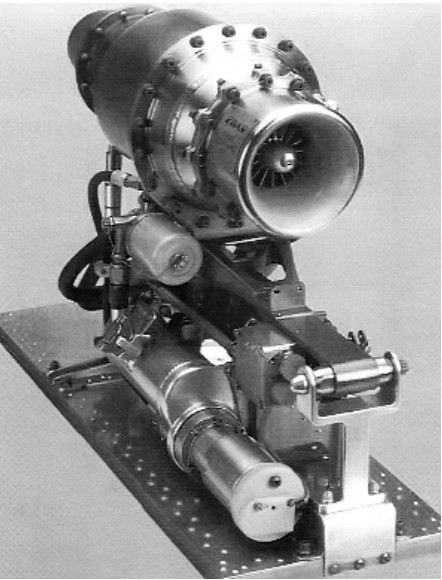
ln 1963, Max Dreher began work on the design of the youngest member of his turbine family, the TJD-76 Baby Mamba. It was designed to power a sailplane and had a static thrust of 55 lbs. He tried to keep it as simple and light as possible. No gear reduction was used and it had a free-spinning rotor. He selected a single-stage mixed flow compressor, an annular combustion chamber and a single stage axia-flow turbine for the basic layout.
A single-shaft turbojet, the air intake at the front, with an air flow of 0.50 kg (1.1 lb)/sec. The compressor is a single-stage mixed-flow, with single 17-4 PH stainless steel impeller with sixteen vanes. Splined to shaft and supported in two ball bearings. Mixed-flow two-stage diffuser of 347 stainless steel. Pressure ratio : 2.8 : 1
The compressor casing is of 2024 aluminium alloy and 347 stainless steel.
The combustion chamber is an annular type with Hastelloy X outer casing and flame tube. Vaporising system with fuel/air pre-mix. One spark plug in flame tube.Fuel system: Manual with pressurised fuel supply, or electrically-driven fuel pump. Fuel pressure 5.52 bars(80 lb/sq in). Automatic system for drone applications. Fuel grade: Kerosene or petrol.
The nozzle guide vanes are single axial stage, with sixteen investment-cast vanes in Stellite 31.Turbine: Single-stage axial-flow, with nineteen integrally-cast blades, of Inconel 713 LC. Gas temperature 770°C before turbine, 675°C after turbine, at continuous cruising power.
A fixed type jet pipe, with jet pipe and cone of Hastelloy X. LUBRICATION: Air/oil mist system with total loss, using bleed air equivalent to 2.5 per cent of total mass flow. Capacity 1 litre (2 US pints) of MIL-L-7808E (Turbo 15).
Mounting is by two rigid connections on diffuser section and one flexible connection on turbine section. Starting is by compressed air 1034 bars (150 lb/sq in), via three nozzles driving turbine wheel.
The whole job, from the begining to end, took about 3600 hours.
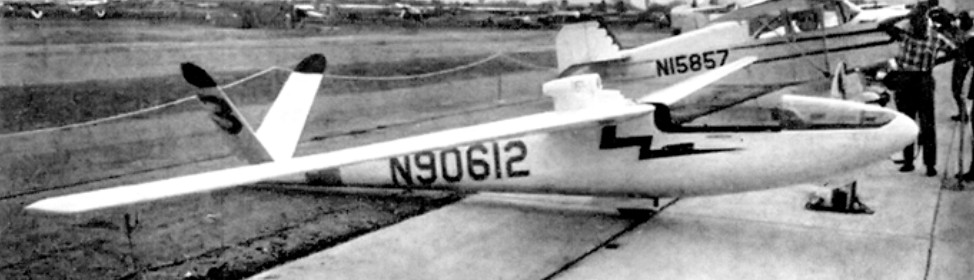
After initial running on the test stand, Max Dreher installed the engine on his Prue 215A sailplane. To do this he designed a jet pack consisting of the engine, the pressurized fuel system and the lubrication unit. the total weight of this first pack was 25 pounds. An auxiliary oil tank is mounted separately and employs an electrical driven gear pump.
A third unit, the jet control pack (engine controls, instruments, switches) is located in the cockpit.
Prue 215A – Mamba Jet
Length overall: 416 mm (16.38 in) Diameter: 151 mm (5.94 in) Dry weight: 6.4 kg (14.1 lb) Complete weight with fuel tank: 10.0 kg (22 lb) Specific fuel consumption: 42.5 mg/Ns (1.5 lb/hr/lb st) At max rating Oil consumption: 25 cc/min At max rating Max rating: 0.245 kN (55 lb st) Continuous rating: 0.20 kN (45 lb st)
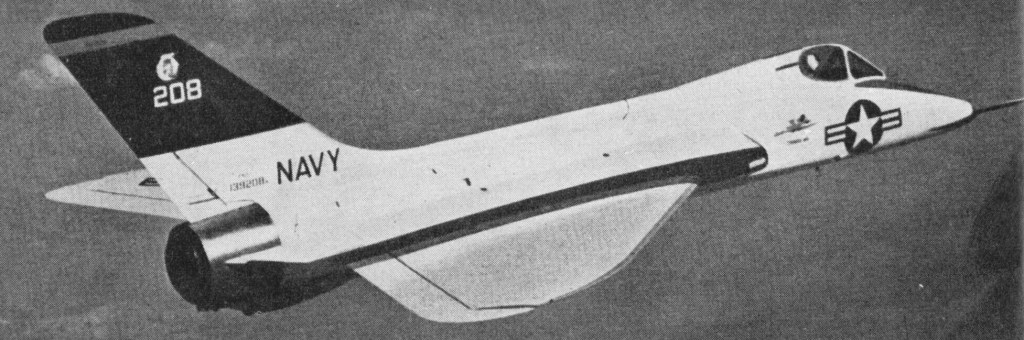
The Douglas F5D was envisaged originally as an improved all-weather development of the F4D (F-6) Skyray, and two prototypes were ordered in 1953 under the designation F4D-2N.
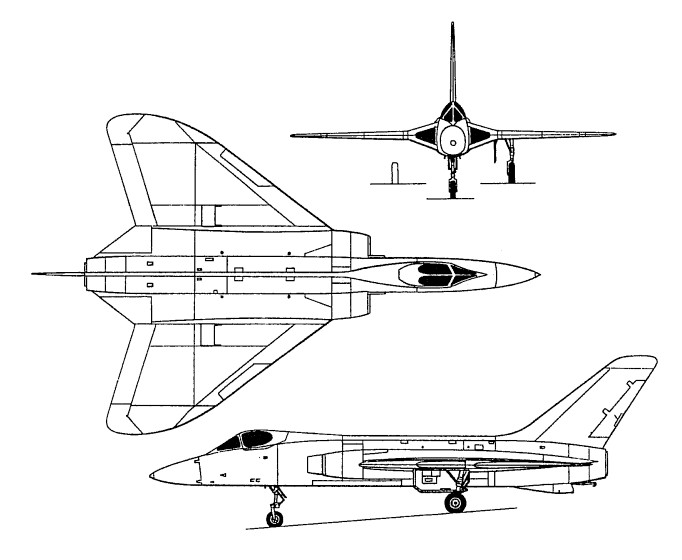
Substantial changes, including wings of much reduced thickness/chord ratio, a lengthened fuselage, revised vertical tail surfaces and the introduction of a new cockpit canopy brought the redesignation F5D-1 (subsequently named Skylancer) before the first flight was recorded on 21 April 1956.
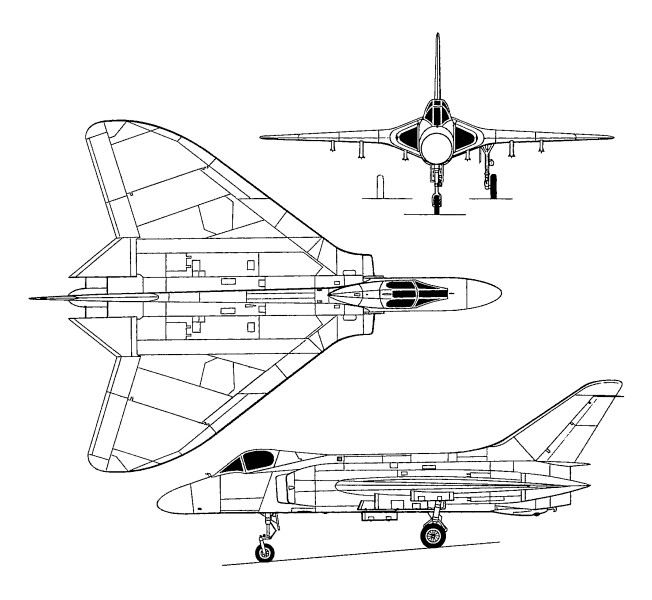
The F5D Skylancer was basically an enlarged version of the Skyray with a fuselage of increased fineness ratio and a wing of reduced thickness/chord ratio for higher supersonic performance on the power provided by a Pratt & Whitney J57-P-8 afterburning turbojet.
The first of four XF5D prototypes went supersonic on its initial flight, and by then, nine preproduction and 51 production examples had been ordered, but following early flight testing the programme was cancelled except for two of the preproduction aircraft. The performance of the F5D was little better than that of the Chance Vought F8U-1 which was on the point of entering service.
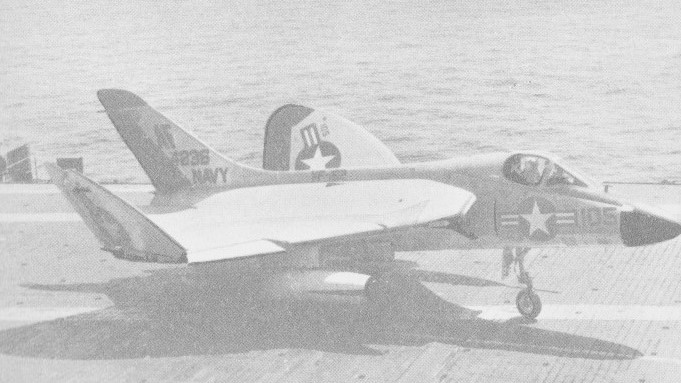
F5D
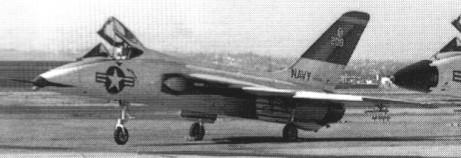
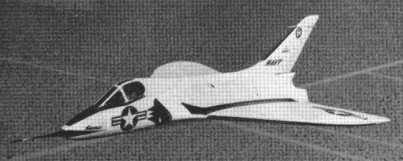
By 1957 two prototypes of the XF5D-1 Skylancer were flying.
XF5D-1
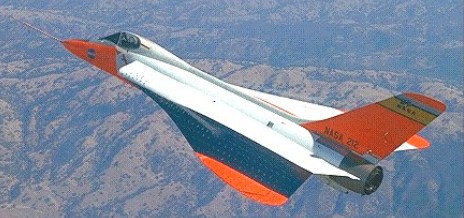
The four F5D-1s were used by the US Navy as flying testbeds for a variety of equipment before they were handed over to NASA for experimental use.
Two prototypes given to NASA in late 1960 essentially as castaways. Neil Armstrong flew one of the F5Ds on 26 September 1960 during a visit to NASA Ames and realised the F5D could serve well in a study of Dyna-Soar abort procedures because its wing planform was a match for the X-20.
Armstrong began flight tests in the F5D in July 1961, and after no fewer than 10 flights, developed an effective maneuver of X-20 abort. His last flight in the F5D was 1 November 1961.
Neil Armstrong’s last flight as a Flight Research Centre employee occurred on Friday 28 September 1962. It was another low L/D flight in an F5D.
F5D Engine: 1 x Pratt-Whitney J57-P-8, 7250kg Max take-off weight: 12733 kg / 28072 lb Empty weight: 7912 kg / 17443 lb Wingspan: 10.21 m / 33 ft 6 in Length: 16.4 m / 53 ft 10 in Height: 4.52 m / 14 ft 10 in Wing area: 51.75 sq.m / 557.03 sq ft Max. speed: 1760 km/h / 1094 mph Cruise speed: 1025 km/h / 637 mph Ceiling: 17500 m / 57400 ft Range: 2140 km / 1330 miles Crew: 1
US Navy interest in German delta-wing research led, in 1947, to the design by Douglas of a carrier-based interceptor with a variation of the pure delta wing. Approval of the Douglas design was signified by the award of a contract for two Douglas XF4D-1 prototypes on 16 December 1948, the first making its maiden flight on 23 January 1951 powered by a 2268kg thrust Allison J35-A-17 engine. This represented an emergency powerplant, resulting from delays in development of the Westinghouse J40 turbojet which had been the planned engine. Both prototypes were flown subsequently with the XJ40-WE-6 developing 3175kg thrust and the XJ40-WE-8 which had a rating of 5262kg with afterburning, but problems with this engine programme led to final selection of the Pratt & Whitney J57 engine for production aircraft.
The F4D Skyray was a cantilever mid-wing monoplane, the wing of modified delta configuration incorporating elevons to serve collectively as elevators or differentially as ailerons. The tail unit had only swept vertical surfaces, landing gear was of retractable tricycle-type. The pilot was accommodated well forward of the wing. The potential of the F4D was demonstrated effectively by the second prototype on 3 October 1953, then powered by the XJ40-WE-8 turbojet, which set a new world speed record of 1211.746km/h.
The first production F4D-1 was flown on 5 June 1954, powered by a Pratt & Whitney J57-P-2 turbojet developing 6123kg thrust with afterburning, but it was not until 16 April 1956 that deliveries began, initially to US Navy Squadron VC-3. The 419th and last production aircraft was delivered on 22 December 1958, but in the intervening period a change had been made by installation of the higher-rated J57-P-8 engine. All aircraft retained the F4D-1 designation, the popular (derived) name being Ford.
The new Douglas factory at Torrance (Plant B-6) in May 1954 was in volume production with both the AD-5 and 6 Skyraider and the F4D-1 Skyray, the latter with the J57 turbojet with afterburner. This leaves the El Segundo division almost clear to turn out twin-jet Skywarriors. Navy contracts for the Skyray were sufficient to keep Torrance busy until the end of 1956. Reports came to the effect that a new variant, the F4D-2, was being developed “with some configuration changes.” After manufacture at Torrance, Skyrays are put aboard a flat truck and taken to El Segundo, where final operational equipment is installed preparatory to flight testing.
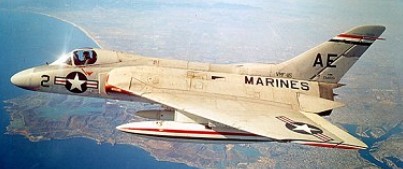
At the peak of its utilisation, the Skyray equipped 11 US Navy, six US Marine and three reserve squadrons, but none was used operationally. The type survived in first-line service until the late 1960s, with two front-line squadrons not converting to the type until 1964. It was redesignated F-6A in September 1962.
F4D Engine: 1 x Pratt & Whitney J57-P-8B turbojet, 64.5kN / 9700 lb with afterburner Max take-off weight: 11340 kg / 25001 lb Empty weight: 7268 kg / 16023 lb Wingspan: 10.21 m / 33 ft 6 in Length: 13.93 m / 45 ft 8 in Height: 3.96 m / 12 ft 12 in Wing area: 51.75 sq.m / 557.03 sq ft Ceiling: 16765 m / 55000 ft Range: 1931 km / 1200 miles Crew: 1 Armament: 4 x 20mm cannons, 1814kg of weapons on six hardpoints
F4D-1 Engine: Pratt & Whitney J57-P-2 turbojet, 9,7001b. thrust Wingspan: 33 ft. 6 in Length: 42 ft. Loaded weight: approx. 16,000 lb. Max. speed: approx. 750 m.p.h. Ceiling: 50,000 ft. Endurance: 45 min. Armament: 4×20 mm. Cannon Bombload: 2x 1,000 lb. bombs, 6 pods of 7×2.75 in. rockets or 4 pods of 19×2.75 in. rockets. Crew: 1.
F4D-1 Engine: Pratt & Whitney J57-P-8, 14,550 lb with reheat Wingspan: 33 ft 6 in Wing area: 557 sq.ft Length: 45 ft 8.25 in Height: 13 ft Empty weight: 16.024 lb MTOW: 27,000 lb Max speed SL: 722 m[h / M0.95 Max speed 36,000 ft: 693 mph M1.05 Max ROC: 18,000 fpm Service ceiling: 55,000 ft Max range: 950 miles External fuel: 2 x 250 gal underwing Armament: 4 x 20mm cannon
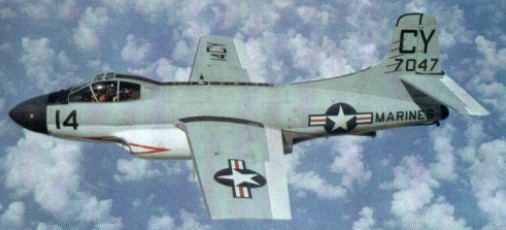
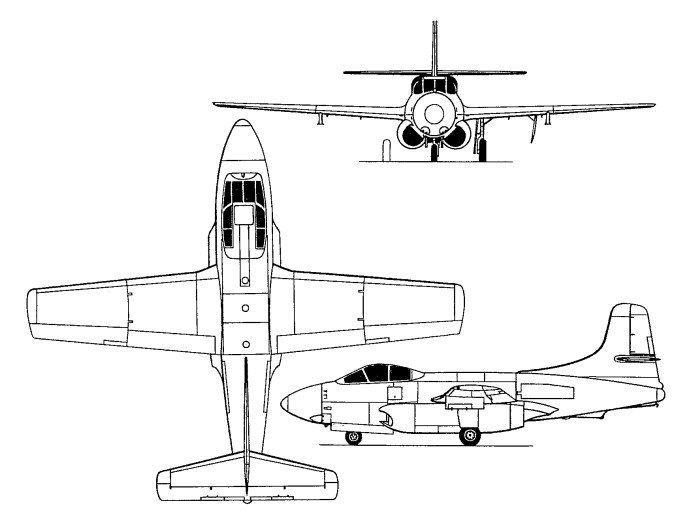
Unique in being the US Navy’s first jet-powered night-fighter, the Skyknight began development in 1945, Douglas being awarded a contract for three XF3D-1 prototypes in April 1946. The type emerged as a cantilever mid-wing monoplane of all-metal construction, the wings incorporating hydraulic folding for carrier stowage. The circular-section fuselage mounted hydraulically actuated speed-brakes, provided side-by-side pressurised accommodation for the pilot and radar operator, and carried at the rear a tail unit very similar to that of the D-558-1 Skystreak. An unusual feature was a crew escape tunnel, extending from the rear of the cabin to the underside of the fuselage. Landing gear was retractable tricycle-type, and the powerplant of the prototypes was two 1361kg thrust Westinghouse J34-WE-24 turbojets, mounted on the lower edges of the forward fuselage, beneath the wing roots. The first prototype made its maiden flight from Muroc (now Edwards AFB) on 23 March 1948, this event being followed in June by an order for 28 production F3D-1 (later redesignated F-10A) fighters while company testing was still in progress. The first of these was flown on 13 February 1950. Service acceptance trials were conducted by VC-3 at Moffett Field from December 1950, the type then being handed over to Marine Night Fighter Squadron VMF(N)-542. The F3D-1 differed from the prototypes by having improved avionics and equipment and, as delivered initially, had 1361kg thrust J34-WE-32 turbojets. These engines were uprated subsequently to 1474kg thrust, becoming redesignated J34-WE-34. In the event, the F3D-l did not see action.
Before delivery of the first F3D-1, Douglas had received a contract for production of an improved F3D-2 (F-l0B), which was to be the major and ultimate production version, with a total of 237 built in the early 1950s. It was intended that the F3D-2 should be powered by 2087kg thrust J46-WE-3 turbojets, but development of this engine was abandoned and, instead, they were all powered by J34-WE-36s. Improvements included the provision of an autopilot and updated systems and equipment. The first of these F3D-2s was flown on 14 February 1951 and all had been delivered just over a year later. It was this model which made the Skyknight’s combat debut with VMF(N)-513 in June 1952.
The Skynight saw extensive use in Korea, this all-weather fighter accounting for the majority of all victories scored by the US Navy and US Marine Corps. On the night of 2 November 1952, it succeeded in downing a North Korean Yakovlev Yak- 15, this marking the first recorded kill in a jet-versus-jet combat at night. Even more remarkable is the fact that the F3D ended the Korean War as the most successful naval fighter type in terms of aircraft destroyed in air combat.
In US Navy service, the F3D enjoyed only a brief front-line career, being quickly relegated to radar intercept training duties as the F3D-2T and F3D-2T2 (TF-10B), the last example being retired in the early 1960s. US Marine Corps composite squadrons continued to use the F3D-2Q (EF-10B) type in ECM duties, however, and the type again saw action in Vietnam with VMCJ-1 until 1969 when it was finally replaced by the Grumman EA-6A Intruder.
Two examples of the Skyknight were used by the US Army in support of air defence missile testing at White Sands, New Mexico. A proposed swept-wing version known as the F3D-3 was cancelled in 1952, but other service variants were the missile-armed F3D-1M and F3D-2M (MF-l0B).
F3D-1 Skyknight Engines: 2 x Westinghouse J34-WE-32 turbojets, 3000 lb thrust. Wingspan: 50 ft Length: 45 ft. 5 in. Loaded weight: 27,000 lb. Max speed: approx. 530 m.p.h. Range: about 1,200 miles. Armament: 4 20 mm cannon Crew: 2.
F3D-2 / F 10B Skyknight Powerplant: two 1542-kg (3,400-lb) thrust Westinghouse J34-WE-36/36A turbojets. Wing span 15.24 m (50 ft 0 in) Length 13.84 m (45 ft 5 in) Height 4.90 (16 ft 1 in) Wing area 37.16 sq.m (400 sq.ft). Maximum speed 909 km/h (565 mph) at 6095 m (20,000 ft) Cruise speed: 628 km/h / 390 mph Service ceiling 11645 m (38,200 ft) Range 2478 km (1,540 miles) Empty weight: 8237 kg (18,160 lb) Maximum take-off 12556 kg (27,681 lbs). Armament: four 20-mm cannon, plus two 907-kg (2,000-lb) bombs.
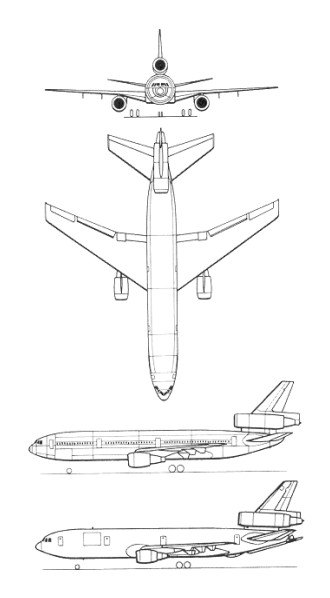
Douglas designed the DC-10 in 1966, competing directly with Lockheed to produce an airbus capable of operating from normal-length runways. By designing the DC-10 around three General Electric CF6-6 turbofan engines, Douglas avoided the financial difficulties encountered by Lockheed with the Rolls-Royce RB.211. In a multi-company manufacturing agreement, Convair produces the fuselage and Aeritalia the fins (vertical stabilizers). The -10 is a short/medium-haul version; the long-range -30 and -40 have an extra forward-retracting main gear, uniquely mounted on the centreline. An aircraft with a fixed wing sweep (the DC-10 wing, designed just before the advanced supercritical form was introduced, is broad and strongly swept) cannot be best for all ranges, but the DC-10’s sales record of 250 testifies to its attraction as a sophisticated wide¬bodied jet that can fly global routes.
The Series 10, able to accommodate up to 380 economy class passengers on domestic routes, was first flown on 29 August 1970, certified on 29 July 1971, and made its first scheduled passenger flight with American Airlines on 5 August 1971. Introduction of DC-10 service-between Los Angeles and Chicago came one week after American formally accepted the trijet from McDonnell Douglas. It was followed by the inter-continental range Series 20, which flew for the first time on 28 February 1972.
Conversion of the CF6-50A engines to -50C standard increases the thrust from 49,000 lbs to 51,000 lbs.
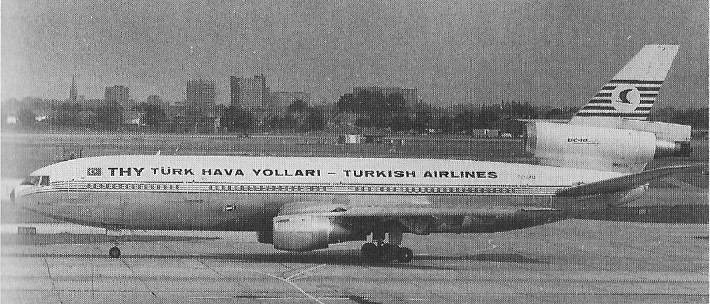
Turkish airlines took delivery of three DC-10-10 between December 1972 and February 1973; TC-JAU, TC-JAV, and TC-JAY. TC-JAV was lost at Paris in 1974.
DC-10-10 TC-JAU
First flight of the long range Pratt & Whitney JT9D powered McDonnell Douglas DC 10 20 took place on February 28, 1972. Northwest Airlines having ordered 14, with 14 more on option
DC-10-30 C-GXRC November 1978
A derivative of the commercial DC-10-30CF, selected in 1977 as the USAF’s advanced tanker/cargo aircraft (ATCA), the first KC-10A flew in July 1980. The aircraft has high-flow-rate, 5,680lit/min refuelling boom plus an independent, 2,2701it/min hose-drogue system. As a transport the KC-10 has a cargo capacity comparable with that of the C-5 to 8,300km range, but is superior over longer ranges up to 18,500km.
DC 10 Srs 10 Engines: 3 x General Electric CF6 6D turbojets, 40,000 lbs thrust each. Length: 181 ft 4.75 in. Wingspan: 155 ft 4 in. Ceiling: 35,000 ft. Range: 2,429 mls.
DC-10-30 Engines: 3 x CF6-50C, 51,000 lbs thrust. Wing span: 165.3 ft. Max takeoff weight: 259.45 tonnes. Max landing weight: 182.79 tonnes. Fuel capacity 111.40 tonnes. Pax cap: 247. Range: 10,232 km.
DC-10-30ER Engines: 3 x CF6-50C2, 233.5 kN. Wing span: 50.4m. Length: 55.5m. Height: 17.7m. Max speed: 0.88M @ 7620m. Max range (full load): 7410 km. Crew: 3. Accommodation: 243 pax.
DC-10-30CF / KC-10A Extender Engine: 3 x GE CF6 turbofan. Installed thrust: 701 kW. Span: 50.4 m. Length: 55.3 m. Wing area: 339 sq.m. Empty wt: 109,350 kg. MTOW: 267,620 kg. Payload: 78,840 kg. Max speed: 956 kph. Initial ROC: 20 min to 8530 m. Ceiling: 12,800 m. T/O run: 2590 m. Ldg run: 790 m. Fuel internal: 200,940 lt. Range: 11,110 km with 45,400 kg payload. Air refuel: Yes.
McDonnell Douglas KC 10 A Extender Engine : 3 x General Electric CF6 50C2, 229064 N / 23350 kp Length : 181.759 ft / 55.4 m Height : 58.071 ft / 17.7 m Wingspan : 165.354 ft / 50.4 m Wing area : 3957.923 sqft / 367.7 sq.m Max take off weight : 590102.1 lb / 267620.0 kg Weight empty : 241072.7 lb / 109330.0 kg Max. payload weight : 349029.5 lb / 158290.0 kg Max. speed : 530 kts / 982 km/h Landing speed : 138 kts / 256 km/h Cruising speed : 490 kts / 908 km/h Initial climb rate : 2755.91 ft/min / 14.0 m/s Service ceiling : 32808 ft / / 10000 m Wing load : 149.24 lb/sq.ft / 728.0 kg/sq.m Range : 9989 nm / 18500 km Crew : 6 Fuel capacity : 132330 lt
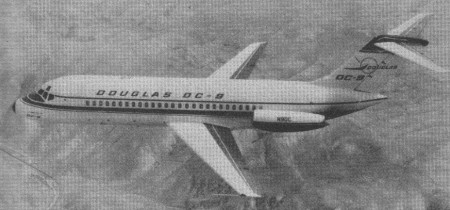
McDonnell Douglas’s only four engined civil jet airliner, the DC 8, preceded the company’s very successful DC 9 twin jet, which first flew at Long Beach, California, on February 25, 1965.
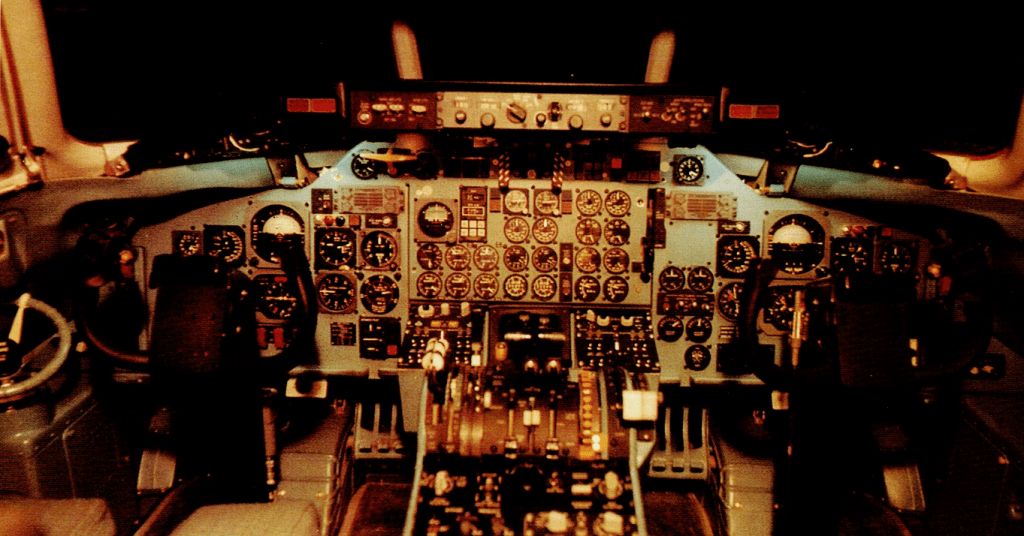
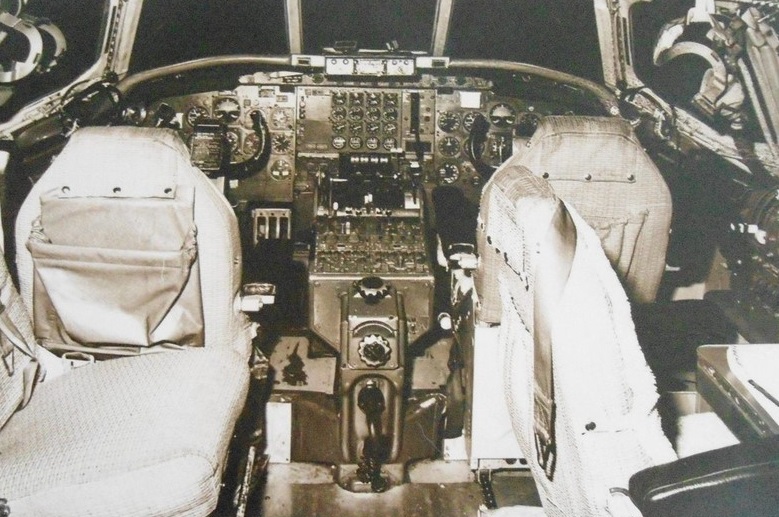
By 1962 Douglas’s Model 2086 had become a firm design, and the subject of negotiations with several opera¬tors. At last Delta agreed to buy a fleet and the Model 2086 became the DC-9 on 8 April 1963. In April 1963 the company announced that it would build the DC 9 and John Brizendine, who ten years later became President of Douglas Aircraft, was named programme manager. The programme was given top priority with more than 40,000 man hours a week expended on the project. The primary aims of the project were to produce a simple and reliable, easy to operate and maintain airliner. Construction of the prototype began in July 1963 and the first DC-9 flew from Long Beach on 25 February 1965. US airlines made no advance orders. Douglas’ own capital was tied up in modifications to the DC-8, so the company reduced the risk by utilizing the DC-8’s flight deck, and persuading major suppliers to design and manufacture different parts, receiving payment only as each aircraft was delivered to a customer. De Havilland Canada produced the complete wing, rear fuselage and tail. Later, the Douglas Aircraft Company bought part of their Toronto factory, and continued production there. By producing a series of stretched versions, to stay abreast of the demand for larger capacity aircraft, Douglas outsold all competitors in the same category. A big manufacturing programme was launched, with DH Canada making the wings, rear fuselage and tail. From the start Douglas planned to offer different versions, and the original DC-9 Series 10 could weigh anything from the basic 77,000lb with JT8D-5 engines of 12,000-lb thrust to 90,000 lb with extra fuel and 14,000-lb JT8D-1 or -7 engines. The first off the line flew a month early, on 25 February 1965, and services began with Delta on 8 December the same year. A total of 137 were built. Douglas offered a stretched ‘DC-9B’ and on 25 February 1965 and won an Eastern order. The designation was changed to DC-9 Series 30, with 14,500-lb engines and a considerable stretch both to the span and length. The weight was 98,000 lb, matched by full-span slats and double-slotted flaps. The first Srs 30 flew on 1 August 1966. Subsequently the Srs 30 (503 sold) grew to 108,000 lb with more-powerful engines, seating up to 115. Then came the Srs 20, for operation out of difficult airports by SAS. It combined the wings and engines of the Srs 30 with the original short fuselage. On 28 November 1967 Douglas, by now part of McDonnell Douglas, flew the DC-9 Srs 40, with engines of up to 16,000-lb thrust, enabling weight to rise to 122,000lb. The fuselage was stretched yet again, to seat up to 132. To meet airline demand for a DC 9 with larger capacity the 40 was developed with a longer fuselage enclosing a 132 seat configuration. Below floor cargo space was also increased. This version entered service in March 1968. Last of the original DC-9 variants was the Srs 50, first flown on 17 December 1974. This introduced many attractive new features, but the main difference was that, still keeping at 122,000-lb weight, the body was stretched yet again to seat 139. The 50 began airline operation in August 1975. Each DC 9 was, in practice, a stretched version of the Series 10. The 20 carried 115 passengers and featured a longer wingspan and a high lift wing system of leading edge slats for short field performance. The 30 was the most widely used. US Air Force versions were designated C 9A Nightingale and VC-9C and C 9B Skytrain for the US Navy.
Douglas also offered various cargo and convertible versions. A total of 649 DC-9s had been delivered by 1 February 1972. This includes the C-9A variant for the 375th Aeromedical Wing of the USAF MAC. Important orders were also placed by the US Air Force and Navy (Marines) for the C-9A Nightingale aeromedical aircraft, the C-9B Skytrain II (longest-ranged of all versions) and VC-9C for VIP missions. Each of the C-9A can carry 30-40 litter patients, two nurses and three aeromedical technicians, and have intensive care compartments. Ten were converted. The final aircraft off the assembly line, a DC¬9 30, was transferred to the US Navy as a C 9B in October 1982. Thrust for the 976 DC 9s completed over an 18 year production run was provided exclusively by the Pratt & Whitney JT8D family of engines. In mid 1998 there were in excess of 870 of the type being flown by over 70 operators worldwide. A new version was launched as the DC-9 Super 80, with an order from Swissair, closely fol¬lowed by Austrian and Southern, in October 1977. The first aircraft flew on 18 October 1979. Changes included a further (and very large) stretch to the fuselage, an extension to the span at both the wing roots and tips, a digital electronic flight guidance system, a further increase in fuel capacity and, not least, fitting the JT8D-200 series engine. The refanned engine, used initially in -209 form at 18,500-lb thrust, dramatically reduced noise and eliminated worries over impending noise legislation. Seating capacity was typically up to 172. In 1983 the company at last abandoned the famed ‘DC’ and adopted ‘MD’ for its designations, McDonnell Douglas launched the MD-80. Altogether Douglas sold 976 DC-9s, production being completed in September 1982.
DC 9 Srs 10 Engines: 2 x Pratt & Whitney JT8D 5 turbofans, 12,250 lb / 53.4kN thrust each. Length: 31.8 m / 104 ft 4.75 in. Wingspan: 89 ft 5 in. Height: 8.3 m / 27 ft 3 in Wing area: 85.9 sq.m / 924.62 sq ft Max take-off weight: 35245 kg / 77702 lb Max. speed: 895 km/h / 556 mph Ceiling: 25,000 ft. Range 1,311 mls. Pax cap: 90. Crew: 2 Passengers: 65-90
DC-9-10 Engines: 2 x Pratt & Whitney JT8D-1 or -7, 12,000-14,000 lb. Length: 104 ft 4 ¾in. Pax capacity: up to 90. MTOW: 77,000-90,000 lb.
Engines: 2 x 14,000 lb. (6,350 kg.) thrust Pratt & Whitney JT8D. Length 119.25 ft. (36.37 m.) Wing span 93.4 ft. (28.47 m.) Weight empty 52,935 lb. (24,010 kg.) Max cruise: 565 m.p.h. (909 kph) Range: 1,725 miles (2,775 km.) with 50 passengers.
DC-9-20 Engines: 2 x Pratt & Whitney JT8D. Length: 104 ft 4 ¾in. Pax cap: 90. Entered service: 1968.
DC-9-30 Engines: 2 x Pratt & Whitney JT8D, 14,000 lb. Pax capacity: up to 115. Max wt: 108,000 lb. Length: 119.3 ft. Entered service: 1967.
Wing span: 93 ft 5 in (28.47 m). Length: 119 ft 3.5 in (36.37 m). Height: 27 ft 6 in (8.38 m). Max level speed: 565 mph (909 kph).
DC-9-40 Engines: 2 x Pratt & Whitney JT8D, 15,500 lbs. Pax capacity: up to 132. Max wt: 122,000lb. Length: 125.6 ft. Entered service: 1968.
DC-9-50 Engines: 2 x Pratt & Whitney JT8D, 16,000 lbs. Pax capacity: up to 139. Length: 133.5 ft. Entered service: 1975.
DC-9-80 Engines: 2 x Pratt & Whitney JT8D-209, 18,500 lbs thrust. Length: 147 ft 10 in. Pax capacity: up to 172. MTOW: 108,000 lb. Entered service: 1980.
McDonnell Douglas C 9 A Nightingale Length : 117.126 ft / 35.7 m Height : 26.903 ft / 8.2 m Wingspan : 91.535 ft / 27.9 m Max take off weight : 107163.0 lb / 48600.0 kg Weight empty : 59224.1 lb / 26859.0 kg Cruising speed : 501 kts / 928 km/h Cruising altitude : 34797 ft / 10606 m Range : 1739 nm / 3220 km Engine : 2 x Pratt & Whitney JT8D-9, 64501 N / 6575 kp Crew : 8 Payload : 40 Pax
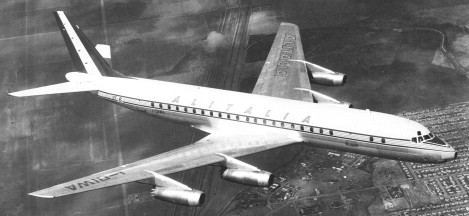
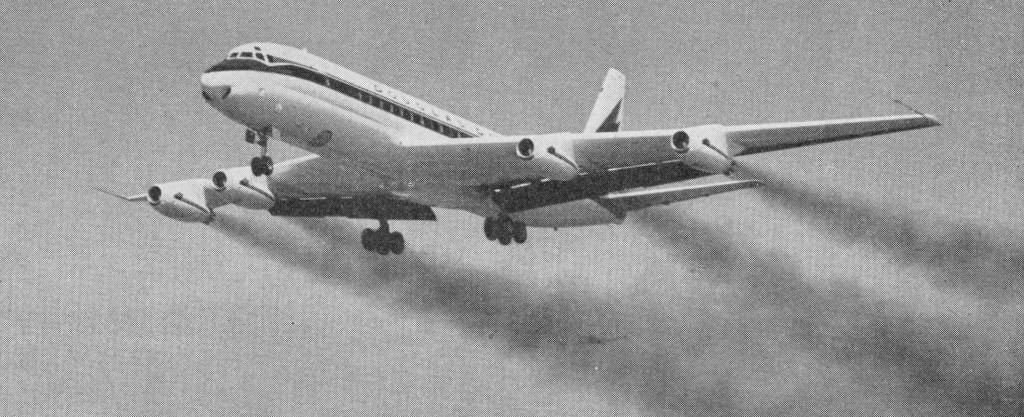
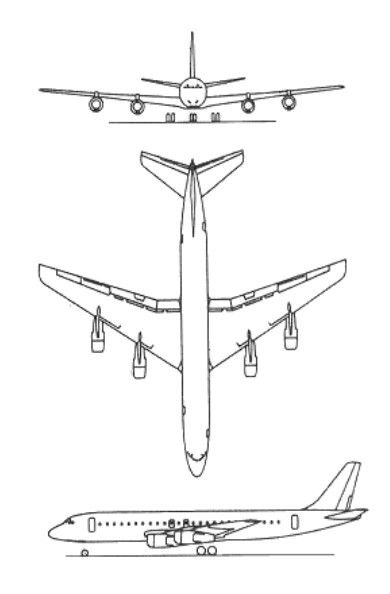
The Douglas Aircraft Company announced its intention, on 7 June 1955, to enter the pure jet stakes with the DC-8. Originally powered by the same Pratt & Whitney JT3 turbofans as the 707, it had a fractionally more slender body, less wing sweep, and fully powered flight controls. To reduce drag and avoid stress between wing and fuselage, the aerofoil changes shape toward the root, becoming flatter on top and more curved beneath. Douglas began assembling the first DC-8 in February 1957 and, there being no prototype as such, was rolled out and first flew on 30 May 1958.
DC-8 first take-off 30 May 1958
There are four main families of DC-8s: Douglas made the first five versions the same size differing only in power and fuel capacity. Douglas had announced that all projected versions would have the same overall dimensions. It adhered to this policy until 1965, and the first five versions of the DC-8 have an identical airframe, with uniform electrical, hydraulic, control and air conditioning systems. The intercontinental versions differ from the domestic models only in having extra fuel capacity and the structural modifications needed to carry the additional fuel. The modifications are limited to the use of thicker skin and stronger material within the wing structure, the aft portion of the fuselage and the tailplane. The landing gear is also more robust in the case of the heavier intercontinental versions.
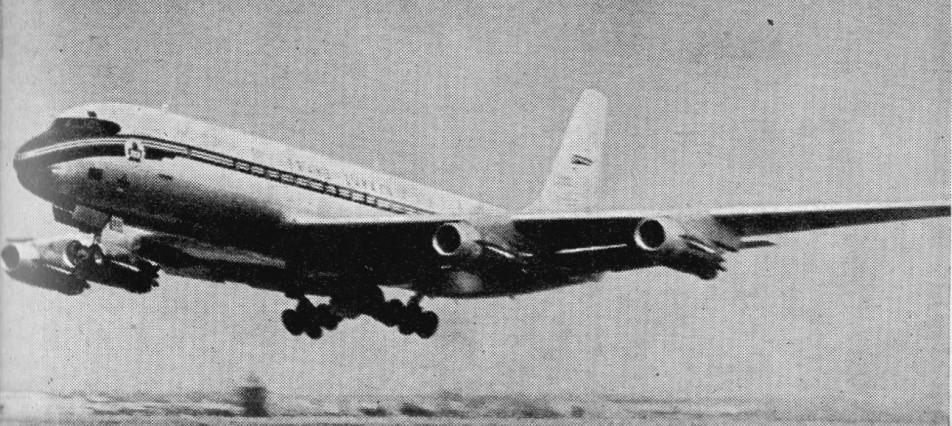
It was offered in several models, the series 10 for domestic services, the series 30 for longer ranges and the Series 40 powered by the Rolls Royce Conway bypass engine for Trans Canadian Airlines, Air Canada.
On 23 July 1959 the first DC-8 with Rolls-Royce Conway engines made its first flight from Long Beach, California. It was the ninth DC-8 to fly in 14 months.
DC-8 no.9
A DC-8-40 became the first jet airliner to exceed the speed of sound when, in 1961, it reached Mach 1.012 (667 mph) in a shallow dive. In 1959 Douglas introduced an extended wing leading edge and slightly extended tips, allowing weight to reach 310,000 lb.
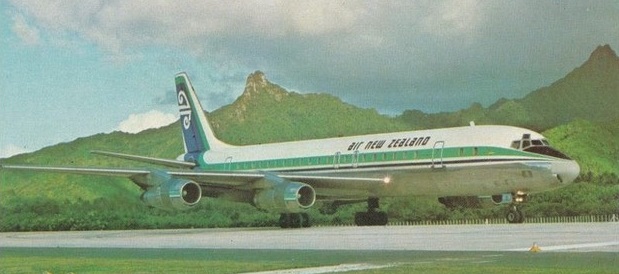
The DC-8 with JT-3C engines received its FAA Type Approval on 31 August 1959 and went into service with United Airlines and Delta Airlines on 18 September 1959.
DC – 8 ZK-NZF
In 1960 the Series 50 introduced the JT3D turbofan engine, with weights up to 325,000lb. The Series 50 evolved after Pratt and Whitney developed the new JT3D turbofan housed in new nacelles with distinct exhaust louvres on either side. The 50 range was developed into the 51 for domestic operations, the 52, 53 and 55 for long range versions differing in the model of engine fitted. A subsequent version, the 54, was developed as a freighter.
The Series 50 DC 8 had a still air range of around 6900 miles with a maximum cruise of 580 miles an hour at 220,000 lb. The series 52 had a total fuel capacity of 150,055 lb. The forward freight compartment had a capacity of 690 cu ft and the rear a usable capacity of 700 cu ft.
DC-8-52 ZK-NZD
In April 1965 Douglas announced the Super Sixty series. This comprised the DC-8-61, stretched by 36ft 8in to seat up to 259 pas¬sengers; the -62 with only a small stretch, to seat 189, but with extra fuel for very long range, enhanced by an improved wing and engine pods; the -63, fuselage lengthened by 36.7 ft. (11.18 m.), an extended wing span. Powered by JT3Ds of up to 19,000-lb thrust, these extended the DC-8 line from 293 to 556, production continuing until 1972. The Super Sixties proved such good aircraft that in the early 1980s 110 were retrofitted with the CFM56-2 engine as the DC-8-71.
A total of 556 DC-8s were produced before the production line closed in early 1972.
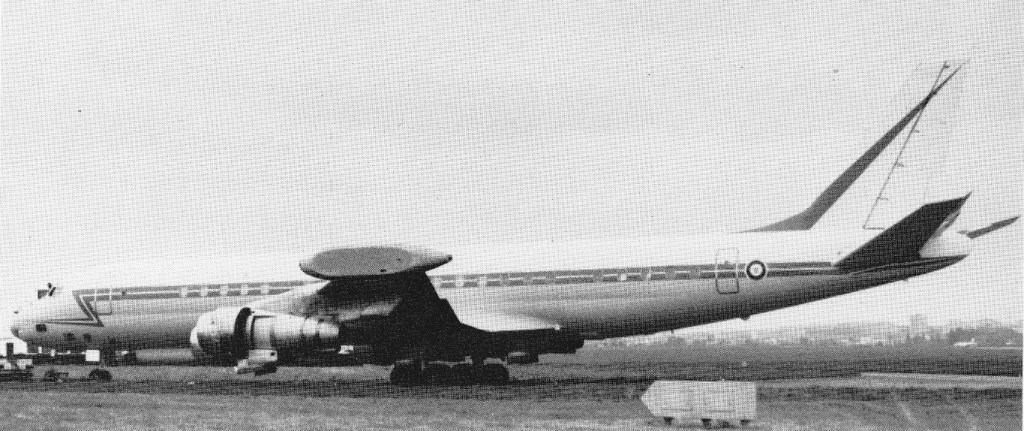
The French Air Force operated an electronic reconnaissance version of the DC-8. They were equipped with large antenna pods on both wingtips and under the fuselage. Reconnaissance squadron Escadron Electronique 51 ‘Aubrac’ operated at least two converted DC-8, 45570 and 46043, from 1977 from Evreux airfield. The first ELINT DC-8 was ordered as early as 1973.
DC-8-50 Engines: 4 x P&WJT-3 D-1 turbofan, 75.7kN Wingspan: 43.4 m / 142 ft 5 in Length: 45.9 m / 150 ft 7 in Height: 12.9 m / 42 ft 4 in Wing area: 257.6 sq.m / 2772.78 sq ft Empty weight: 57000 kg / 125664 lb Max take-off weight: 142880 kg / 314998 lb Cruise speed: 932 km/h / 579 mph Range w/max.fuel: 11100 km / 6897 miles Range w/max.payload: 9200 km / 5717 miles Crew: 3-5 Passengers: 105-189
DC-8-54 Engine: 4 x JT3D3B turbofan.
DC 8 Super 61 Engines: 4 x Pratt & Whitney JT3D 3B turbofans, 18,000 lbs thrust. Length: 187 ft 5 in. Wingspan: 142 ft 5 in. Ceiling: 30,000 ft. Range: 3,750 miles. Pax cap: 259.
DC-8 Super 63 Engines: 4 x 19,000 lb. (8,618 kg.) Pratt & Whitney JT3D. Length: 187.4 ft. (57.12 m.) Wing span 148.4 ft. (45.23 m.) Height: 42 ft 5 in (12.92 m). Weight empty 153,749 lb. (69,739 kg.) Max TO wt: 350,000 lb (158,760 kg). Max. capacity: 251 passengers Max cruise 600 m.p.h. (965 kph) Range 4,600 miles (7,400 km.) with max. payload. Max range: 7,700 miles (12,400 km). Max level speed: 600 mph (965 kph).
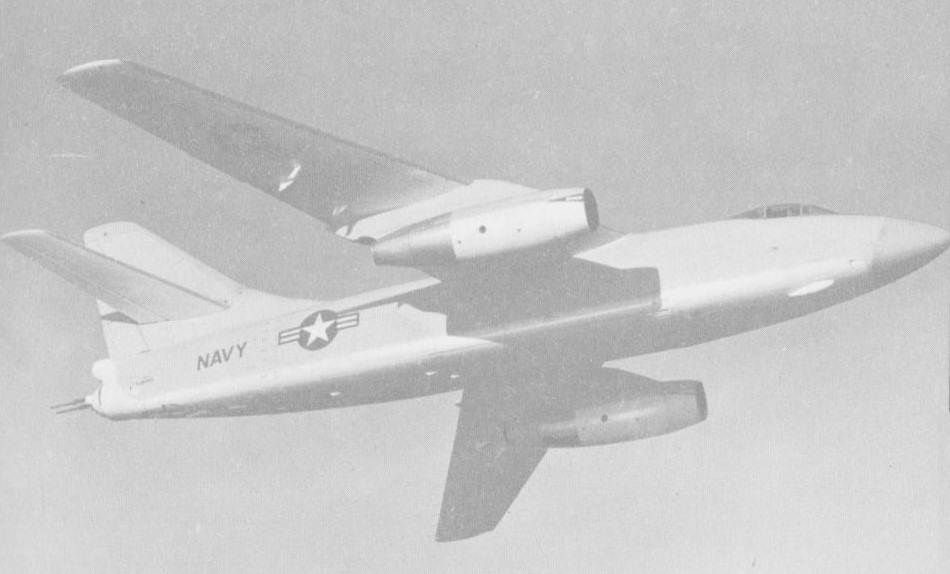
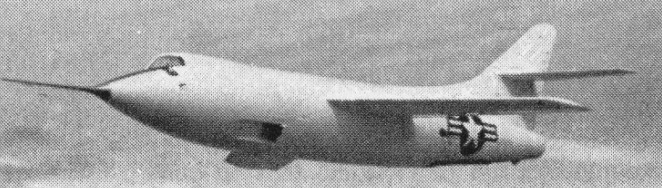
The Douglas A3D Skywarrior originated from a US Navy requirement of 1947. An attack bomber with strategic strike capability was envisaged for the new ‘Forrestal’ class aircraft-carriers.
The design was a high-wing monoplane, with retractable tricycle landing gear, two podded turbojets beneath the wing, and a large fifteen foot internal weapons bay to accommodate up to 5443kg of varied weapons. The wings were swept back 36° and had high-aspect ratio for long range, all tail surfaces were swept, and the outer wing panels and vertical tail folded.
Lateral control is by ailerons and spoilers on the outer wings. The wings are equipped with automatic leading-edge slats outboard of the engines, slotted trailing-edge flaps, and all-moving tailplane. Sideways opening airbrakes are on each side of the rear fuselage. Provision was made for twelve 4500 lb thrust jettisonable JATO rockets mounted on the side of the rear fuselage.
The first of two prototypes made its maiden flight on 28 October 1952, powered by 3175kg Westinghouse XJ40-WET3 engines, but the failure of this engine programme meant that the 4400kg thrust Pratt & Whitney J57-P-6 powered the production A3D-1. The first of these A3D-1s flew on 16 September 1953, and deliveries to the US Navy’s VAH-1 attack squadron began on 31 March 1956.
In 1962 the designation was changed to A-3, the initial three-seat production version becoming A-3A. Five of these were modified subsequently for ECM missions under the designation EA-3A. The A-3B (previously A3D-2) which entered service in 1957 had more powerful J57-P-10 engines and an inflight-refuelling probe. A reconnaissance variant with cameras in the weapons bay was designated RA-3B (A3D-2P), and EA-3B (A3D-2Q) identified ECM aircraft with a four-man crew in the weapons bay.
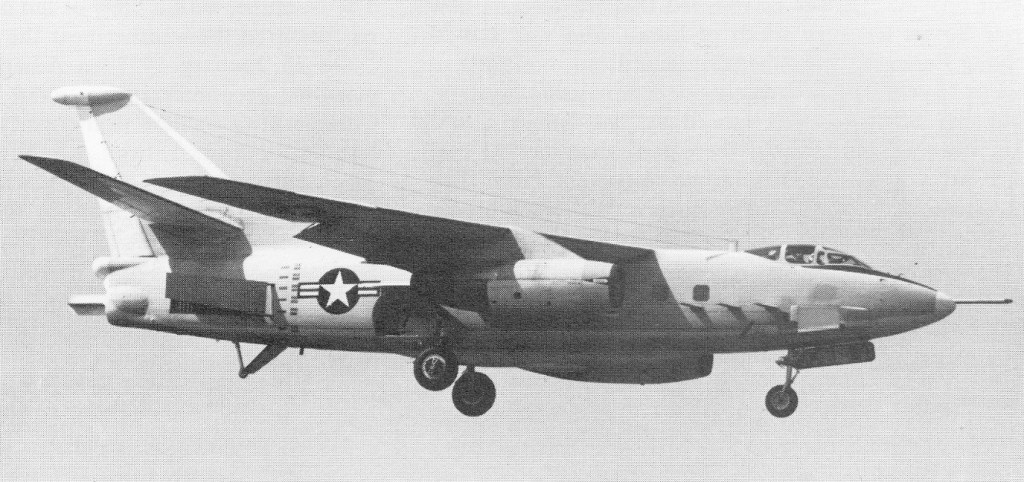
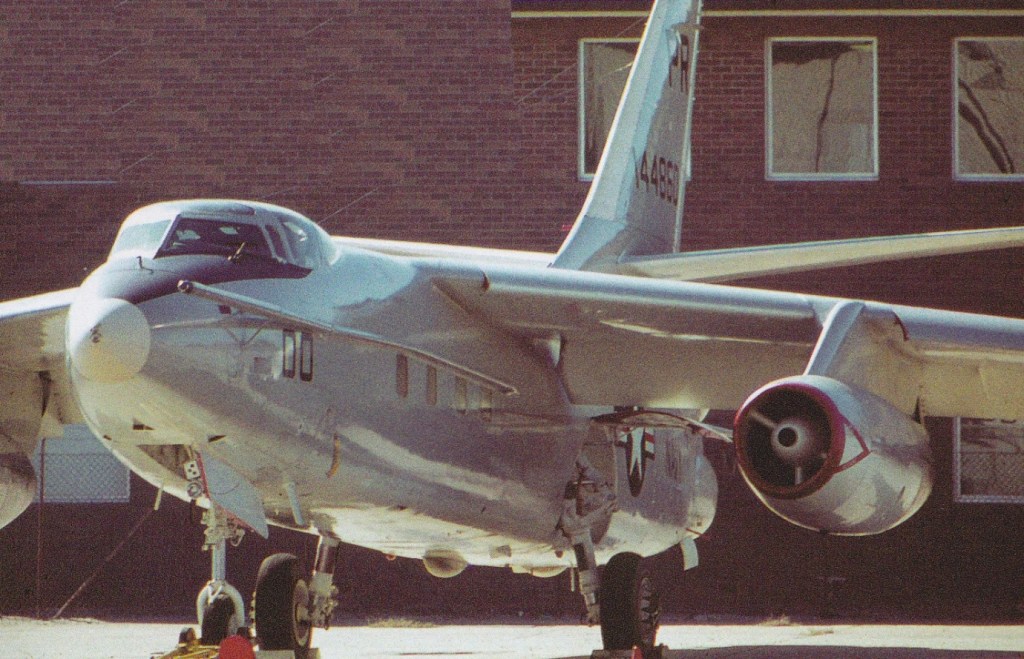
The EA-3B flew for the first time on 10 December 1958 as A3D-2Q and a year later the first batch of 24 production aircraft was delivered to the US Navy. Operated by VQ-1 and VQ-2 Squadrons, accidents reduced the number to about 12. The EA-3B, weighing around 33 tonne, operated regularly from aircraft carriers, fitted with hook for arrester cables and catapult. Behind the three cockpit crew members, a pressurised cabin holds four electronics specialists. The Skywarrior’s antennae are located in a wedge-shaped ventral pod under the fuselage and in the tail. Some VQ aircraft stationed at Guam had antennae on top of the fin and on either side of the cockpit.
EA-3B Seawing from VQ-2 at Rota
Apart from the American national insignia and the word NAVY, the registration number consists of one or two digits. Sometimes the identification letters PR from VQ-1 or JQ from VQ-2 were affixed, but sometimes nothing at all.
EA-3B from VQ-1
Other designations include 12 TA-3B (A3D-2T) trainers for radar operators, one VA-3B (A3D-2Z) executive transport, and the final variants in front-line US Navy service were KA-3B inflight-refuelling tankers and 30 EKA-3B tanker/counter-measures/strike aircraft. Skywarrior variants serving included TA-3B crew trainers, EKA-3B early-warning ‘aggressor’ trainers, and KA-3B tankers with Squadrons VAQ-33 at Key West and VAQ-34 at NAS Point Mugu, together with an NA-3B test aircraft operated by the Naval Weapons Test Center and NRA-3Bs with the Pacific Missile Test Center.
Of the 12 TA-3B Skywarrior built, three were converted to VIP transports with cabin windows in the forward fuselage.
TA-3B Skywarrior BuAer 144860 VIP transport
Douglas A3D-2 Skywarrior
An A3D-2 Skywarrior set a record takeoff weight from an aircraft carrier when it took off three times at 38,102 kg on 25 August 1959 from the USN’s newest aircraft carrier, the USS Independence, during suitability trials prior to the ship’s commissioning.
A3D-2 Skywarrior Naval attack bomber Engines: 2x Pratt & Whitney J57-P-2 turbojets, 10,000 lb. (approx.) thrust Wingspan: 72 ft. 6 in Length: 75 ft. 2 in Loaded weight: 67,000 lb Max. speed: nearly 700 m.p.h. Ceiling: 45,000 ft. Range: 1,500-2,000 miles. Crew: 3 Armament: 2 x 20 mm. tail guns.
A-3B Engine: 2 x Pratt & Whitney J57-P-10 turbojets, 4763kg / 10,500 lb each Max take-off weight: 37195 kg / 82001 lb Empty weight: 17876 kg / 39410 lb Wingspan: 22.10 m / 72 ft 6 in Length: 23.27 m / 76 ft 4 in Height: 6.95 m / 22 ft 10 in Wing area: 75.43 sq.m / 811.92 sq ft Max. speed: 982 km/h / 610 mph Cruise speed: 837 km/h / 520 mph Ceiling: 12495 m / 41,000 ft Range: 1690 km / 1050 miles Armament: 2 x 20mm rear-firing cannon, 5500kg / 12,000 lb of bombs
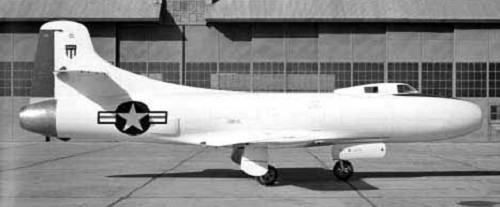
The Douglas company’s initial essay into high-speed research aircraft was the D-558-1 Skystreak which first flew on 14 April 1947 at the beginning of a programme to investigate free-flight air load measurements of the type that were then unobtainable in wing tunnel tests. The D-558-1 was fitted with a pressure-recording system connected to 400 points on the aeroplane’s surface, and powered by a 4,000-lb (1814-kg) Allison J35-A-23 turbojet yielded invaluable research data. The type was later re-engined with the 5000-lb (2 268-kg) thrust J35-A-11, and secured two world air speed records during 1947. The Skystreak set two speed records in 1947. Pilot on the second attempt was Major Marion Carl USMC who averaged 650.92 mph in two runs over a 3 km course.
The three D-558-I Skystreaks were turbojet-powered aircraft that took off from the ground under their own power. The D-558-1 Skystreak broke sound barrier in 1948. Of the three built, the first aircraft is on display at the Naval Aviation Museum in Pensacola, Florida. The second D-558-I crashed on3 May 1948, killing NACA pilot Howard C. Lilly. The third Skystreak is owned by the Carolinas Historical Aviation Museum located at the Charlotte International Airport in North Carolina.
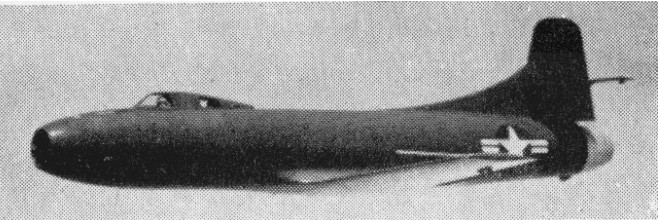
Developed from D-558-1 the Skystreak, the D-558-II Skyrocket (first flown 4 February 1948) was built primarily to investigate the properties of swept wings for high-speed flight. The D-558-2 Skyrocket was in essence a swept-wing version of the straight-winged D-558-1 powered by a 3000-lb (1361-kg) thrust Westinghouse J34-WE-22 turbojet supplemented by a 6000-lb (2722-kg) thrust Reaction Motors XLR-8 rocket motor. The type first flew in February 1948 and the rocket engine enabled the Skyrocket to exceed Mach 1 in October 1947 and later, on 20 November 1953, piloted by NACA test pilot A. Scott Crossfield with the turbojet removed and the rocket fuel capacity doubled, it reached Mach 2.01 (1327 mph) at a height of 65,000ft after being released from a Superfortress mother-plane. Three months earlier it had reached 83,235 ft after a similar launch. The D-558-II last flew on 12 December 1956.
D-558-2
The rocket-powered air-launched D-558-II Skyrocket became the first aircraft to exceed Mach 2. The first D-558-II is on display at the Planes of Fame Museum in Chino, California. The number two Skyrocket, the aircraft used by Scott Crossfield to first break Mach 2, is on display at the National Air and Space Museum in Washington DC. The last D-558-II is displayed on a pedestal at Antelope Valley College, Lancaster, California.
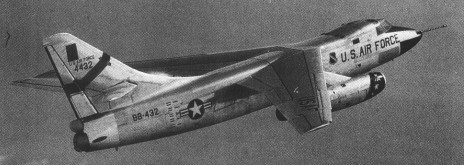
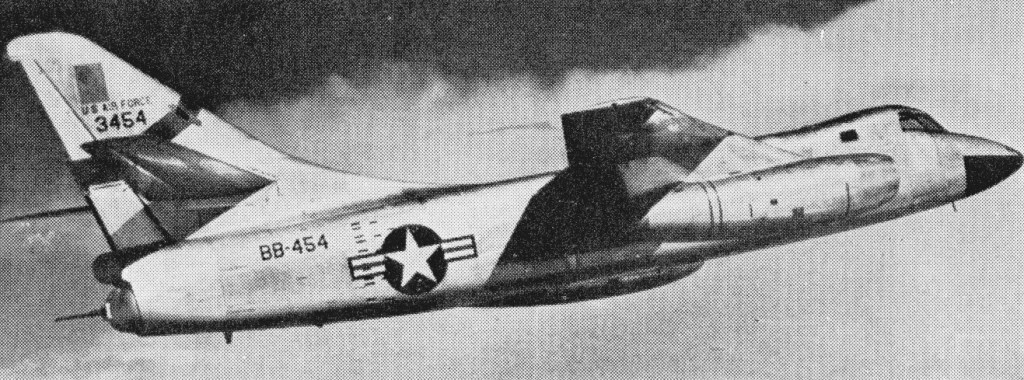
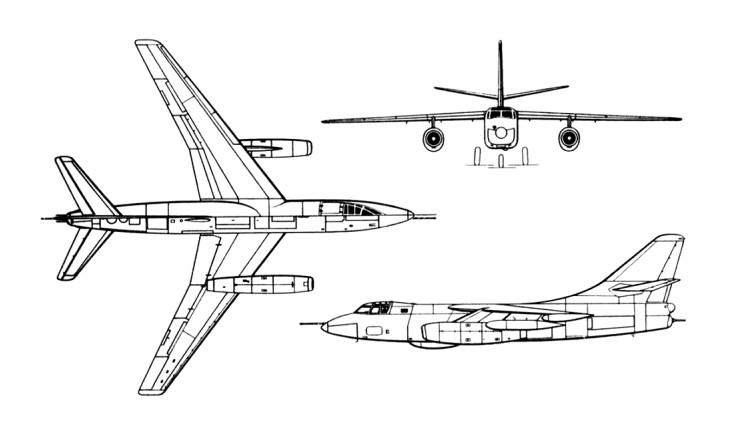
US Air Force involvement in the Korean War highlighted an urgent need for a high performance day/night tactical bomber. To speed the availability of such an aircraft it was planned to procure a land-based version of the A3D Skywarrior then being developed for the US Navy. To this end Douglas was given a contract for five pre-production Douglas RB-66A all-weather/night photo-reconnaissance aircraft, the first of which was flown on 28 June 1954 at the Long Beach plant. Although retaining the basic overall configuration of the A3D Skywarrior, the USAF’s RB-66A Destroyer dispensed with the arrester gear, strengthened landing gear and wing-folding of the naval version; it introduced aerodynamic changes in the wing design, revised accommodation for the three-man crew who were provided with ejection seats, and detail changes in equipment, including a multiple-camera installation and the provision of bombing and navigation radar. Power for this initial version was provided by two 4341kg thrust Allison YJ71-A-9 turbojets.
Successful testing of the RB-66As led to a contract for the first production version, the RB-66B powered by 4627kg thrust Allison J71-A-11s or J71-A-13s. The first of 145 RB-66Bs was flown in March 1955 and deliveries to the USAF began on 1 February 1956.
Deliveries of RB-66 were made to the USAF 19th Tactical Reconnaissance Squadron at RAF Sculthorpe, Norfolk, in 1957 to replace North American RB-45 Tornado.
Production versions included also the B-66B bomber (72 built), which had the same powerplant as the RB-66B and could carry up to 6804kg of bombs in place of reconnaissance equipment.
The new Douglas factory at Torrance (Plant B-6) in May 1954 was in volume production with both the AD-5 and 6 Skyraider and the F4D-1 Skyray, the latter with the J57 turbojet with afterburner. This leaves the El Segundo division almost clear to turn out twin-jet Skywarriors. The U.S.A.F. version of this machine (B-66) is made at Long Beach, and the main factory, at Santa Monica, makes Globemasters and DC-7s.
The RB-66C (36 built), was an electronic reconnaissance and ECM-aircraft with J71-A-11 or J71-A-13 turbojets and a crew of seven including five specialist radar operators, four of them accommodated in what had initially been the bomb bay. The WB-66D (36 built) was a combat-area weather reconnaissance aircraft with J71-A-13 engines and a crew of five (two plus equipment in the bomb bay).
B-66B
ECM versions of the B-66/RB-66 proved of great value during operations in Vietnam, locating, classifying and jamming enemy radars, but withdrawal of US forces from Southeast Asia brought retirement of these aircraft.
RB-66A Reconnaissance-bomber Engines: 2x Allison J71-A-9 turbojets, 10,000 lb (approx) thrust. Loaded weight: about 75,000 lb. Max. speed: over 650 m.p.h. Ceiling: over 45,000 ft. Range: over 1,500 miles Crew: 3 Armament: 2 x 20 mm. tail guns.
RB-66B Engines: 2 x 4627kg / 10,200 lb thrust Allison J71-A-11s or J71-A-13s Wingspan: 22.1 m / 72 ft 6 in Wing area: 72.46 sq.m / 779.95 sq ft Length: 22.9 m / 75 ft 2 in Height: 7.19 m / 23 ft 7 in Max take-off weight: 37648 kg / 83,000 lb Empty weight: 19720 kg / 43475 lb Internal fuel: 3738 USG Max. speed: 1015 km/h / 631 mph at 10,000 ft Cruise speed: 845 km/h / 525 mph Ceiling: 11855 m / 38900 ft Range: 3000 km / 1864 miles Crew: 3. Armament: 2 x 20mm M-24A-1 cannon.
RB-66C Engines: 2 x 4627kg thrust Allison J71-A-11 or J71-A-13 turbojets








 All Aero