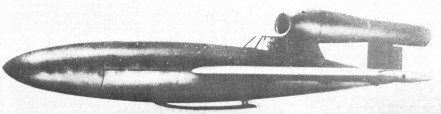
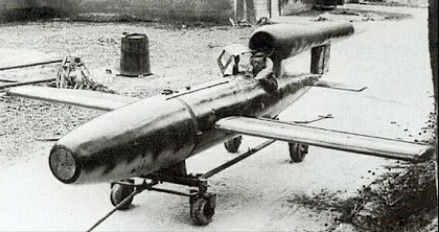
SS officer Otto Skorzeny is credited with the idea of a piloted version of the Argus pulsejet powered Fieseler Fi 103 V-1 flying bomb able to make precision attacks, and design began before the first unguided V-1s fell on London in June 1944. To study why many test V-1s crashed soon after launch an earlier piloted version was tested. Two pilots were injured before famed woman test pilot Hanna Reitsch confirmed that the engine noise was vibrating the airframe off course.
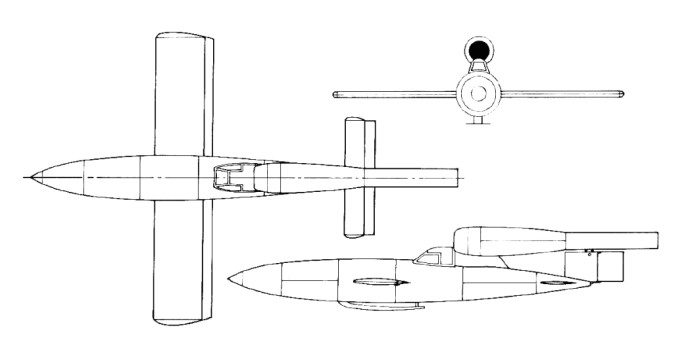
Proposals were made to launch the manned bomb from be¬neath a carrier aircraft. On operations the piloted flying bomb would have been carried and launched in pairs from modified Heinkel He 111 bombers. A total of about 175 piloted Fi 103Rs (Reichenberg being the oper¬ational codename covering the pro¬ject) were completed: the R-I, R II and R III were test and training versions, and the R IV was intended for oper-ational use. The Reichenberg IV had only basic instrumentation and could supposedly be flown after minimal training training. The cockpit had only four instruments. Testing was undertaken by Rechlin pilots but after two had crashed development flying was taken over by DFS test pilots Hanna Reitsch and Heinz Kensche. Handling in the air was fairly straightforward but landing was extremely tricky owing to the rudimentary control provided and the very high landing speed. The 100 volunteers who signed up to fly the bombs were known unofficially as ‘Selbstopfermaenner’ or ‘Self-sacrifice Men’ for special unit KG 200, but none were actually used operationally and development stopped in October 1944.
Fi 103R-IV Powerplant: one 350 kg (772 1b) thrust Argus 109 014 pulsejet. Max powered level speed 650 kph (404 mph) at sea level Endurance (limited by pulsejet life) 20 min. Weight: at launch 2180 kg (4,806 lb). Wing span: 5.715 m (18 ft 9 in) Length 8.00 m (26 ft 3 in) Height: 1.42 m / 4 ft 8 in Maximum fuselage diameter 0.838 m (2 ft 9 in) Warhead: 850 kg (1,874 lb).
In 1959, the Societa per Azioni Fiat was awarded an Italian Defence Ministry contract to design and build a medium capacity helicopter for use by the Italian Air Force.
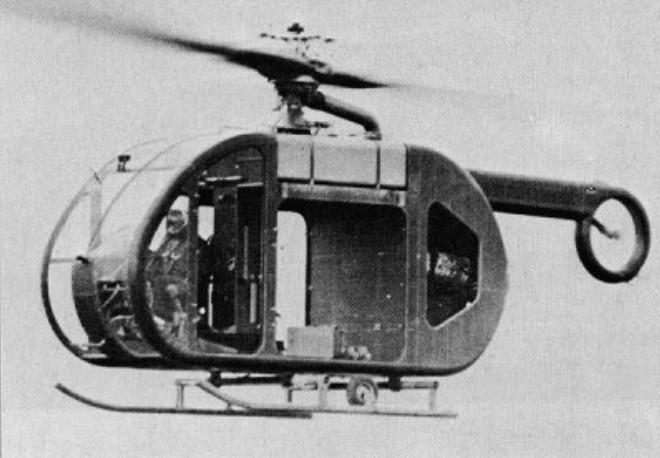
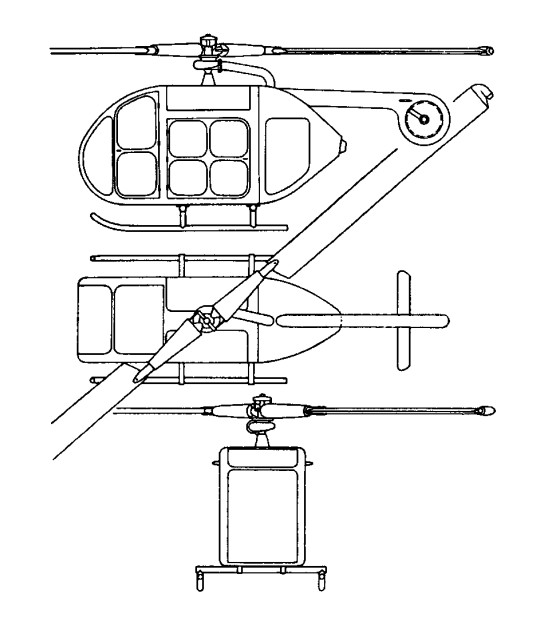
The Fiat 7002 is a medium-capacity dual-control helicopter for passenger transport and general-purpose duties. The main rotor is of the “cold jet” type, and is turned by ejecting compressed air, without any form of combustion, from nozzles at the blade-tips. Compressed air is provided by a Fiat 4700 turbogenerator. A small ducted tail rotor, mechanically-driven by the main rotor, ensures good manoeuvrability at low forward speeds and in autorotation.
The rotor system has a two-blade main rotor on tilting hub. Blades have leading-edge and spar of welded stainless steel sheet. Ducts in leading-edge and spar carry compressed air to propulsion nozzles at blade-tips. Blades linked together by steel strips which bear centrifugal loads and permit pitch variation. Blade chord 0.43m. Small ducted two-blade tail rotor.
The fuselage is light alloy sheet structure in three portions. Front portion accommodates side-by-side pilot’s seats; centre portion accommodates passengers or payload; rear portion carries power plant. Short semi-monocoque tail-boom carries ducted tail rotor and small horizontal stabiliser. Twin tubular-skid type.
Power is from one Fiat 4700 turbogenerator with equivalent power of 530hp housed vertically in rear of fuselage. Fuel in tanks above cabin, with total capacity of 525 litres.
Two pilots, or pilot and passenger, sit side-by-side in front portion of fuselage, with dual controls. Large sideways-opening door on each side. Centre cabin for five passengers or 2.5cu.m of freight, etc. In casualty evacuation role can carry pilot, attendant, two litters internally and two externally. Very large door on each side of main cabin.
The sole prototype flew on 26 January 1961, but development was discontinued in 1963. Fiat then designed a new high-speed three-seat helicopter, designated Fiat 7005, which had a pusher propeller mounted immediately behind the rotor pylon. This was not built and Fiat discontinued helicopter development in 1967.
Fiat 7002 Engine: Fiat 4700 turbo-compressor, 405kW Main rotor diameter: 12.0m Fuselage length: 6.12m Height: 2.88m Max take-off weight: 1400kg Empty weight: 650kg Max speed: 170km/h Cruising speed: 140km/h Ceiling: 3400m Range: 300km Crew: 2
The Fiat 4700 was an Italian turbo-generator developed by Fiat Aviazione under contract to the Italian Defence Ministry and used to power the experimental Fiat 7002 helicopter. The 4700 was a turbo-driven air compressor driven by the primary engine, a turbojet engine based on the Fiat 4002. The compressor and primary engine are mechanically independent. The engine is mounted vertically to reduce the length of the compressed-air ducts to the rotor. First run in 1960, the engine was used on the Fiat 7002 helicopter which first flew on 26 January 1961 where the Fiat 4700 was used to power the cold tip-jets on the two-blade rotor.
Applications Fiat 7002
Specification Type: Gas generator Length: 1,300 mm (51.18 in) (height) Diameter: 612 mm (24.09 in) Dry weight: 152 kg (335.10 lb) Compressor: Single-sided centrifugal flow + gas generator single sided centrifugal flow compressor driven by the free power turbine Combustors: Annular with 16 burners Turbine: 1-stage axial flow (gas trubine power) + 1-stage axial flow free power turbine (Gas generator power) Fuel type: Aviation kerosene to MIL-F-5624 (JP-4) Oil system: Re-circulating pressure system with one pressure pump and three scavenge pumps, oil grade DERD 2479. Maximum power output: 454.88 kW (610 hp) (gas hp for take-off), 376.58 kW (505 hp) (ghp max continuous) Overall pressure ratio: 4:1 Power-to-weight ratio: 2.99 kW/kg (1.82 hp/lb)
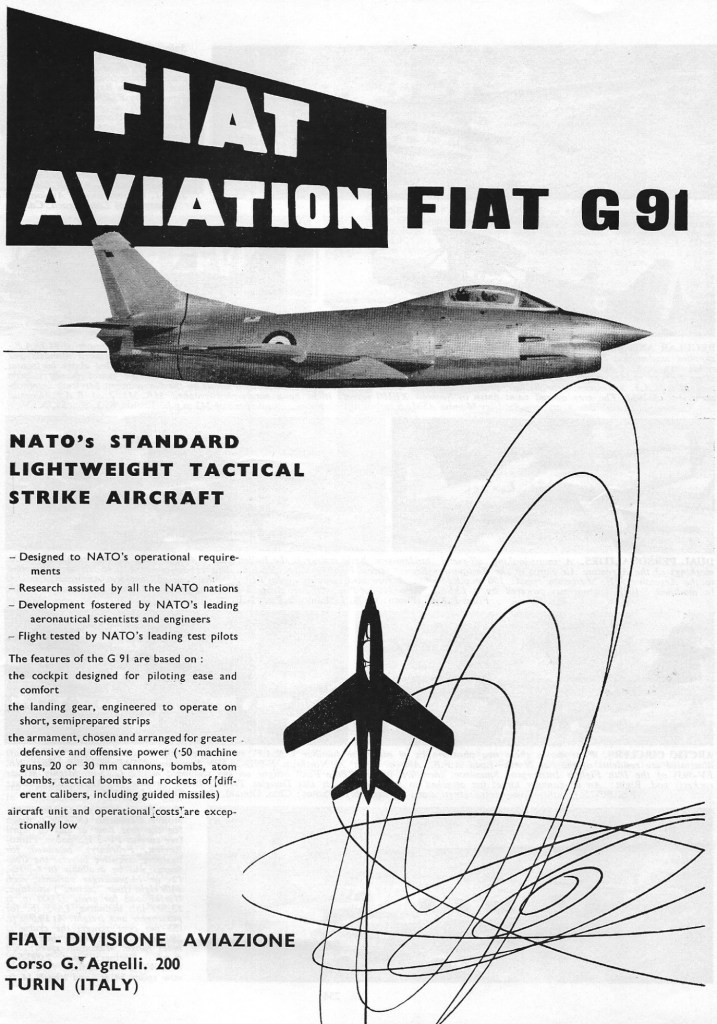
In 1954, NATO publicised the specifications for the project through the Mutual Weapon Development Programme, announcing a competition which would involve major European aerospace industries. The theme of the contest was obviously the design of a fighter intended to undertake close air support, reconnaissance and light interdiction missions, NMBR/1. Empty weight should not exceed 8 000 lbs (3,630 kg) and the fighter should be easily maintained, with high manoeuvrability and reasonable speed at low level. Fundamental to the project was the capability to operate from grass strips, semi-prepared runways and small airfields. The aim of the project was to release close air support fighters from dependence on traditional large air bases which would surely be amongst the first targets to be destroyed in any conflict. The Italian design emerged as the winner from a number of submissions and would be produced by Fiat Aviazione. It was assigned the designation G-91. An order was placed in June 1955 for three prototypes and 27 pre¬production aircraft.
The airframe low-set wings featured a 37 degrees sweepback, and swept-back tail surfaces. Conventional ailerons, elevator, rudder, and slotted flaps are fitted, and variable incidence tailplane. Two air-brakes side-by-side are fitted under the centre-fuselage. The tricycle undercarriage has single wheels on each unit. The main wheels retract inward into the fuselage and the nose wheel retracts rearward. Fuel tanks in the fuselage can be supplemented by underwing tanks.
Designed by Giuseppe Gabrielli, the first prototype flew on August 9, 1956, powered by a 1837 kg (4050 1b) st Bristol Orpheus B Or.1 turbojet. Control problems arose later during a high speed level run, and the structural failure of the tail caused the pilot to eject. After exhaustive tests on the tail unit the second prototype was fitted with a larger tailplane and a small ventral keel; the cockpit was also raised by some 63 mm (2.5 in). Powered by a 2200 kg (4850 1b) st Bristol Orpheus B Or. 3 turbojet, this aircraft flew for the first time in July 1957. It was equipped with one of the basic sets of armament: four 0.50 in (12.7 mm) Colt Browning machine¬guns, two mounted on each side below the cockpit and each having 300 rounds of ammunition. Alternative installations were two 20 mm (0.79 in) or two 30 mm (1.18 in) cannon (one each side), with 200 or 120 rounds respectively. The guns could be supplemented by two underwing packs of 25 51¬mm (2in), 15 70 mm (2.75 in) or six 127 mm (5in) rockets, or two 250 kg (551 lb) bombs.
Construction was conventional and simple. There was an all metal semimonocoque fuselage built in three sections, with an armoured cockpit fitted with a Martin Baker Mk 4 ejection seat. The nosewheel retracted rearward under the cockpit, the main undercarriage inward into a central fuselage bay. A braking parachute was fitted at the base of the rudder. The first of the preproduction G91s was flown in February 20, 1958, and in August of that year the 103O Gruppo Caccia Tattici Leggeri (Light Tactical Fighter Group) of the Italian air force was formed for operational evaluation. After limited squadron service, 16 of the preproduction aircraft were modified in 1964 for use by the Italian aerobatic team, receiving the new designation G91PAN (Pattuglia Acrobatica Nazionale).
July 1958
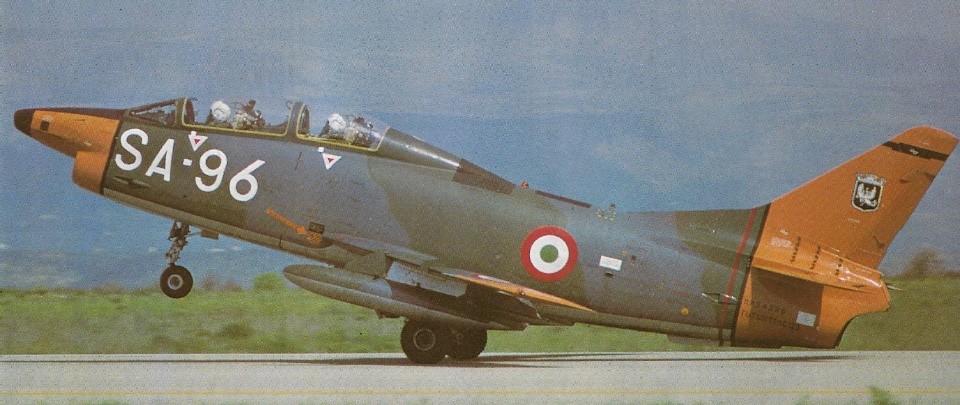
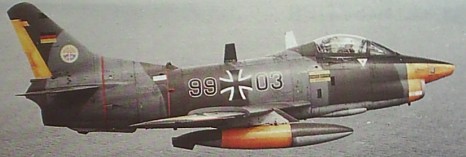
Two basic service versions of the original G91 were developed: the 1959 G91R single seat reconnaissance fighter and the G91T tandem two seat combat trainer/tactical fighter. Both had shortened and revised nose housings for three Vinten aerial cameras for forward and lateral oblique photography. Twenty four G91R/Is and the same number of R/IAs (with improved navigational aids) were delivered to the Aeronautica Militare Italiano, together with 50 G91R/111 fighter bombers. These models all carried the armament of four 0.50 in (12.7 mm) machine guns, as did the 101 G91T/1 trainers also delivered. It was, however, the Federal German Luftwaffe which employed the largest number of G91s, receiving 344 G91R/3s, nearly 300 of which were built in that country by Dornier, Heinkel and Messerschmitt. Fifty Italian built G91R14s and 66 Fiat/Dornier built G91T/3s, all with twin 30 mm (1.18 in) DEFA cannon, also served with the Luftwaffe. The German G91Rs (transferred later to the Portuguese air force) had two additional underwing pylons inboard, each capable of carrying 227 kg (500 lb) of stores.
The initial production variant was the G91R-1 which entered service with the Italian air force at the beginning of the 1960s, this air arm eventually acquiring over 100 similar aircraft. However, it was West Germany which proved to be the major customer, receiving a sizeable batch of Fiat-built G91R-3 aircraft plus a substantial number built under licence by a consortium comprising Dormer, Messerschmitt and Heinkel. The first German-built example of the G91R-3 made its maiden flight from Oberpfaffenhofen during July 1961, and the type entered service with Aufklärungsgeschwader 53 at Leipheim during 1962.
In 1964 West Germany cut down the intended size of its Luftwaffe because of shortages of funds and manpower. They will reduce the nine F-104G Starfighter squadrons to seven, and two Fiat G.91 reconnaissance squadrons instead of four. First line strength will be 380 F-104G’s and 170 G.91’s.
In the event, Germany’s Luftwaffe also operated some 50 or so G91R4 aircraft, originally being earmarked for equal distribution between Greece and Turkey, which eventually rejected them. After a fairly short career with the Luftwaffe, 40 of these aircraft were transferred to Portugal alongside a number of G91 R-3s made redundant when the Luftwaffe re-equipped its light attack units with DassaultBreguet/Dornier Alpha jets in the late 1970s and early 1980s.
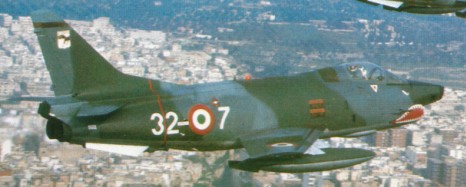
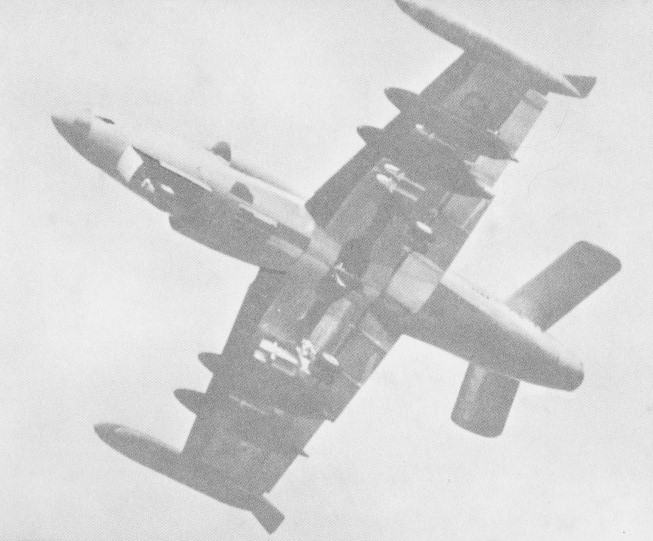
In the spring of 1965 details were announced of the G91Y, a single seat twin jet tactical fighter bomber developed as a follow on type for the AMI. Based on the two seat G91T airframe, it incorporated two 1235/1850 kg (2722/4078 1b) st General Electric J85 GE 13A afterburning jet engines, mounted side by side in the rear fuselage and giving 60% more total thrust. Two prototypes (converted G9ITs) were flown on December 27, 1966, and September 1967, respectively. In July 1968 the first of 20 preproduction G91Ys appeared, and orders for a further 45 followed. Delivery of these was completed by mid 1976, and they are now in service with the 1O and 13O Gruppi in Italy. They have provision for JATO (jet assisted takeoff) units which can halve the distance required for takeoff, and three nose¬mounted cameras are fitted as standard. Armament comprises two 30 mm (1.18 in) DEFA cannon in the nose, and four under¬wing hardpoints for up to 1814 kg (4000 lb) of bombs, rockets or napalm canisters.
During the 1960s within the ranks of the AMI General Staff (Stato Maggiore), the idea began to emerge of a new type with higher performance than that offered by the G-91R. To avoid protracted development and coincident cost increases, Gabrielli based his design on the same aerodynamic formula as that adopted by the G-91R. Similarly, the requirements specified by the AMI were in part based on those of its predecessor and included high manoeuvrability, high subsonic speed (Mach 0.95) at low level, mechanical simplicity, high operational efficiency and the ability to operate from small fields. Payload and radius of action were greatly increased and a more complex electronic fit was embodied, although this was relatively simple to achieve since the G-91R carried only rudimentary equipment. The new aircraft would be equipped with a navigation and attack system, with a gyroscopic collimator as well as an inertial platform, which at the time constituted a useful electronics fit. Consistent with thinking of the period, no passive or active ECM package was planned. Adoption of a twin-engine formula using two general Electric J85-GE13A turbojets was planned to give the type good flight safety. Nevertheless, the configuration of the air intake system was designed in a way that later caused problems and the loss of some aircraft. The front air intake, shared by both power units, splits into a ‘y’ form near the cockpit and it was this layout which was to be the source of a number of failures. In comparison with the G-91R, the G-91Y features a 24 per cent increase in empty weight, a 73 per cent improvement in payload, a 63 per cent increase in take-off power and double the fuel load. The J85 provides 1,235 kg of ‘military’ thrust, climbing to 1,850 kg when afterburner is selected. The G-91Y was also designed to accept JATO rockets and can utilise a catapult device for take-off, something that necessitated enlargement and strengthening of certain undercarriage components. Installation of a ventral hook allows the use of arrester barriers.
G-91R
With regard to electronics, besides the normal communications equipment, the G-91Y possesses an inertial platform, a position and homing indicator (PHI), a doppler radar, an air data calculator, a radar altimeter, a radio compass and a gyroscopic calculator. Armament comprises two 30 min DEFA 552 cannon with 125 rounds each. External stores are fixed to four wing pylons, two on each side, with a maximum load 1,815 kg. The Yankee is also equipped for daylight tactical reconnaissance and carries three lateral TA-7M2 cameras and a forward-looking KA-60C camera with a rotating prism for panoramic work. All cameras are housed in the nose section. The first prototype G-91Y made its maiden flight from Turin-Caselle on 27 December 1966 and was subsequently used to explore the flight envelope. The second prototype was used for weapons trials and electronic system tests and featured modifications to the windscreen as well as the nose contours. It also had a double engine cooling air intake replacing the original, which was located at the base of the dorsal fin. The flight test programme was rapidly brought to a conclusion and in July 1968 the first production example was flown. Nevertheless, deliveries of the type to operational units only began two years later, as problems concerning the engines had first to be resolved. The first unit to receive the type was the 101st Gruppo of the 8th Stormo, which deployed temporarily to the experimental base at Pratica di Mare for transition to the new aircraft. For nearly four years, the Gruppo was the only one to operate the G-91Y and it struggled to achieve operational status and overcome the problems that construction of only two prototypes had prevented the manufacturer from solving. Later, in 1974, the 13th Gruppo of the 32nd Stormo began transition to the new type which was at last adjudged to be fully operational. In total, production of the G-91Y amounted to some 65 aircraft (MM6441-MM6495 and MM6951-MM6960), to which should be added two prototypes (NIM579 and MMS80). The final batch of eight (MM6961-MM6968) was cancelled and the last Yankee was assigned to the 32nd Stornio in 1976. In addition about 160 examples of the two-seat G91T trainer variant were also completed and this has also seen service with Italy, Portugal and West Germany. The G-91 was also evaluated by the Schweizerische Flugwaffe (Swiss Air Force) as a possible Venom replacement. In the light of Swiss interest, Aeritalia modified a production example (MM6461, c/n 2023), transforming it into the prototype ‘G-91YS’. These modifications comprised the addition of two underwing pylons capable of launching the AIM-9 Sidewinder and the replacement of the nose cameras by a Swedish-designed laser aiming system. The new nose was slightly elongated and two ventral fins were added to the two already present. Maximum takeoff weight rose from 8,700 kg to 9,000 kg, thereby increasing the take-off run by around 20 per cent. The new version was a finalist in a fly-off competition with the Vought/LTV A-7 Corsair II but negotiations were suspended and no other nation showed interest in buying the Aeritalia fighter. Principal versions – G91 (initial light attack model), G91R/1 (attack and reconnaissance model), G91R/1A (version with improved navigation system), G91R/1B (strengthened and updated version of the G91R/ 1A), G91R/3 (West German model with two 30¬mm cannon, Doppler navigation and other im¬provements), G91R/4 (G91R/3 variant with the armament of the G91R/1), G91T/1 (Italian two-seat trainer with two 0.5-in/12.7-mm machine guns), and G91T/2 (West German version of the G91T/1).
G91R Engine: 1 x Fiat-built Bristol Siddeley Orpheus 80302, 5000 lb Wingspan: 28 ft 1 in Wingarea: 176.7 sq.ft Length: 33 ft 9 in Height: 13 ft 1 in Empty weight: 6700 lb MTOW: 11,465 lb Max speed: 668 mph / M0.88 at SL Max ROC: 6000 fpm
G91R/1 Engine: one 5,000-lb (2,268-kg) thrust Fiat-built Rolls-Royce (Bristol Siddeley) Orpheus Mk 803 turbojet. Maximum speed 675 mph (1,086 km/h) at 4,920 ft (1,500 m) Initial climb rate 6,005 ft (1,830 m) per minute Service ceiling 42,980 ft (13,100 m) Radius 199 miles (320 km). Empty weight: 6,834 lb (3,100 kg) Maximum take-off weight: 12,125 lb (5,500 kg). Wing span 28 ft 1 in (8.56 m) Length 33 ft 9.5 in (10.30 m) Height 13 ft 1.5 in (4.00 m) Wing area 176.75 sq ft (16.42 sq.m). Armament: four 0.5-in (12.7-mm) machine guns / 1,500 lb (680 kg) of disposable stores.
FIAT G 91 R3 Gina Engine: Bristol Siddeley Orpheus 801, 22269 N / 2270 kp Length: 33.05 ft / 10.06 m Height: 12.992 ft / 3.96 m Wingspan: 27.986 ft / 8.53 m Max take off weight: 12502.4 lb / 5670.0 kg Max. speed: 580 kts / 1075 km/h Service ceiling: 42979 ft / 13100 m Range: 999 nm / 1850 km Crew: 1 Armament: 4MG 12,7mm 2MK 30mm Hardpoints: 4
G91T/1 Span: 8.60 m (28 ft 2.5 in) Length: 11.70 m (38 ft 4.5 in) Height: 14 ft 7.25 in / 4.45 m Gross weight: 6050 kg (13338 lb) Maximum speed: 1030 km/h (640 mph) at 5000 ft / 1525 m Service ceiling: 40,000 ft / 12190 m
G91Y Engines: two General Electric J85GE-13A turbojet, 1851 kg (4080-1b) afterburning thrust. Maximum speed 1110 km/h (690 mph) at SL Maximum speed 1038 km/h (645 mph) at 30,000 ft / 9145 m Cruise: 497 mph / 800 kph at 35,000 ft / 10670 m Initial ROC: 17,000 fpm / 5180 m/min Time to 42,000 ft / 12200m; 4 min 30 sec Service ceiling 12500 m (41,000 ft) Combat radius at sea level 600 km (372 miles) Ferry range 3500 km (2,175 miles) Empty weight 3900 kg (8,598 lb) Maximum take-off 8700 kg (19,180 lb). Wingspan 9.01 m (29 ft 6½ in) Length 11.67 m (38 ft 3½ in) Height 4.43 m (14 ft 6 in) Wing area 16.42 sq.m (176.74 sq.ft).
The first true jet aircraft built in Italy (discounting the piston¬ engined Caproni Campini N.1) was the prototype Fiat G.80, flown on a 1360 kg (3000 1b) thrust D.H. Goblin turbojet on December 10, 1951. After exhaustive flight development a batch of ten G.80 3B fighter/trainers were built in 1954 and delivered to the Aeronautica Militare Italiana. By this time the same basic tandem seat or single seat design had been developed into the G.82, with modified inlets feeding a fuselage plenum bay housing a Rolls Royce Nene RN.6 21 rated at 2450 kg (5400 lb) thrust. The basic Italian produc¬tion version was the tandem seat G.82 1B with two 12.7 mm (0.5 in) Breda SAFAT machine guns in the nose, and wing racks for two 113 kg (250 1b) bombs or eight 127 mm (5 in) rockets.
The first true jet aircraft built in Italy (discounting the piston¬ engined Caproni Campini N.1) was the prototype Fiat G.80, flown on a 1360 kg (3000 1b) thrust D.H. Goblin turbojet on December 10, 1951. After exhaustive flight development a batch of ten G.80 3B fighter/trainers were built in 1954 and delivered to the Aeronautica Militare Italiana. By this time the same basic tandem seat or single seat design had been developed into the G.82.
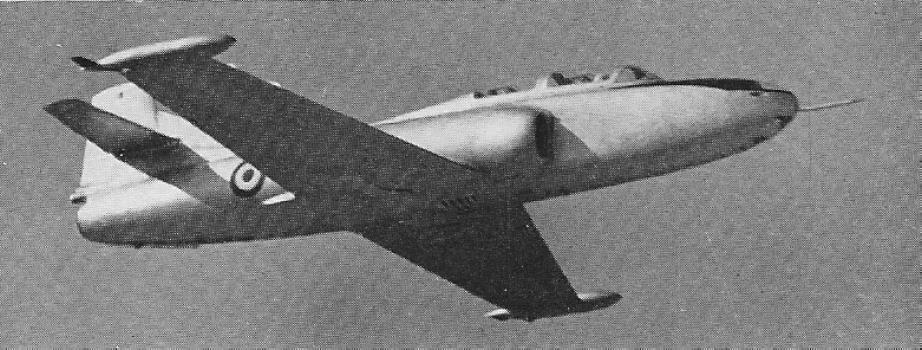
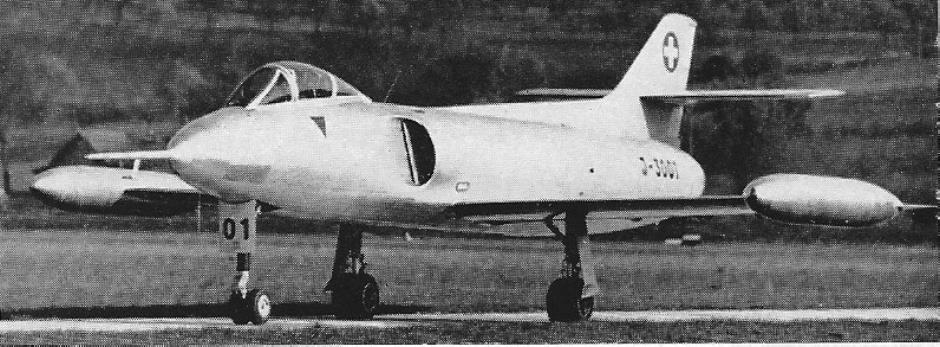
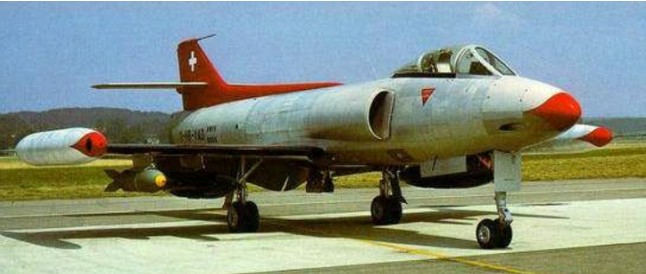
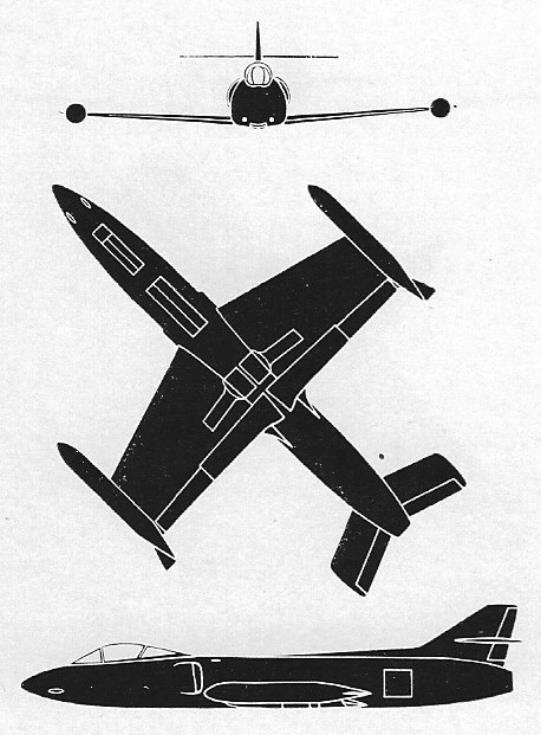
FFA was awarded development contract July 1952 for P-16.04 interceptor/ground-attack aircraft with Armstrong Siddeley Sapphire, first flown April 28,1955. Fitted with leading-edge flaps, the first prototype had a wing thickness/chord ratio of between 5 and 6%. The second prototype was reduced to 4% and a higher powered turbojet.
P-16.04
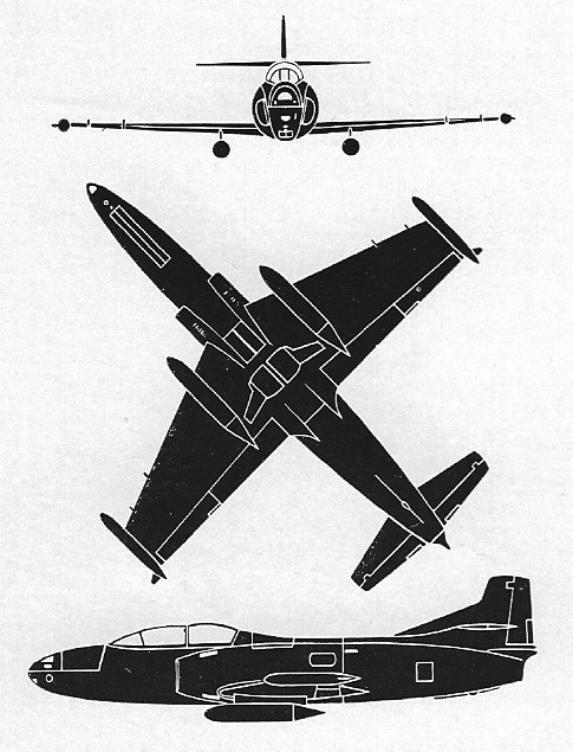
The airframe is low wing, with 20o sweepback. Swept tail surfaces, have a variable incidence tailplane mounted mid-way up the fin, with conventional rudder and elevators. The ailerons can be lowered with Fowler flaps to provide additional flap area. Full-span leading edge flaps and an air-brake is fitted on each side of the rear fuselage. A tricycle undercarriage, with twin wheels on each unit, main wheels retracting inwards into the fuselage and the nose wheel retracts reward.
Internal fuel capacity is 550 gal, including fixed wingtip tanks. The is provision for two 100 gal underwing jettisonable tanks. Armament is two 30mm Hispano cannon in the nose and 44 air-to-air unguided rockets in fuselage pack.
The prototype Mk.III first flew in March 1960.
Mk.III
Program cancelled by Swiss Government but continued as private venture until June 1960; five aircraft built.
The P-16 wing formed the basis of the Gates Learjet design.
Engine: Armstrong-Siddeley Sapphire Sa.7 Length: 11.14 m Span: 12.3 m Max T/O weight: 11700 kg Weapons load: 3000 kg Max. horizontal speed: 1140 km/h / M 0.92 Altitude: 14000 m T/O and Landing roll: < 500 m Range: 1480 km
P-16 Mk.III Engine: Bristol Siddeley Sapphire, 11,000 lb Wingspan: 36 ft 7 in Wing area: 320 sq.ft Length: 46 ft 9 in Height: 13 ft 5 in Empty weight: 15,520 lb MTOW: 27,795 lb Internal fuel: 550 gal Max speed: 696 mph SL Service ceiling: 46,000 ft Max range: 620 mi Armament: 2 x 30mm Hispano cannon Hardpoints: 4 Wheel track: 10 ft 2 in Wheel base: 18 ft
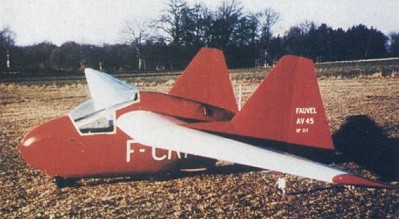
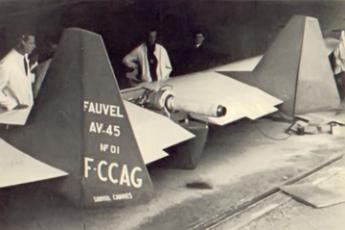
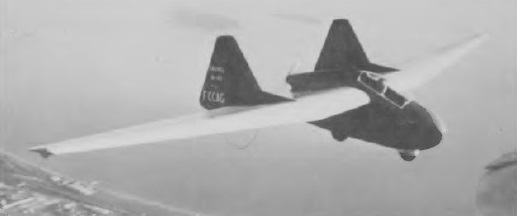
Inspired by two previous German experiences of motorizing the AV-36, and greatly motivated by the concept of the motorglider, Charles Fauvel flew the new AV-45 on May 4, 1960, an AV-36 very modified and powered by a pusher Nelson motor of 37 hp driving a two blade propeller. Later a 45hp Nelson engine was fitted. The second improved prototype, built by the SAN (Société Aéronautique Normande) in Bernay, took off with Charles Fauvel in command in 1962. This copy was equipped with a Solo engine of 23 hp that permitted, in spite of its low power output, enough power to take off in less than 100 ms and to climb at up to 3 m/sec.
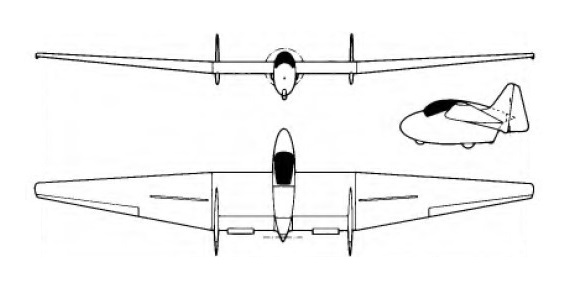
This second prototype was representative of production AV 45s, which are intended for amateur construction, and it incorporated several changes, including the introduction of additional windows under the cockpit canopy, moving the pilot’s seat 2.4in further forward, lengthening the fuselage by 3.5 in, and fitting larger vertical tail surfaces carrying at the bottom small steerable skids which replace the underwing curved wire ‘bumpers’ of the first prototype. Hoerner wing tips were also successfully tried on the AV 45, and the original two-blade fixed-pitch airscrew was later replaced by an automatically feathering prop.
Microturbo was anxious to test this 78 Kp turbojet on a glider and Fauvel made available AV45 # 1. In 1967, the Nelson H 59A motor was replaced by a Microturbo Eclair 012-01 turbojet of 68 Kg / 150 lb of thrust in the summer of 1967. It was equipped with an electric starter and battery (NiCd 9.5 kg) for a self-starting it (both in the ground and in the air). The installation was characterized by the need to have a very long nozzle to allow ejection of the jet behind the fuselage.
Fauvel AV45-01R Microturbo Éclair
The first flight was by Charles Fauvel, and the second he was joined by Jacques Hemet Stampe as a photographer filming the event. In this form the prototype was redesignated AV 45-01R and the Eclair gave it a maximum level speed of over 140mph at 2,625ft and the maximum rate of climb 990ft/min, the time to 10,000ft being 15min. The Eclair’s battery permitted repeated restarts in flight as well as ground starting, and this turbojet was also seen as a possible powerplant for two other Fauvel tailless powered glider projects.
The prohibitive price of this jet engine did not allow its use for practical reasons. The prototype was later fitted with a 30hp Rockwell-JLO engine by an amateur builder. The standard engine recommended for production aircraft is the 40-55hp modified Hirth 0-280R ‘flat four’, there being integral wooden fuel tanks in the wing leading edges.
AV45
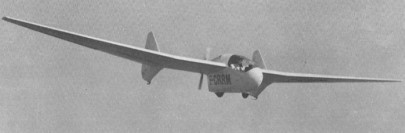
The first AV-45 motorglider of amateur construction, equipped with a Solo engine, was constructed in Japan and flew in South Africa (with Hirth Solo engine), while several copies were begun in the United States, in Finland, Germany and Spain. A French homebuilt AV 45 was flying with a Nelson engine. In France alone, even though some copies were constructed by amateurs, most glider pilots remained for the most part unconvinced of the charms of this motorglider. In early 1978 11 more AV45s were being built by amateur constructors, four in France, three in the USA, and one each in Finland, Germany, Martinique and Spain, the German one having a Solo engine. Like the AV 361, the AV 45 can be fitted with a wing of Wortmann laminar flow section, which gives an improved best glide ratio of 30:1.
Not discouraged, Charles Fauvel further improved the motorglider with the AV-451 version. This ship had its span extended to 15 m (49ft 2.5 in), incorporated a new airfoil design from Wortmann : the Laminar FX 66-H 159, a new fuselage shape obtained by using an existing glass canopy design (the one on the Grob Astir glider). The nose is more tapered, the wheel fairings more streamlined, and the vertical tail surfaces are of Wortmann symmetrical section. The propeller was automatically folded rearward by airflow effect when the engine was stopped.
The Gross (Fauvel) AV 451, actually the first AV 451, was designed and built by Mons Francois Gross with his son’s help and is a modification of AV45 F-CCRM with the 15m wing span and new Wortmann wing section of the AV451, a longer fuselage modified in the cockpit area to take the canopy from a Grob Astir, and with a 38hp Rotax 642 two-cylinder two-stroke engine aft of the cockpit, driving a two-blade Hoffmann pusher propeller. It made its first flight in the beginning of September 1978. The cantilever shoulder wings are of Fz 17% thickness/chord ratio section or Wortmann profile, with no dihedral on the centre section and 5° 13′ on the outer wings. The wings are single-spar wooden structures, with a plywood leading edge torsion box and fabric covering aft of the spar; there are conventional ailerons and the elevators are in the trailing edge of the centre wing, with a large trim tab in the port one. Schempp-Hirth air brakes are fitted in the upper and lower surfaces of each outer wing, just outboard of the fins. The fuselage consists of a short wooden nacelle with glassfibre covering, the pilot sitting under a sideways-hinged blown plastic canopy. The wooden twin fins and rudders are inset at the junctions of the centre section and the outer wings, there being no tailplane; the fins are plywood-covered and the rudders fabric-covered. The undercarriage consists of two wheels in tandem, a steerable front wheel and a rear wheel with mechanical brake, supplemented by small steerable skids at the bottom of the vertical tail surfaces. Endowed with a L/D of 32:1, the AV-451 was the last flying wing of Fauvel. An entirely fibreglas composite version (AV-48) had been considered, but a fire at the shop where the prototype was to be constructed put an end to this adventure.
AV.451
The death of Charles Fauvel explains in part the fact that the AV-451 didn’t attain the success of the AV-36 and AV-361.
AV 45 second prototype Span: 45 ft 1 in Length: 11 ft 9 in Height: 6 ft 0 in Wing area: 171.7 sqft Aspect ratio: 11.84 Empty weight: 476 lb Max weight: 772 lb Economical cruising speed: 80 mph Min sinking speed: 2.62 ft/sec at 43.5 mph Best glide ratio: 27:1 at 53 mph Rate of climb at sea level: 550 ft/min Take-off run: 492 ft
AV.45 Wing span: 13.75 m Length: 3.6 m Wing area: 14.80 sq.m Airfoil: Fauvel F4 17% Aspect ratio: 10.8 Empty weight: 219 kg Maximum gross weight: 350 kg Glide ratio: 26:1 Min sink rate: 0.82 m/sec
AV.45 Engine: Hirth O-280R, 30-41 kW / 40-55 hp Wing span: 13.74 m / 45 ft 1 in Length: 3.59 m / 11 ft 9 in Wing area: 15.95 sq.m / 171.7 sq.ft Wing section: F2 17% Aspect ratio: 11.84 Empty weight: 216 kg / 476 lb Max weight: 350 kg / 772 lb Water ballast: None Max wing loading: 21.94 kg/sq.m / 4.49 lb/sq ft Max speed: 77 kt / 142 km/h Min sinking speed: 0.8 m/sec / 2.62 ft/sec at 37.5 kt / 70 km/h Best glide ratio: 27 at 45.5 kt / 85 km/h T-O run: 493 ft / 150m Rate of climb: 168 m/min / 550 ft/min
AV45-01R Engine: Microturbo Éclair, 68 kg thrust Best glide: 29 @ 85 Km / h Min rate of descent: 0.78 m / s Performances tinkering usage provisioning engine Rate of climb: 240 m / min @ 120 Km / h Maximum speed (800 m): 225 km / h Time to 3000 m: 15 min Fuel capacity: 31 lt Endurance: 22 min
AV.451 Wing span: 15.0 m Length: 3.84 m Wing area: 16.68 sq.m Airfoil: Wortmann FX-66 H 159 Aspect ratio: 13.5 Empty weight: 250 kg Maximum gross weight: 380 kg Glide ratio: 32:1 Min sink rate: 0.72 m/sec
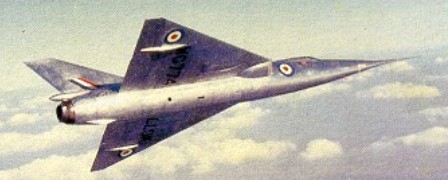
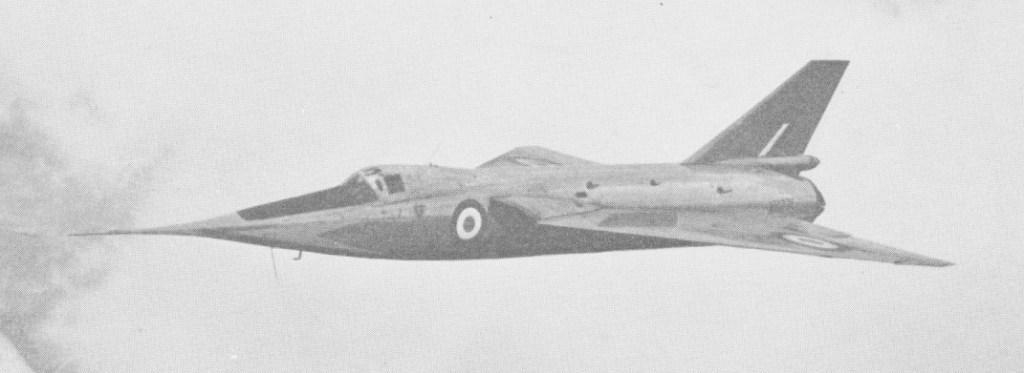
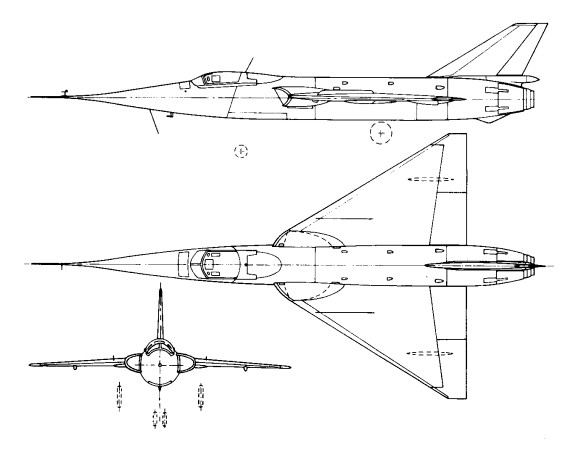
The Delta 2 was built to investigate the characteristics of flight and control at transonic and supersonic speeds. A 60 degree delta, one feature was a nose that drooped 10 degrees for landing for visibility.
The first made its maiden flight on 6 October 1954. Powered by a 12,000-lb (5443-kg) afterburning thrust Rolls-Royce Avon RA.5, the initial F.D.2 secured the first world air speed record at more than 1000 mph (1609 km/h) in March 1956, when an average of 1132 mph (1821 km/h) was recorded in two flights, piloted by Peter Twiss.The second aircraft had the 13,000-1b (5896-kg) afterburing thrust Avon RA.28 and helped to expand the F.D.2’s flight envelope in an important research programme.
On 10 March 1956 the RA.5-powered aircraft (flown by Peter Twiss) became the first aircraft to set an over-1,000mph world speed record, with an average of two flights of 1,821km/h.
The first machine was later revised as the British Aircraft Corporation 221 to evaluate the ogival wing proposed for the Anglo-French supersonic airliner that finally appeared as the BAC/Aerospatiale Concorde. The Concorde also adopted another F.D.2 feature, the drooping nose that gave the pilot an adequate field of vision for takeoff and landing.
Fairey F.D.2 Engine: 1 x Rolls-Royce “Avon” 200 turbo-jet, 44.5kN Max take-off weight: 6298 kg / 13885 lb Empty weight: 4990 kg / 11001 lb Wingspan: 8.18 m / 26 ft 10 in Length: 15.74 m / 51 ft 8 in Height: 3.35 m / 10 ft 12 in Wing area: 33.44 sq.m / 359.94 sq ft Max. speed: 2092 km/h / 1300 mph Range: 1336 km / 830 miles Crew: 1
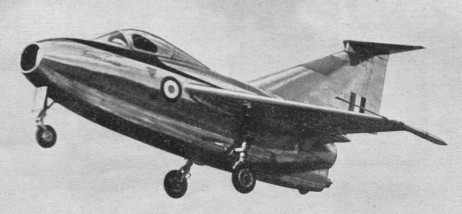
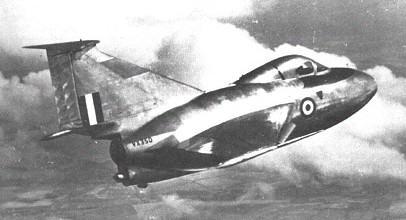
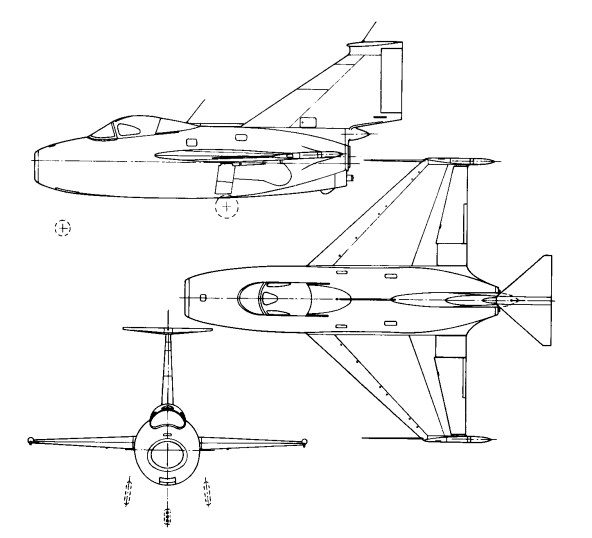
The Fairey FD.1 was produced as a prototype for the investigation of the handling characteristics of a planned vertical take-off fighter (using an inclined ramp). For that reason had provision for four small rocket engines mounted round the efflux of the Derwent engine. These rocket engines were never fitted, and with its very small wing and high wing loading, the F.D.1 required a very long run to take off.and first flew on 12 March 1951, but then adapted for research into the flying qualities of delta-winged aircraft. Powered with a 3600lb (1633-kg) thrust Derwent 8 turbojet. The type had poor handling qualities and was soon abandoned.
Engine: 3600lb (1633-kg) thrust Derwent 8 turbojet Empty weight: 3084 kg / 6799 lb Wingspan: 5.95 m / 19 ft 6 in Length: 7.99 m / 26 ft 3 in Max. speed: 1011 km/h / 628 mph


 All Aero